Indian Environmental Legislation
Presented By:
Mona Verma
Ph.D. Research Scholar
Deptt. of Textile and Apparel
Designing, CCSHAU,HISAR
mona.verma35057@gmail.com
In the field of forest protection, the enactment of the Forest Act,
1865 was the first step at asserting the State monopoly right over
the forests. The customary rights of rural communities to manage
forests were curtailed by the Act.
The Shore Nuisance (Bombay and Kolaba) Act of 1853 and the
Oriental Gas Company Act of 1857 imposed restrictions on the
fouling of water. The Merchant Shipping Act of 1858 dealt with
prevention of pollution of sea by oil.
In 1860, for the first time, an attempt was made to control
especially water and atmospheric pollution through criminal
sanctions under the Indian Penal Code, 1860.
Policy and Laws in British India
Policy and Laws in
India after
Independence
The Factories Act of 1948 required all factories to make effective
arrangements for waste disposal and empowered State Governments
to frame rules implementing this directive.
Under the River Boards Act of 1956, river boards established are
empowered to prevent water pollution of inter-state rivers.
Some States took initiative in the filed of environmental protection,
viz., Orissa River Pollution Prevention Act, 1953, and, Maharashtra
Prevention of Water Pollution Act, 1969.
The Wildlife (Protection) Act, 1972, aimed at rational and modern
wild life management.
The Water (Prevention and Control of Pollution) Act, 1974,
provides for the establishment of pollution control boards at Centre
and States to act as watchdogs for prevention and control of
pollution.
The Forest(Conservation) Act, 1980 aimed to check
deforestation, diversion of forest land for non-forestry purposes,
and to promote social forestry.
The Air(Prevention and Control of Pollution) Act,1981, aimed at
checking air pollution via pollution control boards.
The Environment (Protection) Act, 1986 is a landmark legislation
which provides for single focus in the country for protection of
environment and aims at plugging the loopholes in existing
legislation. It provides mainly for pollution control, with stringent
penalties for violations.
The Public Liability Insurance Act, 1991, provides for mandatory
insurance for the purpose of providing immediate relief to person
affected by accidents occurring while handling any hazardous
substance.
The National Environment Tribunals Act, 1995, was formulated
in view of the fact that civil courts litigations take a long time (as
happened in Bhopal case).
The Act provides for speedy disposal of environmental related
cases through environmental tribunals. Under the Act, four benches
of the tribunal will be set up in Delhi, Calcutta, Madras and
Bombay and 8,000 of the most Hazardous industrial units in the
country will be brought under its security.
The
National Environment Appellate
Authority Act, 1997,
It provides for the established of a National Environment Appellant
Authority (NEAA) to hear appeals with respect to restriction in areas
in which any industries, operations or processes shall not be carried
out or shall be carried out subject to certain safeguards under the
Environment (Protection) Act, 1986.
In 1992, the Union Government adopted a “National Conservation
Strategy and Policy Statement on Environment and
Development” (NCS).
The preamble to the NCS adopts the policy of “sustainable
development” and declares the government’s commitment to re-
orient policies and action “in unison with the environmental
perspective”.
The NCS proceeds to recognize the enormous dimensions of the
environmental problems facing India and declares strategies for
action in various spheres such as agriculture, forestry, industrial
development, mining and tourism.
Special sections in the NCS deal with the rehabilitation of persons
ousted by large development projects; the role of NGOs; and the
special relationship between women and the environment.
The Central Government framed the Recycled Plastic
Manufacture and Usage Rules, 1999. The Rules prohibit vendors
of foodstuffs from packing their wares in bags or containers made
from recycled plastics. If foodstuffs are to be sold in plastic bags,
the carry bag must be made of virgin plastic.
The Municipal Solid Wastes (Management and Handling)
Rules, 2000, apply to every municipal authority responsible for
collection, segregations, storage, transportation, processing and
disposal of municipal solid wastes.
The Battery (Management and Handling) Rules, 2000, provides
for specific categories of wastes such as battery, waste oil, etc.
These rules shall apply to every manufacturer, importer, re-
conditioner, assembler, dealer, recycler, re-smelter, auctioneer,
consumer and bulk consumer involved in manufacturer, processing,
sale and purchase of batteries.
In 2000, the Noise Pollution (Regulation and Control) Rules, framed
by the Central Government under the Environment Protection Act,
1986, came into effect.
These Rules prescribed ambient air quality standards in respect of noise
for industrial, commercial and residential areas as well as designated
„silence zones‟.
In the same year, the Central Government enacted the Ozone
Depleting Substances (Regulation and Control), rules, 2000 under
the Environment Protection Act.
The producers, dealers, users engaged in the manufacture/use of ozone
depleting substances such as CFCs, Halon, Cabontetrachloride (CCI4),
etc., are required to compulsorily register under the Rules.
The Environment Protection Act, 1986
Though there is a host of legislation in India aimed at protecting the
environment from pollution and maintaining the ecological
balance, the environment has not so far been considered in its
totality. The Environment
Ecomark It is a label given to environmental-friendly consumer
products. Any product will get eco-mark if its life-cycle
(manufacturing process, raw material, product use, disposal and
packaging) is environment-friendly at every stage.
In 1991, the Ministry of Environment and Forests (MoEF) decided to
institute a scheme on labeling environment friendly products. Household
and other consumer products can be accredited and labeled as satisfying
environmental criteria, in addition to quality requirements laid down by
the Bureau of Indian Standards for the product. The label is known as
Ecomark.
The scheme was meant to provide incentive to the manufacturers, to
assists consumers to become environmentally responsible, and to
improve the quality of environment leading to sustainable management
of resources. In certain categories such as toilet soaps and detergents,
paints, paper and laundry soaps, the MoEF has already finalized and
notified the criteria for the product.
Ecomark
Biodiversity Act, 2000 India is one of the twelve mega-biodiversity
countries of the world and became a party to the International
Convention on Biological Diversity in 1994.
The objectives of the convention are:
 The conservation of Biological Diversity,
 The sustainable use of its component, and
 The fair and equitable sharing of the benefits arising of the
utilization of genetic resources.
It is worth mentioning the names of few important rules, which have
been notified under the Environment (Protection) Act, 1986 in recent
past for the management and control of hazardous substances, which
include hazardous chemicals, waste and micro-organisms.
(i) Hazardous Waste (Management and Handling) Rules of 1989:
Objective is to control generation, collection, treatment, import,
storage and handling of hazardous waste.
(i) The Manufacture, Storage and Import of Hazardous Chemical
Rules of 1989
(ii) The Manufacture, use, Import, Export and Storage of
Hazardous Micro-Organisms/Genetically Engineered
Organisms or Cells Rules of 1989.
These were introduced with a view to protect the environment, nature
and health in connection with the application of gene technology
and micro-organisms.
(iv) Biomedical Waste (Management and Handling) Rules of 1998
It is a legal binding on the healthcare institutions of streamline the
process of proper handling of hospital waste such as its segregation,
disposal, collection and treatment.
(v) Recycled Plastic Manufacture and Usage Rules of 1999 &
Recycled Plastic Manufacture and Usage Amendment Rules Of 2002.
(vi) Municipal Solid Wastes (Management and Handling) Rules,
2000
According to these rules any municipal solid waste generated in a city
or a town, shall be managed and handled in accordance with the
compliance criteria and the procedure laid down in Schedules of these
rules.
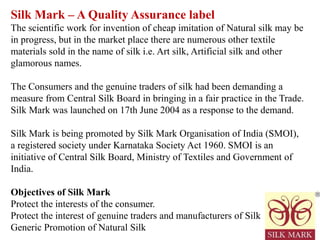
Silk Mark – A Quality Assurance label
The scientific work for invention of cheap imitation of Natural silk may be
in progress, but in the market place there are numerous other textile
materials sold in the name of silk i.e. Art silk, Artificial silk and other
glamorous names.
The Consumers and the genuine traders of silk had been demanding a
measure from Central Silk Board in bringing in a fair practice in the Trade.
Silk Mark was launched on 17th June 2004 as a response to the demand.
Silk Mark is being promoted by Silk Mark Organisation of India (SMOI),
a registered society under Karnataka Society Act 1960. SMOI is an
initiative of Central Silk Board, Ministry of Textiles and Government of
India.
Objectives of Silk Mark
Protect the interests of the consumer.
Protect the interest of genuine traders and manufacturers of Silk
Generic Promotion of Natural Silk
Handloom mark
The Textile Committee is yet to obtain "home protection" by registering the
Handloom Mark logo as a Certification Mark under the Indian Trade and
Merchandise Marks Act, 1958.
Under the new Geographical Indication of Goods (Registration &
Protection) Act, 1999, (which has become operational on September 15,
2003), the Textile Committee and the government have been filing
applications to register handloom products as a geographical indication.
Pochampally and Kota products are already registered under this provision.
Objective
Promote handloom products in Domestic as well as International Market.
Provide assurance to the consumers about the genuineness of the product
origin.
Improve international marketing linkages to the handloom weavers.
Strengthen supply chain for Handloom products
Improve price realization of the Handloom products in Domestic as well as
International Market
Improve the earnings of the handloom weaver community
Facilitate uninterrupted workflow throughout the year to the handloom
weavers.
Develop database on the handloom supplies and weavers that will help in
supporting the weavers through the existing schemes being implemented by
the Govt. of India and framing of the future plans.
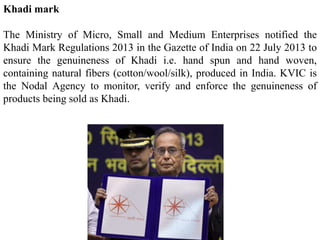
Khadi mark
The Ministry of Micro, Small and Medium Enterprises notified the
Khadi Mark Regulations 2013 in the Gazette of India on 22 July 2013 to
ensure the genuineness of Khadi i.e. hand spun and hand woven,
containing natural fibers (cotton/wool/silk), produced in India. KVIC is
the Nodal Agency to monitor, verify and enforce the genuineness of
products being sold as Khadi.

Indian environmental legislation

  • 1.
    Indian Environmental Legislation PresentedBy: Mona Verma Ph.D. Research Scholar Deptt. of Textile and Apparel Designing, CCSHAU,HISAR mona.verma35057@gmail.com
  • 2.
    In the fieldof forest protection, the enactment of the Forest Act, 1865 was the first step at asserting the State monopoly right over the forests. The customary rights of rural communities to manage forests were curtailed by the Act. The Shore Nuisance (Bombay and Kolaba) Act of 1853 and the Oriental Gas Company Act of 1857 imposed restrictions on the fouling of water. The Merchant Shipping Act of 1858 dealt with prevention of pollution of sea by oil. In 1860, for the first time, an attempt was made to control especially water and atmospheric pollution through criminal sanctions under the Indian Penal Code, 1860. Policy and Laws in British India
  • 3.
    Policy and Lawsin India after Independence
  • 4.
    The Factories Actof 1948 required all factories to make effective arrangements for waste disposal and empowered State Governments to frame rules implementing this directive. Under the River Boards Act of 1956, river boards established are empowered to prevent water pollution of inter-state rivers. Some States took initiative in the filed of environmental protection, viz., Orissa River Pollution Prevention Act, 1953, and, Maharashtra Prevention of Water Pollution Act, 1969. The Wildlife (Protection) Act, 1972, aimed at rational and modern wild life management. The Water (Prevention and Control of Pollution) Act, 1974, provides for the establishment of pollution control boards at Centre and States to act as watchdogs for prevention and control of pollution.
  • 5.
    The Forest(Conservation) Act,1980 aimed to check deforestation, diversion of forest land for non-forestry purposes, and to promote social forestry. The Air(Prevention and Control of Pollution) Act,1981, aimed at checking air pollution via pollution control boards. The Environment (Protection) Act, 1986 is a landmark legislation which provides for single focus in the country for protection of environment and aims at plugging the loopholes in existing legislation. It provides mainly for pollution control, with stringent penalties for violations.
  • 6.
    The Public LiabilityInsurance Act, 1991, provides for mandatory insurance for the purpose of providing immediate relief to person affected by accidents occurring while handling any hazardous substance. The National Environment Tribunals Act, 1995, was formulated in view of the fact that civil courts litigations take a long time (as happened in Bhopal case). The Act provides for speedy disposal of environmental related cases through environmental tribunals. Under the Act, four benches of the tribunal will be set up in Delhi, Calcutta, Madras and Bombay and 8,000 of the most Hazardous industrial units in the country will be brought under its security.
  • 7.
    The National Environment Appellate AuthorityAct, 1997, It provides for the established of a National Environment Appellant Authority (NEAA) to hear appeals with respect to restriction in areas in which any industries, operations or processes shall not be carried out or shall be carried out subject to certain safeguards under the Environment (Protection) Act, 1986.
  • 8.
    In 1992, theUnion Government adopted a “National Conservation Strategy and Policy Statement on Environment and Development” (NCS). The preamble to the NCS adopts the policy of “sustainable development” and declares the government’s commitment to re- orient policies and action “in unison with the environmental perspective”. The NCS proceeds to recognize the enormous dimensions of the environmental problems facing India and declares strategies for action in various spheres such as agriculture, forestry, industrial development, mining and tourism. Special sections in the NCS deal with the rehabilitation of persons ousted by large development projects; the role of NGOs; and the special relationship between women and the environment.
  • 9.
    The Central Governmentframed the Recycled Plastic Manufacture and Usage Rules, 1999. The Rules prohibit vendors of foodstuffs from packing their wares in bags or containers made from recycled plastics. If foodstuffs are to be sold in plastic bags, the carry bag must be made of virgin plastic. The Municipal Solid Wastes (Management and Handling) Rules, 2000, apply to every municipal authority responsible for collection, segregations, storage, transportation, processing and disposal of municipal solid wastes. The Battery (Management and Handling) Rules, 2000, provides for specific categories of wastes such as battery, waste oil, etc. These rules shall apply to every manufacturer, importer, re- conditioner, assembler, dealer, recycler, re-smelter, auctioneer, consumer and bulk consumer involved in manufacturer, processing, sale and purchase of batteries.
  • 10.
    In 2000, theNoise Pollution (Regulation and Control) Rules, framed by the Central Government under the Environment Protection Act, 1986, came into effect. These Rules prescribed ambient air quality standards in respect of noise for industrial, commercial and residential areas as well as designated „silence zones‟. In the same year, the Central Government enacted the Ozone Depleting Substances (Regulation and Control), rules, 2000 under the Environment Protection Act. The producers, dealers, users engaged in the manufacture/use of ozone depleting substances such as CFCs, Halon, Cabontetrachloride (CCI4), etc., are required to compulsorily register under the Rules.
  • 11.
    The Environment ProtectionAct, 1986 Though there is a host of legislation in India aimed at protecting the environment from pollution and maintaining the ecological balance, the environment has not so far been considered in its totality. The Environment
  • 12.
    Ecomark It isa label given to environmental-friendly consumer products. Any product will get eco-mark if its life-cycle (manufacturing process, raw material, product use, disposal and packaging) is environment-friendly at every stage. In 1991, the Ministry of Environment and Forests (MoEF) decided to institute a scheme on labeling environment friendly products. Household and other consumer products can be accredited and labeled as satisfying environmental criteria, in addition to quality requirements laid down by the Bureau of Indian Standards for the product. The label is known as Ecomark. The scheme was meant to provide incentive to the manufacturers, to assists consumers to become environmentally responsible, and to improve the quality of environment leading to sustainable management of resources. In certain categories such as toilet soaps and detergents, paints, paper and laundry soaps, the MoEF has already finalized and notified the criteria for the product. Ecomark
  • 13.
    Biodiversity Act, 2000India is one of the twelve mega-biodiversity countries of the world and became a party to the International Convention on Biological Diversity in 1994. The objectives of the convention are:  The conservation of Biological Diversity,  The sustainable use of its component, and  The fair and equitable sharing of the benefits arising of the utilization of genetic resources.
  • 14.
    It is worthmentioning the names of few important rules, which have been notified under the Environment (Protection) Act, 1986 in recent past for the management and control of hazardous substances, which include hazardous chemicals, waste and micro-organisms. (i) Hazardous Waste (Management and Handling) Rules of 1989: Objective is to control generation, collection, treatment, import, storage and handling of hazardous waste. (i) The Manufacture, Storage and Import of Hazardous Chemical Rules of 1989 (ii) The Manufacture, use, Import, Export and Storage of Hazardous Micro-Organisms/Genetically Engineered Organisms or Cells Rules of 1989. These were introduced with a view to protect the environment, nature and health in connection with the application of gene technology and micro-organisms.
  • 15.
    (iv) Biomedical Waste(Management and Handling) Rules of 1998 It is a legal binding on the healthcare institutions of streamline the process of proper handling of hospital waste such as its segregation, disposal, collection and treatment. (v) Recycled Plastic Manufacture and Usage Rules of 1999 & Recycled Plastic Manufacture and Usage Amendment Rules Of 2002. (vi) Municipal Solid Wastes (Management and Handling) Rules, 2000 According to these rules any municipal solid waste generated in a city or a town, shall be managed and handled in accordance with the compliance criteria and the procedure laid down in Schedules of these rules.
  • 16.
    Silk Mark –A Quality Assurance label The scientific work for invention of cheap imitation of Natural silk may be in progress, but in the market place there are numerous other textile materials sold in the name of silk i.e. Art silk, Artificial silk and other glamorous names. The Consumers and the genuine traders of silk had been demanding a measure from Central Silk Board in bringing in a fair practice in the Trade. Silk Mark was launched on 17th June 2004 as a response to the demand. Silk Mark is being promoted by Silk Mark Organisation of India (SMOI), a registered society under Karnataka Society Act 1960. SMOI is an initiative of Central Silk Board, Ministry of Textiles and Government of India. Objectives of Silk Mark Protect the interests of the consumer. Protect the interest of genuine traders and manufacturers of Silk Generic Promotion of Natural Silk
  • 17.
    Handloom mark The TextileCommittee is yet to obtain "home protection" by registering the Handloom Mark logo as a Certification Mark under the Indian Trade and Merchandise Marks Act, 1958. Under the new Geographical Indication of Goods (Registration & Protection) Act, 1999, (which has become operational on September 15, 2003), the Textile Committee and the government have been filing applications to register handloom products as a geographical indication. Pochampally and Kota products are already registered under this provision.
  • 18.
    Objective Promote handloom productsin Domestic as well as International Market. Provide assurance to the consumers about the genuineness of the product origin. Improve international marketing linkages to the handloom weavers. Strengthen supply chain for Handloom products Improve price realization of the Handloom products in Domestic as well as International Market Improve the earnings of the handloom weaver community Facilitate uninterrupted workflow throughout the year to the handloom weavers. Develop database on the handloom supplies and weavers that will help in supporting the weavers through the existing schemes being implemented by the Govt. of India and framing of the future plans.
  • 19.
    Khadi mark The Ministryof Micro, Small and Medium Enterprises notified the Khadi Mark Regulations 2013 in the Gazette of India on 22 July 2013 to ensure the genuineness of Khadi i.e. hand spun and hand woven, containing natural fibers (cotton/wool/silk), produced in India. KVIC is the Nodal Agency to monitor, verify and enforce the genuineness of products being sold as Khadi.