the e-waste (ManageMent
and handling) Rules, 2011

Y. K. uPadhYaY
noise Pollution
The increasing ambient noise levels in public places from various
sources, inter-alia,
 industrial activity,
 construction activity,
 generator sets,
 loud speakers,
 public address systems,
 music systems,
 vehicular horns and
 other mechanical devices
have deleterious effects on human health and the psychological well
being of the people
It is considered necessary to regulate and control noise producing and
generating sources with the objective of maintaining the ambient air
quality standards in respect of noise;
2
noise Pollution
Whereas a draft of Noise Pollution (Control and Regulation) Rules,
1999 was published under the notification of the Government of India
in the Ministry of Environment and Forests vide number S.O. 528 (E)
dated the 2e June, 1999
inviting objections and suggestions from all the persons likely to be
affected thereby,
before the expiry of the period of sixty days from the date on which
the copies of the Gazette containing the said notification are made
available to the public-,

3
noise Pollution
The objections and suggestions received from the public in respect of
the said draft rules have been duly considered by the Central
Government-,
In exercise of the powers conferred by clause (ii) of sub-section (2) of
section 3, sub-section (1) and clause (b) of sub-section (2) of section 6
and section 25 of the Environment (Protection) Act, 1986 (29 of 1986)
read with rule 5 of the Environment (Protection) Rules, 1986, the
Central Government hereby made The Noise Pollution (Regulation
and Control) Rules, 2000 for the regulation and control of noise
producing and generating sources.

4
2. Definitions.(c) "authority" means any authority or officer authorised by the
Central Government, or as the case may be, the State Government in
accordance with the laws in force and includes a District Magistrate,
Police Commissioner, or any other officer designated for the
maintenance of the ambient air quality standards in respect of noise
under any law for the time being in force;
(d) "person" in relation to any factory or premises means a person or
occupier or his agent, who has control over the affairs of the factory
or premises;

5
3. Ambient Air guAlity stAnDArDs in respect of
noise for Different AreAs/zones.

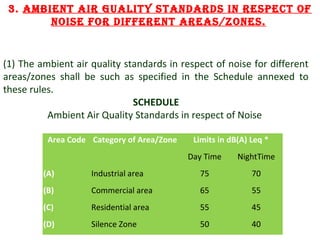
(1) The ambient air quality standards in respect of noise for different
areas/zones shall be such as specified in the Schedule annexed to
these rules.
SCHEDULE
Ambient Air Quality Standards in respect of Noise
Area Code Category of Area/Zone

Limits in dB(A) Leq *
Day Time

NightTime

(A)

Industrial area

75

70

(B)

Commercial area

65

55

(C)

Residential area

55

45

(D)

Silence Zone

50

40

6
3. Ambient Air guAlity stAnDArDs in respect of
noise for Different AreAs/zones.

(2) The State Government may categorize the areas into industrial,
commercial, residential or silence areas/zones for the purpose of
implementation of noise standards for different areas.
(3) The State Government shall take measures for abatement of noise
including noise emanating from vehicular movements and ensure that
the existing noise levels do not exceed the ambient air quality
standards specified under these rules.

7
3. Ambient Air guAlity stAnDArDs in respect of
noise for Different AreAs/zones.

(4) All development authorities, local bodies and other concerned
authorities while planning developmental activity or carrying out
functions relating to town and country planning shall take into
consideration all aspects of noise pollution as a parameter of quality
of life to avoid noise menace and to achieve the objective of
maintaining the ambient air quality standards in respect of noise.
(5) An area comprising not less than 100 metres around hospitals,
educational institutions and courts may be declared as silence
area/zone for the purpose of these rules.

8
4. Responsibility as to enfoRcement of noise
pollution contRol measuRes.

(1) The noise levels in any area/zone shall not exceed the
ambient air quality standards in respect of noise as specified
in the Schedule.
(2) The authority shall be responsible for the enforcement
of noise pollution control measures and the due compliance
of the ambient air quality standards in respect of noise.

9
5. RestRictions on the use of loud
speakeRs/public addRess s1stem.
(1) A loud speaker or a public address system shall not be
used except after obtaining written permission from the
authority.
(2) A loud speaker or a public address system shall not be
used at night (between 10.00 p.m. to 6.00 a.m.) except in
closed premises for communication within, e.g. auditoria,
conference rooms, community halls and banquet halls.

10
6. consequences of any violation
in silence zone/aRea.
Whoever, in any place covered under the silence zone/area
commits any of the following offence, he shall be liable for
penalty under the provisions of the Act:
(i) whoever, plays any music or uses any sound amplifiers,
(ii) whoever, beats a drum or tom-tom or blows a horn
either musical or pressure, or trumpet or beats or sounds
any instrument, or
(iii) whoever, exhibits any mimetic, musical or other
performances of a nature to 44raq crowds.
11
7. complaints to be made to the
authoRity.
(1) A person may, if the noise level exceeds the ambient
noise standards by 10 dB(A) or more given in the
corresponding columns against any area/zone, make a
complaint to the authority.
(2) The authority shall act on the complaint and take action
against the violator in accordance with the provisions of
these rules and any other law in force.

12
8. Power to vrohibit etc. continuance of
music sound or noise.
(1) If the authority is satisfied from the report of an officer
in-charge of a police station or other information received
by him that it is necessary to do so in order to prevent
annoyance, disturbance, discomfort or injury or risk of
annoyance, disturbance, discomfort or injury to the public
or to any person who dwell or occupy property on the
vicinity, he may, by a written order issue such directions as
he may consider necessary to any person for preventing,
prohibiting, controlling or regulating:

13
8. Power to vrohibit etc. continuance of
music sound or noise.
(a) the incidence or continuance in or upon any premises of (i) any vocal or instrumental music,
(ii) sounds caused by playing, beating, clashing, blowing or
use in any manner whatsoever of any instrument including
loudspeakers, public address systems, appliance or apparatus
or contrivance which is capable of producing or re-producing
sound, or
(b) the carrying on in or upon, any premises of any trade,
avocation or operation or process resulting in or attended
with noise.
14
8. Power to vrohibit etc. continuance of
music sound or noise.
(2) The authority empowered under sub-rule (1) may, either
on its own motion, or on the application of any person
aggrieved by an order made under sub-rule (1), either
rescind, modify or alter any such order:
Provided that before any such application is disposed of, the
said authority shall afford to the applicant an opportunity of
appearing before it either in person or by a person
representing him and showing cause against the order and
shall, if it rejects any such application either wholly or in part,
record its reasons for such rejection.
15

Noise rules

  • 1.
    the e-waste (ManageMent andhandling) Rules, 2011 Y. K. uPadhYaY
  • 2.
    noise Pollution The increasingambient noise levels in public places from various sources, inter-alia,  industrial activity,  construction activity,  generator sets,  loud speakers,  public address systems,  music systems,  vehicular horns and  other mechanical devices have deleterious effects on human health and the psychological well being of the people It is considered necessary to regulate and control noise producing and generating sources with the objective of maintaining the ambient air quality standards in respect of noise; 2
  • 3.
    noise Pollution Whereas adraft of Noise Pollution (Control and Regulation) Rules, 1999 was published under the notification of the Government of India in the Ministry of Environment and Forests vide number S.O. 528 (E) dated the 2e June, 1999 inviting objections and suggestions from all the persons likely to be affected thereby, before the expiry of the period of sixty days from the date on which the copies of the Gazette containing the said notification are made available to the public-, 3
  • 4.
    noise Pollution The objectionsand suggestions received from the public in respect of the said draft rules have been duly considered by the Central Government-, In exercise of the powers conferred by clause (ii) of sub-section (2) of section 3, sub-section (1) and clause (b) of sub-section (2) of section 6 and section 25 of the Environment (Protection) Act, 1986 (29 of 1986) read with rule 5 of the Environment (Protection) Rules, 1986, the Central Government hereby made The Noise Pollution (Regulation and Control) Rules, 2000 for the regulation and control of noise producing and generating sources. 4
  • 5.
    2. Definitions.(c) "authority"means any authority or officer authorised by the Central Government, or as the case may be, the State Government in accordance with the laws in force and includes a District Magistrate, Police Commissioner, or any other officer designated for the maintenance of the ambient air quality standards in respect of noise under any law for the time being in force; (d) "person" in relation to any factory or premises means a person or occupier or his agent, who has control over the affairs of the factory or premises; 5
  • 6.
    3. Ambient AirguAlity stAnDArDs in respect of noise for Different AreAs/zones. (1) The ambient air quality standards in respect of noise for different areas/zones shall be such as specified in the Schedule annexed to these rules. SCHEDULE Ambient Air Quality Standards in respect of Noise Area Code Category of Area/Zone Limits in dB(A) Leq * Day Time NightTime (A) Industrial area 75 70 (B) Commercial area 65 55 (C) Residential area 55 45 (D) Silence Zone 50 40 6
  • 7.
    3. Ambient AirguAlity stAnDArDs in respect of noise for Different AreAs/zones. (2) The State Government may categorize the areas into industrial, commercial, residential or silence areas/zones for the purpose of implementation of noise standards for different areas. (3) The State Government shall take measures for abatement of noise including noise emanating from vehicular movements and ensure that the existing noise levels do not exceed the ambient air quality standards specified under these rules. 7
  • 8.
    3. Ambient AirguAlity stAnDArDs in respect of noise for Different AreAs/zones. (4) All development authorities, local bodies and other concerned authorities while planning developmental activity or carrying out functions relating to town and country planning shall take into consideration all aspects of noise pollution as a parameter of quality of life to avoid noise menace and to achieve the objective of maintaining the ambient air quality standards in respect of noise. (5) An area comprising not less than 100 metres around hospitals, educational institutions and courts may be declared as silence area/zone for the purpose of these rules. 8
  • 9.
    4. Responsibility asto enfoRcement of noise pollution contRol measuRes. (1) The noise levels in any area/zone shall not exceed the ambient air quality standards in respect of noise as specified in the Schedule. (2) The authority shall be responsible for the enforcement of noise pollution control measures and the due compliance of the ambient air quality standards in respect of noise. 9
  • 10.
    5. RestRictions onthe use of loud speakeRs/public addRess s1stem. (1) A loud speaker or a public address system shall not be used except after obtaining written permission from the authority. (2) A loud speaker or a public address system shall not be used at night (between 10.00 p.m. to 6.00 a.m.) except in closed premises for communication within, e.g. auditoria, conference rooms, community halls and banquet halls. 10
  • 11.
    6. consequences ofany violation in silence zone/aRea. Whoever, in any place covered under the silence zone/area commits any of the following offence, he shall be liable for penalty under the provisions of the Act: (i) whoever, plays any music or uses any sound amplifiers, (ii) whoever, beats a drum or tom-tom or blows a horn either musical or pressure, or trumpet or beats or sounds any instrument, or (iii) whoever, exhibits any mimetic, musical or other performances of a nature to 44raq crowds. 11
  • 12.
    7. complaints tobe made to the authoRity. (1) A person may, if the noise level exceeds the ambient noise standards by 10 dB(A) or more given in the corresponding columns against any area/zone, make a complaint to the authority. (2) The authority shall act on the complaint and take action against the violator in accordance with the provisions of these rules and any other law in force. 12
  • 13.
    8. Power tovrohibit etc. continuance of music sound or noise. (1) If the authority is satisfied from the report of an officer in-charge of a police station or other information received by him that it is necessary to do so in order to prevent annoyance, disturbance, discomfort or injury or risk of annoyance, disturbance, discomfort or injury to the public or to any person who dwell or occupy property on the vicinity, he may, by a written order issue such directions as he may consider necessary to any person for preventing, prohibiting, controlling or regulating: 13
  • 14.
    8. Power tovrohibit etc. continuance of music sound or noise. (a) the incidence or continuance in or upon any premises of (i) any vocal or instrumental music, (ii) sounds caused by playing, beating, clashing, blowing or use in any manner whatsoever of any instrument including loudspeakers, public address systems, appliance or apparatus or contrivance which is capable of producing or re-producing sound, or (b) the carrying on in or upon, any premises of any trade, avocation or operation or process resulting in or attended with noise. 14
  • 15.
    8. Power tovrohibit etc. continuance of music sound or noise. (2) The authority empowered under sub-rule (1) may, either on its own motion, or on the application of any person aggrieved by an order made under sub-rule (1), either rescind, modify or alter any such order: Provided that before any such application is disposed of, the said authority shall afford to the applicant an opportunity of appearing before it either in person or by a person representing him and showing cause against the order and shall, if it rejects any such application either wholly or in part, record its reasons for such rejection. 15