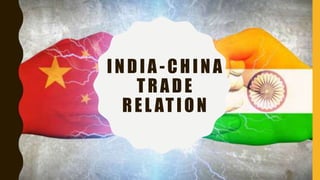
INDIA -CHINA
TRADE
REL ATION
INTRODUCTION:-
India-china trade relation also known as “ SINO-INDIAN relationship.
INDIAN AND CHINA are two of most powerful and biggest economy in
the world.
The relation of both countries is 61 years old and in terms of investment
the relation is fantabulous among both the nation.
China is the world leader in manufacturing and on the other India is in
it’s way to become world leader in services especially in IT services.
India and china together are home to the world’s largest pools of skilled
human resources.
COMPARISION:-
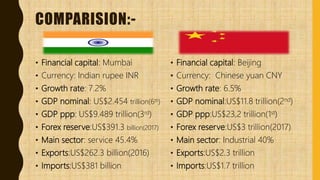
INDIA
• Financial capital: Mumbai
• Currency: Indian rupee INR
• Growth rate: 7.2%
• GDP nominal: US$2.454 trillion(6th)
• GDP ppp: US$9.489 trillion(3rd)
• Forex reserve:US$391.3 billion(2017)
• Main sector: service 45.4%
• Exports:US$262.3 billion(2016)
• Imports:US$381 billion
CHINA
• Financial capital: Beijing
• Currency: Chinese yuan CNY
• Growth rate: 6.5%
• GDP nominal:US$11.8 trillion(2nd)
• GDP ppp:US$23,2 trillion(1st)
• Forex reserve:US$3 trillion(2017)
• Main sector: Industrial 40%
• Exports:US$2.3 trillion
• Imports:US$1.7 trillion
BACKGROUND:-
• 1949:- Government of India extents recognition to the people’s
Republic of China.
• 1950:- India establish trade relation with China.
• 1954:- Trade agreement between India and china signed in New
Delhi.
• 1976:- India and China restore trade relation after 20 years.
• 1994:- The signing of double taxation avoidance agreement
between India and China take place
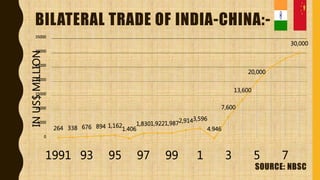
• 2008:- Bilateral trade breaks $50 billion mark and China becomes
India’s largest trading partner in goods.
TRADE OF INDIA AND CHINA
BILATERAL TRADE:
• The India-China trade relations are regulated by the India-
China JBC ( joint business council), which was setup by
CCPIT ( china council for the promotion of international
trade) and FICCI Federation of Indian chamber of commerce
and industry) in 1985.
• 0.8% of China’s overall imports is from India and 12.6%
India’s overall imports is from China.
• China is already India’s largest trading partner, overtaking
even the US.
CONT’D
• India and china signed a trade agreement in 1984.
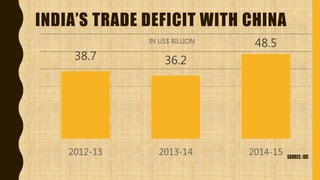
• India’s trade deficit with china touched almost $40 billion in
2012-13.
• The highest value of trade agreement is of almost $71 billion
(2016)
• China’s export increased by 0.2% and India’s decreased by
2.1%.
• In result India’s trade deficit with china mounts to
$52.69billion (2016).
BILATERAL TRADE OF INDIA-CHINA:-
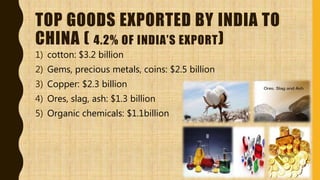
TOP GOODS EXPORTED BY INDIA TO
CHINA ( 4.2% OF INDIA’S EXPORT)
1) cotton: $3.2 billion
2) Gems, precious metals, coins: $2.5 billion
3) Copper: $2.3 billion
4) Ores, slag, ash: $1.3 billion
5) Organic chemicals: $1.1billion
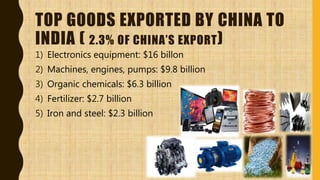
TOP GOODS EXPORTED BY CHINA TO
INDIA ( 2.3% OF CHINA’S EXPORT)
1) Electronics equipment: $16 billon
2) Machines, engines, pumps: $9.8 billion
3) Organic chemicals: $6.3 billion
4) Fertilizer: $2.7 billion
5) Iron and steel: $2.3 billion
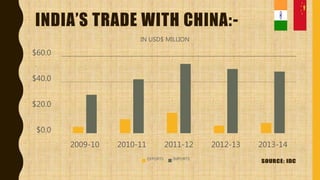
INDIA’S TRADE WITH CHINA:-
.
$0.0
$20.0
$40.0
$60.0
2009-10 2010-11 2011-12 2012-13 2013-14
IN USD$ MILLION
EXPORTS IMPORTS
INDIA’S TRADE DEFICIT WITH CHINA
38.7 36.2
48.5
2012-13 2013-14 2014-15
IN US$ BILLION
IT’S REASONS:-
• The imbalance is mainly because India has limited exports
to china while Chinese manufacturer has competitive
advantage in Indian market.
• Chinese government tightening policies in the real state
sector, reduced demand for Indian raw materials-mainly
iron, which account for the bulk of Indian exports to
China.
• Too much dependency an Chinese products.
DUMPING OF CHINA IN INDIA:-
Dumping in reference to international trade is the export by a
country or company of a product at a price that is lower in the
foreign market than the price charged in the domestic market.
• China always has upper hand over India in manufacturing sector.
• Taking advantage of this China dumps numbers of it’s goods or
commodity in India.
. This severely affect the domestic manufactures or companies of
India.
CONT’D:-
• In order to counter china’s this action India is been putting
anti-dumping duties on various Chinese products ex:- India
put anti-dumping duties on Chinese steel products, yarn etc.
• In 2009 India become the first country to file 42 anti-dumping
complaints at WTO and 17 of them were against China.
• Recently India imposed anti-dumping duty on steel products,
ceramic items, chemicals, aluminium foil in order to safe
domestic industries.
EFFECT OF DUMPING IN INDIAN:-
MAINLY FROM CHINA
• Actual or potential decline in sales of domestic
companies.
• Loss of profit of domestic companies.
• Decrease in the market share of domestic companies.
• Reduction in wages.
• Cut down in manpower.
• Shutdown of domestic manufacturing plants.
CONCLUSION:-
• An analysis on INDIA-CHINA trade relation shows that the
magnitude of trade has expanded rapidly over the past
few years.
• China is emerging as a significant link in the
manufacturing chain of the world.
While India’s potential for knowledge based
service and manufacturing is being noticed.
THANK YOU FOR YOUR ATTENTION
Presentation By:
Vaibhav Yadav

India china

  • 1.
  • 2.
    INTRODUCTION:- India-china trade relationalso known as “ SINO-INDIAN relationship. INDIAN AND CHINA are two of most powerful and biggest economy in the world. The relation of both countries is 61 years old and in terms of investment the relation is fantabulous among both the nation. China is the world leader in manufacturing and on the other India is in it’s way to become world leader in services especially in IT services. India and china together are home to the world’s largest pools of skilled human resources.
  • 3.
    COMPARISION:- INDIA • Financial capital:Mumbai • Currency: Indian rupee INR • Growth rate: 7.2% • GDP nominal: US$2.454 trillion(6th) • GDP ppp: US$9.489 trillion(3rd) • Forex reserve:US$391.3 billion(2017) • Main sector: service 45.4% • Exports:US$262.3 billion(2016) • Imports:US$381 billion CHINA • Financial capital: Beijing • Currency: Chinese yuan CNY • Growth rate: 6.5% • GDP nominal:US$11.8 trillion(2nd) • GDP ppp:US$23,2 trillion(1st) • Forex reserve:US$3 trillion(2017) • Main sector: Industrial 40% • Exports:US$2.3 trillion • Imports:US$1.7 trillion
  • 4.
    BACKGROUND:- • 1949:- Governmentof India extents recognition to the people’s Republic of China. • 1950:- India establish trade relation with China. • 1954:- Trade agreement between India and china signed in New Delhi. • 1976:- India and China restore trade relation after 20 years. • 1994:- The signing of double taxation avoidance agreement between India and China take place • 2008:- Bilateral trade breaks $50 billion mark and China becomes India’s largest trading partner in goods.
  • 5.
    TRADE OF INDIAAND CHINA BILATERAL TRADE: • The India-China trade relations are regulated by the India- China JBC ( joint business council), which was setup by CCPIT ( china council for the promotion of international trade) and FICCI Federation of Indian chamber of commerce and industry) in 1985. • 0.8% of China’s overall imports is from India and 12.6% India’s overall imports is from China. • China is already India’s largest trading partner, overtaking even the US.
  • 6.
    CONT’D • India andchina signed a trade agreement in 1984. • India’s trade deficit with china touched almost $40 billion in 2012-13. • The highest value of trade agreement is of almost $71 billion (2016) • China’s export increased by 0.2% and India’s decreased by 2.1%. • In result India’s trade deficit with china mounts to $52.69billion (2016).
  • 7.
    BILATERAL TRADE OFINDIA-CHINA:-
  • 8.
    TOP GOODS EXPORTEDBY INDIA TO CHINA ( 4.2% OF INDIA’S EXPORT) 1) cotton: $3.2 billion 2) Gems, precious metals, coins: $2.5 billion 3) Copper: $2.3 billion 4) Ores, slag, ash: $1.3 billion 5) Organic chemicals: $1.1billion
  • 9.
    TOP GOODS EXPORTEDBY CHINA TO INDIA ( 2.3% OF CHINA’S EXPORT) 1) Electronics equipment: $16 billon 2) Machines, engines, pumps: $9.8 billion 3) Organic chemicals: $6.3 billion 4) Fertilizer: $2.7 billion 5) Iron and steel: $2.3 billion
  • 10.
    INDIA’S TRADE WITHCHINA:- . $0.0 $20.0 $40.0 $60.0 2009-10 2010-11 2011-12 2012-13 2013-14 IN USD$ MILLION EXPORTS IMPORTS
  • 11.
    INDIA’S TRADE DEFICITWITH CHINA 38.7 36.2 48.5 2012-13 2013-14 2014-15 IN US$ BILLION
  • 12.
    IT’S REASONS:- • Theimbalance is mainly because India has limited exports to china while Chinese manufacturer has competitive advantage in Indian market. • Chinese government tightening policies in the real state sector, reduced demand for Indian raw materials-mainly iron, which account for the bulk of Indian exports to China. • Too much dependency an Chinese products.
  • 13.
    DUMPING OF CHINAIN INDIA:- Dumping in reference to international trade is the export by a country or company of a product at a price that is lower in the foreign market than the price charged in the domestic market. • China always has upper hand over India in manufacturing sector. • Taking advantage of this China dumps numbers of it’s goods or commodity in India. . This severely affect the domestic manufactures or companies of India.
  • 14.
    CONT’D:- • In orderto counter china’s this action India is been putting anti-dumping duties on various Chinese products ex:- India put anti-dumping duties on Chinese steel products, yarn etc. • In 2009 India become the first country to file 42 anti-dumping complaints at WTO and 17 of them were against China. • Recently India imposed anti-dumping duty on steel products, ceramic items, chemicals, aluminium foil in order to safe domestic industries.
  • 15.
    EFFECT OF DUMPINGIN INDIAN:- MAINLY FROM CHINA • Actual or potential decline in sales of domestic companies. • Loss of profit of domestic companies. • Decrease in the market share of domestic companies. • Reduction in wages. • Cut down in manpower. • Shutdown of domestic manufacturing plants.
  • 16.
    CONCLUSION:- • An analysison INDIA-CHINA trade relation shows that the magnitude of trade has expanded rapidly over the past few years. • China is emerging as a significant link in the manufacturing chain of the world. While India’s potential for knowledge based service and manufacturing is being noticed.
  • 17.
    THANK YOU FORYOUR ATTENTION Presentation By: Vaibhav Yadav