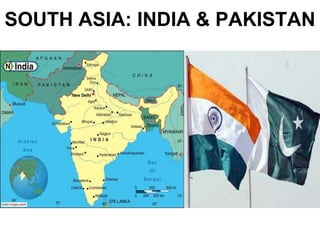
SOUTH ASIA: INDIA & PAKISTAN
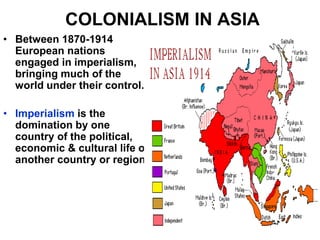
COLONIALISM IN ASIA
• Between 1870-1914
European nations
engaged in imperialism,
bringing much of the
world under their control.
• Imperialism is the
domination by one
country of the political,
economic & cultural life of
another country or region.
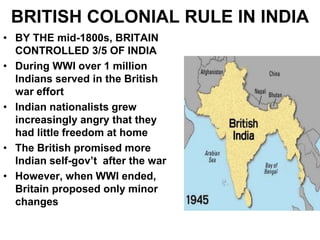
BRITISH COLONIAL RULE IN INDIA
• BY THE mid-1800s, BRITAIN
CONTROLLED 3/5 OF INDIA
• During WWI over 1 million
Indians served in the British
war effort
• Indian nationalists grew
increasingly angry that they
had little freedom at home
• The British promised more
Indian self-gov’t after the war
• However, when WWI ended,
Britain proposed only minor
changes
INDIAN PROTESTS BEGIN
• 1919 Amritsar massacre:
– Peaceful protestors shot by British
soldiers
– A turning point:
• Convinced many Indians of the
need for complete independence
• 1920s:
– Mohandas Gandhi emerged as a
new leader:
• United all Indians behind the drive
for independence
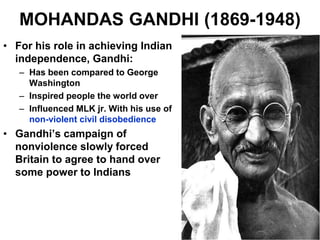
MOHANDAS GANDHI (1869-1948)
• For his role in achieving Indian
independence, Gandhi:
– Has been compared to George
Washington
– Inspired people the world over
– Influenced MLK jr. With his use of
non-violent civil disobedience
• Gandhi’s campaign of
nonviolence slowly forced
Britain to agree to hand over
some power to Indians
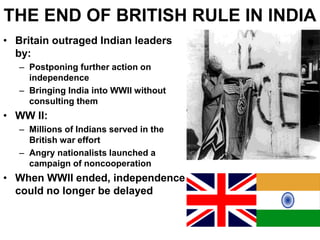
THE END OF BRITISH RULE IN INDIA
• Britain outraged Indian leaders
by:
– Postponing further action on
independence
– Bringing India into WWII without
consulting them
• WW II:
– Millions of Indians served in the
British war effort
– Angry nationalists launched a
campaign of noncooperation
• When WWII ended, independence
could no longer be delayed
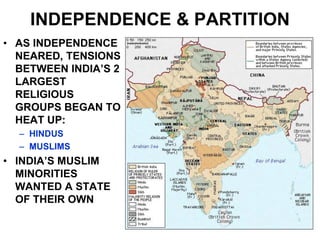
INDEPENDENCE & PARTITION
• AS INDEPENDENCE
NEARED, TENSIONS
BETWEEN INDIA’S 2
LARGEST
RELIGIOUS
GROUPS BEGAN TO
HEAT UP:
– HINDUS
– MUSLIMS
• INDIA’S MUSLIM
MINORITIES
WANTED A STATE
OF THEIR OWN
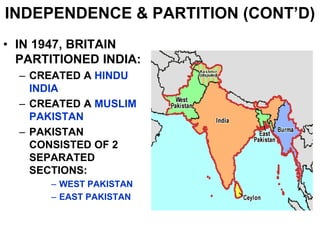
INDEPENDENCE & PARTITION (CONT’D)
• IN 1947, BRITAIN
PARTITIONED INDIA:
– CREATED A HINDU
INDIA
– CREATED A MUSLIM
PAKISTAN
– PAKISTAN
CONSISTED OF 2
SEPARATED
SECTIONS:
– WEST PAKISTAN
– EAST PAKISTAN
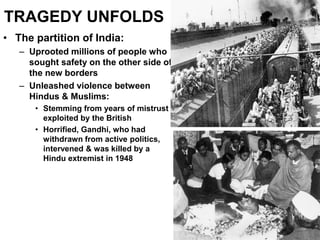
TRAGEDY UNFOLDS
• The partition of India:
– Uprooted millions of people who
sought safety on the other side of
the new borders
– Unleashed violence between
Hindus & Muslims:
• Stemming from years of mistrust
exploited by the British
• Horrified, Gandhi, who had
withdrawn from active politics,
intervened & was killed by a
Hindu extremist in 1948
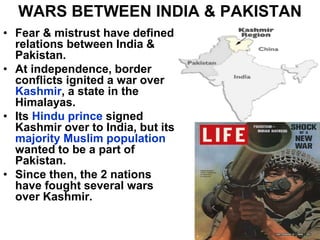
WARS BETWEEN INDIA & PAKISTAN
• Fear & mistrust have defined
relations between India &
Pakistan.
• At independence, border
conflicts ignited a war over
Kashmir, a state in the
Himalayas.
• Its Hindu prince signed
Kashmir over to India, but its
majority Muslim population
wanted to be a part of
Pakistan.
• Since then, the 2 nations
have fought several wars
over Kashmir.
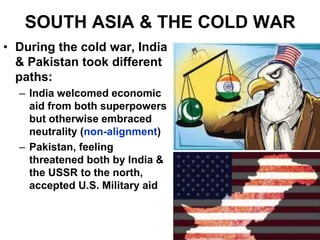
SOUTH ASIA & THE COLD WAR
• During the cold war, India
& Pakistan took different
paths:
– India welcomed economic
aid from both superpowers
but otherwise embraced
neutrality (non-alignment)
– Pakistan, feeling
threatened both by India &
the USSR to the north,
accepted U.S. Military aid
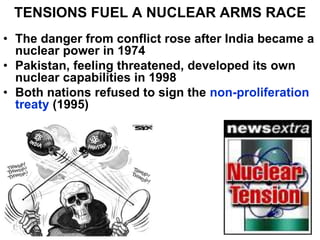
TENSIONS FUEL A NUCLEAR ARMS RACE
• The danger from conflict rose after India became a
nuclear power in 1974
• Pakistan, feeling threatened, developed its own
nuclear capabilities in 1998
• Both nations refused to sign the non-proliferation
treaty (1995)
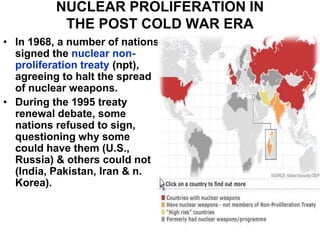
NUCLEAR PROLIFERATION IN
THE POST COLD WAR ERA
• In 1968, a number of nations
signed the nuclear non-
proliferation treaty (npt),
agreeing to halt the spread
of nuclear weapons.
• During the 1995 treaty
renewal debate, some
nations refused to sign,
questioning why some
could have them (U.S.,
Russia) & others could not
(India, Pakistan, Iran & n.
Korea).

India and Pakistan.pptx

  • 1.
  • 2.
    COLONIALISM IN ASIA •Between 1870-1914 European nations engaged in imperialism, bringing much of the world under their control. • Imperialism is the domination by one country of the political, economic & cultural life of another country or region.
  • 3.
    BRITISH COLONIAL RULEIN INDIA • BY THE mid-1800s, BRITAIN CONTROLLED 3/5 OF INDIA • During WWI over 1 million Indians served in the British war effort • Indian nationalists grew increasingly angry that they had little freedom at home • The British promised more Indian self-gov’t after the war • However, when WWI ended, Britain proposed only minor changes
  • 4.
    INDIAN PROTESTS BEGIN •1919 Amritsar massacre: – Peaceful protestors shot by British soldiers – A turning point: • Convinced many Indians of the need for complete independence • 1920s: – Mohandas Gandhi emerged as a new leader: • United all Indians behind the drive for independence
  • 5.
    MOHANDAS GANDHI (1869-1948) •For his role in achieving Indian independence, Gandhi: – Has been compared to George Washington – Inspired people the world over – Influenced MLK jr. With his use of non-violent civil disobedience • Gandhi’s campaign of nonviolence slowly forced Britain to agree to hand over some power to Indians
  • 6.
    THE END OFBRITISH RULE IN INDIA • Britain outraged Indian leaders by: – Postponing further action on independence – Bringing India into WWII without consulting them • WW II: – Millions of Indians served in the British war effort – Angry nationalists launched a campaign of noncooperation • When WWII ended, independence could no longer be delayed
  • 7.
    INDEPENDENCE & PARTITION •AS INDEPENDENCE NEARED, TENSIONS BETWEEN INDIA’S 2 LARGEST RELIGIOUS GROUPS BEGAN TO HEAT UP: – HINDUS – MUSLIMS • INDIA’S MUSLIM MINORITIES WANTED A STATE OF THEIR OWN
  • 8.
    INDEPENDENCE & PARTITION(CONT’D) • IN 1947, BRITAIN PARTITIONED INDIA: – CREATED A HINDU INDIA – CREATED A MUSLIM PAKISTAN – PAKISTAN CONSISTED OF 2 SEPARATED SECTIONS: – WEST PAKISTAN – EAST PAKISTAN
  • 9.
    TRAGEDY UNFOLDS • Thepartition of India: – Uprooted millions of people who sought safety on the other side of the new borders – Unleashed violence between Hindus & Muslims: • Stemming from years of mistrust exploited by the British • Horrified, Gandhi, who had withdrawn from active politics, intervened & was killed by a Hindu extremist in 1948
  • 10.
    WARS BETWEEN INDIA& PAKISTAN • Fear & mistrust have defined relations between India & Pakistan. • At independence, border conflicts ignited a war over Kashmir, a state in the Himalayas. • Its Hindu prince signed Kashmir over to India, but its majority Muslim population wanted to be a part of Pakistan. • Since then, the 2 nations have fought several wars over Kashmir.
  • 11.
    SOUTH ASIA &THE COLD WAR • During the cold war, India & Pakistan took different paths: – India welcomed economic aid from both superpowers but otherwise embraced neutrality (non-alignment) – Pakistan, feeling threatened both by India & the USSR to the north, accepted U.S. Military aid
  • 12.
    TENSIONS FUEL ANUCLEAR ARMS RACE • The danger from conflict rose after India became a nuclear power in 1974 • Pakistan, feeling threatened, developed its own nuclear capabilities in 1998 • Both nations refused to sign the non-proliferation treaty (1995)
  • 13.
    NUCLEAR PROLIFERATION IN THEPOST COLD WAR ERA • In 1968, a number of nations signed the nuclear non- proliferation treaty (npt), agreeing to halt the spread of nuclear weapons. • During the 1995 treaty renewal debate, some nations refused to sign, questioning why some could have them (U.S., Russia) & others could not (India, Pakistan, Iran & n. Korea).