Tricia Benscoter
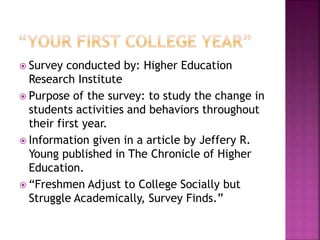
 Survey conducted by: Higher Education
Research Institute
 Purpose of the survey: to study the change in
students activities and behaviors throughout
their first year.
 Information given in a article by Jeffery R.
Young published in The Chronicle of Higher
Education.
 “Freshmen Adjust to College Socially but
Struggle Academically, Survey Finds.”
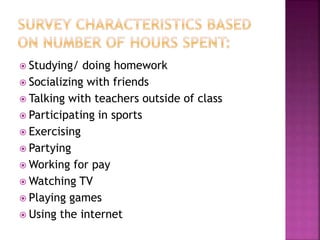
 Studying/ doing homework
 Socializing with friends
 Talking with teachers outside of class
 Participating in sports
 Exercising
 Partying
 Working for pay
 Watching TV
 Playing games
 Using the internet
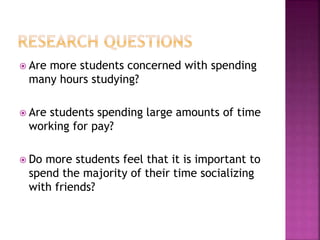
 Are more students concerned with spending
many hours studying?
 Are students spending large amounts of time
working for pay?
 Do more students feel that it is important to
spend the majority of their time socializing
with friends?
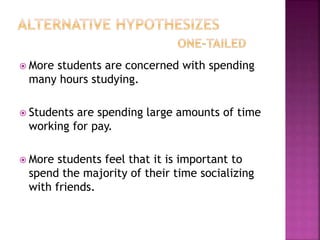
 More students are concerned with spending
many hours studying.
 Students are spending large amounts of time
working for pay.
 More students feel that it is important to
spend the majority of their time socializing
with friends.
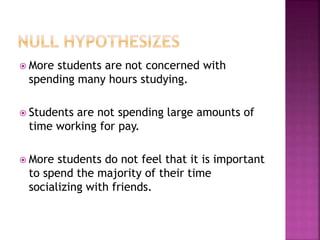
 More students are not concerned with
spending many hours studying.
 Students are not spending large amounts of
time working for pay.
 More students do not feel that it is important
to spend the majority of their time
socializing with friends.
>20 Hours
0 Hours
1-5 Hours
16-20 Hours
6-15 Hours
53%
31%
11%
3%
3%
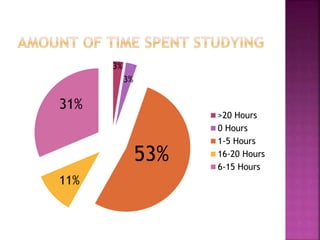
According to the data given, 53%
of students spend 1-5 hours
studying. With 31% of students
committing 6-15 hours.
The least amount of hours
committed to studying is tied at
3% by 20+ hours, and 0 hours.
>20 Hours
0 Hours
1-5 Hours
16-20 Hours
6-15 Hours
12%
27%
33%
16% 13%
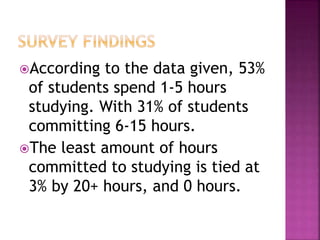
In the survey the largest amount of
students, worked 6–15 hours,
consisting of 33% of the population.
Closely following were students who
didn’t work at all, with 27% of the
population
>20 Hours
0 Hours
1-5 Hours
16-20 Hours
6-15 Hours
12%
41%
25%
21%
1%
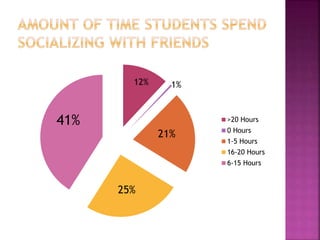
41% of the sample population say
that they spend 6-15 hours
socializing with their friends
While only 1% confess to not
spending any time with friends
 I think that by using the data given it is safe
to say that administrators do not need to be
overly worried about this class of students.
 They are able to balance their
responsibilities of studying, and working for
pay while still maintaining a social life which
is so important to the college experience.
Ind stat presentation

Ind stat presentation

  • 1.
  • 2.
     Survey conductedby: Higher Education Research Institute  Purpose of the survey: to study the change in students activities and behaviors throughout their first year.  Information given in a article by Jeffery R. Young published in The Chronicle of Higher Education.  “Freshmen Adjust to College Socially but Struggle Academically, Survey Finds.”
  • 3.
     Studying/ doinghomework  Socializing with friends  Talking with teachers outside of class  Participating in sports  Exercising  Partying  Working for pay  Watching TV  Playing games  Using the internet
  • 4.
     Are morestudents concerned with spending many hours studying?  Are students spending large amounts of time working for pay?  Do more students feel that it is important to spend the majority of their time socializing with friends?
  • 5.
     More studentsare concerned with spending many hours studying.  Students are spending large amounts of time working for pay.  More students feel that it is important to spend the majority of their time socializing with friends.
  • 6.
     More studentsare not concerned with spending many hours studying.  Students are not spending large amounts of time working for pay.  More students do not feel that it is important to spend the majority of their time socializing with friends.
  • 7.
    >20 Hours 0 Hours 1-5Hours 16-20 Hours 6-15 Hours 53% 31% 11% 3% 3%
  • 8.
    According to thedata given, 53% of students spend 1-5 hours studying. With 31% of students committing 6-15 hours. The least amount of hours committed to studying is tied at 3% by 20+ hours, and 0 hours.
  • 9.
    >20 Hours 0 Hours 1-5Hours 16-20 Hours 6-15 Hours 12% 27% 33% 16% 13%
  • 10.
    In the surveythe largest amount of students, worked 6–15 hours, consisting of 33% of the population. Closely following were students who didn’t work at all, with 27% of the population
  • 11.
    >20 Hours 0 Hours 1-5Hours 16-20 Hours 6-15 Hours 12% 41% 25% 21% 1%
  • 12.
    41% of thesample population say that they spend 6-15 hours socializing with their friends While only 1% confess to not spending any time with friends
  • 13.
     I thinkthat by using the data given it is safe to say that administrators do not need to be overly worried about this class of students.  They are able to balance their responsibilities of studying, and working for pay while still maintaining a social life which is so important to the college experience.