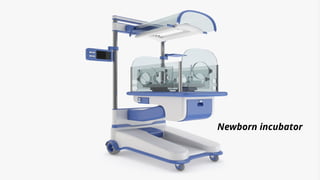
The document discusses the function of newborn incubators in monitoring and maintaining clinical parameters for preterm infants and those with specific birth conditions. It details various pathologies such as intraventricular hemorrhage and periventricular leukomalacia that necessitate the use of incubators and outlines the principles of operation including temperature, light, oxygenation, and humidity control. Additionally, it highlights the challenges of preventing infections and the importance of using intelligent systems for early detection in neonatal intensive care units.

![1- Intraventricular hemorrhage (IVH)
Intraventricular hemorrhage (IVH) is a common
cause of illness in newborn infants, primarily
occurring during the third day of birth and
sometimes before delivery, with machine
learning techniques potentially improving early
detection[1,2].
Main pathological conditions requiring the use of NICU incubators](https://image.slidesharecdn.com/incubator-241225090247-f65e1a92/85/incubator-and-it-components-in-simple-pptx-4-320.jpg)
![MAIN PATHOLOGICAL CONDITIONS REQUIRING THE
USE OF NICU INCUBATORS
2- Periventricular leukomalacia (PVL)
Premature infants with a birth weight
below 1500g develop PVL, a disease
causing white matter near cerebral
ventricles to die. It is caused by oxygen
and CO2 variations during delivery and
birth. Researchers propose techniques
to predict PVL in neonates[4,5]](https://image.slidesharecdn.com/incubator-241225090247-f65e1a92/85/incubator-and-it-components-in-simple-pptx-5-320.jpg)
![MAIN PATHOLOGICAL CONDITIONS REQUIRING
THE USE OF NICU INCUBATORS
4-Nosocomial Infection
Infections are the leading cause of infant mortality and illness, affecting 45% of infants
born before 25-28 weeks gestation in NICU incubators. Identifying these infections
early is challenging due to advanced symptoms. Few intelligent systems exist[6].
5- Pneumothorax
Pneumothorax is a condition where air or gas accumulates during inhaling and
exhaling, affecting 1-2% of infants. The pleural cavity, a fluid-filled space, surrounds the
lungs and moves when inhaled or exhaled, emitted fluid for lung lubrication.
MAIN PATHOLOGICAL CONDITIONS REQUIRING THE
USE OF NICU INCUBATORS](https://image.slidesharecdn.com/incubator-241225090247-f65e1a92/85/incubator-and-it-components-in-simple-pptx-6-320.jpg)
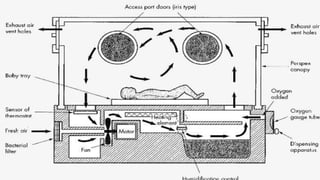
![Principles of Incubation
Incubators for babies all operate on the
same concept.
Over a water container and a heating
element, filtered ambient air is blown by a
fan.Additional oxygen can be added to the
air using a control valve.Along with the
infant, the heated, enriched, and moistened
air now flows into the cabinet above.Vent
holes allow some of the air to escape from
the cabinet, while other parts return to the
air processing system[8].](https://image.slidesharecdn.com/incubator-241225090247-f65e1a92/85/incubator-and-it-components-in-simple-pptx-7-320.jpg)
![1.Temperature
Infants struggle with low thermal regulation, leading to preterm birth.
Improper thermoregulation can cause babies to lose heat, leading to
hypothermia and increased risk of health problems and death. To
prevent heat loss, dry the baby, wrap it in clean cloth, and cover the
head.
PARAMETER AFFECTING THE INCUBATOR[9]](https://image.slidesharecdn.com/incubator-241225090247-f65e1a92/85/incubator-and-it-components-in-simple-pptx-8-320.jpg)

![REFERENCES
• [1] J. Nates, Icu admission, discharge, and triage guidelines:A framework to enhance clinical operations, development
of institutional policies, and further research, Critical Care Medicine 44 (2016) 1553–1602,.
doi:10.1097/CCM.0000000000001856.
• [2] A. Ehteshami, F. Sadoughi, M.Ahmadi, P. Kashefi, Intensive care information system impacts,Acta Informatica
Medica 21 (2013) 185,. doi:10.5455/AIM.2013.21.185-191
• [3] D. Szpecht, M. Szymankiewicz, I. Nowak, J. Gadzinowski, Intraventricular hemorrhage in neonates born before 32
weeks of gestation—retrospective analysis of risk factors, Child’s Nervous System 32 (2016) 1399–1404,.
doi:10.1007/S00381-016-3127-X/TABLES/1
• [4] A. Jalali,A. F. Simpao, J.A. Gálvez, D. J. Licht, C. Nataraj, Prediction of periventricular leukomalacia in neonates after
cardiac surgery using machine learning algorithms, Journal of medical systems 42 (2018) 1–11.
• [5] H. Khan, F. Baig, R. Mehboob, Nosocomial infections: Epidemiology, prevention, control and surveillance,Asian
Pacific Journal ofTropical Biomedicine 7 (2017) 478–482,.
• [6]J.-F. Hsu,Y.-F. Chang, H.-J. Cheng, C.Yang, C.-Y. Lin, S.-M. Chu, H.-R. Huang, M.-C. Chiang, H.-C.Wang, M.-H.Tsai,
Machine learning approaches to predict in-hospital mortality among neonates with clinically suspected sepsis in the
neonatal intensive care unit, Journal of Personalized Medicine 11 (2021) 695.
• [7] S. Edwardson, C. Cairns, Nosocomial infections in the icu,Anaesthesia Intensive Care Medicine 20 (2019) 14–18,.
doi:10.1016/J.MPAIC.2018.11.004.
• [8] Paternain Soler, Carlos. "Prototyping a closed loop control system for a neonatal incubator." (2009).
• [9] Mittal, Hitu, Lini Mathew, and Ashish Gupta. "Design and development of an infant incubator for controlling
multiple parameters." International Journal of emerging trends in electrical and electronics 11.5 (2015): 65-72.](https://image.slidesharecdn.com/incubator-241225090247-f65e1a92/85/incubator-and-it-components-in-simple-pptx-13-320.jpg)


![APPROACH TO FEVER IN PEDIATRICS[1].pptTT](https://cdn.slidesharecdn.com/ss_thumbnails/approachtofeverinpediatrics1-260125081456-d559e079-thumbnail.jpg?width=640&height=640&fit=bounds)


![Cells and Organs of immune system [Autosaved].pptx](https://cdn.slidesharecdn.com/ss_thumbnails/cellsandorgansofimmunesystemautosaved-260123152717-ea0cb261-thumbnail.jpg?width=640&height=640&fit=bounds)

![Hypothalamus short notes on location, function and disorders by Dr. Neha [PT]...](https://cdn.slidesharecdn.com/ss_thumbnails/hypothalamusbydr-260124142231-2b48143d-thumbnail.jpg?width=640&height=640&fit=bounds)


