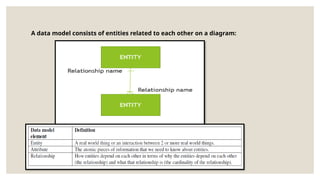
Data modeling is the process of creating a data model to define and analyze data requirements for information systems, involving collaboration between data modelers and business stakeholders. A data model conceptualizes data structures, relationships, and business rules, and is categorized into conceptual, logical, and physical types. It aids in standardizing data management, enhancing communication across functional areas, and supporting business processes.
![Introduction
◦ Process of creating a data model for an information system by
applying formal data modeling techniques.
◦ Process used to define and analyze data requirements needed
to support the business processes.
◦ Therefore, the process of data modeling involves professional
data modelers working closely with business stakeholders, as
well as potential users of the information system[1].](https://image.slidesharecdn.com/datamodeling-241227103608-a82bea5e/85/data-modelingEntity-Relationship-E-R-Models-UML-unified-modeling-language-pptx-2-320.jpg)
![◦ A data model provides a way to describe the design of
a database at the physical, logical and view levels.
◦ There are three different types of data models
produced while progressing from requirements to the
actual database to be used for the information
system[2].
What is Data Model](https://image.slidesharecdn.com/datamodeling-241227103608-a82bea5e/85/data-modelingEntity-Relationship-E-R-Models-UML-unified-modeling-language-pptx-4-320.jpg)
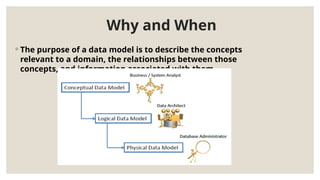
![◦ Conceptual: describes WHAT the system contains
◦ Logical: describes HOW the system will be implemented,
regardless of the DBMS
◦ Physical: describes HOW the system will be implemented using a
specific DBMS [3]
Different Data Models](https://image.slidesharecdn.com/datamodeling-241227103608-a82bea5e/85/data-modelingEntity-Relationship-E-R-Models-UML-unified-modeling-language-pptx-5-320.jpg)
![◦ Used to model data in a standard, consistent, predictable
manner in order to manage it as a resource.
◦ To have a clear picture of the base data that your business
needs
◦ To identify missing and redundant base data [4].
Why and When](https://image.slidesharecdn.com/datamodeling-241227103608-a82bea5e/85/data-modelingEntity-Relationship-E-R-Models-UML-unified-modeling-language-pptx-13-320.jpg)
![◦ To Establish a baseline for communication across
functional boundaries within your organization
◦ Provides a basis for defining business rules
◦ Makes it cheaper, easier, and faster to upgrade your IT
solutions[5].
Why and When](https://image.slidesharecdn.com/datamodeling-241227103608-a82bea5e/85/data-modelingEntity-Relationship-E-R-Models-UML-unified-modeling-language-pptx-14-320.jpg)
![References
◦ [1] Pedersen, Torben Bach, and Christian S. Jensen. "Multidimensional data modeling for
complex data." Proceedings 15th International Conference on Data Engineering (Cat. No.
99CB36337). IEEE, 1999.
◦ [2] Kitchenham, Barbara A., Robert T. Hughes, and Stephen G. Linkman. "Modeling
software measurement data." IEEE Transactions on Software Engineering 27.9 (2001): 788-
804.
◦ [3] Chebotko, Artem, Andrey Kashlev, and Shiyong Lu. "A big data modeling methodology
for Apache Cassandra." 2015 IEEE International Congress on Big Data. IEEE, 2015.
◦ [4] Peckham, Joan, and Fred Maryanski. "Semantic data models." ACM Computing Surveys
(CSUR) 20.3 (1988): 153-189.
◦ [5] Lv, Zhihan, et al. "Next-generation big data analytics: State of the art, challenges, and
future research topics." IEEE Transactions on Industrial Informatics 13.4 (2017): 1891-1899.](https://image.slidesharecdn.com/datamodeling-241227103608-a82bea5e/85/data-modelingEntity-Relationship-E-R-Models-UML-unified-modeling-language-pptx-15-320.jpg)



![[DSC Europe 25] Milovan Jovicic - Beyond AI's Reach: The Enduring Value of Ev...](https://cdn.slidesharecdn.com/ss_thumbnails/pyeij0hurgwq5jugmtnv-2-milovan-jovicic-beyond-ais-reach-the-enduring-value-of-evergreen-design-v2-260120105856-d6ee57e5-thumbnail.jpg?width=640&height=640&fit=bounds)


![[DSC Europe 25] Milos Belcevic - Product Professional's Journey to Full-Stack...](https://cdn.slidesharecdn.com/ss_thumbnails/1zovd6fgsycdg4wvgvls-milos-belcevic-product-professionals-journey-to-full-stack-product-developer-260123083019-d993120d-thumbnail.jpg?width=640&height=640&fit=bounds)


![[DSC Europe 25] Bojan Banjac - AI is always right when it comes to the matter...](https://cdn.slidesharecdn.com/ss_thumbnails/syoxtqierpydwxm5srcb-4-bojan-banjac-ai-is-always-right-when-it-comes-to-the-matters-of-taste-260119101519-694ee7d7-thumbnail.jpg?width=640&height=640&fit=bounds)
![[DSC Europe 25] Marcos Heidemann - Beyond the Hype: Making AI Coding Assistan...](https://cdn.slidesharecdn.com/ss_thumbnails/eexkhvldrjsopspdjbur-marcos-heidemann-beyond-the-hype-getting-real-value-out-of-ai-assisted-coding-260121115910-7e9d41ec-thumbnail.jpg?width=640&height=640&fit=bounds)


