PREVENTION of SSIs
AUDIT TOOL INTRODUCTION
April 30, 2015
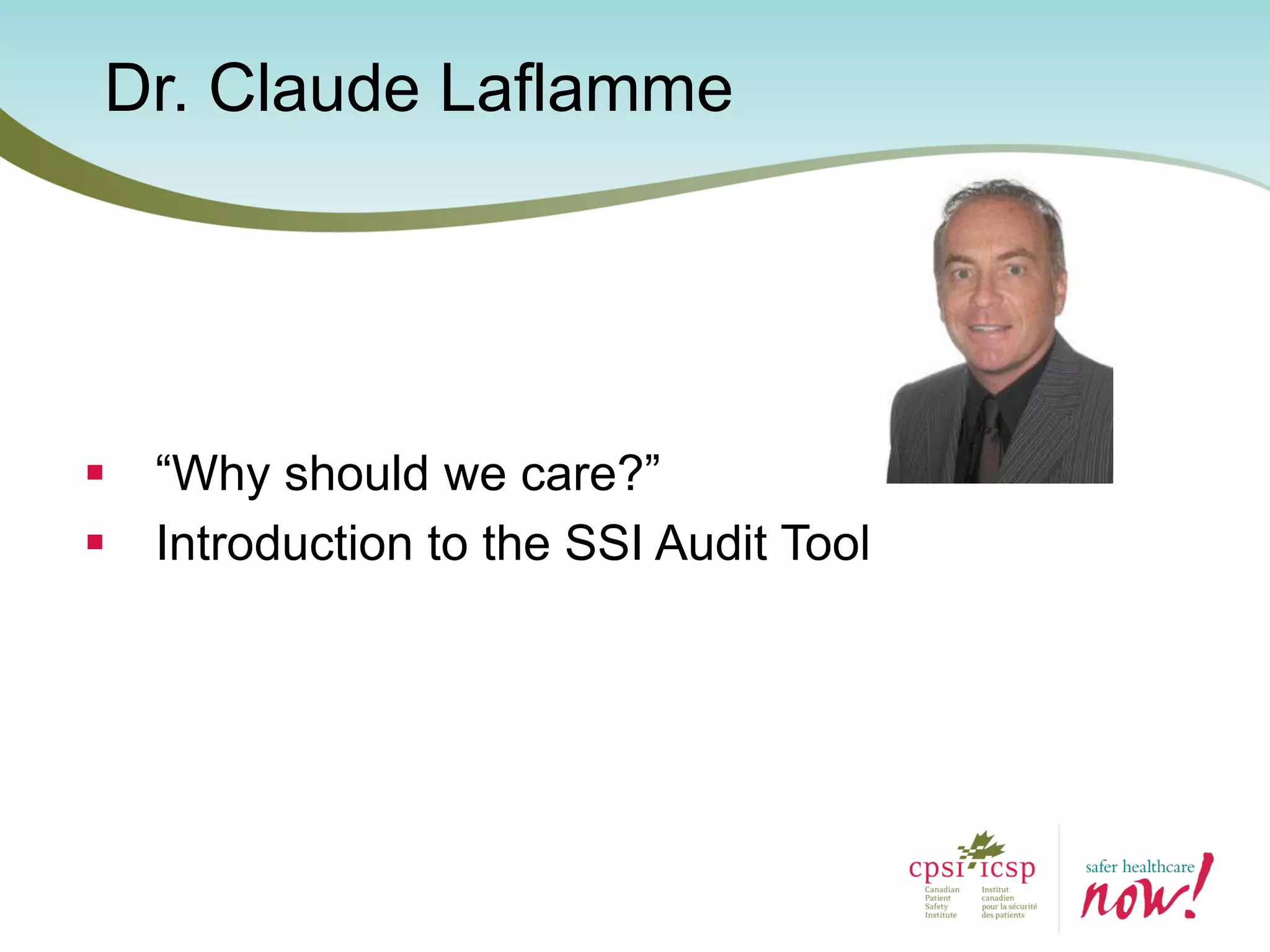
Dr. Claude Laflamme
Physician Lead for the Safer Healthcare Now! Surgical Site Infection Intervention
Director of Cardiac Anesthesia, Sunnybrook Health Science Centre, Toronto, ON
Assistant Professor, University of Toronto
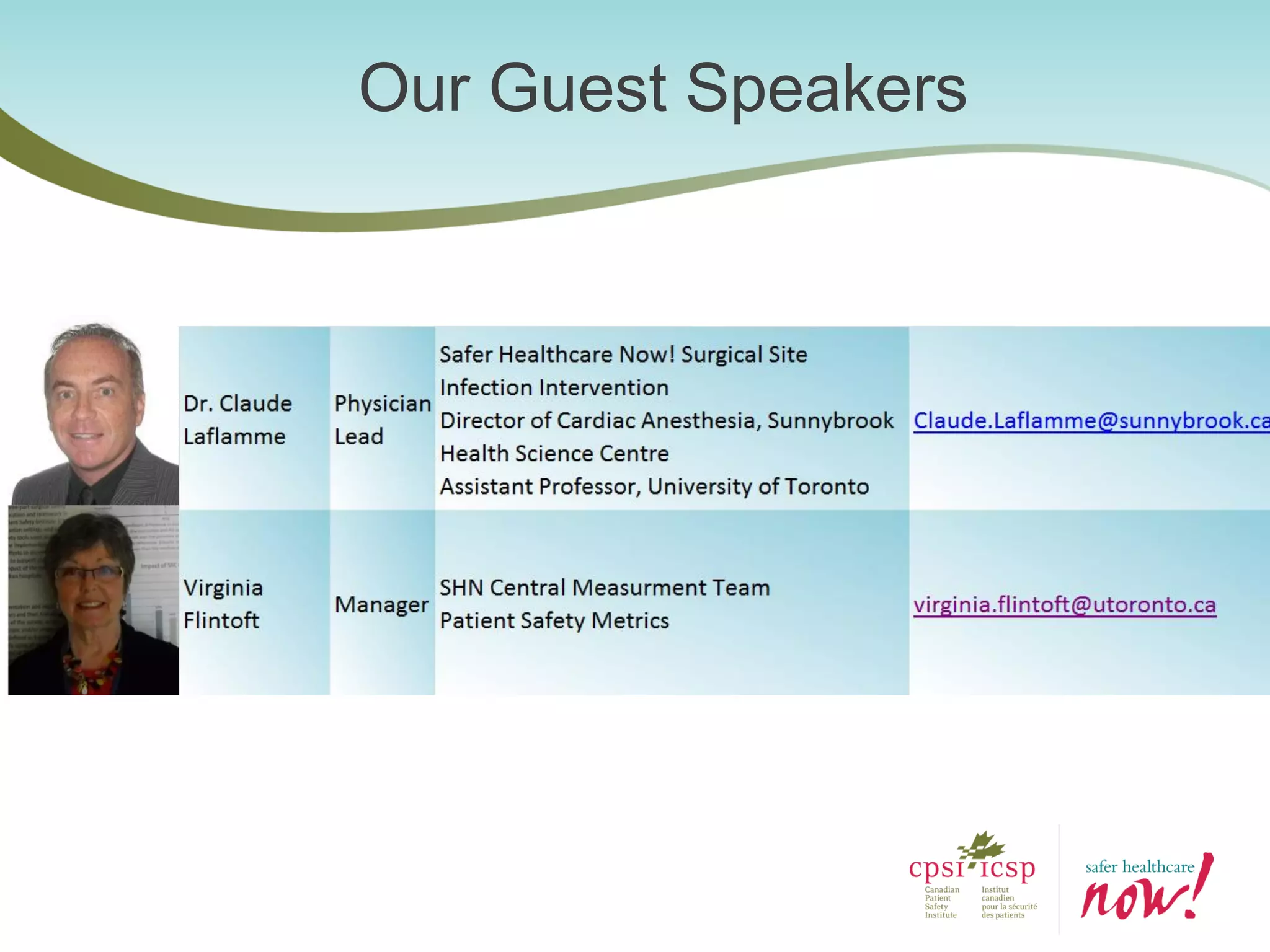
Virginia Flintoft MSc BN
Safer Healthcare Now! Manager, Central Measurement Team
 French slides available during presentation
 Links to:
a) English presentation slides and
b) English and French GSKs posted in chat box
 Interested in using new data collection form?
 Advance notice: SSI National Audit Fall 2015
Post questions in the chat box;
to “All Participants”
 Using a MAC computer?
Before we get started
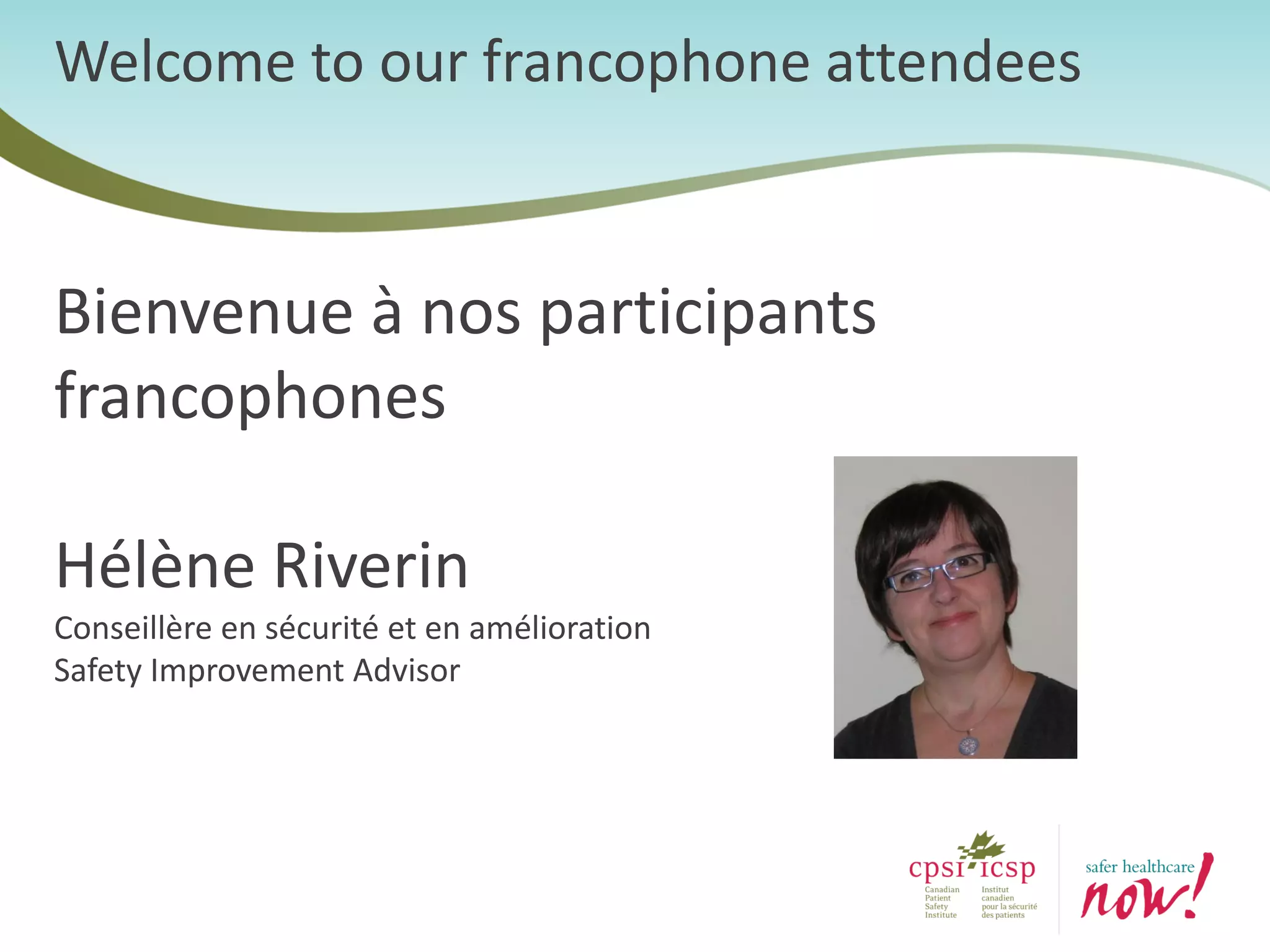
Welcome to our francophone attendees
Bienvenue à nos participants
francophones
Hélène Riverin
Conseillère en sécurité et en amélioration
Safety Improvement Advisor
Our Guest Speakers
Dr. Claude Laflamme
 “Why should we care?”
 Introduction to the SSI Audit Tool
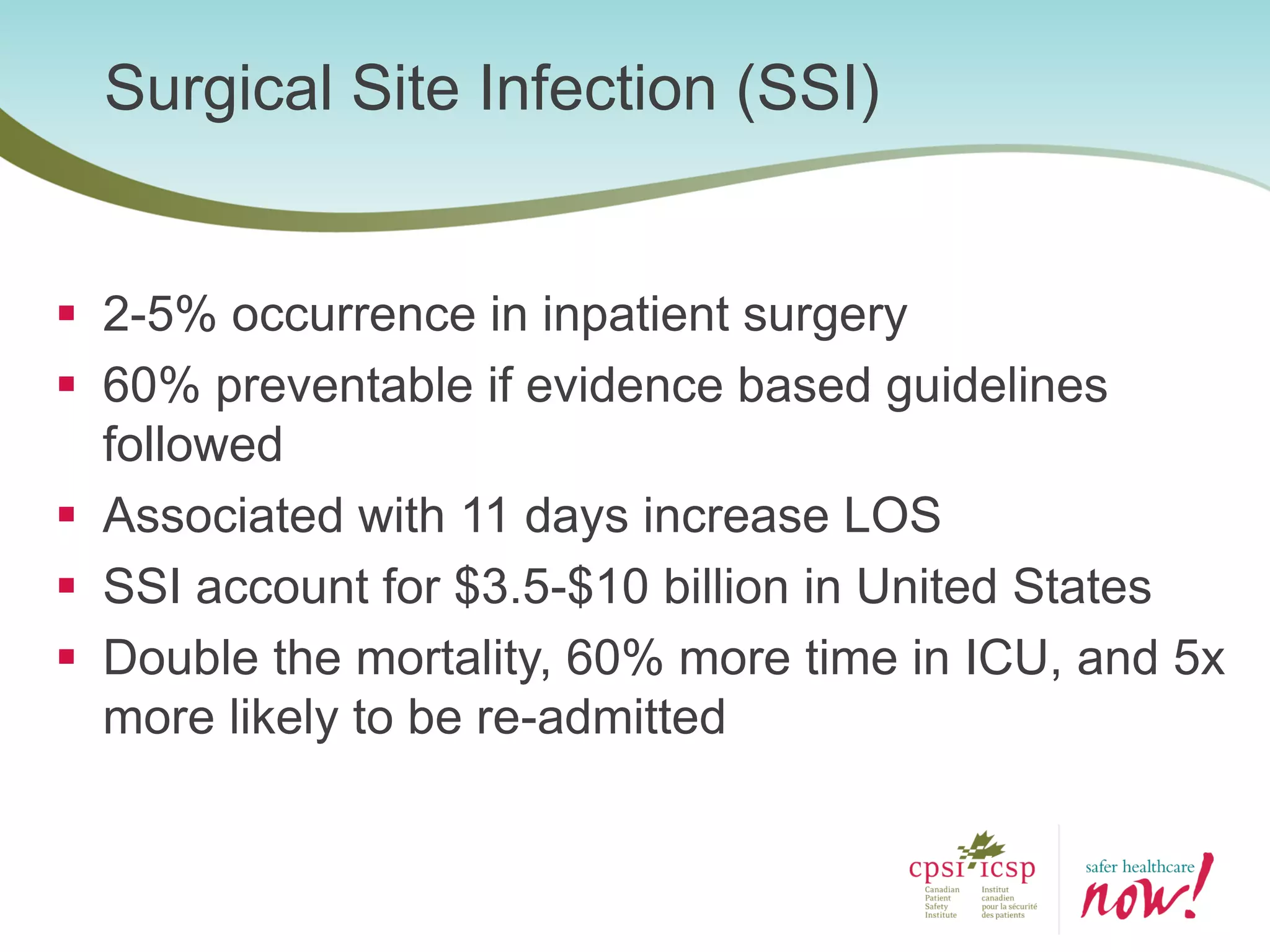
Surgical Site Infection (SSI)
 2-5% occurrence in inpatient surgery
 60% preventable if evidence based guidelines
followed
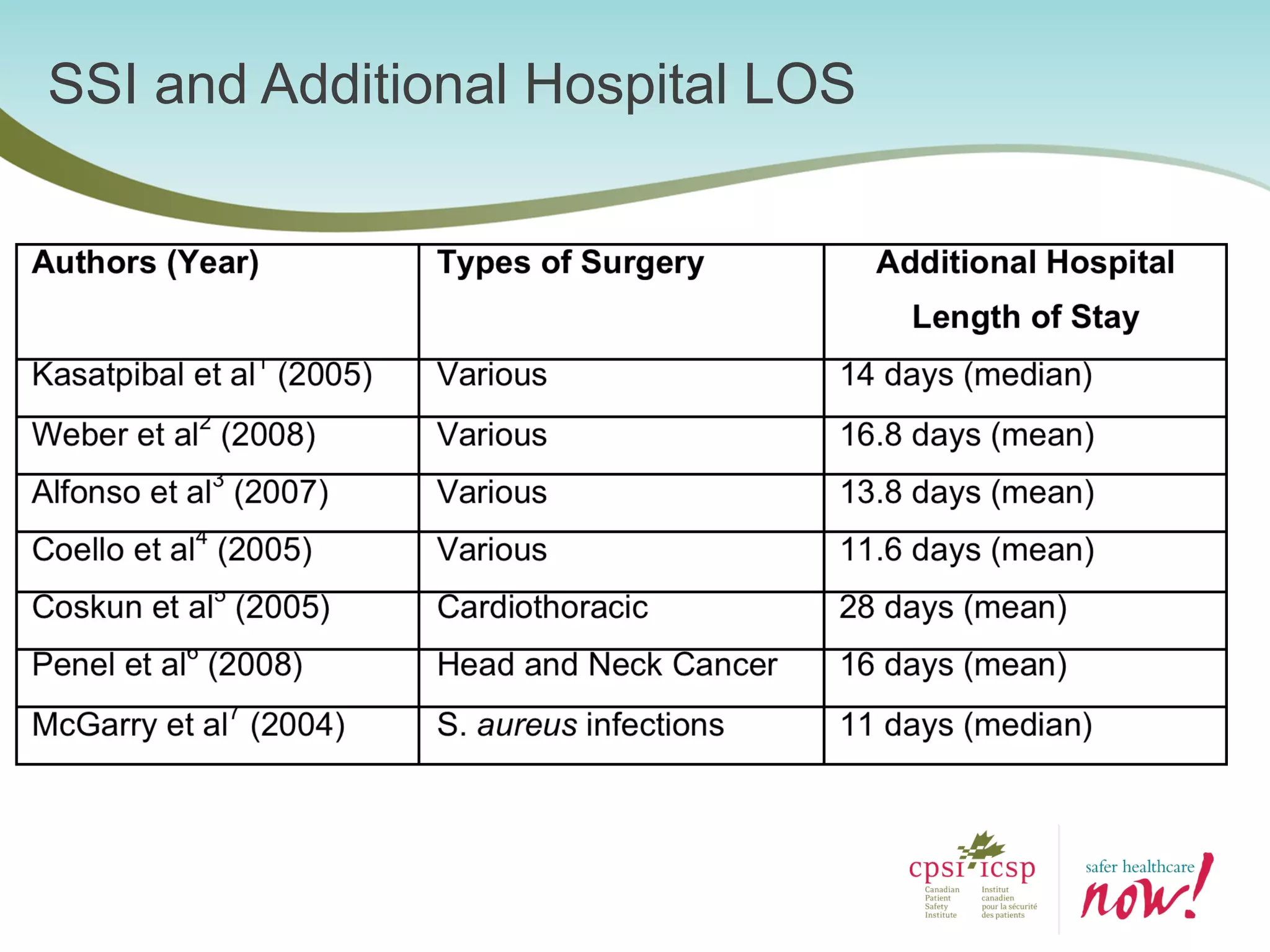
 Associated with 11 days increase LOS
 SSI account for $3.5-$10 billion in United States
 Double the mortality, 60% more time in ICU, and 5x
more likely to be re-admitted
SSI and Additional Hospital LOS
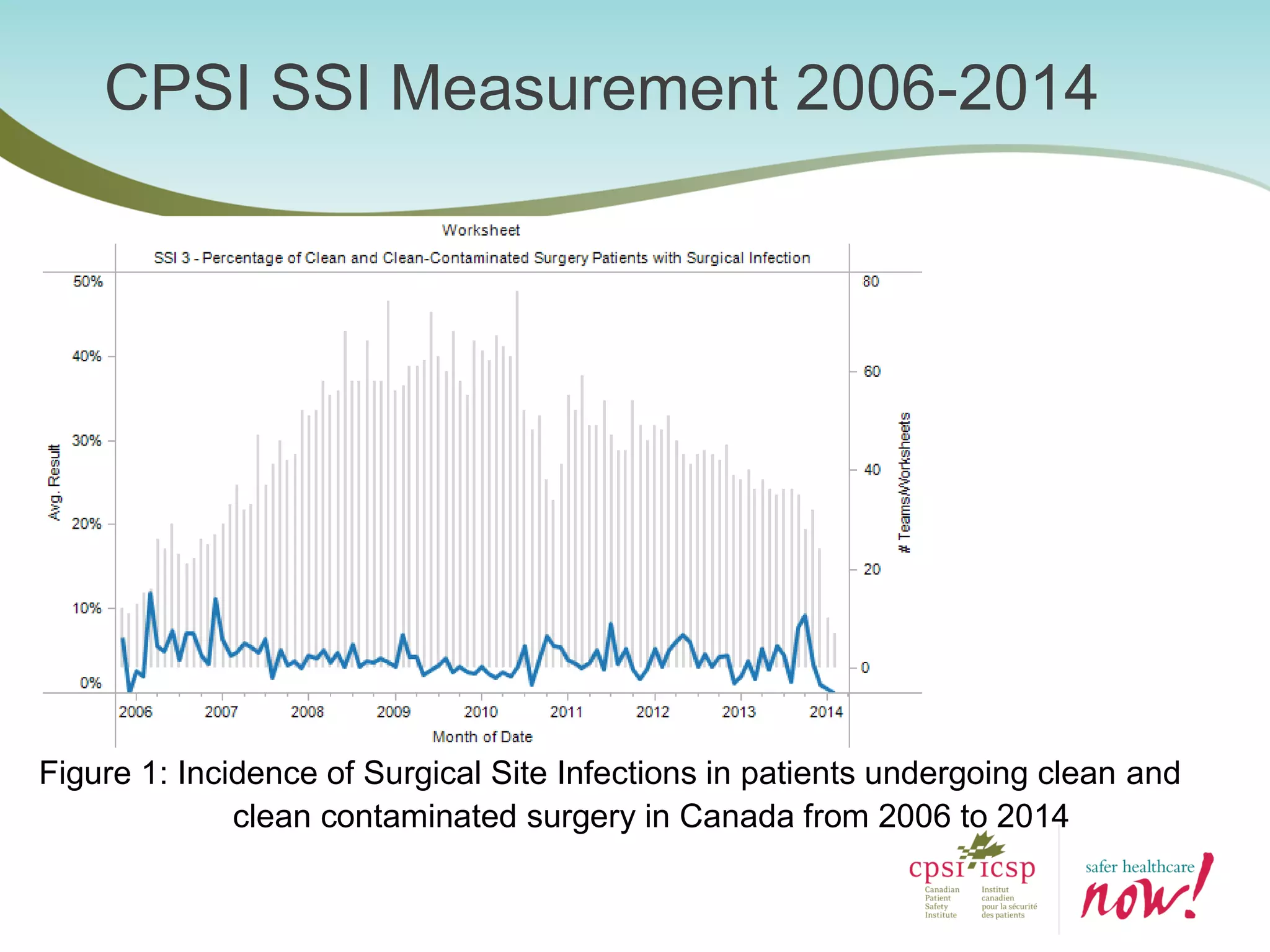
CPSI SSI Measurement 2006-2014
Figure 1: Incidence of Surgical Site Infections in patients undergoing clean and
clean contaminated surgery in Canada from 2006 to 2014
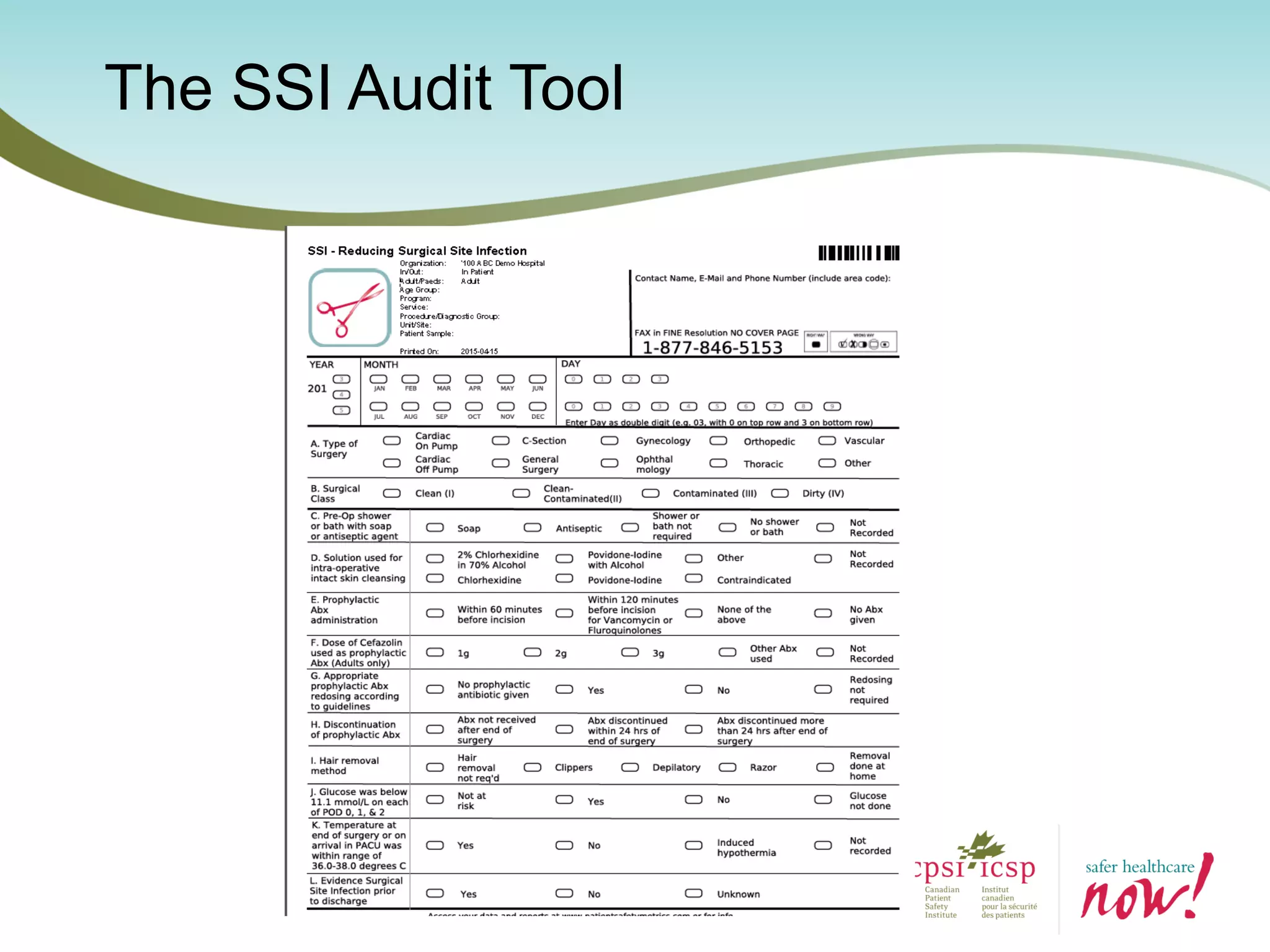
The SSI Audit Tool
The SSI Audit Tool
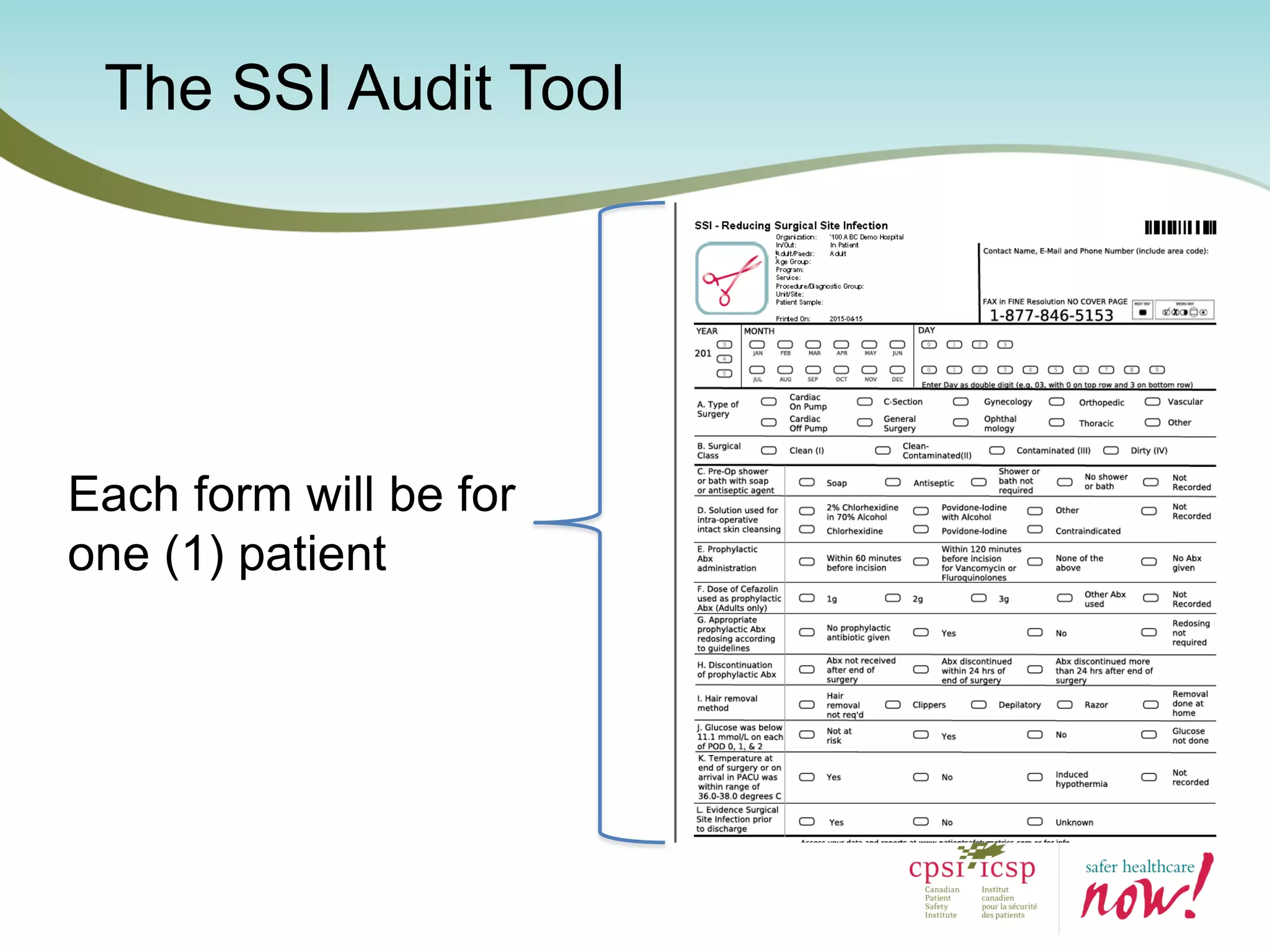
Each form will be for
one (1) patient
The SSI Audit Tool
Each question (A to L)
is one element of the
audit tool and rolls up
to an indicator
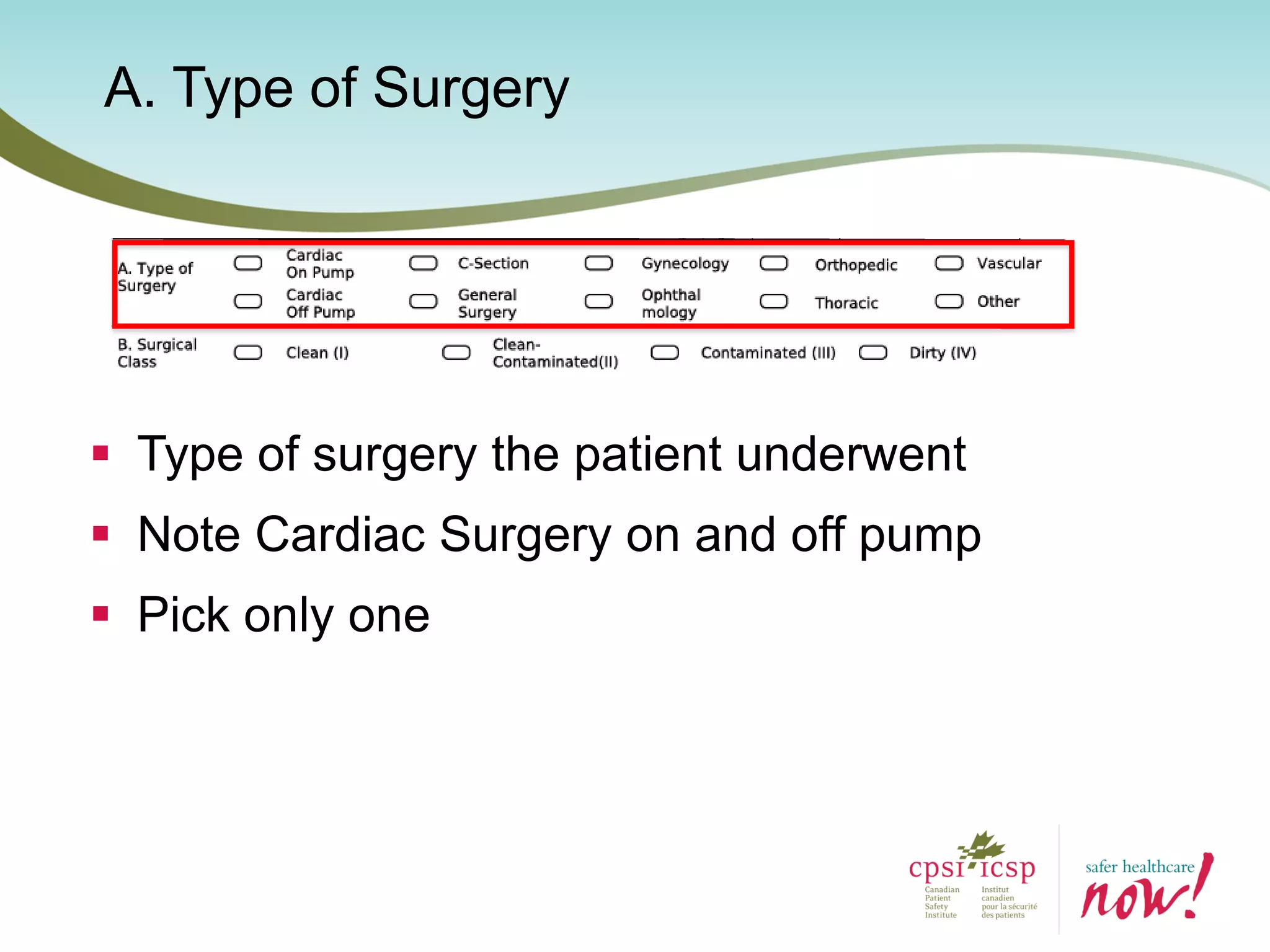
A. Type of Surgery
 Type of surgery the patient underwent
 Note Cardiac Surgery on and off pump
 Pick only one
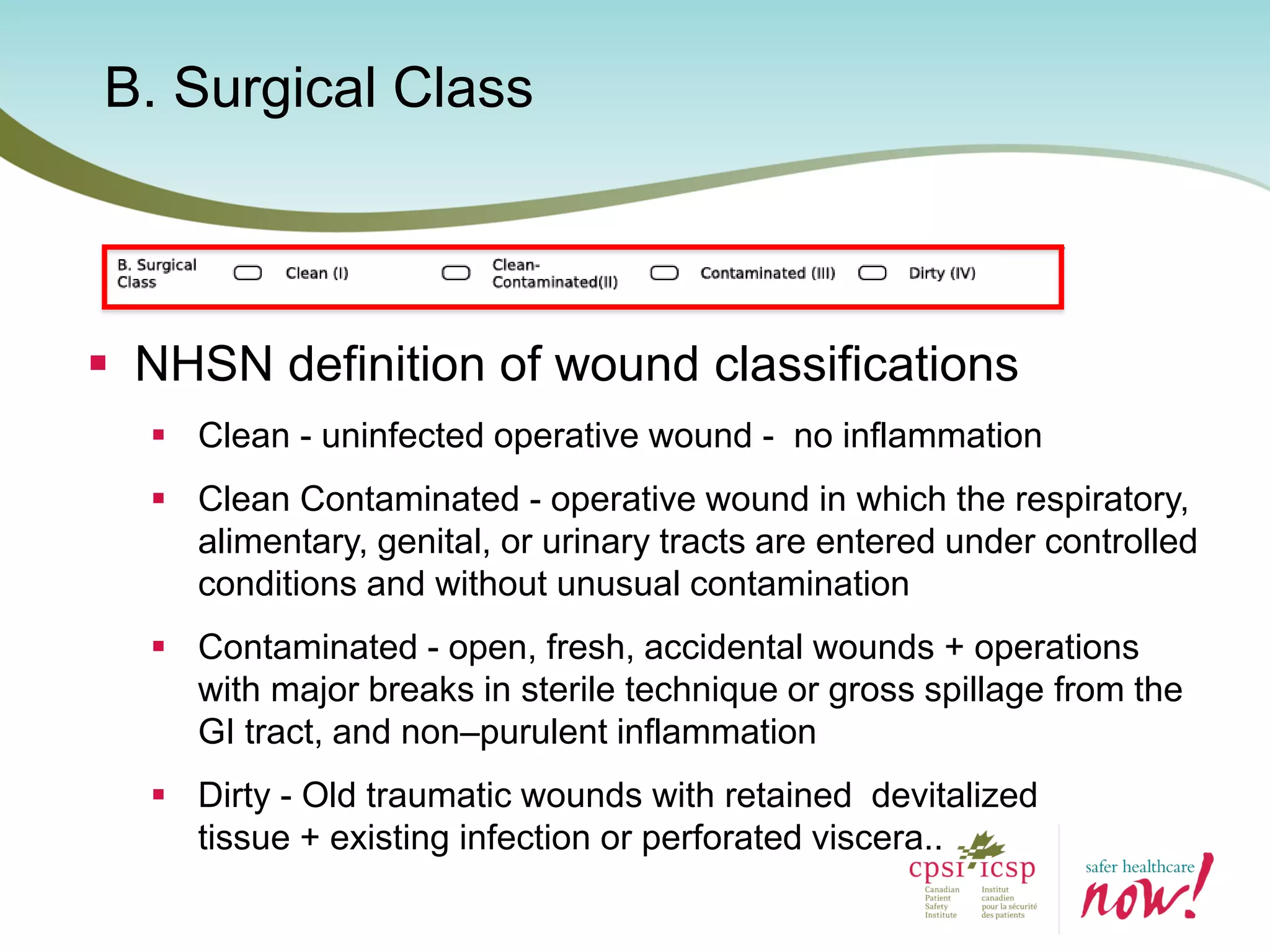
B. Surgical Class
 NHSN definition of wound classifications
 Clean - uninfected operative wound - no inflammation
 Clean Contaminated - operative wound in which the respiratory,
alimentary, genital, or urinary tracts are entered under controlled
conditions and without unusual contamination
 Contaminated - open, fresh, accidental wounds + operations
with major breaks in sterile technique or gross spillage from the
GI tract, and non–purulent inflammation
 Dirty - Old traumatic wounds with retained devitalized
tissue + existing infection or perforated viscera..
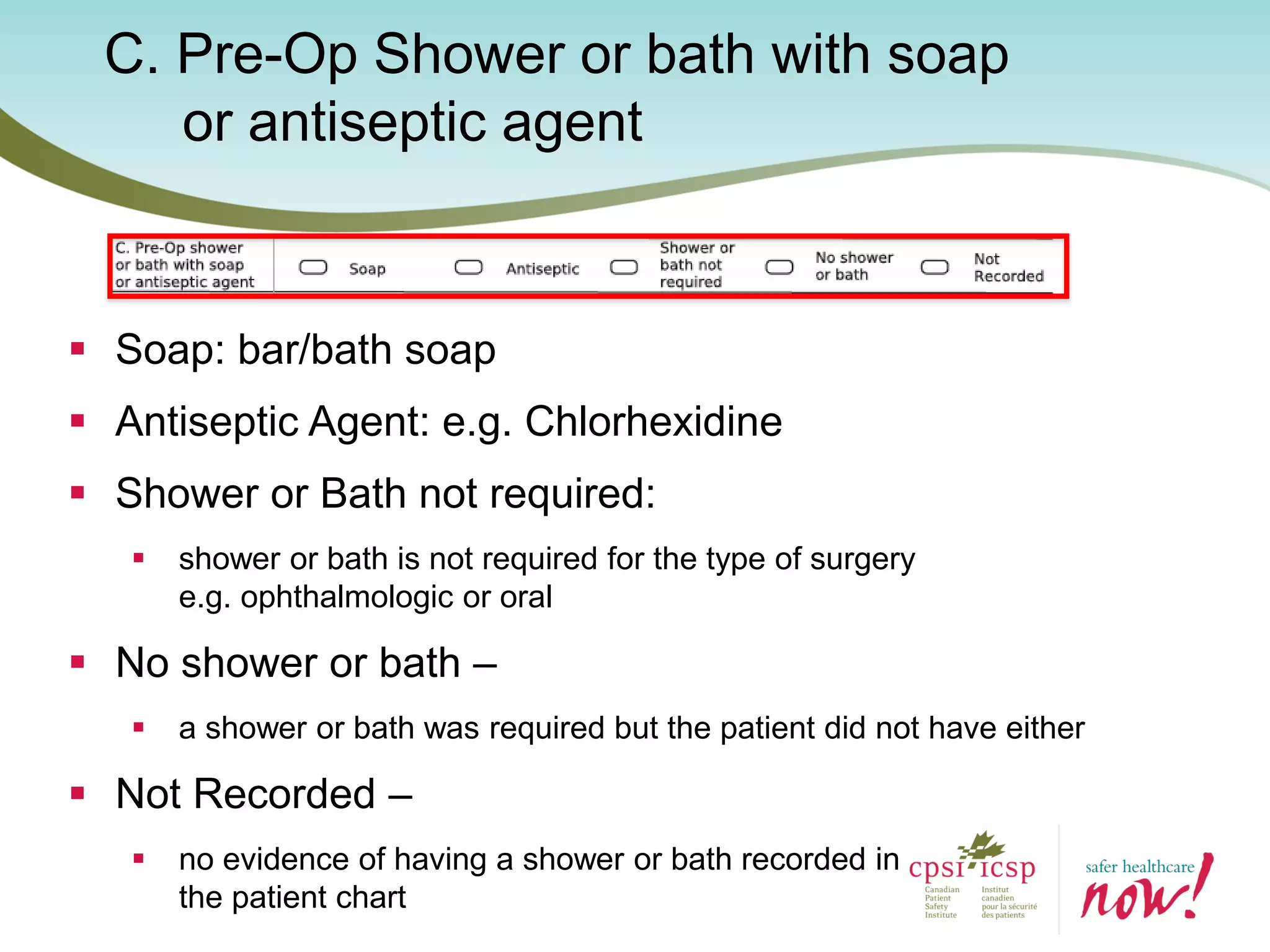
C. Pre-Op Shower or bath with soap
or antiseptic agent
 Soap: bar/bath soap
 Antiseptic Agent: e.g. Chlorhexidine
 Shower or Bath not required:
 shower or bath is not required for the type of surgery
e.g. ophthalmologic or oral
 No shower or bath –
 a shower or bath was required but the patient did not have either
 Not Recorded –
 no evidence of having a shower or bath recorded in
the patient chart
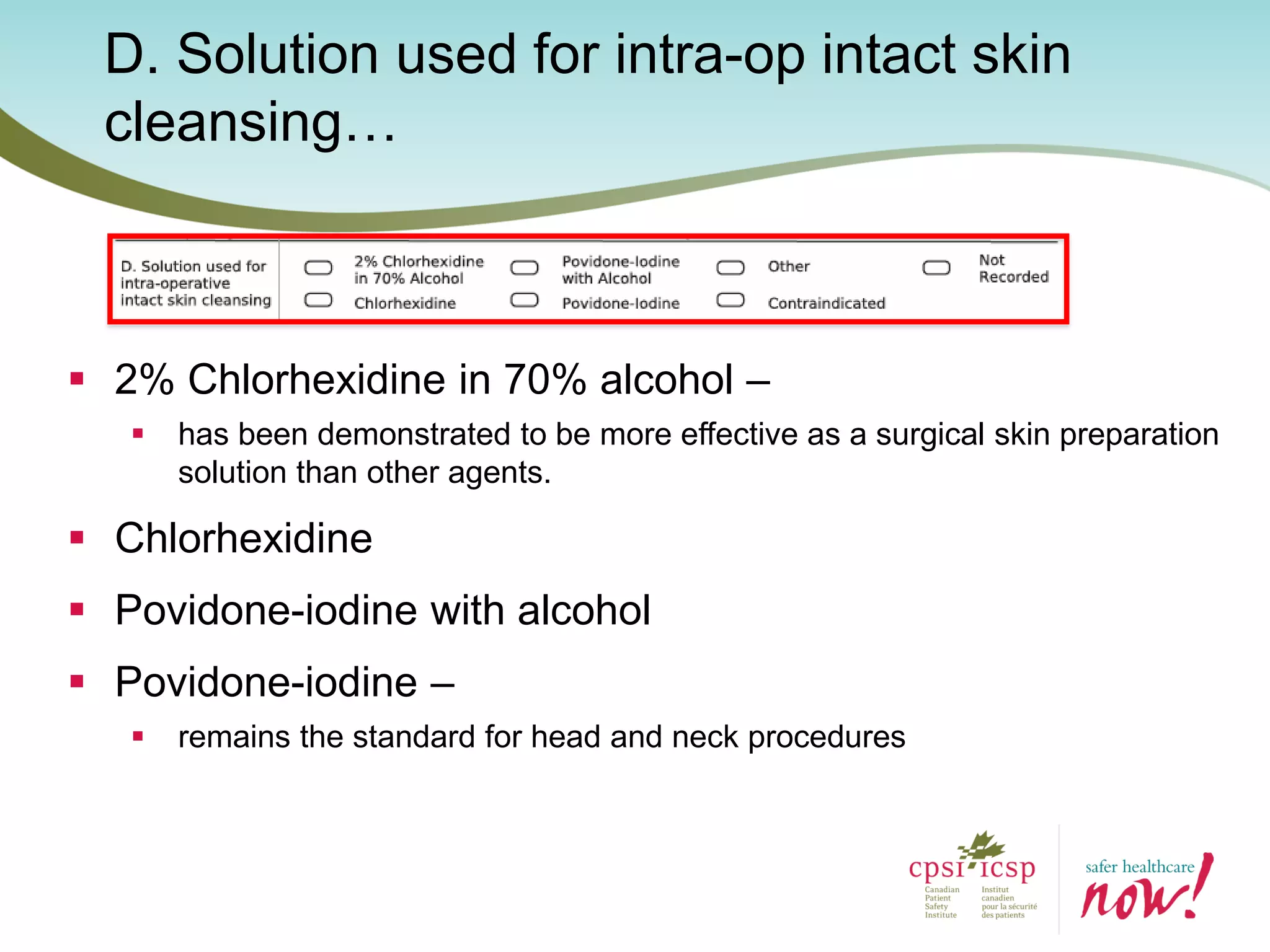
D. Solution used for intra-op intact skin
cleansing…
 2% Chlorhexidine in 70% alcohol –
 has been demonstrated to be more effective as a surgical skin preparation
solution than other agents.
 Chlorhexidine
 Povidone-iodine with alcohol
 Povidone-iodine –
 remains the standard for head and neck procedures
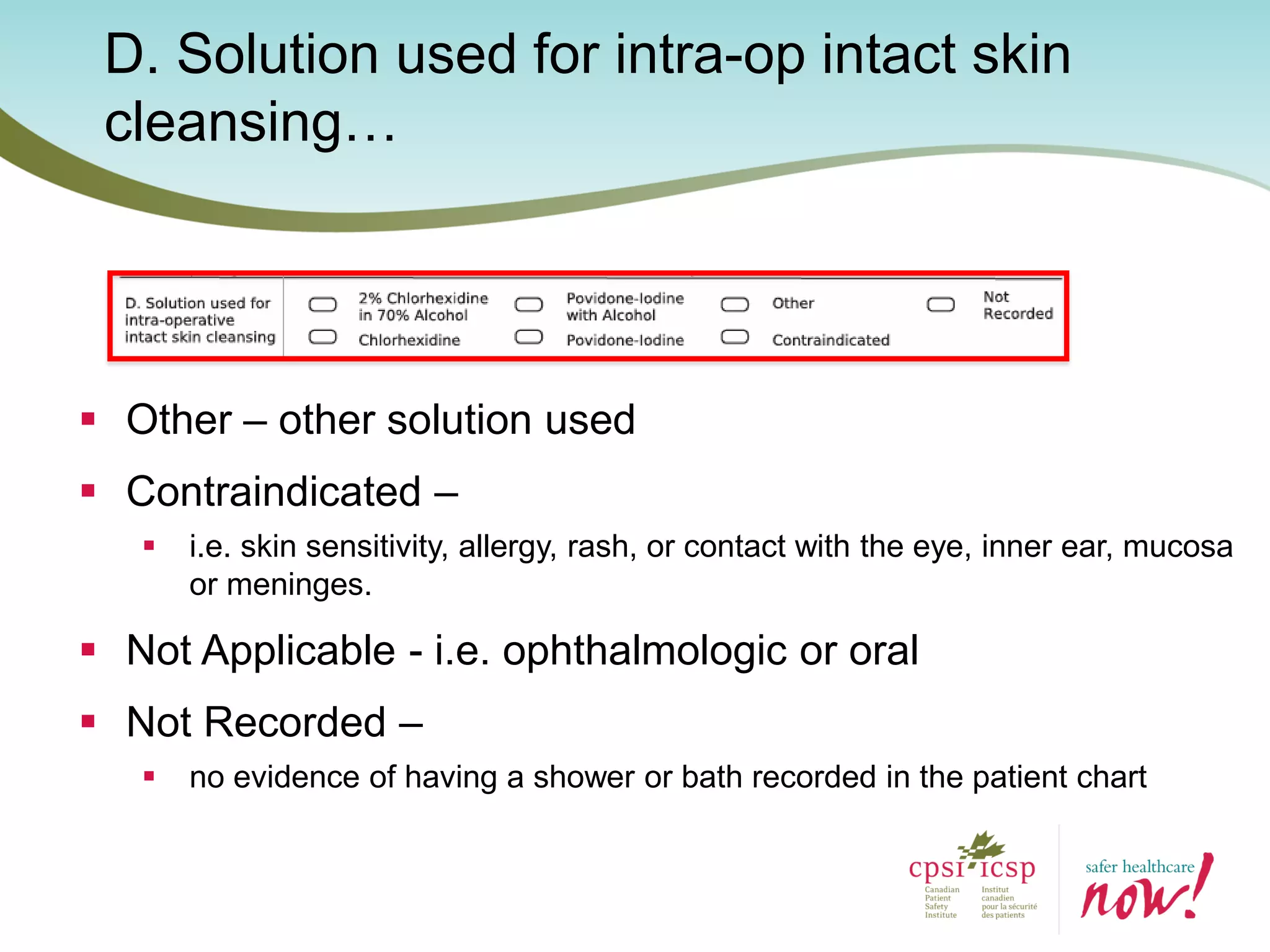
D. Solution used for intra-op intact skin
cleansing…
 Other – other solution used
 Contraindicated –
 i.e. skin sensitivity, allergy, rash, or contact with the eye, inner ear, mucosa
or meninges.
 Not Applicable - i.e. ophthalmologic or oral
 Not Recorded –
 no evidence of having a shower or bath recorded in the patient chart
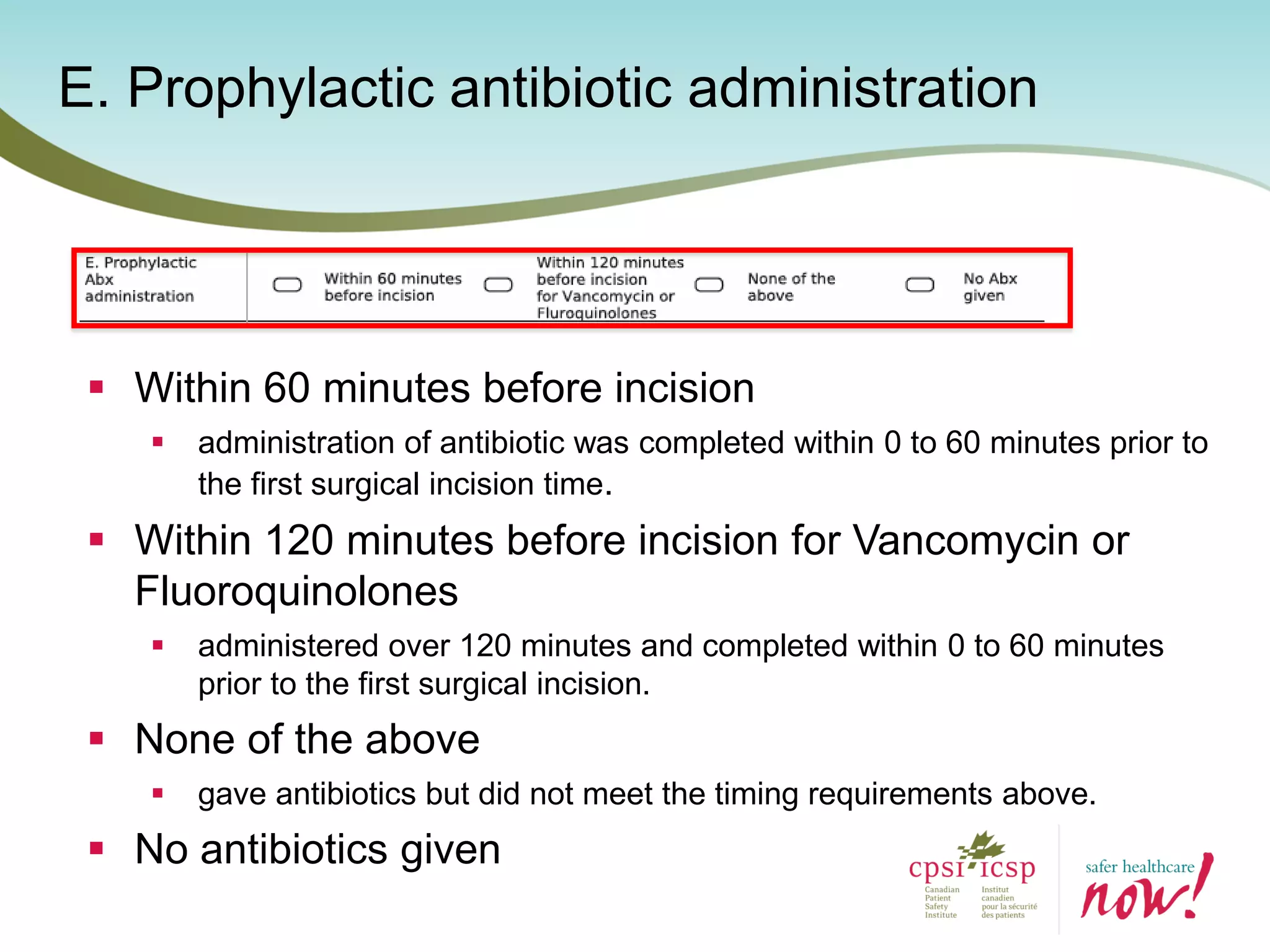
E. Prophylactic antibiotic administration
 Within 60 minutes before incision
 administration of antibiotic was completed within 0 to 60 minutes prior to
the first surgical incision time.
 Within 120 minutes before incision for Vancomycin or
Fluoroquinolones
 administered over 120 minutes and completed within 0 to 60 minutes
prior to the first surgical incision.
 None of the above
 gave antibiotics but did not meet the timing requirements above.
 No antibiotics given
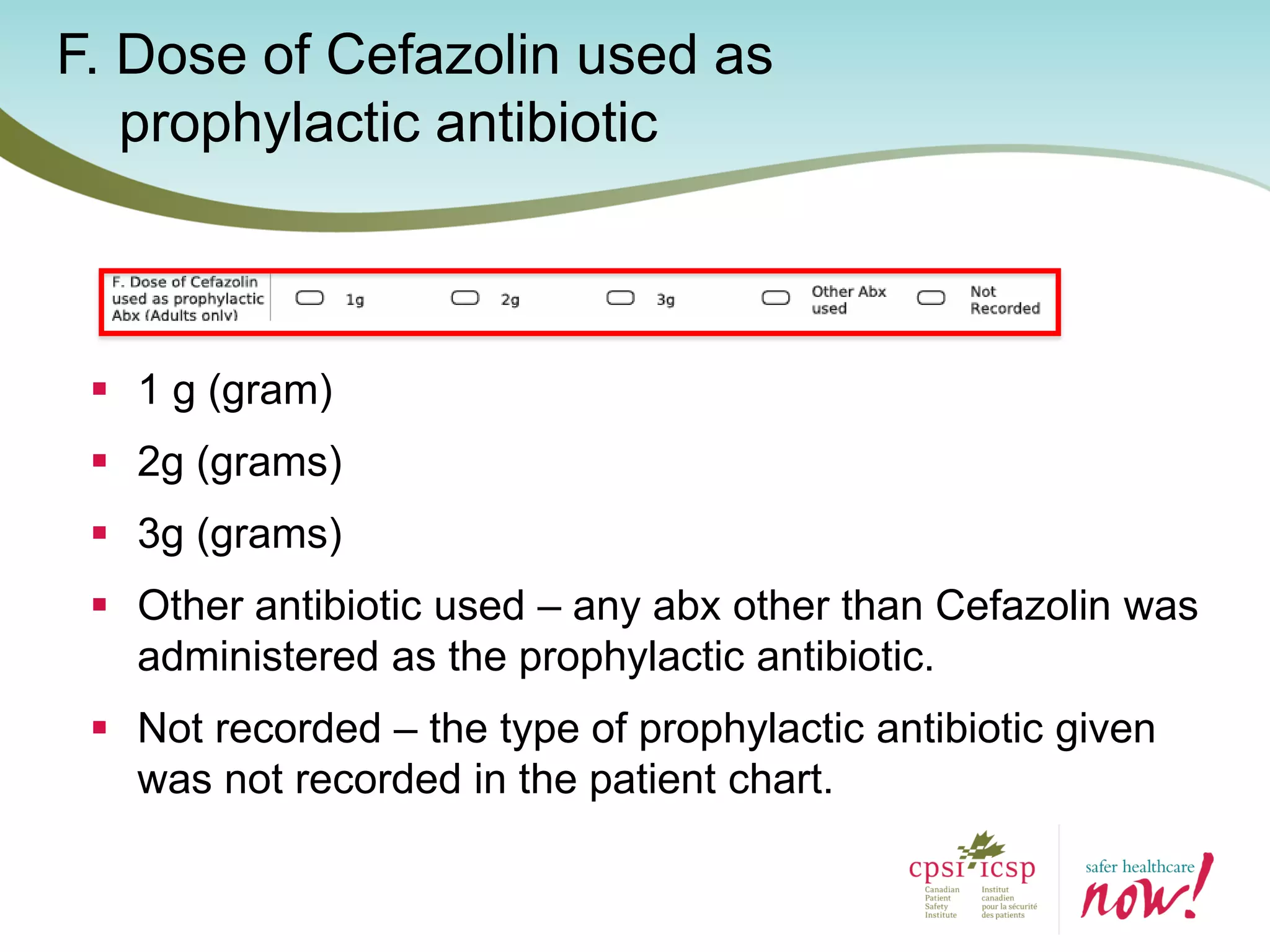
F. Dose of Cefazolin used as
prophylactic antibiotic
 1 g (gram)
 2g (grams)
 3g (grams)
 Other antibiotic used – any abx other than Cefazolin was
administered as the prophylactic antibiotic.
 Not recorded – the type of prophylactic antibiotic given
was not recorded in the patient chart.
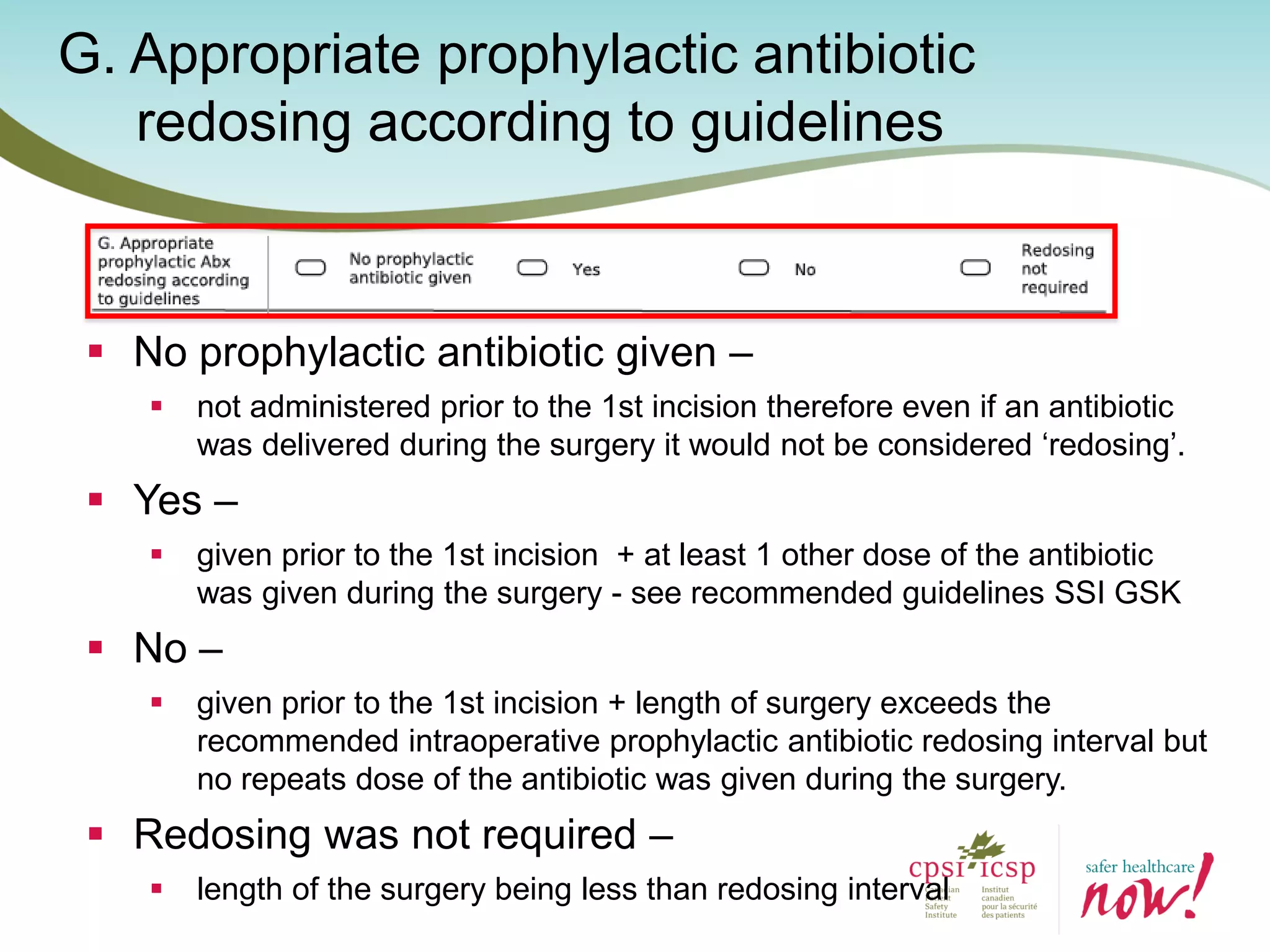
G. Appropriate prophylactic antibiotic
redosing according to guidelines
 No prophylactic antibiotic given –
 not administered prior to the 1st incision therefore even if an antibiotic
was delivered during the surgery it would not be considered ‘redosing’.
 Yes –
 given prior to the 1st incision + at least 1 other dose of the antibiotic
was given during the surgery - see recommended guidelines SSI GSK
 No –
 given prior to the 1st incision + length of surgery exceeds the
recommended intraoperative prophylactic antibiotic redosing interval but
no repeats dose of the antibiotic was given during the surgery.
 Redosing was not required –
 length of the surgery being less than redosing interval
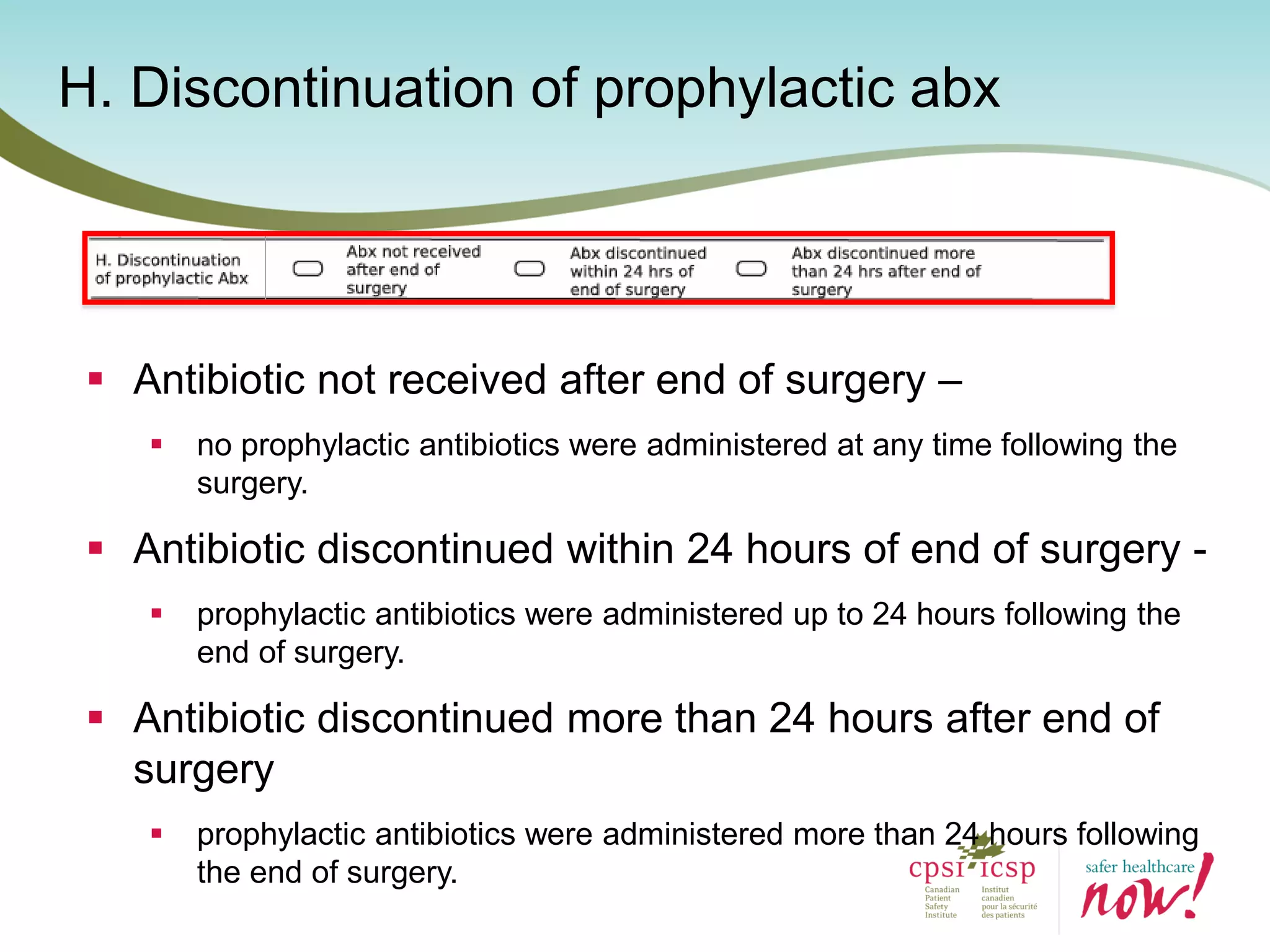
H. Discontinuation of prophylactic abx
 Antibiotic not received after end of surgery –
 no prophylactic antibiotics were administered at any time following the
surgery.
 Antibiotic discontinued within 24 hours of end of surgery -
 prophylactic antibiotics were administered up to 24 hours following the
end of surgery.
 Antibiotic discontinued more than 24 hours after end of
surgery
 prophylactic antibiotics were administered more than 24 hours following
the end of surgery.
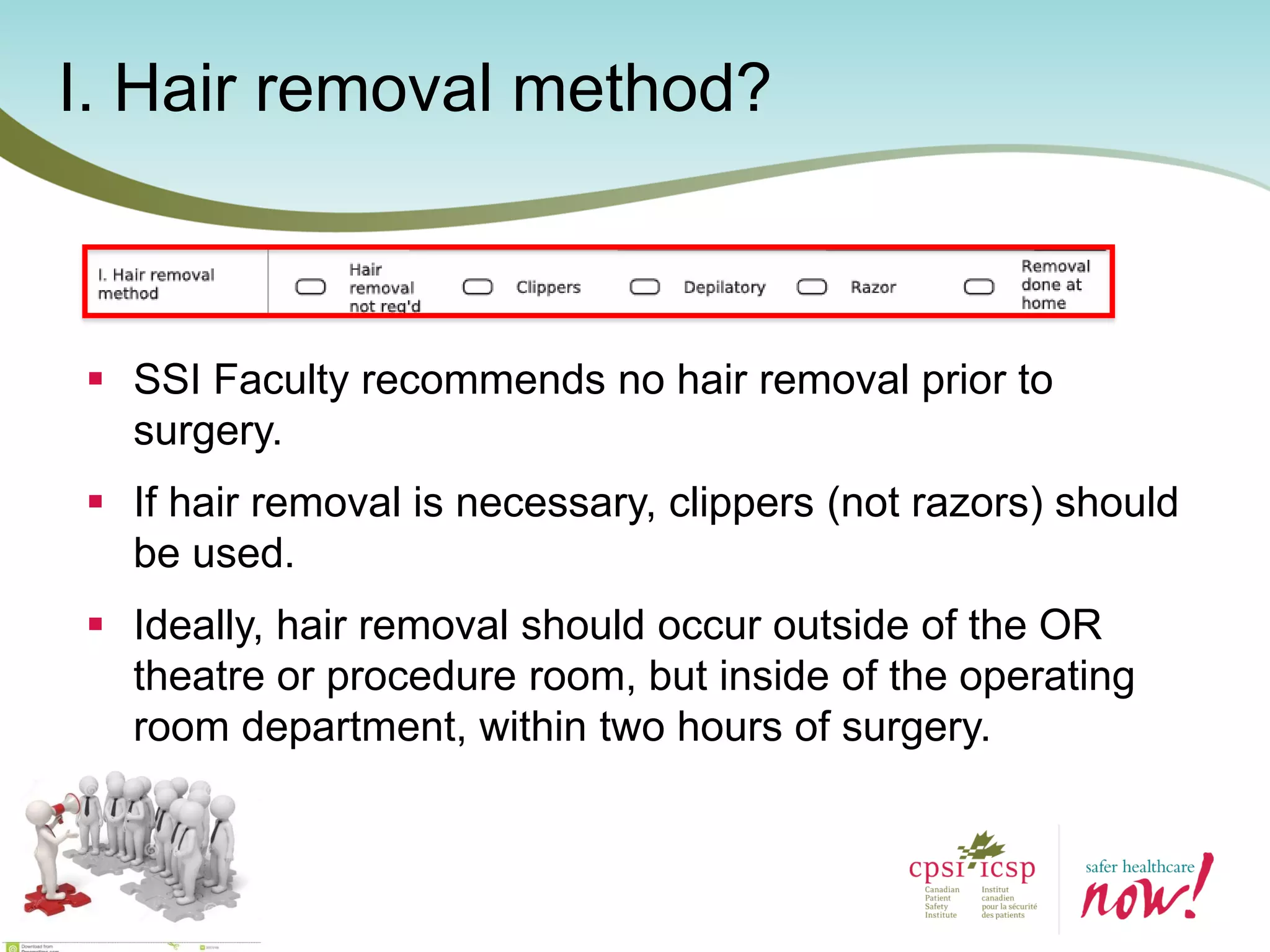
I. Hair removal method?
 SSI Faculty recommends no hair removal prior to
surgery.
 If hair removal is necessary, clippers (not razors) should
be used.
 Ideally, hair removal should occur outside of the OR
theatre or procedure room, but inside of the operating
room department, within two hours of surgery.
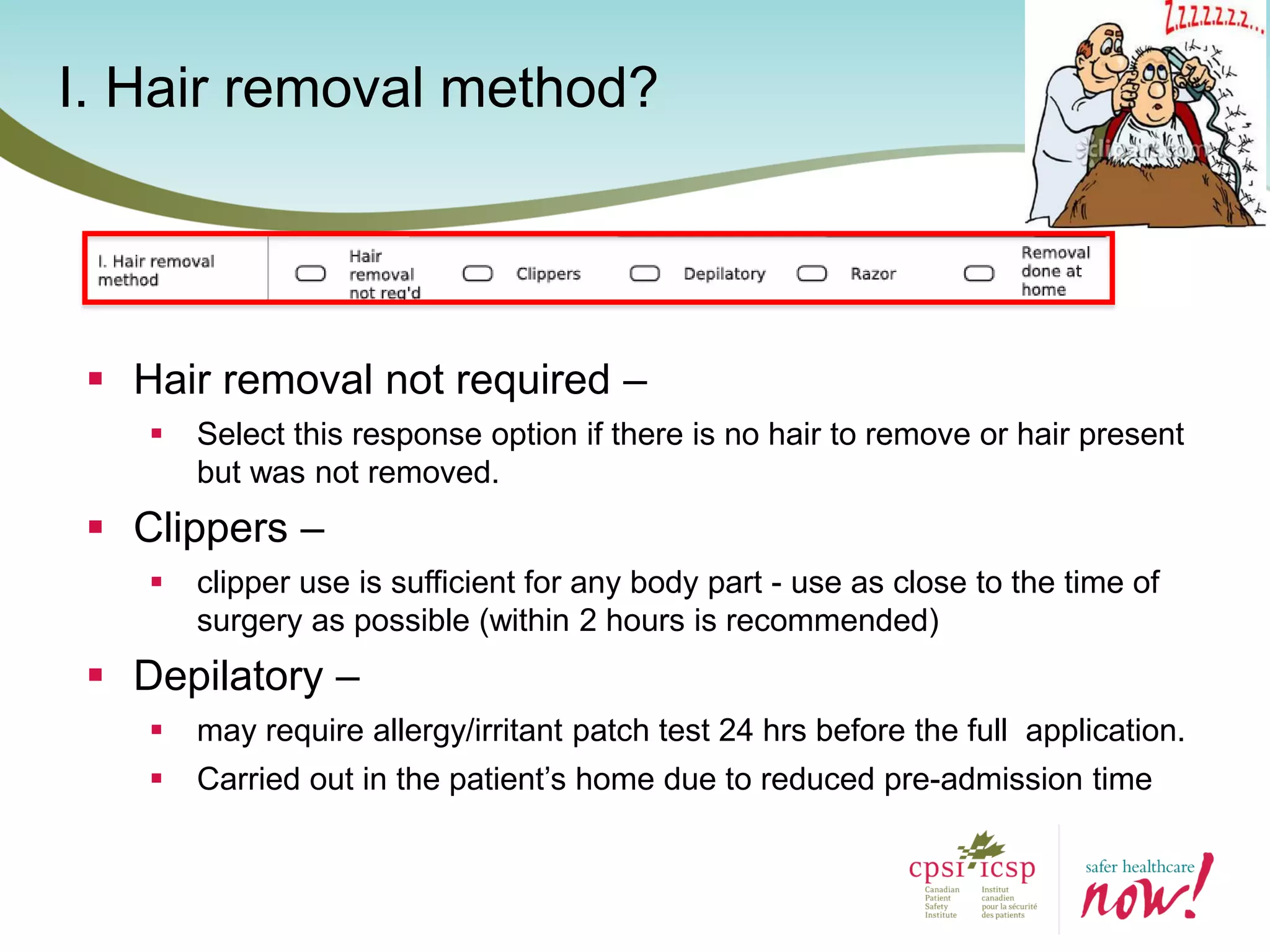
I. Hair removal method?
 Hair removal not required –
 Select this response option if there is no hair to remove or hair present
but was not removed.
 Clippers –
 clipper use is sufficient for any body part - use as close to the time of
surgery as possible (within 2 hours is recommended)
 Depilatory –
 may require allergy/irritant patch test 24 hrs before the full application.
 Carried out in the patient’s home due to reduced pre-admission time
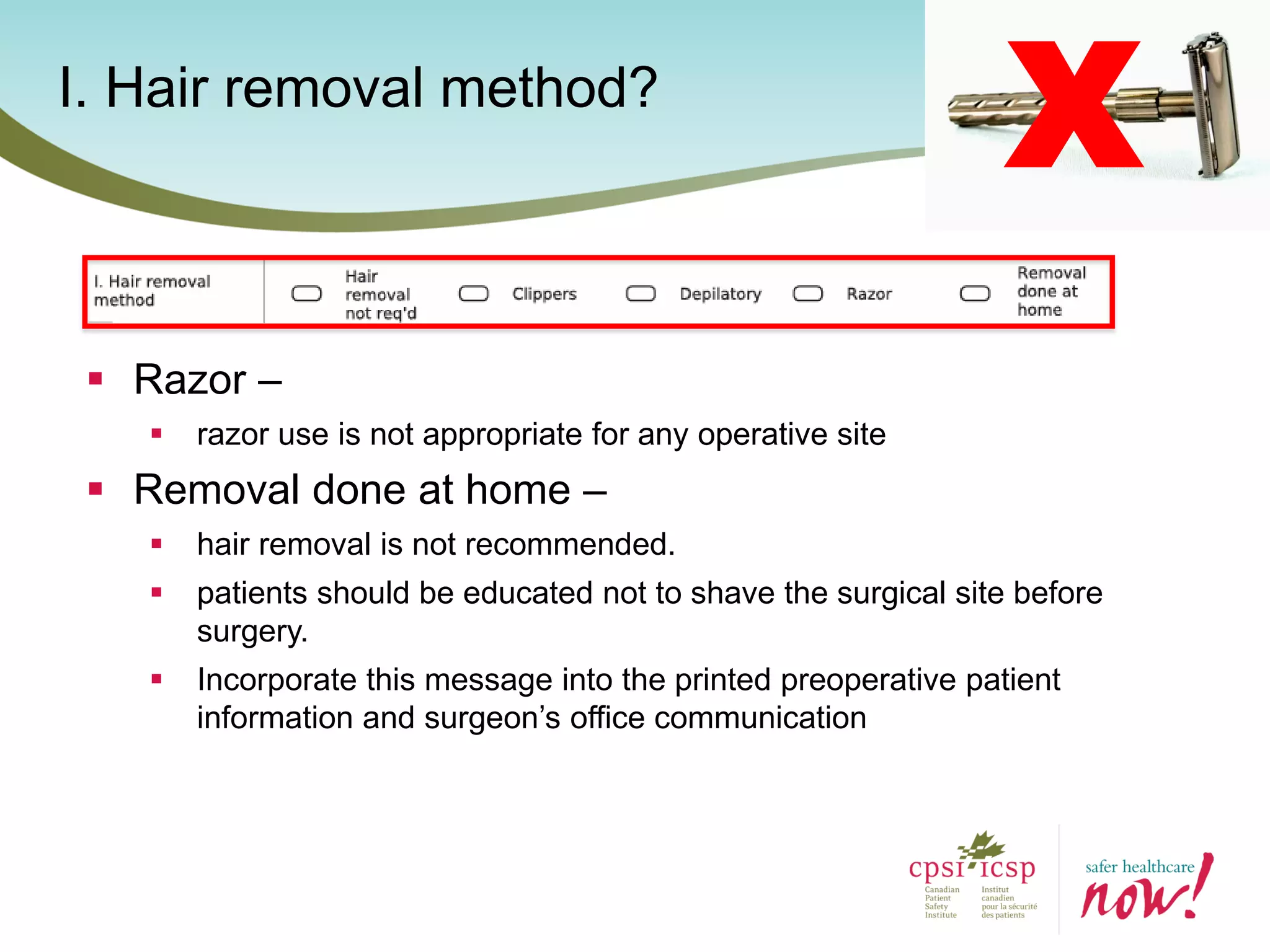
I. Hair removal method?
 Razor –
 razor use is not appropriate for any operative site
 Removal done at home –
 hair removal is not recommended.
 patients should be educated not to shave the surgical site before
surgery.
 Incorporate this message into the printed preoperative patient
information and surgeon’s office communication
X
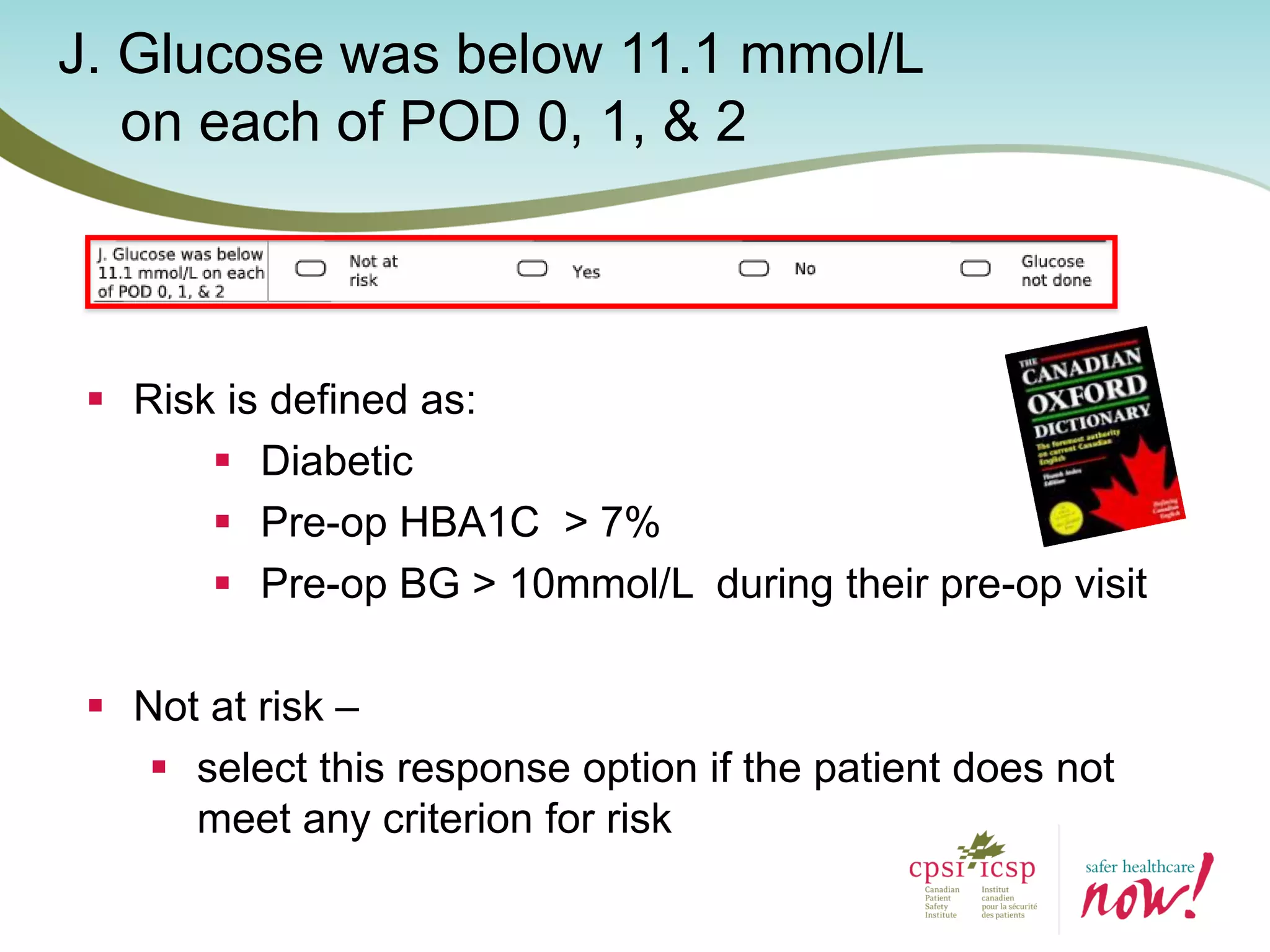
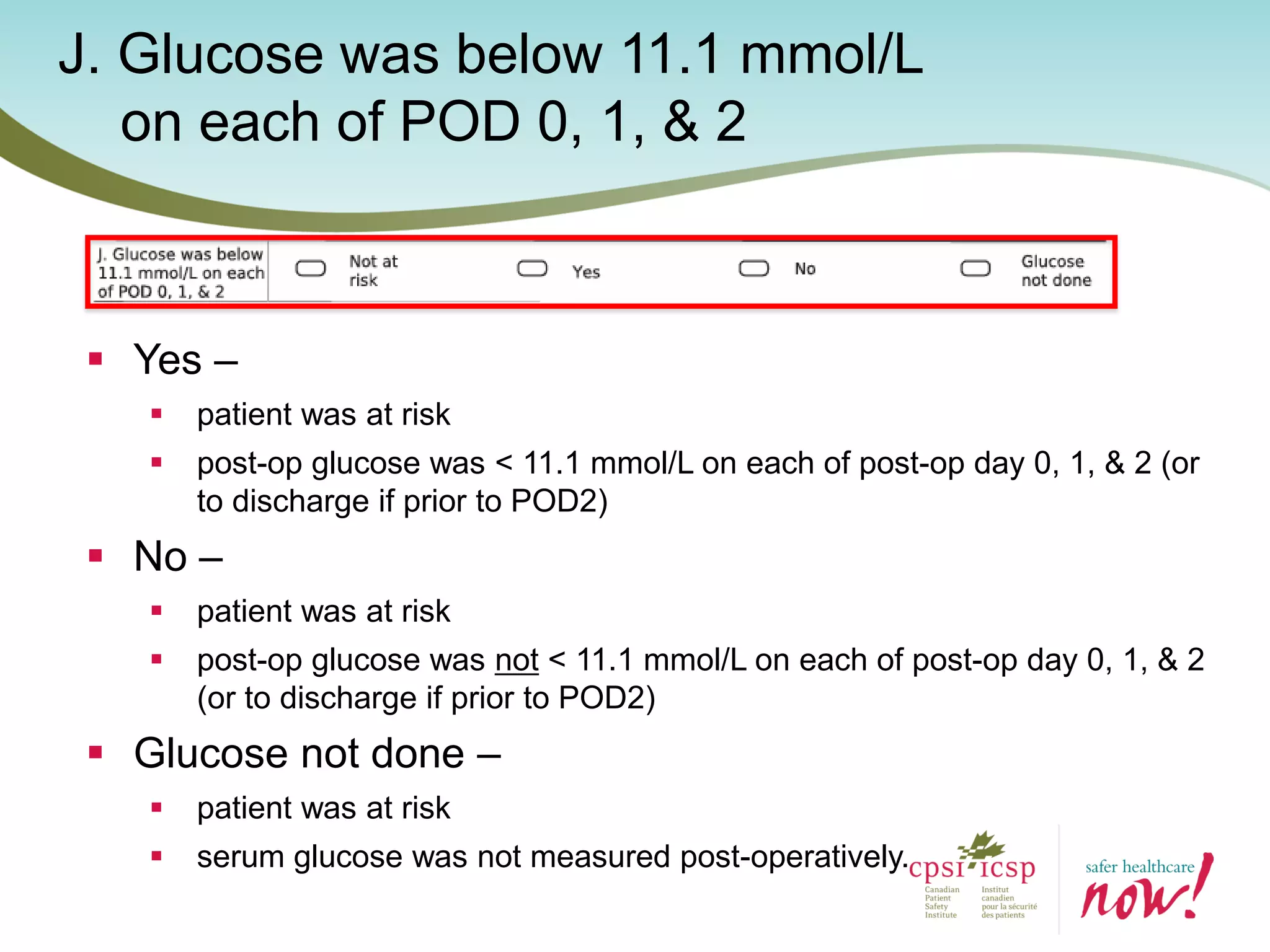
J. Glucose was below 11.1 mmol/L
on each of POD 0, 1, & 2
 Risk is defined as:
 Diabetic
 Pre-op HBA1C > 7%
 Pre-op BG > 10mmol/L during their pre-op visit
 Not at risk –
 select this response option if the patient does not
meet any criterion for risk
J. Glucose was below 11.1 mmol/L
on each of POD 0, 1, & 2
 Yes –
 patient was at risk
 post-op glucose was < 11.1 mmol/L on each of post-op day 0, 1, & 2 (or
to discharge if prior to POD2)
 No –
 patient was at risk
 post-op glucose was not < 11.1 mmol/L on each of post-op day 0, 1, & 2
(or to discharge if prior to POD2)
 Glucose not done –
 patient was at risk
 serum glucose was not measured post-operatively.
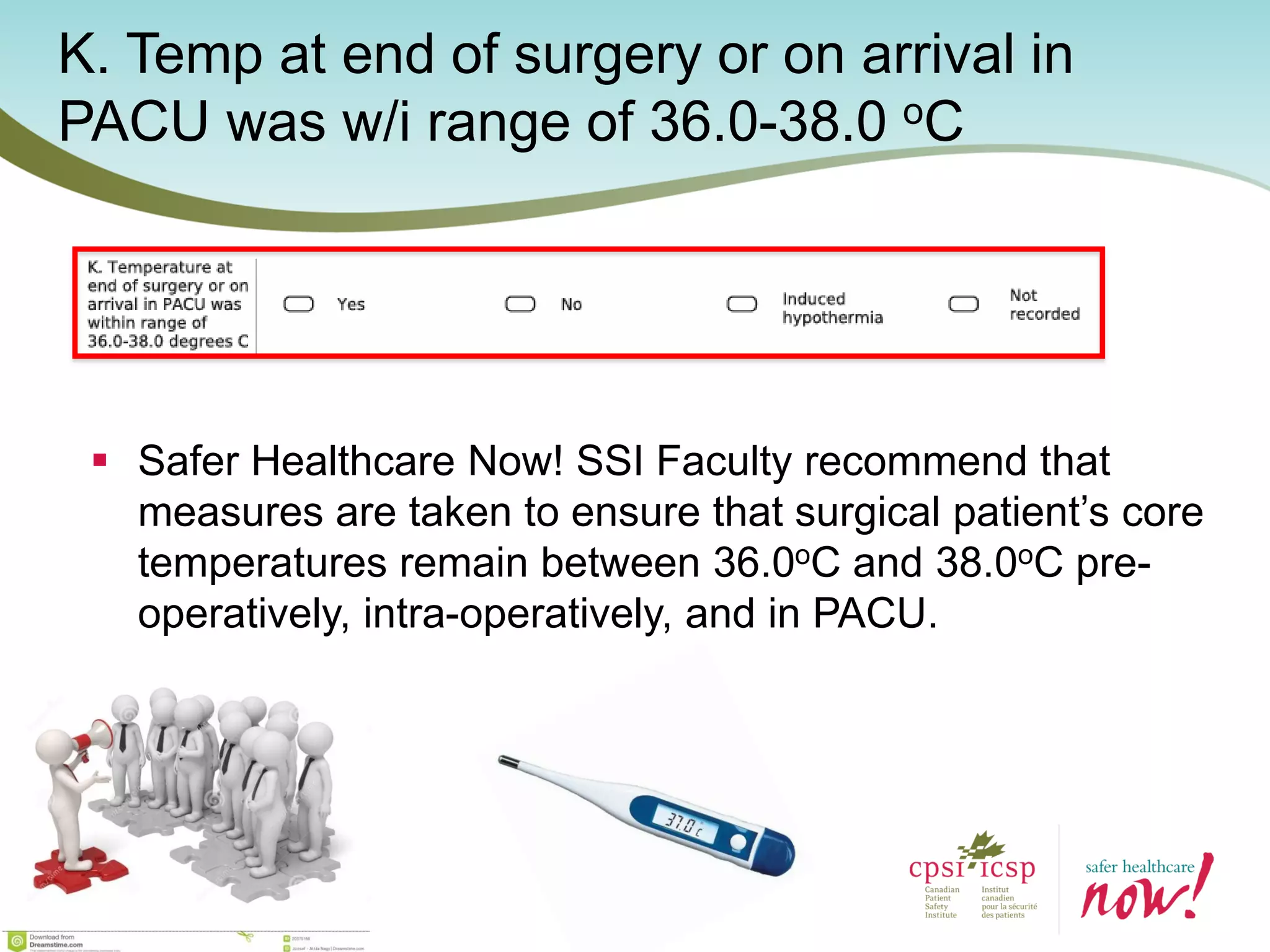
 Safer Healthcare Now! SSI Faculty recommend that
measures are taken to ensure that surgical patient’s core
temperatures remain between 36.0oC and 38.0oC pre-
operatively, intra-operatively, and in PACU.
K. Temp at end of surgery or on arrival in
PACU was w/i range of 36.0-38.0 oC
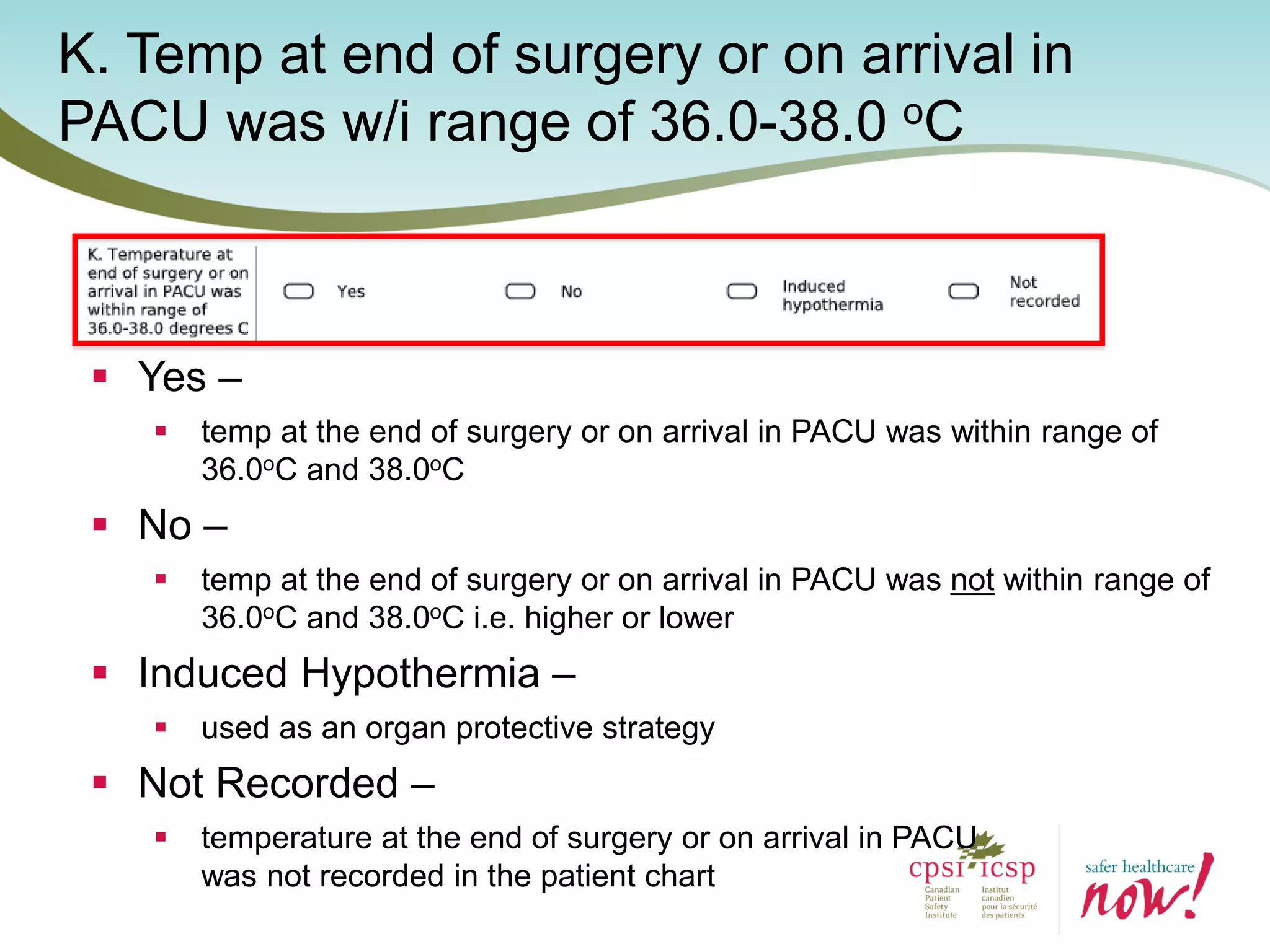
K. Temp at end of surgery or on arrival in
PACU was w/i range of 36.0-38.0 oC
 Yes –
 temp at the end of surgery or on arrival in PACU was within range of
36.0oC and 38.0oC
 No –
 temp at the end of surgery or on arrival in PACU was not within range of
36.0oC and 38.0oC i.e. higher or lower
 Induced Hypothermia –
 used as an organ protective strategy
 Not Recorded –
 temperature at the end of surgery or on arrival in PACU
was not recorded in the patient chart
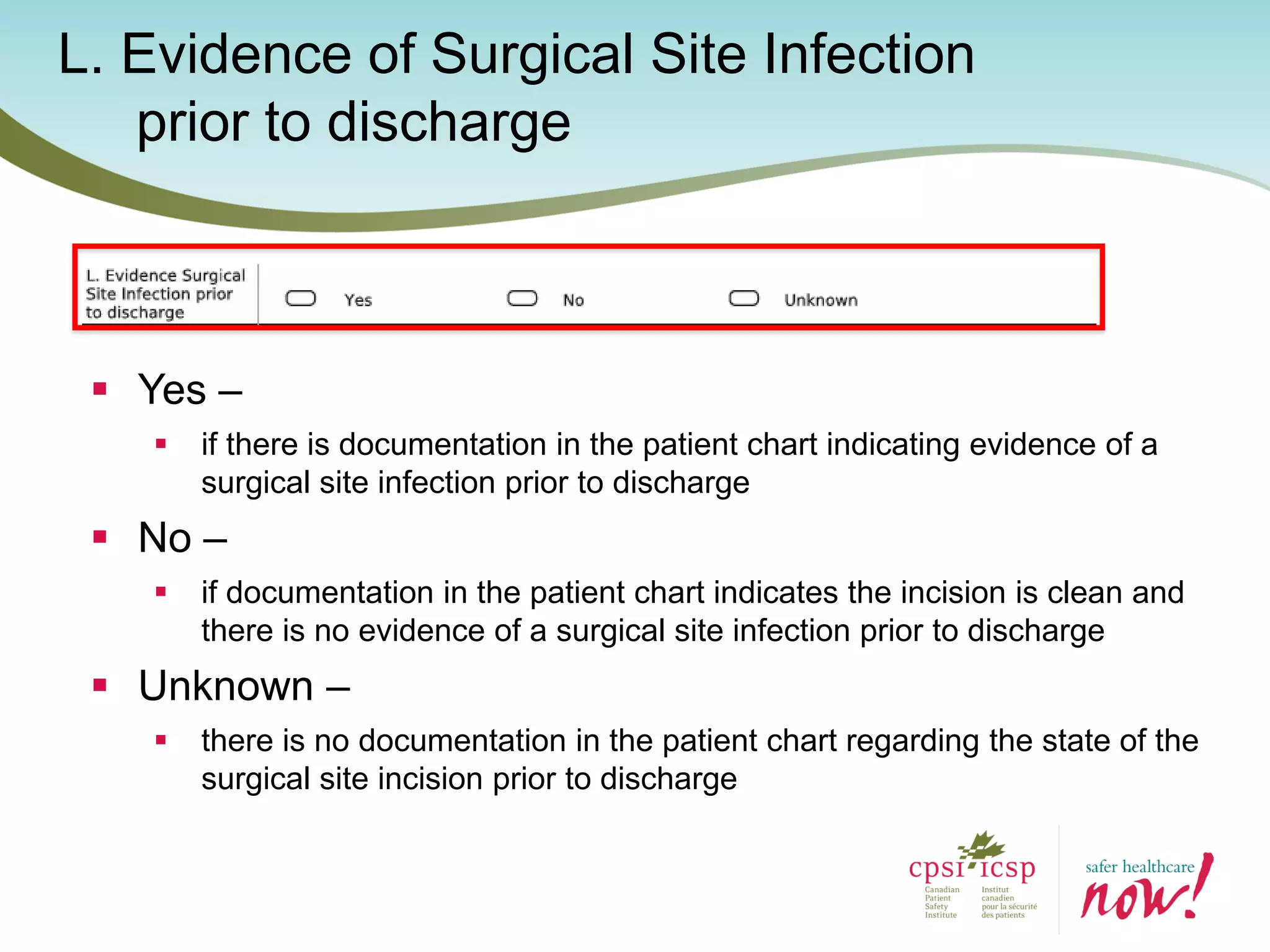
L. Evidence of Surgical Site Infection
prior to discharge
 Yes –
 if there is documentation in the patient chart indicating evidence of a
surgical site infection prior to discharge
 No –
 if documentation in the patient chart indicates the incision is clean and
there is no evidence of a surgical site infection prior to discharge
 Unknown –
 there is no documentation in the patient chart regarding the state of the
surgical site incision prior to discharge
PREVENTION OF SSI
DATA COLLECTION FORM
Virginia Flintoft, MSc, BN and Alexandru Titeu, BA (Hons)
April 30, 2015
 Brief introduction to PS Metrics
 SSI Data Collection Methods and tools
Objectives
Features:
 Free, cloud-based data collection and reporting tool
 Available in English and French
 User friendly and simple to navigate
 Accessible from website with login details
 Tracks >100 process and outcome measures over 14
interventions
 Provides real time reporting and export of data to CSV/Excel
 Reduces burden of data collection, entry and analysis
 Roll Up or Drill Down Reports (i.e. Unit  Organization  Health
Region  Province  National) with automated Run Charts
 Capacity to customize measures and reports
 Provides real time reporting and export of data to CSV/Excel
Patient Safety Metrics - Introduction
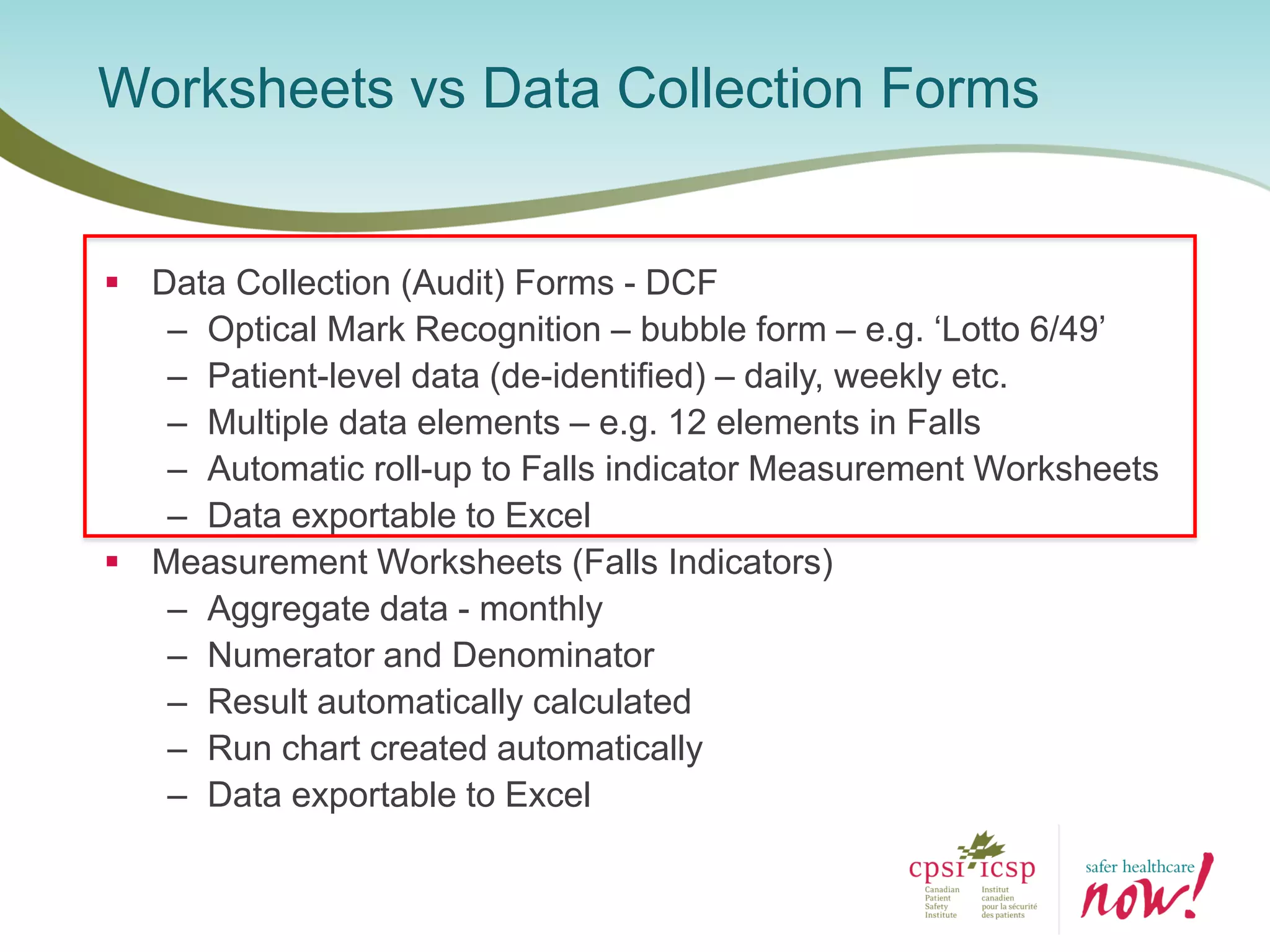
 Data Collection (Audit) Forms - DCF
– Optical Mark Recognition – bubble form – e.g. ‘Lotto 6/49’
– Patient-level data (de-identified) – daily, weekly etc.
– Multiple data elements – e.g. 12 elements in Falls
– Automatic roll-up to Falls indicator Measurement Worksheets
– Data exportable to Excel
 Measurement Worksheets (Falls Indicators)
– Aggregate data - monthly
– Numerator and Denominator
– Result automatically calculated
– Run chart created automatically
– Data exportable to Excel
Worksheets vs Data Collection Forms
SSI Audit Tool
Retrospective review of selected charts
Focus on processes
Measures for continuous improvement
Use of the Tool
 Ideally an auditor(s) should:
o be someone familiar with the SSI
prevention process(es), forms used and
overall chart layout
o not audit their own work
o have some training or guidance provided (to
ensure consistency in application of org-
specific criteria)
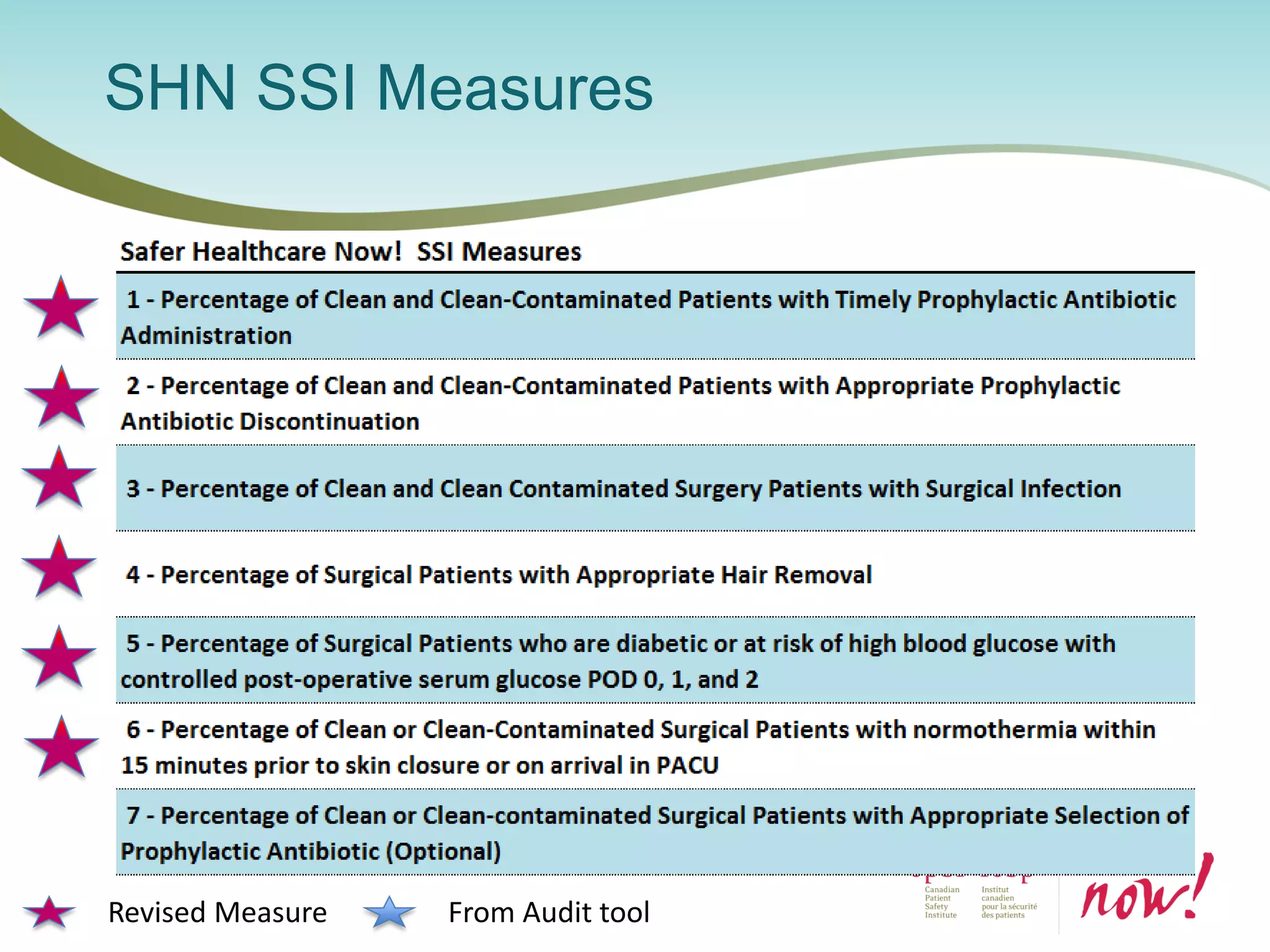
SHN SSI Measures
Revised Measure From Audit tool
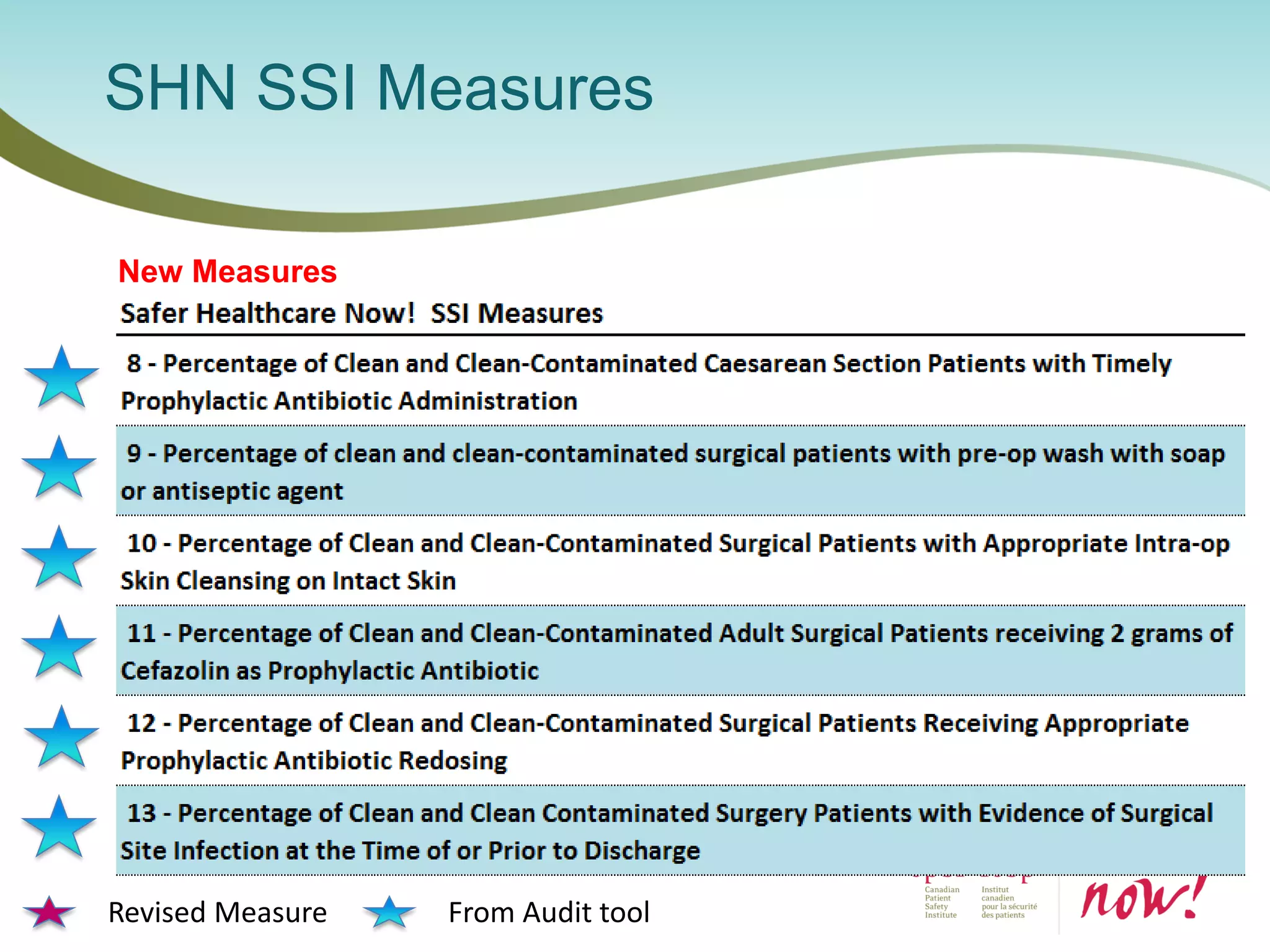
SHN SSI Measures
Revised Measure From Audit tool
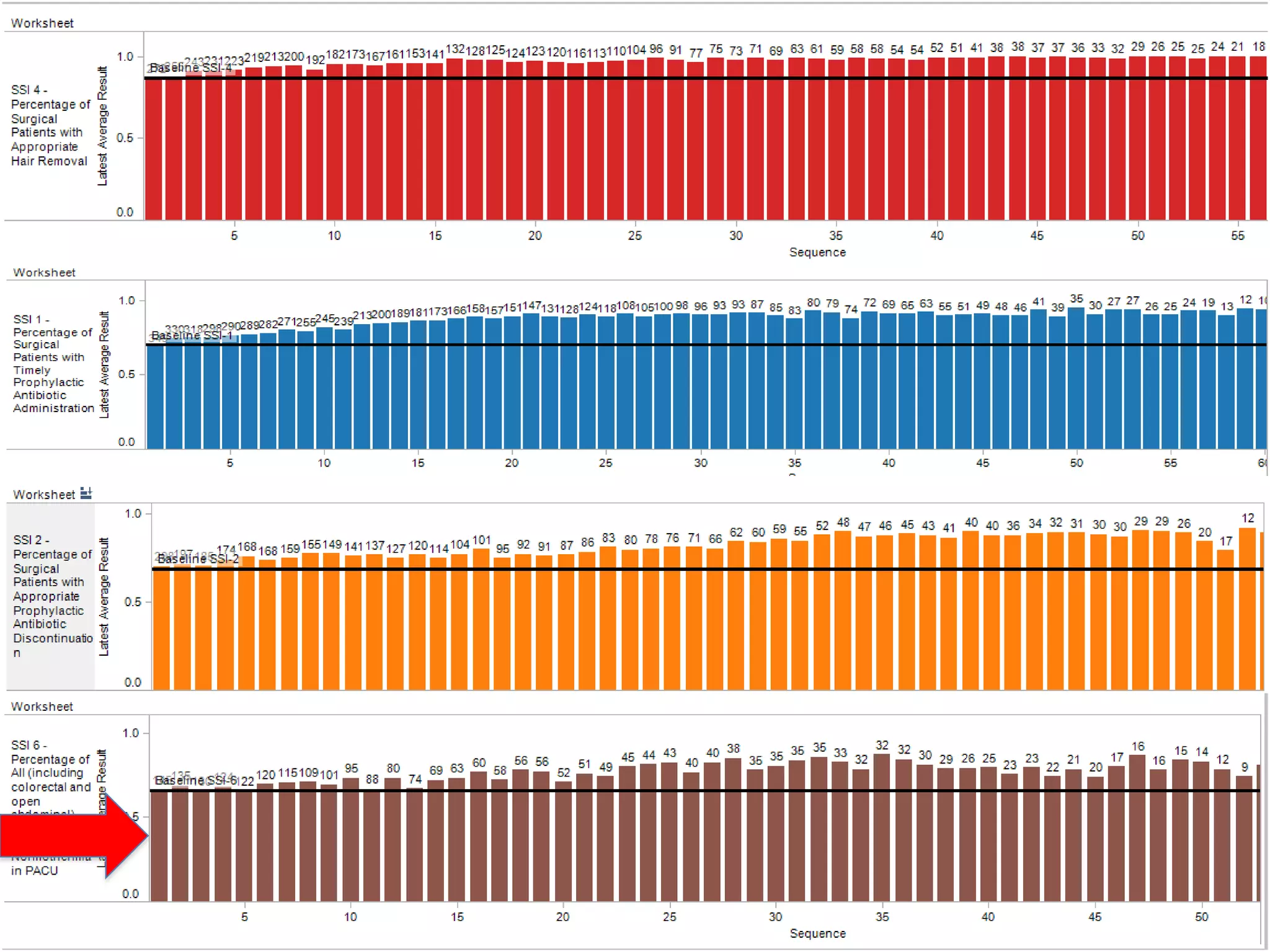
New Measures
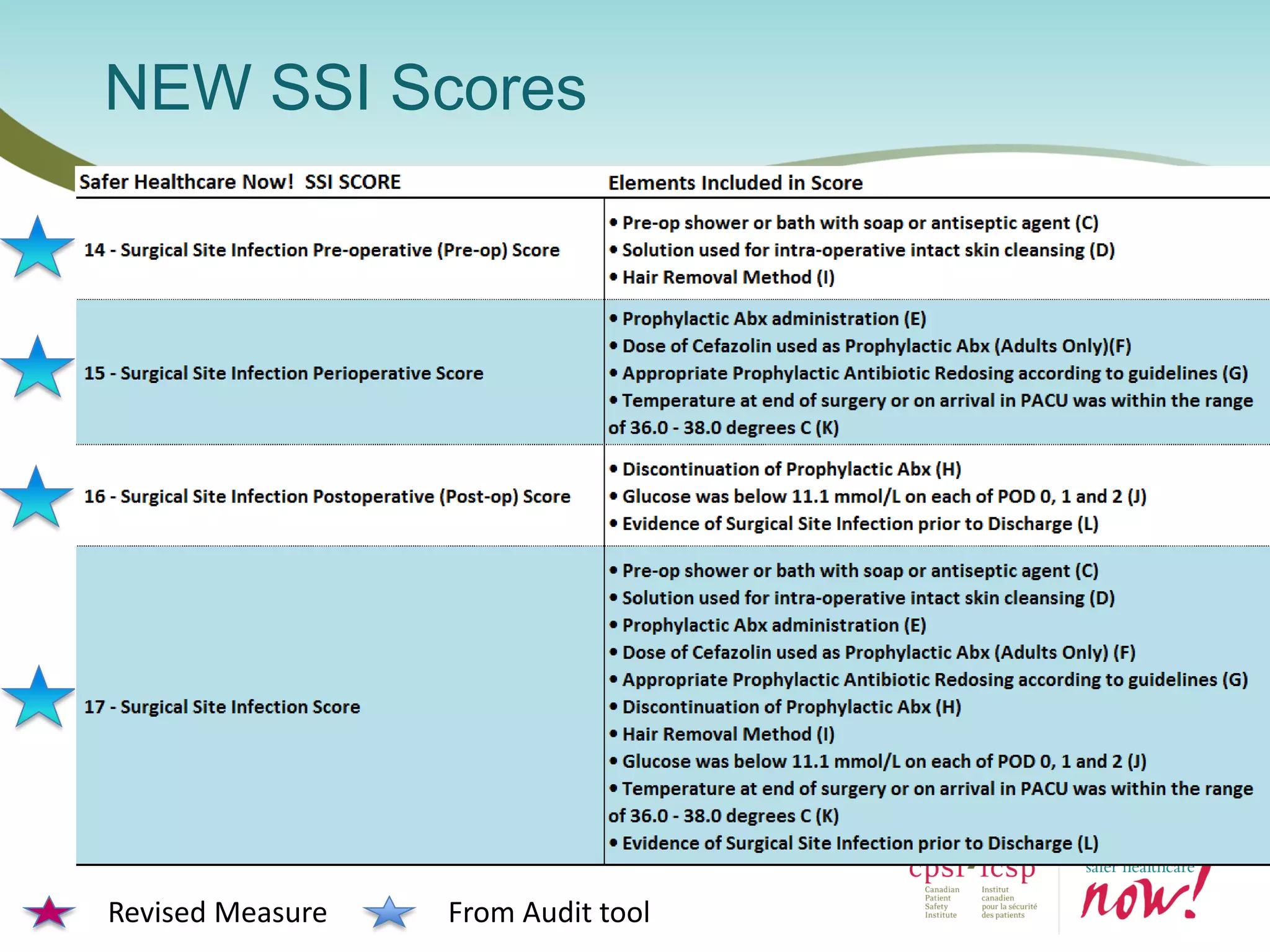
NEW SSI Scores
Revised Measure From Audit tool
New Measures
40
40
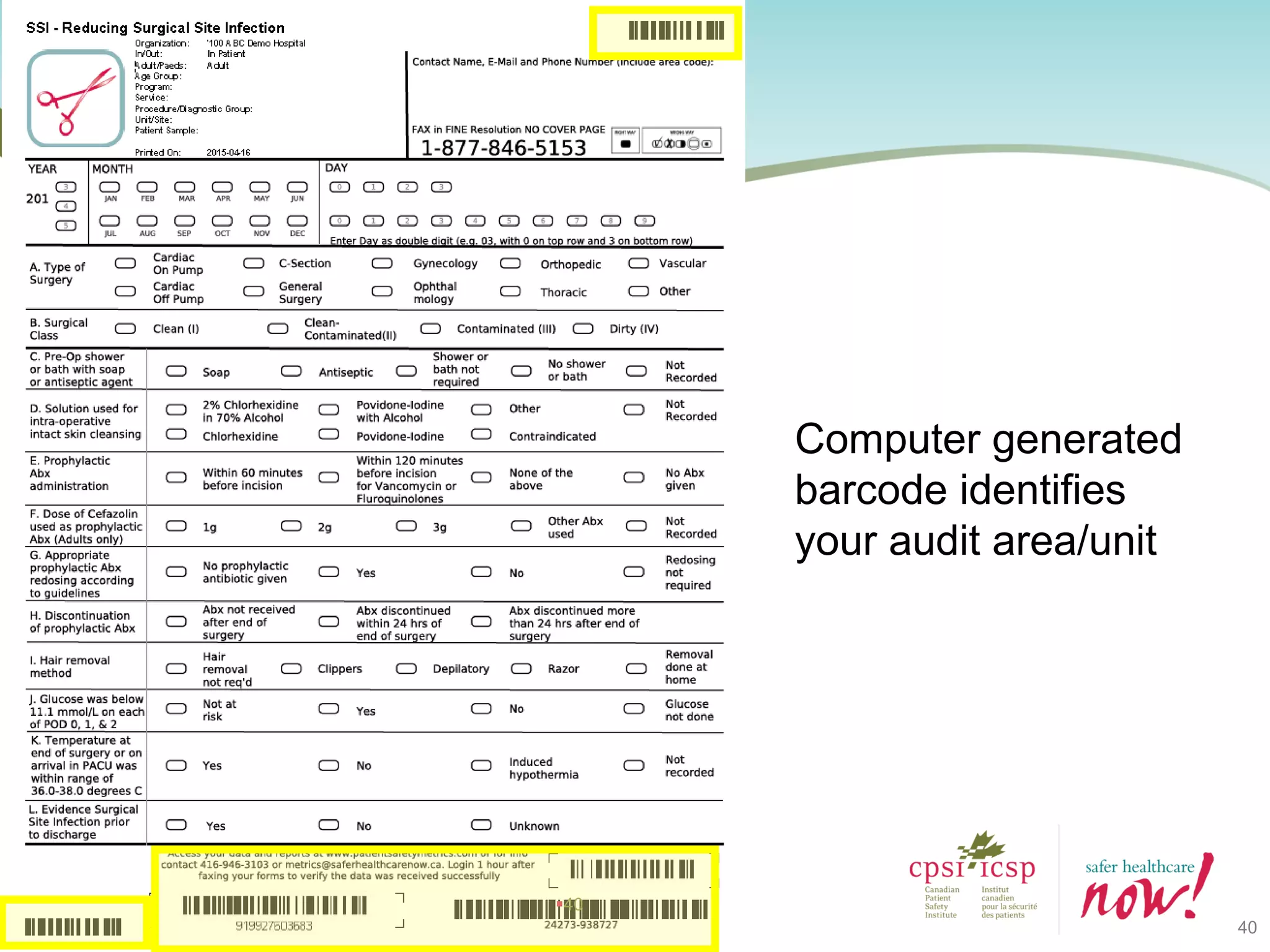
Computer generated
barcode identifies
your audit area/unit
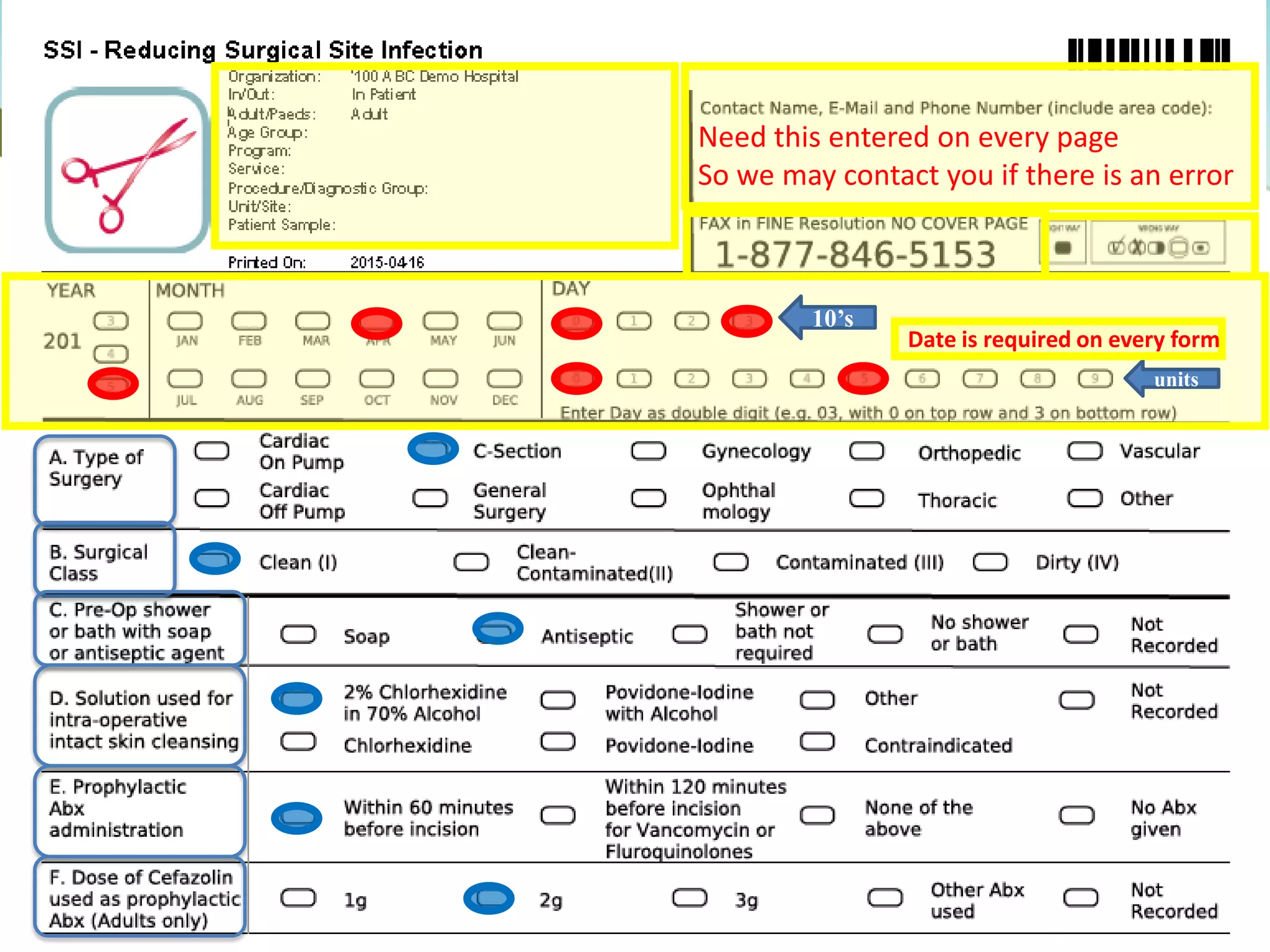
Need this entered on every page
So we may contact you if there is an error
10’s
units
Date is required on every form
43
43
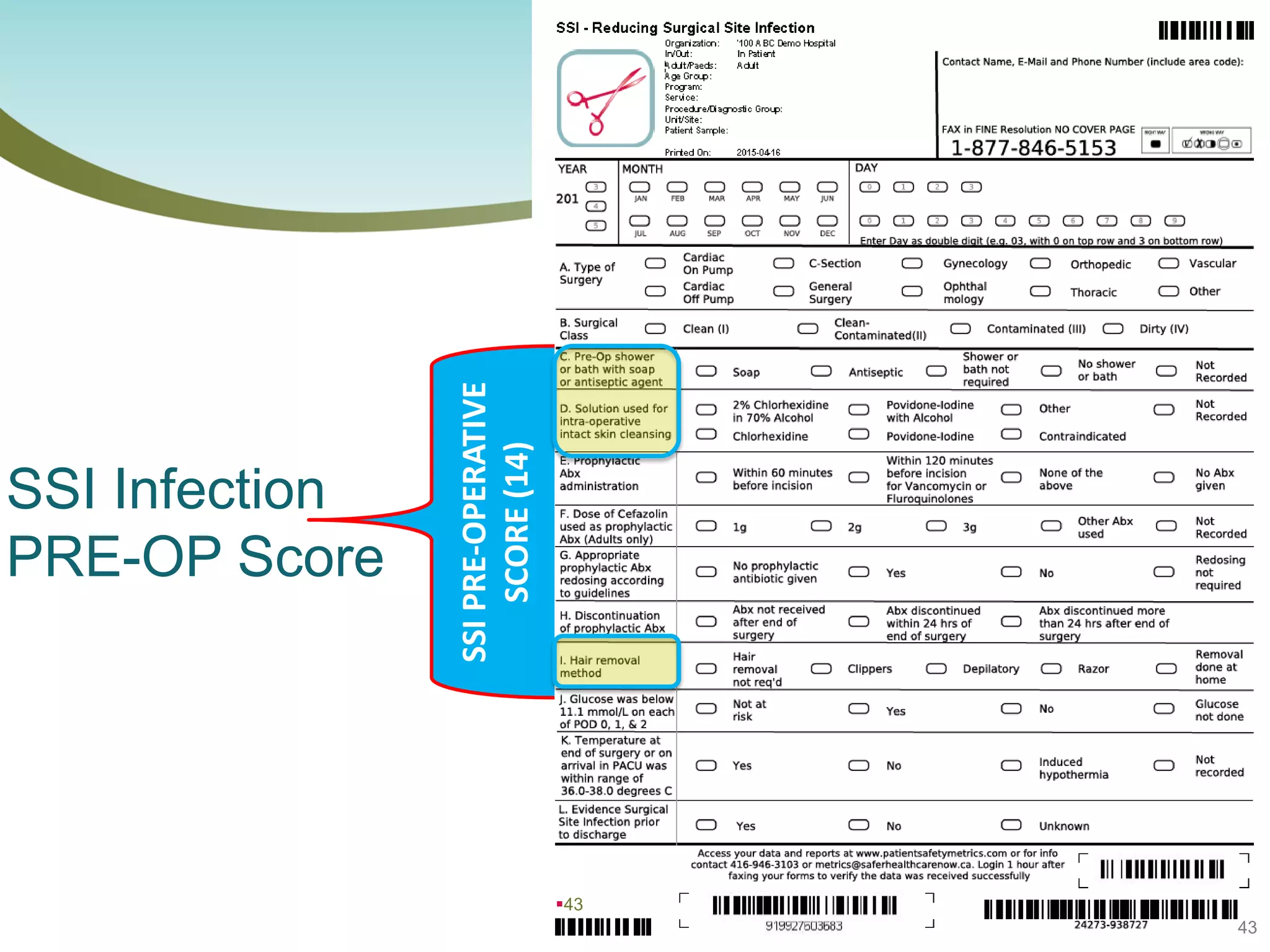
SSI Infection
PRE-OP Score
SSIPRE-OPERATIVE
SCORE(14)
44
44
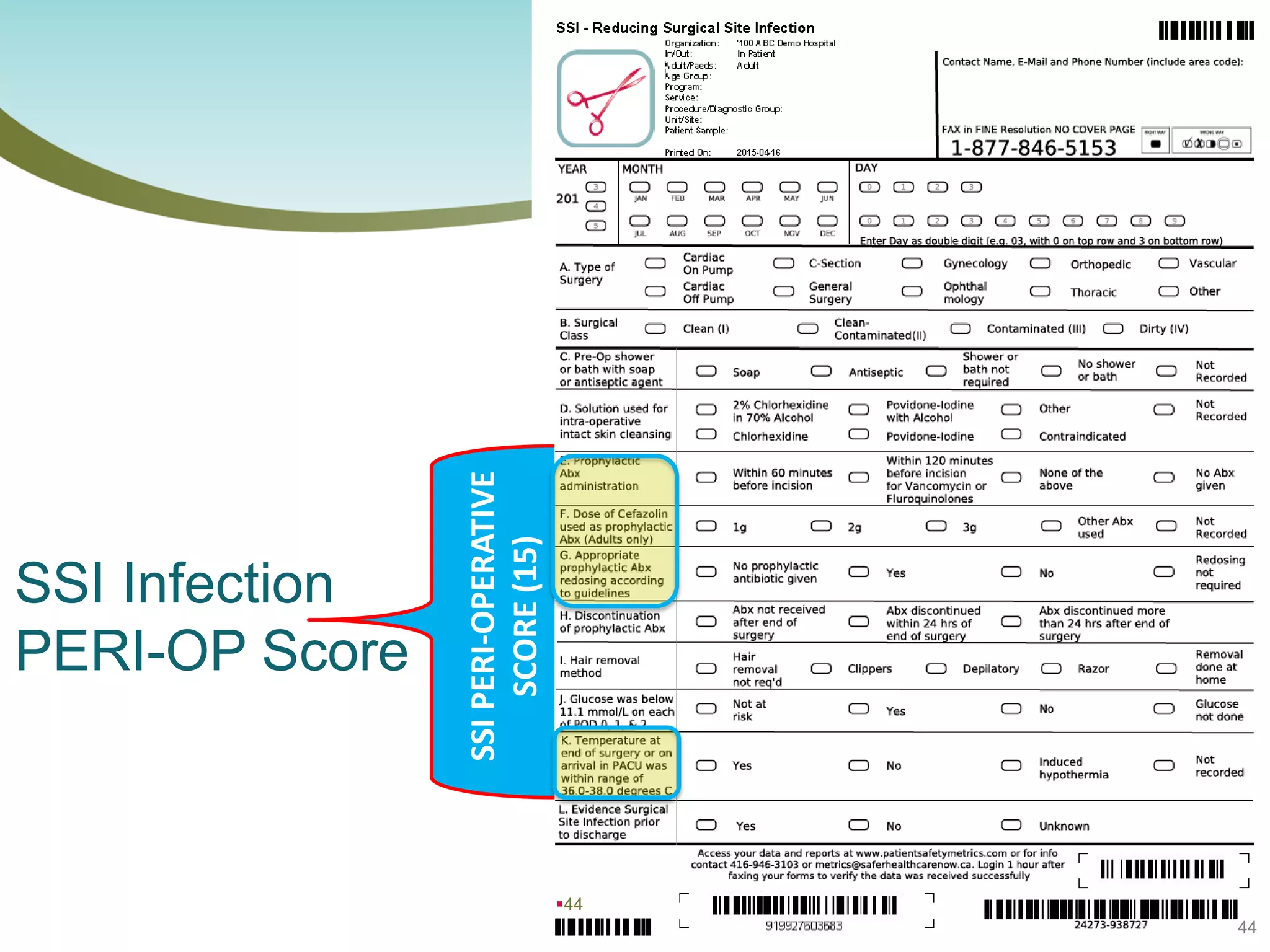
SSI Infection
PERI-OP Score
SSIPERI-OPERATIVE
SCORE(15)
45
45
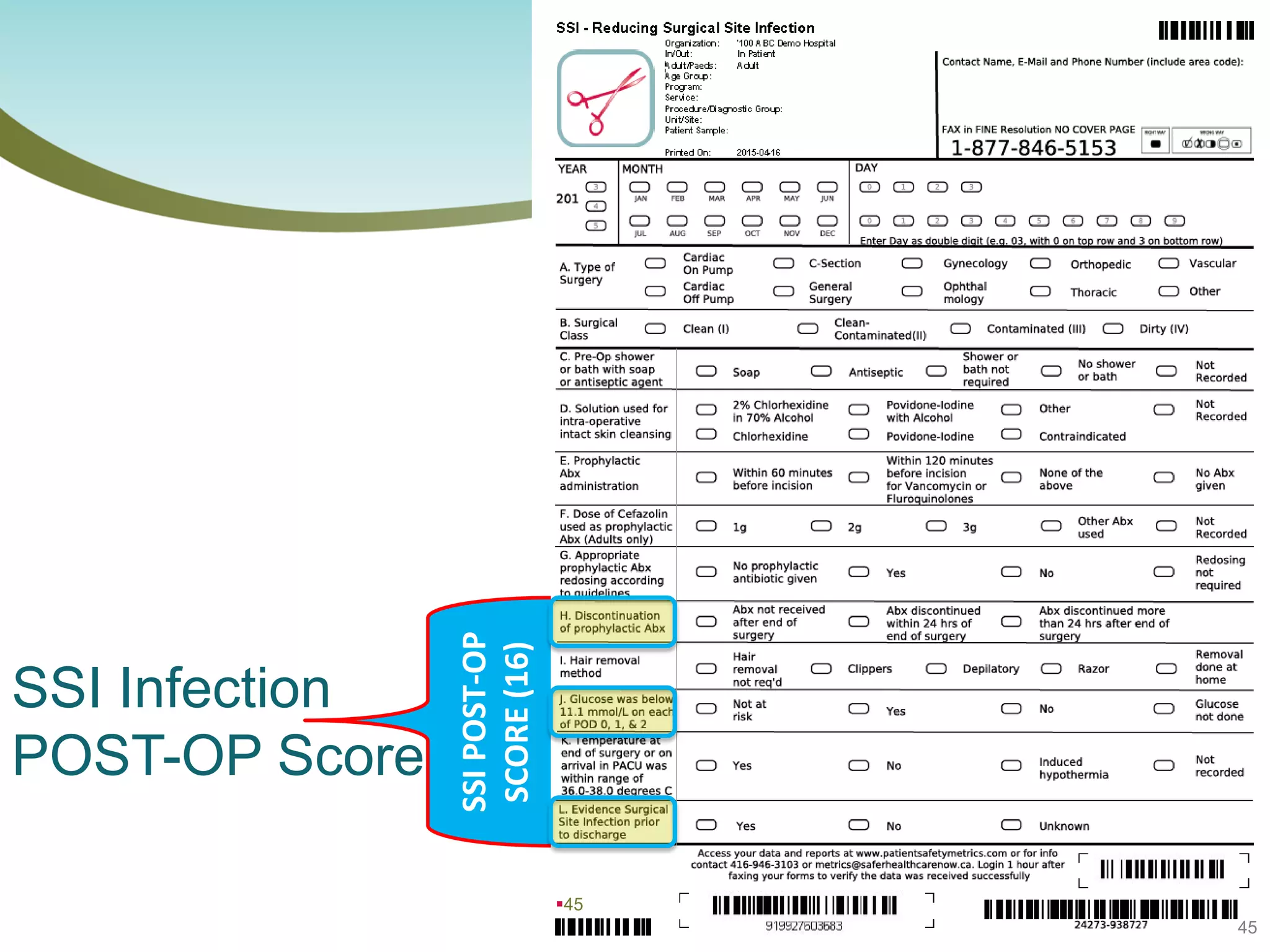
SSI Infection
POST-OP Score
SSIPOST-OP
SCORE(16)
46
46
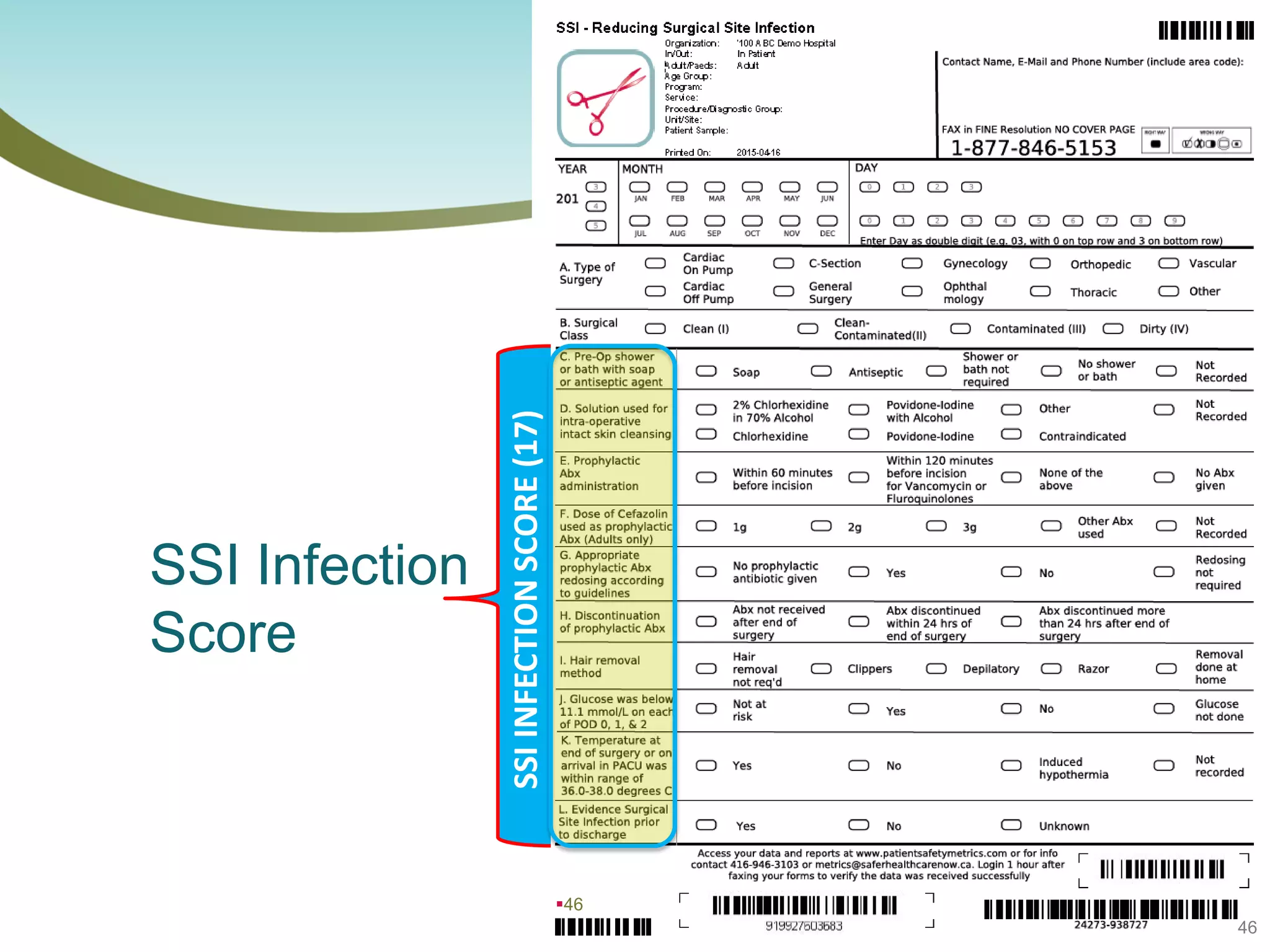
SSI Infection
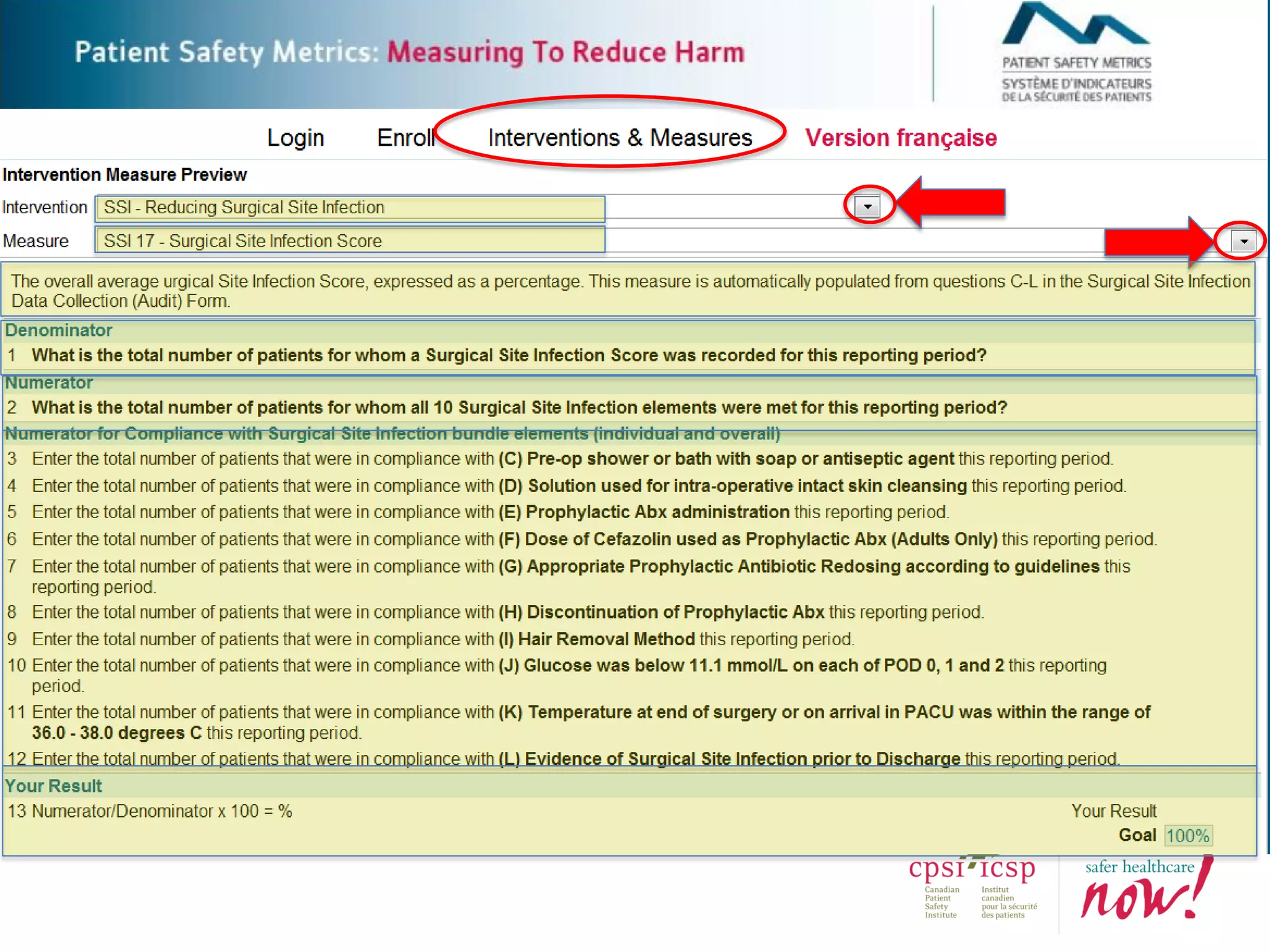
Score
SSIINFECTIONSCORE(17)
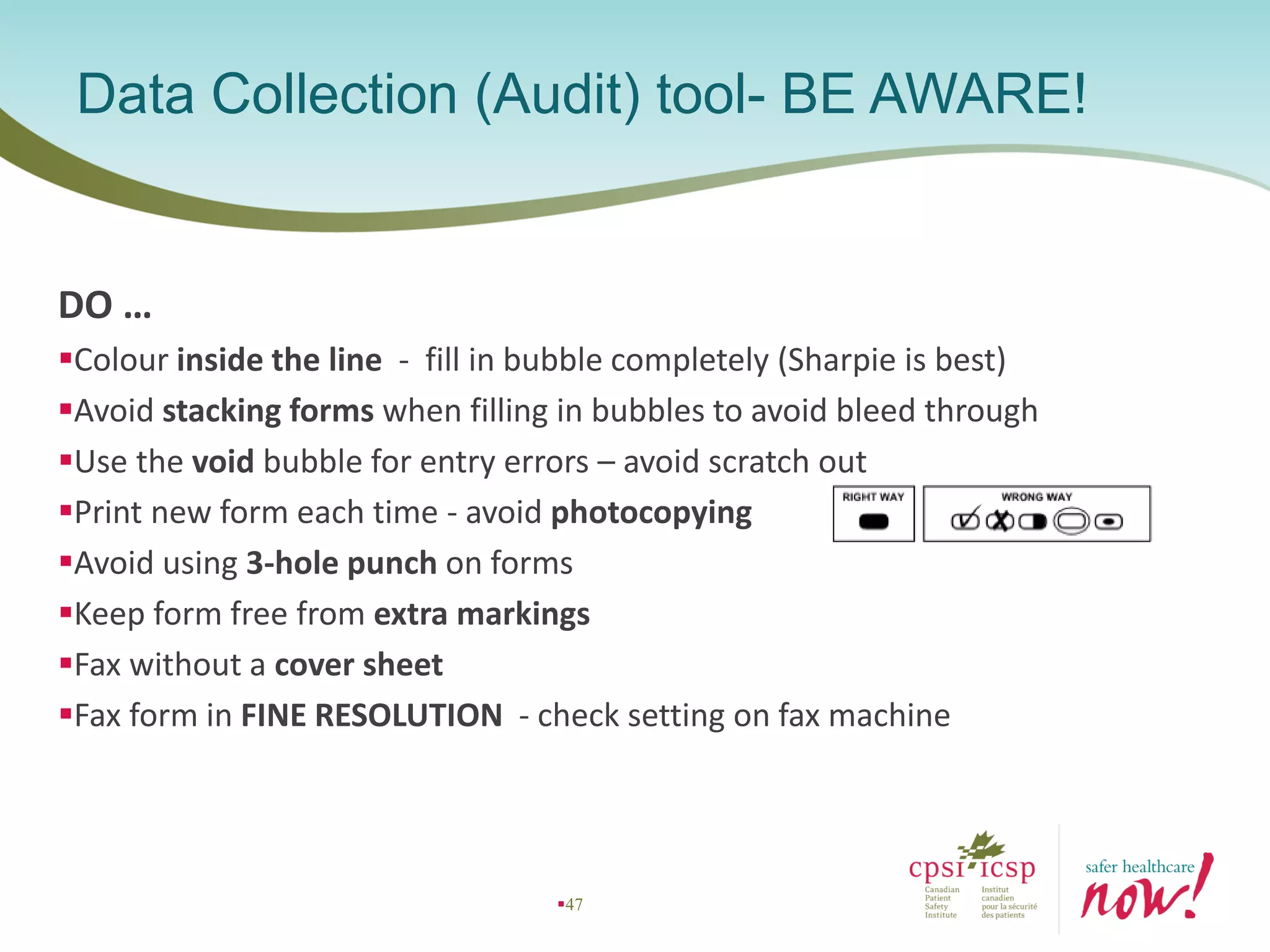
DO …
Colour inside the line - fill in bubble completely (Sharpie is best)
Avoid stacking forms when filling in bubbles to avoid bleed through
Use the void bubble for entry errors – avoid scratch out
Print new form each time - avoid photocopying
Avoid using 3-hole punch on forms
Keep form free from extra markings
Fax without a cover sheet
Fax form in FINE RESOLUTION - check setting on fax machine
Data Collection (Audit) tool- BE AWARE!
47
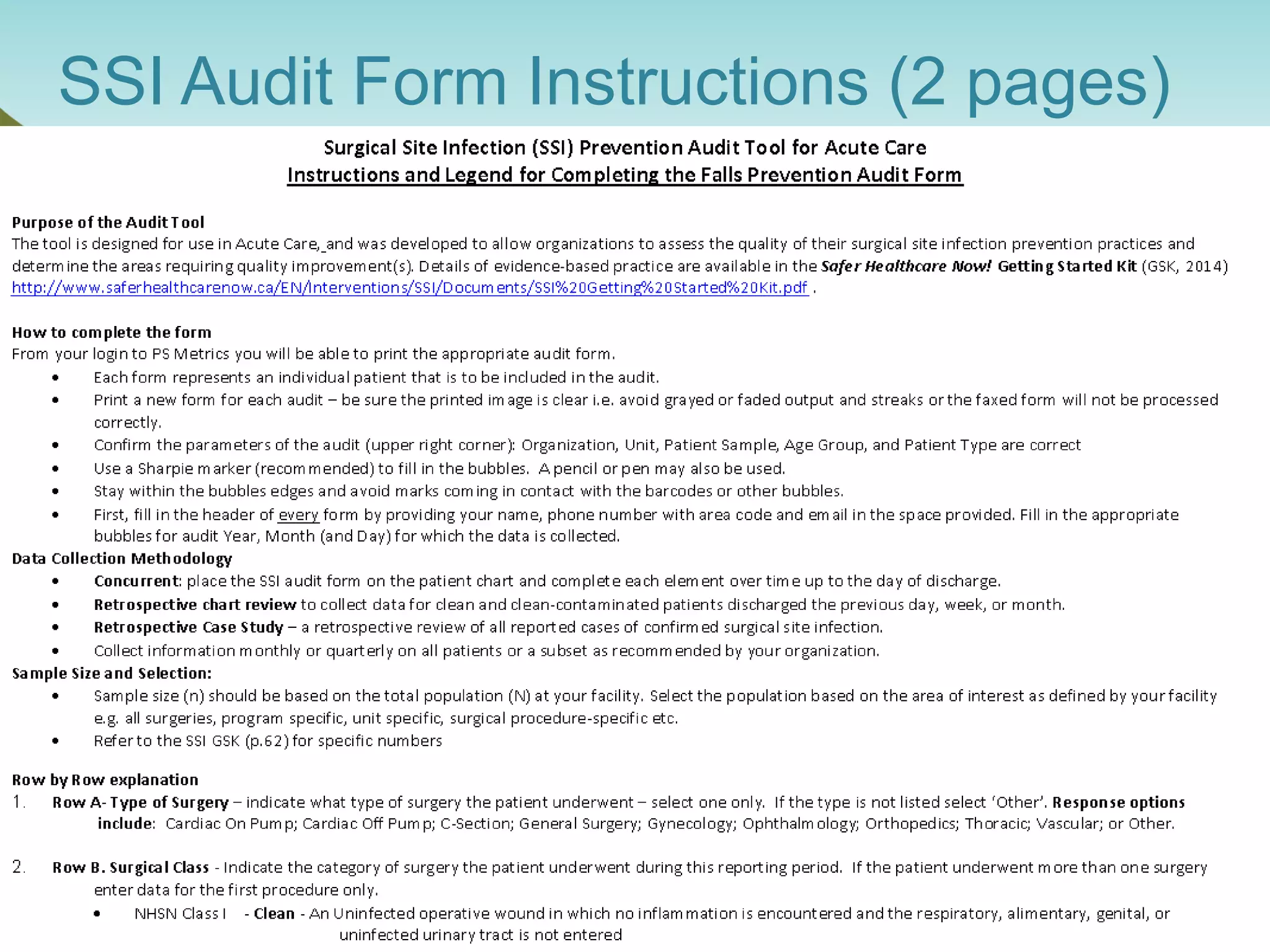
SSI Audit Form Instructions (2 pages)
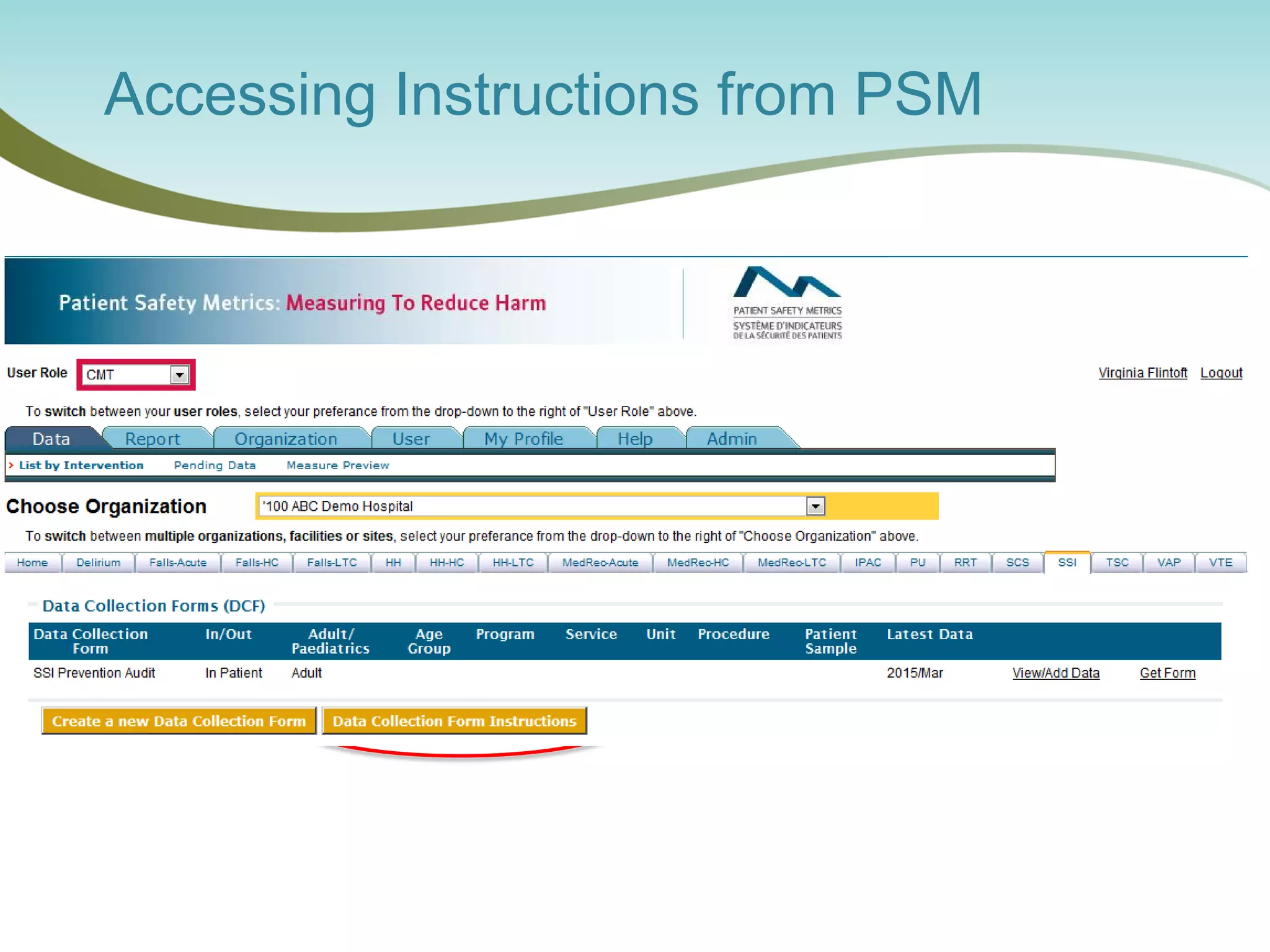
Accessing Instructions from PSM
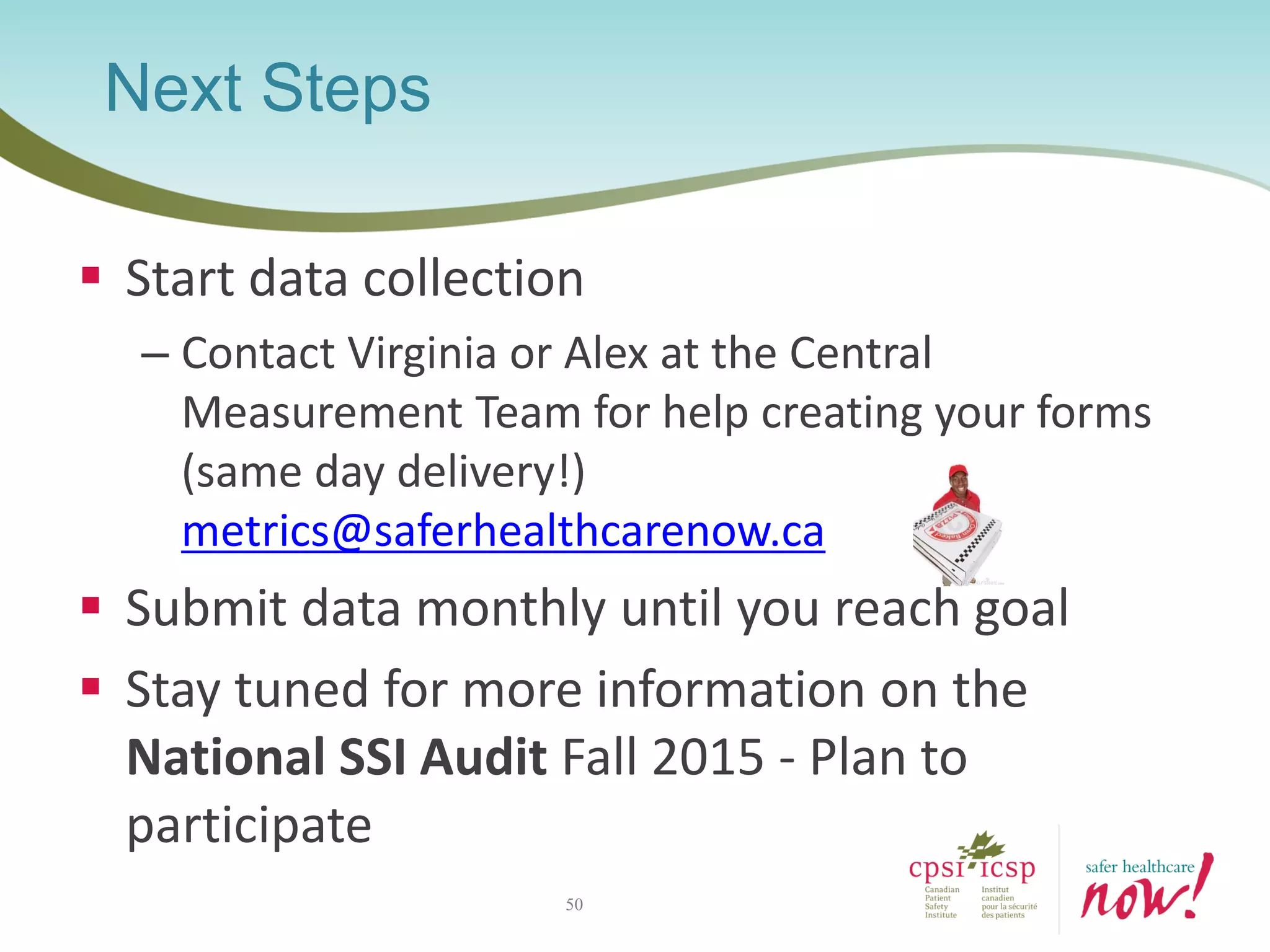
 Start data collection
– Contact Virginia or Alex at the Central
Measurement Team for help creating your forms
(same day delivery!)
metrics@saferhealthcarenow.ca
 Submit data monthly until you reach goal
 Stay tuned for more information on the
National SSI Audit Fall 2015 - Plan to
participate
Next Steps
50
Questions?
51
Thank You / Merci
53
CPSI Central Measurement Team
Virginia Flintoft - 416-946-8350
Alexandru Titeu - 416-946-3103
metrics@saferhealthcarenow.ca
CPSI Patient Safety Intervention Lead
Carla Williams
cwilliams@cpsi-icsp.ca
We are here to help!

Increase Your SSI Data Collection Efficiency

  • 1.
    PREVENTION of SSIs AUDITTOOL INTRODUCTION April 30, 2015 Dr. Claude Laflamme Physician Lead for the Safer Healthcare Now! Surgical Site Infection Intervention Director of Cardiac Anesthesia, Sunnybrook Health Science Centre, Toronto, ON Assistant Professor, University of Toronto Virginia Flintoft MSc BN Safer Healthcare Now! Manager, Central Measurement Team
  • 2.
     French slidesavailable during presentation  Links to: a) English presentation slides and b) English and French GSKs posted in chat box  Interested in using new data collection form?  Advance notice: SSI National Audit Fall 2015 Post questions in the chat box; to “All Participants”  Using a MAC computer? Before we get started
  • 3.
    Welcome to ourfrancophone attendees Bienvenue à nos participants francophones Hélène Riverin Conseillère en sécurité et en amélioration Safety Improvement Advisor
  • 4.
  • 5.
    Dr. Claude Laflamme “Why should we care?”  Introduction to the SSI Audit Tool
  • 6.
    Surgical Site Infection(SSI)  2-5% occurrence in inpatient surgery  60% preventable if evidence based guidelines followed  Associated with 11 days increase LOS  SSI account for $3.5-$10 billion in United States  Double the mortality, 60% more time in ICU, and 5x more likely to be re-admitted
  • 7.
    SSI and AdditionalHospital LOS
  • 8.
    CPSI SSI Measurement2006-2014 Figure 1: Incidence of Surgical Site Infections in patients undergoing clean and clean contaminated surgery in Canada from 2006 to 2014
  • 10.
  • 11.
    The SSI AuditTool Each form will be for one (1) patient
  • 12.
    The SSI AuditTool Each question (A to L) is one element of the audit tool and rolls up to an indicator
  • 13.
    A. Type ofSurgery  Type of surgery the patient underwent  Note Cardiac Surgery on and off pump  Pick only one
  • 14.
    B. Surgical Class NHSN definition of wound classifications  Clean - uninfected operative wound - no inflammation  Clean Contaminated - operative wound in which the respiratory, alimentary, genital, or urinary tracts are entered under controlled conditions and without unusual contamination  Contaminated - open, fresh, accidental wounds + operations with major breaks in sterile technique or gross spillage from the GI tract, and non–purulent inflammation  Dirty - Old traumatic wounds with retained devitalized tissue + existing infection or perforated viscera..
  • 15.
    C. Pre-Op Showeror bath with soap or antiseptic agent  Soap: bar/bath soap  Antiseptic Agent: e.g. Chlorhexidine  Shower or Bath not required:  shower or bath is not required for the type of surgery e.g. ophthalmologic or oral  No shower or bath –  a shower or bath was required but the patient did not have either  Not Recorded –  no evidence of having a shower or bath recorded in the patient chart
  • 16.
    D. Solution usedfor intra-op intact skin cleansing…  2% Chlorhexidine in 70% alcohol –  has been demonstrated to be more effective as a surgical skin preparation solution than other agents.  Chlorhexidine  Povidone-iodine with alcohol  Povidone-iodine –  remains the standard for head and neck procedures
  • 17.
    D. Solution usedfor intra-op intact skin cleansing…  Other – other solution used  Contraindicated –  i.e. skin sensitivity, allergy, rash, or contact with the eye, inner ear, mucosa or meninges.  Not Applicable - i.e. ophthalmologic or oral  Not Recorded –  no evidence of having a shower or bath recorded in the patient chart
  • 18.
    E. Prophylactic antibioticadministration  Within 60 minutes before incision  administration of antibiotic was completed within 0 to 60 minutes prior to the first surgical incision time.  Within 120 minutes before incision for Vancomycin or Fluoroquinolones  administered over 120 minutes and completed within 0 to 60 minutes prior to the first surgical incision.  None of the above  gave antibiotics but did not meet the timing requirements above.  No antibiotics given
  • 19.
    F. Dose ofCefazolin used as prophylactic antibiotic  1 g (gram)  2g (grams)  3g (grams)  Other antibiotic used – any abx other than Cefazolin was administered as the prophylactic antibiotic.  Not recorded – the type of prophylactic antibiotic given was not recorded in the patient chart.
  • 20.
    G. Appropriate prophylacticantibiotic redosing according to guidelines  No prophylactic antibiotic given –  not administered prior to the 1st incision therefore even if an antibiotic was delivered during the surgery it would not be considered ‘redosing’.  Yes –  given prior to the 1st incision + at least 1 other dose of the antibiotic was given during the surgery - see recommended guidelines SSI GSK  No –  given prior to the 1st incision + length of surgery exceeds the recommended intraoperative prophylactic antibiotic redosing interval but no repeats dose of the antibiotic was given during the surgery.  Redosing was not required –  length of the surgery being less than redosing interval
  • 21.
    H. Discontinuation ofprophylactic abx  Antibiotic not received after end of surgery –  no prophylactic antibiotics were administered at any time following the surgery.  Antibiotic discontinued within 24 hours of end of surgery -  prophylactic antibiotics were administered up to 24 hours following the end of surgery.  Antibiotic discontinued more than 24 hours after end of surgery  prophylactic antibiotics were administered more than 24 hours following the end of surgery.
  • 22.
    I. Hair removalmethod?  SSI Faculty recommends no hair removal prior to surgery.  If hair removal is necessary, clippers (not razors) should be used.  Ideally, hair removal should occur outside of the OR theatre or procedure room, but inside of the operating room department, within two hours of surgery.
  • 23.
    I. Hair removalmethod?  Hair removal not required –  Select this response option if there is no hair to remove or hair present but was not removed.  Clippers –  clipper use is sufficient for any body part - use as close to the time of surgery as possible (within 2 hours is recommended)  Depilatory –  may require allergy/irritant patch test 24 hrs before the full application.  Carried out in the patient’s home due to reduced pre-admission time
  • 24.
    I. Hair removalmethod?  Razor –  razor use is not appropriate for any operative site  Removal done at home –  hair removal is not recommended.  patients should be educated not to shave the surgical site before surgery.  Incorporate this message into the printed preoperative patient information and surgeon’s office communication X
  • 25.
    J. Glucose wasbelow 11.1 mmol/L on each of POD 0, 1, & 2  Risk is defined as:  Diabetic  Pre-op HBA1C > 7%  Pre-op BG > 10mmol/L during their pre-op visit  Not at risk –  select this response option if the patient does not meet any criterion for risk
  • 26.
    J. Glucose wasbelow 11.1 mmol/L on each of POD 0, 1, & 2  Yes –  patient was at risk  post-op glucose was < 11.1 mmol/L on each of post-op day 0, 1, & 2 (or to discharge if prior to POD2)  No –  patient was at risk  post-op glucose was not < 11.1 mmol/L on each of post-op day 0, 1, & 2 (or to discharge if prior to POD2)  Glucose not done –  patient was at risk  serum glucose was not measured post-operatively.
  • 27.
     Safer HealthcareNow! SSI Faculty recommend that measures are taken to ensure that surgical patient’s core temperatures remain between 36.0oC and 38.0oC pre- operatively, intra-operatively, and in PACU. K. Temp at end of surgery or on arrival in PACU was w/i range of 36.0-38.0 oC
  • 28.
    K. Temp atend of surgery or on arrival in PACU was w/i range of 36.0-38.0 oC  Yes –  temp at the end of surgery or on arrival in PACU was within range of 36.0oC and 38.0oC  No –  temp at the end of surgery or on arrival in PACU was not within range of 36.0oC and 38.0oC i.e. higher or lower  Induced Hypothermia –  used as an organ protective strategy  Not Recorded –  temperature at the end of surgery or on arrival in PACU was not recorded in the patient chart
  • 29.
    L. Evidence ofSurgical Site Infection prior to discharge  Yes –  if there is documentation in the patient chart indicating evidence of a surgical site infection prior to discharge  No –  if documentation in the patient chart indicates the incision is clean and there is no evidence of a surgical site infection prior to discharge  Unknown –  there is no documentation in the patient chart regarding the state of the surgical site incision prior to discharge
  • 30.
    PREVENTION OF SSI DATACOLLECTION FORM Virginia Flintoft, MSc, BN and Alexandru Titeu, BA (Hons) April 30, 2015
  • 31.
     Brief introductionto PS Metrics  SSI Data Collection Methods and tools Objectives
  • 32.
    Features:  Free, cloud-baseddata collection and reporting tool  Available in English and French  User friendly and simple to navigate  Accessible from website with login details  Tracks >100 process and outcome measures over 14 interventions  Provides real time reporting and export of data to CSV/Excel  Reduces burden of data collection, entry and analysis  Roll Up or Drill Down Reports (i.e. Unit  Organization  Health Region  Province  National) with automated Run Charts  Capacity to customize measures and reports  Provides real time reporting and export of data to CSV/Excel Patient Safety Metrics - Introduction
  • 33.
     Data Collection(Audit) Forms - DCF – Optical Mark Recognition – bubble form – e.g. ‘Lotto 6/49’ – Patient-level data (de-identified) – daily, weekly etc. – Multiple data elements – e.g. 12 elements in Falls – Automatic roll-up to Falls indicator Measurement Worksheets – Data exportable to Excel  Measurement Worksheets (Falls Indicators) – Aggregate data - monthly – Numerator and Denominator – Result automatically calculated – Run chart created automatically – Data exportable to Excel Worksheets vs Data Collection Forms
  • 34.
    SSI Audit Tool Retrospectivereview of selected charts Focus on processes Measures for continuous improvement
  • 35.
    Use of theTool  Ideally an auditor(s) should: o be someone familiar with the SSI prevention process(es), forms used and overall chart layout o not audit their own work o have some training or guidance provided (to ensure consistency in application of org- specific criteria)
  • 36.
    SHN SSI Measures RevisedMeasure From Audit tool
  • 37.
    SHN SSI Measures RevisedMeasure From Audit tool New Measures
  • 38.
    NEW SSI Scores RevisedMeasure From Audit tool New Measures
  • 40.
  • 41.
    Need this enteredon every page So we may contact you if there is an error 10’s units Date is required on every form
  • 43.
  • 44.
  • 45.
  • 46.
  • 47.
    DO … Colour insidethe line - fill in bubble completely (Sharpie is best) Avoid stacking forms when filling in bubbles to avoid bleed through Use the void bubble for entry errors – avoid scratch out Print new form each time - avoid photocopying Avoid using 3-hole punch on forms Keep form free from extra markings Fax without a cover sheet Fax form in FINE RESOLUTION - check setting on fax machine Data Collection (Audit) tool- BE AWARE! 47
  • 48.
    SSI Audit FormInstructions (2 pages)
  • 49.
  • 50.
     Start datacollection – Contact Virginia or Alex at the Central Measurement Team for help creating your forms (same day delivery!) metrics@saferhealthcarenow.ca  Submit data monthly until you reach goal  Stay tuned for more information on the National SSI Audit Fall 2015 - Plan to participate Next Steps 50
  • 51.
  • 52.
  • 53.
    53 CPSI Central MeasurementTeam Virginia Flintoft - 416-946-8350 Alexandru Titeu - 416-946-3103 metrics@saferhealthcarenow.ca CPSI Patient Safety Intervention Lead Carla Williams cwilliams@cpsi-icsp.ca We are here to help!