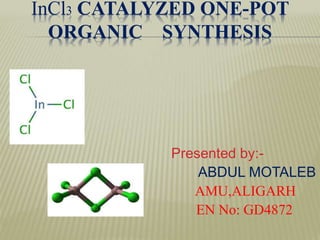

InCl3 CATALYZED ONE-POT 
ORGANIC SYNTHESIS 
Presented by:- 
ABDUL MOTALEB 
AMU,ALIGARH 
EN No: GD4872
CONTENTS 
 INTRODUCTION 
 PREPARATION AND PROPERTIES OF InCl3 
 ADVANTAGES OF InCl3 
 MULTICOMPONENT REACTIONS 
 InCl3 PROMOTED ORGANIC SYENTHESIS 
 APPLICATIONS 
 CONCLUSION 
 REFERENCES
INTRODUCTION 
 Presentation aims to illustrate the progress in a large 
variety of InCl3 catalyzed reactions performed in 
solvent and solvent free conditions. 
 Synthetic potential of InCl3 mediated reactions, 
which have recently emerged as useful strategy in 
organic synthesis. 
 A variety of two component and multicomponent 
reactions catalyzed by InCl3 that led to the 
production of structurally diverse compounds under 
mild reaction conditions.
CONT… 
 Study of the InCl3 catalyzed chemistry have been 
the object of an interest which include the 
development of new synthetic strategies, the 
optimization of reaction conditions and the 
application to the synthesis of bioactive 
derivatives. 
Ref: Yadav, J. S.; Aneesh, A.; Jimil, G.; Reddy, B. V. S. Eur. J. Org. Chem. 2010, 591.
PREPARATION AND PROPERTIES OF 
InCl3 
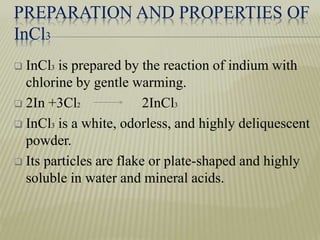
 InCl3 is prepared by the reaction of indium with 
chlorine by gentle warming. 
 2In +3Cl2 2InCl3 
 InCl3 is a white, odorless, and highly deliquescent 
powder. 
 Its particles are flake or plate-shaped and highly 
soluble in water and mineral acids.
ADVANTAGES OF InCl3 
 Development of practical catalysts for efficient synthesis 
is of key importance to both academia and the chemical 
industry. 
 Lewis acid catalysis has attracted much attention in 
organic synthesis. These Lewis acids generally must be 
used under strictly anhydrous conditions. The most 
active Lewis acids such as BF3, TiCl4 and AlCl3 react 
violently with water and can not be used under aqueous 
conditions. 
 In addition, recovery and reuse of the conventional 
Lewis acids are also formidable tasks. These 
disadvantages have restricted the use of Lewis acids in 
organic synthesis under aqueous media.
CONT… 
Some advantages are as follows 
 Compatibility both to aqueous and organic solvent 
 Water stability And Recyclability 
 Highly chemo, regio and stereoselective. 
 Operational simplicity 
 A strong tolerance to oxygen and nitrogen containing 
substrates and functional groups. 
 Its lower heterophilicity makes it an ideal catalyst for 
the C-C bond formation reactions. 
 Harmless and environment friendly. 
 InCl3 is not only compatible with water but also 
cheaper than other indium salts. 
Ref: Braga, A. L.; Schneider, P. H.;Paixao, M. W.; Deobald, A. M. Tetrahedron Lett. 
2006, 47, 7195;
MULTICOMPONENT REACTIONS 
 Multicomponent reactions (MCRs) has emerged as a 
powerful tool in synthetic chemistry for the rapid 
generation of molecular complexity and diversity. 
 Among the various methods of bond formation and 
bond cleavages, multicomponent reactions 
undoubtedly occupy a prime position in organic 
synthesis - 
 Primarily due to their convergent nature. 
 Superior atom-economy. 
 Straightforward experimental procedure. 
Ref: Adib, M.; Sheikhi, E.; Kavoosi, A.; Bijanzadeh, H. R. Tetrahedron 2010, 66, 9263.
InCl3 PROMOTED ORGANIC 
SYENTHESIS 
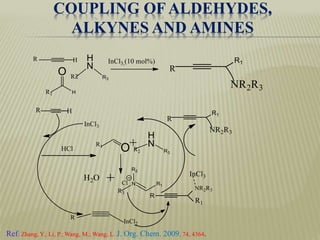
 Coupling of Aldehydes, Alkynes and Amines 
 Synthesis of 1,3,5-tri-substituted benzenes 
 Synthesis of 1,8-naphthyridines 
 Synthesis of carbonyl compounds 
 Synthesis of dihydropyranochromenediones 
 Synthesis of coumarin derivatives 
 InCl3-catalyzed Diels-Alder reaction, Friedel-crafts 
reaction, Mannich reaction 
 One-pot synthesis of quinolines 
 Michael addition reaction 
 Synthesis of functionalized benzof chromenes
COUPLING OF ALDEHYDES, 
ALKYNES AND AMINES 
Ref: Zhang, Y.; Li, P.; Wang, M.; Wang, L. J. Org. Chem. 2009, 74, 4364.
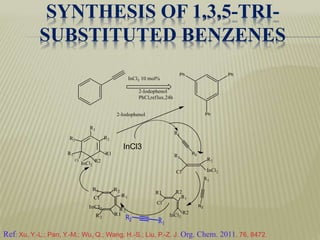
SYNTHESIS OF 1,3,5-TRI-SUBSTITUTED 
BENZENES 
InCl3 
Ref: Xu, Y.-L.; Pan, Y.-M.; Wu, Q.; Wang, H.-S.; Liu, P.-Z. J. Org. Chem. 2011, 76, 8472.
InCl3-CATALYZED FRIEDEL-CRAFTS 
REACTION 
+ 
Ref: Miyai, T.; Onishi, Y.; Baba, A. Tetrahedron Lett. 1998, 39, 6291;
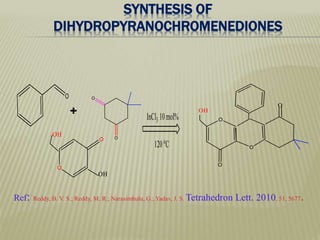
SYNTHESIS OF 
DIHYDROPYRANOCHROMENEDIONES 
+ 
Ref: Reddy, B. V. S.; Reddy, M. R.; Narasimhulu, G.; Yadav, J. S. Tetrahedron Lett. 2010, 51, 5677.
ONE-POT SYNTHESIS OF 
QUINOLINES 
AROMATIZATION 
Ref: Ranu, B. C.; Hajra, A.; Dey, S. S.; Jana, U. Tetrahedron 2003, 59, 813;
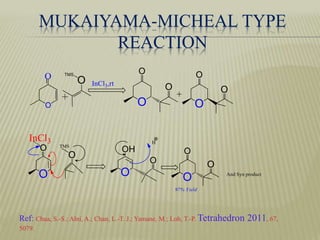
MUKAIYAMA-MICHEAL TYPE 
REACTION 
Ref: Chua, S.-S.; Alni, A.; Chan, L.-T. J.; Yamane, M.; Loh, T.-P. Tetrahedron 2011, 67, 
5079.
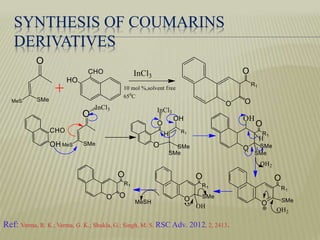
SYNTHESIS OF COUMARINS 
DERIVATIVES 
Ref: Verma, R. K.; Verma, G. K.; Shukla, G.; Singh, M. S. RSC Adv. 2012, 2, 2413.
CONCLUSIONS 
 The result summarized in this presentation clearly indicate 
that there has been continues to be substantial interest in the 
organic transformation promoted by indium chloride. 
 InCl3 is being routinely used todays preparation in simple to 
complex molecules and we described the importance of 
indium chloride in the construction and functionalization of 
various important scaffolds. 
 Indium chloride is cheap, nontoxic, stable to water and 
moisture and easy to handle, all these protocol represents an 
optimal development with regard to economic and ecological 
consideration. 
 Major challenge in future would be to explore the utility of 
InCl3 catalyzed protocol for the synthesis of hitherto 
inaccessible and highly complex scaffolds.
REFERENCES 
 Maya Shankar Singh, Keshav Raghuvanshi 
TETRAHEDRON Report number 987. 
Department of Chemistry (Centre of advanced Study), Faculty of Science, Banaras Hindu 
University, Varanasi 221005, India. 
Received on 31 may 2012
InCl3 catalyst

InCl3 catalyst

  • 1.
    InCl3 CATALYZED ONE-POT ORGANIC SYNTHESIS Presented by:- ABDUL MOTALEB AMU,ALIGARH EN No: GD4872
  • 2.
    CONTENTS  INTRODUCTION  PREPARATION AND PROPERTIES OF InCl3  ADVANTAGES OF InCl3  MULTICOMPONENT REACTIONS  InCl3 PROMOTED ORGANIC SYENTHESIS  APPLICATIONS  CONCLUSION  REFERENCES
  • 3.
    INTRODUCTION  Presentationaims to illustrate the progress in a large variety of InCl3 catalyzed reactions performed in solvent and solvent free conditions.  Synthetic potential of InCl3 mediated reactions, which have recently emerged as useful strategy in organic synthesis.  A variety of two component and multicomponent reactions catalyzed by InCl3 that led to the production of structurally diverse compounds under mild reaction conditions.
  • 4.
    CONT…  Studyof the InCl3 catalyzed chemistry have been the object of an interest which include the development of new synthetic strategies, the optimization of reaction conditions and the application to the synthesis of bioactive derivatives. Ref: Yadav, J. S.; Aneesh, A.; Jimil, G.; Reddy, B. V. S. Eur. J. Org. Chem. 2010, 591.
  • 5.
    PREPARATION AND PROPERTIESOF InCl3  InCl3 is prepared by the reaction of indium with chlorine by gentle warming.  2In +3Cl2 2InCl3  InCl3 is a white, odorless, and highly deliquescent powder.  Its particles are flake or plate-shaped and highly soluble in water and mineral acids.
  • 6.
    ADVANTAGES OF InCl3  Development of practical catalysts for efficient synthesis is of key importance to both academia and the chemical industry.  Lewis acid catalysis has attracted much attention in organic synthesis. These Lewis acids generally must be used under strictly anhydrous conditions. The most active Lewis acids such as BF3, TiCl4 and AlCl3 react violently with water and can not be used under aqueous conditions.  In addition, recovery and reuse of the conventional Lewis acids are also formidable tasks. These disadvantages have restricted the use of Lewis acids in organic synthesis under aqueous media.
  • 7.
    CONT… Some advantagesare as follows  Compatibility both to aqueous and organic solvent  Water stability And Recyclability  Highly chemo, regio and stereoselective.  Operational simplicity  A strong tolerance to oxygen and nitrogen containing substrates and functional groups.  Its lower heterophilicity makes it an ideal catalyst for the C-C bond formation reactions.  Harmless and environment friendly.  InCl3 is not only compatible with water but also cheaper than other indium salts. Ref: Braga, A. L.; Schneider, P. H.;Paixao, M. W.; Deobald, A. M. Tetrahedron Lett. 2006, 47, 7195;
  • 8.
    MULTICOMPONENT REACTIONS Multicomponent reactions (MCRs) has emerged as a powerful tool in synthetic chemistry for the rapid generation of molecular complexity and diversity.  Among the various methods of bond formation and bond cleavages, multicomponent reactions undoubtedly occupy a prime position in organic synthesis -  Primarily due to their convergent nature.  Superior atom-economy.  Straightforward experimental procedure. Ref: Adib, M.; Sheikhi, E.; Kavoosi, A.; Bijanzadeh, H. R. Tetrahedron 2010, 66, 9263.
  • 9.
    InCl3 PROMOTED ORGANIC SYENTHESIS  Coupling of Aldehydes, Alkynes and Amines  Synthesis of 1,3,5-tri-substituted benzenes  Synthesis of 1,8-naphthyridines  Synthesis of carbonyl compounds  Synthesis of dihydropyranochromenediones  Synthesis of coumarin derivatives  InCl3-catalyzed Diels-Alder reaction, Friedel-crafts reaction, Mannich reaction  One-pot synthesis of quinolines  Michael addition reaction  Synthesis of functionalized benzof chromenes
  • 10.
    COUPLING OF ALDEHYDES, ALKYNES AND AMINES Ref: Zhang, Y.; Li, P.; Wang, M.; Wang, L. J. Org. Chem. 2009, 74, 4364.
  • 11.
    SYNTHESIS OF 1,3,5-TRI-SUBSTITUTED BENZENES InCl3 Ref: Xu, Y.-L.; Pan, Y.-M.; Wu, Q.; Wang, H.-S.; Liu, P.-Z. J. Org. Chem. 2011, 76, 8472.
  • 12.
    InCl3-CATALYZED FRIEDEL-CRAFTS REACTION + Ref: Miyai, T.; Onishi, Y.; Baba, A. Tetrahedron Lett. 1998, 39, 6291;
  • 13.
    SYNTHESIS OF DIHYDROPYRANOCHROMENEDIONES + Ref: Reddy, B. V. S.; Reddy, M. R.; Narasimhulu, G.; Yadav, J. S. Tetrahedron Lett. 2010, 51, 5677.
  • 14.
    ONE-POT SYNTHESIS OF QUINOLINES AROMATIZATION Ref: Ranu, B. C.; Hajra, A.; Dey, S. S.; Jana, U. Tetrahedron 2003, 59, 813;
  • 15.
    MUKAIYAMA-MICHEAL TYPE REACTION Ref: Chua, S.-S.; Alni, A.; Chan, L.-T. J.; Yamane, M.; Loh, T.-P. Tetrahedron 2011, 67, 5079.
  • 16.
    SYNTHESIS OF COUMARINS DERIVATIVES Ref: Verma, R. K.; Verma, G. K.; Shukla, G.; Singh, M. S. RSC Adv. 2012, 2, 2413.
  • 17.
    CONCLUSIONS  Theresult summarized in this presentation clearly indicate that there has been continues to be substantial interest in the organic transformation promoted by indium chloride.  InCl3 is being routinely used todays preparation in simple to complex molecules and we described the importance of indium chloride in the construction and functionalization of various important scaffolds.  Indium chloride is cheap, nontoxic, stable to water and moisture and easy to handle, all these protocol represents an optimal development with regard to economic and ecological consideration.  Major challenge in future would be to explore the utility of InCl3 catalyzed protocol for the synthesis of hitherto inaccessible and highly complex scaffolds.
  • 18.
    REFERENCES  MayaShankar Singh, Keshav Raghuvanshi TETRAHEDRON Report number 987. Department of Chemistry (Centre of advanced Study), Faculty of Science, Banaras Hindu University, Varanasi 221005, India. Received on 31 may 2012

Editor's Notes

  • #11 Ref: Zhang, Y.; Li, P.; Wang, M.; Wang, L. J. Org. Chem. 2009, 74, 4364.