In Conservative Times
        Grace Soto
      Michael Fetchet
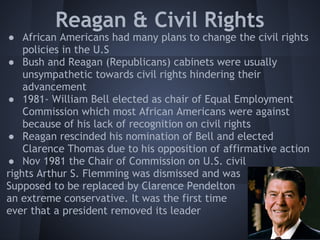
Reagan & Civil Rights
● African Americans had many plans to change the civil rights
    policies in the U.S
● Bush and Reagan (Republicans) cabinets were usually
    unsympathetic towards civil rights hindering their
    advancement
● 1981- William Bell elected as chair of Equal Employment
    Commission which most African Americans were against
    because of his lack of recognition on civil rights
● Reagan rescinded his nomination of Bell and elected
    Clarence Thomas due to his opposition of affirmative action
● Nov 1981 the Chair of Commission on U.S. civil
rights Arthur S. Flemming was dismissed and was
Supposed to be replaced by Clarence Pendelton
an extreme conservative. It was the first time
ever that a president removed its leader
● In 1982 Reagan made it clear that he would only elect
  people who were against civil rights since the beginning of
  the 60'2
● People from the Senate Judiciary Committee asked the
  president not to elect these people because it "tainted the
  integrity" of the commission
● Reagan however fired leaders of the Civil Rights Commission
  which almost decimated it
● Dec. 1985 Julius Chambers director of the NAACP Legal
  Defense Fund stated clearly that Reagan fought for voting
  rights, school desegregation and equal employment
● Thornburg v. Gingles- Ruled in favor of a voter, which said
  that voting districts were discriminatory in North Carolina
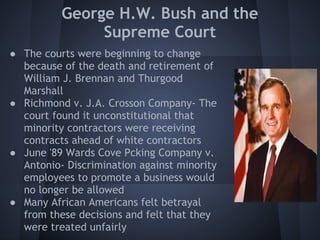
George H.W. Bush and the
               Supreme Court
● The courts were beginning to change
  because of the death and retirement of
  William J. Brennan and Thurgood
  Marshall
● Richmond v. J.A. Crosson Company- The
  court found it unconstitutional that
  minority contractors were receiving
  contracts ahead of white contractors
● June '89 Wards Cove Pcking Company v.
  Antonio- Discrimination against minority
  employees to promote a business would
  no longer be allowed
● Many African Americans felt betrayal
  from these decisions and felt that they
  were treated unfairly
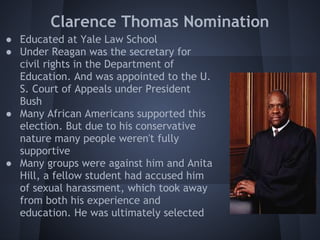
Clarence Thomas Nomination
● Educated at Yale Law School
● Under Reagan was the secretary for
  civil rights in the Department of
  Education. And was appointed to the U.
  S. Court of Appeals under President
  Bush
● Many African Americans supported this
  election. But due to his conservative
  nature many people weren't fully
  supportive
● Many groups were against him and Anita
  Hill, a fellow student had accused him
  of sexual harassment, which took away
  from both his experience and
  education. He was ultimately selected
Judicial Conservatism

● During the Reagan and Bush administration this
  conservatism was seen as a way to weaken black voters
● June '95- Supreme Court found Georgia's voting district
  violated constitutional rights of equal protection for white
  voters
● This decision also occurred in areas of North Carolina &
  Louisiana
● Black voters subsequently joined the Black Caucus
● Clinton administration and scholars joined in an effort to
  overcome the court's decision
Educational Disparities
● Racially separate and unequal schools, continued even
  45 years after the Supreme Court made the decision to
  outlaw segregation in public schools
● A not-so-subtle argument was being made that the
  presence of "inferior" blacks was affecting the
  education of whites
● The Bell Curve: Intelligence in Class Structure in
  American Life published in 1994 by Richard Herrnstein
  and Charles Murray, spoke on the idea that blacks
  were inherently intellectually inferior
● Herrnstein and Murray agreed that blacks and whites
  should not have the same educational opportunities
Educational Disparities continued...
● Because of the violence in suburban schools, some
    black parents looked for other options to be able to
    continue on the education of their children
●   There were too little All-black privates schools
    (Milwaukee) to take in all the students whom needed
    schools
●   Muslim schools and quasi-public charter schools as well
    as many others were being located to try to get more
    students in but the availability of room for more
    students was too little to help
●   Catholic schools, especially in Boston, New York, and
    Chicago became very important alternatives for black
    parents
....
● By 1999 not enough financial support was given which
  led to systematic closing of parochial schools
  (religious) in many inner city areas
● Because of lack of financial support for inner city area
  school black children were deprived of the opportunity
  of digital divide, then becoming unprepared for the
  20th century
● By mid 1960s the feared happen, colleges and
  universities no longer were looking for a racially
  diverse student body
● Civil right era enrollments started (diversity)
● This was in hopes to make change, but became very
  criticised
Opposition to Affirmative Action
● In the 1990s Mainstream media became used to help a
    new voice be heard louder than ever before
●   The most vocal opposition to affirmative action
    policies ("reverse discrimination"), were constituted by
    Economist Professors Thomas Sowell, Walter Williams,
    and Glenn Loury, as well as English Professor Shelby
    Steele
●   California Board of Regent, African American member
    Ward Connerly, helped organize conservative voters in
    a campaign that successfully enacted Proposition 209
    in 1996
Opposition to Affirmative Action
● African American enrollment dropped at the
  University of Washington after the passing
  of a California-style law and at the
  University of Texas Law school
● Cheryl Hopwood, a white women who
  challenged the use of race as a factor in its
  admissions process (U of Texas Law)
Racial Unrest
● More new was being put out about racial profiling and
    violence
●   March 1991, Rodney King, an African American,
    arrested following a high-speed chase by white Los
    Angeles police officer, severely beaten by the officer,
    officer accused him of resisting arrest and that he had
    been threatened
●   The beating was caught on tape by surveillance
    camera, because of this a public outcry for the
    dismissal of Los Angeles chief of police Daryl Gates,
    and that the officers be tried for using excessive force
In conservative times

In conservative times

  • 1.
    In Conservative Times Grace Soto Michael Fetchet
  • 2.
    Reagan & CivilRights ● African Americans had many plans to change the civil rights policies in the U.S ● Bush and Reagan (Republicans) cabinets were usually unsympathetic towards civil rights hindering their advancement ● 1981- William Bell elected as chair of Equal Employment Commission which most African Americans were against because of his lack of recognition on civil rights ● Reagan rescinded his nomination of Bell and elected Clarence Thomas due to his opposition of affirmative action ● Nov 1981 the Chair of Commission on U.S. civil rights Arthur S. Flemming was dismissed and was Supposed to be replaced by Clarence Pendelton an extreme conservative. It was the first time ever that a president removed its leader
  • 3.
    ● In 1982Reagan made it clear that he would only elect people who were against civil rights since the beginning of the 60'2 ● People from the Senate Judiciary Committee asked the president not to elect these people because it "tainted the integrity" of the commission ● Reagan however fired leaders of the Civil Rights Commission which almost decimated it ● Dec. 1985 Julius Chambers director of the NAACP Legal Defense Fund stated clearly that Reagan fought for voting rights, school desegregation and equal employment ● Thornburg v. Gingles- Ruled in favor of a voter, which said that voting districts were discriminatory in North Carolina
  • 4.
    George H.W. Bushand the Supreme Court ● The courts were beginning to change because of the death and retirement of William J. Brennan and Thurgood Marshall ● Richmond v. J.A. Crosson Company- The court found it unconstitutional that minority contractors were receiving contracts ahead of white contractors ● June '89 Wards Cove Pcking Company v. Antonio- Discrimination against minority employees to promote a business would no longer be allowed ● Many African Americans felt betrayal from these decisions and felt that they were treated unfairly
  • 5.
    Clarence Thomas Nomination ●Educated at Yale Law School ● Under Reagan was the secretary for civil rights in the Department of Education. And was appointed to the U. S. Court of Appeals under President Bush ● Many African Americans supported this election. But due to his conservative nature many people weren't fully supportive ● Many groups were against him and Anita Hill, a fellow student had accused him of sexual harassment, which took away from both his experience and education. He was ultimately selected
  • 6.
    Judicial Conservatism ● Duringthe Reagan and Bush administration this conservatism was seen as a way to weaken black voters ● June '95- Supreme Court found Georgia's voting district violated constitutional rights of equal protection for white voters ● This decision also occurred in areas of North Carolina & Louisiana ● Black voters subsequently joined the Black Caucus ● Clinton administration and scholars joined in an effort to overcome the court's decision
  • 7.
    Educational Disparities ● Raciallyseparate and unequal schools, continued even 45 years after the Supreme Court made the decision to outlaw segregation in public schools ● A not-so-subtle argument was being made that the presence of "inferior" blacks was affecting the education of whites ● The Bell Curve: Intelligence in Class Structure in American Life published in 1994 by Richard Herrnstein and Charles Murray, spoke on the idea that blacks were inherently intellectually inferior ● Herrnstein and Murray agreed that blacks and whites should not have the same educational opportunities
  • 8.
    Educational Disparities continued... ●Because of the violence in suburban schools, some black parents looked for other options to be able to continue on the education of their children ● There were too little All-black privates schools (Milwaukee) to take in all the students whom needed schools ● Muslim schools and quasi-public charter schools as well as many others were being located to try to get more students in but the availability of room for more students was too little to help ● Catholic schools, especially in Boston, New York, and Chicago became very important alternatives for black parents
  • 9.
    .... ● By 1999not enough financial support was given which led to systematic closing of parochial schools (religious) in many inner city areas ● Because of lack of financial support for inner city area school black children were deprived of the opportunity of digital divide, then becoming unprepared for the 20th century ● By mid 1960s the feared happen, colleges and universities no longer were looking for a racially diverse student body ● Civil right era enrollments started (diversity) ● This was in hopes to make change, but became very criticised
  • 10.
    Opposition to AffirmativeAction ● In the 1990s Mainstream media became used to help a new voice be heard louder than ever before ● The most vocal opposition to affirmative action policies ("reverse discrimination"), were constituted by Economist Professors Thomas Sowell, Walter Williams, and Glenn Loury, as well as English Professor Shelby Steele ● California Board of Regent, African American member Ward Connerly, helped organize conservative voters in a campaign that successfully enacted Proposition 209 in 1996
  • 11.
    Opposition to AffirmativeAction ● African American enrollment dropped at the University of Washington after the passing of a California-style law and at the University of Texas Law school ● Cheryl Hopwood, a white women who challenged the use of race as a factor in its admissions process (U of Texas Law)
  • 12.
    Racial Unrest ● Morenew was being put out about racial profiling and violence ● March 1991, Rodney King, an African American, arrested following a high-speed chase by white Los Angeles police officer, severely beaten by the officer, officer accused him of resisting arrest and that he had been threatened ● The beating was caught on tape by surveillance camera, because of this a public outcry for the dismissal of Los Angeles chief of police Daryl Gates, and that the officers be tried for using excessive force