WHO Indicator and Measurement Registry (IMR)
                  SDMX-HD Summary Data Format


                                             Patrick Whitaker


1|   Health Care Informatics | May 9, 2012
Definitions

 M&E – Monitoring and Evaluation

 Summary data – Data summarized from raw, e.g. clinical, data

 Indicator – An indicator quantifies and simplifies phenomena and helps us
  understand complex realities. Indicators are aggregates of raw and
  processed data but they can be further aggregated to form complex indices.
  International Institute for Sustainable Development (IISD)

 IMR – WHO Indicator and Measurement Registry

 SDMX – Statistical Data and Metadata Exchange(ISO/TS 17369:2005)

 SDMX-HD – WHO implementation of SDMX for the health domain


 2|   Health Care Informatics | May 9, 2012
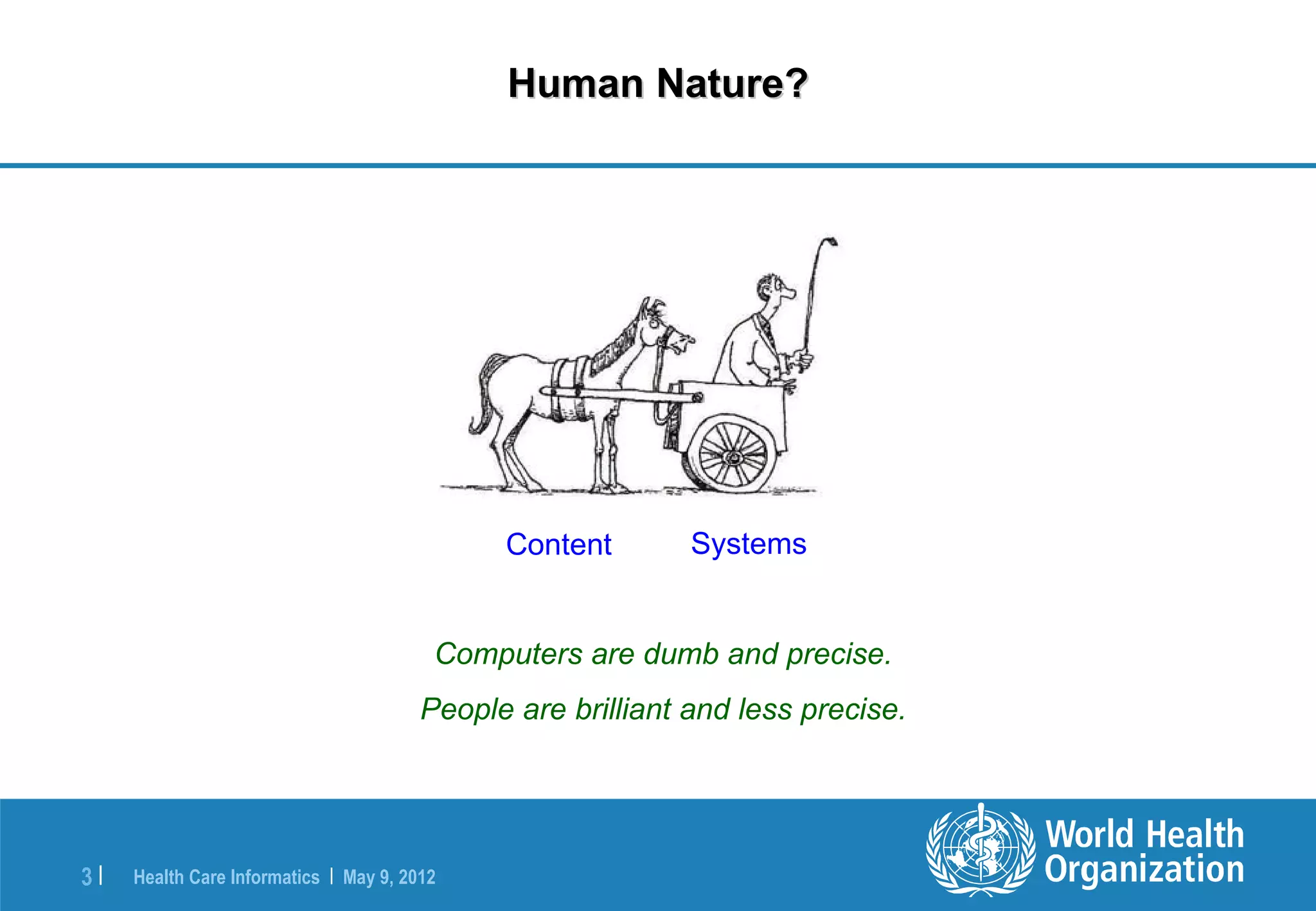
Human Nature?


                                              Content        Systems


                                         Computers are dumb and precise.
                                        People are brilliant and less precise.


3|   Health Care Informatics | May 9, 2012
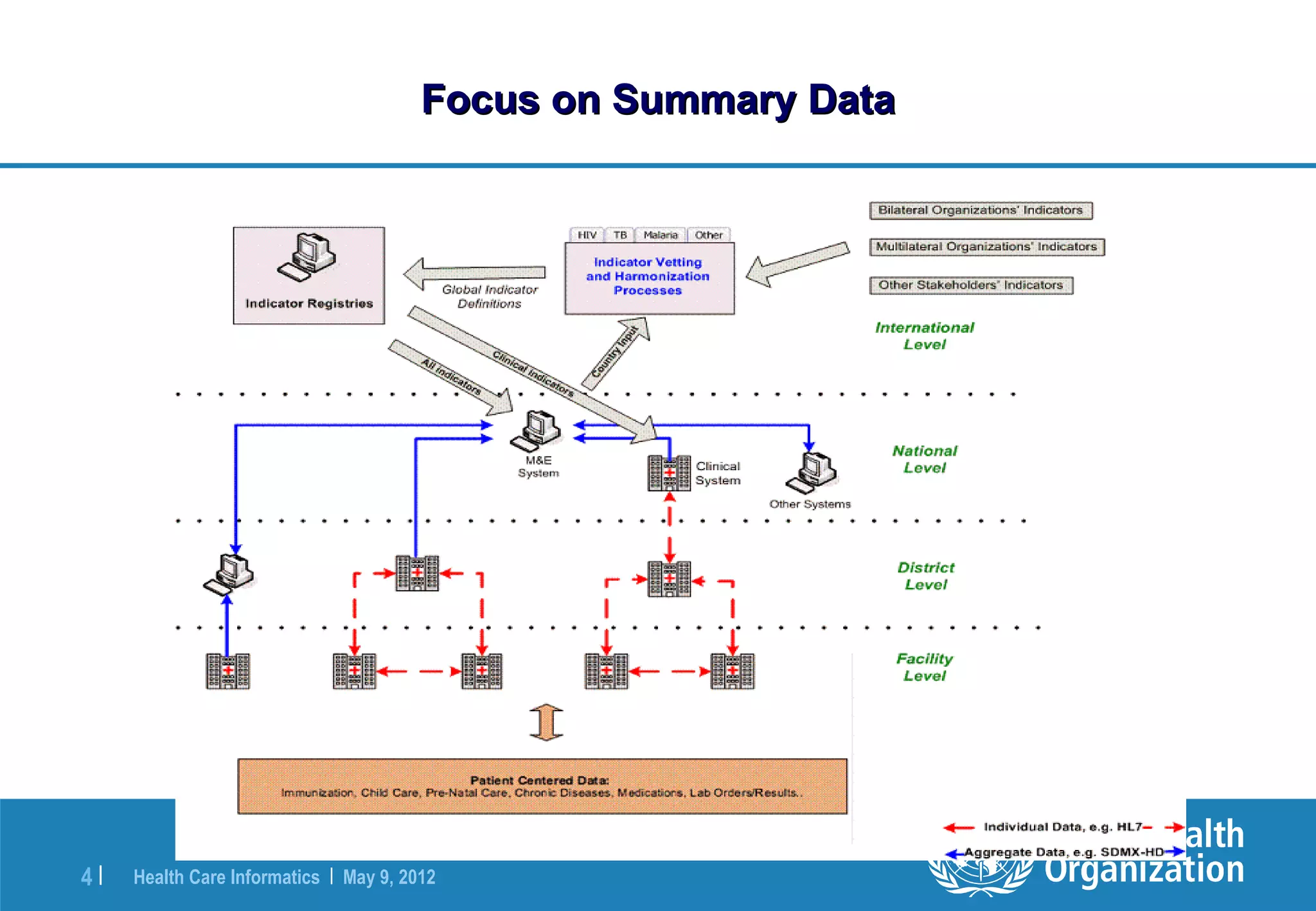
Focus on Summary Data


4|   Health Care Informatics | May 9, 2012
Issues Impacting Interoperability


 Multitude of guidelines documents.

 Insufficient metadata in indicator definitions.

 Competing organizational standards.

 Weak harmonization processes.

 Lack of a global repository for indicator (and clinical concept) definitions.

 Lack of a standard exchange format for summary data.


 5|   Health Care Informatics | May 9, 2012
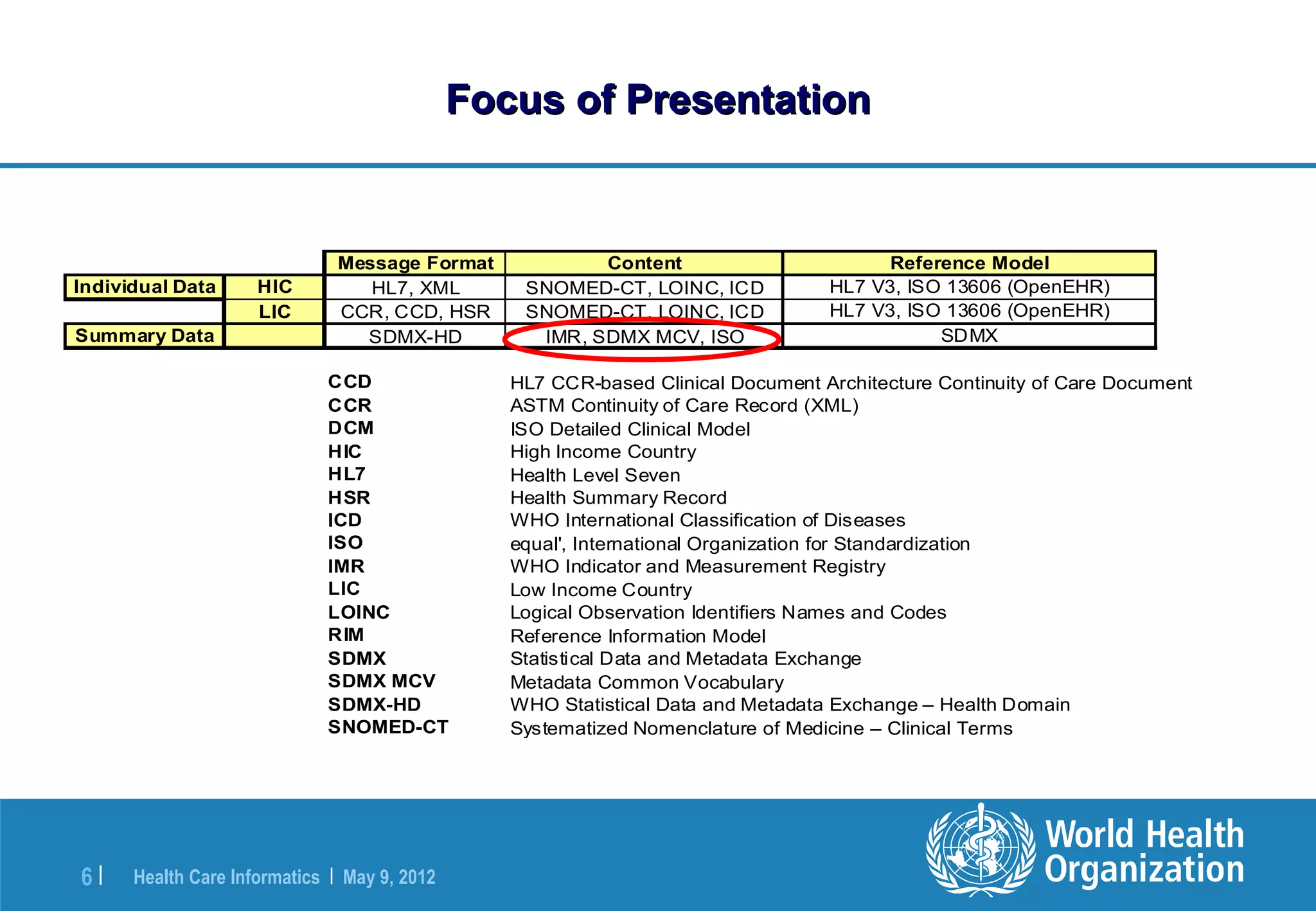
Focus of Presentation


                               Message Format            Content                        Reference Model
Individual Data      HIC          HL7, XML        SNOMED-CT, LOINC, ICD           HL7 V3, ISO 13606 (OpenEHR)
                     LIC       CCR, CCD, HSR      SNOMED-CT, LOINC, ICD           HL7 V3, ISO 13606 (OpenEHR)
Summary Data                     SDMX-HD           IMR, SDMX MCV, ISO                        SDMX

                             CCD                 HL7 CCR-based Clinical Document Architecture Continuity of Care Document
                             CCR                 ASTM Continuity of Care Record (XML)
                             DCM                 ISO Detailed Clinical Model
                             HIC                 High Income Country
                             HL7                 Health Level Seven
                             HSR                 Health Summary Record
                             ICD                 WHO International Classification of Diseases
                             ISO                 equal', International Organization for Standardization
                             IMR                 WHO Indicator and Measurement Registry
                             LIC                 Low Income Country
                             LOINC               Logical Observation Identifiers Names and Codes
                             RIM                 Reference Information Model
                             SDMX                Statistical Data and Metadata Exchange
                             SDMX MCV            Metadata Common Vocabulary
                             SDMX-HD             WHO Statistical Data and Metadata Exchange – Health Domain
                             SNOMED-CT           Systematized Nomenclature of Medicine – Clinical Terms


6|    Health Care Informatics | May 9, 2012
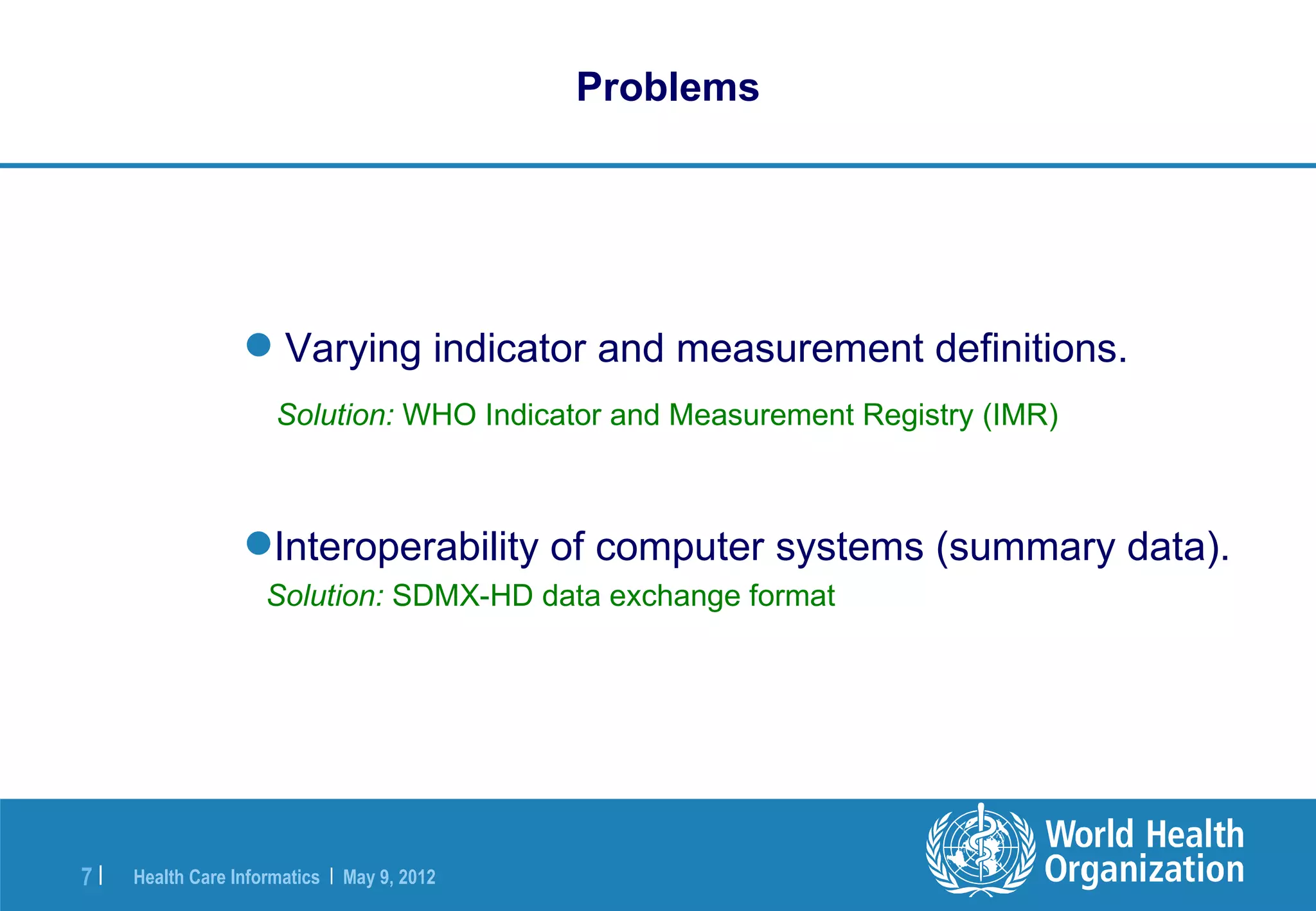
Problems


                   Varying indicator and measurement definitions.
                      Solution: WHO Indicator and Measurement Registry (IMR)


                  Interoperability of computer systems (summary data).
                     Solution: SDMX-HD data exchange format


7|   Health Care Informatics | May 9, 2012
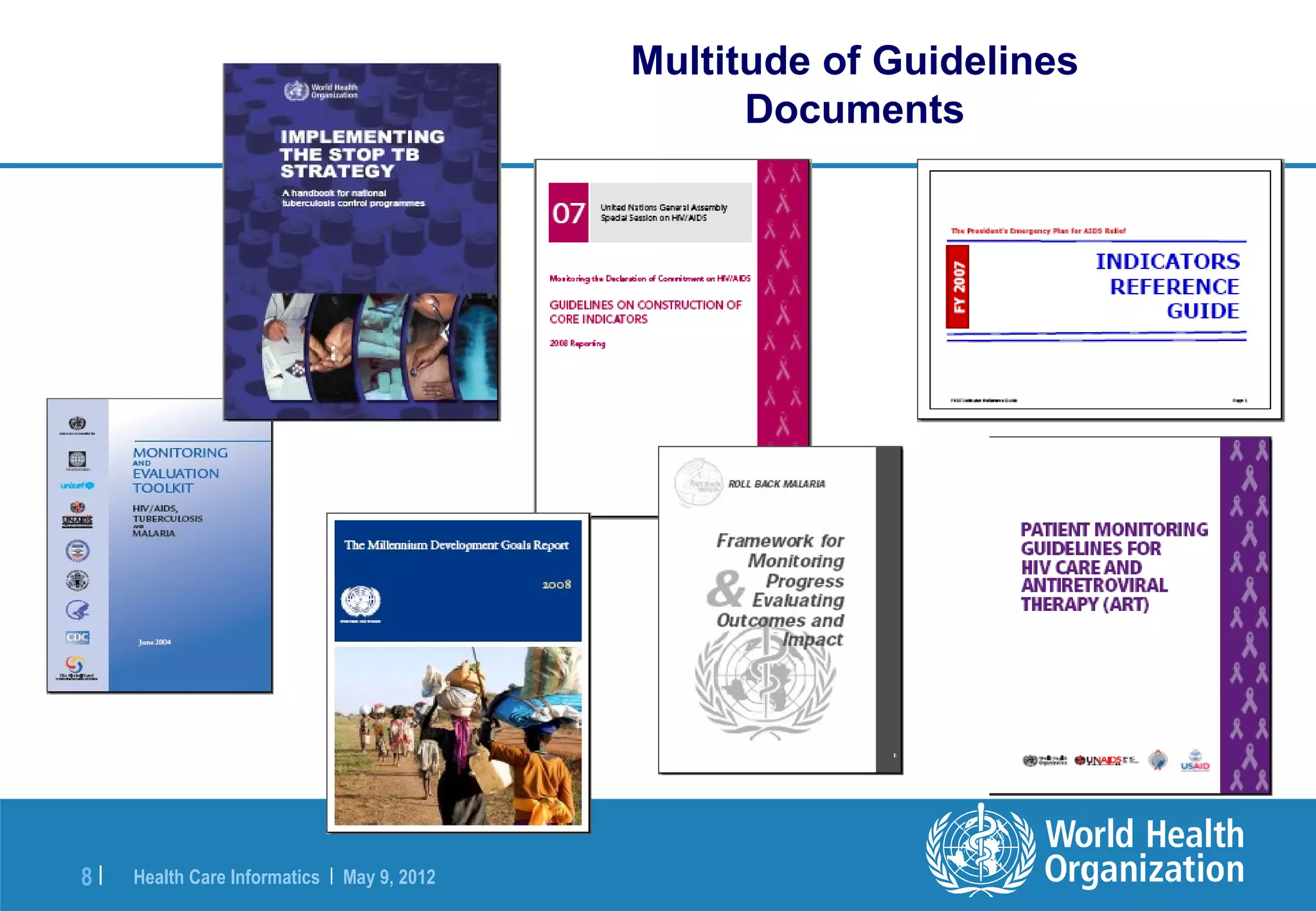
Multitude of Guidelines
                                                   Documents


8|   Health Care Informatics | May 9, 2012
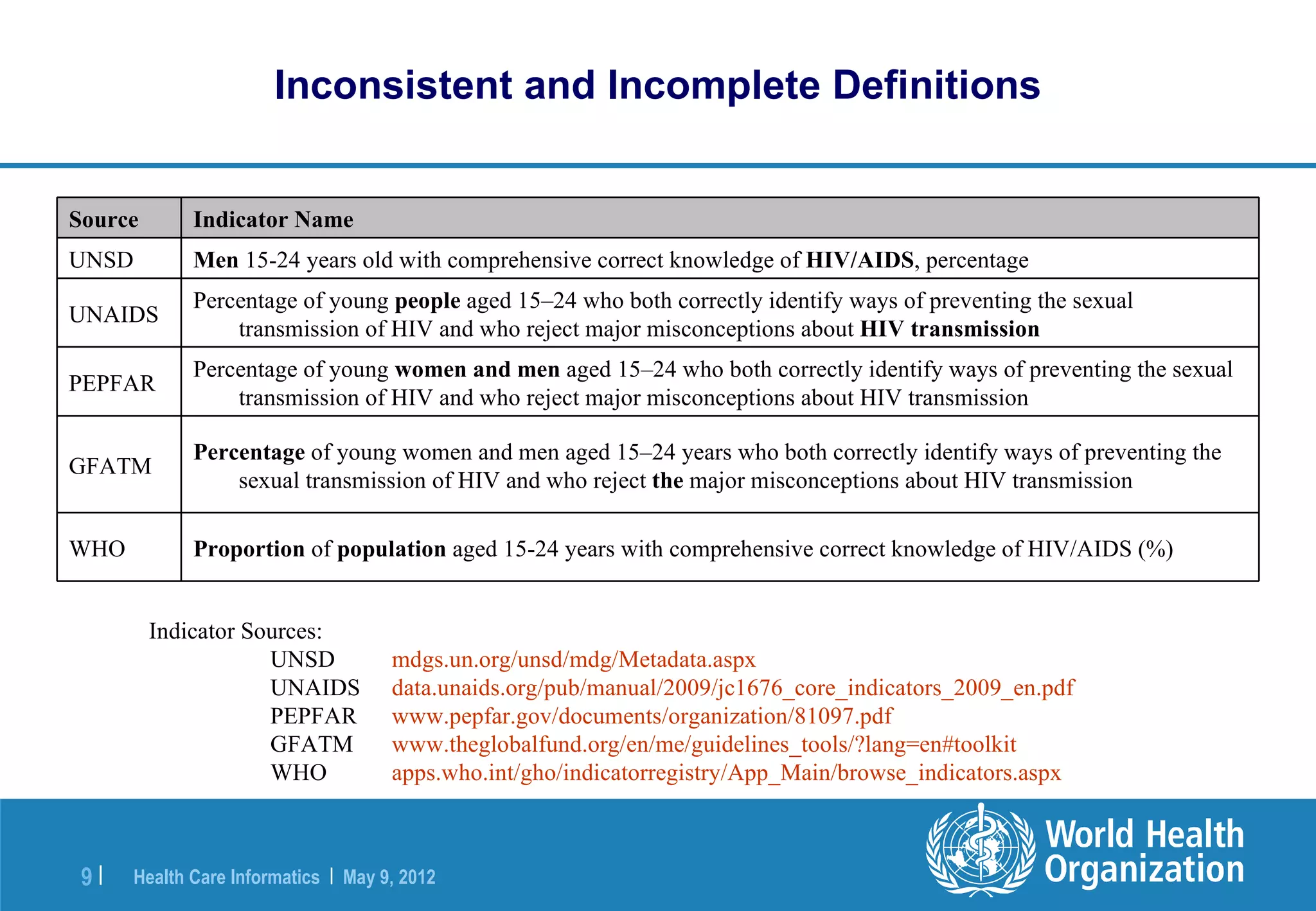
Inconsistent and Incomplete Definitions


Source       Indicator Name
UNSD         Men 15-24 years old with comprehensive correct knowledge of HIV/AIDS, percentage
             Percentage of young people aged 15–24 who both correctly identify ways of preventing the sexual
UNAIDS
                 transmission of HIV and who reject major misconceptions about HIV transmission
             Percentage of young women and men aged 15–24 who both correctly identify ways of preventing the sexual
PEPFAR
                 transmission of HIV and who reject major misconceptions about HIV transmission

             Percentage of young women and men aged 15–24 years who both correctly identify ways of preventing the
GFATM
                 sexual transmission of HIV and who reject the major misconceptions about HIV transmission

WHO          Proportion of population aged 15-24 years with comprehensive correct knowledge of HIV/AIDS (%)


         Indicator Sources:
                     UNSD            mdgs.un.org/unsd/mdg/Metadata.aspx
                     UNAIDS          data.unaids.org/pub/manual/2009/jc1676_core_indicators_2009_en.pdf
                     PEPFAR          www.pepfar.gov/documents/organization/81097.pdf
                     GFATM           www.theglobalfund.org/en/me/guidelines_tools/?lang=en#toolkit
                     WHO             apps.who.int/gho/indicatorregistry/App_Main/browse_indicators.aspx


 9|   Health Care Informatics | May 9, 2012
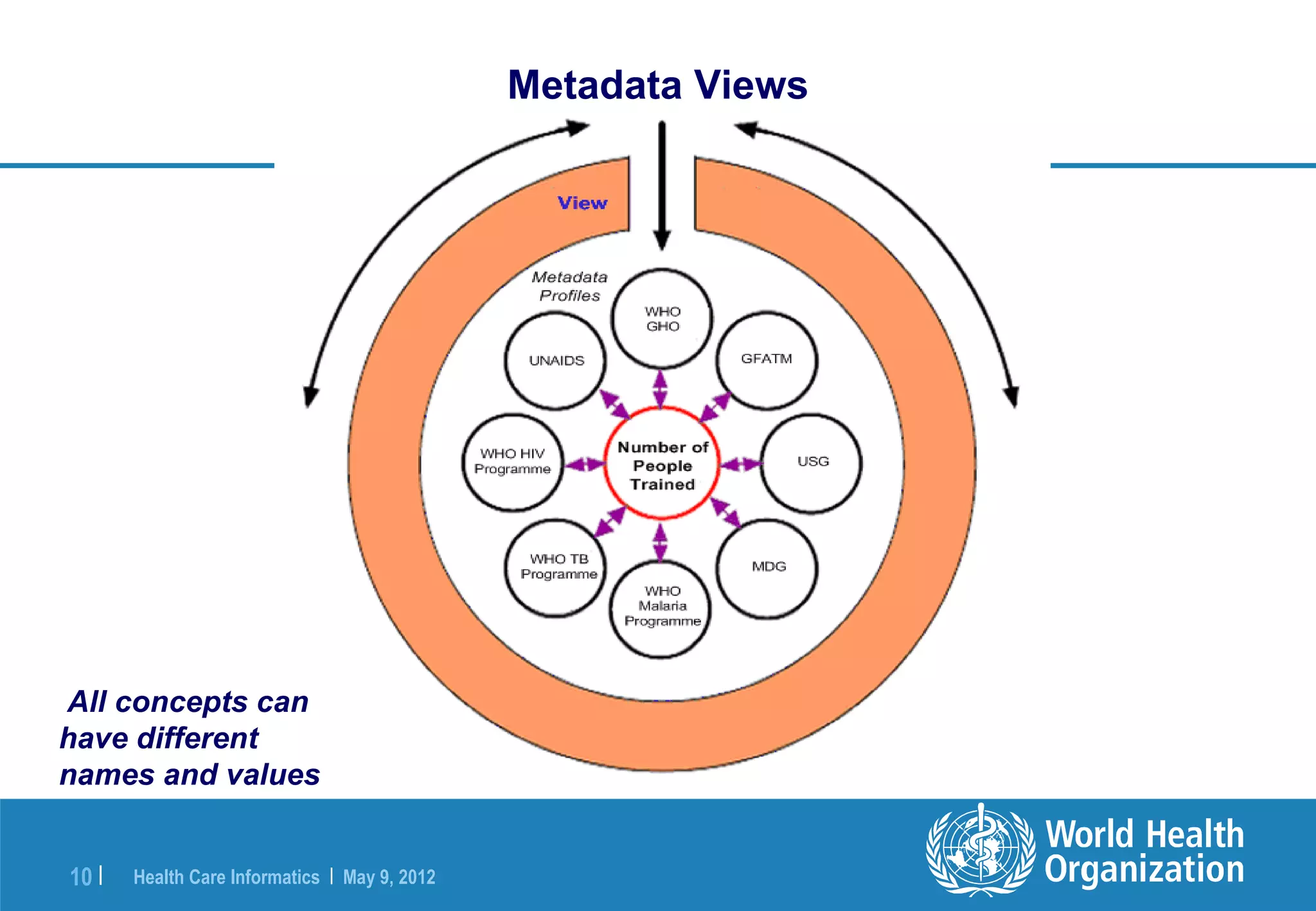
Metadata Views


All concepts can
have different
names and values


10 |   Health Care Informatics | May 9, 2012
IMR
                                WHO Indicator and Measurement Registry


11 |   Health Care Informatics | May 9, 2012
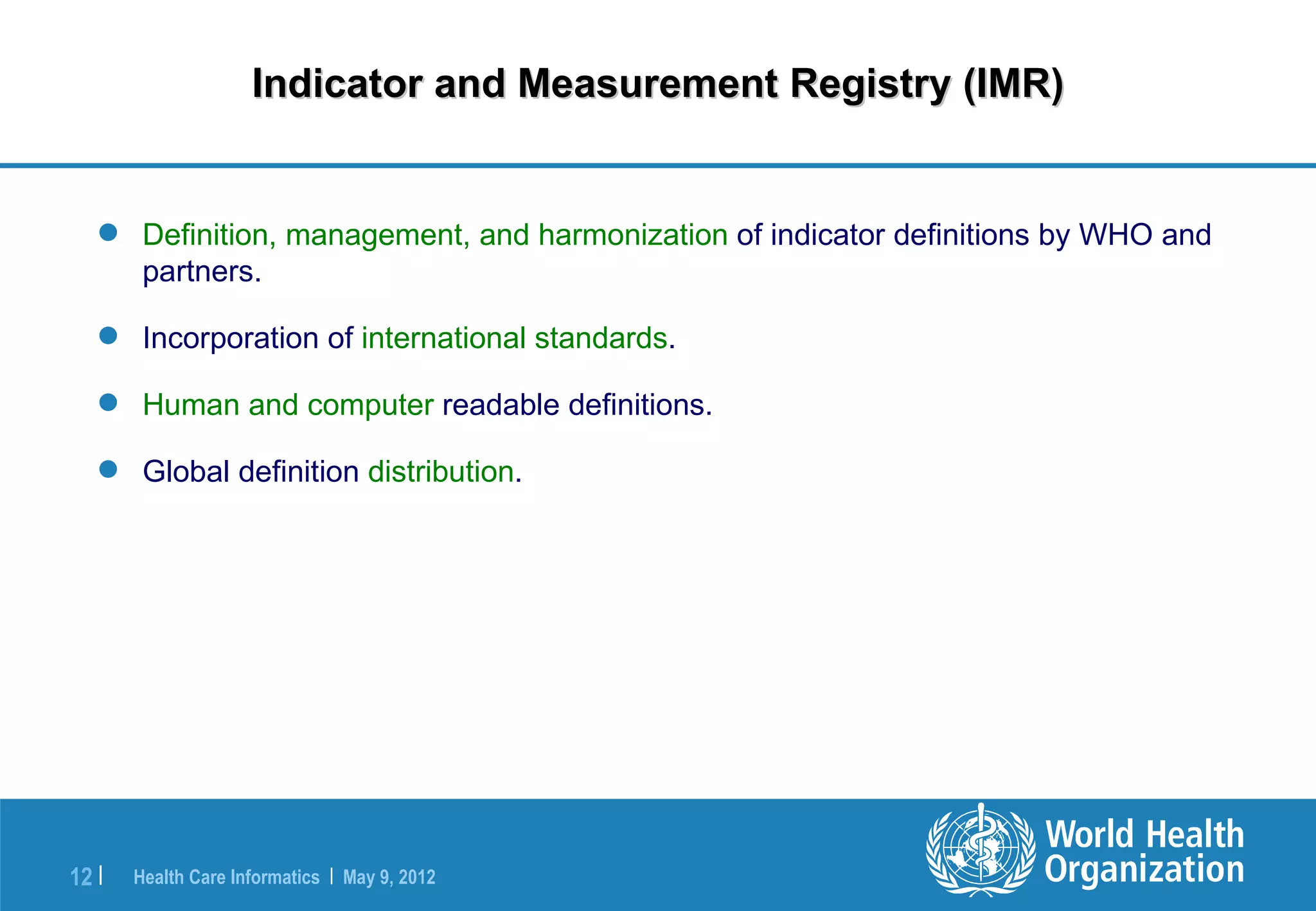
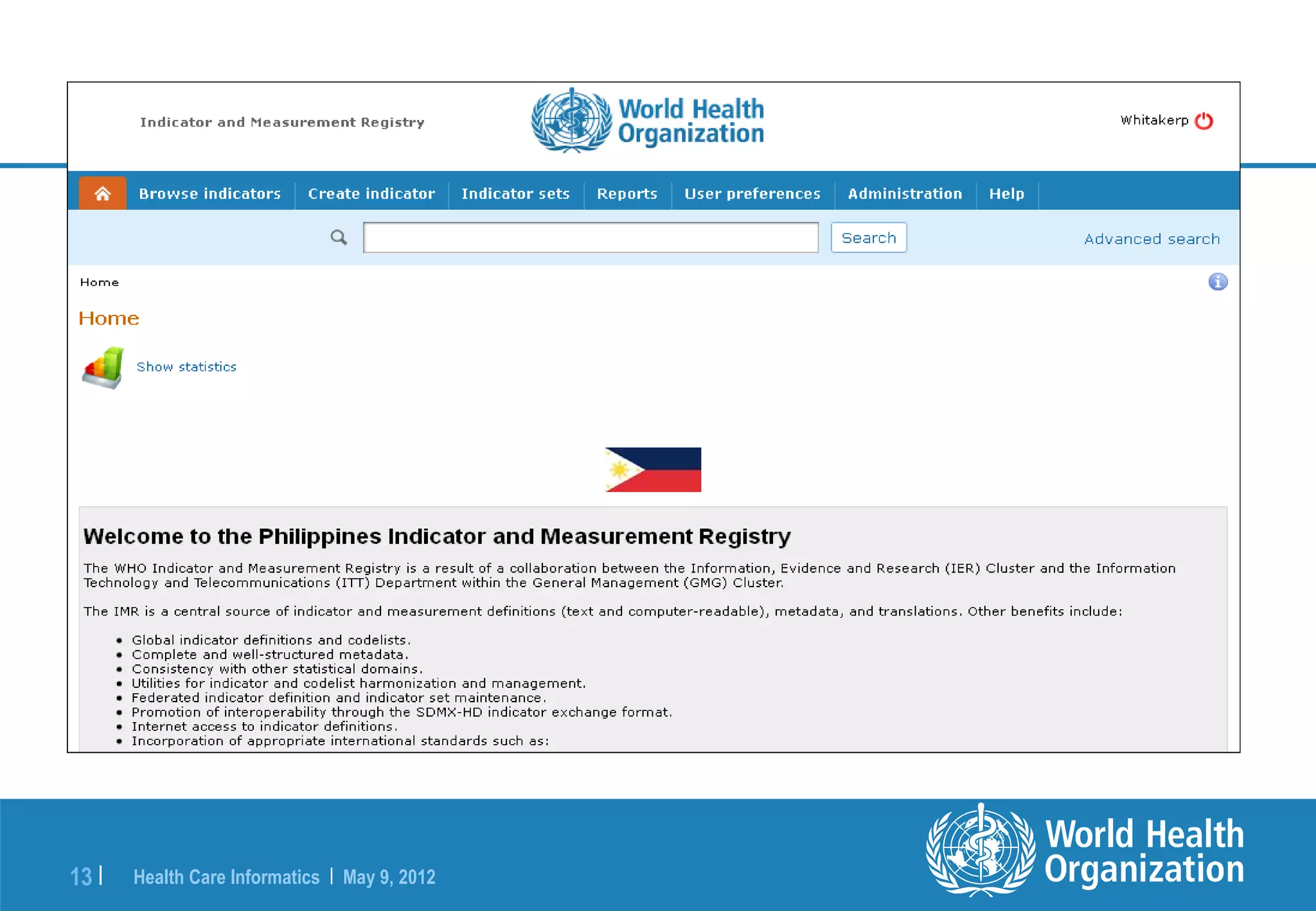
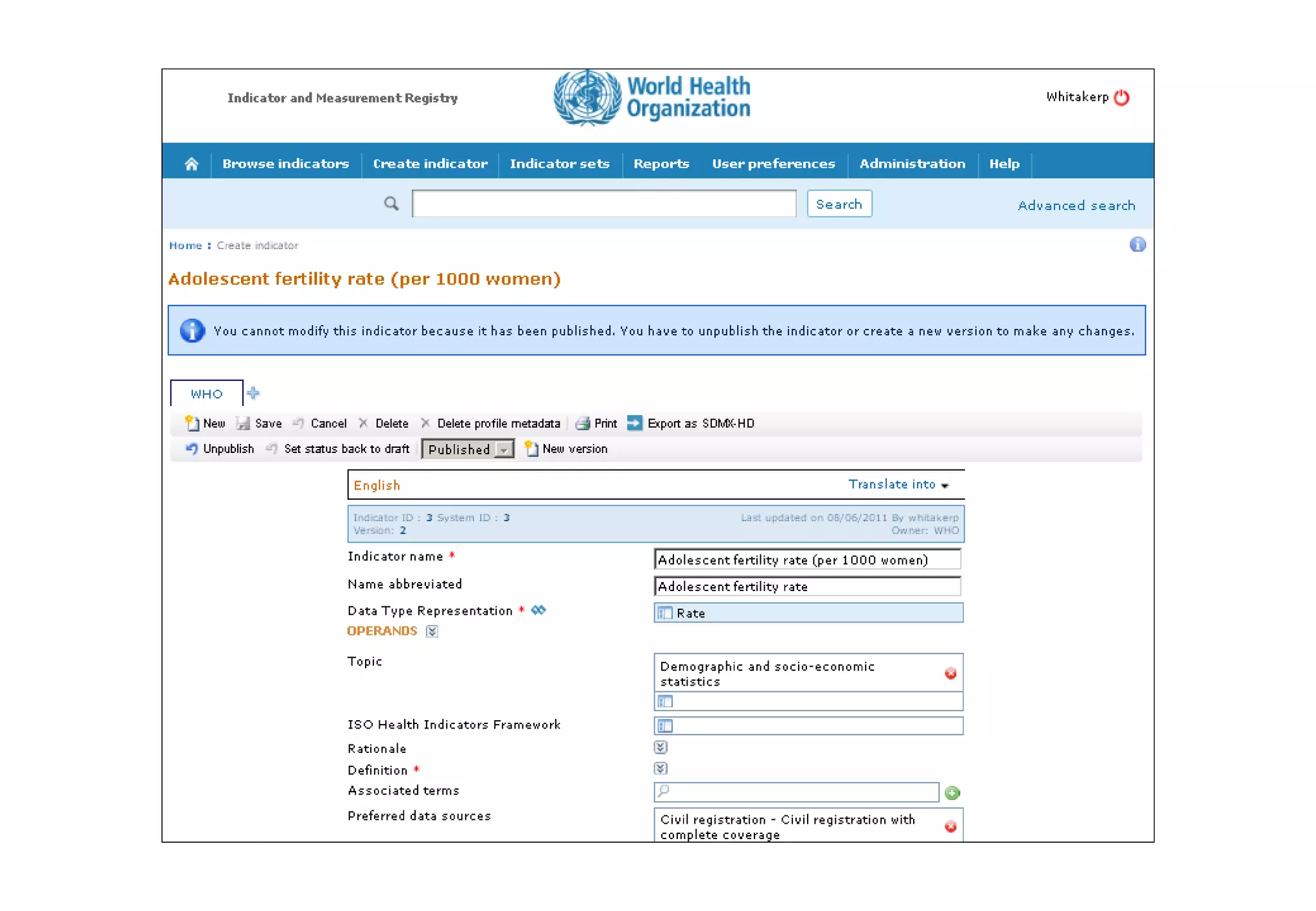
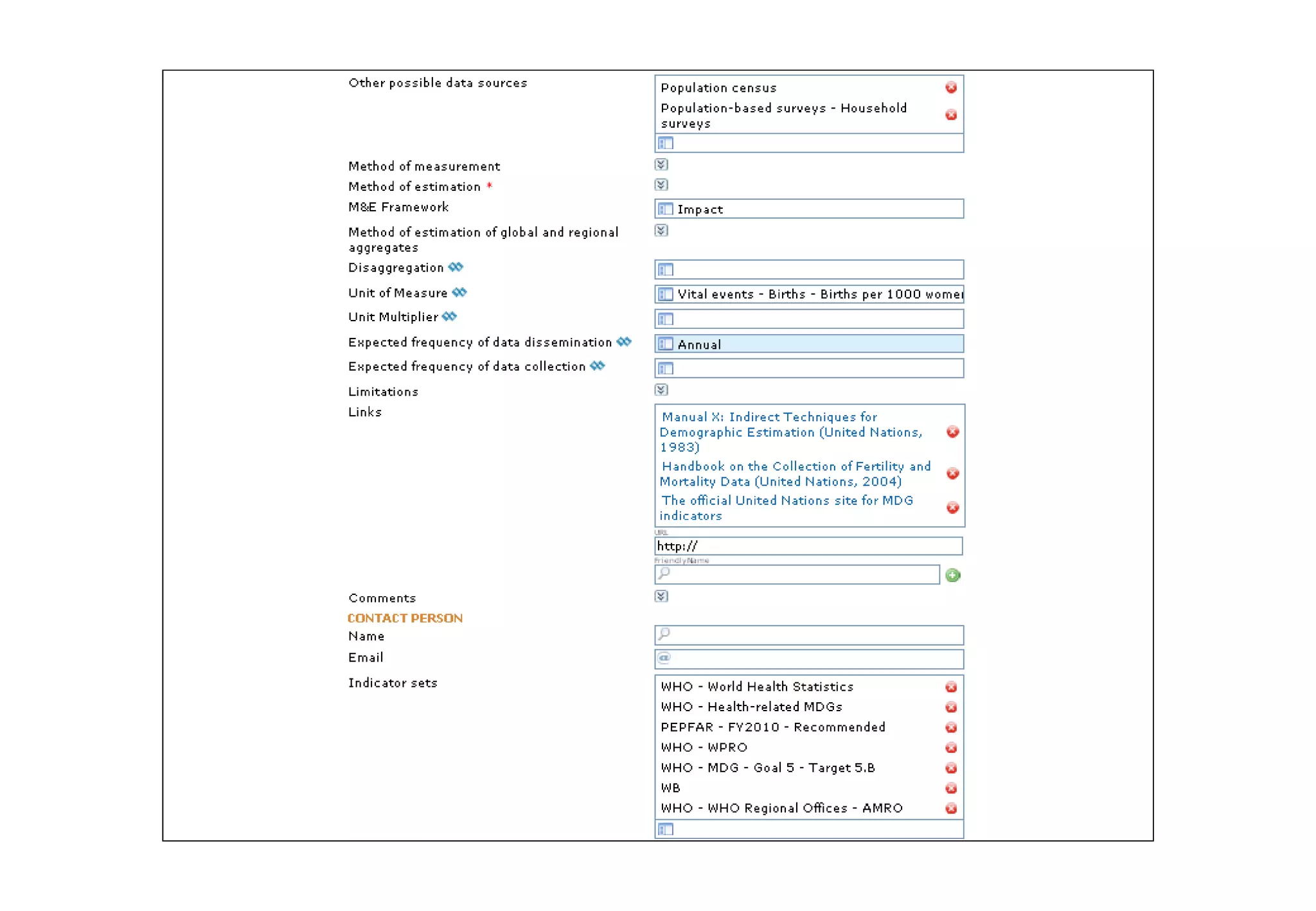
Indicator and Measurement Registry (IMR)


    Definition, management, and harmonization of indicator definitions by WHO and
     partners.

    Incorporation of international standards.

    Human and computer readable definitions.

    Global definition distribution.


12 |   Health Care Informatics | May 9, 2012
13 |   Health Care Informatics | May 9, 2012
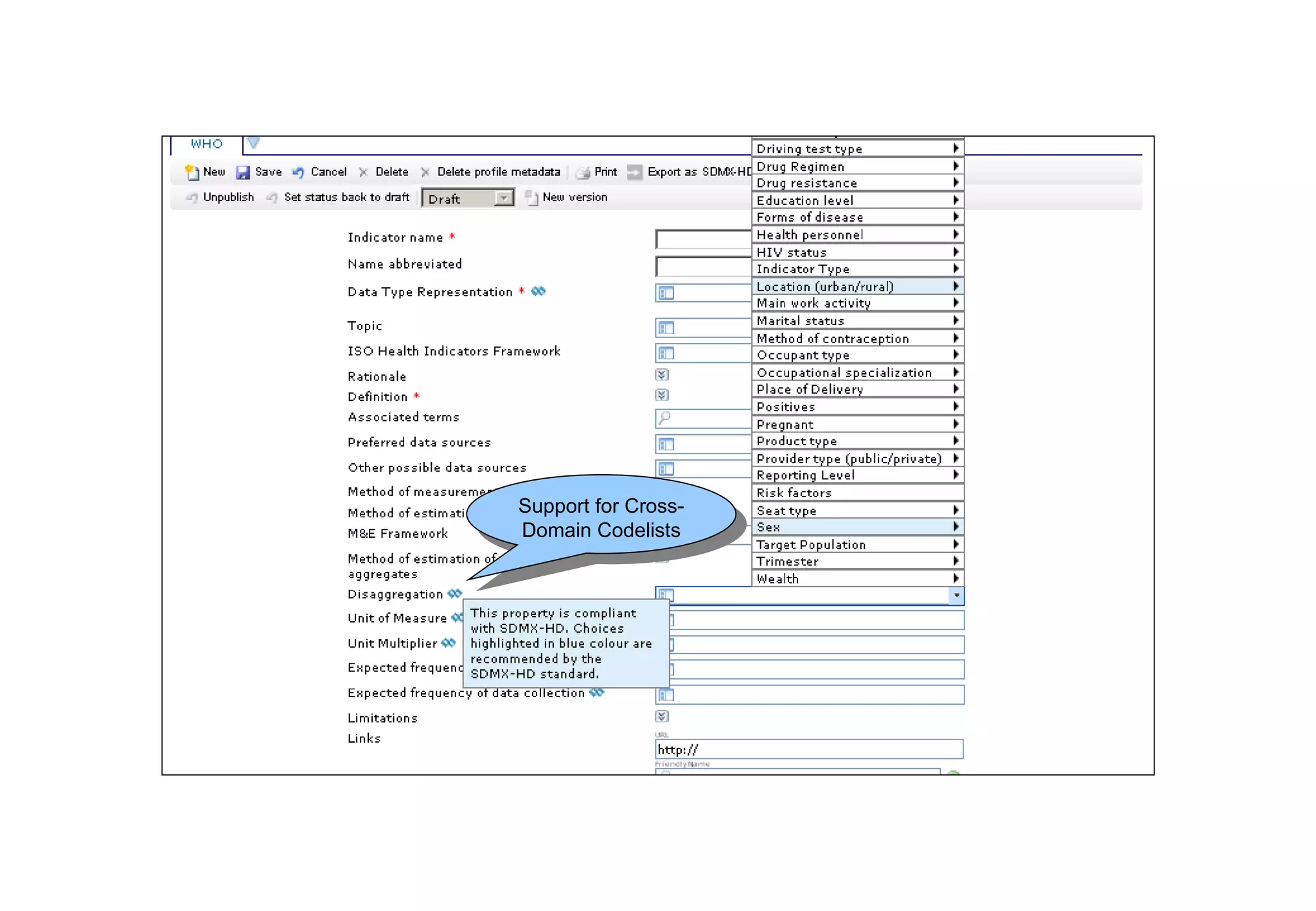
Support for Cross-
Domain Codelists
Harmonization


                Establishment of processes to reconcile country and organizational
                       differences in indicator definitions without duplication.


17 |   Health Care Informatics | May 9, 2012
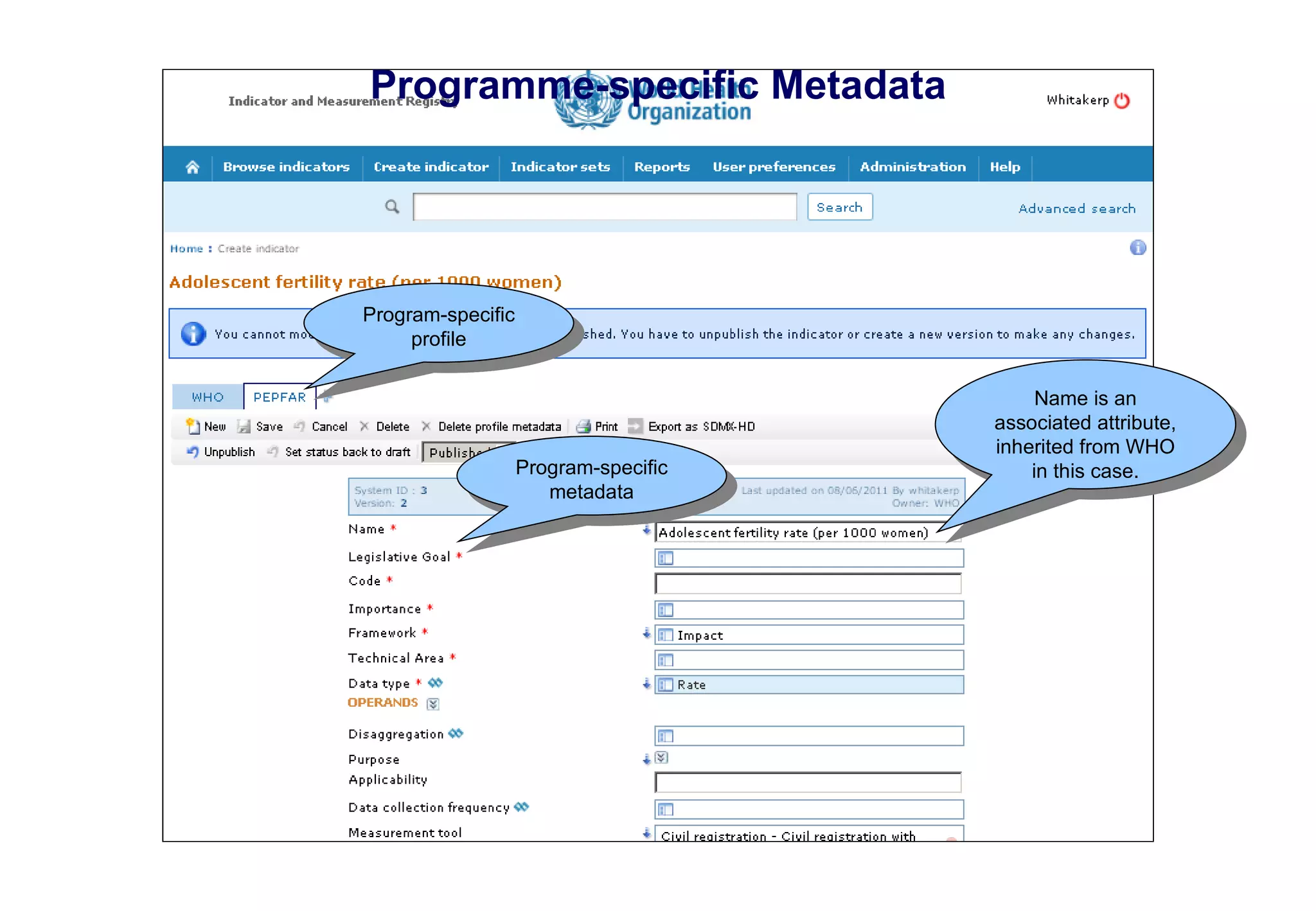
Programme-specific Metadata


Program-specific
     profile

                                           Name is an
                                      associated attribute,
                                      inherited from WHO
                   Program-specific       in this case.
                      metadata
Publishing


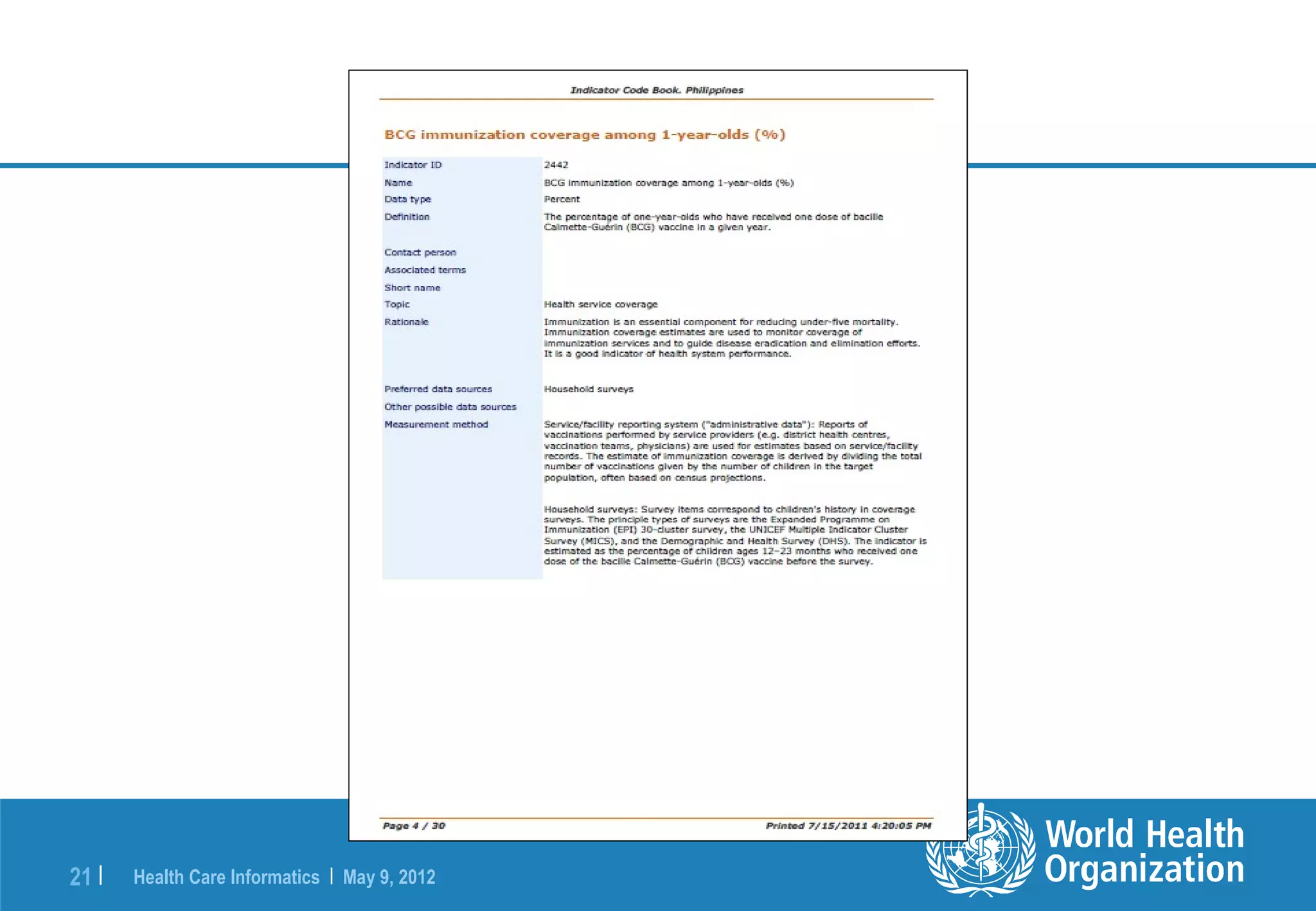
                       Human and Computer-readable Indicator Definitions


19 |   Health Care Informatics | May 9, 2012
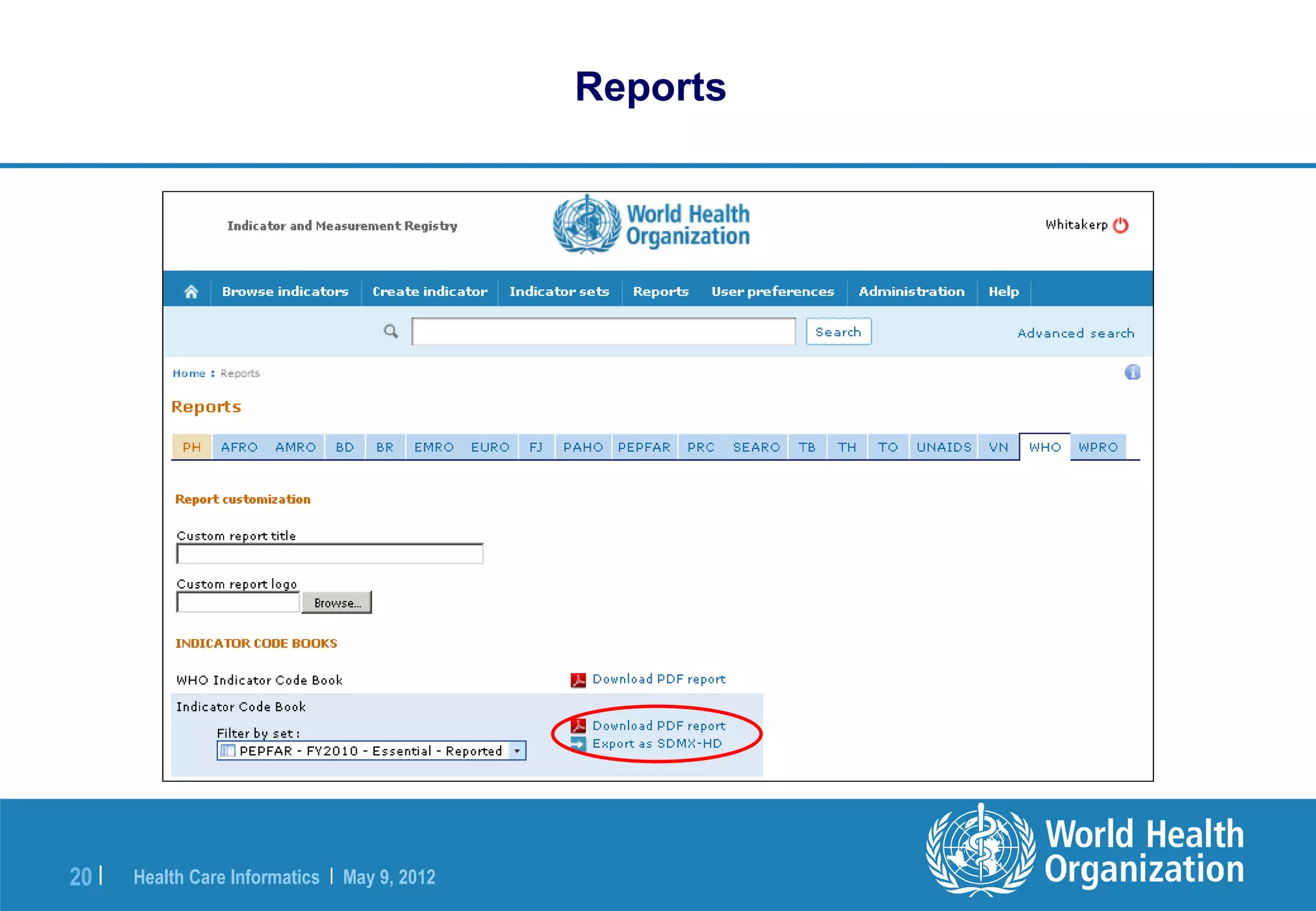
Reports


20 |   Health Care Informatics | May 9, 2012
21 |   Health Care Informatics | May 9, 2012
SDMX-HD


                  Statistical Data and Metadata Exchange – Health Domain


22 |   Health Care Informatics | May 9, 2012
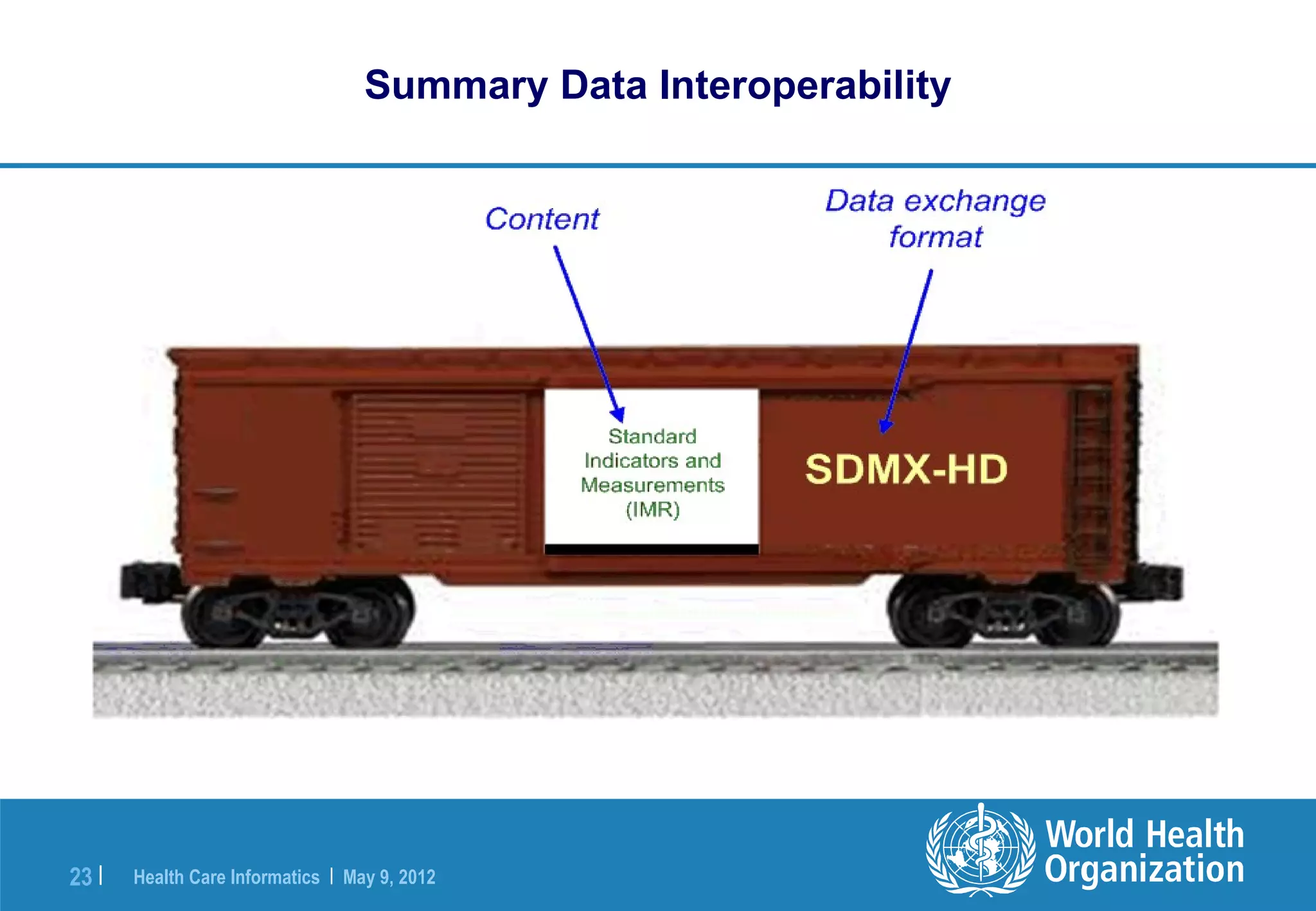
Summary Data Interoperability


23 |   Health Care Informatics | May 9, 2012
SDMX History

 Evolved from work on GESMES/TS in Central Banking community.

 Developed in ISO Technical Committee (TC)154 - Processes, data
  elements and documents in commerce, industry and administration.

 Note that the version 1.0 of SDMX is ISO Technical Specification (TS)
  17369.

 Current SDMX version is 2.1.


24 |   Health Care Informatics | May 9, 2012
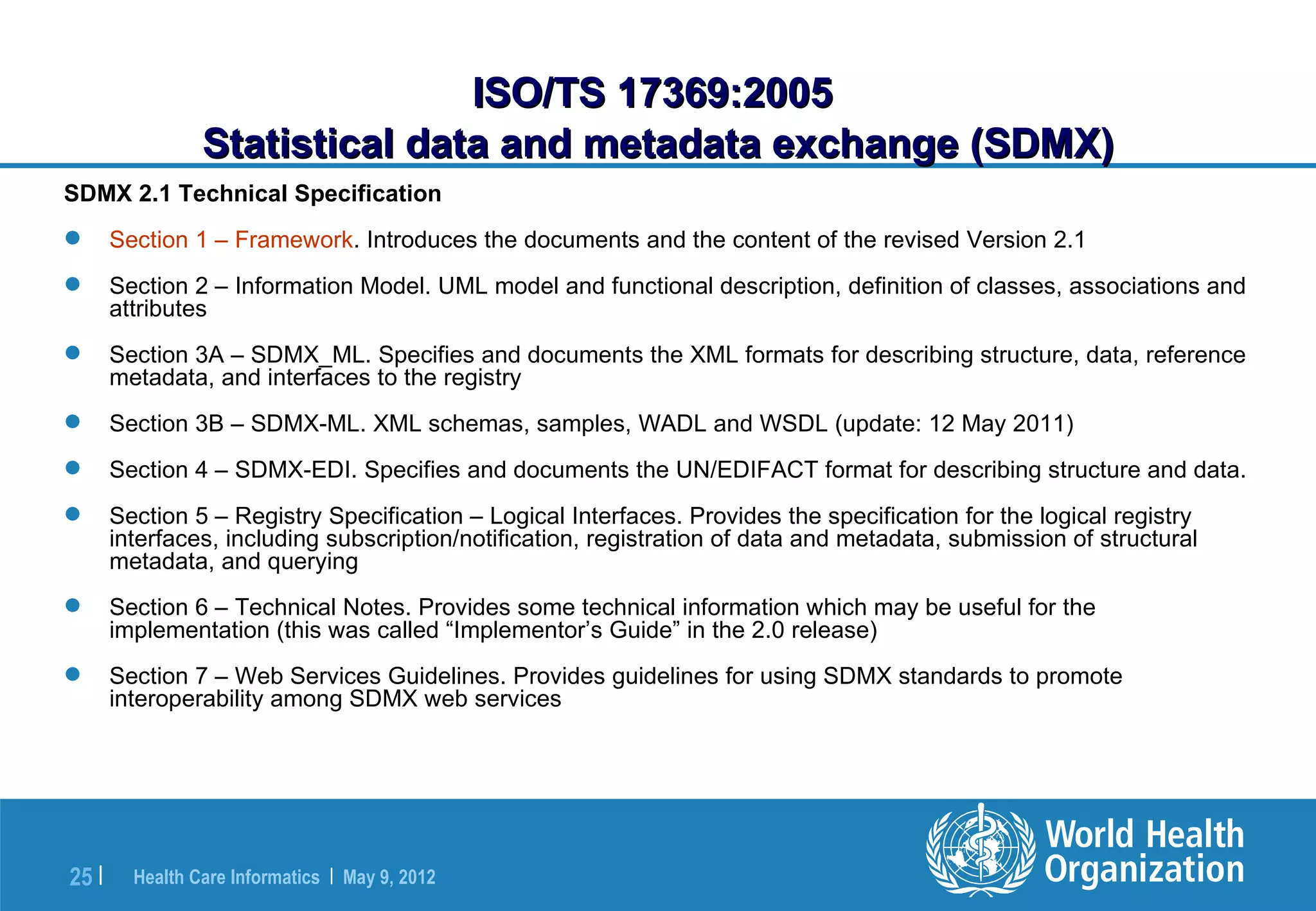
ISO/TS 17369:2005
                 Statistical data and metadata exchange (SDMX)
SDMX 2.1 Technical Specification
      Section 1 – Framework. Introduces the documents and the content of the revised Version 2.1
      Section 2 – Information Model. UML model and functional description, definition of classes, associations and
       attributes
      Section 3A – SDMX_ML. Specifies and documents the XML formats for describing structure, data, reference
       metadata, and interfaces to the registry
      Section 3B – SDMX-ML. XML schemas, samples, WADL and WSDL (update: 12 May 2011)
      Section 4 – SDMX-EDI. Specifies and documents the UN/EDIFACT format for describing structure and data.
      Section 5 – Registry Specification – Logical Interfaces. Provides the specification for the logical registry
       interfaces, including subscription/notification, registration of data and metadata, submission of structural
       metadata, and querying
      Section 6 – Technical Notes. Provides some technical information which may be useful for the
       implementation (this was called “Implementor’s Guide” in the 2.0 release)
      Section 7 – Web Services Guidelines. Provides guidelines for using SDMX standards to promote
       interoperability among SDMX web services


25 |     Health Care Informatics | May 9, 2012
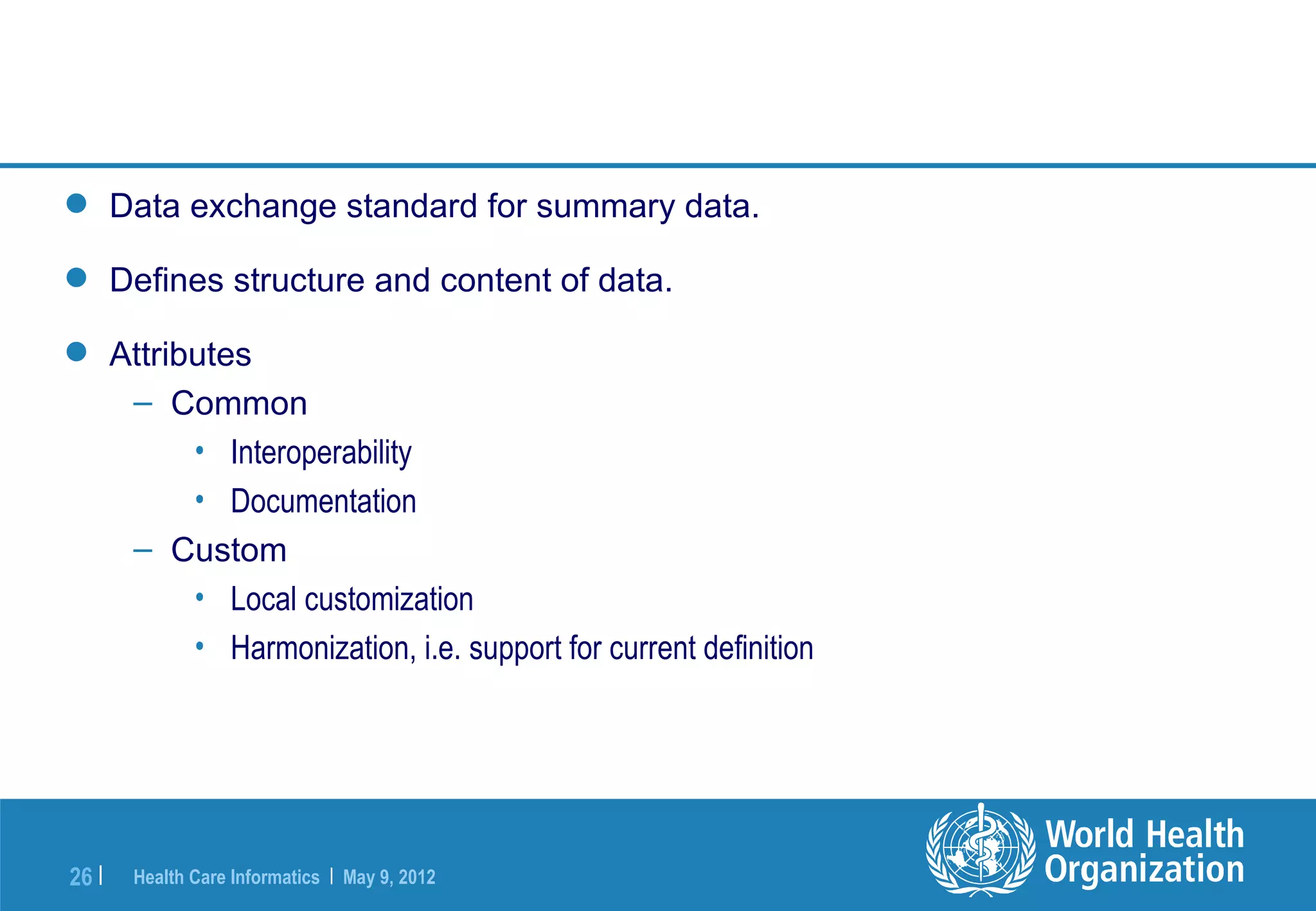
 Data exchange standard for summary data.

 Defines structure and content of data.

 Attributes
   – Common
        • Interoperability
        • Documentation
   – Custom
        • Local customization
        • Harmonization, i.e. support for current definition


26 |   Health Care Informatics | May 9, 2012
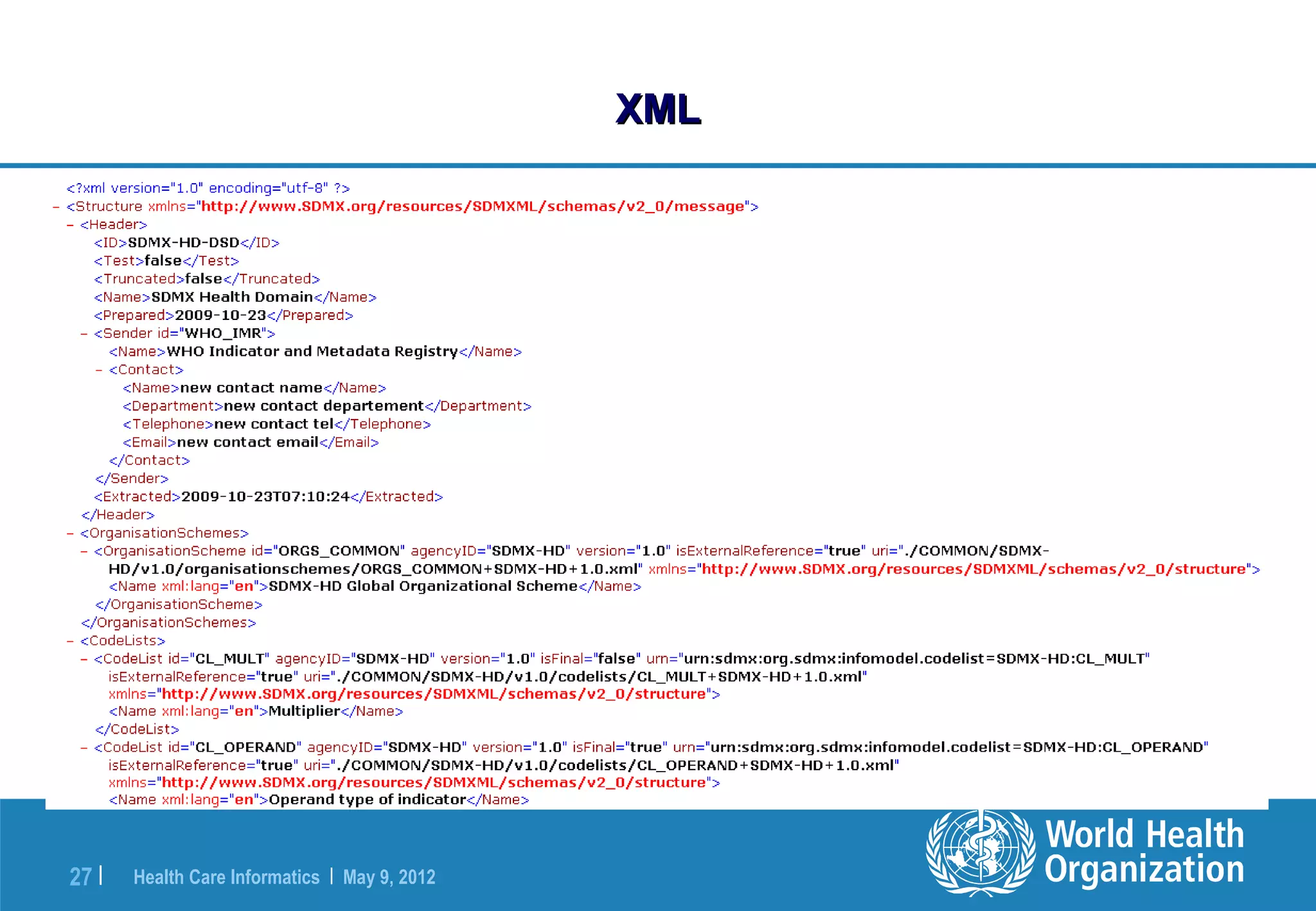
XML


27 |   Health Care Informatics | May 9, 2012
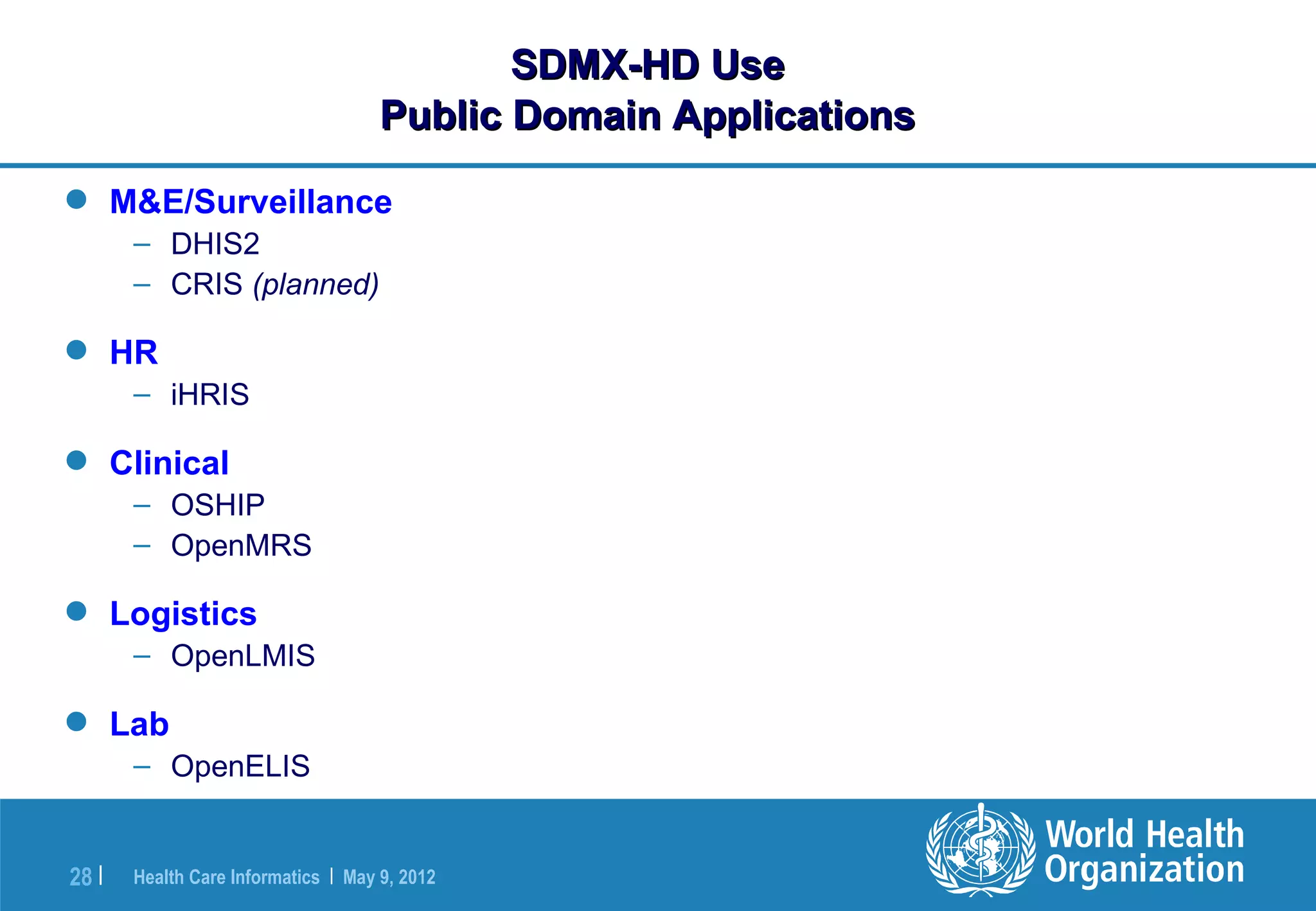
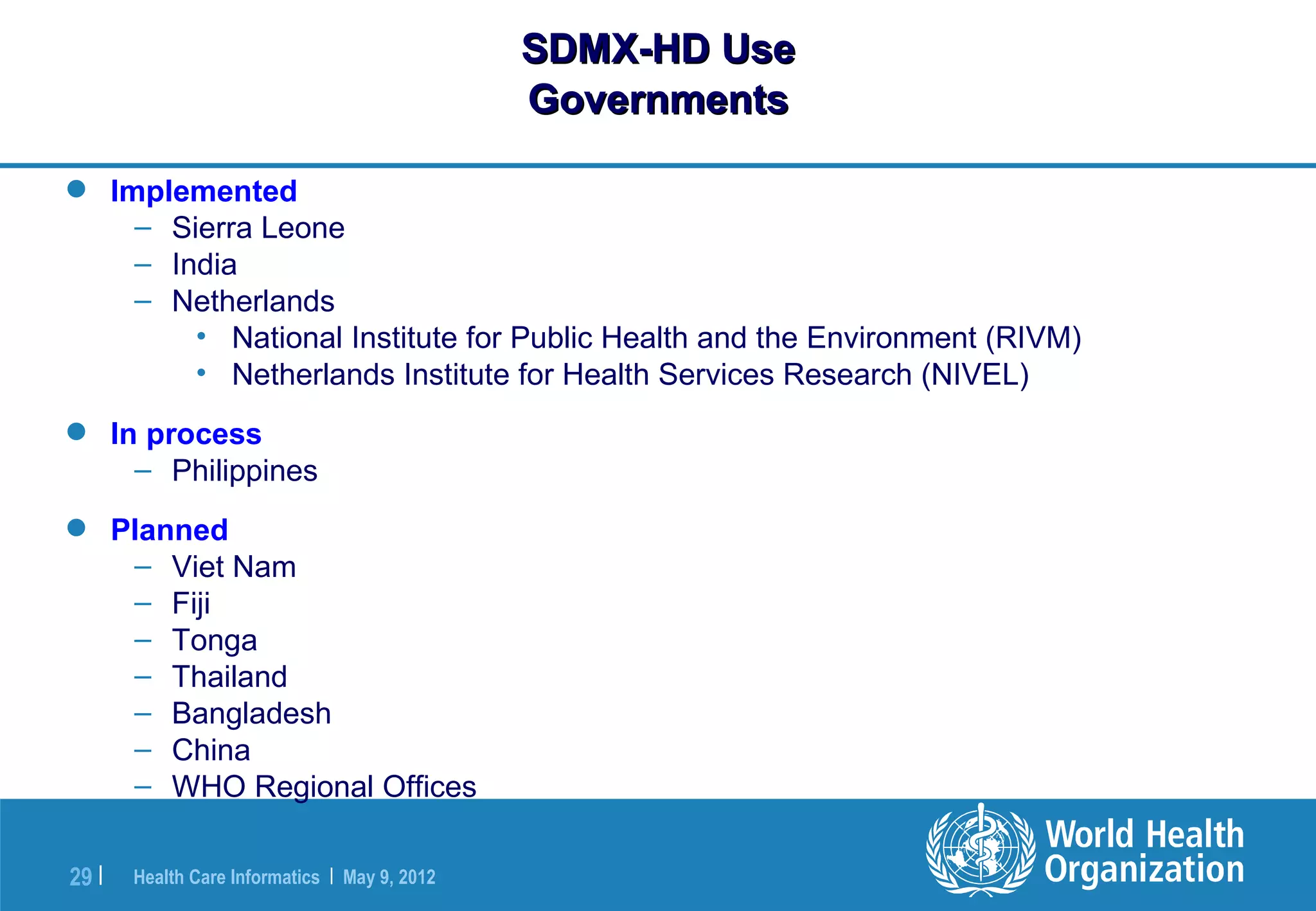
SDMX-HD Use
                                     Public Domain Applications

 M&E/Surveillance
       – DHIS2
       – CRIS (planned)

 HR
       – iHRIS

 Clinical
       – OSHIP
       – OpenMRS

 Logistics
       – OpenLMIS

 Lab
       – OpenELIS


28 |   Health Care Informatics | May 9, 2012
SDMX-HD Use
                                               Governments

 Implemented
    – Sierra Leone
    – India
    – Netherlands
        • National Institute for Public Health and the Environment (RIVM)
        • Netherlands Institute for Health Services Research (NIVEL)
 In process
    – Philippines
 Planned
   – Viet Nam
   – Fiji
   – Tonga
   – Thailand
   – Bangladesh
   – China
   – WHO Regional Offices

29 |   Health Care Informatics | May 9, 2012
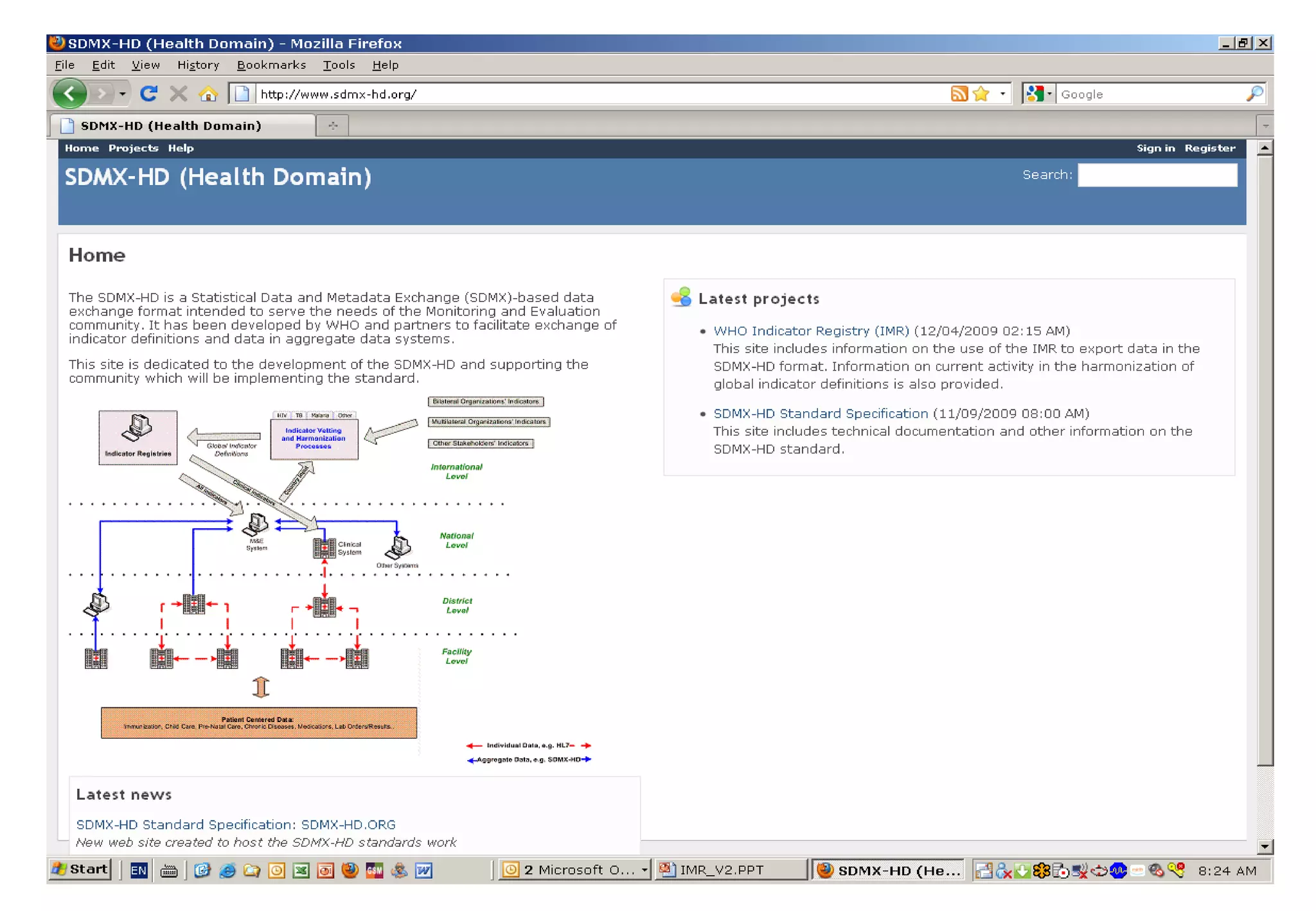
SDMX-HD Group
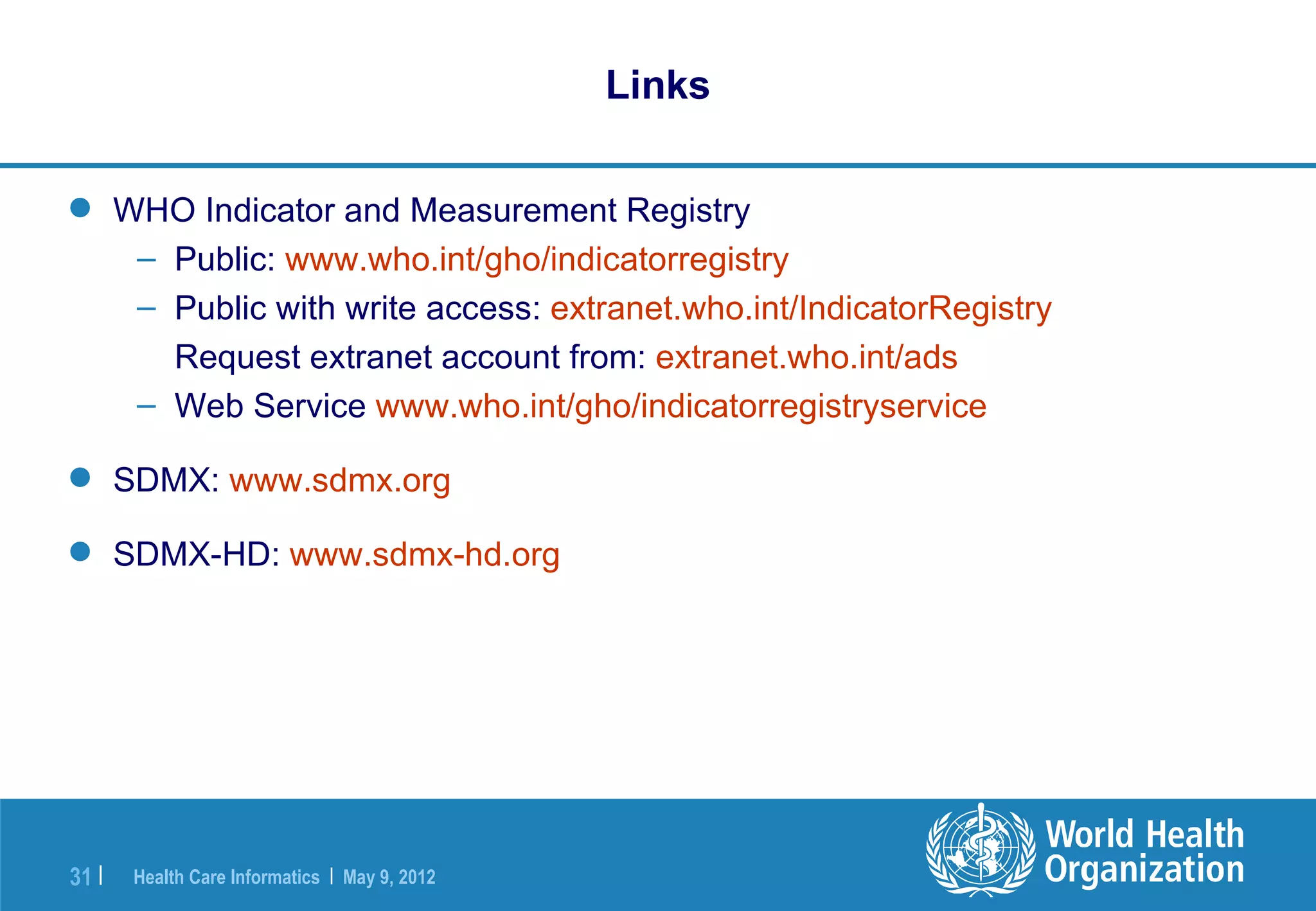
Links

 WHO Indicator and Measurement Registry
   – Public: www.who.int/gho/indicatorregistry
   – Public with write access: extranet.who.int/IndicatorRegistry
     Request extranet account from: extranet.who.int/ads
   – Web Service www.who.int/gho/indicatorregistryservice

 SDMX: www.sdmx.org

 SDMX-HD: www.sdmx-hd.org


31 |   Health Care Informatics | May 9, 2012

Imr V3

  • 1.
    WHO Indicator andMeasurement Registry (IMR) SDMX-HD Summary Data Format Patrick Whitaker 1| Health Care Informatics | May 9, 2012
  • 2.
    Definitions  M&E –Monitoring and Evaluation  Summary data – Data summarized from raw, e.g. clinical, data  Indicator – An indicator quantifies and simplifies phenomena and helps us understand complex realities. Indicators are aggregates of raw and processed data but they can be further aggregated to form complex indices. International Institute for Sustainable Development (IISD)  IMR – WHO Indicator and Measurement Registry  SDMX – Statistical Data and Metadata Exchange(ISO/TS 17369:2005)  SDMX-HD – WHO implementation of SDMX for the health domain 2| Health Care Informatics | May 9, 2012
  • 3.
    Human Nature? Content Systems Computers are dumb and precise. People are brilliant and less precise. 3| Health Care Informatics | May 9, 2012
  • 4.
    Focus on SummaryData 4| Health Care Informatics | May 9, 2012
  • 5.
    Issues Impacting Interoperability Multitude of guidelines documents.  Insufficient metadata in indicator definitions.  Competing organizational standards.  Weak harmonization processes.  Lack of a global repository for indicator (and clinical concept) definitions.  Lack of a standard exchange format for summary data. 5| Health Care Informatics | May 9, 2012
  • 6.
    Focus of Presentation Message Format Content Reference Model Individual Data HIC HL7, XML SNOMED-CT, LOINC, ICD HL7 V3, ISO 13606 (OpenEHR) LIC CCR, CCD, HSR SNOMED-CT, LOINC, ICD HL7 V3, ISO 13606 (OpenEHR) Summary Data SDMX-HD IMR, SDMX MCV, ISO SDMX CCD HL7 CCR-based Clinical Document Architecture Continuity of Care Document CCR ASTM Continuity of Care Record (XML) DCM ISO Detailed Clinical Model HIC High Income Country HL7 Health Level Seven HSR Health Summary Record ICD WHO International Classification of Diseases ISO equal', International Organization for Standardization IMR WHO Indicator and Measurement Registry LIC Low Income Country LOINC Logical Observation Identifiers Names and Codes RIM Reference Information Model SDMX Statistical Data and Metadata Exchange SDMX MCV Metadata Common Vocabulary SDMX-HD WHO Statistical Data and Metadata Exchange – Health Domain SNOMED-CT Systematized Nomenclature of Medicine – Clinical Terms 6| Health Care Informatics | May 9, 2012
  • 7.
    Problems  Varying indicator and measurement definitions. Solution: WHO Indicator and Measurement Registry (IMR) Interoperability of computer systems (summary data). Solution: SDMX-HD data exchange format 7| Health Care Informatics | May 9, 2012
  • 8.
    Multitude of Guidelines Documents 8| Health Care Informatics | May 9, 2012
  • 9.
    Inconsistent and IncompleteDefinitions Source Indicator Name UNSD Men 15-24 years old with comprehensive correct knowledge of HIV/AIDS, percentage Percentage of young people aged 15–24 who both correctly identify ways of preventing the sexual UNAIDS transmission of HIV and who reject major misconceptions about HIV transmission Percentage of young women and men aged 15–24 who both correctly identify ways of preventing the sexual PEPFAR transmission of HIV and who reject major misconceptions about HIV transmission Percentage of young women and men aged 15–24 years who both correctly identify ways of preventing the GFATM sexual transmission of HIV and who reject the major misconceptions about HIV transmission WHO Proportion of population aged 15-24 years with comprehensive correct knowledge of HIV/AIDS (%) Indicator Sources: UNSD mdgs.un.org/unsd/mdg/Metadata.aspx UNAIDS data.unaids.org/pub/manual/2009/jc1676_core_indicators_2009_en.pdf PEPFAR www.pepfar.gov/documents/organization/81097.pdf GFATM www.theglobalfund.org/en/me/guidelines_tools/?lang=en#toolkit WHO apps.who.int/gho/indicatorregistry/App_Main/browse_indicators.aspx 9| Health Care Informatics | May 9, 2012
  • 10.
    Metadata Views All conceptscan have different names and values 10 | Health Care Informatics | May 9, 2012
  • 11.
    IMR WHO Indicator and Measurement Registry 11 | Health Care Informatics | May 9, 2012
  • 12.
    Indicator and MeasurementRegistry (IMR)  Definition, management, and harmonization of indicator definitions by WHO and partners.  Incorporation of international standards.  Human and computer readable definitions.  Global definition distribution. 12 | Health Care Informatics | May 9, 2012
  • 13.
    13 | Health Care Informatics | May 9, 2012
  • 16.
  • 17.
    Harmonization Establishment of processes to reconcile country and organizational differences in indicator definitions without duplication. 17 | Health Care Informatics | May 9, 2012
  • 18.
    Programme-specific Metadata Program-specific profile Name is an associated attribute, inherited from WHO Program-specific in this case. metadata
  • 19.
    Publishing Human and Computer-readable Indicator Definitions 19 | Health Care Informatics | May 9, 2012
  • 20.
    Reports 20 | Health Care Informatics | May 9, 2012
  • 21.
    21 | Health Care Informatics | May 9, 2012
  • 22.
    SDMX-HD Statistical Data and Metadata Exchange – Health Domain 22 | Health Care Informatics | May 9, 2012
  • 23.
    Summary Data Interoperability 23| Health Care Informatics | May 9, 2012
  • 24.
    SDMX History  Evolvedfrom work on GESMES/TS in Central Banking community.  Developed in ISO Technical Committee (TC)154 - Processes, data elements and documents in commerce, industry and administration.  Note that the version 1.0 of SDMX is ISO Technical Specification (TS) 17369.  Current SDMX version is 2.1. 24 | Health Care Informatics | May 9, 2012
  • 25.
    ISO/TS 17369:2005 Statistical data and metadata exchange (SDMX) SDMX 2.1 Technical Specification  Section 1 – Framework. Introduces the documents and the content of the revised Version 2.1  Section 2 – Information Model. UML model and functional description, definition of classes, associations and attributes  Section 3A – SDMX_ML. Specifies and documents the XML formats for describing structure, data, reference metadata, and interfaces to the registry  Section 3B – SDMX-ML. XML schemas, samples, WADL and WSDL (update: 12 May 2011)  Section 4 – SDMX-EDI. Specifies and documents the UN/EDIFACT format for describing structure and data.  Section 5 – Registry Specification – Logical Interfaces. Provides the specification for the logical registry interfaces, including subscription/notification, registration of data and metadata, submission of structural metadata, and querying  Section 6 – Technical Notes. Provides some technical information which may be useful for the implementation (this was called “Implementor’s Guide” in the 2.0 release)  Section 7 – Web Services Guidelines. Provides guidelines for using SDMX standards to promote interoperability among SDMX web services 25 | Health Care Informatics | May 9, 2012
  • 26.
     Data exchangestandard for summary data.  Defines structure and content of data.  Attributes – Common • Interoperability • Documentation – Custom • Local customization • Harmonization, i.e. support for current definition 26 | Health Care Informatics | May 9, 2012
  • 27.
    XML 27 | Health Care Informatics | May 9, 2012
  • 28.
    SDMX-HD Use Public Domain Applications  M&E/Surveillance – DHIS2 – CRIS (planned)  HR – iHRIS  Clinical – OSHIP – OpenMRS  Logistics – OpenLMIS  Lab – OpenELIS 28 | Health Care Informatics | May 9, 2012
  • 29.
    SDMX-HD Use Governments  Implemented – Sierra Leone – India – Netherlands • National Institute for Public Health and the Environment (RIVM) • Netherlands Institute for Health Services Research (NIVEL)  In process – Philippines  Planned – Viet Nam – Fiji – Tonga – Thailand – Bangladesh – China – WHO Regional Offices 29 | Health Care Informatics | May 9, 2012
  • 30.
  • 31.
    Links  WHO Indicatorand Measurement Registry – Public: www.who.int/gho/indicatorregistry – Public with write access: extranet.who.int/IndicatorRegistry Request extranet account from: extranet.who.int/ads – Web Service www.who.int/gho/indicatorregistryservice  SDMX: www.sdmx.org  SDMX-HD: www.sdmx-hd.org 31 | Health Care Informatics | May 9, 2012