Improving Your
Writing Skills on
the TOEFL iBT
César Maldonado
TOEFL iBT Outreach Officer
MA in Applied Linguistics
cmaldonado@iie.org
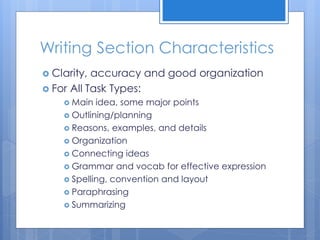
Writing Section Characteristics
 Clarity, accuracy and good organization
 For All Task Types:
 Main idea, some major points
 Outlining/planning
 Reasons, examples, and details
 Organization
 Connecting ideas
 Grammar and vocab for effective expression
 Spelling, convention and layout
 Paraphrasing
 Summarizing
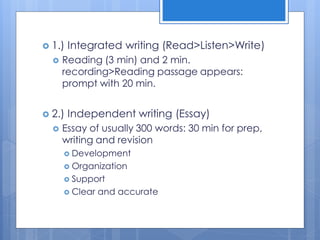
 1.) Integrated writing (Read>Listen>Write)
 Reading (3 min) and 2 min.
recording>Reading passage appears:
prompt with 20 min.
 2.) Independent writing (Essay)
 Essay of usually 300 words: 30 min for prep,
writing and revision
 Development
 Organization
 Support
 Clear and accurate
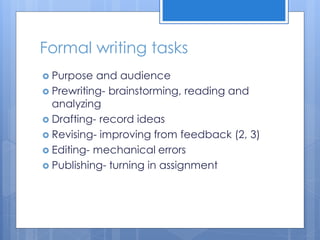
Formal writing tasks
 Purpose and audience
 Prewriting- brainstorming, reading and
analyzing
 Drafting- record ideas
 Revising- improving from feedback (2, 3)
 Editing- mechanical errors
 Publishing- turning in assignment
Writing based on reading
and listening
Practice finding main
points.
 30 sec. recordings -
- summarize
 Replay recording-
check summary
 Mark sections
 Review accuracy:
 Teacher or friend
 listen to recording
again and identify
problem areas
Read two short articles or
essays that take related or
opposite views on the same
topic or issue.
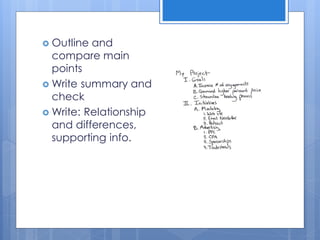
 Outline and
compare main
points
 Write summary and
check
 Write: Relationship
and differences,
supporting info.
Read one lengthy article in
English from a magazine or a
website each day.
 Outline article
 Write summary in
English as quickly
as you feel
comfortable
 Review grammar,
vocab, and
accuracy
 Combine related
ideas -- more
lengthy, complex
sentences
Read short but interesting
academic articles in
magazines and on websites
in your own language each
day.
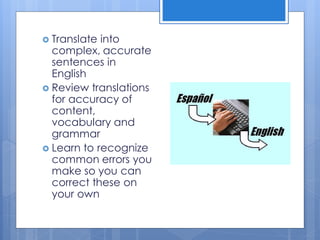
 Translate into
complex, accurate
sentences in
English
 Review translations
for accuracy of
content,
vocabulary and
grammar
 Learn to recognize
common errors you
make so you can
correct these on
your own
Practice combining
information that you have
heard and read in a written
summary.
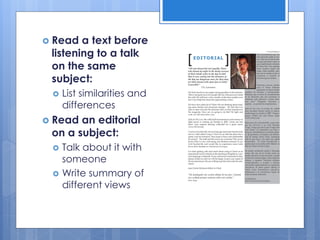
 Read a text before
listening to a talk
on the same
subject:
 List similarities and
differences
 Read an editorial
on a subject:
 Talk about it with
someone
 Write summary of
different views
Get a book that teaches the
different types of connecting
words. These expressions
show the relationship
between sentences and
paragraphs.
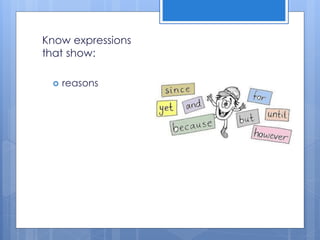
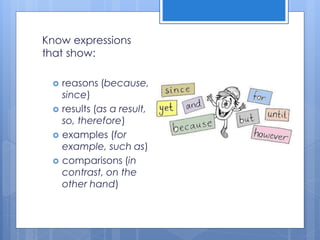
Know expressions
that show:
 reasons
Know expressions
that show:
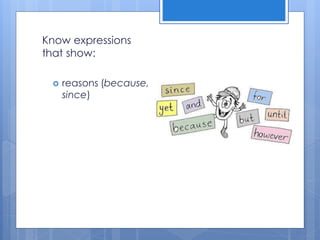
 reasons (because,
since)
Know expressions
that show:
 reasons (because,
since)
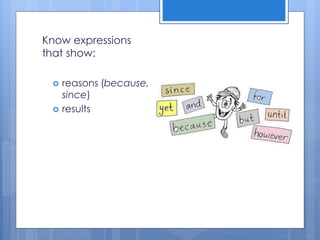
 results
Know expressions
that show:
 reasons (because,
since)
 results (as a result,
so, therefore)
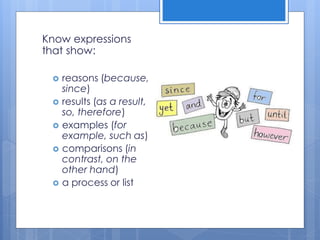
Know expressions
that show:
 reasons (because,
since)
 results (as a result,
so, therefore)
 examples
Know expressions
that show:
 reasons (because,
since)
 results (as a result,
so, therefore)
 examples (for
example, such as)
Know expressions
that show:
 reasons (because,
since)
 results (as a result,
so, therefore)
 examples (for
example, such as)
 comparisons
Know expressions
that show:
 reasons (because,
since)
 results (as a result,
so, therefore)
 examples (for
example, such as)
 comparisons (in
contrast, on the
other hand)
Know expressions
that show:
 reasons (because,
since)
 results (as a result,
so, therefore)
 examples (for
example, such as)
 comparisons (in
contrast, on the
other hand)
 a process or list
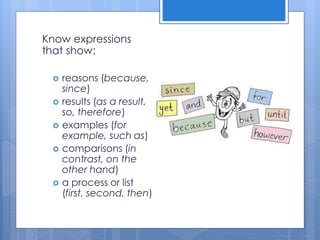
Know expressions
that show:
 reasons (because,
since)
 results (as a result,
so, therefore)
 examples (for
example, such as)
 comparisons (in
contrast, on the
other hand)
 a process or list
(first, second, then)
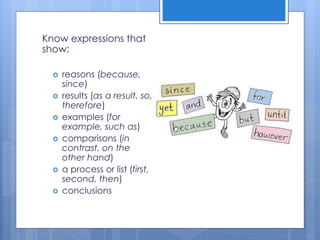
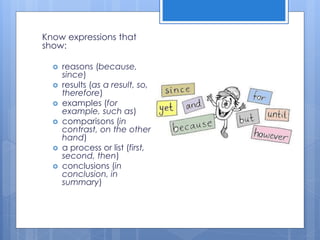
Know expressions that
show:
 reasons (because,
since)
 results (as a result, so,
therefore)
 examples (for
example, such as)
 comparisons (in
contrast, on the
other hand)
 a process or list (first,
second, then)
 conclusions
Know expressions that
show:
 reasons (because,
since)
 results (as a result, so,
therefore)
 examples (for
example, such as)
 comparisons (in
contrast, on the other
hand)
 a process or list (first,
second, then)
 conclusions (in
conclusion, in
summary)
Writing based on knowledge
and experience
Pay attention to how ideas
support a position and
practice generating ideas to
support a position.
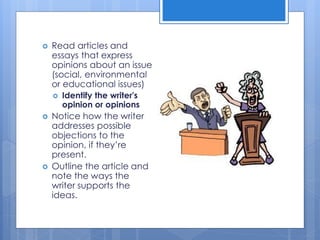
 Read articles and
essays that express
opinions about an issue
(social, environmental
or educational issues)
 Identify the writer's
opinion or opinions
 Notice how the writer
addresses possible
objections to the
opinion, if they’re
present.
 Outline the article and
note the ways the
writer supports the
ideas.
 Write response to
article or essay in
English, taking the
opposite viewpoint
 Outline your response.
 Note the methods
you use to support
your ideas
 Reread what you have
written
 Make sure your
supporting ideas are
clearly related to your
main point
 Make sure you have
developed each of
your points in detail. Is
there anything more
 you could have said
to strengthen your
points?
Pay attention to how you
organize ideas and think
about how a reader who
isn’t familiar with your topic is
going to be able to follow
the information you want to
present.
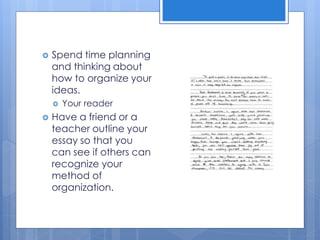
 Spend time planning
and thinking about
how to organize your
ideas.
 Your reader
 Have a friend or a
teacher outline your
essay so that you
can see if others can
recognize your
method of
organization.
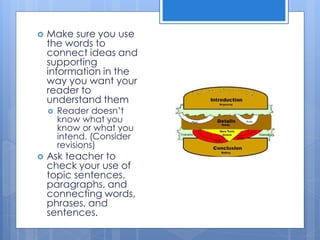
 Make sure you use
the words to
connect ideas and
supporting
information in the
way you want your
reader to
understand them
 Reader doesn’t
know what you
know or what you
intend. (Consider
revisions)
 Ask teacher to
check your use of
topic sentences,
paragraphs, and
connecting words,
phrases, and
sentences.
Think about who will be
reading your writing. In some
situations you need to write
in a formal manner and your
sentence structure,
vocabulary use and general
style should reflect that.
Work to expand the types of
sentences you write and
increase your vocabulary.
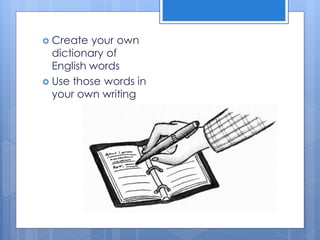
 Create your own
dictionary of
English words
 Use those words in
your own writing
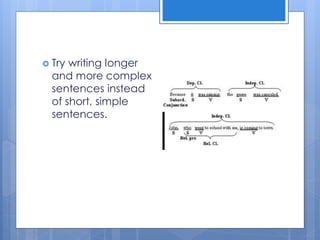
 Try writing longer
and more complex
sentences instead
of short, simple
sentences.
Make your writing clear by
avoiding grammatical
mistakes.
 No vague words and
phrases
 Focus on a different
aspect of English
grammar each week
 Read article or essay
in English in a
magazine or on a
website each day
 Summarize and
respond to it in
English
 Proofread and revise
 Ask your teacher to
review your writing
Read a lot in English. This will
help you recognize good
writing styles.
Your suggestions?
What has worked for you?
Thank you for attending
today’s webinar!
César Maldonado
cmaldonado@iie.org

Improving your writing skills

  • 1.
    Improving Your Writing Skillson the TOEFL iBT César Maldonado TOEFL iBT Outreach Officer MA in Applied Linguistics cmaldonado@iie.org
  • 2.
    Writing Section Characteristics Clarity, accuracy and good organization  For All Task Types:  Main idea, some major points  Outlining/planning  Reasons, examples, and details  Organization  Connecting ideas  Grammar and vocab for effective expression  Spelling, convention and layout  Paraphrasing  Summarizing
  • 3.
     1.) Integratedwriting (Read>Listen>Write)  Reading (3 min) and 2 min. recording>Reading passage appears: prompt with 20 min.  2.) Independent writing (Essay)  Essay of usually 300 words: 30 min for prep, writing and revision  Development  Organization  Support  Clear and accurate
  • 4.
    Formal writing tasks Purpose and audience  Prewriting- brainstorming, reading and analyzing  Drafting- record ideas  Revising- improving from feedback (2, 3)  Editing- mechanical errors  Publishing- turning in assignment
  • 5.
    Writing based onreading and listening
  • 6.
  • 7.
     30 sec.recordings - - summarize  Replay recording- check summary  Mark sections  Review accuracy:  Teacher or friend  listen to recording again and identify problem areas
  • 8.
    Read two shortarticles or essays that take related or opposite views on the same topic or issue.
  • 9.
     Outline and comparemain points  Write summary and check  Write: Relationship and differences, supporting info.
  • 10.
    Read one lengthyarticle in English from a magazine or a website each day.
  • 11.
     Outline article Write summary in English as quickly as you feel comfortable  Review grammar, vocab, and accuracy  Combine related ideas -- more lengthy, complex sentences
  • 12.
    Read short butinteresting academic articles in magazines and on websites in your own language each day.
  • 13.
     Translate into complex,accurate sentences in English  Review translations for accuracy of content, vocabulary and grammar  Learn to recognize common errors you make so you can correct these on your own
  • 14.
    Practice combining information thatyou have heard and read in a written summary.
  • 15.
     Read atext before listening to a talk on the same subject:  List similarities and differences  Read an editorial on a subject:  Talk about it with someone  Write summary of different views
  • 16.
    Get a bookthat teaches the different types of connecting words. These expressions show the relationship between sentences and paragraphs.
  • 17.
  • 18.
    Know expressions that show: reasons (because, since)
  • 19.
    Know expressions that show: reasons (because, since)  results
  • 20.
    Know expressions that show: reasons (because, since)  results (as a result, so, therefore)
  • 21.
    Know expressions that show: reasons (because, since)  results (as a result, so, therefore)  examples
  • 22.
    Know expressions that show: reasons (because, since)  results (as a result, so, therefore)  examples (for example, such as)
  • 23.
    Know expressions that show: reasons (because, since)  results (as a result, so, therefore)  examples (for example, such as)  comparisons
  • 24.
    Know expressions that show: reasons (because, since)  results (as a result, so, therefore)  examples (for example, such as)  comparisons (in contrast, on the other hand)
  • 25.
    Know expressions that show: reasons (because, since)  results (as a result, so, therefore)  examples (for example, such as)  comparisons (in contrast, on the other hand)  a process or list
  • 26.
    Know expressions that show: reasons (because, since)  results (as a result, so, therefore)  examples (for example, such as)  comparisons (in contrast, on the other hand)  a process or list (first, second, then)
  • 27.
    Know expressions that show: reasons (because, since)  results (as a result, so, therefore)  examples (for example, such as)  comparisons (in contrast, on the other hand)  a process or list (first, second, then)  conclusions
  • 28.
    Know expressions that show: reasons (because, since)  results (as a result, so, therefore)  examples (for example, such as)  comparisons (in contrast, on the other hand)  a process or list (first, second, then)  conclusions (in conclusion, in summary)
  • 29.
    Writing based onknowledge and experience
  • 30.
    Pay attention tohow ideas support a position and practice generating ideas to support a position.
  • 31.
     Read articlesand essays that express opinions about an issue (social, environmental or educational issues)  Identify the writer's opinion or opinions  Notice how the writer addresses possible objections to the opinion, if they’re present.  Outline the article and note the ways the writer supports the ideas.
  • 32.
     Write responseto article or essay in English, taking the opposite viewpoint  Outline your response.  Note the methods you use to support your ideas  Reread what you have written  Make sure your supporting ideas are clearly related to your main point  Make sure you have developed each of your points in detail. Is there anything more  you could have said to strengthen your points?
  • 33.
    Pay attention tohow you organize ideas and think about how a reader who isn’t familiar with your topic is going to be able to follow the information you want to present.
  • 34.
     Spend timeplanning and thinking about how to organize your ideas.  Your reader  Have a friend or a teacher outline your essay so that you can see if others can recognize your method of organization.
  • 35.
     Make sureyou use the words to connect ideas and supporting information in the way you want your reader to understand them  Reader doesn’t know what you know or what you intend. (Consider revisions)  Ask teacher to check your use of topic sentences, paragraphs, and connecting words, phrases, and sentences.
  • 36.
    Think about whowill be reading your writing. In some situations you need to write in a formal manner and your sentence structure, vocabulary use and general style should reflect that.
  • 37.
    Work to expandthe types of sentences you write and increase your vocabulary.
  • 38.
     Create yourown dictionary of English words  Use those words in your own writing
  • 39.
     Try writinglonger and more complex sentences instead of short, simple sentences.
  • 40.
    Make your writingclear by avoiding grammatical mistakes.
  • 41.
     No vaguewords and phrases  Focus on a different aspect of English grammar each week  Read article or essay in English in a magazine or on a website each day  Summarize and respond to it in English  Proofread and revise  Ask your teacher to review your writing
  • 42.
    Read a lotin English. This will help you recognize good writing styles.
  • 43.
  • 44.
    Thank you forattending today’s webinar! César Maldonado cmaldonado@iie.org