Chapter 9 –
Reading and Writing
Expository Texts
© 2016. Cengage Learning. All rights reserved.
 By the time you finish reading and studying
this chapter, you should be able to:
 LO1 Understand expository texts.
 LO2 Read and respond to expository texts.
 LO3 Plan an expository narrative.
 LO4 Write the first draft.
 LO5 Revise the writing.
 LO6 Edit the writing.
Learning Outcomes
© 2016 Cengage Learning®. May not be scanned, copied or duplicated, or posted to a publicly accessible website, in whole or in part.
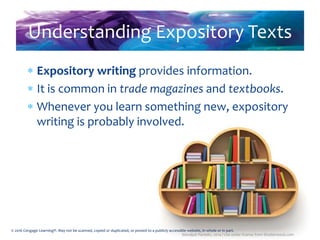
 Expository writing provides information.
 It is common in trade magazines and textbooks.
 Whenever you learn something new, expository
writing is probably involved.
Understanding Expository Texts
Slavoljub Pantelic, 2014 / Use under license from Shutterstock.com
© 2016 Cengage Learning®. May not be scanned, copied or duplicated, or posted to a publicly accessible website, in whole or in part.
Understanding Expository Texts
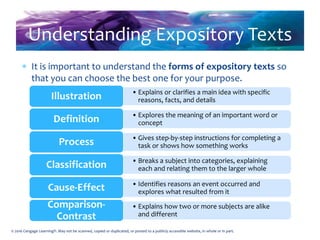
 It is important to understand the forms of expository texts so
that you can choose the best one for your purpose.
• Explains or clarifies a main idea with specific
reasons, facts, and details
Illustration
• Explores the meaning of an important word or
concept
Definition
• Gives step-by-step instructions for completing a
task or shows how something works
Process
• Breaks a subject into categories, explaining
each and relating them to the larger whole
Classification
• Identifies reasons an event occurred and
explores what resulted from it
Cause-Effect
• Explains how two or more subjects are alike
and different
Comparison-
Contrast
© 2016 Cengage Learning®. May not be scanned, copied or duplicated, or posted to a publicly accessible website, in whole or in part.
Reading and Responding to
Narrative Texts
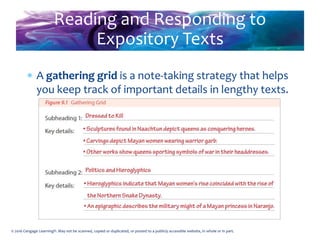
 A gathering grid is a note-taking strategy that helps
you keep track of important details in lengthy texts.
Reading and Responding to
Expository Texts
© 2016 Cengage Learning®. May not be scanned, copied or duplicated, or posted to a publicly accessible website, in whole or in part.
Reading and Responding to
Narrative Texts
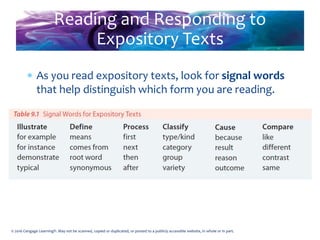
 As you read expository texts, look for signal words
that help distinguish which form you are reading.
Reading and Responding to
Expository Texts
© 2016 Cengage Learning®. May not be scanned, copied or duplicated, or posted to a publicly accessible website, in whole or in part.
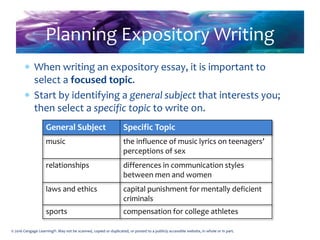
 When writing an expository essay, it is important to
select a focused topic.
 Start by identifying a general subject that interests you;
then select a specific topic to write on.
Planning Expository Writing
General Subject Specific Topic
music the influence of music lyrics on teenagers’
perceptions of sex
relationships differences in communication styles
between men and women
laws and ethics capital punishment for mentally deficient
criminals
sports compensation for college athletes
© 2016 Cengage Learning®. May not be scanned, copied or duplicated, or posted to a publicly accessible website, in whole or in part.
Planning Expository Writing
Primary Sources
 Events of experiences
 Interviews
 Museum exhibits
 Surveys/questionnaires
 Letters/diaries/journals
Secondary Sources
 Textbooks
 Magazine/journal articles
 News reports
 Websites
 Books
After selecting a topic, you need to select sources and gather
details. Consider both primary and secondary sources.
© 2016 Cengage Learning®. May not be scanned, copied or duplicated, or posted to a publicly accessible website, in whole or in part.
 Form a thesis that identifies your topic and provides a focus for
your essay.
specific topic + thought or feeling about it = thesis statement
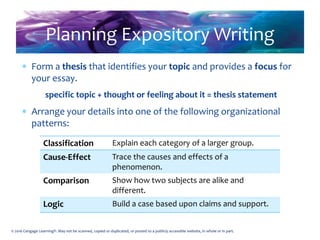
 Arrange your details into one of the following organizational
patterns:
Planning Expository Writing
Classification Explain each category of a larger group.
Cause-Effect Trace the causes and effects of a
phenomenon.
Comparison Show how two subjects are alike and
different.
Logic Build a case based upon claims and support.
© 2016 Cengage Learning®. May not be scanned, copied or duplicated, or posted to a publicly accessible website, in whole or in part.
Writing the First Draft
 To develop an opening
paragraph:
 Set the scene
 Make a shocking statement
 Start with an interesting story
 In the middle paragraphs:
 Try to include at least 2 types of
details per paragraph
 Provide enough information to
make each point clear
 Follow the organizational
pattern you selected
 Use transitions to help you
move from one point to the
next
 To create the closing paragraph:
 Provide a strong final quotation
 Pose a thought-provoking
question
ImageryMajestic, 2014 / Use under license from Shutterstock.com
© 2016 Cengage Learning®. May not be scanned, copied or duplicated, or posted to a publicly accessible website, in whole or in part.
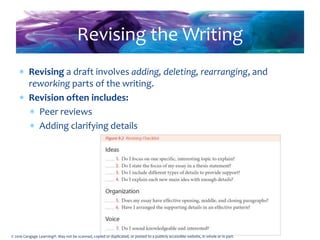
 Revising a draft involves adding, deleting, rearranging, and
reworking parts of the writing.
 Revision often includes:
 Peer reviews
 Adding clarifying details
Revising the Writing
© 2016 Cengage Learning®. May not be scanned, copied or duplicated, or posted to a publicly accessible website, in whole or in part.
 Avoid fragments – any group of words that lacks a subject,
verb, or does not express a complete thought.
Fragment: Maya expecting the judges to arrive any minute now.
Sentence: Maya is expecting the judges to arrive any minute now.
Fragment: Because I have been waiting all afternoon for you.
Sentence: I have been waiting all afternoon for you.
Fragment: Looked for new bedroom furniture at several
different stores but couldn’t find anything they liked.
Sentence: The couple looked for new bedroom furniture at
several different stores but couldn’t find anything they liked.
Editing the Writing
© 2016 Cengage Learning®. May not be scanned, copied or duplicated, or posted to a publicly accessible website, in whole or in part.
 Avoid run-ons and comma splices.
 A run-on occurs when two sentences are joined without any
punctuation.
 A comma splice occurs when two sentences are joined with a
comma only.
Run-on: Erin arrived at the store early it wasn’t open yet.
Correct: Erin arrived at the store early, but it wasn’t open yet.
Comma Splice: We saw the play, then we got something to eat.
Correct: We saw the play; then we got something to eat.
Comma Splice: You should hang that picture a little lower, it’s too high
the way it is.
Correct: You should hang that picture a little lower because it’s too high
the way it is.
Editing the Writing
© 2016 Cengage Learning®. May not be scanned, copied or duplicated, or posted to a publicly accessible website, in whole or in part.
 Use an editing checklist to look for errors.
Editing the Writing
© 2016 Cengage Learning®. May not be scanned, copied or duplicated, or posted to a publicly accessible website, in whole or in part.
 Finish with these strategies
for adding an attention-
getting title:
 Highlight the thesis.
 Think creatively.
 Make a dramatic
pronouncement.
Editing the Writing
alphaspirit, 2014 / Use under license from Shutterstock.com
© 2016 Cengage Learning®. May not be scanned, copied or duplicated, or posted to a publicly accessible website, in whole or in part.

Power point Chapter 9.pptx

  • 1.
    Chapter 9 – Readingand Writing Expository Texts © 2016. Cengage Learning. All rights reserved.
  • 2.
     By thetime you finish reading and studying this chapter, you should be able to:  LO1 Understand expository texts.  LO2 Read and respond to expository texts.  LO3 Plan an expository narrative.  LO4 Write the first draft.  LO5 Revise the writing.  LO6 Edit the writing. Learning Outcomes © 2016 Cengage Learning®. May not be scanned, copied or duplicated, or posted to a publicly accessible website, in whole or in part.
  • 3.
     Expository writingprovides information.  It is common in trade magazines and textbooks.  Whenever you learn something new, expository writing is probably involved. Understanding Expository Texts Slavoljub Pantelic, 2014 / Use under license from Shutterstock.com © 2016 Cengage Learning®. May not be scanned, copied or duplicated, or posted to a publicly accessible website, in whole or in part.
  • 4.
    Understanding Expository Texts It is important to understand the forms of expository texts so that you can choose the best one for your purpose. • Explains or clarifies a main idea with specific reasons, facts, and details Illustration • Explores the meaning of an important word or concept Definition • Gives step-by-step instructions for completing a task or shows how something works Process • Breaks a subject into categories, explaining each and relating them to the larger whole Classification • Identifies reasons an event occurred and explores what resulted from it Cause-Effect • Explains how two or more subjects are alike and different Comparison- Contrast © 2016 Cengage Learning®. May not be scanned, copied or duplicated, or posted to a publicly accessible website, in whole or in part.
  • 5.
    Reading and Respondingto Narrative Texts  A gathering grid is a note-taking strategy that helps you keep track of important details in lengthy texts. Reading and Responding to Expository Texts © 2016 Cengage Learning®. May not be scanned, copied or duplicated, or posted to a publicly accessible website, in whole or in part.
  • 6.
    Reading and Respondingto Narrative Texts  As you read expository texts, look for signal words that help distinguish which form you are reading. Reading and Responding to Expository Texts © 2016 Cengage Learning®. May not be scanned, copied or duplicated, or posted to a publicly accessible website, in whole or in part.
  • 7.
     When writingan expository essay, it is important to select a focused topic.  Start by identifying a general subject that interests you; then select a specific topic to write on. Planning Expository Writing General Subject Specific Topic music the influence of music lyrics on teenagers’ perceptions of sex relationships differences in communication styles between men and women laws and ethics capital punishment for mentally deficient criminals sports compensation for college athletes © 2016 Cengage Learning®. May not be scanned, copied or duplicated, or posted to a publicly accessible website, in whole or in part.
  • 8.
    Planning Expository Writing PrimarySources  Events of experiences  Interviews  Museum exhibits  Surveys/questionnaires  Letters/diaries/journals Secondary Sources  Textbooks  Magazine/journal articles  News reports  Websites  Books After selecting a topic, you need to select sources and gather details. Consider both primary and secondary sources. © 2016 Cengage Learning®. May not be scanned, copied or duplicated, or posted to a publicly accessible website, in whole or in part.
  • 9.
     Form athesis that identifies your topic and provides a focus for your essay. specific topic + thought or feeling about it = thesis statement  Arrange your details into one of the following organizational patterns: Planning Expository Writing Classification Explain each category of a larger group. Cause-Effect Trace the causes and effects of a phenomenon. Comparison Show how two subjects are alike and different. Logic Build a case based upon claims and support. © 2016 Cengage Learning®. May not be scanned, copied or duplicated, or posted to a publicly accessible website, in whole or in part.
  • 10.
    Writing the FirstDraft  To develop an opening paragraph:  Set the scene  Make a shocking statement  Start with an interesting story  In the middle paragraphs:  Try to include at least 2 types of details per paragraph  Provide enough information to make each point clear  Follow the organizational pattern you selected  Use transitions to help you move from one point to the next  To create the closing paragraph:  Provide a strong final quotation  Pose a thought-provoking question ImageryMajestic, 2014 / Use under license from Shutterstock.com © 2016 Cengage Learning®. May not be scanned, copied or duplicated, or posted to a publicly accessible website, in whole or in part.
  • 11.
     Revising adraft involves adding, deleting, rearranging, and reworking parts of the writing.  Revision often includes:  Peer reviews  Adding clarifying details Revising the Writing © 2016 Cengage Learning®. May not be scanned, copied or duplicated, or posted to a publicly accessible website, in whole or in part.
  • 12.
     Avoid fragments– any group of words that lacks a subject, verb, or does not express a complete thought. Fragment: Maya expecting the judges to arrive any minute now. Sentence: Maya is expecting the judges to arrive any minute now. Fragment: Because I have been waiting all afternoon for you. Sentence: I have been waiting all afternoon for you. Fragment: Looked for new bedroom furniture at several different stores but couldn’t find anything they liked. Sentence: The couple looked for new bedroom furniture at several different stores but couldn’t find anything they liked. Editing the Writing © 2016 Cengage Learning®. May not be scanned, copied or duplicated, or posted to a publicly accessible website, in whole or in part.
  • 13.
     Avoid run-onsand comma splices.  A run-on occurs when two sentences are joined without any punctuation.  A comma splice occurs when two sentences are joined with a comma only. Run-on: Erin arrived at the store early it wasn’t open yet. Correct: Erin arrived at the store early, but it wasn’t open yet. Comma Splice: We saw the play, then we got something to eat. Correct: We saw the play; then we got something to eat. Comma Splice: You should hang that picture a little lower, it’s too high the way it is. Correct: You should hang that picture a little lower because it’s too high the way it is. Editing the Writing © 2016 Cengage Learning®. May not be scanned, copied or duplicated, or posted to a publicly accessible website, in whole or in part.
  • 14.
     Use anediting checklist to look for errors. Editing the Writing © 2016 Cengage Learning®. May not be scanned, copied or duplicated, or posted to a publicly accessible website, in whole or in part.
  • 15.
     Finish withthese strategies for adding an attention- getting title:  Highlight the thesis.  Think creatively.  Make a dramatic pronouncement. Editing the Writing alphaspirit, 2014 / Use under license from Shutterstock.com © 2016 Cengage Learning®. May not be scanned, copied or duplicated, or posted to a publicly accessible website, in whole or in part.