A joint Christian Aid,
Save the Children,
Humanitarian
Accountability
Partnership Report
Andy Featherstone,
Research consultant
24 June 2013
Background to the research
 Despite greater agency uptake and interest in the use of
accountability mechanisms, practice is patchy
 Recent evaluations and ALNAP’s 2012 State of the
Humanitarian System suggests that many of those
receiving assistance continue to feel detached from it
 There is a growing understanding of the potential
benefits of using accountability mechanisms but little
evidence of the contribution they make to quality
The research process
 In what ways do accountability mechanisms from aid
organisations to affected communities contribute to the
quality of the assistance provided.
 Literature review with support from the HAP peer
learning group
 Development of an approach and set of methods
 Case studies – Christian Aid/UCCS resilience programme
in Kenya and Save the Children child protection & non-
formal education programme in Myanmar
 Analysis and report publication
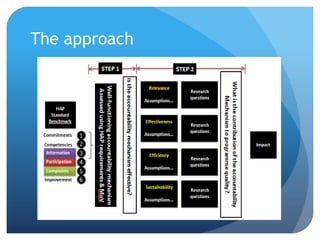
The approach
A note on the methodology
 Measurement: A mix of methods was used with a focus
on qualitative exercises (scorecards and opinion ranking
exercises) from which quantitative analysis could be
undertaken
 Credibility: Used agencies as entry points and the
research was conducted by an independent team with
efforts taken to address potential bias
 Causality: Sought to find evidence of contribution
through ‘pattern matching’ (identifying patterns of
responses). Findings triangulated in each village within
groups and between groups
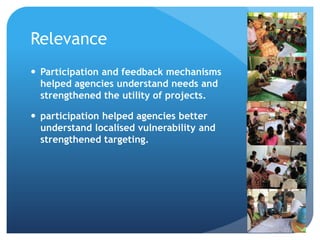
Relevance
 Participation and feedback mechanisms
helped agencies understand needs and
strengthened the utility of projects.
 participation helped agencies better
understand localised vulnerability and
strengthened targeting.
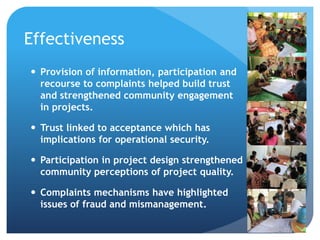
Effectiveness
 Provision of information, participation and
recourse to complaints helped build trust
and strengthened community engagement
in projects.
 Trust linked to acceptance which has
implications for operational security.
 Participation in project design strengthened
community perceptions of project quality.
 Complaints mechanisms have highlighted
issues of fraud and mismanagement.
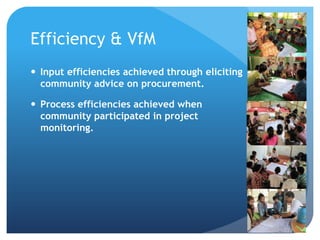
Efficiency & VfM
 Input efficiencies achieved through eliciting
community advice on procurement.
 Process efficiencies achieved when
community participated in project
monitoring.
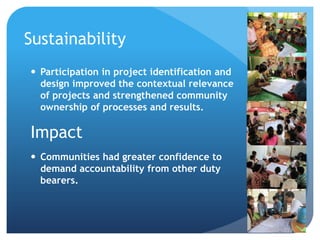
Sustainability
 Participation in project identification and
design improved the contextual relevance
of projects and strengthened community
ownership of processes and results.
Impact
 Communities had greater confidence to
demand accountability from other duty
bearers.
findings - methodology
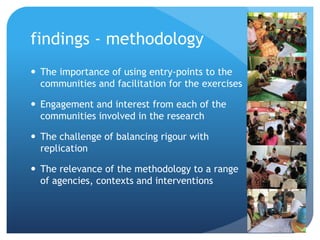
 The importance of using entry-points to the
communities and facilitation for the exercises
 Engagement and interest from each of the
communities involved in the research
 The challenge of balancing rigour with
replication
 The relevance of the methodology to a range
of agencies, contexts and interventions
findings - accountability
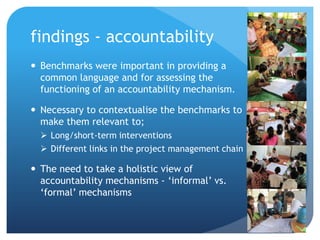
 Benchmarks were important in providing a
common language and for assessing the
functioning of an accountability mechanism.
 Necessary to contextualise the benchmarks to
make them relevant to;
 Long/short-term interventions
 Different links in the project management chain
 The need to take a holistic view of
accountability mechanisms - ‘informal’ vs.
‘formal’ mechanisms
Recommendations
Accountability mechanisms contribute to project quality BUT
it is of concern that development assistance and humanitarian
aid continues to feel distant to so many people.
 The results are compelling but practice is patchy. The use
of accountability mechanisms must become routine.
 There is an important need to more rigorously document
accountability practice and continue to build the evidence
base.
 Given the commitments made in the Transformative
Agenda, the adoption of the methodology by an HCT could
strengthen the response in real-time

Improving impact - do accountability mechanisms deliver results

  • 1.
    A joint ChristianAid, Save the Children, Humanitarian Accountability Partnership Report Andy Featherstone, Research consultant 24 June 2013
  • 2.
    Background to theresearch  Despite greater agency uptake and interest in the use of accountability mechanisms, practice is patchy  Recent evaluations and ALNAP’s 2012 State of the Humanitarian System suggests that many of those receiving assistance continue to feel detached from it  There is a growing understanding of the potential benefits of using accountability mechanisms but little evidence of the contribution they make to quality
  • 3.
    The research process In what ways do accountability mechanisms from aid organisations to affected communities contribute to the quality of the assistance provided.  Literature review with support from the HAP peer learning group  Development of an approach and set of methods  Case studies – Christian Aid/UCCS resilience programme in Kenya and Save the Children child protection & non- formal education programme in Myanmar  Analysis and report publication
  • 4.
  • 5.
    A note onthe methodology  Measurement: A mix of methods was used with a focus on qualitative exercises (scorecards and opinion ranking exercises) from which quantitative analysis could be undertaken  Credibility: Used agencies as entry points and the research was conducted by an independent team with efforts taken to address potential bias  Causality: Sought to find evidence of contribution through ‘pattern matching’ (identifying patterns of responses). Findings triangulated in each village within groups and between groups
  • 6.
    Relevance  Participation andfeedback mechanisms helped agencies understand needs and strengthened the utility of projects.  participation helped agencies better understand localised vulnerability and strengthened targeting.
  • 7.
    Effectiveness  Provision ofinformation, participation and recourse to complaints helped build trust and strengthened community engagement in projects.  Trust linked to acceptance which has implications for operational security.  Participation in project design strengthened community perceptions of project quality.  Complaints mechanisms have highlighted issues of fraud and mismanagement.
  • 8.
    Efficiency & VfM Input efficiencies achieved through eliciting community advice on procurement.  Process efficiencies achieved when community participated in project monitoring.
  • 9.
    Sustainability  Participation inproject identification and design improved the contextual relevance of projects and strengthened community ownership of processes and results. Impact  Communities had greater confidence to demand accountability from other duty bearers.
  • 10.
    findings - methodology The importance of using entry-points to the communities and facilitation for the exercises  Engagement and interest from each of the communities involved in the research  The challenge of balancing rigour with replication  The relevance of the methodology to a range of agencies, contexts and interventions
  • 11.
    findings - accountability Benchmarks were important in providing a common language and for assessing the functioning of an accountability mechanism.  Necessary to contextualise the benchmarks to make them relevant to;  Long/short-term interventions  Different links in the project management chain  The need to take a holistic view of accountability mechanisms - ‘informal’ vs. ‘formal’ mechanisms
  • 12.
    Recommendations Accountability mechanisms contributeto project quality BUT it is of concern that development assistance and humanitarian aid continues to feel distant to so many people.  The results are compelling but practice is patchy. The use of accountability mechanisms must become routine.  There is an important need to more rigorously document accountability practice and continue to build the evidence base.  Given the commitments made in the Transformative Agenda, the adoption of the methodology by an HCT could strengthen the response in real-time