Impressio
nism
&
Realism
Done by: Ghida Kawtharani and Yasmin
Ashi
Realism and Impressionism were both radical art
movements. Art that represents radical ideas; radical
approach or radical change.
the movements are both very much influenced by the art
of the centuries before them. If you were to compare it to
a book, they’re both like chapter two, if you will, of
different stories in the same genre of storytelling.
Intro
Realism
Realism is a late 19th-century movement that
originated in France as an opposite reaction to
romanticism. The writers and artists emphasized
accurate observations of the surroundings, the
daily struggles of the common man, and the
gruesome reality of society. The movement’s aim
was either to change the socioeconomic and
political circumstances prevailing at that time or to
capture solid details like a photograph does.
Impressionism
Impressionism is a late 19th-century art movement
that began in France as an answer to the
limitations of Realism. Although it shared its
interest with realism in depicting reality, the
impressionists only wanted to portray the pleasing
aspects of a scene. They did not focus on morbid
details and favored imaginative idealization over
actual representation. They made loose brush
strokes and used pure colors to catch the
“impression” of fleeting movements of light and
atmosphere.
Realism impressionism
Timeline c. 1840s to 1880s c. 1860s to 1900s
Features
(in Art)
– Focus on minute details and accurate
observation
– Use of dark colors to show gritty and
‘ugly’ reality
– Portraying all the details as visible to the
eye and not to the mind
– The subject matter is often the urban
industrial setting, a commonplace
gathering, or the lower-middle-class areas
of society
Focus on the artist’s perspective of the scenery
– Use of light, vibrant, and unmixed colors to capture the movement of the objects
– Portraying only the appealing or pleasing aspects of the scenery
– The subject matter is the urban setting, but the one that is pleasant to the senses of the
audience
Features
(in Literature)
– Focus on facts and the minutest details
– Reliable omniscient narrator
– Organized, slow-moving plot
– Detached storytelling
– Realistic characters with internal
motivations
– Themes of hard work, common life,
misery, the relationship between society
and man
– Straightforward diction and clear use of
language
– Focus on the inner ramblings of characters
– Unreliable narrator
– Disorganized plot, no beginning, middle, and end
– Influence of personal feelings and emotions
– Self-conscious, passionate characters
– Play of light and color to create transient effects
– Confused and incomplete sentences, use of interior monologues, and stream-of-
consciousness technique
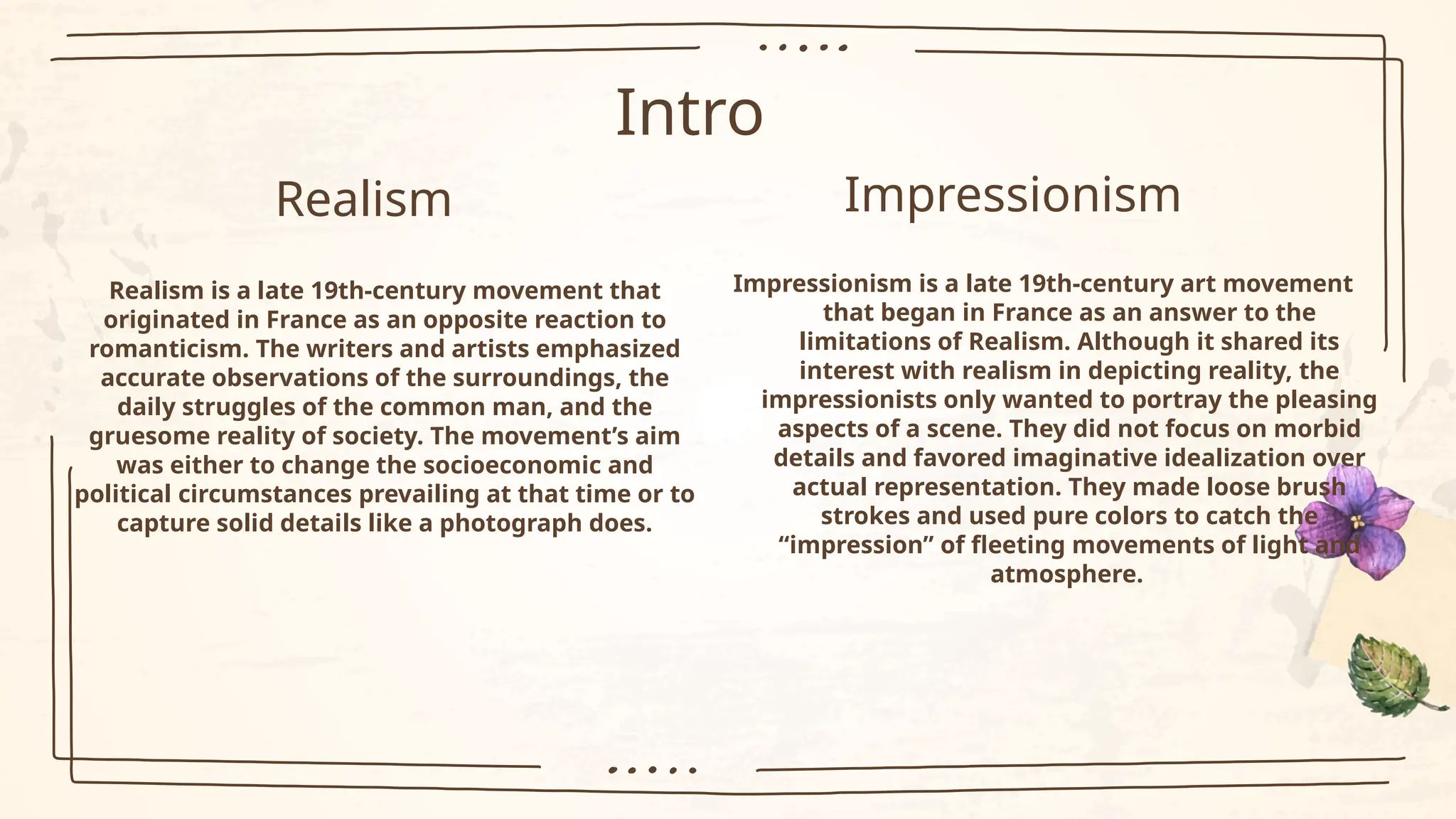
The Stone Breakers- Gustave Courbet
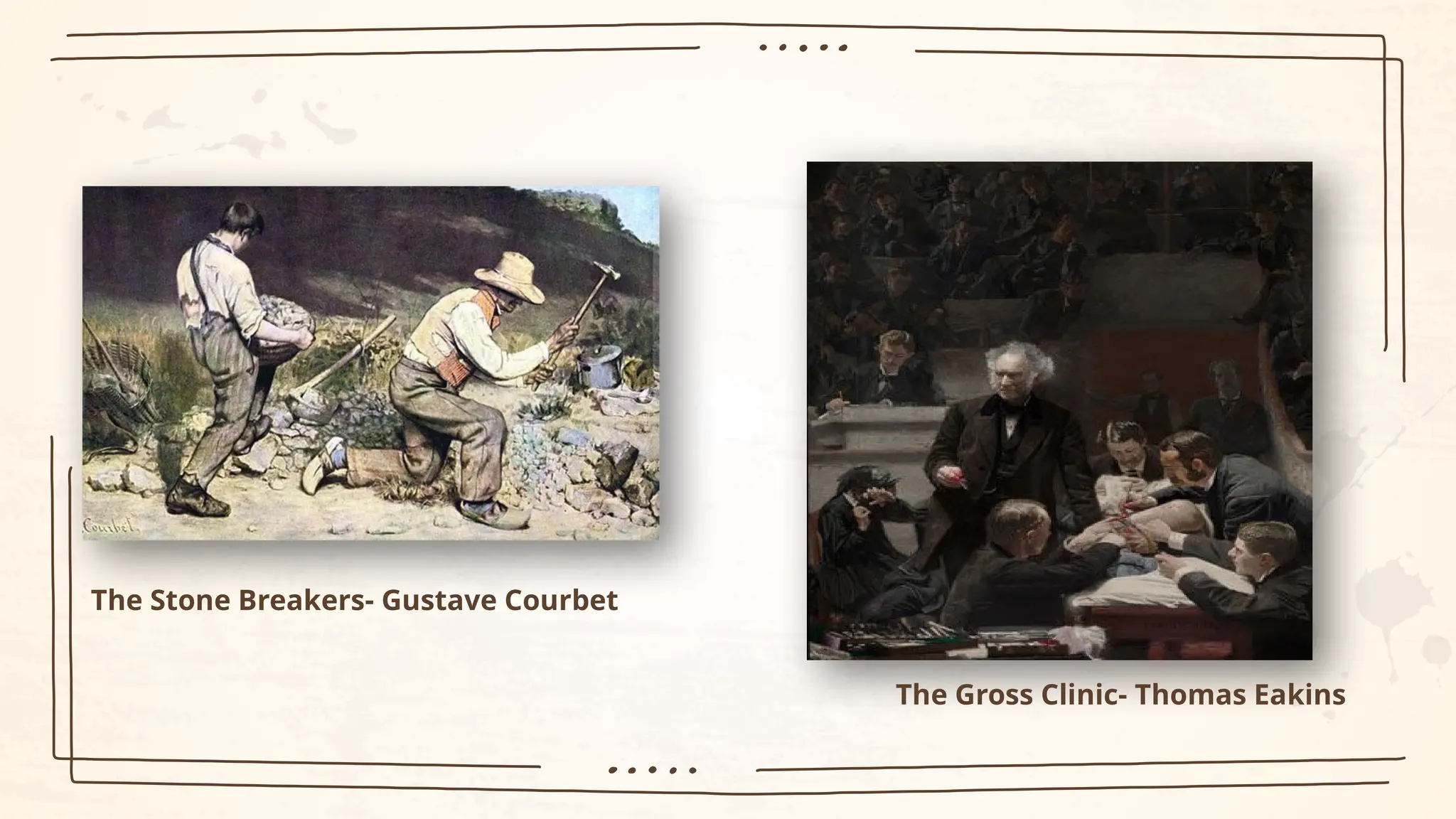
The Gross Clinic- Thomas Eakins
The Cradle- Berthe Morisot The ballet class- Edgar Degras

Impressionism vs Realism Movements in Literature

  • 1.
    Impressio nism & Realism Done by: GhidaKawtharani and Yasmin Ashi
  • 2.
    Realism and Impressionismwere both radical art movements. Art that represents radical ideas; radical approach or radical change. the movements are both very much influenced by the art of the centuries before them. If you were to compare it to a book, they’re both like chapter two, if you will, of different stories in the same genre of storytelling.
  • 3.
    Intro Realism Realism is alate 19th-century movement that originated in France as an opposite reaction to romanticism. The writers and artists emphasized accurate observations of the surroundings, the daily struggles of the common man, and the gruesome reality of society. The movement’s aim was either to change the socioeconomic and political circumstances prevailing at that time or to capture solid details like a photograph does. Impressionism Impressionism is a late 19th-century art movement that began in France as an answer to the limitations of Realism. Although it shared its interest with realism in depicting reality, the impressionists only wanted to portray the pleasing aspects of a scene. They did not focus on morbid details and favored imaginative idealization over actual representation. They made loose brush strokes and used pure colors to catch the “impression” of fleeting movements of light and atmosphere.
  • 4.
    Realism impressionism Timeline c.1840s to 1880s c. 1860s to 1900s Features (in Art) – Focus on minute details and accurate observation – Use of dark colors to show gritty and ‘ugly’ reality – Portraying all the details as visible to the eye and not to the mind – The subject matter is often the urban industrial setting, a commonplace gathering, or the lower-middle-class areas of society Focus on the artist’s perspective of the scenery – Use of light, vibrant, and unmixed colors to capture the movement of the objects – Portraying only the appealing or pleasing aspects of the scenery – The subject matter is the urban setting, but the one that is pleasant to the senses of the audience Features (in Literature) – Focus on facts and the minutest details – Reliable omniscient narrator – Organized, slow-moving plot – Detached storytelling – Realistic characters with internal motivations – Themes of hard work, common life, misery, the relationship between society and man – Straightforward diction and clear use of language – Focus on the inner ramblings of characters – Unreliable narrator – Disorganized plot, no beginning, middle, and end – Influence of personal feelings and emotions – Self-conscious, passionate characters – Play of light and color to create transient effects – Confused and incomplete sentences, use of interior monologues, and stream-of- consciousness technique
  • 5.
    The Stone Breakers-Gustave Courbet The Gross Clinic- Thomas Eakins
  • 6.
    The Cradle- BertheMorisot The ballet class- Edgar Degras