IMPORTANCE OF
TIMETABLE
Content List:
■ Definition of Timetable
■ How to maintain a Timetable
■ Why create Timetable
■ Types
■ Purpose
■ Importance
■ Advantages
■ Conclusion
Timetable:
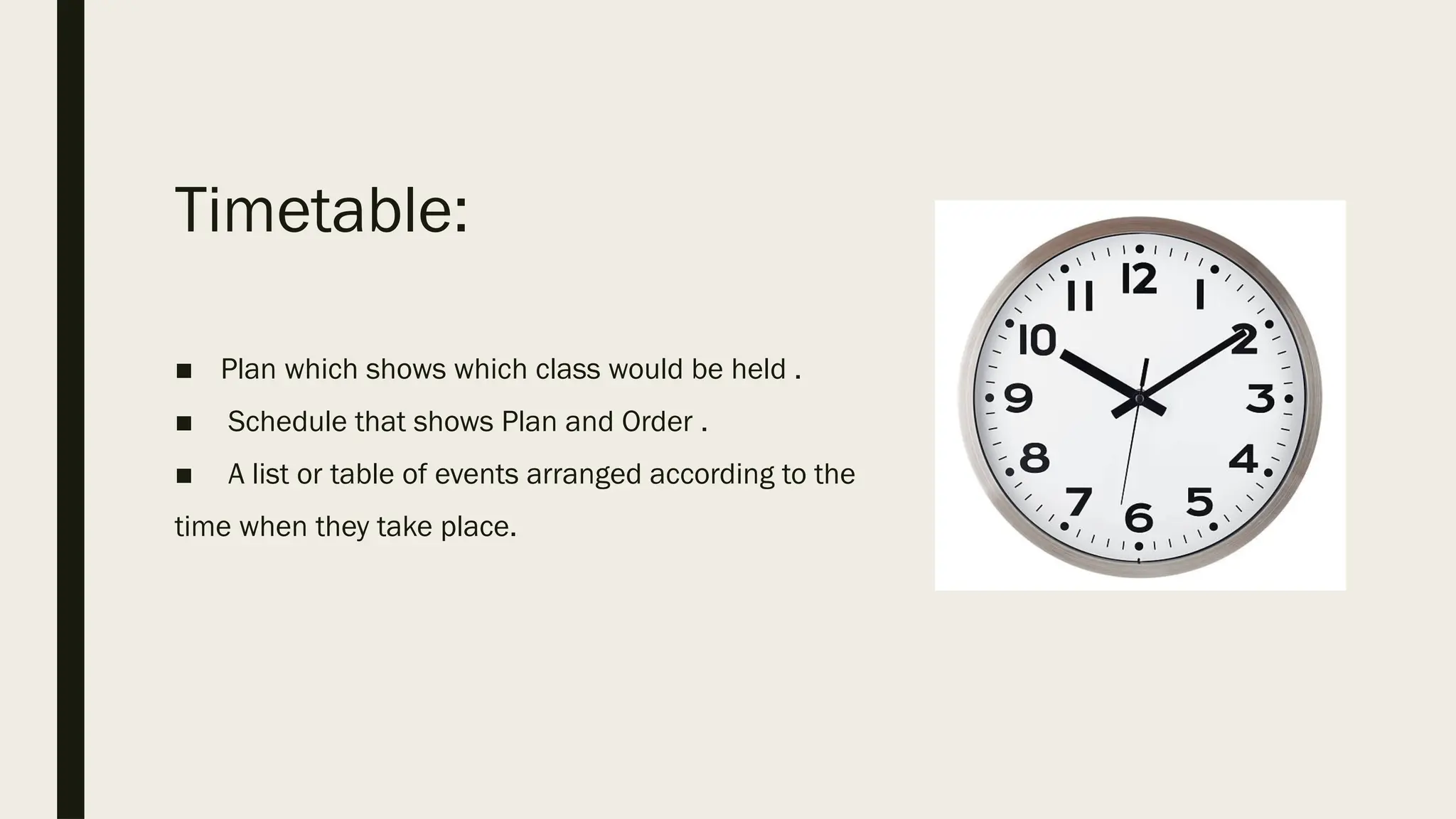
■ Plan which shows which class would be held .
■ Schedule that shows Plan and Order .
■ A list or table of events arranged according to the
time when they take place.
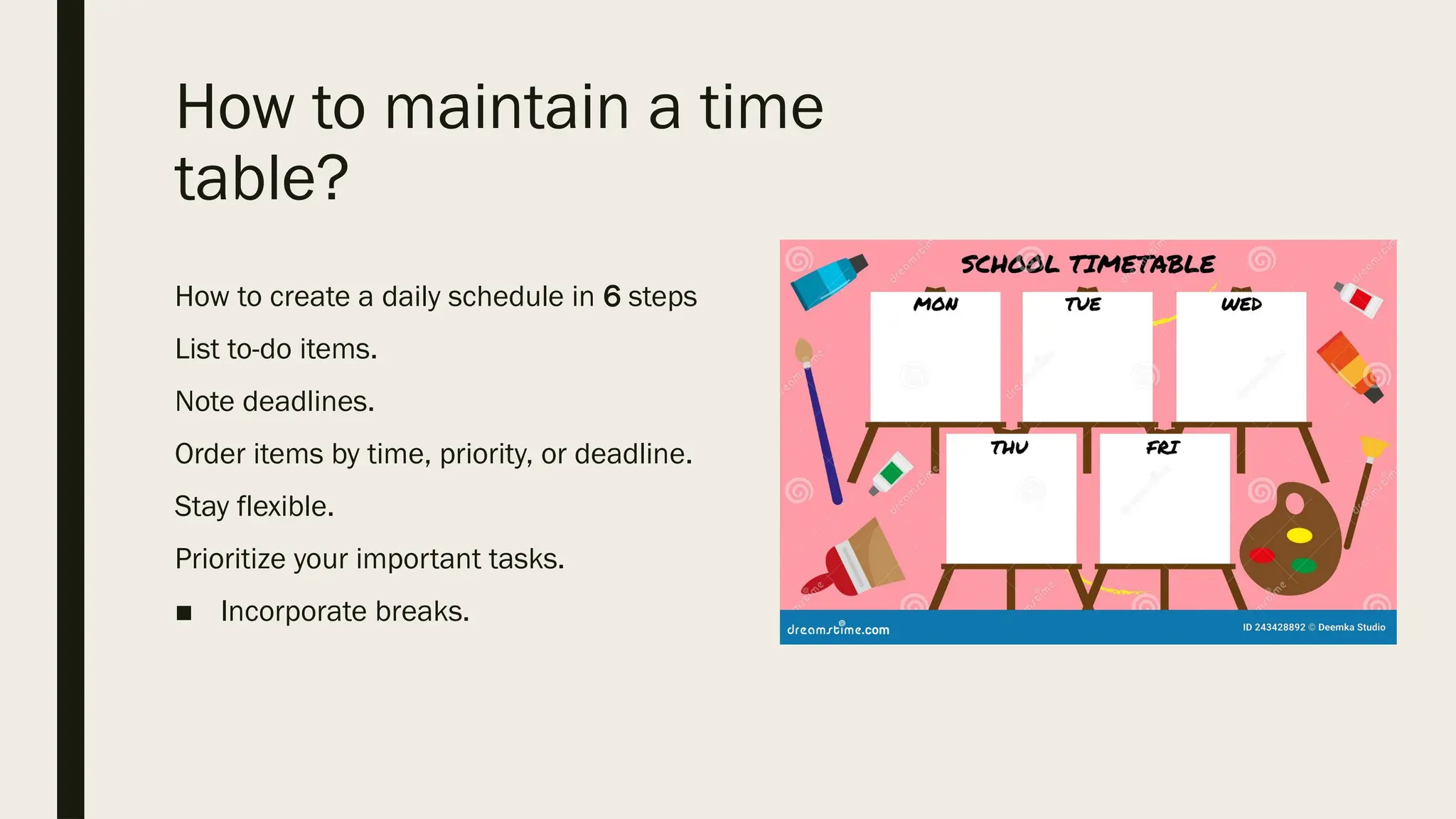
How to maintain a time
table?
How to create a daily schedule in 6 steps
List to-do items.
Note deadlines.
Order items by time, priority, or deadline.
Stay flexible.
Prioritize your important tasks.
■ Incorporate breaks.
Why create timetable?
Timetables can help you stay on top of your tasks or meet a goal as you
create a visual map of your day (hours, weeks, or months), making time
management easier to navigate.
At a glance, it lets you know what needs to be done and when and how you
could ideally be using your time.
■ Effective time management allows teachers to allocate dedicated time
for lesson planning and preparation. By setting aside specific blocks of
time for these tasks, teachers can streamline their planning process,
organize materials, and develop engaging lesson plans.
Types:
There are 4 types of Timetable that we will discuss:
■ Master Timetable
■ Class wise timetable
■ Teacher wise timetable
■ Vacant Period Timetable
MASTER TIME TABLE:
This time table gives a complete, correct and comprehensive picture of the entire
school program.
It is consolidated time table.
This time table is meant to be used by the principal .
It helps in supervising the teachers work.
It indicates the detailed work of individual teachers.
It is a combined time-table of all the classes in school.
■ A copy of it should be kept in the principal’s o ce as well as sta -room.
ffi ff
CLASS-WISE TIME-TABLE
This time table shows the daily program of a class .
It defines the distribution of each subject for each class.
It specifies that what a particular teacher will teach in particular class , about particular
subject.
It fixes the responsibility of teacher for a complete subject .
■ It indicates the breaks and the periods for games and other co-curricular activities.
TEACHER-WISE TIME-TABLE
This timetable focuses on the teacher.
The whole course is distributed teacher-wise.
This is useful for teachers as it indicates where he/she will teach a subject.
■ Teachers’ time-tables should also indicate a schedule of their non-academic duties.
VACANT PERIODTIME-TABLE
This time-table showing the vacant periods of all the teachers should also be prepared.
This will be helpful in allotting work when some teacher is on leave.
This type of time-table will show the teachers available in a particular period and thus
these teachers may be requested to keep the vacant class occupied when needed.
This is the best way of keeping the classes busy and using idle time of teachers.
■ A copy of this should be with the principal so that he/she can use this to arrange for
a substitution when one of the teachers is absent.
Purpose of Timetable
■ The purpose of a timetable in schools is to efficiently allocate resources.
■ Minimize conflicts
■ Improve overall efficiency in course allocation and classroom management.
■ The purpose of a timetable in schools is to define the date and time for classes to
be given by teachers in educational institutions.
What is the importance of the time
table?
A schedule is important for all people and not just students. It keeps the person and the
task organised and helps achieve tasks effectively in a timely manner .
■ Timetables ensure that all subjects receive their deserved weightage and are taught
for holistic development.
■ They also provide teachers with a fixed routine, promoting coordination and
reducing workload.
■ Fixes routine of both teachers and students.
Advantages:
■ Hassle-free timetable creation.
■ Equitable distribution of time for every subject.
■ Flexibility in implementation.
■ Overcome flaws of manual approach .
■ Prevents wastage of time and energy .
■ Self-discipline
■ Punctuality
■ Orderliness in students.
Conclusion
■ Timetables are an integral part of academic life, teaching discipline, time
management, and task completion.
■ Implementing a robust school management system can simplify the process,
enhance coordination, and benefit both students and teachers.
■ By choosing a reliable ed-tech solution
importance of timetable, types, class wise timetable

importance of timetable, types, class wise timetable

  • 1.
  • 2.
    Content List: ■ Definitionof Timetable ■ How to maintain a Timetable ■ Why create Timetable ■ Types ■ Purpose ■ Importance ■ Advantages ■ Conclusion
  • 3.
    Timetable: ■ Plan whichshows which class would be held . ■ Schedule that shows Plan and Order . ■ A list or table of events arranged according to the time when they take place.
  • 4.
    How to maintaina time table? How to create a daily schedule in 6 steps List to-do items. Note deadlines. Order items by time, priority, or deadline. Stay flexible. Prioritize your important tasks. ■ Incorporate breaks.
  • 5.
    Why create timetable? Timetablescan help you stay on top of your tasks or meet a goal as you create a visual map of your day (hours, weeks, or months), making time management easier to navigate. At a glance, it lets you know what needs to be done and when and how you could ideally be using your time. ■ Effective time management allows teachers to allocate dedicated time for lesson planning and preparation. By setting aside specific blocks of time for these tasks, teachers can streamline their planning process, organize materials, and develop engaging lesson plans.
  • 6.
    Types: There are 4types of Timetable that we will discuss: ■ Master Timetable ■ Class wise timetable ■ Teacher wise timetable ■ Vacant Period Timetable
  • 7.
    MASTER TIME TABLE: Thistime table gives a complete, correct and comprehensive picture of the entire school program. It is consolidated time table. This time table is meant to be used by the principal . It helps in supervising the teachers work. It indicates the detailed work of individual teachers. It is a combined time-table of all the classes in school. ■ A copy of it should be kept in the principal’s o ce as well as sta -room. ffi ff
  • 8.
    CLASS-WISE TIME-TABLE This timetable shows the daily program of a class . It defines the distribution of each subject for each class. It specifies that what a particular teacher will teach in particular class , about particular subject. It fixes the responsibility of teacher for a complete subject . ■ It indicates the breaks and the periods for games and other co-curricular activities.
  • 9.
    TEACHER-WISE TIME-TABLE This timetablefocuses on the teacher. The whole course is distributed teacher-wise. This is useful for teachers as it indicates where he/she will teach a subject. ■ Teachers’ time-tables should also indicate a schedule of their non-academic duties.
  • 10.
    VACANT PERIODTIME-TABLE This time-tableshowing the vacant periods of all the teachers should also be prepared. This will be helpful in allotting work when some teacher is on leave. This type of time-table will show the teachers available in a particular period and thus these teachers may be requested to keep the vacant class occupied when needed. This is the best way of keeping the classes busy and using idle time of teachers. ■ A copy of this should be with the principal so that he/she can use this to arrange for a substitution when one of the teachers is absent.
  • 11.
    Purpose of Timetable ■The purpose of a timetable in schools is to efficiently allocate resources. ■ Minimize conflicts ■ Improve overall efficiency in course allocation and classroom management. ■ The purpose of a timetable in schools is to define the date and time for classes to be given by teachers in educational institutions.
  • 12.
    What is theimportance of the time table? A schedule is important for all people and not just students. It keeps the person and the task organised and helps achieve tasks effectively in a timely manner . ■ Timetables ensure that all subjects receive their deserved weightage and are taught for holistic development. ■ They also provide teachers with a fixed routine, promoting coordination and reducing workload. ■ Fixes routine of both teachers and students.
  • 13.
    Advantages: ■ Hassle-free timetablecreation. ■ Equitable distribution of time for every subject. ■ Flexibility in implementation. ■ Overcome flaws of manual approach . ■ Prevents wastage of time and energy . ■ Self-discipline ■ Punctuality ■ Orderliness in students.
  • 14.
    Conclusion ■ Timetables arean integral part of academic life, teaching discipline, time management, and task completion. ■ Implementing a robust school management system can simplify the process, enhance coordination, and benefit both students and teachers. ■ By choosing a reliable ed-tech solution