Import Financing
sn
Roadmap
 FEMA regulations relating to import
 Buyers credit and suppliers credit
 External Commercial borrowings
Imports – Regulatory checklist
 DGFT – Foreign Trade Policy
 Normal banking practices & UCP guidelines for
letters of credit
 Compliance with IT Act where applicable
 Compliance with R&D cess Act for import of
drawings and designs
 Compliance with KYC norms
 A-I form to be used for imports in excess of USD
500
 EC Copy of Import Licenses for items in negative
list
FEMA Obligations
 Forex can be used either for the purpose furnished by buyer or for any purpose for
which forex can be purchased- Sec 10 (6) of FEMA
 AD can open LCs, make remittances etc for all permissible imports
 Evidence of Import of goods to be obtained when Fx used for import
 Modes of payment – remittances from India or credit to account of overseas
supplier in India
 Remittances against Imports to be normally completed within 180 days from date
of shipment
 Import of books to be allowed - no time restriction provided interest if any is as
applicable under Trade credit
 Delegation to ADs to allow delayed remittances – financial difficulties, disputes
etc.
 Interest on delayed import bills, usance bills, overdue interest upto three years in
terms of interest applicable to trade credits
Definition
 Deferred payment arrangements, including suppliers and
buyers credit, providing for payments beyond a period of six
months from date of shipment up to a period of less than
three years, are treated as trade credits for which the
procedural guidelines laid down in the Master Circular for
External Commercial Borrowings and Trade Credits may be
followed. (Imports)
 Trade Credits (TC) refer to credits extended for imports
directly by the overseas supplier, bank and financial
institution for maturity of less than three years. (ECBs and
TCs)
Advance Remittances
 AD can allow upto USD 100,000 without guarantee
 Discretion to allow upto USD 5 million without guarantee –
track record and own guidelines
 For PSUs waiving guarantee beyond USD 100,000 requires
approval from MoF.
 Advance remittance for diamond imports from specified
mining companies without limits subject to:
 Recognition of importer by Gem and Jewellery EPC
 Good track record of realisation and requirement in sale contract
 No conflict diamonds
 KYC, due diligence, commercial judgment of AD
 Half yearly statement to RBI of advance remittances without
guarantee in excess of USD 5,000,000
Adv Remittances – Aircraft
 AD can permit remittances upto USD 50 mio
for import of aircraft waiving requirement of
guarantee subject to:
 KYC, due diligence, commercial judgment
 Payment in terms of sale contract and direct to
manufacturer
 Documentary evidence of import within specified
time - undertaking
 Approval of DGCA
 Ensure refund in case of non import
Service imports
 Advance Remittance: No ceiling for amounts with
guarantee
 May permit USD 500,000 without guarantee in case
of service contracts
 Obligation to ensure fulfillment of contract
 BPOs may be allowed to make remittances towards
the cost of equipment for their overseas sites for
setting up International Call Centres subject to:
 Approval of Ministry of IT for setting up ICC
 Remittance in terms of contract direct to overseas supplier
 Evidence of import – certificate from CEO/ Auditor
Trade Credit
 Suppliers credit and buyers credit upto 3 years
 SC and BC 3 years and above – ECB
 AD can approve TC upto 20 million per import
 For non CG for maturity upto one year from date of shipment
 For CG for maturity upto 3 years from date of shipment
 No rollover and extension beyond the periods
 No TCs beyond USD 20 million without prior approval of RBI
 All in cost ceiling currently at LIBOR + 200 bps ( all
inclusive
 ADs can issue guarantees/ LoCs etc for facilitating
TCs
 Reporting to RBI
Direct receipt of import bills
 Should be received through AD normally
 Exceptions
 Value of import does not exceed USD 300,000
 Bills received by WOS of foreign cos.
 Bills received by Status holders, 100% EOUs, SEZ units, PSU
 All limited companies
 Specified sector – Diamonds upto USD 300,000 with
documentary evidence of import
 Direct receipt by AD from overseas supplier – AD satisfied of
financial standing etc., report on overseas supplier for imports
exceeding USD 300,000
Documentary Evidence of import
 Physical imports in excess of USD 100,000
 EC copy of BE for HC, EC copy for Warehousing in case of EOUs
 Customs assessment certificate or postal appraisal certificate for postal
imports
 If remittance on DA basis insist on D/E of import before remittance
 Alternate documents
 Certificate from CEO/auditor of company if amount less than USD
1,000,000
 Listed company with net worth over Rs 100 cr/ PSU etc
 Academic bodies like IIT/ IISc etc
 Non physical imports – CA certificate
 Issue of acknowledgement, instructions for preservation,
reporting in BEF etc.
Import of gold, precious metals etc
 Direct import of gold allowed by EOUs, SEZ
units etc and nominated agencies
 Total trade credit not to exceed 90 days from
date of shipment
 AD to ensure KYC/AML
 Credentials of supplier to be checked
 Large unusual transactions to be watched
 Import by nominated agencies etc. on
consignment basis or unfixed price basis
Import Factoring
 Financial service that enables purchase of goods
from overseas supplier on short term credit of upto
180 days on open account terms without the need for
opening a letter of credit (LC).
 Import factoring works on a two factor platform
 Supplier approaches Export factor in his country to
request a credit line on India buyer
 Export factor applies to import factor for evaluation of
credit risk, collection and due date payment
 Both factors are generally members of FCI
Merchanting Trade
 Goods involved permitted to be imported
 All regulation for export and import except
GR and BE to be followed
 Entire transaction to be completed within 6
months
 Forex outlay not to exceed 3 months
 Payment received on export leg in time
 No trade credit can be availed at any stage
External Commercial borrowings
(ECB)
 Commercial loans in the form of bank loans, buyers’
credit, suppliers’ credit, securitized instruments
availed of from non-resident lenders with minimum
average maturity of 3 years
 FCCBs, FCEBs need to follow ECB guidelines
 Preference shares, debentures and such capital
market instruments with debt characteristics need to
adhere to ECB Guidelines to the extent applicable
 Companies in real sector – industrial and
infrastructure and specified service sectors can raise
ECB under Automatic route
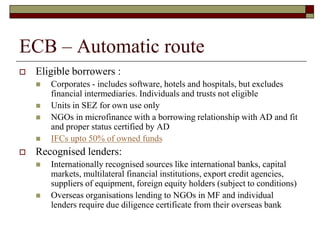
ECB – Automatic route
 Eligible borrowers :
 Corporates - includes software, hotels and hospitals, but excludes
financial intermediaries. Individuals and trusts not eligible
 Units in SEZ for own use only
 NGOs in microfinance with a borrowing relationship with AD and fit
and proper status certified by AD
 IFCs upto 50% of owned funds
 Recognised lenders:
 Internationally recognised sources like international banks, capital
markets, multilateral financial institutions, export credit agencies,
suppliers of equipment, foreign equity holders (subject to conditions)
 Overseas organisations lending to NGOs in MF and individual
lenders require due diligence certificate from their overseas bank
ECB – Infrastructure Finance cos
 NBFCs engaged in financing infrastructure and
classified as such by RBI vide DNBS.PD. CC No.
168 / 03.02.089 /2009-10 dated Feb 12, 2010 can
avail ECB under Automatic route upto 50% of
owned funds
 Compliance with terms of circular dated Feb 12, 2010
 Hedging of risk in full
 Total outstanding ECBs not to exceed 50% of owned
funds
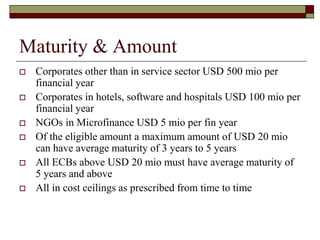
Maturity & Amount
 Corporates other than in service sector USD 500 mio per
financial year
 Corporates in hotels, software and hospitals USD 100 mio per
financial year
 NGOs in Microfinance USD 5 mio per fin year
 Of the eligible amount a maximum amount of USD 20 mio
can have average maturity of 3 years to 5 years
 All ECBs above USD 20 mio must have average maturity of
5 years and above
 All in cost ceilings as prescribed from time to time
End use
 Investment [such as import of capital goods, new projects, modernization /expansion of
existing production units in the real sector - industrial sector including small and
medium enterprises (SME), infrastructure sector and specific service sectors, namely
hotel, hospital and software - in India.
 Overseas investments in JVs WOS
 Acquisition of shares in disinvestment of PSUs
 Payment for 3G license etc.
 For onlending to SHGs etc by NGOs in MF
 Premature buyback of FCCBs as and when permitted
DON’Ts
 No onlending, investment in capital market or acquisition of company – part of whole –
permitted out of ECB funds
 No investment in real estate
 No working capital, refinancing Rupee loans, general corporate purpose etc permitted
 No issue of guarantees by AD
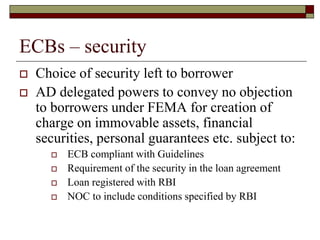
ECBs – security
 Choice of security left to borrower
 AD delegated powers to convey no objection
to borrowers under FEMA for creation of
charge on immovable assets, financial
securities, personal guarantees etc. subject to:
 ECB compliant with Guidelines
 Requirement of the security in the loan agreement
 Loan registered with RBI
 NOC to include conditions specified by RBI
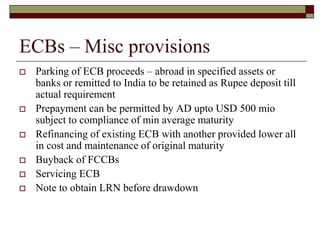
ECBs – Misc provisions
 Parking of ECB proceeds – abroad in specified assets or
banks or remitted to India to be retained as Rupee deposit till
actual requirement
 Prepayment can be permitted by AD upto USD 500 mio
subject to compliance of min average maturity
 Refinancing of existing ECB with another provided lower all
in cost and maintenance of original maturity
 Buyback of FCCBs
 Servicing ECB
 Note to obtain LRN before drawdown
ECBs – Approval route
 Eligible borrowers:
 Financial institutions dealing exclusively in infrastructure or
exports
 Banks and FIs participating in steel and textile restructuring
package approved by GOI
 NBFCs in infrastructure beyond Auto Route
 FCCBs by HFCs
 SPVs set up for infrastructure financing and notified
 Multi state co-op societies in mfg
 SEZ developers for infrastructure as defined
 Corporates who have violated norms or are under ED
investigation etc
 Cases falling outside purview of Auto Route
ECBs- Approval Route
 Recognised lender – on similar lines as Auto Route
 Maturity and Amount – Amounts in excess of USD 500 mio
in a financial year can be considered under Approval Route.
Maturity restrictions apply
 Cost – same as auto route
 Guarantee for ECB for SME only considered under Approval
Route
 Prepayment in excess of USD 500 mio
 Buyback of FCCBs outside Auto route
 Cases considered by Empowered Committee
 Reporting and dissemination of information – form 83, ECB
and ECB 2
Structured Obligations
 Rupee denominated structured obligations can be
credit enhanced by international banks, FIs, JV
partners etc. under approval route
 Credit enhancement permissible for domestic debt
raised in the capital markets by Indian companies
engaged exclusively in infrastructure and
infrastructure financing companies classified as such
by RBI:
 Credit enhancement by multilateral regional financial institutions
and Govt owned FIs
 Minimum average maturity of 7 years
 Guarantee fee / all in cost – 2%

Import Financing.ppt

  • 1.
  • 2.
    Roadmap  FEMA regulationsrelating to import  Buyers credit and suppliers credit  External Commercial borrowings
  • 3.
    Imports – Regulatorychecklist  DGFT – Foreign Trade Policy  Normal banking practices & UCP guidelines for letters of credit  Compliance with IT Act where applicable  Compliance with R&D cess Act for import of drawings and designs  Compliance with KYC norms  A-I form to be used for imports in excess of USD 500  EC Copy of Import Licenses for items in negative list
  • 4.
    FEMA Obligations  Forexcan be used either for the purpose furnished by buyer or for any purpose for which forex can be purchased- Sec 10 (6) of FEMA  AD can open LCs, make remittances etc for all permissible imports  Evidence of Import of goods to be obtained when Fx used for import  Modes of payment – remittances from India or credit to account of overseas supplier in India  Remittances against Imports to be normally completed within 180 days from date of shipment  Import of books to be allowed - no time restriction provided interest if any is as applicable under Trade credit  Delegation to ADs to allow delayed remittances – financial difficulties, disputes etc.  Interest on delayed import bills, usance bills, overdue interest upto three years in terms of interest applicable to trade credits
  • 5.
    Definition  Deferred paymentarrangements, including suppliers and buyers credit, providing for payments beyond a period of six months from date of shipment up to a period of less than three years, are treated as trade credits for which the procedural guidelines laid down in the Master Circular for External Commercial Borrowings and Trade Credits may be followed. (Imports)  Trade Credits (TC) refer to credits extended for imports directly by the overseas supplier, bank and financial institution for maturity of less than three years. (ECBs and TCs)
  • 6.
    Advance Remittances  ADcan allow upto USD 100,000 without guarantee  Discretion to allow upto USD 5 million without guarantee – track record and own guidelines  For PSUs waiving guarantee beyond USD 100,000 requires approval from MoF.  Advance remittance for diamond imports from specified mining companies without limits subject to:  Recognition of importer by Gem and Jewellery EPC  Good track record of realisation and requirement in sale contract  No conflict diamonds  KYC, due diligence, commercial judgment of AD  Half yearly statement to RBI of advance remittances without guarantee in excess of USD 5,000,000
  • 7.
    Adv Remittances –Aircraft  AD can permit remittances upto USD 50 mio for import of aircraft waiving requirement of guarantee subject to:  KYC, due diligence, commercial judgment  Payment in terms of sale contract and direct to manufacturer  Documentary evidence of import within specified time - undertaking  Approval of DGCA  Ensure refund in case of non import
  • 8.
    Service imports  AdvanceRemittance: No ceiling for amounts with guarantee  May permit USD 500,000 without guarantee in case of service contracts  Obligation to ensure fulfillment of contract  BPOs may be allowed to make remittances towards the cost of equipment for their overseas sites for setting up International Call Centres subject to:  Approval of Ministry of IT for setting up ICC  Remittance in terms of contract direct to overseas supplier  Evidence of import – certificate from CEO/ Auditor
  • 9.
    Trade Credit  Supplierscredit and buyers credit upto 3 years  SC and BC 3 years and above – ECB  AD can approve TC upto 20 million per import  For non CG for maturity upto one year from date of shipment  For CG for maturity upto 3 years from date of shipment  No rollover and extension beyond the periods  No TCs beyond USD 20 million without prior approval of RBI  All in cost ceiling currently at LIBOR + 200 bps ( all inclusive  ADs can issue guarantees/ LoCs etc for facilitating TCs  Reporting to RBI
  • 10.
    Direct receipt ofimport bills  Should be received through AD normally  Exceptions  Value of import does not exceed USD 300,000  Bills received by WOS of foreign cos.  Bills received by Status holders, 100% EOUs, SEZ units, PSU  All limited companies  Specified sector – Diamonds upto USD 300,000 with documentary evidence of import  Direct receipt by AD from overseas supplier – AD satisfied of financial standing etc., report on overseas supplier for imports exceeding USD 300,000
  • 11.
    Documentary Evidence ofimport  Physical imports in excess of USD 100,000  EC copy of BE for HC, EC copy for Warehousing in case of EOUs  Customs assessment certificate or postal appraisal certificate for postal imports  If remittance on DA basis insist on D/E of import before remittance  Alternate documents  Certificate from CEO/auditor of company if amount less than USD 1,000,000  Listed company with net worth over Rs 100 cr/ PSU etc  Academic bodies like IIT/ IISc etc  Non physical imports – CA certificate  Issue of acknowledgement, instructions for preservation, reporting in BEF etc.
  • 12.
    Import of gold,precious metals etc  Direct import of gold allowed by EOUs, SEZ units etc and nominated agencies  Total trade credit not to exceed 90 days from date of shipment  AD to ensure KYC/AML  Credentials of supplier to be checked  Large unusual transactions to be watched  Import by nominated agencies etc. on consignment basis or unfixed price basis
  • 13.
    Import Factoring  Financialservice that enables purchase of goods from overseas supplier on short term credit of upto 180 days on open account terms without the need for opening a letter of credit (LC).  Import factoring works on a two factor platform  Supplier approaches Export factor in his country to request a credit line on India buyer  Export factor applies to import factor for evaluation of credit risk, collection and due date payment  Both factors are generally members of FCI
  • 14.
    Merchanting Trade  Goodsinvolved permitted to be imported  All regulation for export and import except GR and BE to be followed  Entire transaction to be completed within 6 months  Forex outlay not to exceed 3 months  Payment received on export leg in time  No trade credit can be availed at any stage
  • 15.
    External Commercial borrowings (ECB) Commercial loans in the form of bank loans, buyers’ credit, suppliers’ credit, securitized instruments availed of from non-resident lenders with minimum average maturity of 3 years  FCCBs, FCEBs need to follow ECB guidelines  Preference shares, debentures and such capital market instruments with debt characteristics need to adhere to ECB Guidelines to the extent applicable  Companies in real sector – industrial and infrastructure and specified service sectors can raise ECB under Automatic route
  • 16.
    ECB – Automaticroute  Eligible borrowers :  Corporates - includes software, hotels and hospitals, but excludes financial intermediaries. Individuals and trusts not eligible  Units in SEZ for own use only  NGOs in microfinance with a borrowing relationship with AD and fit and proper status certified by AD  IFCs upto 50% of owned funds  Recognised lenders:  Internationally recognised sources like international banks, capital markets, multilateral financial institutions, export credit agencies, suppliers of equipment, foreign equity holders (subject to conditions)  Overseas organisations lending to NGOs in MF and individual lenders require due diligence certificate from their overseas bank
  • 17.
    ECB – InfrastructureFinance cos  NBFCs engaged in financing infrastructure and classified as such by RBI vide DNBS.PD. CC No. 168 / 03.02.089 /2009-10 dated Feb 12, 2010 can avail ECB under Automatic route upto 50% of owned funds  Compliance with terms of circular dated Feb 12, 2010  Hedging of risk in full  Total outstanding ECBs not to exceed 50% of owned funds
  • 18.
    Maturity & Amount Corporates other than in service sector USD 500 mio per financial year  Corporates in hotels, software and hospitals USD 100 mio per financial year  NGOs in Microfinance USD 5 mio per fin year  Of the eligible amount a maximum amount of USD 20 mio can have average maturity of 3 years to 5 years  All ECBs above USD 20 mio must have average maturity of 5 years and above  All in cost ceilings as prescribed from time to time
  • 19.
    End use  Investment[such as import of capital goods, new projects, modernization /expansion of existing production units in the real sector - industrial sector including small and medium enterprises (SME), infrastructure sector and specific service sectors, namely hotel, hospital and software - in India.  Overseas investments in JVs WOS  Acquisition of shares in disinvestment of PSUs  Payment for 3G license etc.  For onlending to SHGs etc by NGOs in MF  Premature buyback of FCCBs as and when permitted DON’Ts  No onlending, investment in capital market or acquisition of company – part of whole – permitted out of ECB funds  No investment in real estate  No working capital, refinancing Rupee loans, general corporate purpose etc permitted  No issue of guarantees by AD
  • 20.
    ECBs – security Choice of security left to borrower  AD delegated powers to convey no objection to borrowers under FEMA for creation of charge on immovable assets, financial securities, personal guarantees etc. subject to:  ECB compliant with Guidelines  Requirement of the security in the loan agreement  Loan registered with RBI  NOC to include conditions specified by RBI
  • 21.
    ECBs – Miscprovisions  Parking of ECB proceeds – abroad in specified assets or banks or remitted to India to be retained as Rupee deposit till actual requirement  Prepayment can be permitted by AD upto USD 500 mio subject to compliance of min average maturity  Refinancing of existing ECB with another provided lower all in cost and maintenance of original maturity  Buyback of FCCBs  Servicing ECB  Note to obtain LRN before drawdown
  • 22.
    ECBs – Approvalroute  Eligible borrowers:  Financial institutions dealing exclusively in infrastructure or exports  Banks and FIs participating in steel and textile restructuring package approved by GOI  NBFCs in infrastructure beyond Auto Route  FCCBs by HFCs  SPVs set up for infrastructure financing and notified  Multi state co-op societies in mfg  SEZ developers for infrastructure as defined  Corporates who have violated norms or are under ED investigation etc  Cases falling outside purview of Auto Route
  • 23.
    ECBs- Approval Route Recognised lender – on similar lines as Auto Route  Maturity and Amount – Amounts in excess of USD 500 mio in a financial year can be considered under Approval Route. Maturity restrictions apply  Cost – same as auto route  Guarantee for ECB for SME only considered under Approval Route  Prepayment in excess of USD 500 mio  Buyback of FCCBs outside Auto route  Cases considered by Empowered Committee  Reporting and dissemination of information – form 83, ECB and ECB 2
  • 24.
    Structured Obligations  Rupeedenominated structured obligations can be credit enhanced by international banks, FIs, JV partners etc. under approval route  Credit enhancement permissible for domestic debt raised in the capital markets by Indian companies engaged exclusively in infrastructure and infrastructure financing companies classified as such by RBI:  Credit enhancement by multilateral regional financial institutions and Govt owned FIs  Minimum average maturity of 7 years  Guarantee fee / all in cost – 2%