IMPLEMENTING CLOUD COMPUTING 1
Implementing Cloud Computing in Bentley’s Automotive - Manufacturing Sector
By: Student’s name: Adam Malik
45 sneyd road
City, state: London nw2 6al
+447469701795
Professor’s name
University name
Date of submission
Idiots who don’t pay for academic assistance
IMPLEMENTING CLOUD COMPUTING 2
IMPLEMENTING CLOUD COMPUTING 3
Abstract
As new corporations enter the automotive industry with their dire hunger for huge consumer
base, drastic changes have been witnessed within the entire industry. Competition have been stiff
with new technological advancements defining the direction of the sector. A sample case
representing these revolutionary changes in the sector is the way the automotive manufacturers
are incorporating Information Technology assets to enhance the recording of data, costs of
products, services processing, and storage associated. The summative result of this activities
have, henceforth, resulted in the integration of cloud computing to improve efficiency in services
delivery and overall consumer satisfaction. Nonetheless, various challenges have emerged,
blocking the migration of individual automotive firms into cloud-based services. Most of these
challenges hover around the security and integrity of the resultant cloud services. As such, the
following report base its research at Bentley Motors. In this, a detailed review to the current
information systems and their use to improve efficiency in services deliver is made. Further, the
Bentley Motors instance is used to further evaluate the security considerations that encompass
the use of cloud-based services within the automotive industry. The end result of the report
concludes at providing strategic recommendation along which mitigation strategies can be
implemented to overcome the security limitations associated with the implementation of cloud
services within the automotive industry.
IMPLEMENTING CLOUD COMPUTING 4
Table of Contents
Abstract ........................................................................................................................................... 3
Introduction..................................................................................................................................... 5
Sales, Staff, and Consumer Base at Bentley Motors................................................................... 5
Information Systems at Bentley Motors...................................................................................... 6
Current status of Cloud Computing ................................................................................................ 7
Cloud Deployment Models ......................................................................................................... 7
Cloud Service Models ................................................................................................................. 7
Cloud Characteristics .................................................................................................................. 7
Application of Cloud Computing in the Automotive Industry ................................................... 8
Example Applications ................................................................................................................. 9
Potential benefits of Cloud Computing........................................................................................... 9
Potential security issues associated with Cloud Computing......................................................... 10
Proposals for the secure implementation of Cloud Computing .................................................... 11
Conclusion .................................................................................................................................... 11
Bibliography.................................................................................................................................. 13
List of Figures
Figure 1: Deliveries, Profits, and Staff at Bentley, Crewe, UK (Ramsey, 2012). .......................... 6
Figure 2: Property-pack of cloud computing systems (Xiong, 2014)............................................. 8
IMPLEMENTING CLOUD COMPUTING 5
Implementing Cloud Computing in Bentley’s Automotive - Manufacturing Sector
Introduction
Bentley Motors Limited, registered in Britain, represents a design, development, and
manufacturing company to the most luxurious motorcars in the world. Even more stunning, most
of these luxurious motorcar designs are largely hand built. Based in Crewe, England, Bentley
Motors began as a subsidiary of Volkswagen AG and founded by W. O. Bentley back in 1919 in
Cricklewood, London. Not all production for the Bentley cars is made at Crewe, UK. Other
small number of the newly introduced Continental Flying Spurs are amassed at Dresden,
Germany (Frankel, 2008). While the greater number of the Continental Flying Spurs are shipped
from Zwickau, Germany.
Sales, Staff, and Consumer Base at Bentley Motors
However, once the company was taken over by Volkswagen, up to $845 million of cash was
used to renew and modernize the Crewe base. The undertaking resulted into expanded workforce
with high and more exquisite production capacities. As of 2010, the Crewe base recorded a
workforce of 3, 500 (Parissien, 2013). With such a workforce, Bentley has ever since been
investing strongly on innovation and new inventions to ensure that they new productions, such as
the 2016 Mulsanne, meet customer satisfaction to the highest level possible. Advantageously,
this strategy oversaw the success of Bentleys rise radically, covering a customer base all over the
globe. Indeed, Bentley’s growth began facing a steady up flow. The Wall Street Journal reports
that by 2011, the car sales rose by 37% hitting up at 7, 003 vehicles where the new Continental
GT accounted for over a third of the total sales (Rauwald, 2012). Similarly, the workforce
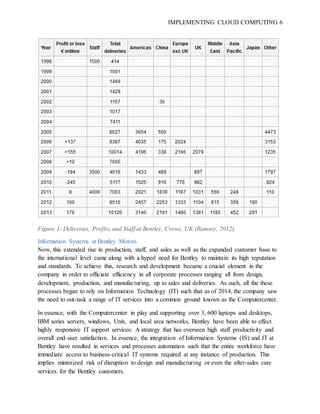
recorded a raise reaching 4, 000 people (Rauwald, 2012). A better insight of the company’s
sales, deliveries, and staff group is provided in the figure below:
IMPLEMENTING CLOUD COMPUTING 6
Figure 1: Deliveries, Profits, and Staff at Bentley, Crewe, UK (Ramsey, 2012).
Information Systems at Bentley Motors
Now, this extended rise in production, staff, and sales as well as the expanded customer base to
the international level came along with a hyped need for Bentley to maintain its high reputation
and standards. To achieve this, research and development became a crucial element in the
company in order to officiate efficiency in all corporate processes ranging all from design,
development, production, and manufacturing, up to sales and deliveries. As such, all the these
processes began to rely on Information Technology (IT) such that as of 2014, the company saw
the need to out-task a range of IT services into a common ground known as the Computercenter.
In essence, with the Computercenter in play and supporting over 3, 600 laptops and desktops,
IBM series servers, windows, Unix, and local area networks, Bentley have been able to effect
highly responsive IT support services: A strategy that has overseen high staff productivity and
overall end-user satisfaction. In essence, the integration of Information Systems (IS) and IT at
Bentley have resulted in services and processes automation such that the entire workforce have
immediate access to business-critical IT systems required at any instance of production. This
implies minimized risk of disruption to design and manufacturing or even the after-sales care
services for the Bentley customers.
IMPLEMENTING CLOUD COMPUTING 7
Current status of Cloud Computing
Cloud computing will generally comprise of a model that enables convenient, ubiquitous, and
on-demand access to shared pool of configurable computing resources over a network. These
resources, which will comprise of applications, services, servers, networks, and storage among
others, can be released and provisioned rapidly with minimal services provider interaction or
management effort when accessed via the cloud (Miller, 2012). As of today, this cloud-based
model is provisioned over there services models comprising of five essential features and four
deployment models (Haugen & Musser, 2013).
Cloud Deployment Models
A business may decide either to deploy the cloud services in either of the following models
depending on the anticipated user coverage:
1. Private cloud.
2. Public cloud.
3. Hybrid cloud (comprise of both private and public clouds).
4. Community cloud.
Cloud Service Models
Similarly, the following comprise the three basic service models along which a corporation can
allow its staff and customers to access and utilize the cloud:
i. Software as a Service (SaaS). This service pack allows consumers to access and use
applications running on a given cloud infrastructure.
ii. Platform as a Service (SaaS). This service pack allows consumers to deploy the
consumer-created or acquired applications on a given cloud infrastructure.
iii. Infrastructure as a Service (IaaS). This service pack allows consumers to obtain
networks, storage, processing, and other fundamental computing resources provided
on a given cloud infrastructure.
Cloud Characteristics
Among any of the above service models or deployment models used, a cloud computing
infrastructure is entitled to bare the following characteristics:
i. Resources pooling. All computing resources including servers, networks, memory,
processing, storage, virtual machines, and bandwidth among others are pooled
together in order to serve multiple clients. These resources are assigned and
reassigned dynamically to the consumers depending on the apparent consumer
demand.
IMPLEMENTING CLOUD COMPUTING 8
ii. Measured services. Bu use of filter mechanisms, the cloud systems are able to
automatically optimize and control resources appropriately depending on the resource
type.
iii. On-demand self-service. Customers to the cloud systems are entitled to access and
use any of the computing resources such as network storage or server time
automatically at any time without having to interact with human or service provider.
iv. Rapid elasticity. The cloud systems users are able to access cloud capabilities
elastically, or automatically in some cases, and can be purchased and accessed at any
time and quantity.
v. Broad network access. The individual cloud capabilities are made available by the
cloud systems over a network where they are accessed via a standard mechanism that
support multiple client platforms such as personal digital assistants (PDAs), laptops
or mobile phones.
Below includes a diagrammatic representation of the summative cloud service models,
deployment models, essential characteristics, and essential and common characteristics:
Figure 2: Property-pack of cloud computing systems (Xiong, 2014).
Application of Cloud Computing in the Automotive Industry
Given the above highlighted property-pack of cloud computing, its implementation in the
automotive industry represents a major necessity in order to improve operations efficiency within
the industry. The industry is just like any other production industry. This implies that the supply
chain is an essential factor for the entire industry. Organizations such as Bentley have been seen
to rely on IT solutions, given its recently inaugurated Computercenter, to warrant smooth
operations in its supply chain (Rauwald, 2012).
IMPLEMENTING CLOUD COMPUTING 9
Indeed, this is a step towards cloud computing. It only shows that implementing cloud system
within such an organization will only pull the firm strides ahead in the entire industry. As
(Parissien, 2013) confirms, cloud computing implemented in automotive industry can result in a
more lean, agile, and flexible supply chain (Haugen & Musser, 2013). This way, and with
addition of the basic features that come along with cloud systems, a firm such as Bentley is able
to effect a higher end-user satisfaction. It is able to rapidly adapt to the changing logistics,
consumers, and market demands. More specifically, cloud computing implementation is the
automotive industry can push an added capability of the auto-manufacturers to optimize their
supply chains cost-effectively, and hence enhancing a brighter future growth (Gaynor, 2012).
Example Applications
Such cloud based solution have made it possible for car manufactures such as Volkswagen and
BMW to implement services such as the location-based marker. This service ensures that the car
is adequately networked with its environs (Haugen & Musser, 2013). An example includes a case
where a car system identifies and warns the users once the fuel levels are low and suggests on the
nearest services stations with low services costs. Other cloud-enhanced systems include the
urban-area wireless traffic networks. These systems work such that external controls are used to
regulate a car’s speed and distance to other vehicles in order to avoid traffic jams and accidents
(Haugen & Musser, 2013).
Potential benefits of Cloud Computing
Enormous benefits are likely to become the automotive industry upon implementation of cloud-
based services. For instance, consider the following instances:
i. Optimized supply chain making it more lean and adaptable to the highly changing
organization and business needs. The end result to such occurrence is increased
productivity and customer service as well as customer satisfaction.
ii. Expenditure and effort shift from maintenance to strategic investments and hence
reduced production and supply costs.
iii. The implementation of subscription-based pricing model hence ensuring the firms
only pay for the capacities and resources required and time they are required for.
iv. Accelerated production and supply of innovative products and services.
v. The ability to scale IT capacity smoothly so as to adequately respond to the changing
market and business conditions.
vi. Cloud-based collaboration. The individual automotive firms could be able to share
information and collaborate with their partner networks such that there is improved
efficiency in the supply chain, procurement, product launch, logistics, demand
planning, compliance, and tracking.
vii. Cloud-based analytics. These allow the individual automotive firm to track and
evaluate its key performance indicators and hence increasing visibility in organization
goals and objectives.
IMPLEMENTING CLOUD COMPUTING 10
viii. Computer-based simulators and designs. These are used to generate huge amounts of
data for simulation within the automotive firms. However, there is provisioned low-
cost storage as these data grows into enormous volumes. In such a case, cloud-based
services can offer a cost effective solution where big data analysis techniques such as
Hadoop can be used to analyze and manage huge corporate data.
The above listed points comprise some of the advantages that are likely to become any
automotive organization upon implementation of cloud services within its services and products
production processes.
An example of an automotive center that has benefited from cloud computing systems is Pune.
Pune represent one of the top automobile hubs in India, which, as of today, have emerged as the
leading automotive sector not only in the region, but also globally (Ramsey, 2012). Pune
comprise of the ‘who’s and who’ of India including General Motors, Mahindra & Mahindra, and
Volkswagen among others, all who have setup their plants at Pune (Ramsey, 2012).
Potential security issues associated with Cloud Computing
The major security issues associated with the implementation of cloud computing systems within
automotive firms mainly on data security. For instance, the IT manager need to research on and
conclusively respond to the following questions before making any considerations of adopting a
cloud-based system:
i. How secure shall the organizational data be at the time of transition from the current
information systems to a new cloud based system?
ii. Will the new cloud system pay respect to data integrity for each group of users, either
for the organization, its employees, and the consumer group?
iii. Does the new cloud system pay adequate respect to both the internal or external
ethical and social requirements?
iv. Shall the new cloud system ensure secure and personalized use of the cloud-based
resources reliably?
To achieve the highest level of user satisfaction with the product vehicle, car manufactures such
as Bentley install computer systems that collect user-specific data. The data may include voice or
even personal identifications and credentials which are then transferred into the cloud. This
means that, if access to such personal data is not made absolute only to the authorized personnel,
then the entire cloud system represents a fault. Private user data may leak to malicious groups
that could hold malicious intents against the car users.
The second major security consideration while implementing cloud systems in automotive firms
include social and organizational ethics. For instance, cloud services such as the location-based
cloud services that warns a car user when the gas is low and locates the nearest service station for
the user acts as a typical surveillance system that monitors and records every move that a
particular car owner makes. Such is a major security and ethical concern that information
IMPLEMENTING CLOUD COMPUTING 11
systems specialists at Bentley Motors or any other automotive firm need to concern themselves
with and device adequate strategies that ensure that such monitoring is only accessible in order
of highest integrity as much possible.
Proposals for the secure implementation of Cloud Computing
Foremost, research works provided by (Enrique, et al., 2015) make it clear that cloud computing
systems are levelly complicated to assimilate, especially within huge, complex, and multinational
organizations. Similarly, it is evident that firms and organizations have by far understudied the
basic roles that cloud computing systems are entitled to play within the immediate organizational
structure. Enrique, et al. state that there exist multiple reasons along which different firms can
fail to realize the expected payoffs from these systems (Enrique, et al., 2015). These will range
from the very technical difficulties associated with the deployment and use of Information
Technology based systems to the hold of unrealistic expectations or underestimation of the
systems (Marler & Liang, 2012).
However, on the bright side and based on the above research, there exist cautionary strategies
that can be adopted such that they ensure smooth transition and adoption of cloud computing-
based services such that there are minimal security risks in play. First, Enrique et al. (2015)
commend that if at all the organization have to fully succeed in use of cloud computing systems,
then it must identify and give-in to the three premises that govern the nature, purpose, and
consequence of information gathering and use within firms. These include:
i. The fact that firms are open systems that must process data from and about their
environs (Marler & Liang, 2012).
ii. Also, firms’ managements must realize that cognitive processes that govern the
interpretation of events are always distributed throughout the firm and not isolated to
one individual, but the entire workforce.
iii. Finally, managements need to realize that different organizations differ in the process
or mode through which they interpret their environments.
This way, any module implemented while transitioning into the cloud-based services is
configured such that access and security emerge as the key factors of implementation. This
recommendation is based on the fact that as much as the implementation of cloud services aims
at allows access to sharable computer resources from any place and time, the service should also
ensure that these resources are only accessed by authorized personnel.
Conclusion
Conclusively, in order for a given automotive company to implement cloud services while
mitigating either security risks that come along with the latter, adequate funds should be
rendered into the research and development (R&D) sector. The sector should then exhaustively
cover on all firm’s processes and how they correlate to other organizational entities such as the
workforce and the management or even to other organizations, suppliers, partners, and
IMPLEMENTING CLOUD COMPUTING 12
consumers (Pressman, 2015). It is the end-results from this research which ensure that only the
authorized personnel gain access to the resources or data in question not to mention the achieved
absoluteness in system scalability, usability, integrity, and reliability (Pressman, 2015). In the
same, all the social and ethical margins will be considered accordingly at the research and
development level such that the end result shall have minimal conflicts to either the internal or
external ethical and social requirements. A further mitigation strategy include the supply of
dedicated expert staff present on a 24*7 basis where they monitor the system for security as well
as breakdown failures.
IMPLEMENTING CLOUD COMPUTING 13
Bibliography
Enrique, M., Kirsch, L. J. & SButler, B., 2015. The assimilation of enterprise information
system: An interpretation systems perspective.. Information & Management, 52(3), pp. 359-370.
Frankel, A., 2008. Bentley: The Story.. 3 ed. London: Redwood Publishing.
Gaynor, B., 2012. Advantages of Information Technologies:. [Online]
Available at: www.buzzle.com/…ages-of-information-technology.html
[Accessed 28 October 2015].
Haugen, M. D. & Musser, S., 2013. Technology and the Cloud. Manchester: Macmillan.
Hellens, S., Nielsen, L. V. & Beekhuyzen, J., 2015. Qualitative case studies on implementation
of enterprise wide systems.. 2 ed. Hershey, PA: Idea Group Pub..
Marler, J. H. & Liang, X., 2012. Information technology change, work complexity and service
jobs: A contingent perspective.. New Technology, Work and Employment , 2(133-46), p. 27.
Metheny, M., 2012. Federal Cloud Computing: The Definitive Guide for Cloud Service
Providers. Amsterdam: Elsevier/Syngress.
Miller, K. (., 2012. Organizational Communication: Approaches and Process. Sixth edition ed.
Boston, MA, USA: Wadsworth..
Parissien, S., 2013. The Life of the Automobile - A New History of the Motor Car (Hardback).. 2
ed. London: Atlantic Books.
Pressman, R. S., 2015. Software Engineering: A Practitioner's Approach,. New York: The
McGraw-Hill Companies.
Rainer, R. K. & Cegielski, C. G., 2012. Introduction to Information Systems: Supporting and
Transforming Business. 4th edition ed. s.l.:Wiley.
Ramsey, J., 2012. Volkswagen AG 2012 Annual Report. [Online]
Available at: Annualreport2012.volkswagenag.com.
[Accessed 8 march 2016].
Rauwald, C., 2012. "Bentley Mulls Its Own SV".. The Wall Street Journal, 58(4), p. B3.
Wong, E. W. & Tinghuai, M., 2012. Emerging Technologies for Information System, Computing
and Management. s.l.:electronic.
Xiong, K., 2014. Resource Optimization and Computing for Cloud Services. New York: John
Wiley & Sons.
IMPLEMENTING CLOUD COMPUTING 14

Implementing cloud computing in bentley

  • 1.
    IMPLEMENTING CLOUD COMPUTING1 Implementing Cloud Computing in Bentley’s Automotive - Manufacturing Sector By: Student’s name: Adam Malik 45 sneyd road City, state: London nw2 6al +447469701795 Professor’s name University name Date of submission Idiots who don’t pay for academic assistance
  • 2.
  • 3.
    IMPLEMENTING CLOUD COMPUTING3 Abstract As new corporations enter the automotive industry with their dire hunger for huge consumer base, drastic changes have been witnessed within the entire industry. Competition have been stiff with new technological advancements defining the direction of the sector. A sample case representing these revolutionary changes in the sector is the way the automotive manufacturers are incorporating Information Technology assets to enhance the recording of data, costs of products, services processing, and storage associated. The summative result of this activities have, henceforth, resulted in the integration of cloud computing to improve efficiency in services delivery and overall consumer satisfaction. Nonetheless, various challenges have emerged, blocking the migration of individual automotive firms into cloud-based services. Most of these challenges hover around the security and integrity of the resultant cloud services. As such, the following report base its research at Bentley Motors. In this, a detailed review to the current information systems and their use to improve efficiency in services deliver is made. Further, the Bentley Motors instance is used to further evaluate the security considerations that encompass the use of cloud-based services within the automotive industry. The end result of the report concludes at providing strategic recommendation along which mitigation strategies can be implemented to overcome the security limitations associated with the implementation of cloud services within the automotive industry.
  • 4.
    IMPLEMENTING CLOUD COMPUTING4 Table of Contents Abstract ........................................................................................................................................... 3 Introduction..................................................................................................................................... 5 Sales, Staff, and Consumer Base at Bentley Motors................................................................... 5 Information Systems at Bentley Motors...................................................................................... 6 Current status of Cloud Computing ................................................................................................ 7 Cloud Deployment Models ......................................................................................................... 7 Cloud Service Models ................................................................................................................. 7 Cloud Characteristics .................................................................................................................. 7 Application of Cloud Computing in the Automotive Industry ................................................... 8 Example Applications ................................................................................................................. 9 Potential benefits of Cloud Computing........................................................................................... 9 Potential security issues associated with Cloud Computing......................................................... 10 Proposals for the secure implementation of Cloud Computing .................................................... 11 Conclusion .................................................................................................................................... 11 Bibliography.................................................................................................................................. 13 List of Figures Figure 1: Deliveries, Profits, and Staff at Bentley, Crewe, UK (Ramsey, 2012). .......................... 6 Figure 2: Property-pack of cloud computing systems (Xiong, 2014)............................................. 8
  • 5.
    IMPLEMENTING CLOUD COMPUTING5 Implementing Cloud Computing in Bentley’s Automotive - Manufacturing Sector Introduction Bentley Motors Limited, registered in Britain, represents a design, development, and manufacturing company to the most luxurious motorcars in the world. Even more stunning, most of these luxurious motorcar designs are largely hand built. Based in Crewe, England, Bentley Motors began as a subsidiary of Volkswagen AG and founded by W. O. Bentley back in 1919 in Cricklewood, London. Not all production for the Bentley cars is made at Crewe, UK. Other small number of the newly introduced Continental Flying Spurs are amassed at Dresden, Germany (Frankel, 2008). While the greater number of the Continental Flying Spurs are shipped from Zwickau, Germany. Sales, Staff, and Consumer Base at Bentley Motors However, once the company was taken over by Volkswagen, up to $845 million of cash was used to renew and modernize the Crewe base. The undertaking resulted into expanded workforce with high and more exquisite production capacities. As of 2010, the Crewe base recorded a workforce of 3, 500 (Parissien, 2013). With such a workforce, Bentley has ever since been investing strongly on innovation and new inventions to ensure that they new productions, such as the 2016 Mulsanne, meet customer satisfaction to the highest level possible. Advantageously, this strategy oversaw the success of Bentleys rise radically, covering a customer base all over the globe. Indeed, Bentley’s growth began facing a steady up flow. The Wall Street Journal reports that by 2011, the car sales rose by 37% hitting up at 7, 003 vehicles where the new Continental GT accounted for over a third of the total sales (Rauwald, 2012). Similarly, the workforce recorded a raise reaching 4, 000 people (Rauwald, 2012). A better insight of the company’s sales, deliveries, and staff group is provided in the figure below:
  • 6.
    IMPLEMENTING CLOUD COMPUTING6 Figure 1: Deliveries, Profits, and Staff at Bentley, Crewe, UK (Ramsey, 2012). Information Systems at Bentley Motors Now, this extended rise in production, staff, and sales as well as the expanded customer base to the international level came along with a hyped need for Bentley to maintain its high reputation and standards. To achieve this, research and development became a crucial element in the company in order to officiate efficiency in all corporate processes ranging all from design, development, production, and manufacturing, up to sales and deliveries. As such, all the these processes began to rely on Information Technology (IT) such that as of 2014, the company saw the need to out-task a range of IT services into a common ground known as the Computercenter. In essence, with the Computercenter in play and supporting over 3, 600 laptops and desktops, IBM series servers, windows, Unix, and local area networks, Bentley have been able to effect highly responsive IT support services: A strategy that has overseen high staff productivity and overall end-user satisfaction. In essence, the integration of Information Systems (IS) and IT at Bentley have resulted in services and processes automation such that the entire workforce have immediate access to business-critical IT systems required at any instance of production. This implies minimized risk of disruption to design and manufacturing or even the after-sales care services for the Bentley customers.
  • 7.
    IMPLEMENTING CLOUD COMPUTING7 Current status of Cloud Computing Cloud computing will generally comprise of a model that enables convenient, ubiquitous, and on-demand access to shared pool of configurable computing resources over a network. These resources, which will comprise of applications, services, servers, networks, and storage among others, can be released and provisioned rapidly with minimal services provider interaction or management effort when accessed via the cloud (Miller, 2012). As of today, this cloud-based model is provisioned over there services models comprising of five essential features and four deployment models (Haugen & Musser, 2013). Cloud Deployment Models A business may decide either to deploy the cloud services in either of the following models depending on the anticipated user coverage: 1. Private cloud. 2. Public cloud. 3. Hybrid cloud (comprise of both private and public clouds). 4. Community cloud. Cloud Service Models Similarly, the following comprise the three basic service models along which a corporation can allow its staff and customers to access and utilize the cloud: i. Software as a Service (SaaS). This service pack allows consumers to access and use applications running on a given cloud infrastructure. ii. Platform as a Service (SaaS). This service pack allows consumers to deploy the consumer-created or acquired applications on a given cloud infrastructure. iii. Infrastructure as a Service (IaaS). This service pack allows consumers to obtain networks, storage, processing, and other fundamental computing resources provided on a given cloud infrastructure. Cloud Characteristics Among any of the above service models or deployment models used, a cloud computing infrastructure is entitled to bare the following characteristics: i. Resources pooling. All computing resources including servers, networks, memory, processing, storage, virtual machines, and bandwidth among others are pooled together in order to serve multiple clients. These resources are assigned and reassigned dynamically to the consumers depending on the apparent consumer demand.
  • 8.
    IMPLEMENTING CLOUD COMPUTING8 ii. Measured services. Bu use of filter mechanisms, the cloud systems are able to automatically optimize and control resources appropriately depending on the resource type. iii. On-demand self-service. Customers to the cloud systems are entitled to access and use any of the computing resources such as network storage or server time automatically at any time without having to interact with human or service provider. iv. Rapid elasticity. The cloud systems users are able to access cloud capabilities elastically, or automatically in some cases, and can be purchased and accessed at any time and quantity. v. Broad network access. The individual cloud capabilities are made available by the cloud systems over a network where they are accessed via a standard mechanism that support multiple client platforms such as personal digital assistants (PDAs), laptops or mobile phones. Below includes a diagrammatic representation of the summative cloud service models, deployment models, essential characteristics, and essential and common characteristics: Figure 2: Property-pack of cloud computing systems (Xiong, 2014). Application of Cloud Computing in the Automotive Industry Given the above highlighted property-pack of cloud computing, its implementation in the automotive industry represents a major necessity in order to improve operations efficiency within the industry. The industry is just like any other production industry. This implies that the supply chain is an essential factor for the entire industry. Organizations such as Bentley have been seen to rely on IT solutions, given its recently inaugurated Computercenter, to warrant smooth operations in its supply chain (Rauwald, 2012).
  • 9.
    IMPLEMENTING CLOUD COMPUTING9 Indeed, this is a step towards cloud computing. It only shows that implementing cloud system within such an organization will only pull the firm strides ahead in the entire industry. As (Parissien, 2013) confirms, cloud computing implemented in automotive industry can result in a more lean, agile, and flexible supply chain (Haugen & Musser, 2013). This way, and with addition of the basic features that come along with cloud systems, a firm such as Bentley is able to effect a higher end-user satisfaction. It is able to rapidly adapt to the changing logistics, consumers, and market demands. More specifically, cloud computing implementation is the automotive industry can push an added capability of the auto-manufacturers to optimize their supply chains cost-effectively, and hence enhancing a brighter future growth (Gaynor, 2012). Example Applications Such cloud based solution have made it possible for car manufactures such as Volkswagen and BMW to implement services such as the location-based marker. This service ensures that the car is adequately networked with its environs (Haugen & Musser, 2013). An example includes a case where a car system identifies and warns the users once the fuel levels are low and suggests on the nearest services stations with low services costs. Other cloud-enhanced systems include the urban-area wireless traffic networks. These systems work such that external controls are used to regulate a car’s speed and distance to other vehicles in order to avoid traffic jams and accidents (Haugen & Musser, 2013). Potential benefits of Cloud Computing Enormous benefits are likely to become the automotive industry upon implementation of cloud- based services. For instance, consider the following instances: i. Optimized supply chain making it more lean and adaptable to the highly changing organization and business needs. The end result to such occurrence is increased productivity and customer service as well as customer satisfaction. ii. Expenditure and effort shift from maintenance to strategic investments and hence reduced production and supply costs. iii. The implementation of subscription-based pricing model hence ensuring the firms only pay for the capacities and resources required and time they are required for. iv. Accelerated production and supply of innovative products and services. v. The ability to scale IT capacity smoothly so as to adequately respond to the changing market and business conditions. vi. Cloud-based collaboration. The individual automotive firms could be able to share information and collaborate with their partner networks such that there is improved efficiency in the supply chain, procurement, product launch, logistics, demand planning, compliance, and tracking. vii. Cloud-based analytics. These allow the individual automotive firm to track and evaluate its key performance indicators and hence increasing visibility in organization goals and objectives.
  • 10.
    IMPLEMENTING CLOUD COMPUTING10 viii. Computer-based simulators and designs. These are used to generate huge amounts of data for simulation within the automotive firms. However, there is provisioned low- cost storage as these data grows into enormous volumes. In such a case, cloud-based services can offer a cost effective solution where big data analysis techniques such as Hadoop can be used to analyze and manage huge corporate data. The above listed points comprise some of the advantages that are likely to become any automotive organization upon implementation of cloud services within its services and products production processes. An example of an automotive center that has benefited from cloud computing systems is Pune. Pune represent one of the top automobile hubs in India, which, as of today, have emerged as the leading automotive sector not only in the region, but also globally (Ramsey, 2012). Pune comprise of the ‘who’s and who’ of India including General Motors, Mahindra & Mahindra, and Volkswagen among others, all who have setup their plants at Pune (Ramsey, 2012). Potential security issues associated with Cloud Computing The major security issues associated with the implementation of cloud computing systems within automotive firms mainly on data security. For instance, the IT manager need to research on and conclusively respond to the following questions before making any considerations of adopting a cloud-based system: i. How secure shall the organizational data be at the time of transition from the current information systems to a new cloud based system? ii. Will the new cloud system pay respect to data integrity for each group of users, either for the organization, its employees, and the consumer group? iii. Does the new cloud system pay adequate respect to both the internal or external ethical and social requirements? iv. Shall the new cloud system ensure secure and personalized use of the cloud-based resources reliably? To achieve the highest level of user satisfaction with the product vehicle, car manufactures such as Bentley install computer systems that collect user-specific data. The data may include voice or even personal identifications and credentials which are then transferred into the cloud. This means that, if access to such personal data is not made absolute only to the authorized personnel, then the entire cloud system represents a fault. Private user data may leak to malicious groups that could hold malicious intents against the car users. The second major security consideration while implementing cloud systems in automotive firms include social and organizational ethics. For instance, cloud services such as the location-based cloud services that warns a car user when the gas is low and locates the nearest service station for the user acts as a typical surveillance system that monitors and records every move that a particular car owner makes. Such is a major security and ethical concern that information
  • 11.
    IMPLEMENTING CLOUD COMPUTING11 systems specialists at Bentley Motors or any other automotive firm need to concern themselves with and device adequate strategies that ensure that such monitoring is only accessible in order of highest integrity as much possible. Proposals for the secure implementation of Cloud Computing Foremost, research works provided by (Enrique, et al., 2015) make it clear that cloud computing systems are levelly complicated to assimilate, especially within huge, complex, and multinational organizations. Similarly, it is evident that firms and organizations have by far understudied the basic roles that cloud computing systems are entitled to play within the immediate organizational structure. Enrique, et al. state that there exist multiple reasons along which different firms can fail to realize the expected payoffs from these systems (Enrique, et al., 2015). These will range from the very technical difficulties associated with the deployment and use of Information Technology based systems to the hold of unrealistic expectations or underestimation of the systems (Marler & Liang, 2012). However, on the bright side and based on the above research, there exist cautionary strategies that can be adopted such that they ensure smooth transition and adoption of cloud computing- based services such that there are minimal security risks in play. First, Enrique et al. (2015) commend that if at all the organization have to fully succeed in use of cloud computing systems, then it must identify and give-in to the three premises that govern the nature, purpose, and consequence of information gathering and use within firms. These include: i. The fact that firms are open systems that must process data from and about their environs (Marler & Liang, 2012). ii. Also, firms’ managements must realize that cognitive processes that govern the interpretation of events are always distributed throughout the firm and not isolated to one individual, but the entire workforce. iii. Finally, managements need to realize that different organizations differ in the process or mode through which they interpret their environments. This way, any module implemented while transitioning into the cloud-based services is configured such that access and security emerge as the key factors of implementation. This recommendation is based on the fact that as much as the implementation of cloud services aims at allows access to sharable computer resources from any place and time, the service should also ensure that these resources are only accessed by authorized personnel. Conclusion Conclusively, in order for a given automotive company to implement cloud services while mitigating either security risks that come along with the latter, adequate funds should be rendered into the research and development (R&D) sector. The sector should then exhaustively cover on all firm’s processes and how they correlate to other organizational entities such as the workforce and the management or even to other organizations, suppliers, partners, and
  • 12.
    IMPLEMENTING CLOUD COMPUTING12 consumers (Pressman, 2015). It is the end-results from this research which ensure that only the authorized personnel gain access to the resources or data in question not to mention the achieved absoluteness in system scalability, usability, integrity, and reliability (Pressman, 2015). In the same, all the social and ethical margins will be considered accordingly at the research and development level such that the end result shall have minimal conflicts to either the internal or external ethical and social requirements. A further mitigation strategy include the supply of dedicated expert staff present on a 24*7 basis where they monitor the system for security as well as breakdown failures.
  • 13.
    IMPLEMENTING CLOUD COMPUTING13 Bibliography Enrique, M., Kirsch, L. J. & SButler, B., 2015. The assimilation of enterprise information system: An interpretation systems perspective.. Information & Management, 52(3), pp. 359-370. Frankel, A., 2008. Bentley: The Story.. 3 ed. London: Redwood Publishing. Gaynor, B., 2012. Advantages of Information Technologies:. [Online] Available at: www.buzzle.com/…ages-of-information-technology.html [Accessed 28 October 2015]. Haugen, M. D. & Musser, S., 2013. Technology and the Cloud. Manchester: Macmillan. Hellens, S., Nielsen, L. V. & Beekhuyzen, J., 2015. Qualitative case studies on implementation of enterprise wide systems.. 2 ed. Hershey, PA: Idea Group Pub.. Marler, J. H. & Liang, X., 2012. Information technology change, work complexity and service jobs: A contingent perspective.. New Technology, Work and Employment , 2(133-46), p. 27. Metheny, M., 2012. Federal Cloud Computing: The Definitive Guide for Cloud Service Providers. Amsterdam: Elsevier/Syngress. Miller, K. (., 2012. Organizational Communication: Approaches and Process. Sixth edition ed. Boston, MA, USA: Wadsworth.. Parissien, S., 2013. The Life of the Automobile - A New History of the Motor Car (Hardback).. 2 ed. London: Atlantic Books. Pressman, R. S., 2015. Software Engineering: A Practitioner's Approach,. New York: The McGraw-Hill Companies. Rainer, R. K. & Cegielski, C. G., 2012. Introduction to Information Systems: Supporting and Transforming Business. 4th edition ed. s.l.:Wiley. Ramsey, J., 2012. Volkswagen AG 2012 Annual Report. [Online] Available at: Annualreport2012.volkswagenag.com. [Accessed 8 march 2016]. Rauwald, C., 2012. "Bentley Mulls Its Own SV".. The Wall Street Journal, 58(4), p. B3. Wong, E. W. & Tinghuai, M., 2012. Emerging Technologies for Information System, Computing and Management. s.l.:electronic. Xiong, K., 2014. Resource Optimization and Computing for Cloud Services. New York: John Wiley & Sons.
  • 14.