Lyme
Disease
Solving the
Puzzle
• Education & Prevention
• Patient Support & Advocacy
• ResearchMinnesota Lyme Association
Minnesota Lyme Association is a 501(c)(3) non-profit dedicated
to education, advocacy and patient support.
MLA works cooperatively with the national Lyme Disease
Association(LDA) and affiliates around the country.
Visit www.mnlyme.org
email lyme@mnlyme.org
MLA is a Lyme Disease Association, Inc. affiliate
Minnesota Lyme Association materials, meeting
presentations and website information are provided for educational pur-
poses only.The information is not intended as medical advice and should
not be relied upon to diagnose or treat any disease. Where medical advice
is needed, a licensed health care professional should always be consulted.
Where Can I Find
More Information?
• Minnesota Lyme Association: mnlyme.org
• Columbia University Lyme Research Center:
columbia-lyme.org
• Lyme Disease Association:
lymediseaseassociation.org
• International Lyme & Associated Diseases Society:
ilads.org
• Lymedisease.org: www.lymedisease.org
What is Lyme Disease?
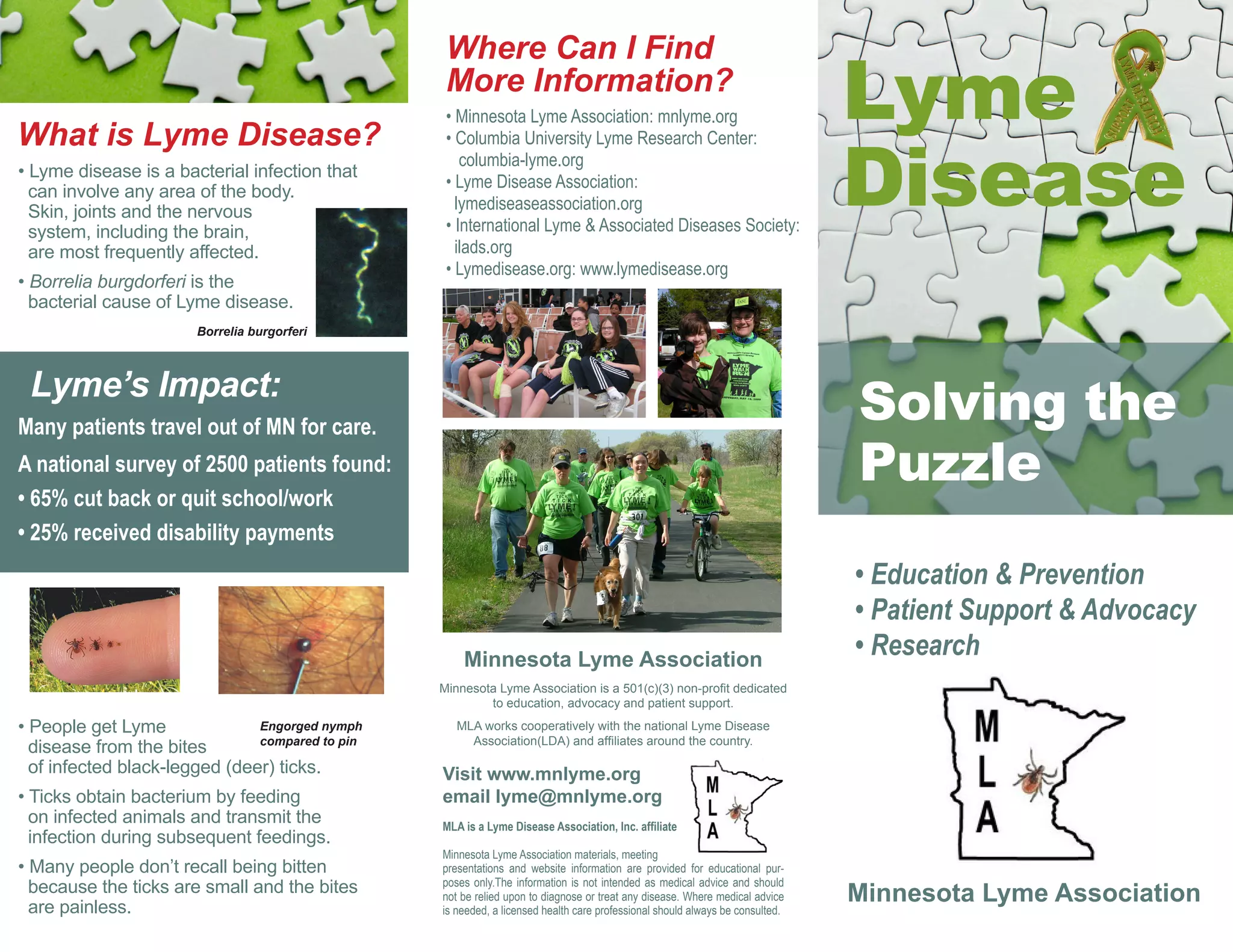
• Lyme disease is a bacterial infection that
can involve any area of the body.
Skin, joints and the nervous
system, including the brain,
are most frequently affected.
• Borrelia burgdorferi is the
bacterial cause of Lyme disease.
Borrelia burgorferi
Lyme’s Impact:
Many patients travel out of MN for care.
A national survey of 2500 patients found:
• 65% cut back or quit school/work
• 25% received disability payments
• People get Lyme
disease from the bites
of infected black-legged (deer) ticks.
• Ticks obtain bacterium by feeding
on infected animals and transmit the
infection during subsequent feedings.
• Many people don’t recall being bitten
because the ticks are small and the bites
are painless.
Engorged nymph
compared to pin
Minnesota Lyme Association
Know the Facts:
Incidence
• CDC estimates that actual cases are
10x higher than official reports. In
MN, this equates to roughly 12,000 new
cases per year based on reports.
Scientific Understanding
• The science is still evolving; many earlier
theories have been revised or disproved.
Treatment
• Treatment is most effective in early
disease when the infection is localized
to the skin but many patients experience
long-term problems. Once the infection
has spread, cures are less common and
post-treatment symptoms occur frequently.
This is especially true for the prevailing
treatment regimens.
• Antibiotic retreatment may be beneficial.
Two NIH-funded studies demonstrated
that some people improved with
addtional antibiotic therapy.
• Multiple peer-reviewed papers have
documented that the bacteria can survive
commonly prescribed antibiotic treatment
regimens.
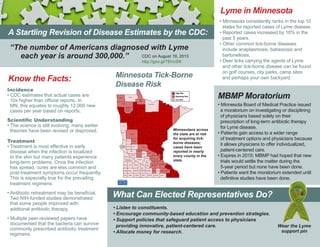
Minnesota Tick-Borne
Disease Risk
Lyme in Minnesota
		
CDC on August 19, 2013
http://goo.gl/TBVzSN
“The number of Americans diagnosed with Lyme
each year is around 300,000.”
• Minnesota consistently ranks in the top 10
states for reported cases of Lyme disease.
• Reported cases increased by 18% in the
past 5 years.
• Other common tick-borne diseases
include anaplasmosis, babesiosis and
bartonellosis.
• Deer ticks carrying the agents of Lyme
and other tick-borne disease can be found
on golf courses, city parks, camp sites
and perhaps your own backyard.
A Startling Revision of Disease Estimates by the CDC:
What Can Elected Representatives Do?
• Listen to constituents.
• Encourage community-based education and prevention strategies.
• Support policies that safeguard patient access to physicians
providing innovative, patient-centered care.
• Allocate money for research.
• Minnesota Board of Medical Practice issued
a moratorium on investigating or disciplining
of physicians based solely on their
prescription of long-term antibiotic therapy
for Lyme disease.
• Patients gain access to a wider range
of treatment options and physicians because
it allows physicians to offer individualized,
patient-centered care.
• Expires in 2015; MBMP had hoped that new
trials would settle the matter during the
5-year period but none have been done.
• Patients want the moratorium extended until
definitive studies have been done.
Minnesotans across
the state are at risk
for acquiring tick-
borne diseases;
cases have been
reported in nearly
every county in the
state.
MBMP Moratorium
Wear the Lyme
support pin

LegBrochFinal

  • 1.
    Lyme Disease Solving the Puzzle • Education& Prevention • Patient Support & Advocacy • ResearchMinnesota Lyme Association Minnesota Lyme Association is a 501(c)(3) non-profit dedicated to education, advocacy and patient support. MLA works cooperatively with the national Lyme Disease Association(LDA) and affiliates around the country. Visit www.mnlyme.org email lyme@mnlyme.org MLA is a Lyme Disease Association, Inc. affiliate Minnesota Lyme Association materials, meeting presentations and website information are provided for educational pur- poses only.The information is not intended as medical advice and should not be relied upon to diagnose or treat any disease. Where medical advice is needed, a licensed health care professional should always be consulted. Where Can I Find More Information? • Minnesota Lyme Association: mnlyme.org • Columbia University Lyme Research Center: columbia-lyme.org • Lyme Disease Association: lymediseaseassociation.org • International Lyme & Associated Diseases Society: ilads.org • Lymedisease.org: www.lymedisease.org What is Lyme Disease? • Lyme disease is a bacterial infection that can involve any area of the body. Skin, joints and the nervous system, including the brain, are most frequently affected. • Borrelia burgdorferi is the bacterial cause of Lyme disease. Borrelia burgorferi Lyme’s Impact: Many patients travel out of MN for care. A national survey of 2500 patients found: • 65% cut back or quit school/work • 25% received disability payments • People get Lyme disease from the bites of infected black-legged (deer) ticks. • Ticks obtain bacterium by feeding on infected animals and transmit the infection during subsequent feedings. • Many people don’t recall being bitten because the ticks are small and the bites are painless. Engorged nymph compared to pin Minnesota Lyme Association
  • 2.
    Know the Facts: Incidence •CDC estimates that actual cases are 10x higher than official reports. In MN, this equates to roughly 12,000 new cases per year based on reports. Scientific Understanding • The science is still evolving; many earlier theories have been revised or disproved. Treatment • Treatment is most effective in early disease when the infection is localized to the skin but many patients experience long-term problems. Once the infection has spread, cures are less common and post-treatment symptoms occur frequently. This is especially true for the prevailing treatment regimens. • Antibiotic retreatment may be beneficial. Two NIH-funded studies demonstrated that some people improved with addtional antibiotic therapy. • Multiple peer-reviewed papers have documented that the bacteria can survive commonly prescribed antibiotic treatment regimens. Minnesota Tick-Borne Disease Risk Lyme in Minnesota CDC on August 19, 2013 http://goo.gl/TBVzSN “The number of Americans diagnosed with Lyme each year is around 300,000.” • Minnesota consistently ranks in the top 10 states for reported cases of Lyme disease. • Reported cases increased by 18% in the past 5 years. • Other common tick-borne diseases include anaplasmosis, babesiosis and bartonellosis. • Deer ticks carrying the agents of Lyme and other tick-borne disease can be found on golf courses, city parks, camp sites and perhaps your own backyard. A Startling Revision of Disease Estimates by the CDC: What Can Elected Representatives Do? • Listen to constituents. • Encourage community-based education and prevention strategies. • Support policies that safeguard patient access to physicians providing innovative, patient-centered care. • Allocate money for research. • Minnesota Board of Medical Practice issued a moratorium on investigating or disciplining of physicians based solely on their prescription of long-term antibiotic therapy for Lyme disease. • Patients gain access to a wider range of treatment options and physicians because it allows physicians to offer individualized, patient-centered care. • Expires in 2015; MBMP had hoped that new trials would settle the matter during the 5-year period but none have been done. • Patients want the moratorium extended until definitive studies have been done. Minnesotans across the state are at risk for acquiring tick- borne diseases; cases have been reported in nearly every county in the state. MBMP Moratorium Wear the Lyme support pin