
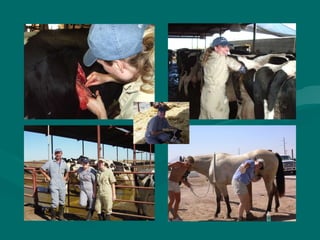





Building Programs in Animal Welfare Science  Diane McClure DVM, PhD, DACLAM Joanne Zurlo
What is Animal Welfare Science?
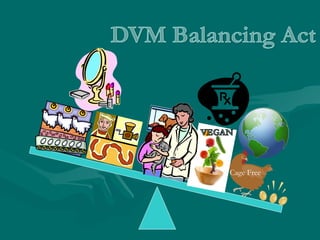
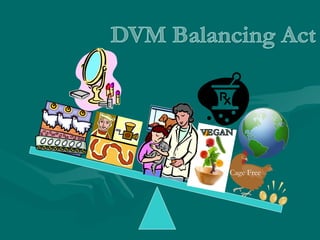
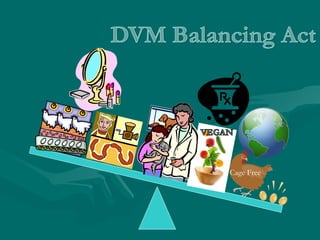
Cage Free
Define the profession’s role in animal well-being –Dean Osburn Establish core values to provide: Freedom from hunger and thirst Freedom from injury and disease Freedom from fear, stress and discomfort Freedom to express normal behavior
Cage Free
CVMA’s 8 Principles of Animal Care & Use Preamble:  As veterinarians, we endorse the following eight principles founded on our education, experience, commitment to and compassion for animals:  1.     Animals are sentient beings with wants and needs that may differ from those of humans and are worthy of respect from individuals and society.
CVMA’s 8 Principles of Animal Care & Use 2.     Animals’ interests should be given thoughtful consideration by individuals and society when determining acceptable care and use. This requires the balancing of scientific knowledge and ethical, philosophical, and moral values. 3.     Acceptable care and use of an animal may not always serve the individual animal, but should be balanced by the greater benefits to other animals, humans, or society.
CVMA’s 8 Principles of Animal Care & Use 4.     Animals should be used purposefully, whether for food and fiber, recreation, companionship, transportation, work, education, or the advancement of scientific knowledge. 5.     Animals should be provided with water, nutrition, and an environment appropriate to their care and use, with consideration for their safety, health, and species-specific biological needs and behavioral natures.
CVMA’s 8 Principles of Animal Care & Use 6.     Animals should be cared for in ways that minimize fear, pain, suffering, and distress. 7.     Through an owner’s actions, animals should be provided with timely and appropriate preventive, medical, dental, and surgical care, and an effort should be made to ensure that animals reproduce responsibly. 8.    Animals should be provided a humane death.
Cage Free
What are Veterinary Colleges Doing to Address Animal Welfare Sciences? Veterinary Ethics Courses Expanding Existing Courses to include AW issues Creating an Animal Welfare Specialty
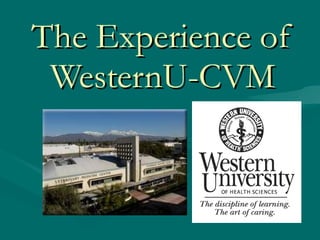
The Experience of WesternU-CVM
Reverence for Life Policy  No consumptive use of animals used for the sole purpose of education Why? Because we don’t have to!
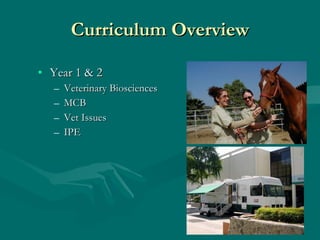
Curriculum Overview Year 1 & 2 Veterinary Biosciences MCB Vet Issues IPE
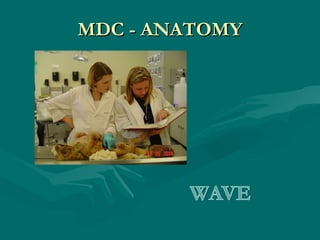
MDC - ANATOMY
Physiology? Pharmacology? Surgery? Mentored Hands On Training Distributive Model
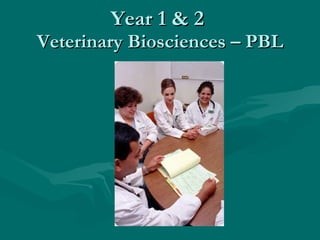
Year 1 & 2  Veterinary Biosciences – PBL
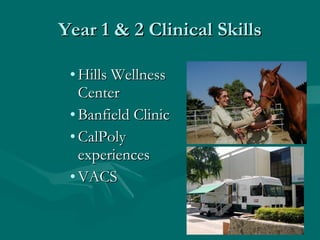
Year 1 & 2 Clinical Skills Hills Wellness Center Banfield Clinic CalPoly experiences VACS
Year 3 Clinical (off-campus) rotations Small Animal Mixed Practice (4) Livestock Mixed Practice (2) Equine Practice (2) Humane Society (junior surgery) Zoo Animal & Wildlife Laboratory Animal Medicine & Research Diagnostic Lab & Pathology


Year 4 4 week rotations Student selected sites/ disciplines ANYWHERE in the WORLD!
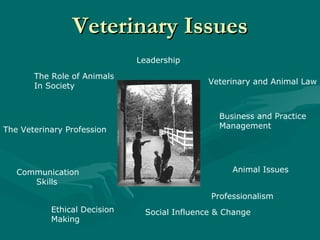
Veterinary Issues The Role of Animals In Society The Veterinary Profession Communication Skills Business and Practice Management Veterinary and Animal Law Ethical Decision Making Animal Issues Professionalism Leadership Social Influence & Change
AVMA Animal Welfare Symposium Nov 2009 JVME 37(1), 2010
Expertise and Advocacy in Animal-Welfare Decision Making: Considerations for a Veterinary Curriculum in Animal Welfare Larry Carbone, UCSF
Ethical Decision Making Students can start simple—‘‘Causing harm to a sentient other requires justification’’  work to refine their values statement, testing it against their experience of the world and in class discussion.  Refinement: Does it apply to all sentient species equally? Is death a harm to animals? What sorts of things can serve as justification
Ethical Decision Making As students refine their values statement, they see that theirs will differ in smaller and larger ways from those of their peers. They also see that the implications of some value statements may lead to conclusions they have not endorsed and either further refine their statement of values or come to endorse positions they previously rejected.
Swimming with the Tide: Animal Welfare in Veterinary Medical Education and Research Summary and Action David B. Morton
Veterinary profession has a responsibility to its members and the public to provide and ensure a good education in  animal welfare science , ethics and law  Recognition of a welfare problem Assessment of the impact Severity (intensity and duration), Numbers affected (surveillance) Outcomes vs. resources Alleviation Prevention * Morton & Griffiths 1985 Vet Rec. 116, 431-436
Potential Actions by AVMA INTERNAL FACTORS To build welfare and ethics into vet school curricula and make them core subjects Set up a group for vets to exchange and promote welfare and veterinary ethics programs, and support welfare science research e.g. ACAW, USDA Center To promote harmonization within the profession Revisit oath “to promote positive welfare” *David Morton
Potential Actions by AVMA EXTERNAL FACTORS Reaffirm publicly that vets take mental health (welfare) seriously Promote discussion with interested parties (non-vet AW scientists, producers, politicians, etc. Condemn obvious abuses & inform on others Note that Vets have to EARN their place at the table (but have a head start but can do better) To be aware of other related issues e.g. human welfare, environmental protection and pollution, sustainability, etc.  *David Morton
Veterinarian's Oath  (2004) Being admitted to the profession of veterinary medicine, I solemnly swear to use my scientific knowledge and skills for the benefit of society through the protection of animal health, the relief of animal suffering, the conservation of animal resources, the promotion of public health, and the advancement of medical knowledge.  I will practice my profession conscientiously, with dignity, and in keeping with the principles of veterinary medical ethics.  I accept as a lifelong obligation the continual improvement of my professional knowledge and competence.
Veterinarian's Oath  (2010) Being admitted to the profession of veterinary medicine, I solemnly swear to use my scientific knowledge and skills for the benefit of society through the protection of animal health  and welfare, the prevention and  relief of animal suffering, the conservation of animal resources, the promotion of public health, and the advancement of medical knowledge.
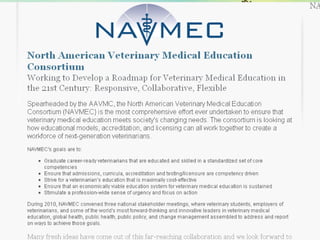
NAVMEC
“ Roadmap for Veterinary Medical Education in the 21st Century: Responsive, Collaborative, Flexible” Draft Submitted by NAVMEC Board of Directors 20 October 2010
Change Driver:  Evolving Societal Needs Expectations that veterinarians will take more of a leadership* role in issues relating to: food safety; animal welfare; environmental health; One Health * leadership = the ability to take direct action and influence others to take action
CORE COMPETENCY  Multi-Species Clinical Expertise Veterinarians apply and integrate medical knowledge, clinical skills and professional attitudes into their practice, and are advocates for animal health and welfare. Veterinary expertise includes knowledge of diverse patient species, in the context of the communities in which they interact. Veterinarians are educated to take a comparative approach with a holistic* perspective, enabling them to practice productively and effectively immediately after graduation.
NAVMEC 5 Strategic Goals Graduate Career-Ready Veterinarians Who are Educated and Skilled in an Agreed Set of Core Ensure that Admissions, Curricula, Accreditation and Testing/Licensure are Competency-Driven Strive for a Veterinarian’s Education that is Maximally Cost-Effective Ensure that an Economically Viable Education System for Veterinary Medical Education is Sustained Stimulate a Profession-Wide Sense of Urgency & Focus on Action
Talking Points
Clinical Skills – Blood Collection Blood Collection & 3Rs Familiarity or proficiency? Trainee skill with equipment? Trainee skill with species? Trainee skill with assessing individual subject
Alternative  Options for VME Artificial Rectum Suturing Others?
What is Animal Welfare Science?
The End


Implementing Animal Welfare In Veterinary Education

  • 1.
    Building Programs inAnimal Welfare Science Diane McClure DVM, PhD, DACLAM Joanne Zurlo
  • 2.
    What is AnimalWelfare Science?
  • 3.
  • 4.
    Define the profession’srole in animal well-being –Dean Osburn Establish core values to provide: Freedom from hunger and thirst Freedom from injury and disease Freedom from fear, stress and discomfort Freedom to express normal behavior
  • 5.
  • 6.
    CVMA’s 8 Principlesof Animal Care & Use Preamble: As veterinarians, we endorse the following eight principles founded on our education, experience, commitment to and compassion for animals:  1.     Animals are sentient beings with wants and needs that may differ from those of humans and are worthy of respect from individuals and society.
  • 7.
    CVMA’s 8 Principlesof Animal Care & Use 2.     Animals’ interests should be given thoughtful consideration by individuals and society when determining acceptable care and use. This requires the balancing of scientific knowledge and ethical, philosophical, and moral values. 3.     Acceptable care and use of an animal may not always serve the individual animal, but should be balanced by the greater benefits to other animals, humans, or society.
  • 8.
    CVMA’s 8 Principlesof Animal Care & Use 4.     Animals should be used purposefully, whether for food and fiber, recreation, companionship, transportation, work, education, or the advancement of scientific knowledge. 5.     Animals should be provided with water, nutrition, and an environment appropriate to their care and use, with consideration for their safety, health, and species-specific biological needs and behavioral natures.
  • 9.
    CVMA’s 8 Principlesof Animal Care & Use 6.     Animals should be cared for in ways that minimize fear, pain, suffering, and distress. 7.     Through an owner’s actions, animals should be provided with timely and appropriate preventive, medical, dental, and surgical care, and an effort should be made to ensure that animals reproduce responsibly. 8.    Animals should be provided a humane death.
  • 10.
  • 11.
    What are VeterinaryColleges Doing to Address Animal Welfare Sciences? Veterinary Ethics Courses Expanding Existing Courses to include AW issues Creating an Animal Welfare Specialty
  • 12.
    The Experience ofWesternU-CVM
  • 13.
    Reverence for LifePolicy No consumptive use of animals used for the sole purpose of education Why? Because we don’t have to!
  • 14.
    Curriculum Overview Year1 & 2 Veterinary Biosciences MCB Vet Issues IPE
  • 15.
  • 16.
    Physiology? Pharmacology? Surgery?Mentored Hands On Training Distributive Model
  • 17.
    Year 1 &2 Veterinary Biosciences – PBL
  • 18.
    Year 1 &2 Clinical Skills Hills Wellness Center Banfield Clinic CalPoly experiences VACS
  • 19.
    Year 3 Clinical(off-campus) rotations Small Animal Mixed Practice (4) Livestock Mixed Practice (2) Equine Practice (2) Humane Society (junior surgery) Zoo Animal & Wildlife Laboratory Animal Medicine & Research Diagnostic Lab & Pathology
  • 20.
  • 21.
  • 22.
  • 23.
    Year 4 4week rotations Student selected sites/ disciplines ANYWHERE in the WORLD!
  • 24.
    Veterinary Issues TheRole of Animals In Society The Veterinary Profession Communication Skills Business and Practice Management Veterinary and Animal Law Ethical Decision Making Animal Issues Professionalism Leadership Social Influence & Change
  • 25.
    AVMA Animal WelfareSymposium Nov 2009 JVME 37(1), 2010
  • 26.
    Expertise and Advocacyin Animal-Welfare Decision Making: Considerations for a Veterinary Curriculum in Animal Welfare Larry Carbone, UCSF
  • 27.
    Ethical Decision MakingStudents can start simple—‘‘Causing harm to a sentient other requires justification’’ work to refine their values statement, testing it against their experience of the world and in class discussion. Refinement: Does it apply to all sentient species equally? Is death a harm to animals? What sorts of things can serve as justification
  • 28.
    Ethical Decision MakingAs students refine their values statement, they see that theirs will differ in smaller and larger ways from those of their peers. They also see that the implications of some value statements may lead to conclusions they have not endorsed and either further refine their statement of values or come to endorse positions they previously rejected.
  • 29.
    Swimming with theTide: Animal Welfare in Veterinary Medical Education and Research Summary and Action David B. Morton
  • 30.
    Veterinary profession hasa responsibility to its members and the public to provide and ensure a good education in animal welfare science , ethics and law Recognition of a welfare problem Assessment of the impact Severity (intensity and duration), Numbers affected (surveillance) Outcomes vs. resources Alleviation Prevention * Morton & Griffiths 1985 Vet Rec. 116, 431-436
  • 31.
    Potential Actions byAVMA INTERNAL FACTORS To build welfare and ethics into vet school curricula and make them core subjects Set up a group for vets to exchange and promote welfare and veterinary ethics programs, and support welfare science research e.g. ACAW, USDA Center To promote harmonization within the profession Revisit oath “to promote positive welfare” *David Morton
  • 32.
    Potential Actions byAVMA EXTERNAL FACTORS Reaffirm publicly that vets take mental health (welfare) seriously Promote discussion with interested parties (non-vet AW scientists, producers, politicians, etc. Condemn obvious abuses & inform on others Note that Vets have to EARN their place at the table (but have a head start but can do better) To be aware of other related issues e.g. human welfare, environmental protection and pollution, sustainability, etc. *David Morton
  • 33.
    Veterinarian's Oath (2004) Being admitted to the profession of veterinary medicine, I solemnly swear to use my scientific knowledge and skills for the benefit of society through the protection of animal health, the relief of animal suffering, the conservation of animal resources, the promotion of public health, and the advancement of medical knowledge. I will practice my profession conscientiously, with dignity, and in keeping with the principles of veterinary medical ethics. I accept as a lifelong obligation the continual improvement of my professional knowledge and competence.
  • 34.
    Veterinarian's Oath (2010) Being admitted to the profession of veterinary medicine, I solemnly swear to use my scientific knowledge and skills for the benefit of society through the protection of animal health and welfare, the prevention and relief of animal suffering, the conservation of animal resources, the promotion of public health, and the advancement of medical knowledge.
  • 35.
  • 36.
    “ Roadmap forVeterinary Medical Education in the 21st Century: Responsive, Collaborative, Flexible” Draft Submitted by NAVMEC Board of Directors 20 October 2010
  • 37.
    Change Driver: Evolving Societal Needs Expectations that veterinarians will take more of a leadership* role in issues relating to: food safety; animal welfare; environmental health; One Health * leadership = the ability to take direct action and influence others to take action
  • 38.
    CORE COMPETENCY Multi-Species Clinical Expertise Veterinarians apply and integrate medical knowledge, clinical skills and professional attitudes into their practice, and are advocates for animal health and welfare. Veterinary expertise includes knowledge of diverse patient species, in the context of the communities in which they interact. Veterinarians are educated to take a comparative approach with a holistic* perspective, enabling them to practice productively and effectively immediately after graduation.
  • 39.
    NAVMEC 5 StrategicGoals Graduate Career-Ready Veterinarians Who are Educated and Skilled in an Agreed Set of Core Ensure that Admissions, Curricula, Accreditation and Testing/Licensure are Competency-Driven Strive for a Veterinarian’s Education that is Maximally Cost-Effective Ensure that an Economically Viable Education System for Veterinary Medical Education is Sustained Stimulate a Profession-Wide Sense of Urgency & Focus on Action
  • 40.
  • 41.
    Clinical Skills –Blood Collection Blood Collection & 3Rs Familiarity or proficiency? Trainee skill with equipment? Trainee skill with species? Trainee skill with assessing individual subject
  • 42.
    Alternative Optionsfor VME Artificial Rectum Suturing Others?
  • 43.
    What is AnimalWelfare Science?
  • 44.
  • 45.
  • 46.
  • 47.

Editor's Notes

  • #34 BUT: No mention of welfare, nor to positive welfare