


Dissertation Report
“A Study on the impact of Artificial Intelligence on Marketing”
Submitted in partial fulfillment of the requirement for the Award of degree of
Master of Business Administration
(Major in Marketing)
SUBMITTED BY:
SADIAH
E.NO:2018-502-092
(BATCH: 2018-2020)
2nd Year
Under the guidance of:
Mr.Tafheem Bashir
DEPARTMENT OF MANAGEMENT
JAMIA HAMDARD UNIVERSITY
NEW DELHI, INDIA
Impact of Artificial Intelligence on Marketing 2
CERTIFICATE
This is to certify that the Dissertation Report titled “Impact of Artificial Intelligence on
Marketing” is a study undertaken by Ms. Sadiah, MBA 2018-2020 Batch.
The Dissertation Report is the result of her own work as declared by the student in “Declaration
from Student of Authentic Work” which is attached in this Dissertation Report.
Mr. Tafheem Bashir
Assistant Professor
(Supervisor)
SMBS | JAMIA HAMDARD
Impact of Artificial Intelligence on Marketing 3
DECLARATION
I hereby declare that this report titled “Impact of Artificial Intelligence on Marketing” submitted
in partial fulfillment of the requirement for the Award of the degree of Masters of Business
Administration to the Department of Management, School of Management and Business Studies,
Jamia Hamdard, is a record of original work done by me under the guidance of Mr. Tafheem
Bashir.
The information and the data given in the report are authentic to the best of my knowledge.
This project report is not submitted to any other university or institution for the award of any
degree, diploma or fellowship or published anytime before.
SADIAH
SMBS | JAMIA HAMDARD
Impact of Artificial Intelligence on Marketing 4
ACKNOWLEDGEMENT
I wish to thank my mentor Mr.Tafheem Bashir for giving me the opportunity to be a part of this
project. His support and guidance helped me in understanding the process and how I should
proceed. He constantly kept a check and showed the right path as the project was developing.
I take this opportunity to convey my sincere thanks to our institution and other faculty members
without whom it wouldn’t have been a success.
I also extend my sincere thanks to those who helped me in and provided modalities to conduct a
survey. I appreciate people who gave me their precious time while conducting the survey.
SMBS | JAMIA HAMDARD
Impact of Artificial Intelligence on Marketing 5
EXECUTIVE SUMMARY
The work is pursued as part of the MBA Curriculum at Jamia Hamdard University, New Delhi.
The project was completed under the supervision and guidance of Mr. Tafheem Bashir.
The project titled “A STUDY ON THE IMPACT OF ARTIFICIAL INTELLIGENCE ON
MARKETING”. The undertaken study implies how Artificial Intelligence is integrated into
marketing functions to improve the performance of the business and thus, achieving profitability
and competitive advantage.
This paper analyzes the impact of artificial intelligence on marketing at micro and macro levels.
Given the wide-ranging topic of AI and its many different applications, I have limited the scope
of this paper to only its impact on marketing. The topic of AI in marketing itself may be vast
enough to justify narrowing the scope of research down further into specific applications and use
cases. However, my intentions for this paper were to address the issue in a manner that provides
a natural entry point for marketers to begin learning about AI in their field, while providing
enough detail for each application and use case to offer novel insights.
AI marketing is a method of leveraging technology to improve the customer journey. It can also
be used to boost the return on investment (ROI) of marketing campaigns. This is accomplished
by using big data analytics, machine learning, and other processes to gain insight into your target
audience. With these insights, you can create more effective customer touchpoints. Whether you
are engaging in email marketing or providing customer support, AI eliminates much of the
guesswork involved in customer interactions.
On a grander scale, it can be used to automate processes that were once dependent on humans.
Content generation, PPC ads, and even web design are all possible applications for AI marketing.
Right now, our agency primarily uses AI to help with our video marketing efforts.
Artificial intelligence drives the opportunities of achieving things with a higher degree of
accuracy and faster. AI helps financial and banking industries greatly in terms of managing data,
retrieving information, the large volume of computation, and cost-effectiveness. With the help of
Artificial intelligence, marketers can make data-driven decisions for better campaign results.
SMBS | JAMIA HAMDARD
Impact of Artificial Intelligence on Marketing 6
Also, they can leverage the prediction efficiency of AI to easily identify their potential
customers, purchasing behavior to achieve higher sales and customer satisfaction.
The paper will examine the impact of AI on marketing by taking the perspectives of marketing
Professionals of various companies.
Other research sources such as white papers, case studies, and blog posts from companies in the
AI industry offer case-by-case data regarding the efficacy of specific AI Marketing applications
and varying viewpoints from marketers who already have experience applying AI in marketing.
In the sections that follow, I will start with an overview of AI: what it is, how it works, and the
need-to-know terminology for marketers. Next, an overview of the current state of AI as used in
marketing today is presented: its current use cases, what is working, and what isn’t working.
Then, I will cover areas in need of improvement and pressing issues of the near future.
Finally, I will close with a handful of frameworks and insights for marketers and companies to
best prepare for and begin the implementation of AI.
A questionnaire has been designed for collecting primary data and secondary data is collected
through the web, company websites, etc. Sample of --- respondents have been approached with
the help of convenience sampling for eliciting information and few columns and pie charts are
used for analysis and interpretation.
SMBS | JAMIA HAMDARD
Impact of Artificial Intelligence on Marketing 7
TABLE OF CONTENTS
SMBS | JAMIA HAMDARD
Sr. No Description Page No
CERTIFICATE 2
DECLARATION 3
ACKNOWLEDGEMENT 4
EXECUTIVE SUMMARY 5-6
1. INTRODUCTION 8-16
2. REVIEW OF LITERATURE 17-20
3. RESEARCH METHODOLOGY 21-22
4. ANALYSIS OF SECONDARY DATA 23-29
5. ANALYSIS AND INTERPRETATION OF PRIMARY DATA 30-42
6. FINDINGS 43
7. CONCLUSION 44
8. REFERENCES 45-46
9. APPENDICES 47-50
Impact of Artificial Intelligence on Marketing 8
CHAPTER - 1
INTRODUCTION
What is AI?
The first thing to understand is that at the core of AI is data. AI needs data to function, which
gives companies with larger and more accurate data sets an advantage.
Artificial intelligence is the creation of intelligence machines which are capable of thinking and
reacting like humans. John McCarthy coined the term “Artificial Intelligence” and McCarthy
was one of the founders of the discipline of artificial intelligence. Artificial Intelligence can
perform tasks more accurately.
What is Machine Learning?
“Machine learning is basically a way for a computer to find the nuggets of information that a
human can’t,” explains Fausto Ibarra, Director of Global Product Management for Google Cloud
Platform. “Once you have your data and train and deploy your models, the machine can go
through terabytes of data and get smarter and smarter — basically train itself — and ultimately
make predictions for you.” In other words, machine learning is a subset or type of AI. Machine
learning is focused on developing algorithms that can learn from data and adapt in real-time as
they’re exposed to more data. The algorithms improve their ability to make decisions as they
operate, by monitoring the data flowing through the system and updating how they make
decisions based on how previous decisions worked. In practice, it’s essentially statistical
optimization that looks through the database to identify what kind of patterns lead to successful
decisions, and what leads to unsuccessful decisions. The algorithm then optimizes towards
successful decisions.
How Big is AI in the Advertising Market and What’s Driving Growth?
SMBS | JAMIA HAMDARD
Impact of Artificial Intelligence on Marketing 9
The AI market is growing at an astounding rate as the amount of data companies collect
increases and businesses look to use that data in meaningful ways. In the digital marketing space,
most of the growth of AI is attributed to programmatic advertising.
How is Artificial Intelligence Impacting Marketing?
AI Marketing is quickly becoming an important ingredient that can no longer be ignored, so what
can marketers expect from AI both now and in the future, and how exactly will it impact their
overall business strategy?
Smarter Search
Today’s digital consumer can find information faster and more efficiently than ever before.
Thanks to a combination of social media and lightening fast search engines like Google, people
no longer spend excessive amounts of time sifting through information for what they need.
Google changes and improves its search algorithm almost daily and marketer must recognize this
and ensure their content stays optimized according to these changes.
However, that can be nearly impossible. Using AI Marketing and other big data solutions can
assist marketers by analyzing ​customer search patterns​. Through that analysis, they can identify
the best areas to hone their efforts. In addition, the evolution of virtual assistants, like Siri or
Alexa, creates a new challenge as marketers must look at how those new technologies impact
SEO and other search optimization tactics.
Smarter Ads
Smarter ads will likely be one of the main reasons AI Marketing will have such an important and
lasting impact in the years to come. The ability for brands to use AI Marketing to develop key
SMBS | JAMIA HAMDARD
Impact of Artificial Intelligence on Marketing 10
marketing aspects like keyword searches, social profiles, and other online data, will allow
marketers to create smarter, more effective​ ​ads which will likely result in more conversions.
AI tools can also be used to collect customer’s data that they willingly input through chat bots.
Marketers can use that data to supplement customer profiles, thereby creating rich information
on each individual and segment. This, in turn, will allow for a better, more thought out and
complete picture of ideal audience targets. Knowing more about their customer preferences
means marketers can better target those smarter ads, further increasing the potential for
conversion.
Smarter Sentiment
There is simply no way for even the largest of marketing teams to sift through everything
customers are saying on blogs, social media on customer surveys, or other channels, especially
as the list of platforms customers can use to express themselves grows every day. Using AI
Marketing solutions, marketers can quickly analyze what their target markets are thinking and
feeling about the brand. Customers express their feelings and sentiments in real time, providing
ample amounts of feedback on the entire response range. AI Marketing can collect and harness
this data, allowing marketers to pivot messaging and provide the best, most impactful reach to
their audiences.
Smarter Customer Service
One thing that doesn’t change year after year when it comes to consumer behavior is the demand
for top-tier customer service, and this is one of the biggest ways that AI Marketing can impact
marketing both now and in the future. AI Marketing solutions will enable customer service
representatives to immediately understand and interpret massive amounts of ​customer data​,
either through their phone number or social media profile. This will enable customer service
issues to be solved more quickly and easily. In some cases, these AI Marketing solutions will be
SMBS | JAMIA HAMDARD
Impact of Artificial Intelligence on Marketing 11
able to solve the issue without even involving customer service – something that will save time,
money, and will also allow these representatives to devote their time to more complex and
pressing issues.
Artificial Intelligence has impacted Digital advertising in many ways; right here are some effects
that Digital Advertising and marketing are going to face in the coming years.
● Increase in user experience
● Highly Predicted ROI
● Helps in decision making
● Sales forecast
● Error rates are minimised
● Tracking user sessions gets easier
● Understanding user persona
Key Uses of AI in Advertising and Marketing Today
While there are many marketing objectives AI can help with, there are some key uses of AI that
currently dominate the market. These include:
1. Product/content recommendations
Fast forward to 2019, and some of the most successful digital companies have built their product
offerings around the ability to provide highly relevant and personalised product or content
recommendations – including Amazon, Netflix and Spotify. As Lori Goldberg wrote in a brief
history of artificial intelligence in advertising for Econsultancy, “This all comes from AI-based
clustering and interpreting of consumer data paired with profile information and demographics.
These AI-based systems continually adapt to your likes and dislikes and react with new
recommendations tailored in real-time.”
SMBS | JAMIA HAMDARD
Impact of Artificial Intelligence on Marketing 12
2. Chatbots
If there’s one type of AI that businesses see as a game-changer , its chatbots. Chatbots are
already on numerous websites, as they excel at answering customers ; frequently asked
questions.The key fascination with chatbots is the impact they can have on the customer
experience. For some businesses, there aren’t enough employees or hours in the day to answer
customer queries quickly. Chatbots allow customers to help themselves. Nonetheless, there is a
right way and a wrong way to use chatbots. This technology should never have the final say
regarding a customer complaint. It should also be easy for a lead or customer to speak with a
human if they prefer. The real potential lies in smart chatbots, as opposed to the simple ones you
regularly see now. These are AI-powered systems that communicate with humans using
real-time, originally generated responses. In the future, I wouldn’t be surprised to see smart
chatbots engaging in sales prospecting, lead generation and customer service.
3. Creating and Generating Content
What? A machine that writes by itself and creates content from scratch? There’s no way! But, I have news
for you…
There is a way! And even though AI still can’t write its own political opinion for a newspaper column or a
blog post on the best and most practical advice for a specific industry, there are certain areas in which
content created by AI can be useful and help attract visitors to your website. It can help you save lots of
time and resources. For example, AI can already write reports and news based on data and information.
4. Content Curation
AI is not only able to generate content; it can also curate it. Content curation by artificial intelligence will
make it possible to better connect with visitors on certain websites and show them more relevant content.
This technology is commonly used to make personalized content recommendations that the user may find
interesting, such as the typical, “people who buy X also buy Y,” like we constantly see on Amazon.
SMBS | JAMIA HAMDARD
Impact of Artificial Intelligence on Marketing 13
Netflix’s recommendation system can also give you suggestions for movies and TV shows you might find
interesting. And it’s pretty accurate!
Now, the question is: How can you benefit from it?
Imagine showing each of your blog’s visitors articles that are more relevant to them, based on posts and
topics they’ve already looked at on your blog. They’d definitely spend more time on it.
5. Email Marketing
Brands are using the power of AI to personalize email marketing campaigns based on preferences and user
behaviors. This makes it possible to better connect with them and, with a bit of luck, turn them into clients.
Machine learning or automatic learning can analyze millions of data about the consumer to then determine
the best times and days of the week to contact the user, the recommended frequency, the content that
catches their attention the most, and which email subjects and titles generate more clicks. Wouldn’t you
love to know all about this so you can launch the main metrics of your digital marketing campaigns?
A/B tests take time and can have a certain margin of error. So, in this sense, AI becomes your best friend
in personalizing email content for each subscriber.
6. Digital Advertising
Digital advertising is, without a doubt, the area of digital marketing that’s most successfully adopted
artificial intelligence.
For example, Facebook and Google ad platforms already use machine learning and artificial intelligence to
find people more prone to making the advertiser’s desired action. To achieve this, they analyze the user’s
information, like their interests, demographics, and other aspects to learn and detect the best audience for
their brand.
Google AdWords already has an automatic auction-based system that lets advertisers pay the lowest
possible cost per conversion.
There’re also already platforms that incorporate AI and the analysis of big data candidates in their
SMBS | JAMIA HAMDARD
Impact of Artificial Intelligence on Marketing 14
processes…but wait until we tell you about Adext.
7. Searches
The way users perform online searches has changed. So, now we must ask ourselves how this will affect
the way in which marketers create and optimize their web content.
There have been two big advances in artificial intelligence that revolutionized Internet searches and search
engine optimization (SEO): voice search and Google’s algorithm, RankBrain.
Innovations like Amazon Echo, Google Home, Apple’s Siri, and Microsoft’s Cortana make it easy for
people to perform searches by just pressing a button or saying a voice command.
8. Predictive Analysis
Predictive analysis is just the use of data, statistical algorithms, and ​machine learning techniques to
identify the probability of future conclusions based on data history.
Predictive models can be applied in several areas, and marketing is no exception. These models make it
possible to predict the probability of a specific prospect becoming a client. They can also predict other
aspects, like the quoted price necessary to make a conversion, or which clients are more prone to making
more than one purchase.
The key here is to remember that predictive models will only be as good as the data you provide while
creating them. So, if there are mistakes in your data, or there’s a high level of randomness, it won’t be able
to make correct or accurate predictions.
This AI application will transform marketers from reactive to proactive planners, thanks to the data that
serves as a forward-thinking element or guide to make the correct decisions​.
SMBS | JAMIA HAMDARD
Impact of Artificial Intelligence on Marketing 15
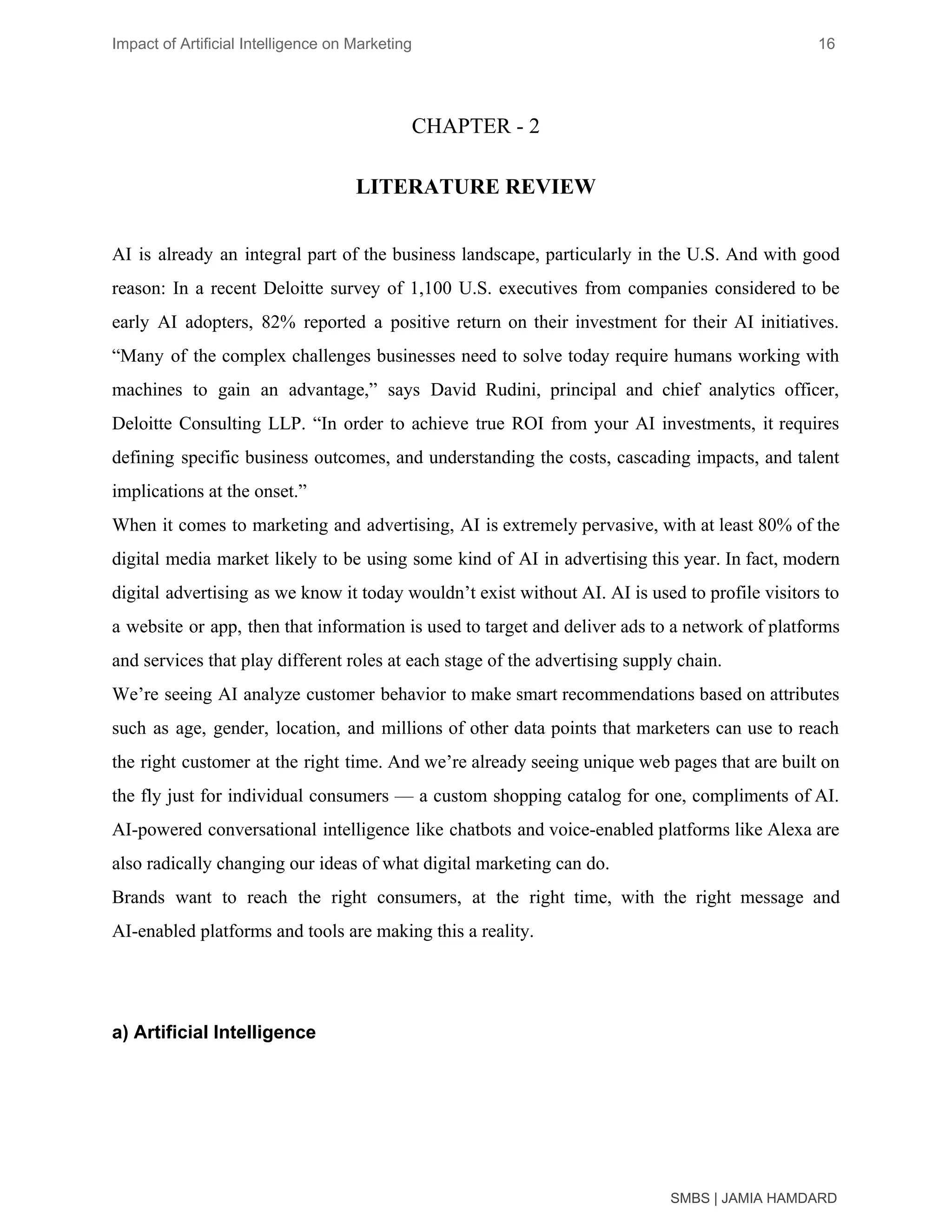
SMBS | JAMIA HAMDARD
Impact of Artificial Intelligence on Marketing 16
CHAPTER - 2
LITERATURE REVIEW
AI is already an integral part of the business landscape, particularly in the U.S. And with good
reason: In a recent Deloitte survey of 1,100 U.S. executives from companies considered to be
early AI adopters, 82% reported a positive return on their investment for their AI initiatives.
“Many of the complex challenges businesses need to solve today require humans working with
machines to gain an advantage,” says David Rudini, principal and chief analytics officer,
Deloitte Consulting LLP. “In order to achieve true ROI from your AI investments, it requires
defining specific business outcomes, and understanding the costs, cascading impacts, and talent
implications at the onset.”
When it comes to marketing and advertising, AI is extremely pervasive, with at least 80% of the
digital media market likely to be using some kind of AI in advertising this year. In fact, modern
digital advertising as we know it today wouldn’t exist without AI. AI is used to profile visitors to
a website or app, then that information is used to target and deliver ads to a network of platforms
and services that play different roles at each stage of the advertising supply chain.
We’re seeing AI analyze customer behavior to make smart recommendations based on attributes
such as age, gender, location, and millions of other data points that marketers can use to reach
the right customer at the right time. And we’re already seeing unique web pages that are built on
the fly just for individual consumers — a custom shopping catalog for one, compliments of AI.
AI-powered conversational intelligence like chatbots and voice-enabled platforms like Alexa are
also radically changing our ideas of what digital marketing can do.
Brands want to reach the right consumers, at the right time, with the right message and
AI-enabled platforms and tools are making this a reality.
a) Artificial Intelligence
SMBS | JAMIA HAMDARD
Impact of Artificial Intelligence on Marketing 17
(AI) As stated by Demis Hassabis, who is the founder of Deepmind – the AI Company of
Google, “Artificial intelligence is the art to make machines intelligent (Ahmed, 2015).” It is the
most widely accepted definition and also a well-fitting one since AI is a broader term used for a
number of a variety of indicators. Under the AI, there are some subcategories including machine
learning and deep learning which manufacture real-world apps of AI, including search
suggestions, voice recognition, virtual assistants and image recognition. The term, AI, refers to
the computer-assisted analytical course that attempts to form automated
systems which can be labeled as intelligent. It is the automated system that inputs data to conduct
tasks of intelligent beings in a manner that increases the success rate. According to Guruduth
Banavar, supervisor of AI research by IBM, there are a broader variety of various types of
Artificial intelligence, therefore, it can be considered as a collection of technologies
(Kaput, 2016). These technologies have various functions and come in a variety of prices, but the
aim of all of them is almost the same which is to mimic human intelligence in technologies to
make the functions intelligent.
The progressions made in AI and its executions in various domains have resulted in the
advancement of AI technologies that is evident to be valuable and beneficial for marketing
professionals. Since more emphasis is on digital marketing as compared to the traditional
methods of marketing, the ample data is there for usage of AI technologies. AI technologies have
the ability to help marketing managers in various functions including lead generation, market
research, social media controlling and customization of consumer experiences (Sterne, 2017). AI
technologies in the field of marketing can be broadly classified to customized AI systems for the
customized usage and to vendor provided and software-as-a-service (SaaS) solutions which
include AI aspects. Customized and real AI technologies can be manufactured by the internal AI
department of companies, outsource providers or it can either be a mix of both. The various
vendor-provided solutions of AI also need customization for personal usage cases (Sterne, 2017).
A majority of software houses and providers have given a lot in AI and technology organizations
such as IBM is giving their own marketing computerized solution with IBM Watson Campaign
Automation. IBM Watson Campaign Automation has AI by default which is built in the solution.
SMBS | JAMIA HAMDARD
Impact of Artificial Intelligence on Marketing 18
Salesforce, which is considered as the leading provider of Customer Relationship Management
(CRM) software has also begun to provide AI service along with the Salesforce Einstein, which
is also executed in the solution (Sterne, 2017). Paul Roetzer, who is the CEO of Marketing
Artificial Intelligence Institute, came up with the structure for AI in marketing which is
commonly known as 5Ps of Marketing AI. The structure was formed for simplifying and
visualizing the ground and it is in line with the research carried out with different AI companies
and engineers on how marketing can take benefit from
AI (Roetzer, 2017).
In today’s world, AI is used to support marketing managers in various tasks and operations
including digital marketing (buying), web development, SEO, external email marketing, lead
generation, social media monitoring and A/B testing (Davenport, 2017).
b) AI in Marketing
The earlier concepts and principles have been examined to tackle the marketing related issue
since a very long time (Wierenga & van Bruggen, 2000) but the major usage and implementation
of AI in marketing have begun to arise in past few years (Wierenga, 2010). AI has been
implemented in most of the companies in today’s world but there is still not a high-level of
implementation in different companies. Different marketers have shown their interest in adopting
AI soon and around 98% of them are now preparing for executing it completely. Whereas, only
20% of the marketers have implemented one or more AI solutions in 2017 in the business
(Bughin, McCarthy & Chui, 2017). The mismatch between the preparation and execution acts as
a major pointer that it is not very late for the implementation of AI in marketing, opposing to the
fact that how the major buzz about AI may result in believing of people that they need to
implement it very soon. However, applications of AI in the field of marketing are quickly
developing with a number of different software and services coming up for the companies to use
for their brands. The researchers also predicted that 2018 and the coming years will be a turning
point in the diffusion of AI in the field of marketing. As marketing is the combination of
qualitative as well as quantitative aspects, it provides a distinctive chance for AI to grow to the
SMBS | JAMIA HAMDARD
Impact of Artificial Intelligence on Marketing 19
domains where it is not sufficient with only econometrics (Wierenga, 2010). The major AI
applications in the field of marketing today include neural networks, case-based reasoning and
expert system (Wierenga, 2010) and in a practical manner, AI has been used to enhance and
upgrade the outdated methods of marketing (Hoanca & Forrest, 2015). Bughin, Hazan, Manyika
& Woetzel (2017) stated that with the help of AI, companies can be successful in creating
customized marketing campaigns by analyzing the data. AI will also help in improving yield
management by presenting dynamic pricing and giving excellent customer service. Marketing
management needs the decision makers related to the market to solve the issues and lead
marketing decisions (Wierenga & van Bruggen, 2000). The software which has been highly
recognized in the marketing is marketing management support systems (MMSS)which allows
the managers to make the decisions, analyze the
data and information with the help of AI (Wierenga & van Bruggen, 2000). More precisely, it is
a knowledge-driven tool which helps in the decision making through examining the information
with the improvement of AI.
SMBS | JAMIA HAMDARD
Impact of Artificial Intelligence on Marketing 20
CHAPTER - 3
METHODOLOGY
The research work has used the primary and secondary data to accomplish the objectives.
Primary data was collected via interview with the help of questionnaire , sample population was
Marketing Professionals and the sample size is 80 and the secondary data was collected through
journals, articles and the past research done on this topic also internet was the great support.
The following tools have been used as methodology in this dissertation.
Objective of the Study​:
The research is aimed to have the following objectives :
1. To find out the impact of Artificial Intelligence on Marketing
2. To find out the transformation of Marketing by Artificial Intelligence.
3. To recommend solutions or strategies for the effective use of AI technologies in
marketing
Research Questions:
1. What is the Impact of Artificial Intelligence on Marketing?
2. What is the recommendation for the effective use of AI technologies in Marketing?
3. What are the different challenges in the use of AI technologies in Marketing?
Research Design – Descriptive, as the research consists of survey & study on the impact of
artificial intelligence on marketing operations done by some companies.
Sampling Technique​ – Convenience Sampling (Part of Non – Probability Sampling Methods).
Sample Size​ - 80
SMBS | JAMIA HAMDARD
Impact of Artificial Intelligence on Marketing 21
Instrument​ - Questionnaire
Tools of Data Collection
1. Primary Data – Responses from the questionnaire.
2. Secondary Data – Companies Profiles, Research Papers, Journals, articles and internet.
SMBS | JAMIA HAMDARD
Impact of Artificial Intelligence on Marketing 22
CHAPTER - 4
ANALYSIS OF SECONDARY DATA
Cases of the companies who have successfully implemented Artificial
Intelligence technologies in their marketing program.
Netflix
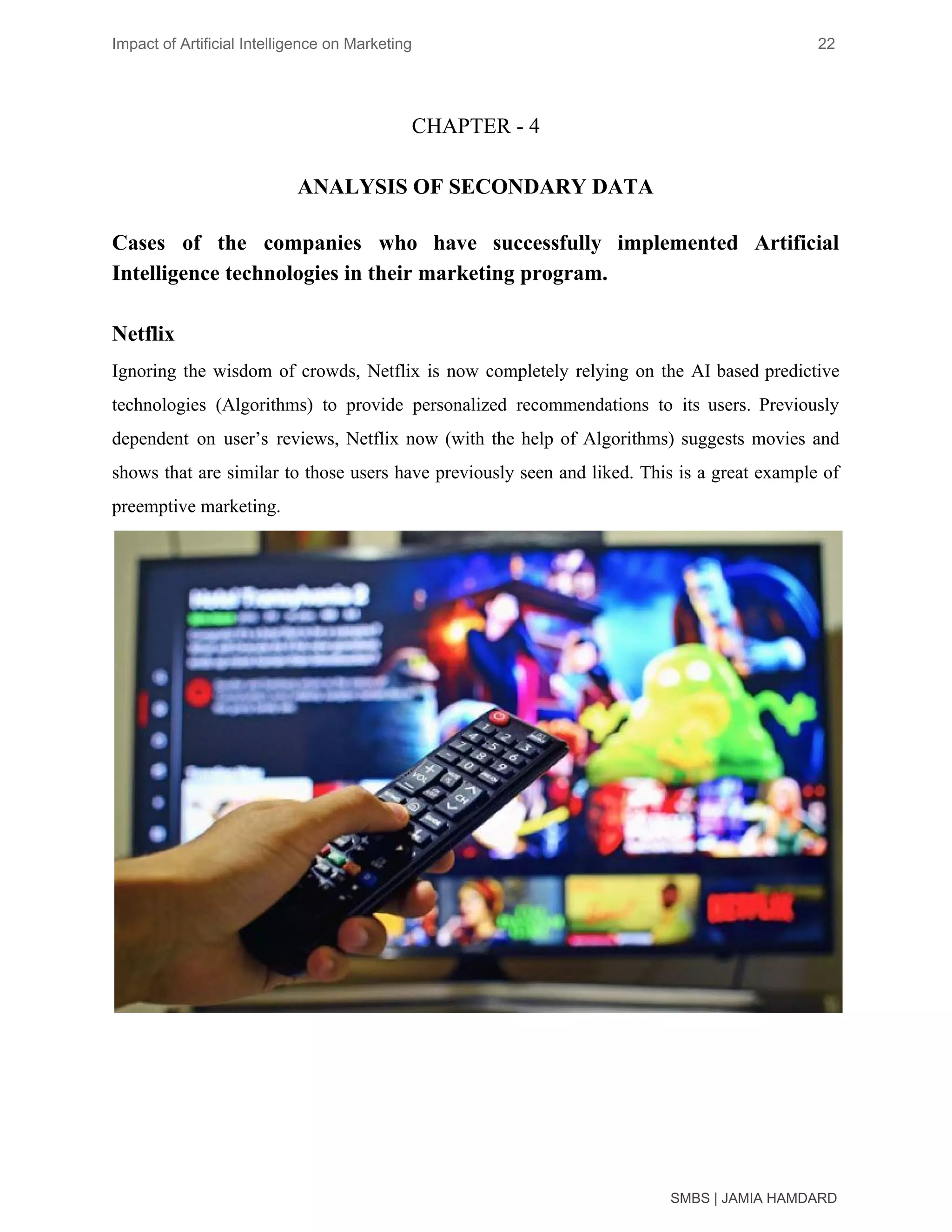
Ignoring the wisdom of crowds, Netflix is now completely relying on the AI based predictive
technologies (Algorithms) to provide personalized recommendations to its users. Previously
dependent on user’s reviews, Netflix now (with the help of Algorithms) suggests movies and
shows that are similar to those users have previously seen and liked. This is a great example of
preemptive marketing.
SMBS | JAMIA HAMDARD
Impact of Artificial Intelligence on Marketing 23
Subsequent to disabling its subscribers from submitting reviews/comment on its collections of
TV shows and movies, the streaming giant purged all the remaining reviews from the users—
putting an end to its rating based system.
Apart from that, Netflix eliminated the annoying pauses and rebuffering issues encountered
during online streaming. It utilized AI technology to refine and optimize each scene of the video,
ensuring high-quality display even on slow internet connection.
Amazon
Being one of the early adopters of AI technology, Amazon has been driving benefits from
product recommendations for long. Its recommendation engine alone constitutes 35 percent of
the company’s overall revenue. Amazon has refined the algorithms from time to time for making
better suggestions and now it’s using machine learning to make the recommendations more
dynamic.
Product reviews on Amazon can be really helpful in marketing and brand promotion. Many
companies misused the platform and generated fake reviews to amplify their product ratings. In
response to which, Amazon created a machine-learning algorithm that filtered authentic reviews
from fake ones.
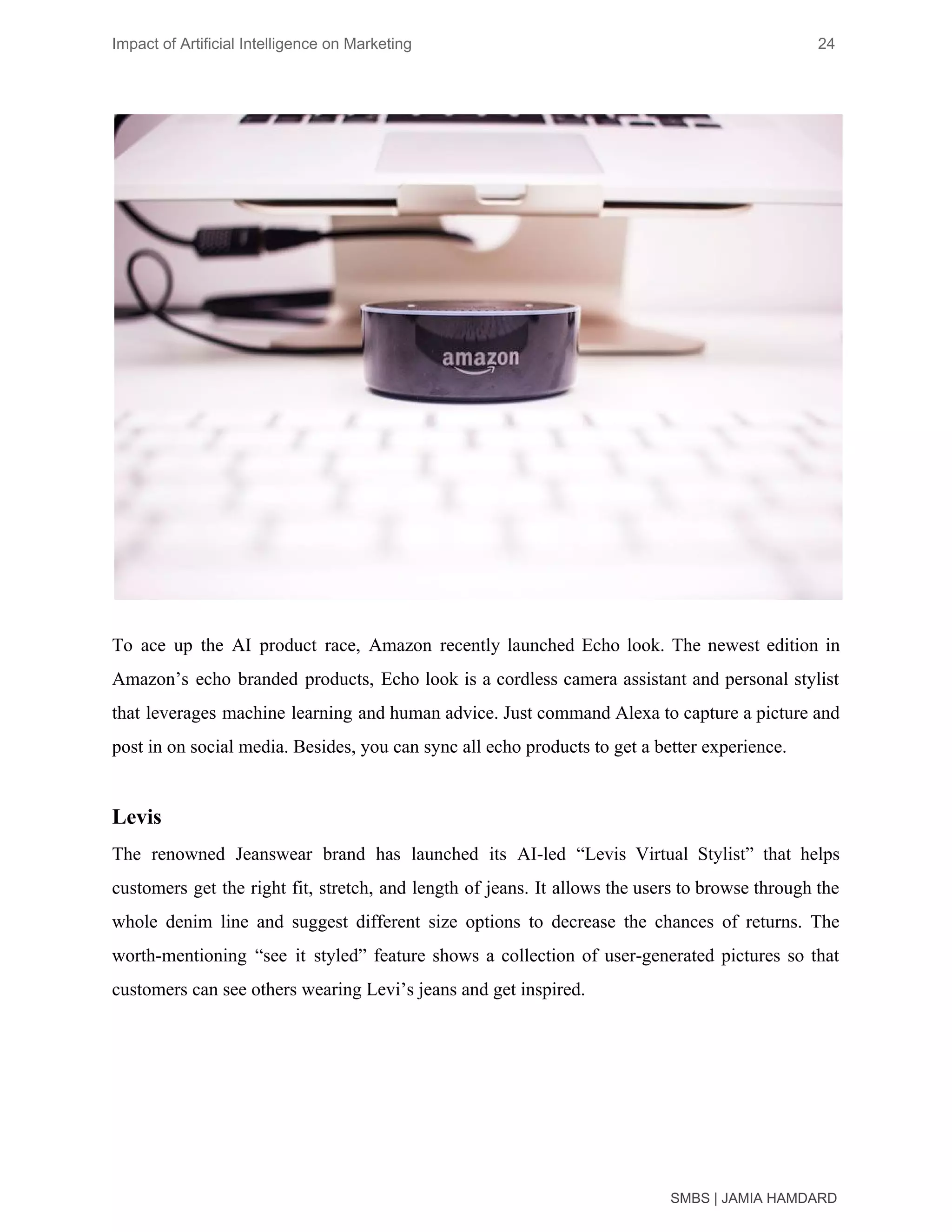
The ecommerce colossus, furthermore, used AI and machine learning to power its three popular
products: Amazon Go Store, Alexa, and Amazon recommendation engine. Amazon’s voice
enabled device, Echo is another note-worthy weapon in Amazon’s machine learning armory.
SMBS | JAMIA HAMDARD
Impact of Artificial Intelligence on Marketing 24
To ace up the AI product race, Amazon recently launched Echo look. The newest edition in
Amazon’s echo branded products, Echo look is a cordless camera assistant and personal stylist
that leverages machine learning and human advice. Just command Alexa to capture a picture and
post in on social media. Besides, you can sync all echo products to get a better experience.
Levis
The renowned Jeanswear brand has launched its AI-led “Levis Virtual Stylist” that helps
customers get the right fit, stretch, and length of jeans. It allows the users to browse through the
whole denim line and suggest different size options to decrease the chances of returns. The
worth-mentioning “see it styled” feature shows a collection of user-generated pictures so that
customers can see others wearing Levi’s jeans and get inspired.
SMBS | JAMIA HAMDARD
Impact of Artificial Intelligence on Marketing 25
Also, drooling at a pair of jeans and then finding it to be out of stock is not going to be the case
with denim customers. Levi’s now syncs the search results with the inventory data, which
ensures that the out-of-stock items are not shown in the first place.
Disney
If you think Disney has had its time, think again. One of the world’s biggest hub of
entertainment, the Walt Disney Company used AI technology (known as “Factorized Variational
Autoencoders,” or FVAEs) to understand its moviegoers and what they really think about a
particular movie.
The system observes the viewers’ reactions for a short while and anticipates facial expressions of
each individual for rest of the movie. FVAE is backed by a pattern-recognition technique that
works just like a recommendation engine; it generalizes the audience reactions and evaluates
those responses to form a result asserting whether the audience is liking it or not.
The findings can further determine the scenes most liked or disliked by the audience.
Disney-owned Marvel has been using the FILE system and big data to monitor the extensive
storyworld that combines its comic book characters and distinguishes the most liked ones that
have a greater fan following.
SMBS | JAMIA HAMDARD
Impact of Artificial Intelligence on Marketing 26
One cannot miss mentioning Magic Bench when talking about Disney’s utilization of AI
technology. It is an innovative combo of augmented reality (AR) and mixed reality (MR) in
which the participant settles on a bench and connects with a humanoid animal. The images of the
user and animated character can be seen on a video display or screen.
Using haptic feedback, vibrations are created when the animal sits down. The haptic sensors and
speakers attached to the bench enhance the overall experience. The room is remodeled in three
dimensions on the screen that allows the user to move ahead or behind the animated animals.
Spotify
Having a rich history of upending the music industry, Spotify has been pushing the technological
boundaries and getting the best out of AI, machine learning and big data. It discovers weekly
playlists personalized for every user’s unique predilections.
Spotify is said to be a data-driven entity for a reason. With millions of users listening to music
nonstop, the company receives an exponential amount of data that it is used to run different
SMBS | JAMIA HAMDARD
Impact of Artificial Intelligence on Marketing 27
interesting campaigns. In 2013, with the help of streaming data and user behavioral information,
Spotify foretold the winners of Grammy Awards before the award show. Unsurprisingly, 4 out of
6 of its predictions turned out to be right.
The music streaming service has also test-launched its dedicated voice search interface to end its
dependency on SIRI and Alexa, earlier this year. And now as we are reaching towards the end of
2018, the yearly Spotify Wrapped 2018 feature is here to enable the users to get a dive into their
whole year’s music flashback.
Unlike previous years’ versions, the year’s feature also creates a ‘Tastebreakers’ playlist
comprising of popular artists and genres users didn’t listen to in 2018 so that they can start new
year with new music.
SMBS | JAMIA HAMDARD
Impact of Artificial Intelligence on Marketing 28
Sephora
An early AI adopter and one of the first retail brands to embrace the chatbots for customer
communication, Sephora teamed up with Facebook and launched Sephora reservation assistant.
The purpose behind this bot was to assist customers in reserving the makeover slots by beauty
specialists easily. Besides boosting the booking rate, it enhanced the customer experience too.
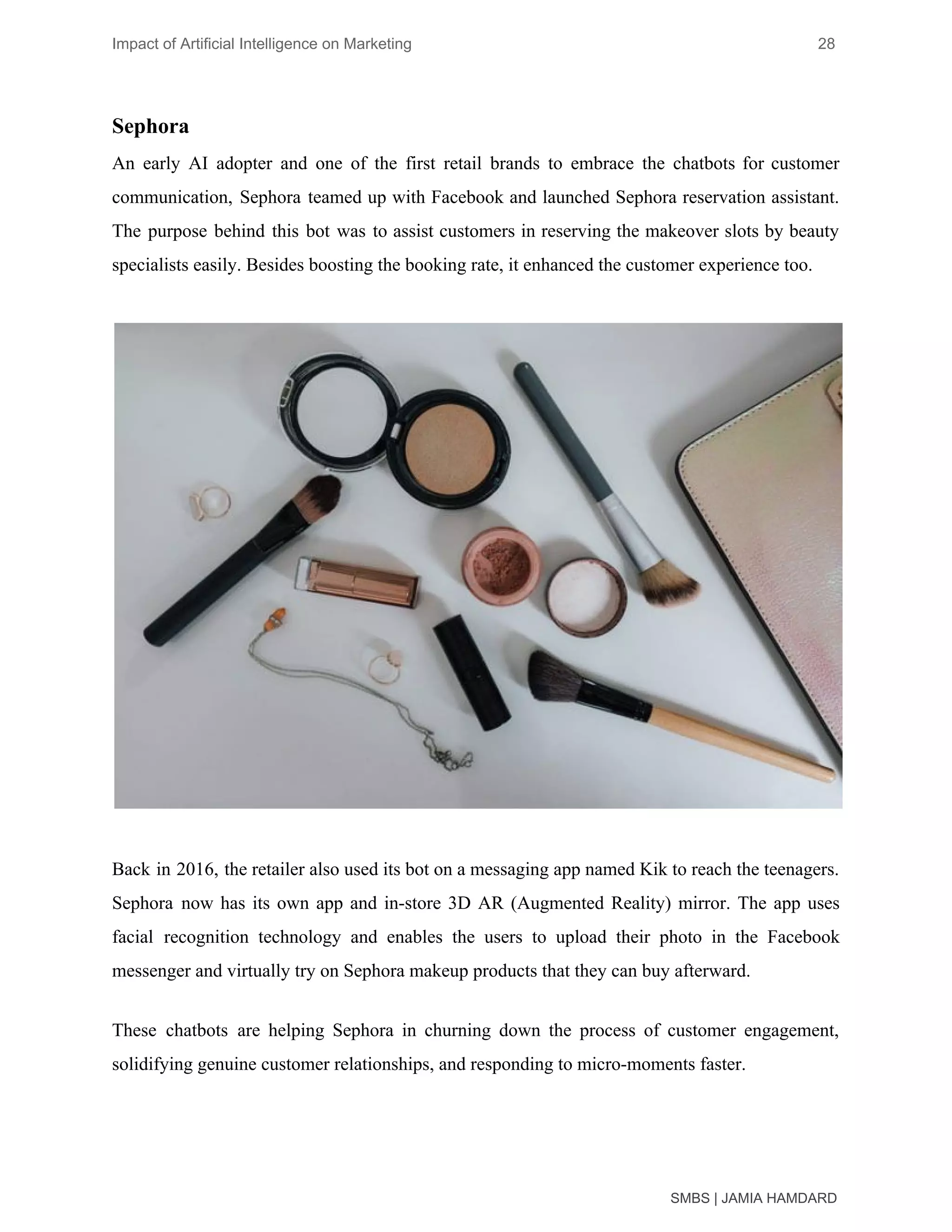
Back in 2016, the retailer also used its bot on a messaging app named Kik to reach the teenagers.
Sephora now has its own app and in-store 3D AR (Augmented Reality) mirror. The app uses
facial recognition technology and enables the users to upload their photo in the Facebook
messenger and virtually try on Sephora makeup products that they can buy afterward.
These chatbots are helping Sephora in churning down the process of customer engagement,
solidifying genuine customer relationships, and responding to micro-moments faster.
SMBS | JAMIA HAMDARD
Impact of Artificial Intelligence on Marketing 29
CHAPTER - 5
ANALYSIS AND INTERPRETATION OF PRIMARY DATA
DEMOGRAPHIC
JOB PROFILE
Since the study is based on the impact of Artificial Intelligence on Marketing, Marketing
professionals were focused for the survey and the responses are collected mainly from
Marketing Managers.
LOCATION
Almost all of the respondents are from India from different states with a majority of them
from Delhi
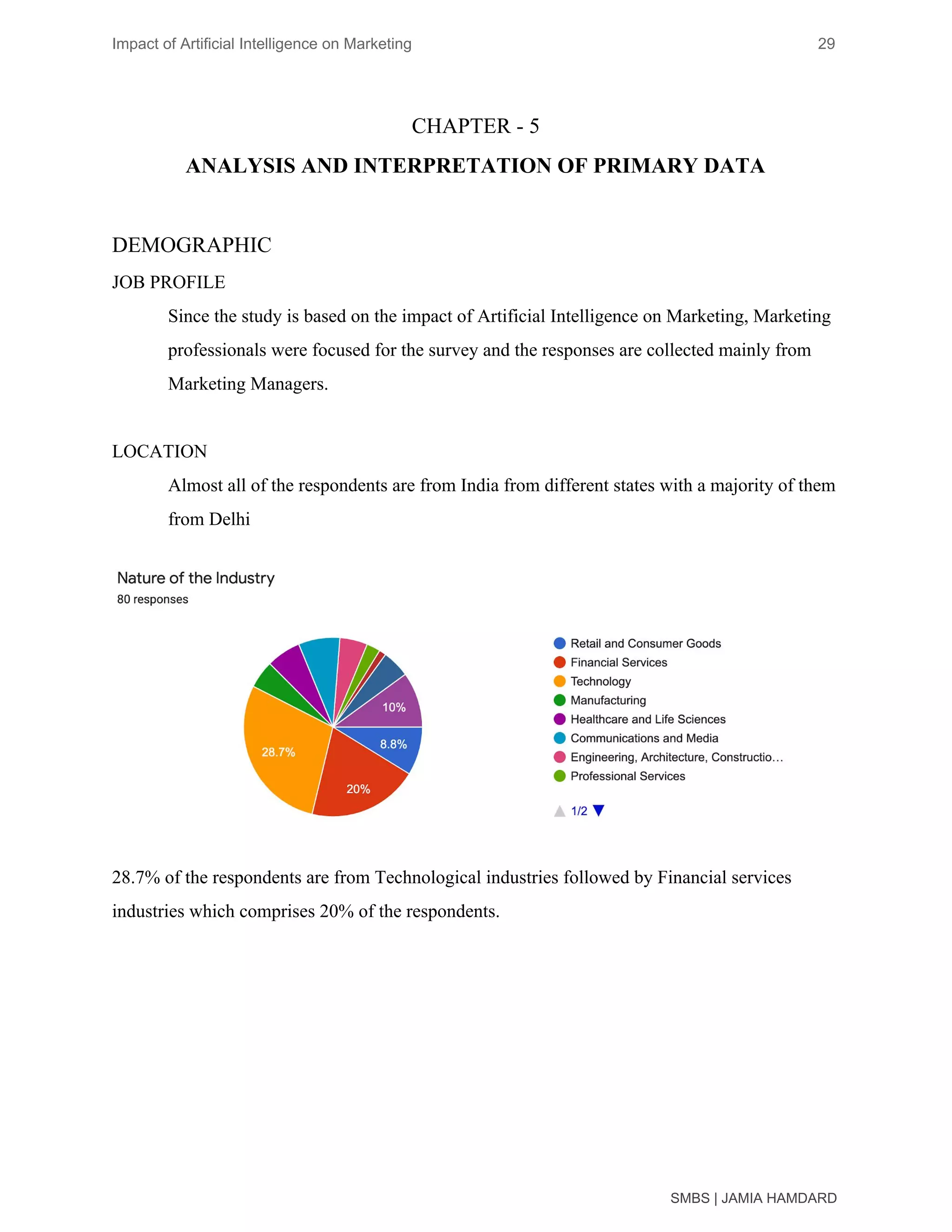
28.7% of the respondents are from Technological industries followed by Financial services
industries which comprises 20% of the respondents.
SMBS | JAMIA HAMDARD
Impact of Artificial Intelligence on Marketing 30
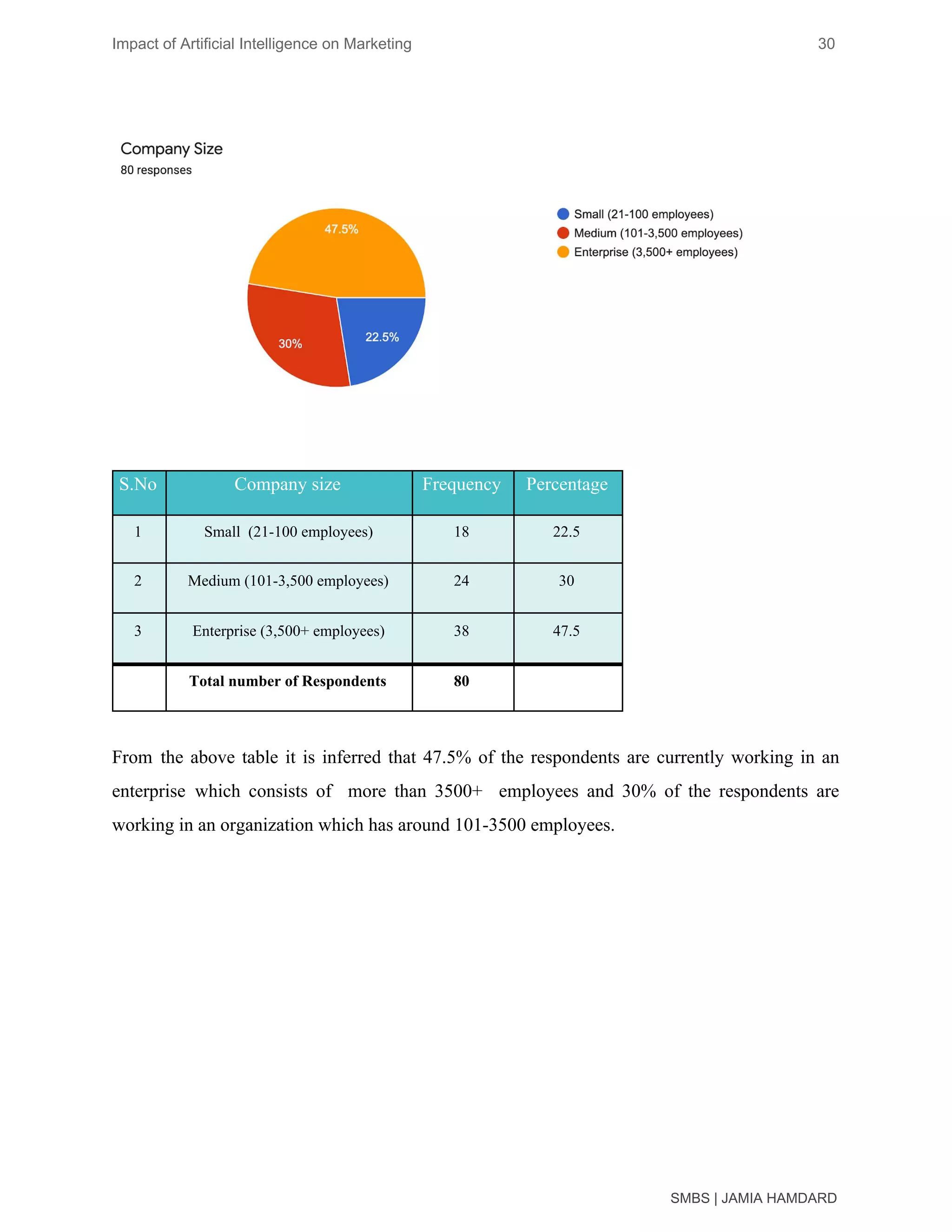
From the above table it is inferred that 47.5% of the respondents are currently working in an
enterprise which consists of more than 3500+ employees and 30% of the respondents are
working in an organization which has around 101-3500 employees.
SMBS | JAMIA HAMDARD
S.No Company size Frequency Percentage
1 Small (21-100 employees) 18 22.5
2 Medium (101-3,500 employees) 24 30
3 Enterprise (3,500+ employees) 38 47.5
Total number of Respondents 80
Impact of Artificial Intelligence on Marketing 31


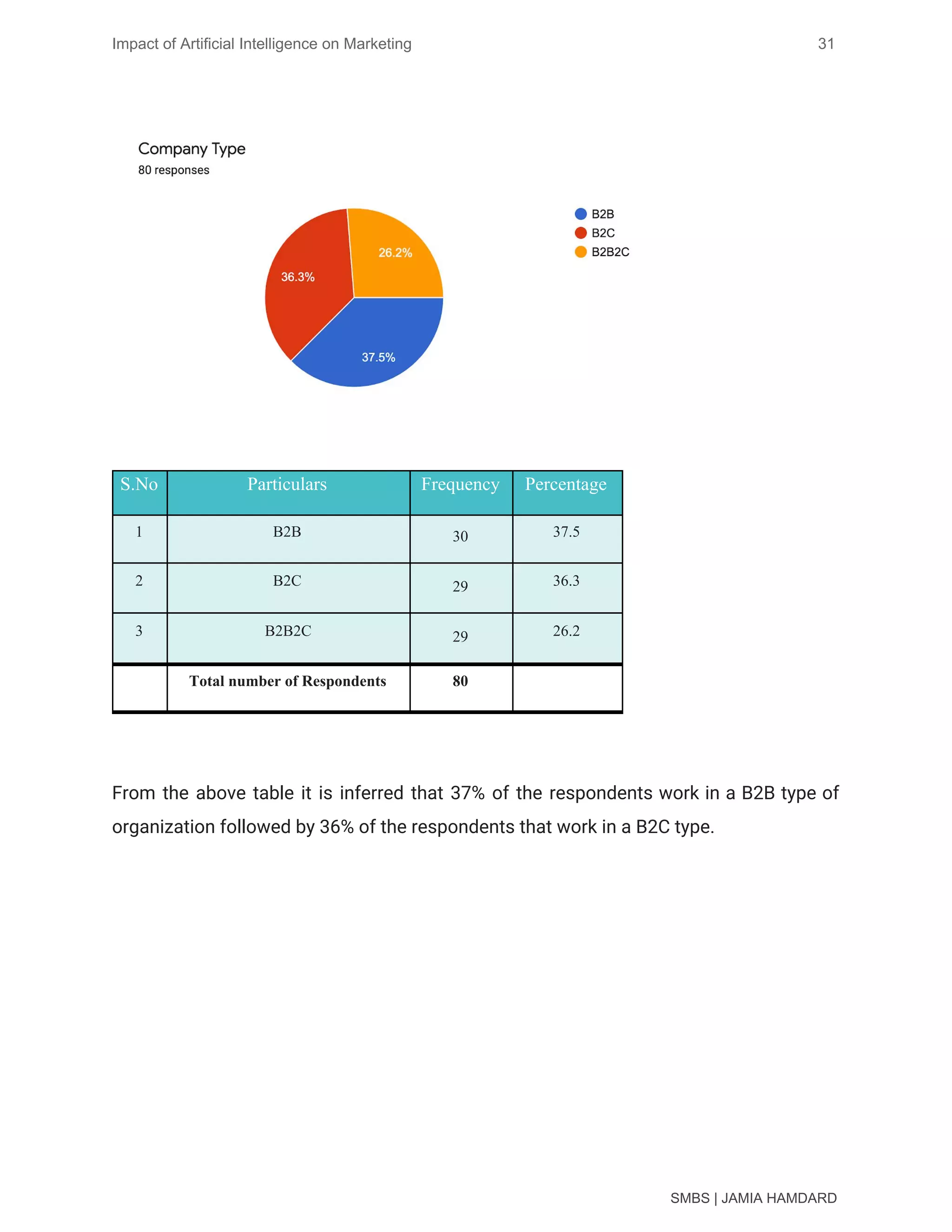
From the above table it is inferred that 37% of the respondents work in a B2B type of
                                   
organization followed by 36% of the respondents that work in a B2C type. 
SMBS | JAMIA HAMDARD
S.No Particulars Frequency Percentage
1 B2B 30 37.5
2 B2C 29 36.3
3 B2B2C 29 26.2
Total number of Respondents 80
Impact of Artificial Intelligence on Marketing 32


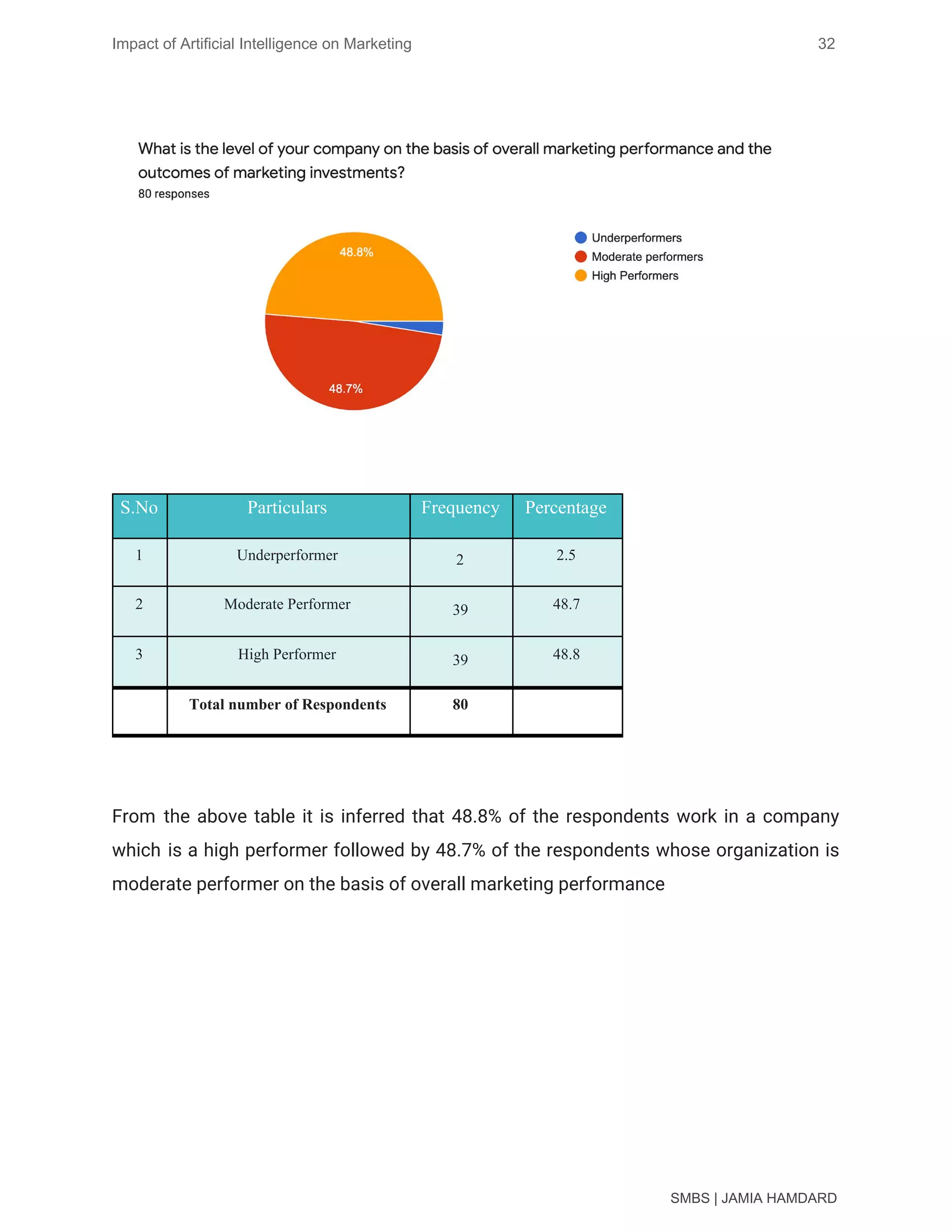
From the above table it is inferred that 48.8% of the respondents work in a company
                               
which is a high performer followed by 48.7% of the respondents whose organization is
                           
moderate performer on the basis of overall marketing performance 
SMBS | JAMIA HAMDARD
S.No Particulars Frequency Percentage
1 Underperformer 2 2.5
2 Moderate Performer 39 48.7
3 High Performer 39 48.8
Total number of Respondents 80
Impact of Artificial Intelligence on Marketing 33
 
 
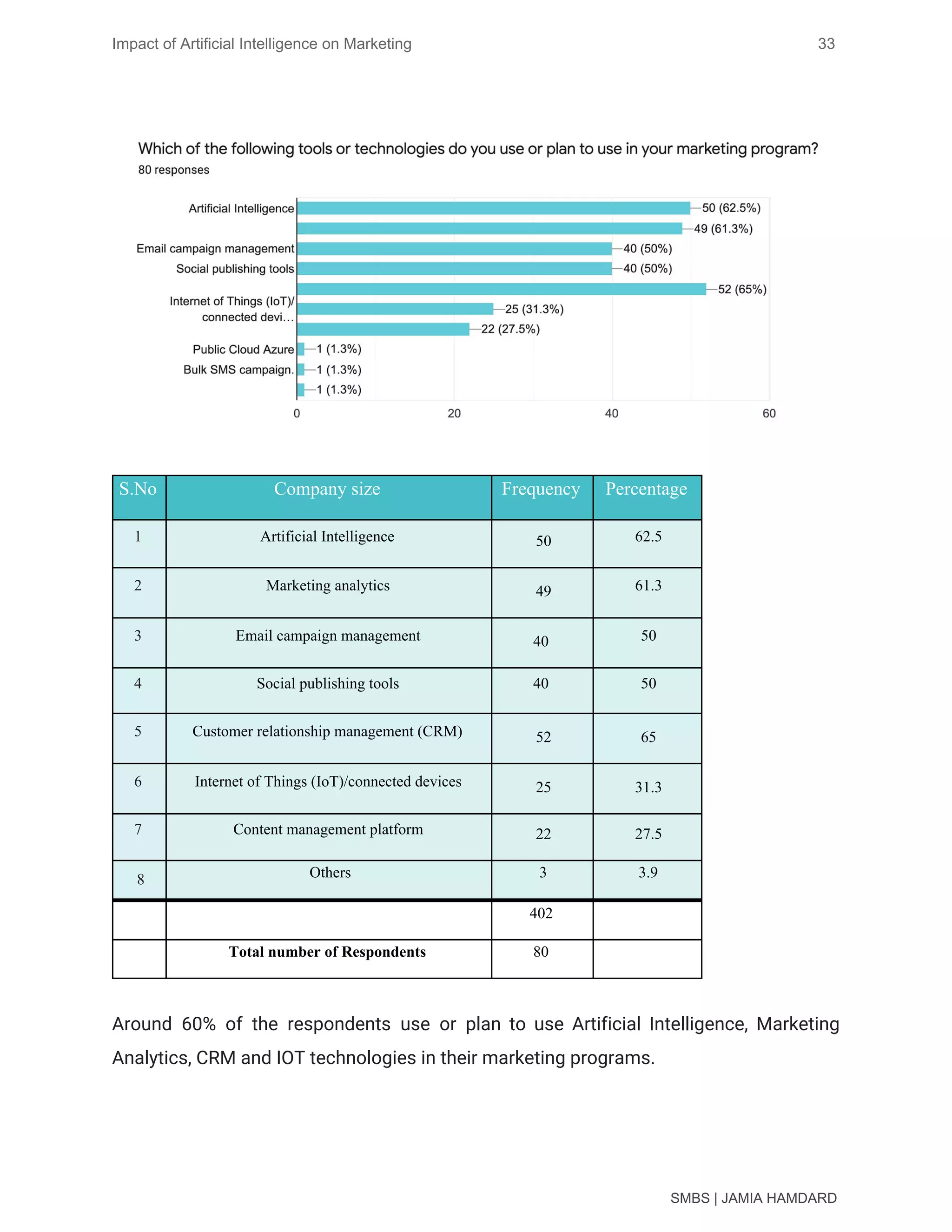
Around 60% of the respondents use or plan to use Artificial Intelligence, Marketing
                         
Analytics, CRM and IOT technologies in their marketing programs. 
 
SMBS | JAMIA HAMDARD
S.No Company size Frequency Percentage
1 Artificial Intelligence 50 62.5
2 Marketing analytics 49 61.3
3 Email campaign management 40 50
4 Social publishing tools 40 50
5 Customer relationship management (CRM) 52 65
6 Internet of Things (IoT)/connected devices 25 31.3
7 Content management platform 22 27.5
8 Others 3 3.9
402
Total number of Respondents 80
Impact of Artificial Intelligence on Marketing 34


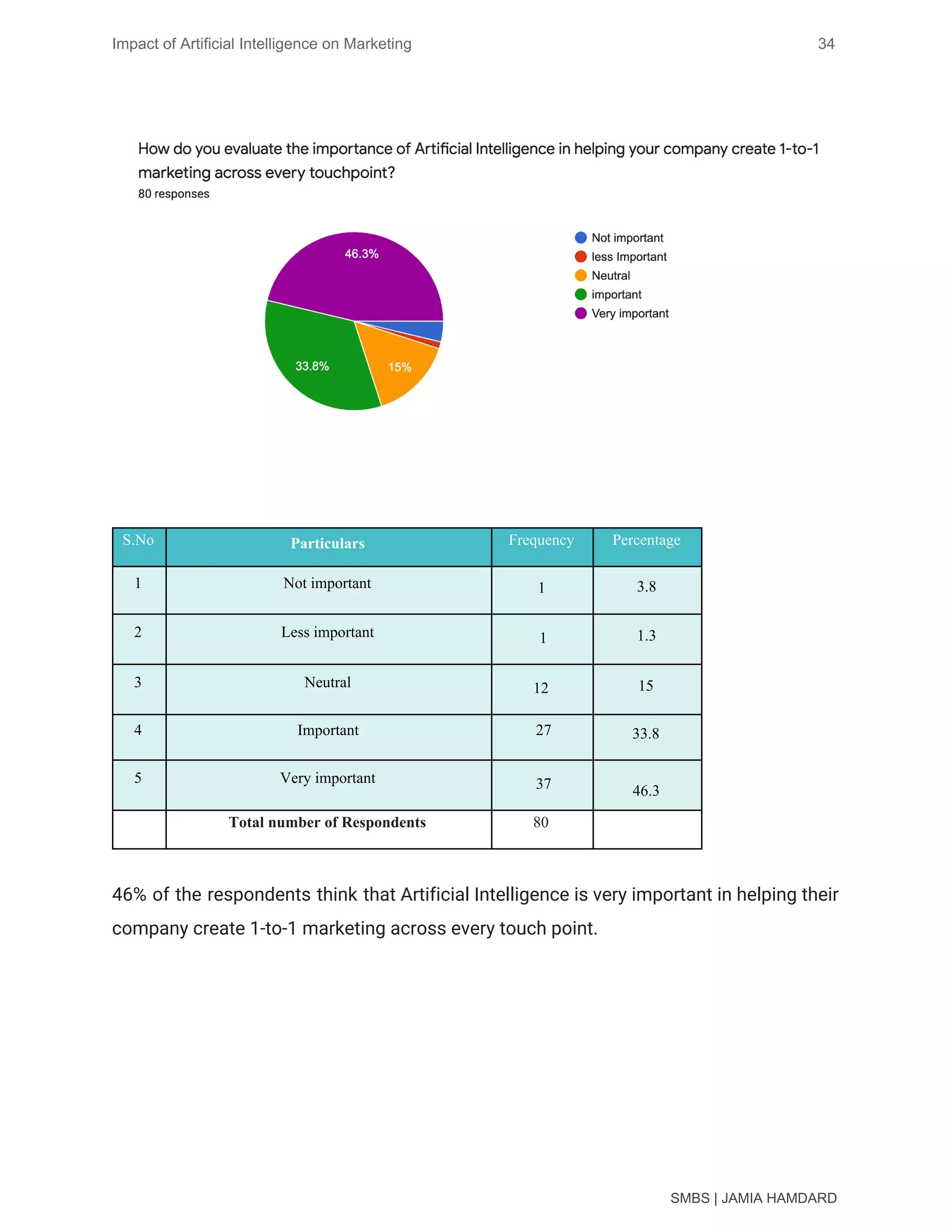
46% of the respondents think that Artificial Intelligence is very important in helping their
                           
company create 1-to-1 marketing across every touch point. 
SMBS | JAMIA HAMDARD
S.No Particulars Frequency Percentage
1 Not important 1 3.8
2 Less important 1 1.3
3 Neutral 12 15
4 Important ​27 33.8
5 Very important 37 46.3
Total number of Respondents 80
Impact of Artificial Intelligence on Marketing 35


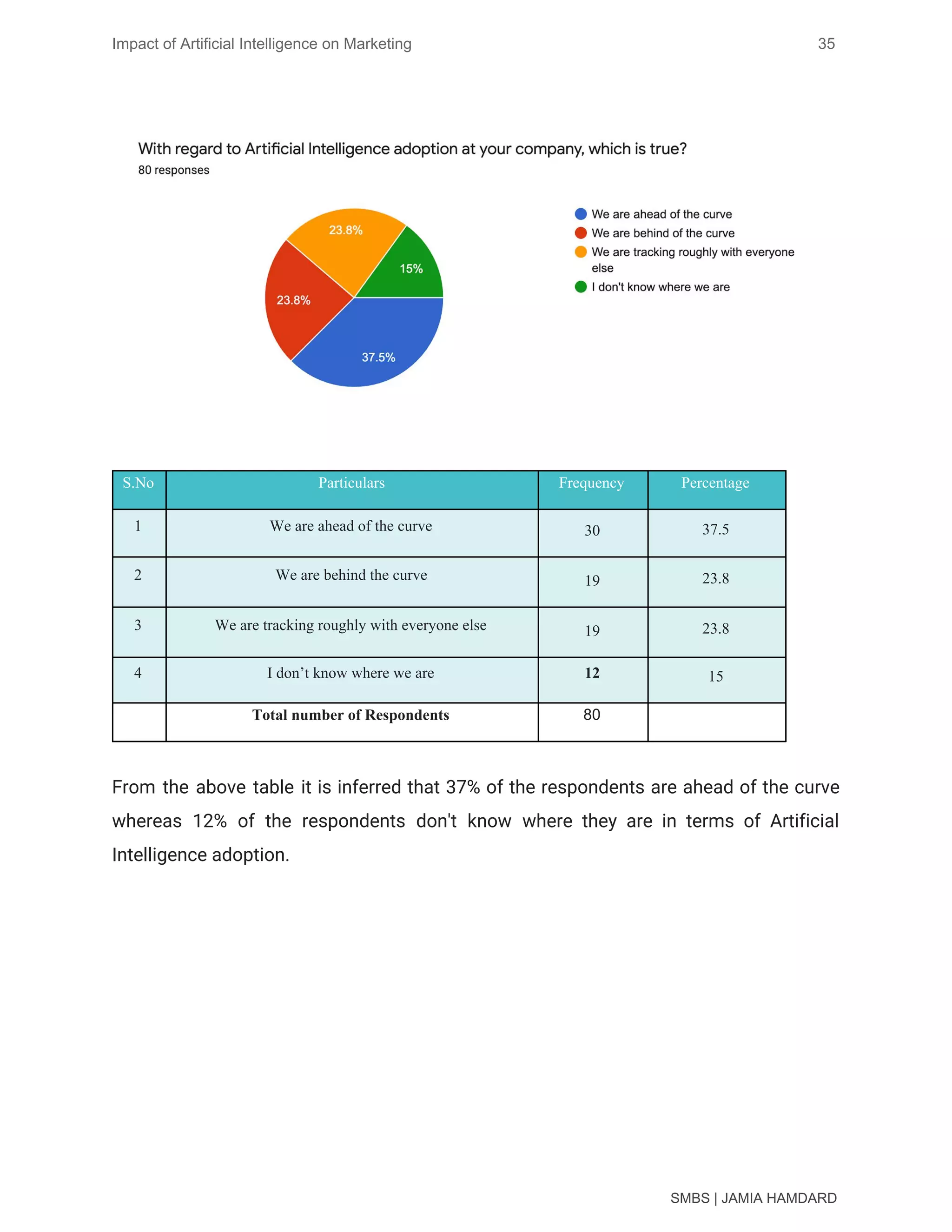
From the above table it is inferred that 37% of the respondents are ahead of the curve
                                 
whereas 12% of the respondents don't know where they are in terms of Artificial
                           
Intelligence adoption. 
SMBS | JAMIA HAMDARD
S.No Particulars Frequency Percentage
1 We are ahead of the curve 30 37.5
2 We are behind the curve 19 23.8
3 We are tracking roughly with everyone else 19 23.8
4 I don’t know where we are 12 15
  Total number of Respondents 80   
Impact of Artificial Intelligence on Marketing 36
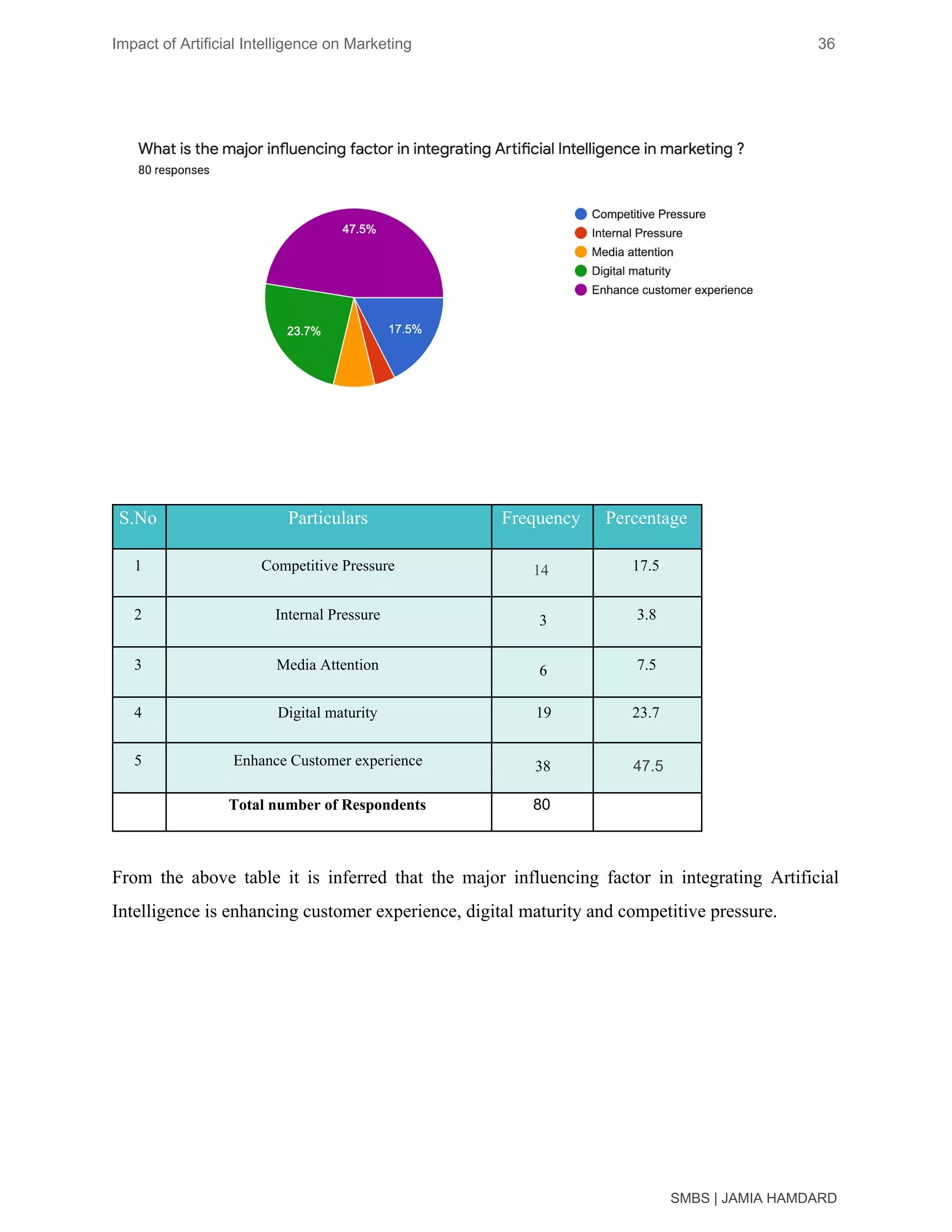
From the above table it is inferred that the major influencing factor in integrating Artificial
Intelligence is enhancing customer experience, digital maturity and competitive pressure.
SMBS | JAMIA HAMDARD
S.No Particulars Frequency Percentage
1 Competitive Pressure 14 17.5
2 Internal Pressure 3 3.8
3 Media Attention 6 7.5
4 Digital maturity 19 23.7
5 Enhance Customer experience ​38 47.5
Total number of Respondents 80
Impact of Artificial Intelligence on Marketing 37
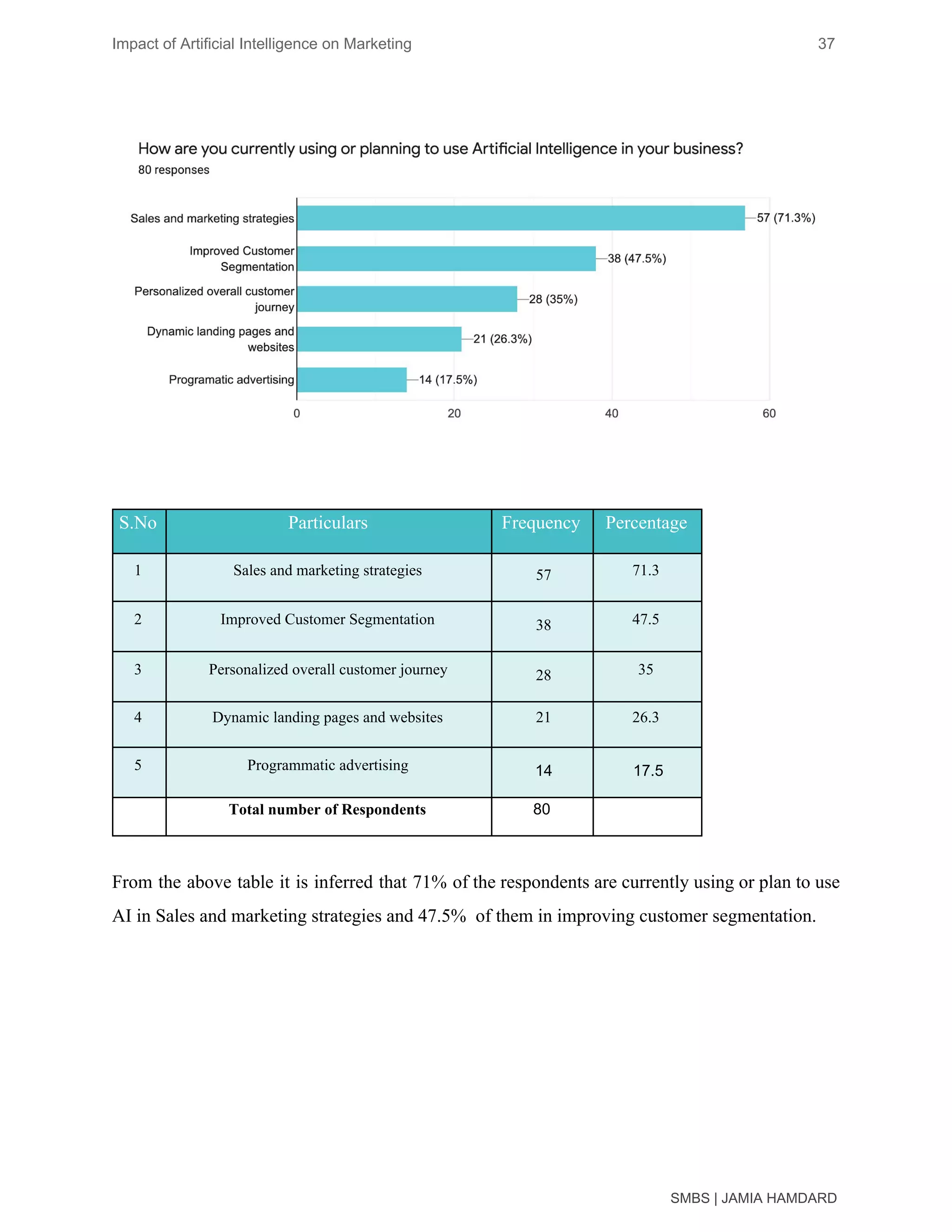
From the above table it is inferred that 71% of the respondents are currently using or plan to use
AI in Sales and marketing strategies and 47.5% of them in improving customer segmentation.
SMBS | JAMIA HAMDARD
S.No Particulars Frequency Percentage
1 Sales and marketing strategies 57 71.3
2 Improved Customer Segmentation 38 47.5
3 Personalized overall customer journey 28 35
4 Dynamic landing pages and websites 21 26.3
5 Programmatic advertising 14 17.5
Total number of Respondents 80
Impact of Artificial Intelligence on Marketing 38
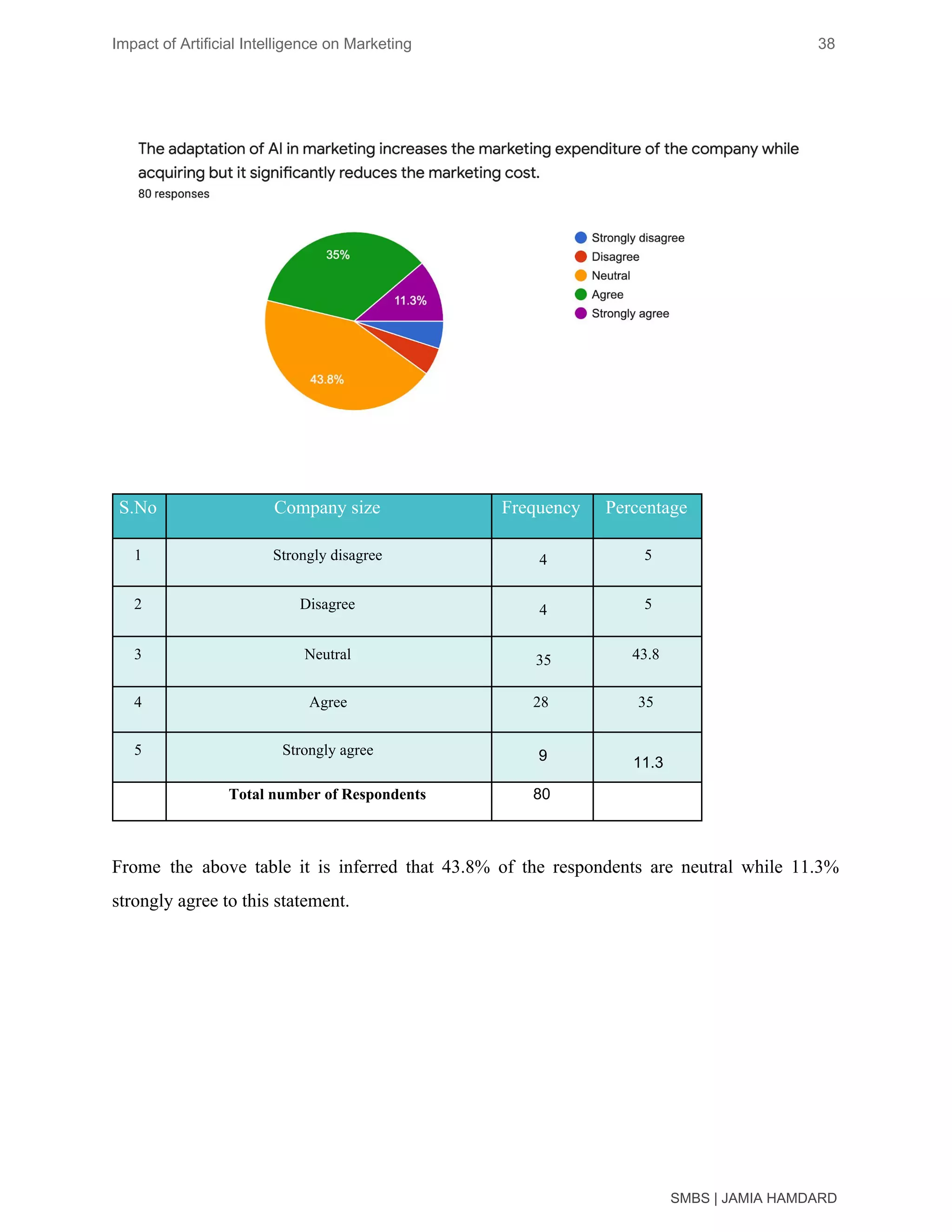
Frome the above table it is inferred that 43.8% of the respondents are neutral while 11.3%
strongly agree to this statement.
SMBS | JAMIA HAMDARD
S.No Company size Frequency Percentage
1 Strongly disagree 4 5
2 Disagree 4 5
3 Neutral 35 43.8
4 Agree 28 35
5 Strongly agree 9 11.3
Total number of Respondents 80
Impact of Artificial Intelligence on Marketing 39
SMBS | JAMIA HAMDARD
S.No Particulars Frequency Percentage
1 Productivity of Marketers 49 61.3
2 Campaign analytics 40 50
3 Lead scoring 34 42.5
4 Hyper personalization of content ​24 30
5 Dynamic Landing pages and website 27 33.8
6 Hyper personalized product recommendation 25 31.3
7 Programmatic advertising 25 31.3
Total number of Respondents 80
Impact of Artificial Intelligence on Marketing 40
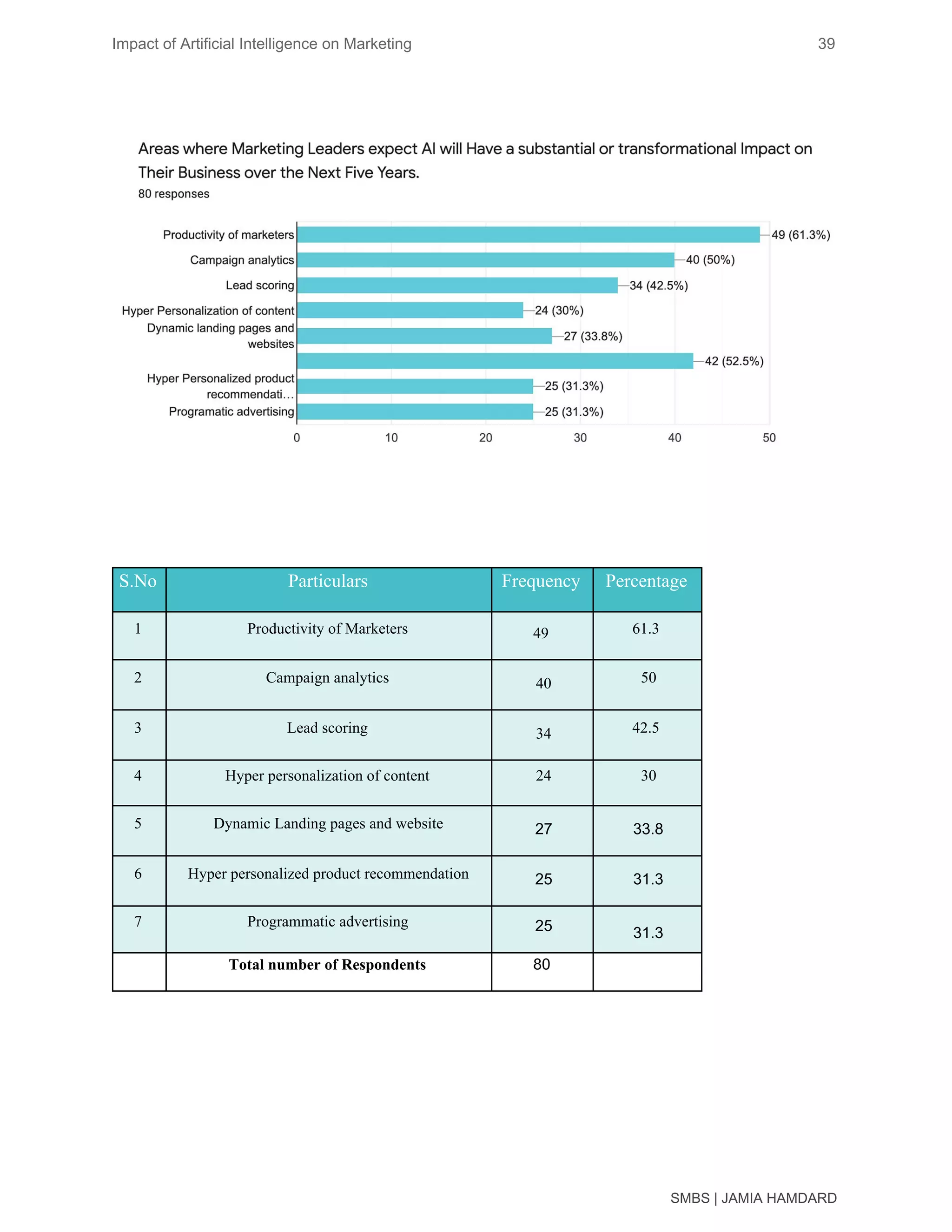
From the above table it is inferred that 61.3% of the respondents think AI will have substantial
impact on productivity of marketers whereas 50% thinks campaign analytics and 42.5% thinks
lead scoring.
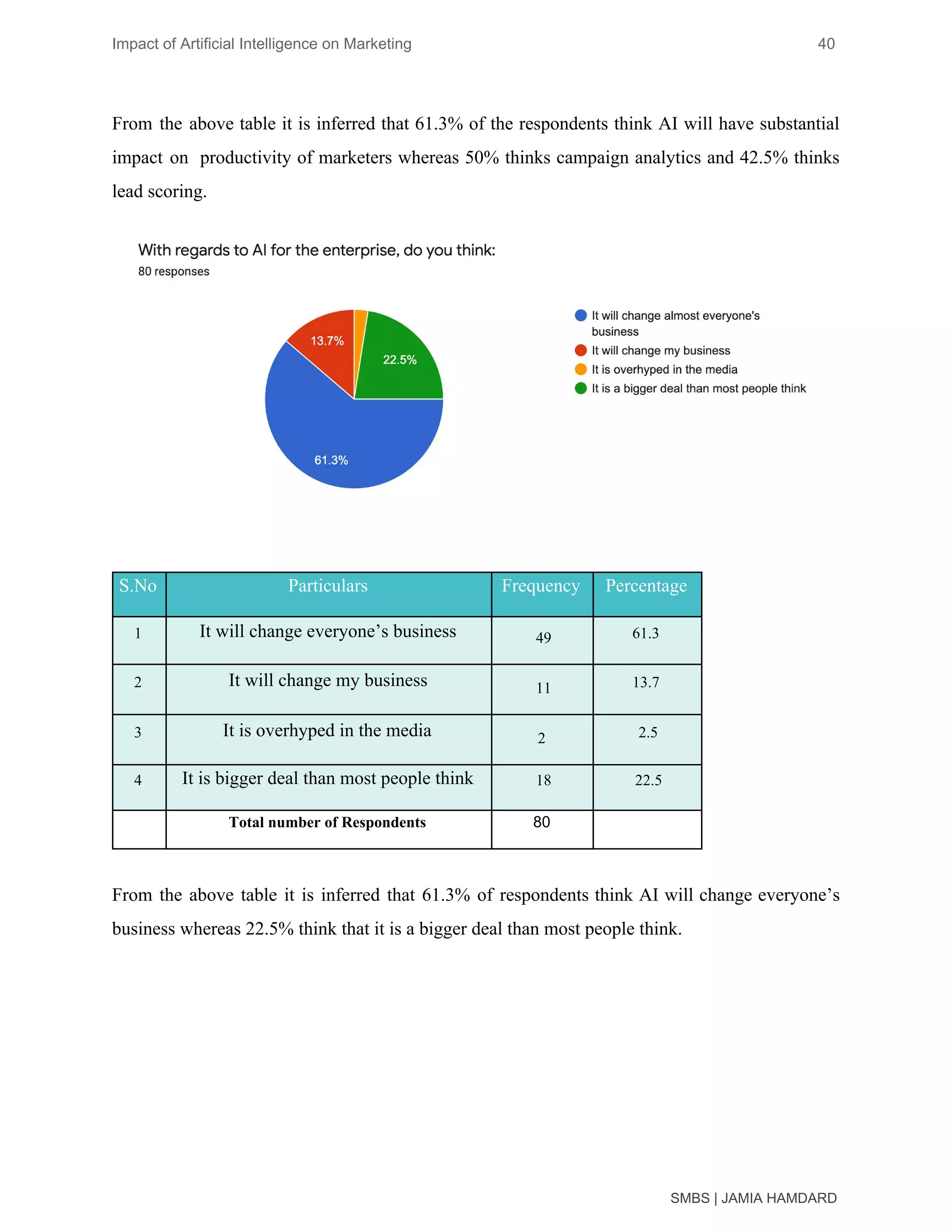
From the above table it is inferred that 61.3% of respondents think AI will change everyone’s
business whereas 22.5% think that it is a bigger deal than most people think.
SMBS | JAMIA HAMDARD
S.No Particulars Frequency Percentage
1 It will change everyone’s business 49 61.3
2 It will change my business 11 13.7
3 It is overhyped in the media 2 2.5
4 It is bigger deal than most people think 18 22.5
Total number of Respondents 80
Impact of Artificial Intelligence on Marketing 41
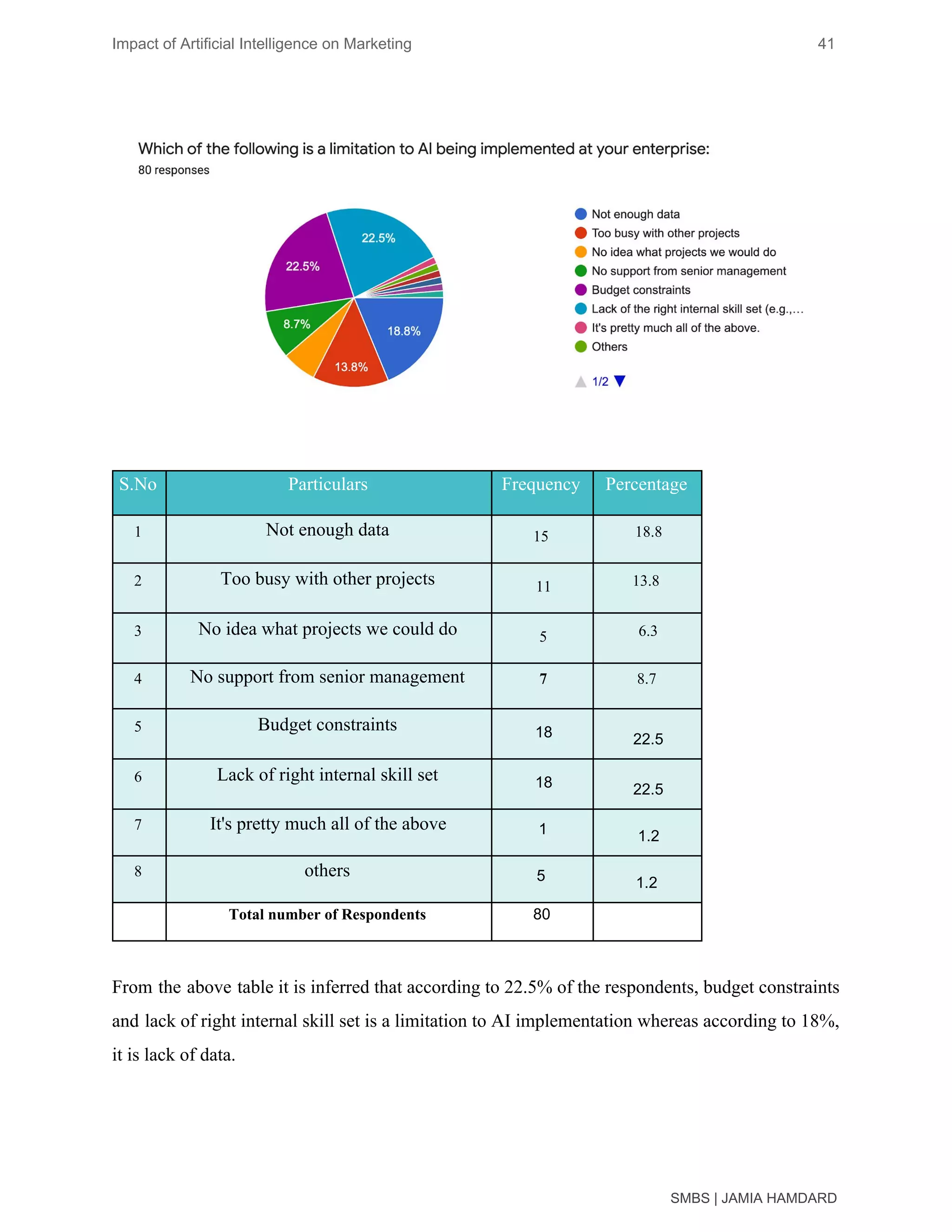
From the above table it is inferred that according to 22.5% of the respondents, budget constraints
and lack of right internal skill set is a limitation to AI implementation whereas according to 18%,
it is lack of data.
SMBS | JAMIA HAMDARD
S.No Particulars Frequency Percentage
1 Not enough data 15 18.8
2 Too busy with other projects 11 13.8
3 No idea what projects we could do 5 6.3
4 No support from senior management 7 8.7
5 Budget constraints 18 22.5
6 Lack of right internal skill set 18 22.5
7 It's pretty much all of the above 1 1.2
8 others 5 1.2
Total number of Respondents 80
Impact of Artificial Intelligence on Marketing 42
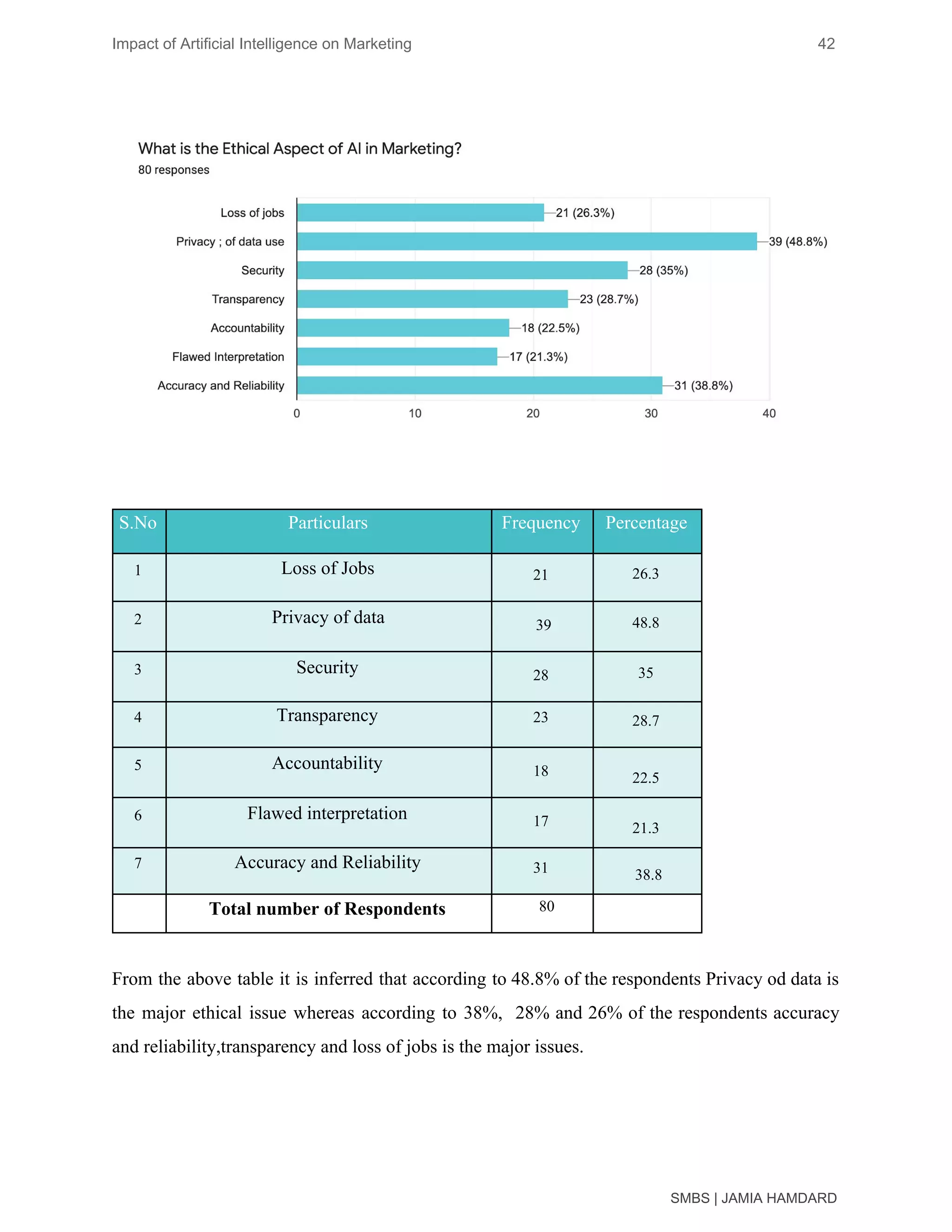
From the above table it is inferred that according to 48.8% of the respondents Privacy od data is
the major ethical issue whereas according to 38%, 28% and 26% of the respondents accuracy
and reliability,transparency and loss of jobs is the major issues.
SMBS | JAMIA HAMDARD
S.No Particulars Frequency Percentage
1 Loss of Jobs 21 26.3
2 Privacy of data 39 48.8
3 Security 28 35
4 Transparency 23 28.7
5 Accountability 18 22.5
6 Flawed interpretation 17 21.3
7 Accuracy and Reliability 31 38.8
Total number of Respondents 80
Impact of Artificial Intelligence on Marketing 43
FINDINGS
The major findings of the research showed that the major influencing factors in integrating AI in
marketing are competitive pressure, media attention, digital maturity, and customers.
On the findings related to the benefits of integrating AI in marketing, different responses were
gathered from the respondents. The major benefits according to the marketing professionals are
increasing efficiency, time-saving in the marketing functions, improving conversion rates, a
better understanding of customer information, making marketing decisions more feasible,
increasing the ROI, insights, enhanced service and customer satisfaction.
Other benefits include improved data analysis and effective handling of marketing processes.
On a question related to the biggest challenge of AI integration in marketing,Budget constraints
,technical compatibility is considered as the major challenge in AI integration according to the
respondents. Respondents also consider that it is important to have data in place as it is the most
important part of AI thus, according to them, data is also the biggest challenge.
According to the respondents, data is the major ethical aspect to take into account concerning the
customers.
On the question related to the usage of AI in the marketing of the company, respondents stated
that AI has made the marketing function more effective and it is used in almost all the important
marketing functions.
They consider that AI helps in developing the sales and marketing strategies that drive
substantial improvements in business performance.
CONCLUSION
SMBS | JAMIA HAMDARD
Impact of Artificial Intelligence on Marketing 44
The aim of the paper was to find out the impact of AI on marketing by including the perspective
of marketing professionals. In order to reach the objective of the research and to answer the
research questions, different steps were followed. At first, a comprehensive literature review was
highlighted which provided a detailed understanding of AI and the use of AI in marketing by
including the perspective of different researchers. Secondly, the researcher used the
qualitative research method which involved semi-structured interviews with different marketing
professionals belonging to different firms in India.
The above findings highlight the importance of AI in the marketing of businesses. AI has
transformed the landscape marketing and helps in updating the outdated methods of marketing.
This will be a major challenge for the organizations to transform according to the changing
landscape of marketing. The organizations need to prepare themselves for the future and train
their employees constantly with the emergence of innovation. The research has positively
contributed to the existing literature by filling the existing gaps present in the literature by taking
the marketing professional’s perspective on the impact of AI in marketing.
This highlighted the importance of AI in marketing and the major benefits associated with the
integration. In addition, major challenges, ethical aspects, and usages provided a guideline to the
companies to adopt AI in marketing. It is recommended to the firms to follow the aspects and
challenges while integrating AI in marketing.
REFERENCES
SMBS | JAMIA HAMDARD
Impact of Artificial Intelligence on Marketing 45
1. Ahmed, K. (2015, September 16). Google's Demis Hassabis – misuse of artificial intelligence
'could do harm'. ​http://www.bbc.com/news/business-34266​ 425 Accessed: 6 November 2018.
2. Bughin, J., Hazan, E., Manyika, J., & Woetzel, J. (2017). Artificial Intelligence: The Next
Digital Frontier. McKinsey Global Institute.
3. Hoanca, B. and Forrest, E. (2015). Artificial Intelligence: Marketing's Game Changer - IGI
Global
4. Kaput, M. (2016, November 1). The Marketer's Guide to Artificial Intelligence Terminology.
https://www.marketingaiinstitute.com/blog/the-marketers-guide-to-artificial-intelligence-termino
logy​ Accessed: 6 November 2018.
6. Lee, C., Wang, M., Yen, S., Wei, T., Wu, I., Chou, P. & Yang, T. (2016, August). Human vs.
Computer Go: Review and Prospect. IEEE Computational Intelligence Magazine.
7. Mannila, H. 1996. Data mining: machine learning, statistics, and databases. URL:
http://people.cs.aau​. dk/~uk/teaching/BSS2/E99/ssdbm.ps. Accessed: 7 November 2018
8. Martínez-López, F. and Casillas, J. (2013). Artificial intelligence-based systems applied in
industrial marketing: An historical overview, current and future insights. Industrial Marketing
Management, 42(4), pp. 489-495
9. McCarthy, J. 2007. What is Artificial Intelligence? URL:
http://www-formal.stanford.edu/jmc/whatisai/​ node1.html. Accessed: 7 November 2018.
10. Mohri, M; Rostamizadeh, A; Talwalkar, A. 2012. Foundations of Machine Learning.
Massachusetts Institute of Technology.
11. Müller, VC. 2016. Fundamental Issues of Artificial Intelligence. Springer Nature.
12. Roetzer, P. (2017). The 5P’s of Marketing Artificial Intelligence. Marketing artificial
intelligence institute blog. URL: ​https://www.marketingaiinstitute.com/ blog/the 5
ps-of-marketing-artificial-intelligence?__hstc=96041603.f6a6d6b1bf0af98d2cc794545b23b
8ed.1501510789624.1511266825703.1511696900272.9&__hssc=96041603.1.1511696900272&
__hsfp=928892310. Accessed: 6 November 2018.
13. Russell, S & Norvig, P. 2010. Artificial Intelligence: A Modern Approach. Third edition.
Pearson Education. Upper Saddle River.
SMBS | JAMIA HAMDARD
Impact of Artificial Intelligence on Marketing 46
14. Sterne, J. 2017. Artificial Intelligence for Marketing: Practical Applications. John Wiley
Sons, Inc.
15. Wierenga, B. (2010). Marketing and artificial intelligence: Great opportunities, reluctant
partners. In Marketing intelligent systems using soft computing (pp. 1-8). Springer, Berlin,
Heidelberg.
16. Wierenga, B., & van Bruggen, G. H. (2000). Marketing management support systems:
Principles, tools, and implementation (Vol. 10). Springer Science & Business Media.
17. Wierenga, B. & Ophuis, P. (1997). Marketing decision support systems: Adoption, use, and
satisfaction. International Journal of Research in Marketing, 14(3), pp. 275-290.
SMBS | JAMIA HAMDARD
Impact of Artificial Intelligence on Marketing 47
APPENDICES
QUESTIONNAIRE
Q1. NAME
Q2. JOB PROFILE
Q3. LOCATION
Q4. Nature of the Industry
● Retail and Consumer Goods
● Financial Services
● Technology
● Manufacturing
● Healthcare and Life Sciences
● Communications and Media
● Engineering, Architecture, Construction and Real Estate
● Professional Services
● Automotive
● Travel,Transportation and Hospitality
● Others
Q5. Company Size
● Small (21-100 employees)
● Medium (101-3,500 employees)
● Enterprise (3,500+ employees)
Q6. Company Type *
● B2B
● B2C
● B2B2C
Q7. What is the level of your company on the basis of overall marketing performance and the
outcomes of marketing investments? *
● Underperformers
● Moderate performers
SMBS | JAMIA HAMDARD
Impact of Artificial Intelligence on Marketing 48
● High Performers
Q8. Which of the following tools or technologies do you use or plan to use in your marketing
program?
● Artificial Intelligence
● Marketing analytics
● Email campaign management
● Social publishing tools
● Customer relationship management (CRM)
● Internet of Things (IoT)/connected devices
● Content management platform
● Other:
Q9. How do you evaluate the importance of Artificial Intelligence in helping your company
create 1-to-1 marketing across every touchpoint? *
● Not important
● less Important
● Neutral
● important
● Very important
Q10. With regard to Artificial Intelligence adoption at your company, which is true? *
● We are ahead of the curve
● We are behind of the curve
● We are tracking roughly with everyone else
● I don't know where we are
Q11. What is the major influencing factor in integrating Artificial Intelligence in marketing ? *
● Competitive Pressure
● Internal Pressure
● Media attention
● Digital maturity
SMBS | JAMIA HAMDARD
Impact of Artificial Intelligence on Marketing 49
● Enhance customer experience
Q12. How are you currently using or planning to use Artificial Intelligence in your business? *
● Sales and marketing strategies
● Improved Customer Segmentation
● Personalized overall customer journey
● Dynamic landing pages and websites
● Programmatic advertising
Q13. The adaptation of AI in marketing increases the marketing expenditure of the company
while acquiring but it significantly reduces the marketing cost. *
● Strongly disagree
● Disagree
● Neutral
● Agree
● Strongly agree
Q14. Areas where Marketing Leaders expect AI will Have a substantial or transformational
Impact on Their Business over the Next Five Years. *
● Productivity of marketers
● Campaign analytics
● Lead scoring
● Hyper Personalization of content
● Dynamic landing pages and websites
● Delivering the right message, on the right channel, at the right time
● Hyper Personalized product recommendations
● Programmatic advertising
Q15. With regards to AI for the enterprise, do you think: *
● It will change almost everyone's business
● It will change my business
● It is overhyped in the media
SMBS | JAMIA HAMDARD
Impact of Artificial Intelligence on Marketing 50
● It is a bigger deal than most people think
Q16. Which of the following is a limitation to AI being implemented at your enterprise: *
● Not enough data
● Too busy with other projects
● No idea what projects we would do
● No support from senior management
● Budget constraints
● Lack of the right internal skill set (e.g., too few data scientists)
● Other:
Q17. What is the Ethical Aspect of AI in Marketing? *
● Loss of jobs
● Privacy ; of data use
● Security
● Transparency
● Accountability
● Flawed Interpretation
● Accuracy and Reliability
 
SMBS | JAMIA HAMDARD
Impact of Artificial Intelligence on Marketing 51
SMBS | JAMIA HAMDARD
Impact of Artificial Intelligence on Marketing 52
SMBS | JAMIA HAMDARD
Impact of Artificial Intelligence on Marketing 53
SMBS | JAMIA HAMDARD

Impact of Artificial Intelligence on Marketing

  • 1.
    Dissertation Report “A Studyon the impact of Artificial Intelligence on Marketing” Submitted in partial fulfillment of the requirement for the Award of degree of Master of Business Administration (Major in Marketing) SUBMITTED BY: SADIAH E.NO:2018-502-092 (BATCH: 2018-2020) 2nd Year Under the guidance of: Mr.Tafheem Bashir DEPARTMENT OF MANAGEMENT JAMIA HAMDARD UNIVERSITY NEW DELHI, INDIA
  • 2.
    Impact of ArtificialIntelligence on Marketing 2 CERTIFICATE This is to certify that the Dissertation Report titled “Impact of Artificial Intelligence on Marketing” is a study undertaken by Ms. Sadiah, MBA 2018-2020 Batch. The Dissertation Report is the result of her own work as declared by the student in “Declaration from Student of Authentic Work” which is attached in this Dissertation Report. Mr. Tafheem Bashir Assistant Professor (Supervisor) SMBS | JAMIA HAMDARD
  • 3.
    Impact of ArtificialIntelligence on Marketing 3 DECLARATION I hereby declare that this report titled “Impact of Artificial Intelligence on Marketing” submitted in partial fulfillment of the requirement for the Award of the degree of Masters of Business Administration to the Department of Management, School of Management and Business Studies, Jamia Hamdard, is a record of original work done by me under the guidance of Mr. Tafheem Bashir. The information and the data given in the report are authentic to the best of my knowledge. This project report is not submitted to any other university or institution for the award of any degree, diploma or fellowship or published anytime before. SADIAH SMBS | JAMIA HAMDARD
  • 4.
    Impact of ArtificialIntelligence on Marketing 4 ACKNOWLEDGEMENT I wish to thank my mentor Mr.Tafheem Bashir for giving me the opportunity to be a part of this project. His support and guidance helped me in understanding the process and how I should proceed. He constantly kept a check and showed the right path as the project was developing. I take this opportunity to convey my sincere thanks to our institution and other faculty members without whom it wouldn’t have been a success. I also extend my sincere thanks to those who helped me in and provided modalities to conduct a survey. I appreciate people who gave me their precious time while conducting the survey. SMBS | JAMIA HAMDARD
  • 5.
    Impact of ArtificialIntelligence on Marketing 5 EXECUTIVE SUMMARY The work is pursued as part of the MBA Curriculum at Jamia Hamdard University, New Delhi. The project was completed under the supervision and guidance of Mr. Tafheem Bashir. The project titled “A STUDY ON THE IMPACT OF ARTIFICIAL INTELLIGENCE ON MARKETING”. The undertaken study implies how Artificial Intelligence is integrated into marketing functions to improve the performance of the business and thus, achieving profitability and competitive advantage. This paper analyzes the impact of artificial intelligence on marketing at micro and macro levels. Given the wide-ranging topic of AI and its many different applications, I have limited the scope of this paper to only its impact on marketing. The topic of AI in marketing itself may be vast enough to justify narrowing the scope of research down further into specific applications and use cases. However, my intentions for this paper were to address the issue in a manner that provides a natural entry point for marketers to begin learning about AI in their field, while providing enough detail for each application and use case to offer novel insights. AI marketing is a method of leveraging technology to improve the customer journey. It can also be used to boost the return on investment (ROI) of marketing campaigns. This is accomplished by using big data analytics, machine learning, and other processes to gain insight into your target audience. With these insights, you can create more effective customer touchpoints. Whether you are engaging in email marketing or providing customer support, AI eliminates much of the guesswork involved in customer interactions. On a grander scale, it can be used to automate processes that were once dependent on humans. Content generation, PPC ads, and even web design are all possible applications for AI marketing. Right now, our agency primarily uses AI to help with our video marketing efforts. Artificial intelligence drives the opportunities of achieving things with a higher degree of accuracy and faster. AI helps financial and banking industries greatly in terms of managing data, retrieving information, the large volume of computation, and cost-effectiveness. With the help of Artificial intelligence, marketers can make data-driven decisions for better campaign results. SMBS | JAMIA HAMDARD
  • 6.
    Impact of ArtificialIntelligence on Marketing 6 Also, they can leverage the prediction efficiency of AI to easily identify their potential customers, purchasing behavior to achieve higher sales and customer satisfaction. The paper will examine the impact of AI on marketing by taking the perspectives of marketing Professionals of various companies. Other research sources such as white papers, case studies, and blog posts from companies in the AI industry offer case-by-case data regarding the efficacy of specific AI Marketing applications and varying viewpoints from marketers who already have experience applying AI in marketing. In the sections that follow, I will start with an overview of AI: what it is, how it works, and the need-to-know terminology for marketers. Next, an overview of the current state of AI as used in marketing today is presented: its current use cases, what is working, and what isn’t working. Then, I will cover areas in need of improvement and pressing issues of the near future. Finally, I will close with a handful of frameworks and insights for marketers and companies to best prepare for and begin the implementation of AI. A questionnaire has been designed for collecting primary data and secondary data is collected through the web, company websites, etc. Sample of --- respondents have been approached with the help of convenience sampling for eliciting information and few columns and pie charts are used for analysis and interpretation. SMBS | JAMIA HAMDARD
  • 7.
    Impact of ArtificialIntelligence on Marketing 7 TABLE OF CONTENTS SMBS | JAMIA HAMDARD Sr. No Description Page No CERTIFICATE 2 DECLARATION 3 ACKNOWLEDGEMENT 4 EXECUTIVE SUMMARY 5-6 1. INTRODUCTION 8-16 2. REVIEW OF LITERATURE 17-20 3. RESEARCH METHODOLOGY 21-22 4. ANALYSIS OF SECONDARY DATA 23-29 5. ANALYSIS AND INTERPRETATION OF PRIMARY DATA 30-42 6. FINDINGS 43 7. CONCLUSION 44 8. REFERENCES 45-46 9. APPENDICES 47-50
  • 8.
    Impact of ArtificialIntelligence on Marketing 8 CHAPTER - 1 INTRODUCTION What is AI? The first thing to understand is that at the core of AI is data. AI needs data to function, which gives companies with larger and more accurate data sets an advantage. Artificial intelligence is the creation of intelligence machines which are capable of thinking and reacting like humans. John McCarthy coined the term “Artificial Intelligence” and McCarthy was one of the founders of the discipline of artificial intelligence. Artificial Intelligence can perform tasks more accurately. What is Machine Learning? “Machine learning is basically a way for a computer to find the nuggets of information that a human can’t,” explains Fausto Ibarra, Director of Global Product Management for Google Cloud Platform. “Once you have your data and train and deploy your models, the machine can go through terabytes of data and get smarter and smarter — basically train itself — and ultimately make predictions for you.” In other words, machine learning is a subset or type of AI. Machine learning is focused on developing algorithms that can learn from data and adapt in real-time as they’re exposed to more data. The algorithms improve their ability to make decisions as they operate, by monitoring the data flowing through the system and updating how they make decisions based on how previous decisions worked. In practice, it’s essentially statistical optimization that looks through the database to identify what kind of patterns lead to successful decisions, and what leads to unsuccessful decisions. The algorithm then optimizes towards successful decisions. How Big is AI in the Advertising Market and What’s Driving Growth? SMBS | JAMIA HAMDARD
  • 9.
    Impact of ArtificialIntelligence on Marketing 9 The AI market is growing at an astounding rate as the amount of data companies collect increases and businesses look to use that data in meaningful ways. In the digital marketing space, most of the growth of AI is attributed to programmatic advertising. How is Artificial Intelligence Impacting Marketing? AI Marketing is quickly becoming an important ingredient that can no longer be ignored, so what can marketers expect from AI both now and in the future, and how exactly will it impact their overall business strategy? Smarter Search Today’s digital consumer can find information faster and more efficiently than ever before. Thanks to a combination of social media and lightening fast search engines like Google, people no longer spend excessive amounts of time sifting through information for what they need. Google changes and improves its search algorithm almost daily and marketer must recognize this and ensure their content stays optimized according to these changes. However, that can be nearly impossible. Using AI Marketing and other big data solutions can assist marketers by analyzing ​customer search patterns​. Through that analysis, they can identify the best areas to hone their efforts. In addition, the evolution of virtual assistants, like Siri or Alexa, creates a new challenge as marketers must look at how those new technologies impact SEO and other search optimization tactics. Smarter Ads Smarter ads will likely be one of the main reasons AI Marketing will have such an important and lasting impact in the years to come. The ability for brands to use AI Marketing to develop key SMBS | JAMIA HAMDARD
  • 10.
    Impact of ArtificialIntelligence on Marketing 10 marketing aspects like keyword searches, social profiles, and other online data, will allow marketers to create smarter, more effective​ ​ads which will likely result in more conversions. AI tools can also be used to collect customer’s data that they willingly input through chat bots. Marketers can use that data to supplement customer profiles, thereby creating rich information on each individual and segment. This, in turn, will allow for a better, more thought out and complete picture of ideal audience targets. Knowing more about their customer preferences means marketers can better target those smarter ads, further increasing the potential for conversion. Smarter Sentiment There is simply no way for even the largest of marketing teams to sift through everything customers are saying on blogs, social media on customer surveys, or other channels, especially as the list of platforms customers can use to express themselves grows every day. Using AI Marketing solutions, marketers can quickly analyze what their target markets are thinking and feeling about the brand. Customers express their feelings and sentiments in real time, providing ample amounts of feedback on the entire response range. AI Marketing can collect and harness this data, allowing marketers to pivot messaging and provide the best, most impactful reach to their audiences. Smarter Customer Service One thing that doesn’t change year after year when it comes to consumer behavior is the demand for top-tier customer service, and this is one of the biggest ways that AI Marketing can impact marketing both now and in the future. AI Marketing solutions will enable customer service representatives to immediately understand and interpret massive amounts of ​customer data​, either through their phone number or social media profile. This will enable customer service issues to be solved more quickly and easily. In some cases, these AI Marketing solutions will be SMBS | JAMIA HAMDARD
  • 11.
    Impact of ArtificialIntelligence on Marketing 11 able to solve the issue without even involving customer service – something that will save time, money, and will also allow these representatives to devote their time to more complex and pressing issues. Artificial Intelligence has impacted Digital advertising in many ways; right here are some effects that Digital Advertising and marketing are going to face in the coming years. ● Increase in user experience ● Highly Predicted ROI ● Helps in decision making ● Sales forecast ● Error rates are minimised ● Tracking user sessions gets easier ● Understanding user persona Key Uses of AI in Advertising and Marketing Today While there are many marketing objectives AI can help with, there are some key uses of AI that currently dominate the market. These include: 1. Product/content recommendations Fast forward to 2019, and some of the most successful digital companies have built their product offerings around the ability to provide highly relevant and personalised product or content recommendations – including Amazon, Netflix and Spotify. As Lori Goldberg wrote in a brief history of artificial intelligence in advertising for Econsultancy, “This all comes from AI-based clustering and interpreting of consumer data paired with profile information and demographics. These AI-based systems continually adapt to your likes and dislikes and react with new recommendations tailored in real-time.” SMBS | JAMIA HAMDARD
  • 12.
    Impact of ArtificialIntelligence on Marketing 12 2. Chatbots If there’s one type of AI that businesses see as a game-changer , its chatbots. Chatbots are already on numerous websites, as they excel at answering customers ; frequently asked questions.The key fascination with chatbots is the impact they can have on the customer experience. For some businesses, there aren’t enough employees or hours in the day to answer customer queries quickly. Chatbots allow customers to help themselves. Nonetheless, there is a right way and a wrong way to use chatbots. This technology should never have the final say regarding a customer complaint. It should also be easy for a lead or customer to speak with a human if they prefer. The real potential lies in smart chatbots, as opposed to the simple ones you regularly see now. These are AI-powered systems that communicate with humans using real-time, originally generated responses. In the future, I wouldn’t be surprised to see smart chatbots engaging in sales prospecting, lead generation and customer service. 3. Creating and Generating Content What? A machine that writes by itself and creates content from scratch? There’s no way! But, I have news for you… There is a way! And even though AI still can’t write its own political opinion for a newspaper column or a blog post on the best and most practical advice for a specific industry, there are certain areas in which content created by AI can be useful and help attract visitors to your website. It can help you save lots of time and resources. For example, AI can already write reports and news based on data and information. 4. Content Curation AI is not only able to generate content; it can also curate it. Content curation by artificial intelligence will make it possible to better connect with visitors on certain websites and show them more relevant content. This technology is commonly used to make personalized content recommendations that the user may find interesting, such as the typical, “people who buy X also buy Y,” like we constantly see on Amazon. SMBS | JAMIA HAMDARD
  • 13.
    Impact of ArtificialIntelligence on Marketing 13 Netflix’s recommendation system can also give you suggestions for movies and TV shows you might find interesting. And it’s pretty accurate! Now, the question is: How can you benefit from it? Imagine showing each of your blog’s visitors articles that are more relevant to them, based on posts and topics they’ve already looked at on your blog. They’d definitely spend more time on it. 5. Email Marketing Brands are using the power of AI to personalize email marketing campaigns based on preferences and user behaviors. This makes it possible to better connect with them and, with a bit of luck, turn them into clients. Machine learning or automatic learning can analyze millions of data about the consumer to then determine the best times and days of the week to contact the user, the recommended frequency, the content that catches their attention the most, and which email subjects and titles generate more clicks. Wouldn’t you love to know all about this so you can launch the main metrics of your digital marketing campaigns? A/B tests take time and can have a certain margin of error. So, in this sense, AI becomes your best friend in personalizing email content for each subscriber. 6. Digital Advertising Digital advertising is, without a doubt, the area of digital marketing that’s most successfully adopted artificial intelligence. For example, Facebook and Google ad platforms already use machine learning and artificial intelligence to find people more prone to making the advertiser’s desired action. To achieve this, they analyze the user’s information, like their interests, demographics, and other aspects to learn and detect the best audience for their brand. Google AdWords already has an automatic auction-based system that lets advertisers pay the lowest possible cost per conversion. There’re also already platforms that incorporate AI and the analysis of big data candidates in their SMBS | JAMIA HAMDARD
  • 14.
    Impact of ArtificialIntelligence on Marketing 14 processes…but wait until we tell you about Adext. 7. Searches The way users perform online searches has changed. So, now we must ask ourselves how this will affect the way in which marketers create and optimize their web content. There have been two big advances in artificial intelligence that revolutionized Internet searches and search engine optimization (SEO): voice search and Google’s algorithm, RankBrain. Innovations like Amazon Echo, Google Home, Apple’s Siri, and Microsoft’s Cortana make it easy for people to perform searches by just pressing a button or saying a voice command. 8. Predictive Analysis Predictive analysis is just the use of data, statistical algorithms, and ​machine learning techniques to identify the probability of future conclusions based on data history. Predictive models can be applied in several areas, and marketing is no exception. These models make it possible to predict the probability of a specific prospect becoming a client. They can also predict other aspects, like the quoted price necessary to make a conversion, or which clients are more prone to making more than one purchase. The key here is to remember that predictive models will only be as good as the data you provide while creating them. So, if there are mistakes in your data, or there’s a high level of randomness, it won’t be able to make correct or accurate predictions. This AI application will transform marketers from reactive to proactive planners, thanks to the data that serves as a forward-thinking element or guide to make the correct decisions​. SMBS | JAMIA HAMDARD
  • 15.
    Impact of ArtificialIntelligence on Marketing 15 SMBS | JAMIA HAMDARD
  • 16.
    Impact of ArtificialIntelligence on Marketing 16 CHAPTER - 2 LITERATURE REVIEW AI is already an integral part of the business landscape, particularly in the U.S. And with good reason: In a recent Deloitte survey of 1,100 U.S. executives from companies considered to be early AI adopters, 82% reported a positive return on their investment for their AI initiatives. “Many of the complex challenges businesses need to solve today require humans working with machines to gain an advantage,” says David Rudini, principal and chief analytics officer, Deloitte Consulting LLP. “In order to achieve true ROI from your AI investments, it requires defining specific business outcomes, and understanding the costs, cascading impacts, and talent implications at the onset.” When it comes to marketing and advertising, AI is extremely pervasive, with at least 80% of the digital media market likely to be using some kind of AI in advertising this year. In fact, modern digital advertising as we know it today wouldn’t exist without AI. AI is used to profile visitors to a website or app, then that information is used to target and deliver ads to a network of platforms and services that play different roles at each stage of the advertising supply chain. We’re seeing AI analyze customer behavior to make smart recommendations based on attributes such as age, gender, location, and millions of other data points that marketers can use to reach the right customer at the right time. And we’re already seeing unique web pages that are built on the fly just for individual consumers — a custom shopping catalog for one, compliments of AI. AI-powered conversational intelligence like chatbots and voice-enabled platforms like Alexa are also radically changing our ideas of what digital marketing can do. Brands want to reach the right consumers, at the right time, with the right message and AI-enabled platforms and tools are making this a reality. a) Artificial Intelligence SMBS | JAMIA HAMDARD
  • 17.
    Impact of ArtificialIntelligence on Marketing 17 (AI) As stated by Demis Hassabis, who is the founder of Deepmind – the AI Company of Google, “Artificial intelligence is the art to make machines intelligent (Ahmed, 2015).” It is the most widely accepted definition and also a well-fitting one since AI is a broader term used for a number of a variety of indicators. Under the AI, there are some subcategories including machine learning and deep learning which manufacture real-world apps of AI, including search suggestions, voice recognition, virtual assistants and image recognition. The term, AI, refers to the computer-assisted analytical course that attempts to form automated systems which can be labeled as intelligent. It is the automated system that inputs data to conduct tasks of intelligent beings in a manner that increases the success rate. According to Guruduth Banavar, supervisor of AI research by IBM, there are a broader variety of various types of Artificial intelligence, therefore, it can be considered as a collection of technologies (Kaput, 2016). These technologies have various functions and come in a variety of prices, but the aim of all of them is almost the same which is to mimic human intelligence in technologies to make the functions intelligent. The progressions made in AI and its executions in various domains have resulted in the advancement of AI technologies that is evident to be valuable and beneficial for marketing professionals. Since more emphasis is on digital marketing as compared to the traditional methods of marketing, the ample data is there for usage of AI technologies. AI technologies have the ability to help marketing managers in various functions including lead generation, market research, social media controlling and customization of consumer experiences (Sterne, 2017). AI technologies in the field of marketing can be broadly classified to customized AI systems for the customized usage and to vendor provided and software-as-a-service (SaaS) solutions which include AI aspects. Customized and real AI technologies can be manufactured by the internal AI department of companies, outsource providers or it can either be a mix of both. The various vendor-provided solutions of AI also need customization for personal usage cases (Sterne, 2017). A majority of software houses and providers have given a lot in AI and technology organizations such as IBM is giving their own marketing computerized solution with IBM Watson Campaign Automation. IBM Watson Campaign Automation has AI by default which is built in the solution. SMBS | JAMIA HAMDARD
  • 18.
    Impact of ArtificialIntelligence on Marketing 18 Salesforce, which is considered as the leading provider of Customer Relationship Management (CRM) software has also begun to provide AI service along with the Salesforce Einstein, which is also executed in the solution (Sterne, 2017). Paul Roetzer, who is the CEO of Marketing Artificial Intelligence Institute, came up with the structure for AI in marketing which is commonly known as 5Ps of Marketing AI. The structure was formed for simplifying and visualizing the ground and it is in line with the research carried out with different AI companies and engineers on how marketing can take benefit from AI (Roetzer, 2017). In today’s world, AI is used to support marketing managers in various tasks and operations including digital marketing (buying), web development, SEO, external email marketing, lead generation, social media monitoring and A/B testing (Davenport, 2017). b) AI in Marketing The earlier concepts and principles have been examined to tackle the marketing related issue since a very long time (Wierenga & van Bruggen, 2000) but the major usage and implementation of AI in marketing have begun to arise in past few years (Wierenga, 2010). AI has been implemented in most of the companies in today’s world but there is still not a high-level of implementation in different companies. Different marketers have shown their interest in adopting AI soon and around 98% of them are now preparing for executing it completely. Whereas, only 20% of the marketers have implemented one or more AI solutions in 2017 in the business (Bughin, McCarthy & Chui, 2017). The mismatch between the preparation and execution acts as a major pointer that it is not very late for the implementation of AI in marketing, opposing to the fact that how the major buzz about AI may result in believing of people that they need to implement it very soon. However, applications of AI in the field of marketing are quickly developing with a number of different software and services coming up for the companies to use for their brands. The researchers also predicted that 2018 and the coming years will be a turning point in the diffusion of AI in the field of marketing. As marketing is the combination of qualitative as well as quantitative aspects, it provides a distinctive chance for AI to grow to the SMBS | JAMIA HAMDARD
  • 19.
    Impact of ArtificialIntelligence on Marketing 19 domains where it is not sufficient with only econometrics (Wierenga, 2010). The major AI applications in the field of marketing today include neural networks, case-based reasoning and expert system (Wierenga, 2010) and in a practical manner, AI has been used to enhance and upgrade the outdated methods of marketing (Hoanca & Forrest, 2015). Bughin, Hazan, Manyika & Woetzel (2017) stated that with the help of AI, companies can be successful in creating customized marketing campaigns by analyzing the data. AI will also help in improving yield management by presenting dynamic pricing and giving excellent customer service. Marketing management needs the decision makers related to the market to solve the issues and lead marketing decisions (Wierenga & van Bruggen, 2000). The software which has been highly recognized in the marketing is marketing management support systems (MMSS)which allows the managers to make the decisions, analyze the data and information with the help of AI (Wierenga & van Bruggen, 2000). More precisely, it is a knowledge-driven tool which helps in the decision making through examining the information with the improvement of AI. SMBS | JAMIA HAMDARD
  • 20.
    Impact of ArtificialIntelligence on Marketing 20 CHAPTER - 3 METHODOLOGY The research work has used the primary and secondary data to accomplish the objectives. Primary data was collected via interview with the help of questionnaire , sample population was Marketing Professionals and the sample size is 80 and the secondary data was collected through journals, articles and the past research done on this topic also internet was the great support. The following tools have been used as methodology in this dissertation. Objective of the Study​: The research is aimed to have the following objectives : 1. To find out the impact of Artificial Intelligence on Marketing 2. To find out the transformation of Marketing by Artificial Intelligence. 3. To recommend solutions or strategies for the effective use of AI technologies in marketing Research Questions: 1. What is the Impact of Artificial Intelligence on Marketing? 2. What is the recommendation for the effective use of AI technologies in Marketing? 3. What are the different challenges in the use of AI technologies in Marketing? Research Design – Descriptive, as the research consists of survey & study on the impact of artificial intelligence on marketing operations done by some companies. Sampling Technique​ – Convenience Sampling (Part of Non – Probability Sampling Methods). Sample Size​ - 80 SMBS | JAMIA HAMDARD
  • 21.
    Impact of ArtificialIntelligence on Marketing 21 Instrument​ - Questionnaire Tools of Data Collection 1. Primary Data – Responses from the questionnaire. 2. Secondary Data – Companies Profiles, Research Papers, Journals, articles and internet. SMBS | JAMIA HAMDARD
  • 22.
    Impact of ArtificialIntelligence on Marketing 22 CHAPTER - 4 ANALYSIS OF SECONDARY DATA Cases of the companies who have successfully implemented Artificial Intelligence technologies in their marketing program. Netflix Ignoring the wisdom of crowds, Netflix is now completely relying on the AI based predictive technologies (Algorithms) to provide personalized recommendations to its users. Previously dependent on user’s reviews, Netflix now (with the help of Algorithms) suggests movies and shows that are similar to those users have previously seen and liked. This is a great example of preemptive marketing. SMBS | JAMIA HAMDARD
  • 23.
    Impact of ArtificialIntelligence on Marketing 23 Subsequent to disabling its subscribers from submitting reviews/comment on its collections of TV shows and movies, the streaming giant purged all the remaining reviews from the users— putting an end to its rating based system. Apart from that, Netflix eliminated the annoying pauses and rebuffering issues encountered during online streaming. It utilized AI technology to refine and optimize each scene of the video, ensuring high-quality display even on slow internet connection. Amazon Being one of the early adopters of AI technology, Amazon has been driving benefits from product recommendations for long. Its recommendation engine alone constitutes 35 percent of the company’s overall revenue. Amazon has refined the algorithms from time to time for making better suggestions and now it’s using machine learning to make the recommendations more dynamic. Product reviews on Amazon can be really helpful in marketing and brand promotion. Many companies misused the platform and generated fake reviews to amplify their product ratings. In response to which, Amazon created a machine-learning algorithm that filtered authentic reviews from fake ones. The ecommerce colossus, furthermore, used AI and machine learning to power its three popular products: Amazon Go Store, Alexa, and Amazon recommendation engine. Amazon’s voice enabled device, Echo is another note-worthy weapon in Amazon’s machine learning armory. SMBS | JAMIA HAMDARD
  • 24.
    Impact of ArtificialIntelligence on Marketing 24 To ace up the AI product race, Amazon recently launched Echo look. The newest edition in Amazon’s echo branded products, Echo look is a cordless camera assistant and personal stylist that leverages machine learning and human advice. Just command Alexa to capture a picture and post in on social media. Besides, you can sync all echo products to get a better experience. Levis The renowned Jeanswear brand has launched its AI-led “Levis Virtual Stylist” that helps customers get the right fit, stretch, and length of jeans. It allows the users to browse through the whole denim line and suggest different size options to decrease the chances of returns. The worth-mentioning “see it styled” feature shows a collection of user-generated pictures so that customers can see others wearing Levi’s jeans and get inspired. SMBS | JAMIA HAMDARD
  • 25.
    Impact of ArtificialIntelligence on Marketing 25 Also, drooling at a pair of jeans and then finding it to be out of stock is not going to be the case with denim customers. Levi’s now syncs the search results with the inventory data, which ensures that the out-of-stock items are not shown in the first place. Disney If you think Disney has had its time, think again. One of the world’s biggest hub of entertainment, the Walt Disney Company used AI technology (known as “Factorized Variational Autoencoders,” or FVAEs) to understand its moviegoers and what they really think about a particular movie. The system observes the viewers’ reactions for a short while and anticipates facial expressions of each individual for rest of the movie. FVAE is backed by a pattern-recognition technique that works just like a recommendation engine; it generalizes the audience reactions and evaluates those responses to form a result asserting whether the audience is liking it or not. The findings can further determine the scenes most liked or disliked by the audience. Disney-owned Marvel has been using the FILE system and big data to monitor the extensive storyworld that combines its comic book characters and distinguishes the most liked ones that have a greater fan following. SMBS | JAMIA HAMDARD
  • 26.
    Impact of ArtificialIntelligence on Marketing 26 One cannot miss mentioning Magic Bench when talking about Disney’s utilization of AI technology. It is an innovative combo of augmented reality (AR) and mixed reality (MR) in which the participant settles on a bench and connects with a humanoid animal. The images of the user and animated character can be seen on a video display or screen. Using haptic feedback, vibrations are created when the animal sits down. The haptic sensors and speakers attached to the bench enhance the overall experience. The room is remodeled in three dimensions on the screen that allows the user to move ahead or behind the animated animals. Spotify Having a rich history of upending the music industry, Spotify has been pushing the technological boundaries and getting the best out of AI, machine learning and big data. It discovers weekly playlists personalized for every user’s unique predilections. Spotify is said to be a data-driven entity for a reason. With millions of users listening to music nonstop, the company receives an exponential amount of data that it is used to run different SMBS | JAMIA HAMDARD
  • 27.
    Impact of ArtificialIntelligence on Marketing 27 interesting campaigns. In 2013, with the help of streaming data and user behavioral information, Spotify foretold the winners of Grammy Awards before the award show. Unsurprisingly, 4 out of 6 of its predictions turned out to be right. The music streaming service has also test-launched its dedicated voice search interface to end its dependency on SIRI and Alexa, earlier this year. And now as we are reaching towards the end of 2018, the yearly Spotify Wrapped 2018 feature is here to enable the users to get a dive into their whole year’s music flashback. Unlike previous years’ versions, the year’s feature also creates a ‘Tastebreakers’ playlist comprising of popular artists and genres users didn’t listen to in 2018 so that they can start new year with new music. SMBS | JAMIA HAMDARD
  • 28.
    Impact of ArtificialIntelligence on Marketing 28 Sephora An early AI adopter and one of the first retail brands to embrace the chatbots for customer communication, Sephora teamed up with Facebook and launched Sephora reservation assistant. The purpose behind this bot was to assist customers in reserving the makeover slots by beauty specialists easily. Besides boosting the booking rate, it enhanced the customer experience too. Back in 2016, the retailer also used its bot on a messaging app named Kik to reach the teenagers. Sephora now has its own app and in-store 3D AR (Augmented Reality) mirror. The app uses facial recognition technology and enables the users to upload their photo in the Facebook messenger and virtually try on Sephora makeup products that they can buy afterward. These chatbots are helping Sephora in churning down the process of customer engagement, solidifying genuine customer relationships, and responding to micro-moments faster. SMBS | JAMIA HAMDARD
  • 29.
    Impact of ArtificialIntelligence on Marketing 29 CHAPTER - 5 ANALYSIS AND INTERPRETATION OF PRIMARY DATA DEMOGRAPHIC JOB PROFILE Since the study is based on the impact of Artificial Intelligence on Marketing, Marketing professionals were focused for the survey and the responses are collected mainly from Marketing Managers. LOCATION Almost all of the respondents are from India from different states with a majority of them from Delhi 28.7% of the respondents are from Technological industries followed by Financial services industries which comprises 20% of the respondents. SMBS | JAMIA HAMDARD
  • 30.
    Impact of ArtificialIntelligence on Marketing 30 From the above table it is inferred that 47.5% of the respondents are currently working in an enterprise which consists of more than 3500+ employees and 30% of the respondents are working in an organization which has around 101-3500 employees. SMBS | JAMIA HAMDARD S.No Company size Frequency Percentage 1 Small (21-100 employees) 18 22.5 2 Medium (101-3,500 employees) 24 30 3 Enterprise (3,500+ employees) 38 47.5 Total number of Respondents 80
  • 31.
    Impact of ArtificialIntelligence on Marketing 31         From the above table it is inferred that 37% of the respondents work in a B2B type of                                     organization followed by 36% of the respondents that work in a B2C type.  SMBS | JAMIA HAMDARD S.No Particulars Frequency Percentage 1 B2B 30 37.5 2 B2C 29 36.3 3 B2B2C 29 26.2 Total number of Respondents 80
  • 32.
    Impact of ArtificialIntelligence on Marketing 32       From the above table it is inferred that 48.8% of the respondents work in a company                                 which is a high performer followed by 48.7% of the respondents whose organization is                             moderate performer on the basis of overall marketing performance  SMBS | JAMIA HAMDARD S.No Particulars Frequency Percentage 1 Underperformer 2 2.5 2 Moderate Performer 39 48.7 3 High Performer 39 48.8 Total number of Respondents 80
  • 33.
    Impact of ArtificialIntelligence on Marketing 33     Around 60% of the respondents use or plan to use Artificial Intelligence, Marketing                           Analytics, CRM and IOT technologies in their marketing programs.    SMBS | JAMIA HAMDARD S.No Company size Frequency Percentage 1 Artificial Intelligence 50 62.5 2 Marketing analytics 49 61.3 3 Email campaign management 40 50 4 Social publishing tools 40 50 5 Customer relationship management (CRM) 52 65 6 Internet of Things (IoT)/connected devices 25 31.3 7 Content management platform 22 27.5 8 Others 3 3.9 402 Total number of Respondents 80
  • 34.
    Impact of ArtificialIntelligence on Marketing 34         46% of the respondents think that Artificial Intelligence is very important in helping their                             company create 1-to-1 marketing across every touch point.  SMBS | JAMIA HAMDARD S.No Particulars Frequency Percentage 1 Not important 1 3.8 2 Less important 1 1.3 3 Neutral 12 15 4 Important ​27 33.8 5 Very important 37 46.3 Total number of Respondents 80
  • 35.
    Impact of ArtificialIntelligence on Marketing 35       From the above table it is inferred that 37% of the respondents are ahead of the curve                                   whereas 12% of the respondents don't know where they are in terms of Artificial                             Intelligence adoption.  SMBS | JAMIA HAMDARD S.No Particulars Frequency Percentage 1 We are ahead of the curve 30 37.5 2 We are behind the curve 19 23.8 3 We are tracking roughly with everyone else 19 23.8 4 I don’t know where we are 12 15   Total number of Respondents 80   
  • 36.
    Impact of ArtificialIntelligence on Marketing 36 From the above table it is inferred that the major influencing factor in integrating Artificial Intelligence is enhancing customer experience, digital maturity and competitive pressure. SMBS | JAMIA HAMDARD S.No Particulars Frequency Percentage 1 Competitive Pressure 14 17.5 2 Internal Pressure 3 3.8 3 Media Attention 6 7.5 4 Digital maturity 19 23.7 5 Enhance Customer experience ​38 47.5 Total number of Respondents 80
  • 37.
    Impact of ArtificialIntelligence on Marketing 37 From the above table it is inferred that 71% of the respondents are currently using or plan to use AI in Sales and marketing strategies and 47.5% of them in improving customer segmentation. SMBS | JAMIA HAMDARD S.No Particulars Frequency Percentage 1 Sales and marketing strategies 57 71.3 2 Improved Customer Segmentation 38 47.5 3 Personalized overall customer journey 28 35 4 Dynamic landing pages and websites 21 26.3 5 Programmatic advertising 14 17.5 Total number of Respondents 80
  • 38.
    Impact of ArtificialIntelligence on Marketing 38 Frome the above table it is inferred that 43.8% of the respondents are neutral while 11.3% strongly agree to this statement. SMBS | JAMIA HAMDARD S.No Company size Frequency Percentage 1 Strongly disagree 4 5 2 Disagree 4 5 3 Neutral 35 43.8 4 Agree 28 35 5 Strongly agree 9 11.3 Total number of Respondents 80
  • 39.
    Impact of ArtificialIntelligence on Marketing 39 SMBS | JAMIA HAMDARD S.No Particulars Frequency Percentage 1 Productivity of Marketers 49 61.3 2 Campaign analytics 40 50 3 Lead scoring 34 42.5 4 Hyper personalization of content ​24 30 5 Dynamic Landing pages and website 27 33.8 6 Hyper personalized product recommendation 25 31.3 7 Programmatic advertising 25 31.3 Total number of Respondents 80
  • 40.
    Impact of ArtificialIntelligence on Marketing 40 From the above table it is inferred that 61.3% of the respondents think AI will have substantial impact on productivity of marketers whereas 50% thinks campaign analytics and 42.5% thinks lead scoring. From the above table it is inferred that 61.3% of respondents think AI will change everyone’s business whereas 22.5% think that it is a bigger deal than most people think. SMBS | JAMIA HAMDARD S.No Particulars Frequency Percentage 1 It will change everyone’s business 49 61.3 2 It will change my business 11 13.7 3 It is overhyped in the media 2 2.5 4 It is bigger deal than most people think 18 22.5 Total number of Respondents 80
  • 41.
    Impact of ArtificialIntelligence on Marketing 41 From the above table it is inferred that according to 22.5% of the respondents, budget constraints and lack of right internal skill set is a limitation to AI implementation whereas according to 18%, it is lack of data. SMBS | JAMIA HAMDARD S.No Particulars Frequency Percentage 1 Not enough data 15 18.8 2 Too busy with other projects 11 13.8 3 No idea what projects we could do 5 6.3 4 No support from senior management 7 8.7 5 Budget constraints 18 22.5 6 Lack of right internal skill set 18 22.5 7 It's pretty much all of the above 1 1.2 8 others 5 1.2 Total number of Respondents 80
  • 42.
    Impact of ArtificialIntelligence on Marketing 42 From the above table it is inferred that according to 48.8% of the respondents Privacy od data is the major ethical issue whereas according to 38%, 28% and 26% of the respondents accuracy and reliability,transparency and loss of jobs is the major issues. SMBS | JAMIA HAMDARD S.No Particulars Frequency Percentage 1 Loss of Jobs 21 26.3 2 Privacy of data 39 48.8 3 Security 28 35 4 Transparency 23 28.7 5 Accountability 18 22.5 6 Flawed interpretation 17 21.3 7 Accuracy and Reliability 31 38.8 Total number of Respondents 80
  • 43.
    Impact of ArtificialIntelligence on Marketing 43 FINDINGS The major findings of the research showed that the major influencing factors in integrating AI in marketing are competitive pressure, media attention, digital maturity, and customers. On the findings related to the benefits of integrating AI in marketing, different responses were gathered from the respondents. The major benefits according to the marketing professionals are increasing efficiency, time-saving in the marketing functions, improving conversion rates, a better understanding of customer information, making marketing decisions more feasible, increasing the ROI, insights, enhanced service and customer satisfaction. Other benefits include improved data analysis and effective handling of marketing processes. On a question related to the biggest challenge of AI integration in marketing,Budget constraints ,technical compatibility is considered as the major challenge in AI integration according to the respondents. Respondents also consider that it is important to have data in place as it is the most important part of AI thus, according to them, data is also the biggest challenge. According to the respondents, data is the major ethical aspect to take into account concerning the customers. On the question related to the usage of AI in the marketing of the company, respondents stated that AI has made the marketing function more effective and it is used in almost all the important marketing functions. They consider that AI helps in developing the sales and marketing strategies that drive substantial improvements in business performance. CONCLUSION SMBS | JAMIA HAMDARD
  • 44.
    Impact of ArtificialIntelligence on Marketing 44 The aim of the paper was to find out the impact of AI on marketing by including the perspective of marketing professionals. In order to reach the objective of the research and to answer the research questions, different steps were followed. At first, a comprehensive literature review was highlighted which provided a detailed understanding of AI and the use of AI in marketing by including the perspective of different researchers. Secondly, the researcher used the qualitative research method which involved semi-structured interviews with different marketing professionals belonging to different firms in India. The above findings highlight the importance of AI in the marketing of businesses. AI has transformed the landscape marketing and helps in updating the outdated methods of marketing. This will be a major challenge for the organizations to transform according to the changing landscape of marketing. The organizations need to prepare themselves for the future and train their employees constantly with the emergence of innovation. The research has positively contributed to the existing literature by filling the existing gaps present in the literature by taking the marketing professional’s perspective on the impact of AI in marketing. This highlighted the importance of AI in marketing and the major benefits associated with the integration. In addition, major challenges, ethical aspects, and usages provided a guideline to the companies to adopt AI in marketing. It is recommended to the firms to follow the aspects and challenges while integrating AI in marketing. REFERENCES SMBS | JAMIA HAMDARD
  • 45.
    Impact of ArtificialIntelligence on Marketing 45 1. Ahmed, K. (2015, September 16). Google's Demis Hassabis – misuse of artificial intelligence 'could do harm'. ​http://www.bbc.com/news/business-34266​ 425 Accessed: 6 November 2018. 2. Bughin, J., Hazan, E., Manyika, J., & Woetzel, J. (2017). Artificial Intelligence: The Next Digital Frontier. McKinsey Global Institute. 3. Hoanca, B. and Forrest, E. (2015). Artificial Intelligence: Marketing's Game Changer - IGI Global 4. Kaput, M. (2016, November 1). The Marketer's Guide to Artificial Intelligence Terminology. https://www.marketingaiinstitute.com/blog/the-marketers-guide-to-artificial-intelligence-termino logy​ Accessed: 6 November 2018. 6. Lee, C., Wang, M., Yen, S., Wei, T., Wu, I., Chou, P. & Yang, T. (2016, August). Human vs. Computer Go: Review and Prospect. IEEE Computational Intelligence Magazine. 7. Mannila, H. 1996. Data mining: machine learning, statistics, and databases. URL: http://people.cs.aau​. dk/~uk/teaching/BSS2/E99/ssdbm.ps. Accessed: 7 November 2018 8. Martínez-López, F. and Casillas, J. (2013). Artificial intelligence-based systems applied in industrial marketing: An historical overview, current and future insights. Industrial Marketing Management, 42(4), pp. 489-495 9. McCarthy, J. 2007. What is Artificial Intelligence? URL: http://www-formal.stanford.edu/jmc/whatisai/​ node1.html. Accessed: 7 November 2018. 10. Mohri, M; Rostamizadeh, A; Talwalkar, A. 2012. Foundations of Machine Learning. Massachusetts Institute of Technology. 11. Müller, VC. 2016. Fundamental Issues of Artificial Intelligence. Springer Nature. 12. Roetzer, P. (2017). The 5P’s of Marketing Artificial Intelligence. Marketing artificial intelligence institute blog. URL: ​https://www.marketingaiinstitute.com/ blog/the 5 ps-of-marketing-artificial-intelligence?__hstc=96041603.f6a6d6b1bf0af98d2cc794545b23b 8ed.1501510789624.1511266825703.1511696900272.9&__hssc=96041603.1.1511696900272& __hsfp=928892310. Accessed: 6 November 2018. 13. Russell, S & Norvig, P. 2010. Artificial Intelligence: A Modern Approach. Third edition. Pearson Education. Upper Saddle River. SMBS | JAMIA HAMDARD
  • 46.
    Impact of ArtificialIntelligence on Marketing 46 14. Sterne, J. 2017. Artificial Intelligence for Marketing: Practical Applications. John Wiley Sons, Inc. 15. Wierenga, B. (2010). Marketing and artificial intelligence: Great opportunities, reluctant partners. In Marketing intelligent systems using soft computing (pp. 1-8). Springer, Berlin, Heidelberg. 16. Wierenga, B., & van Bruggen, G. H. (2000). Marketing management support systems: Principles, tools, and implementation (Vol. 10). Springer Science & Business Media. 17. Wierenga, B. & Ophuis, P. (1997). Marketing decision support systems: Adoption, use, and satisfaction. International Journal of Research in Marketing, 14(3), pp. 275-290. SMBS | JAMIA HAMDARD
  • 47.
    Impact of ArtificialIntelligence on Marketing 47 APPENDICES QUESTIONNAIRE Q1. NAME Q2. JOB PROFILE Q3. LOCATION Q4. Nature of the Industry ● Retail and Consumer Goods ● Financial Services ● Technology ● Manufacturing ● Healthcare and Life Sciences ● Communications and Media ● Engineering, Architecture, Construction and Real Estate ● Professional Services ● Automotive ● Travel,Transportation and Hospitality ● Others Q5. Company Size ● Small (21-100 employees) ● Medium (101-3,500 employees) ● Enterprise (3,500+ employees) Q6. Company Type * ● B2B ● B2C ● B2B2C Q7. What is the level of your company on the basis of overall marketing performance and the outcomes of marketing investments? * ● Underperformers ● Moderate performers SMBS | JAMIA HAMDARD
  • 48.
    Impact of ArtificialIntelligence on Marketing 48 ● High Performers Q8. Which of the following tools or technologies do you use or plan to use in your marketing program? ● Artificial Intelligence ● Marketing analytics ● Email campaign management ● Social publishing tools ● Customer relationship management (CRM) ● Internet of Things (IoT)/connected devices ● Content management platform ● Other: Q9. How do you evaluate the importance of Artificial Intelligence in helping your company create 1-to-1 marketing across every touchpoint? * ● Not important ● less Important ● Neutral ● important ● Very important Q10. With regard to Artificial Intelligence adoption at your company, which is true? * ● We are ahead of the curve ● We are behind of the curve ● We are tracking roughly with everyone else ● I don't know where we are Q11. What is the major influencing factor in integrating Artificial Intelligence in marketing ? * ● Competitive Pressure ● Internal Pressure ● Media attention ● Digital maturity SMBS | JAMIA HAMDARD
  • 49.
    Impact of ArtificialIntelligence on Marketing 49 ● Enhance customer experience Q12. How are you currently using or planning to use Artificial Intelligence in your business? * ● Sales and marketing strategies ● Improved Customer Segmentation ● Personalized overall customer journey ● Dynamic landing pages and websites ● Programmatic advertising Q13. The adaptation of AI in marketing increases the marketing expenditure of the company while acquiring but it significantly reduces the marketing cost. * ● Strongly disagree ● Disagree ● Neutral ● Agree ● Strongly agree Q14. Areas where Marketing Leaders expect AI will Have a substantial or transformational Impact on Their Business over the Next Five Years. * ● Productivity of marketers ● Campaign analytics ● Lead scoring ● Hyper Personalization of content ● Dynamic landing pages and websites ● Delivering the right message, on the right channel, at the right time ● Hyper Personalized product recommendations ● Programmatic advertising Q15. With regards to AI for the enterprise, do you think: * ● It will change almost everyone's business ● It will change my business ● It is overhyped in the media SMBS | JAMIA HAMDARD
  • 50.
    Impact of ArtificialIntelligence on Marketing 50 ● It is a bigger deal than most people think Q16. Which of the following is a limitation to AI being implemented at your enterprise: * ● Not enough data ● Too busy with other projects ● No idea what projects we would do ● No support from senior management ● Budget constraints ● Lack of the right internal skill set (e.g., too few data scientists) ● Other: Q17. What is the Ethical Aspect of AI in Marketing? * ● Loss of jobs ● Privacy ; of data use ● Security ● Transparency ● Accountability ● Flawed Interpretation ● Accuracy and Reliability   SMBS | JAMIA HAMDARD
  • 51.
    Impact of ArtificialIntelligence on Marketing 51 SMBS | JAMIA HAMDARD
  • 52.
    Impact of ArtificialIntelligence on Marketing 52 SMBS | JAMIA HAMDARD
  • 53.
    Impact of ArtificialIntelligence on Marketing 53 SMBS | JAMIA HAMDARD