Review
Metallic-based micro
and nanocomposites
in food contact
materials and active
food packaging*
Amparo Llorensa
,
Elsa Lloretb
, Pierre A. Picouetb
,
Raul Trbojevichc
and
Avelina Fernandeza,
*
a
Instituto de Agroquımica y Tecnologıa de Alimentos,
CSIC, Avda. Agustın Escardino 7, 46980 Paterna,
Valencia, Spain (Tel.: D34 963900022; fax: D34
963636301; e-mail: avelina.fernandez@iata.csic.es)
b
Departament de Tecnologia dels Aliments, Institut de
Recerca i Tecnologia Agroalimentaries (IRTA),
Monells, Girona, Spain
c
Division of Biochemical Toxicology, National Center
for Toxicological Research, U.S. FDA, Jefferson, USA
Metallic-based micro and nano-structured materials are incor-
porated into food contact polymers to enhance mechanical
and barrier properties, and to prevent the photodegradation of
plastics. Additionally heavy metals are effective antimicrobials
in the form of salts, oxides, and colloids, complexes such as sil-
ver zeolites, or as elemental nanoparticles. They are incorpo-
rated for food preservation purposes and to decontaminate
surfaces in industrial environments. Other relevant properties
in active food packaging, such as the capability for ethylene ox-
idation or oxygen scavenging, can be used to extend food shelf-
life. Silver based nano-engineered materials are currently the
most commonly used in commodities due to their antimicrobial
capacity. Copper, zinc and titanium nanostructures are also
showing promise in food safety and technology. The antimicro-
bial properties of zinc oxide at the nanoscale will provide af-
fordable and safe innovative strategies. Copper has been
shown to be an efficient sensor for humidity, and titanium oxide
has resistance to abrasion and UV-blocking performance. The
migration of cations from the polymer matrices is the key point
to determine their antimicrobial effectiveness; however, this cat-
ion migration may affect legal status of the polymer as a food-
contact material.
Introduction
Social changes, globalization, packaging life cycles, and
the requirement for strict safety measures are increasing
the pressure to produce new packaging systems able to trans-
port food items and that also allow the traceability along the
food distribution chain. Consumers have increasing interest
in ready-to-eat commodities with fresh-like and healthy attri-
butes, thus raising the commercialization of minimally pro-
cessed foods. But those foods have high risk of surface
dehydration, moisture loss, oxidation, or browning, and
cross-contamination through cutting boards, knifes, working
surfaces, equipments or the processing environment. Biofilm
forming microorganisms are an additional potential danger
for the consumer in many food types, and may cause toxiin-
fections (Donlan, 2002). The growth potential of foodborne
pathogens such as Salmonella, Campylobacter, Listeria and
Escherichica coli 0157:H7 needs to be minimised, and this
leads to the necessity for the implementation of Food Safety
Management Systems (Luning, Bango, Kussaga, Rivira 
Marcelis, 2008).
Many applications, including food production and stor-
age, might benefit from the incorporation of safe, economi-
cal, and wide spectrum long-lasting biocides into polymers,
paints, or working surfaces (Appendini  Hotchkiss, 2002;
Fernandez, Cava, Ocio,  Lagaron, 2008). Certain metal
ions, such as copper, silver, zinc, palladium, or titanium, oc-
cur naturally and; in some cases, are essential minerals.
These ions do not have adverse effects on eukaryotic cells
below certain concentrations and may be good candidates
for the implementation of novel safety measures. In this con-
text, the antimicrobial, photocatalytic, oxidizing, and UV
protecting properties of highly innovative inorganic nano-
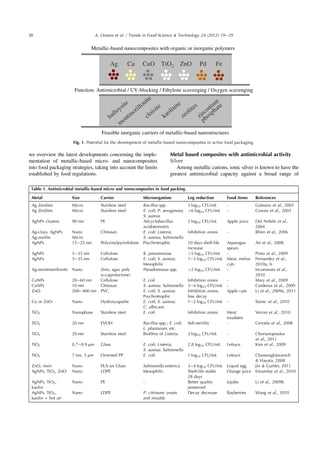
structured materials (Fig. 1) are being investigated and ex-
ploited in numerous applications (Table 1). In this article,
*
This article is not an official U.S. Food and Drug Administration
(FDA) guidance or policy statement. No official support or endorse-
ment by the U.S. FDA is intended or should be inferred.
* Corresponding author.
0924-2244/$ - see front matter Ó 2011 Elsevier Ltd. All rights reserved.
doi:10.1016/j.tifs.2011.10.001
Trends in Food Science  Technology 24 (2012) 19e29
we overview the latest developments concerning the imple-
mentation of metallic-based micro- and nanocomposites
into food packaging strategies, taking into account the limits
established by food regulations.
Metal based composites with antimicrobial activity
Silver
Among metallic cations, ionic silver is known to have the
greatest antimicrobial capacity against a broad range of
Fig. 1. Potential for the development of metallic-based nanocomposites in active food packaging.
Table 1. Antimicrobial metallic-based micro and nonocomposites in food packing.
Metal Size Carrier Microorganism Log reduction Food items References
Ag Zeolites Micro Stainless steel Bacillus spp. 3 log10 CFU/mL - Galeano et al., 2003
Ag Zeolites Micro Stainless steel E. coli; P. aeruginosa;
S. aureus
6 log10 CFU/mL - Cowan et al., 2003
AgNPs clusters 90 nm PE Alicyclobacillus
acidoterrestris
2 log10 CFU/mL Apple juice Del Nobile et al.,
2004
Ag-clays, AgNPs
Ag-zeolite
Nano
Micro
Chitosan E. coli; Listeria;
S. aureus; Salmonella
Inhibition zones - Rhim et al., 2006
AgNPs 15e25 nm Polyvinylpyrrolidone Psychrotrophic 10 days shelf-life
increase
Asparagus
spears
An et al., 2008
AgNPs 5e35 nm Cellulose K. pneumoniae 5 log10 CFU/mL - Pinto et al., 2009
AgNPs 5e35 nm Cellulose E. coli; S. aureus;
Mesophilic
1e3 log10 CFU/mL Meat, melon
cuts
Fernandez et al.,
2010a, b
Ag-montmorillonite Nano Zein, agar, poly
(ε-caprolactone)
Pseudomonas spp. 2 log10 CFU/mL - Incoronato et al.,
2010
CuNPs 20e60 nm Cellulose E. coli Inhibition zones - Mary et al., 2009
CuNPs 10 nm Chitosan S. aureus; Salmonella 3e4 log10 CFU/mL - Cardenas et al., 2009
ZnO 200e400 nm PVC E. coli; S. aureus;
Psychrotrophic
Inhibition zones,
low decay
Apple cuts Li et al., 2009a, 2011
Cu or ZnO Nano Hydroxyapatite E. coli; S. aureus;
C. albicans
1e2 log10 CFU/mL - Stanic et al., 2010
TiO2 Nanophase Stainless steel E. coli Inhibition zones Meat
exudates
Verran et al., 2010
TiO2 20 nm EVOH Bacillus spp.; E. coli;
L. plantarum, etc.
Self-sterility - Cerrada et al., 2008
TiO2 20 nm Stainless steel Biofilms of Listeria 3 log10 CFU/mL - Chorianopoulos
et al., 2011
TiO2 0.7e0.9 mm Glass E. coli; Listeria;
S. aureus; Salmonella
2.8 log10 CFU/mL Lettuce Kim et al., 2009
TiO2 7 nm, 5 mm Oriented PP E. coli 1 log10 CFU/mL Lettuce Chawengkijwanich
 Hayata, 2008
ZnO, nisin Nano PLA on Glass Salmonella enterica 3e4 log10 CFU/mL Liquid egg Jin  Gurtler, 2011
AgNPs, TiO2, ZnO Nano LDPE Mesophilic Shelf-life stable
28 days
Orange juice Emamifar et al., 2010
AgNPs, TiO2,
kaolin
Nano PE - Better quality
preserved
Jujube Li et al., 2009b
AgNPs, TiO2,
kaolin þ hot air
Nano LDPE P. citrinum; yeasts
and moulds
Decay decrease Bayberries Wang et al., 2010
20 A. Llorens et al. / Trends in Food Science  Technology 24 (2012) 19e29
Gramþ and GramÀ microorganisms; it has long-term biocide
properties and low volatility, but low toxicity to eukaryotic
cells. Furthermore, in recent years, silver has gained popular-
ity because of the spread of antibiotic resistant Staphylococcus
aureus strains (Deurenberg  Stobberingh,2008), being resis-
tance to silver considered sporadic with a low clinical inci-
dence (Chopra, 2007; Percival, Bowler,  Russell, 2005).
Consequently, the development of antimicrobial surfaces,
aseptic food containers, and active packaging systems based
on a sustainable release of Agþ
ions is seen as promising.
Low amounts of silver, around 50e100 mg Agþ
/kg
(Galeano, Korff,  Nicholson, 2003), are required to achieve
biocidal effects in low buffered systems or in water; but the
antimicrobial capacity of silver decreases rapidly in the pres-
ence of proteins, and about 10e100 mg Agþ
/kg are required
in realistic food applications (Fernandez, Picouet,  Lloret,
2010a). Standardization of methods to determine MIC values
in complex matrices remains a main problem; inconsistent
results may lead to wrong claims. Molecular basis of resis-
tance to silver have been documented (Silver, 2003), showing
particularly concerns associated to the overuse of silver which
should also be considered in technological applications.
Different mechanisms of action have been described for
ionic silver. Silver ions interact significantly with cytoplas-
matic components and nucleic acids, and alter the enzymatic
activities after chelation by the thiol groups of proteins (Holt
 Bard, 2005). They interact with the ribosomes, thus inhib-
iting the expression of enzymes, and interfere with the mem-
brane permeability. Low concentrations of silver ions induce
a massive proton leakage through the membrane and hinder
the respiratory chain and the mechanisms related to energy
production in the cell.
Generally, silver-based antimicrobial additives consist of
silver ions integrated into inert matrices such as ceramic,
glass, or zeolites (Matsumura, Yoshikata, Kunisaki, 
Tsuchido, 2003). Other additive types, silver salts or metal-
lic silver, may be incorporated into thermoplastic polymers,
such as polyethylene, polypropylene, polystyrene, butadi-
ene styrene, or nylon (Del Nobile et al., 2004).
Silver nanotechnology
The bioactivity of nano-sized silver particles (AgNPs) is an
area of growing scientific interest. Nano-sized elemental
particles with a diameter below 100 nm exhibit optical and
chemical properties that vary with particle size, shape, surface
functionalization, and boundary conditions. Metallic silver
nanoparticles interact with oxygen, boosting their antimicro-
bial activity when compared to the bulk solid or to silver
oxide. Henglein (1998) obtained partially oxidized silver
nanoparticles with chemisorbed Agþ
and demonstrated that
the oxidation state of silver atoms taking part of the AgNPs
is a key point to achieve antimicrobial properties. This was
confirmed by Lok et al. (2007). Zero-valence AgNPs did
not exhibit biological activity, but partially oxidized AgNPs
seemed to have antibacterial properties mediated only by
the silver ions chemisorbed in the surface of the AgNPs.
The antimicrobial activity of the AgNPs themselves was pos-
tulated by Sondi and Salopek-Sondi (2004) and the nanopar-
ticle shape was found relevant for the interaction with E. coli
membranes (Pal, Tak,  Song, 2007). The leakage of intracel-
lular materials due to the association of silver nanoparticles
with the membrane of Gram- E. coli bacteria was interpreted
from TEM imaging. Energy dispersion X-ray analysis pro-
vided evidence for the incorporation of AgNPs in the bacterial
membranes. The antimicrobial activity of the AgNPs is, how-
ever, a highly controversial subject, mainly due to the small
dimensions required to achieving antimicrobial activity, the
necessity of having an oxidized surface, and the subsequently
feasible exchange of silver ions. Regarding the size of AgNPs,
Morones et al. (2005) and Fernandez et al. (2009) confirmed
that optimal antimicrobial activity falls between 1 and 10 nm
of well distributed non-aggregated nanoparticles. Concerning
surface oxidation, especially oxygen availability and the
boundary conditions (pH and ionic strength) need to be con-
sidered (Henglein, 1998), which is expected to lead to the sus-
tained release of silver ions. Antimicrobial activity in food
contact applications could be consequently achieved without
silver nanoparticle migration, acting polymeric matrices as
carriers of silver nanoreservoirs.
A number of methods have been developed to synthesize
non-agglomerated-regular in shape AgNPs. Those include
the use of polymeric matrices as carriers of antimicrobials,
biological macromolecules, mesoporous inorganic materials,
and hydrogels (Mohan, Lee, Premkumar,  Geckeler, 2007).
Silver nanoparticles are synthesised by the reduction of
silver ions from a silver containing salt, being silver nitrate
the most frequently used. Reducing agents are physical
(mainly heat or UV radiation), chemical (borohydride, D-glu-
cose, L-ascorbic acid, lactic acid, etc.), or mixed (hydrother-
mal). In addition, nano-sized metal particles (silver, copper,
gold) are produced from appropriate salts (silver nitrate, cop-
per sulphate, gold nitrate) in the cultivars of different types
of microorganisms, such as bacteria, fungi, or algae. The
nano-sized silver particles may enhance, for example, the
biological activity of antifungal molecules, such as flucona-
zole (Gajbhiye, Kesharwani, Ingle, Gade,  Rai, 2009).
Nano-sized silver particles are being immobilized in food
packaging polymers intended for food packaging applica-
tions. Biobased polymers, and those coming from renewable
sources, are being used as carriers of silver nanoparticles. Bi-
obased polymers are sensitive to humidity and strongly
plasticized due to water sorption, which induces the uncon-
trolled release of immobilized active substances; however sur-
face oxidation due to contact with oxygen and the ionic
exchange are mandatory to achieve the release of metal ions
trapped in nanoparticles. Consequently, the high water sorp-
tion created by the hydrophilic nature of biobased matrices,
promotes the antimicrobial activity of the AgNPs. Chitosan,
a polycationic biopolymer derived from chitin by alkaline
deacetylation, has been proposed in several studies as carrier
polymer or as reducing agent. Most of the studies suggest
methods with direct applicability in the textile industry,
21A. Llorens et al. / Trends in Food Science  Technology 24 (2012) 19e29
biomedical materials and devices, or in tissue engineering. A
few authors have explored the potentiality for technological
applications related to food science. Rhim, Hong, Park, and
Ng (2006) demonstrated the effectiveness of chitosan-based
nanocomposites containing silver nanoparticles against
E. coli, S. aureus and Listeria monocytogenes. Sanpui,
Murugadoss, Prasad, Ghosh, and Chattopadhyay (2008) uti-
lized chitosan as stabilizer and reducing agent, and generated
antimicrobial silver/chitosan nanocomposites. Another study
showed the reduction of silver atoms from silver nitrate in
an aqueous chitosan acetic acid solution by 35 kGy gamma ir-
radiation producing 20e25 nm nanoparticles (Yoksan 
Chirachanchai, 2010), which were incorporated in rice starch
to produce a silver based antimicrobial chitosan/starch film.
These silver loaded chitosan matrices were effective in the in-
hibition of the growth of Gramþ and Gram- microorganisms,
and were suggested as components of food packaging poly-
mers. Ali, Rajendran, and Joshi (2011) also generated
165 nm chitosan-silver nanoparticles by ionic gelation with
tripoliphosphate, and after the subsequent loading with silver
ions, they showed antimicrobial activity against S. aureus.
In addition, other food contact polymers and some typical
GRAS (Generally Recognized as Safe) hydrogels have been
suggested as carriers of silver nanoparticles. This is the case
for highly swelling hydrogels of silver/collagen or silver/al-
ginate, which produced inhibition zones in contact with mi-
croorganisms. Their effectiveness is, however, limited in
biomedical applications due to chelation (Cavanagh,
Burrell,  Ndworny, 2010). Cellulose acetate phthalate films
filled with nano-sized silver particles showed antimicrobial
properties against E. coli and S. aureus (Necula et al.,
2010), and electrospun nanofibres of cellulose acetate con-
taining 20 nm silver nanoparticles showed strong antimicro-
bial activity (Son, Youk,  Park, 2006).
Taking into account aspects relevant for food safety, Del
Nobile et al. (2004) focused on the antimicrobial activity of
a silver-containing polyethyleneoxide-like coating on a poly-
ethylene layer. The 90 nm size plasma deposited silver
clusters showed high bactericide capacity against Alicycloba-
cillus acidoterrestris, and the material prolonged the shelf-life
of apple juice. An, Zhang, Wang, and Tang (2008) were also
able to lengthen the shelf-life of asparagus by about 10 days at
2 
C, when the product was coated with chemically reduced
silver nanoparticles dispersed in polyvinylpyrrolidone; the
nanoparticles were on average 15e25 nm. Nanocomposites
of low density polyethylene filled with a powder containing
95% titanium oxide doping 5% metal-nanosilver (10 nm)
were useful to extend the shelf-life of orange juice during
28 days, without impairing juice relevant quality attributes,
such as colour or ascorbic acid content (Emamifar, Kadivar,
Shahedi,  Soleimanian-Zad, 2010). And Li, Li et al.
(2009) evaluated the capacity of a blend of polyethylene
with a powder containing nano-Ag, nano TiO2 and kaolin
on the shelf-life of Chinese jujube, finding positive effects
on the physicochemical parameters and the sensory quality
of the product.
The porous structure of cellulose has been proposed as
nanoreactor to help in the formation of AgNPs of a regular
shape. Pinto et al. (2009) and Fernandez et al. (2009) stud-
ied different silver loaded cellulose materials. Silver loaded
fluff pulp cellulose, bacterial cellulose, and EFTecÔ nano-
structured cellulose (Engineered Fibres Technology, Shel-
ton, USA) showed differential properties, but a reasonably
good antimicrobial activity against Klebsiella pneumoniae,
E. coli, S. aureus and spore forming B. subtilis in protein
rich cultivation media. A concentration of 60 mg Agþ
/kg
was necessary to reduce the microbial load 1 log10 CFU/
mL in absorbent pads in contact with beef meat. Natural
chelating agents in food matrices, especially proteins, coun-
teract the antimicrobial power of silver ions. This strongly
limits the feasibility of this promising technology in food
contact applications. In contrast, a higher antimicrobial
activity may be expected in the presence of juices with
low protein content, such as vegetable or fruit juices
(Fernandez, Picouet,  Lloret, 2010b).
Silver exchanged inorganic materials
Silver and zinc ions have been trapped in zeolite type
microporous inorganic ceramics, and their use has ex-
panded the applications of silver in diverse fields. Alkaline
or alkaline earth metal ions complexed with aluminosili-
cates are partially replaced with silver or zinc ions by ionic
exchange mechanisms. The silver exchanged zeolites have
shown antimicrobial activity mediated by the release of sil-
ver ions. In addition, inorganic clays have been postulated
as carriers of silver ions or silver nanoparticles. The platelet
clays swell in water and generate a stable network that in-
teracts and stabilizes the exchanged Agþ
ions. Oya, Banse,
Ohashi, and Otani (1991) confirmed the antimicrobial prop-
erties of silver exchanged montmorillonite.
Silver-substituted zeolites are the most common antimi-
crobials incorporated into diverse food contact polymers in
Japan, and Sinanen Zeomic Co. zeolites can be kneaded to
numerous resins. In the USA, zeolite based technologies
are listed under the FDA Food Contact Substance Notifica-
tion for use in all types of food-contact polymers (FDA,
2007). The European Food Safety Agency released a positive
opinion in 2005 concerning the use of two zeolites contain-
ing Agþ
ions in food contact surfaces. In Europe, silver mi-
gration into food matrices is, however, highly restricted since
only 50 mg Agþ
/kg of food is authorized. Companies willing
to commercialize food contact polymers, are required to
prove that silver containing materials do not have any effect
on food shelf-life.
The bactericidal action of the silver zeolites is affected by
inorganic salts and ion chelators, and seems to follow mech-
anisms similar to the action of silver nitrate. The bactericidal
effect seems to be related to the transfer of the Agþ
ions to
the cell, and the generation of reactive oxygen species. In
a similar view, and although the main antimicrobial activity
is probably due to silver release, zinc ions are believed to
reinforce the antimicrobial activity of silver by interfering
22 A. Llorens et al. / Trends in Food Science  Technology 24 (2012) 19e29
with proton transfer and inhibiting nutrient uptake (Galeano
et al., 2003). Silver-zinc zeolites are already being widely
used in diverse applications, such as the decontamination
of surfaces in industrial environments, the disinfection of
medical devices, and for food preservation purposes. For ex-
ample, Cowan, Abshire, Houk, and Evans (2003) demon-
strated the effectiveness of those silver zeolites coating on
stainless steel surfaces against bacteria typically implied in
foodborne illnesses. Relatively high concentrations of zeo-
lite were required, up to 3.13 mg/mL, and a silver concentra-
tion up to 39 mg/mL to eliminate fully Pseudomonas
aeruginosa, E. coli, and S. aureus. Remarkably, P. aerugi-
nosa was resistant to many antimicrobials, but sensitive to
silver exchanged zeolites, present as powders or coatings.
Silver-doped zeolites have also been incorporated in poly-
mers for use in food packaging (Fernandez, Soriano,
Hernandez-Mu~noz,  Gavara, 2010; Kamis¸oglu, Aksoy,
Hasirci,  Bac, 2008; Pehlivan, Balk€ose, €Ulku, ,
Tihminliolu, 2005). These silver-doped zeolites, in most
cases, have shown an increase in polymer crystallinity, low ef-
fects upon mechanical properties, and low rate polymer deg-
radation for the low silver concentrations. However, some
interface incompatibility may cause defects in the distribution
of the zeolites into polypropylene or in polylactic acid. Poly-
urethane composites (Hiyama et al., 1995), polyethylene
(Kamis¸oglu et al., 2008), and polylactide (Fernandez,
Soriano et al., 2010) with silver-doped zeolites showed anti-
microbial activity against E. coli and S. aureus. In those mate-
rials, the migration of silver ions was sensitive to the
processing methodology, such as the ionic strength and the
ion concentration. Chitosan composites with zeolites silver-
doped (Rhim et al., 2006) showed antimicrobial properties
against E. coli., but also showed an increase in mechanical
and water vapour barrier properties due to the filler.
In natural montmorillonites, sodium cations were replaced
by Agþ
from silver nitrate, forming antimicrobial nanocom-
posites (Incoronato, Buonocore, Conte, Lavorgna,  Del
Nobile, 2010). Those silver/clay nanoparticles were embed-
ded in biobased hydrogels such as agar, zein, and
poly(epsilon-caprolactone). Zein was the polymer matrix
showing lower water sorption and lower antimicrobial activity
against Pseudomonas spp. On the other hand, the best antimi-
crobial activity was obtained with agar due to ionic exchange
favoured by the high water sorption. Incoronato, Conte,
Buonocore and Del Nobile (2011) showed the effectiveness
of the agar/silver montmorillonite nanoparticles to prolong
the shelf-life in Fior di Latte cheese. In a similar study,
Busolo, Fernandez, Ocio, and Lagaron (2010) reported the
limited ionic exchange and the subsequent low silver release
from polylactic acid nanocomposites containing a silver ex-
changed montmorillonite, thus confirming the results of
Fernandez, Soriano et al. (2010) with a silver zeolite in the
same matrix. Recently, halloysite and kaolinite were also
attached to polymethacrylic acid (PMA) silver-capped nano-
particles via an electrostatic interaction. The results showed
high molecular weight compounds adsorbed on the clay
platelets surface, with typical layer-by-layer assembly mor-
phology (Burridge, Johnston,  Borrmann, 2011).
Copper
Copper is an essential element and is present in most food
in the form of ions or salts at levels, in most cases, below 2 mg
Cu2þ
/kg (meat, fish, pecans, green vegetables, etc.), but up to
39 mg Cu2þ
/kg in cocoa and liver (Aaseth  Norseth, 1986).
At low concentrations copper is a cofactor for metalloproteins
and enzymes, and it also shows remarkable antimicrobial
properties. In this context, in February 2008 the U.S. Environ-
mental Protection Agency (EPA) approved the registration of
copper alloys based on the claim that they reduce bacteria
linked to potentially fatal microbial infections, and confirmed
the antimicrobial efficacy of copper against E. coli O157:H7,
S. aureus, Enterobacter aerogenes and P. aeruginosa (http://
www.epa.gov/pesticides/factsheets/copper-alloy-products.
htm, consulted 03.05.2011).
Although copper is typically applied to keep uncontami-
nated medical devices, and surfaces free of contaminant mi-
croorganisms, direct applications in food safety have also
been reported for copper salts. Copper cast alloys were eval-
uated in food processing work surfaces and diminished the
risks associated to E. coli O157:H7, although the presence
of beef residues was a limiting factor for the achieved growth
inhibition (Noyce, Michels,  Keevil, 2006). The growth of
Salmonella, E. coli O157:H7 and Cronobacter spp.could be
impaired by subletal concentrations of copper (II) ions
(50 mg/kg) combined with other antimicrobials, such as lac-
tic acid, in infant formula (Al-Holy, Castro,  Al-Quadiri,
2010) and carrot juice (Ibrahim, Yang,  Seo, 2008).
Compared to silver, the potential biocidal activity of cop-
per is lower (about 10 mg Cu2þ
/kg in water is necessary to
kill 106
cells of Saccharomyces cerevisiae). However copper
ions can be easily mobilized due to oxidation. Antimicrobial
nanoparticles (CuNPs) of elementary copper or copper oxide
can be generated by different procedures. Elementary copper
nanoparticles can be formed under thermal or sonochemical
reduction from copper hydrazine carboxylate complexes in
aqueous media (Dhas, Raj,  Gedanken, 1998). Reduction
with borohydride mainly produces copper oxide
(Kotelnikova, Vainio, Pirkkalainen,  Seriman, 2007), which
can be easily oxidized to provide antimicrobial activity in am-
monia containing media. The ion copper utility has been ex-
ploited in different nanocomposites. Copper has been
embedded, for example, in high-pressure polyethylene
(Ushakov, Ul’zutuev,  Kosobudskii, 2008). In addition, var-
ious biobased polymers have been used as carriers of antimi-
crobial copper. Cotton fabrics have been impregnated with
nano-sized copper particles as colloidal solution
(Chattopadhyay  Patel, 2010). Colloidal copper nanopar-
ticles were also regularly distributed in chitosan films in-
tended for food packaging applications (Cardenas, Diaz,
Melendrez, Cruzat,  Garcia Cancino, 2009). And copper
nanoparticles were immobilized on chitosan covalently at-
tached to cellulose fibres after reduction with borohydride
23A. Llorens et al. / Trends in Food Science  Technology 24 (2012) 19e29
(Mary, Bajpai,  Chand, 2009). The nanoparticles were effec-
tive against E. coli in wound dressings, and could be useful for
preserving hygienic conditions in food retail packaging and
display cases.
Zinc oxide
Zinc is a ubiquitous trace metal and essential for a large
number of metalloenzymes. Nano-sized ZnO particles pres-
ent biocidal activity and have some advantages compared to
AgNPs, such as their lower cost, white appearance and UV-
blocking properties (Dastjerdi  Montazer, 2010). They also
present high versatility, and inorganic carriers, such as hy-
droxyapatite, can also be doped with zinc oxide providing
novel structures with antimicrobial activity against E. coli,
S. aureus, and Candida albicans (Stanic et al., 2010).
The feasibility of ZnO incorporated in polymer nanocom-
posites intended for food packaging has been tested. For in-
stance, Li, Xing, Jiang, Ding, and Li (2009) coated poly
(vinyl chloride) films with zinc oxide nanoparticles, and re-
ported antimicrobial activities against E. coli and S. aureus.
In a more recent work, Li et al. (2011) verified also the poten-
tial of the nano-packaging containing ZnO nanoparticles dur-
ing the storage of Fuji apple cuts, observing a better
preservation of quality indicators such as ascorbic acid and
polyphenol content, and lower counts of typical altering
microorganisms. Emamifar et al. (2010) reported on the anti-
microbial activity of nanocomposites of low density polyeth-
ylene (LDPE) containing AgNPs and ZnO, showing
a significant impact of the proposed nano-packaging on the
shelf-life of orange juice. Additionally, combinations of allyl
isothiocyanate, nisin and zinc oxide nanoparticles coated on
glass jars were able to inactivate effectively Salmonella in liq-
uid egg albumen (Jin  Gurtler, 2011).
Titanium dioxide
Titanium oxide has been positively evaluated as a food
additive (Directive 94/36/EC, 1994). Nano-sized TiO2 parti-
cles show photocatalytic properties, being useful as self-
cleaning and antibacterial agents and against UV light
(Nordman  Berlin, 1986). The photocatalytic activity of
TiO2 is strongly related to the crystal structure, which is re-
lated to the characteristic band gap. Titanium dioxide can be
found in three different forms (rutile or anatase, tetragonal,
and brookite, orthorhombic), with different reactivity de-
pending on their characteristic band gap. Titanium dioxide
irradiation at higher energies than the band gap induces
the formation of electronehole pairs, giving rise to redox re-
actions. Negative electrons generate O2-
, and positive electric
holes generate hydroxyl radicals. Reactive oxygen species
oxidize organic molecules, and kill bacteria and viruses.
Nano-sized TiO2 particles are produced following different
methodologies with sol-gel processing the most commonly
used (Ibrahim  Sreekantan, 2011). TiO2 nanoparticles
(anatase or rutile) have also been attached to cellulose
(Daoud, Xin,  Zhang, 2005). TiO2 nanotubes can be formed
hydrothermally at 180 
C, heating titanium oxide with NaOH.
The best antimicrobial activity results are achieved in the pres-
ence of UVA light or black-light bulbs (Chorianopoulos,
Tsoukleris, Panagou, Falaras,  Nychas, 2011).
TiO2 photocatalytic activity has been found particularly
useful to decontaminate water, also wash water, used for
cleaning minimally processed products (Chaleshtori,
Masud,  Saupe, 2008). In food processing, one of the
most promising applications of nano-sized titanium dioxide
particles as antimicrobial is to diminish the risks associated
to biofilms in food contact surfaces (eg.: biofilms of L. mono-
cytogenes, Chorianopoulos et al., 2011), or to improve clean-
ability of stainless steel (Verran, Packer, Kelly,  Whitehead,
2010). The biocide capacity of TiO2 nanocomposites with
typical packaging materials has also been tested. For exam-
ple, EVOH (copolymer of ethylene and vinyl alcohol)-TiO2
nanomaterials with 2e5% TiO2 were acceptably well dis-
persed and adhered, and mechanical properties were en-
hanced. They were efficient against Gramþ and GramÀ
microorganisms, and kept self-sterility (Cerrada et al.,
2008). TiO2 nanotubes filling chitosan produced UV-
blocking semitransparent films (Diaz-Visurraga, Melendrez,
Garcia, Paulraj,  Cardenas, 2010); without UV-excitation,
discrete bactericidal activity against E. coli, S. enterica and
S. aureus was reported, being more effective against Gram-
microorganisms.
At least two studies have reported the potential of TiO2 to
reduce the risks associated to the surface of solid food prod-
ucts. TiO2 coating quartz glass in a UV-reactor with 5 lamps
emitting at 254 nm, was effective in enhancing the antimi-
crobial activity of the UV light, with a remarkable decrease
up to 2.8 log10 CFU/g in E. coli, L. monocytogenes, S. aureus
and S. typhimurium in inoculated iceberg lettuce (Kim et al.,
2009). Also TiO2 coated polypropylene films illuminated
with UV light sources, were effective in decreasing the
counts of E. coli in in intro experiments up to
3 log10 CFU/g, but also during the storage of lettuce a reduc-
tion over 1 log10 CFU/g was observed (Chawengkijwanich
 Hayata, 2008).
Scavenging of low molecular weight molecules
Ethylene is a plant growth regulator and plays a key role in
physiological processes and during postharvest. Controlling
the presence of ethylene in packages and storage environ-
ments could lengthen the shelf-life of a large amount of fresh
products. Stoichiometric oxidizing systems based on potas-
sium permanganate are typically used to control the amount
of ethylene in closed environments. Novel palladium-
promoted materials with a relevant ethylene adsorption capac-
ity have also been tested, and present certain advantages at
high temperatures and relative humidity. Charcoal loaded
with palladium chloride has been proposed to oxidize ethyl-
ene to acetaldehyde (Fujimoto, Takeda,  Kunugi, 1974), de-
celerating the maturation rate of climacteric fruits. Palladium
doped zeolites have provided good ethylene adsorption capac-
ity (4162 ml gÀ1
material), being superior to potassium per-
manganate at high relative humidity (Terry et al., 2007).
24 A. Llorens et al. / Trends in Food Science  Technology 24 (2012) 19e29
Photoactive titanium dioxide can oxidize ethylene to H2O
and CO2. Nano-silver has also been postulated as an ethylene
blocker in several works (Hu  Fu, 2003; Fernandez et al.,
2010b). In particular, Li, Li et al. (2009) reported on the rip-
ening of Chinese jujube packed in a blend of polyethylene
with nano-Ag, kaolin, anatase TiO2 and rutile TiO2
(300e500 nm), observing a decrease in fruit softening, weight
loss, browning, and climacteric evolution. The typical content
of soluble solids and malondialdehyde was also positively af-
fected by the presence of the nanocomposites, due to the de-
celeration in the rate of ethylene production. Blends of
LDPE with a similar powder have shown excellent
performances to decelerate the decay rate of strawberries
(Yang et al., 2010). Wang et al. (2010) confirmed that
a nano-packaging containing Ag and TiO2 (with a hot air treat-
ment) was efficient in improving green mould control and
ethylene production in Chinese bayberries.
Food packaging polymers offer tailored properties at
reasonable costs, but the permeability to low molecular
weight substances, and water and organic vapours is one
of their main limiting factors. Oxygen can trigger or accel-
erate oxidation and also facilitate the growth of aerobic mi-
croorganisms, lowering food quality, and shortening the
shelf-life. Strategies leading to increasing the gas barrier
properties include the use of active oxygen scavengers in
the packaging in sachets, labels, or included in the polymer
layers, or as passive nanocomposites offering a delay in the
oxygen transport due to an increased tortuosity in the oxy-
gen pathway (Brody, Bugusu, Han, Sand,  McHugh,
2008). Active iron-based oxygen scavengers are usually
isolated from the food items in separate devices, and are
typically attached to zeolites. Other products have been
marketed in the form of pellets containing iron powders
blended with resins, mainly of LDPE (Galotto, Anfossi,
 Guarda, 2009). Alternatives to iron are also being inves-
tigated, for example, Yu et al. (2004) reinforced thermo-
plastic polymeric matrices, as PP, LDPE, PET and nylon
6,6 with 1 wt-% palladium or platinum. Those Pd and Pt
nanoparticles provided remarkable oxygen scavenging
properties, which may be of interest in future food packag-
ing applications.
Characterization and quantification of metallic-based
nanomaterials
Nano-sized particles need to be characterized in terms of
various parameters, such as, size, chemical composition, dis-
tribution, shape, and agglomeration grade. Transmission
electron microscopy (TEM) is one of the more popular tools
to study nanoparticles. It is capable of a resolution at 0.1 nm
(high resolution TEM), and provides 2 Dimension informa-
tion about nanoparticles dispersion, structure, and shape.
Scanning electron microscopy (SEM) has a lower resolution
than TEM, but provides surface information. For a chemical
analysis, optional tools incorporated in TEM/SEM micro-
scopes, such as the energy dispersive X-ray analysis, provide
localization of elements in a semi quantitative manner.
SEM equipment with detectors capable of operating at
usual high vacuum, or at low vacuum (w2 Torr) are useful
for testing biological samples. Additionally, atomic force mi-
croscopy (AFM) provides 3D surface images of liquid or solid
samples in contact or tapping modes with high resolution, ap-
prox. 0.5 nm, being tip dimension the limiting factor. Simi-
larly, the scanning tunnelling microscopy (STM) also
provides images with resolutions up to 1 nm or better.
Spectroscopic techniques are also available for nanopar-
ticle analysis and characterization. Static light scattering and
multiangle light scattering (MALL), Photo correlation spec-
troscopy (PCS) or dynamic light scattering (DLS) are reliable
tools to determine the size and aggregation in solution or dis-
persions, with limitations concerning the interference with
other particles. Photon cross correlation spectroscopy
(PCCS) is a novel technique to measure particle size and sta-
bility simultaneously from 1 nm to 10 mm, by performing 3D
cross correlations. However, sample preparation requires high
dilutions to avoid multiple scattering. Small angle X- ray scat-
tering (SAXS) is also useful for solid or liquid samples.
Metallic nanoparticles, quantum dots, cadmium sulphur, and
lead sulphur are also characterized using surface plasmon res-
onant band (metal) or band gap (semiconductors).
Laser techniques are used in solid or liquid samples.
UVeVis or fluorescence spectroscopy are good tools for
characterization. Nanoparticles surface area can be analyzed
by Brunauer-Emmet-Teller (BET), which determines the
specific surface area of nanoparticles by gas absorption.
Zeta potential, liquid chromatography, nuclear magnetic res-
onance (NMR), and other instrumentations can also be used.
The ideal methodologies to characterize nanoparticle
size, shape, distribution, and agglomeration state are mi-
croscopy techniques. In fact EFSA (2011) recommends
the size parameter to be measured by two independent tech-
nologies, being one of them electron microscopy. However,
in complex matrices, additional fractionation steps and
a combination of methods for detection and characteriza-
tion could be required. This is particularly relevant for
metallic-based nanomaterials since they require reactive
surfaces to achieve their functionality, and therefore will
strongly interact with proteins and other food components.
Quantification of migrated ions takes place mainly with
inductively coupled plasma mass spectrometry (ICP-MS)
and X-ray fluorescence (XRF). Some ICP instruments are
equipped with UV laser ablation or with HPLC, where tradi-
tional HPLC columns can be used. XRF is a non-destructive
analysis, and samples can be solid, powder, or liquid; making
sample preparation fast and easy. Sample concentration is
not a limiting factor. The detection limit is typically
0.1e10 ppm. Results are highly dependent on the matrix
complexity for both techniques.
Toxicological and regulatory aspects
Metals and metal alloys are traditionally used as food
contact materials in household utensils, processing equip-
ment containers, cans, and wrapping foils. Traditionally
25A. Llorens et al. / Trends in Food Science  Technology 24 (2012) 19e29
they play a passive role, isolating food from the environ-
ment. Metals are typically separated by epoxy can coatings
or polymer layers to control the migration of undesired
metals ions. In Europe the Draft Guidelines for Metals
and Alloys and Alloys prepared by RD 4/1-48 (Revision
of Guidelines Dated 13.02.2002), has revised main uses
and considerations concerning food contact.
However the problem arising from the use of metals in
food contact surfaces depends on the quantity of ions able
to migrate into the food matrix. An intentional migration of
the active element in the food matrix would fall under Frame-
work Regulation 1935/2004 (http://www.efsa.europa.eu/en/
ceftopics/topic/foodcontactmaterials.htm, consulted on the
05.04.2011) for active packaging materials. But some arti-
cles, such as plastics, recycled plastics, active and intelligent
materials fall within more specific regulations. Commission
Regulation (EC) No 4502/2009 (2009) related to active and
intelligent packaging points out that the active element needs
to be identified, and the active material has to be accompa-
nied by information on the permitted uses, also the maximum
quantity of substances released by the active component
should be specified. Concerning the use of nanoparticles, leg-
islation is not yet fully developed. When nanoparticles come
in contact with food, indirect contamination can also be ex-
pected if those nanoparticles migrate. Guidance on the risk
assessment of nanomaterials has been provided by the
EFSA on the potential risks arising from nanoscience and
nanotechnologies (EFSA, 2011). That document details re-
quirements for the identification, detection and characteriza-
tion of nanomaterials. In vitro and in vivo toxicity studies
are recommended if it cannot be demonstrated that the nano-
material does not persist after formulation, that it does not
migrate, that it is not transformed before ingestion, or that
it is not transformed during digestion. The importance of
the legislation concerning the use of metal based nanomate-
rials is reinforced by scientific data. In a recent work,
Benn, Cavanagh, Hristovski, Posner, and Westerhoff (2010)
recorded information on the migration of silver nanoparticles
and quantified the migration of silver ions in consumer goods,
finding that silver ions and nanoparticles migrate at levels that
approximate the expected toxicity in some goods. Such works
are nowadays highly recommended to estimate the potential
risks for the humans and the environment.
EU safety regulations (EFSA, 2005) mention, in particular,
that silver zeolites in food contact applications should not be
used to extend shelf-life, and the presence of silver ions in
food matrices is strongly limited to 50 mg Agþ
/kg food, which
is not biocide in food. In the US, the FDA approved the use of
silverasanantimicrobialinbottledwater,withaconcentration
not exceeding 17 mg Agþ
/kg (x 172.167, FDA Food Additive
Regulations, 2009). Less restrictive is the use of titanium di-
oxide as a colour additive in confectionary, dairy products,
and soft drinks, which has been approved by code E171 under
Directive 94/36/EC (1994).
Although silver nanoparticles are believed to present low
toxicity for eukaryotic cells, several studies report on non-
negligible effects on organisms and the environment. Remark-
ably, some in vitro studies suggest severe effects of AgNPs on
mammalian cells, such as cytotoxicity, chromosome instabil-
ity, oxidative stress, apoptosis, and interference with DNA
replication fidelity (Yang et al., 2009). Cytotoxicity and gen-
otoxicity has also been reported in fish cells due to silver nano-
particles accumulating in the gill tissue. Also, adverse effects
on embryonic development of oysters and in zebrafish have
been reported (Choi et al., 2010). Oxidative stress, heat shock
stress, DNA damage and apoptosis were induced by AgNPs in
Drosophila melanogaster (Ahamed et al., 2010). Similar ef-
fects have been investigated in nano-TiO2, showing an intra-
cellular accumulation of reactive oxygen species leading to
apoptosis in PC12 cells (Liu, Xu, Zhang, Ren,  Yang,
2010). More studies are still necessary, but evidences point
out for potential risks associated to this new type of materials.
Summary, outlook and future needs
Trace amounts of silver are particularly effective as de-
contaminating agent in water and in low buffered media.
Several studies have shown the utility of coatings containing
silver to prevent biofilm formation in different food-contact
surfaces and several silver-based technologies have been ap-
proved in plastics for food contact applications. They are be-
ing used in aseptic surfaces with different applications, such
as cutting boards, knifes, refrigerators, water filters, liquid
soaps, working surfaces, and reusable food packaging. Silver
is currently the most commonly used nano-engineered
antimicrobial material in consumer goods. For instance, the
database http://www.nanotechproject.org/inventories/silver/
(consulted 05.04.2011) includes approximately 240 silver-
based marketed products, 23 in the category “Food and Bev-
erages”. Commercial trademarks of materials with ex-
changed silver ions available to be incorporated in
polymeric matrices are recorded in Table 2. In addition, re-
cent works have proven that metal nanoparticles act as a sta-
ble nanoreservoir of metal ions which could also provide
diverse properties, such as antimicrobial or oxygen scaveng-
ing activity. Titanium oxide is also frequently used as addi-
tive to edible inks, toothpastes, and pharmaceuticals.
The development of novel metallic-based micro and nano-
composites containing metal loaded inorganic materials or
metal nanoparticles is therefore providing advanced
Table 2. Trademarks of silver modified inorganic carriers and resins.
Fillers Characteristics
AlphasanÒ
Zirconium phosphate-based ceramic
ion-exchange resin
AgionÒ
Silver zinc zeolite
ApaciderÒ
Silver exchanged zeolite
BactekillerÒ
Silver copper zeolite
BactiblockÒ
Silver exchanged montmorillonite
NanogradeÒ
Silver doped calcium phosphate additives
NovaronÒ
Silver on inorganic ion exchanger
ZeomicÒ
Silver zinc zeolite
26 A. Llorens et al. / Trends in Food Science  Technology 24 (2012) 19e29
properties for tailored applications which are being explored
also in food contact and active foodpackaging. However, prior
to industrial implementation, regulations need to be consider-
ing the potential risks associated to the nano-dimension and
the potential migration of metal ions into foods or drinks.
Acknowledgements
Authors thank the Spanish Comision Interministerial de
Ciencia y Tecnologıa (Ministerio de Ciencia e Innovacion)
for financial support under contract AGL07-65936-C02.
A. Llorens thanks the Generalitat Valenciana for a contract
G Forteza FPA2010/075.
References
Aaseth, J.,  Norseth, T. (1986). Handbook on the toxicology of
metals, (2nd ed.). Amsterdam: Elsevier.
Ahamed, M., Posgai, R., Gorey, T. J., Nielsen, M., Hussain, S. M., 
Rowe, J. J. (2010). Silver nanoparticles induced heat shock protein
70 oxidative stress and apoptosis in Drosophila melanogaster.
Toxicology and Applied Pharmacology, 242, 263e269.
Ali, S. W., Rajendran, S.,  Joshi, M. (2011). Synthesis and
characterization of chitosan and silver loaded chitosan nanoparticles
for bioactive polyester. Carbohydrate Polymers, 83, 438e446.
Al-Holy, M. A., Castro, L. F.,  Al-Quadiri, H. M. (2010). Inactivation
of Cronobacter spp. (Enterobacter sakazakii) in infant formula
using lactic acid, copper sulfate and monolaurin. Letters in
Applied Microbiology, 50, 246e251.
An, J., Zhang, M., Wang, S.,  Tang, J. (2008). Physical, chemical and
microbiological changes in stored green asparagus spears as
affected by coating of silver nanoparticles-PVP. LWT - Food
Science and Technology, 41, 1000e1007.
Appendini, P.,  Hotchkiss, J. H. (2002). Review of antimicrobial food
packaging. Innovative Food Science and Emerging Technologies,
3, 113e126.
Benn, T., Cavanagh, B., Hristovski, K., Posner, J. D.,  Westerhoff, P.
(2010). The release of nanosilver from consumer products used in
the home. Journal Environmental Quality, 39, 1875e1882.
Brody, A. L., Bugusu, B., Han, J. H., Sand, C. K.,  McHugh, T. H.
(2008). Innovative food packaging solutions. Journal of Food
Science, 73, 107e116.
Burridge, K., Johnston, J.,  Borrmann, T. (2011). Silver nanoparticle-
clay composites. Journal of Materials Chemistry, 21, 734e742.
Busolo, M. A., Fernandez, P., Ocio, M. J.,  Lagaron, J. M. (2010).
Novel-silver based nanoclay as an antimicrobial i polylactic acidd
food packaging coatings. Food Additives and Contaminants, 27,
1617e1626.
Cardenas, G., Diaz, J., Melendrez, M. F., Cruzat, C.,  Garcia
Cancino, A. (2009). Colloidal Cu nanoparticles/chitosan
composite film obtained by microwave heating for food package
applications. Polymer Bulletin, 62, 511e524.
Cavanagh, M. H., Burrell, R. E.,  Ndworny, P. L. (2010). Evaluating
antimicrobial efficacy of new commercially available silver
dressings. International Wound Journal, 7, 394e405.
Chaleshtori, M. Z., Masud, S. M. S.,  Saupe, G. B. (2008). Using new
porous nanocomposites for photocatalytic water decontamination.
Materials Research Society Symposium Proceedings, 1145,
75e80.
Cerrada, M. L., Serrano, C., Sanchez-Chaves, M., Fernandez-
Garcia, M., Fernandez-Martin, F., De Andres, A., et al. (2008).
Self-sterilized EVOH-TiO2 nanocomposites: interface effects on
biocidal properties. Advanced Functional Materials, 18,
1949e1960.
Chattopadhyay, D. P.,  Patel, B. H. (2010). Effect of nanosized
colloidal copper on cotton fabric. Journal of Engineered Fibers and
Fabrics, 5, 1e6.
Chawengkijwanich, C.,  Hayata, Y. (2008). Development of TiO2
powder-coated food packaging film and its ability to inactivate
Escherichia coli in vitro and in actual tests. International Journal of
Food Microbiology, 123, 288e292.
Choi, J. E., Kim, S., Ahn, J. H., Youn, P., Kang, J. S., Park, K., et al.
(2010). Induction of oxidative stress and apoptosis by silver
nanoparticles in the liver of adult zebrafish. Aquatic Toxicology,
100, 151e159.
Chopra, I. (2007). The increasing of silver-based products as
antimicrobial agents: a useful development or a cause for concern?
Journal of Antimicrobial Chemotherapy, 59, 587e590.
Chorianopoulos, N. G., Tsoukleris, D. S., Panagou, E. Z., Falaras, P., 
Nychas, G.-J. E. (2011). Use of titanium dioxide (TiO2) photocatalysts
as alternative means for Listeria monocytogenes biofilm disinfection
in food processing. Food Microbiology, 28, 164e170.
Cowan, M., Abshire, K. Z., Houk, S. L.,  Evans, S. M. (2003).
Antimicrobial efficacy of a silver-zeolite matrix coating on
stainless steel. Journal of Industrial Microbiogy and
Biotechnology, 30, 102e106.
Daoud, W. A., Xin, J. H.,  Zhang, Y.-H. (2005). Surface
functionalization of cellulose fibers with titanium dioxide
nanoparticles and their combined bactericidal activities. Surface
Science, 599, 69e75.
Dastjerdi, R.,  Montazer, M. (2010). A review on the application of
inorganic nano-structured materials in the modification of textiles:
focus on anti-microbial properties. Colloids and Surfaces B:
Biointerfaces, 79, 5e18.
Del Nobile, M. A., Cannarsi, M., Altieri, C., Sinigaglia, M., Favia, P.,
Iacoviello, G., et al. (2004). Effect of Ag-containing nano-
composite active packaging system on survival of
Alicyclobacillus acidoterrestris. Journal of Food Science, 6,
379e383.
Deurenberg, R. H.,  Stobberingh, E. E. (2008). The evolution of
Staphylococcus aureus. Infection, Genetics and Evolution, 8,
747e763.
Dhas, A. A., Raj, C. P.,  Gedanken, A. (1998). Synthesis,
characterization and properties of metallic copper nanoparticles.
Chemical Materials, 10, 1446e1452.
Diaz-Visurraga, J., Melendrez, M. F., Garcia, A., Paulraj, M., 
Cardenas, G. (2010). Semitransparent chitosan-TiO2 nanotubes
composite film for food package applications. Journal of Applied
Polymer Science, 116, 3503e3515.
Directive 94/36EC (1994). on colors for use in foodstuffs. Official
Journal of the European Community, L237, 13e29, 10.09.94.
Donlan, R. M. (2002). Biofilms: microbial life on surfaces. Emerging
Infectious Diseases, 8, 881e890.
EFSA (2005). Opinion of the scientific panel on food additives,
flavourings, processing aids and materials in contact with food
(AFC) on a request from the Commission related to a 7th
list of
substances for food contact materials (Question N
EFSA-Q-2003-
076, EFSA-Q-2004-144, EFSA-Q-2004-166, EFSA-Q-2004-082,
EFSA-Q-2003-204, EFSA-Q-2003-205, EFSA-Q-2003-206).
The EFSA Journal, 201, 1e28.
EFSA (2011). Guidance on the risk assessment of the application of
nanoscience and nanotechnologies in the food and feed chain.
The EFSA Journal, 9(5), 1e36, 2140.
Emamifar, A., Kadivar, M., Shahedi, M.,  Soleimanian-Zad, S.
(2010). Evaluation of nanocomposites packaging containing Ag
and ZnO on shelf-life of fresh orange juice. Innovative Food
Science and Emerging Technologies, 11, 742e748.
FDAFoodAdditiveRegulations,21CFRPart172FoodAdditivesPermitted
for Direct Addition to Food for Human Consumption (2009).
FDA (2007). Inventory of Effective Food Contact Substance (FCS)
notifications. http://www.cfsan.fda.gov/wdms/opa-fcn.html. FCN
27A. Llorens et al. / Trends in Food Science  Technology 24 (2012) 19e29
697. Zeolite A in which silver and zinc ions have been exchanged
for sodium ions.
Fernandez, A., Cava, D., Ocio, M. J.,  Lagaron, J. M. (2008).
Perspectives for biocatalysts in food packaging. Trends in Food
Science  Technology, 19, 198e206.
Fernandez, A., Picouet, P.,  Lloret, E. (2010a). Reduction of the
spoilage-related microflora in absorbent pads by silver
nanotechnology Turing MAP packaging of beef meat. Journal of
Food Protection, 73, 2263e2269.
Fernandez, A., Picouet, P.,  Lloret, E. (2010b). Cellulose-silver
nanoparticle hybrid materials to control spoilage-related
microflora in absorbent pads located in trays of fresh-cut melon.
International Journal of Food Microbiology, 142, 222e228.
Fernandez, A., Soriano, E., Hernandez-Mu~noz, P.,  Gavara, R. (2010).
Migration of antimicrobial silver from composites of polylactide
with silver zeolites. Journal of Food Science, 75, 186e193.
Fernandez, A., Soriano, E., Lopez-Carballo, G., Picouet, P., Lloret, E.,
Gavara, R., et al. (2009). Preservation of aseptic conditions in
absorbent pads by using silver nanotechnology. Food Research
International, 42, 1105e1111.
Fujimoto, K., Takeda, H.,  Kunugi, T. (1974). Catalytic oxidation of
ethylene to acetaldehyde. Palladium chloride-active charcoal
catalyst. Industrial Engineering Chemistry, 13, 237e242.
Gajbhiye, M., Kesharwani, J., Ingle, A., Gade, A.,  Rai, M. (2009).
Fungus-mediated synthesis of silver nanoparticles and their activity
against pathogenic fungi in combination with fluconazole.
Nanomedicine-Nanotechnology Biology and Medicine, 5,
382e386.
Galeano, B., Korff, E.,  Nicholson, W. L. (2003). Inactivation of
vegetative cells, but not spores, of Bacillus anthracis, B. cereus,
and B. subtilis on stainless steel surfaces coated with an
antimicrobial silver- and zinc- containing zeolite formulation.
Applied Environmental Microbiology, 69, 4329e4331.
Galotto, M. J., Anfossi, S. A.,  Guarda, A. (2009). Oxygen absorption
kinetics of sheets and films containing a commercial iron-based
oxygen scavenger. Food Science and Technology International,
15, 159e168.
Henglein, A. (1998). Colloidal silver nanoparticles: Photochemical
preparation and ineraction with O2, CCl4, and some metal ions.
Chemistry of Materials, 10, 444e450.
Hiyama, K., Morivasu, N., Omori, T., Miyagaxa, O., Seino, Y., 
Goto, Y. (1995). Antibacterial efficency of Ag- and Zn- zeolites and
the bactericidal action of Ag- and Z- zeolite-kneaded polyethylene
films. Journal of Antibacterial and Antifungal Agents, 23, 197e203.
Holt, K. B.,  Bard, A. J. (2005). Interaction of silver(I) ions with the
respiratory chain of Escherichia coli: an electrochemical and
scanning electrochemical microscopy study of the antimicrobial
mechanism of micromolar Ag. Biochemistry, 44, 13214e13223.
Hu, A. W.,  Fu, Z. H. (2003). Nanotechnology and its application in
packaging and packaging machinery. Packaging Engineering, 24,
22e24.
Ibrahim, S. A.,  Sreekantan, S. (2011). Effect of pH on TiO2
nanoparticles via sol-gel method. Advanced Materials Research,
173, 184e189.
Ibrahim, S. A., Yang, H.,  Seo, C. W. (2008). Antimicrobial activity of
lactic acid and copper on growth of Salmonella and Escherichia
coli O157:H7 in laboratory medium and carrot juice. Food
Chemistry, 109, 137e143.
Incoronato, A. L., Buonocore, G. G., Conte, A., Lavorgna, M.,  Del
Nobile, M. A. (2010). Active systems based on silver-
montmorillonite nanoparticles embedded into bio-based polymer
matrices for packaging appliccations. Journal of Food Protection,
73, 2256e2262.
Incoronato, A.L., Conte, A., Buonocore, G.G.,  Del Nobile, M.A.
(2011). Agar hydrogel with silver nanoparticles to prolong the self
life of Fiord i Latte cheese, 94, 1697e1704.
Jin, T.,  Gurtler, J. B. (2011). Inactivation of Salmonella in liquid egg
albumen by animicrobial bottle coatings infused with allyl
isothiocyanate, nisin and zinc oxide nanoparticles. Journal of
Applied Microbiology, 110, 704e712.
Kamis¸oglu, K., Aksoy, E. A., Hasirci, N.,  Bac, N. (2008). Preparation
and characterization of antibacterial zeolite-polyurethane
composites. Journal of Applied Polymer Science, 110,
2854e2861.
Kim, Y., Choi, Y., Kim, S., Park, J., Chung, M., Song, K. B., et al.
(2009). Disinfection of iceberg lettuce by titanium dioxide-UV
photocatalytic reaction. Journal of Food Protection, 72,
1916e1922.
Kotelnikova, N., Vainio, U., Pirkkalainen, K.,  Seriman, R. (2007).
Novel approaches to metallization of cellulose by reduction of
cellulose-incorporated copper and nickel ions. Macromolecular
Symposia, 254, 74e79.
Li, X., Xing, Y., Jiang, Y., Ding, Y.,  Li, W. (2009). Antimicrobial
activities of ZnO powder-coated PVC film to inactivate food
pathogens. International Journal of Food Science and Technology,
44, 2161e2168.
Li, H., Li, F., Wang, L., Sheng, J., Xin, X., Zhao, L., et al. (2009). Effect
of nano-packing on preservation quality of Chinese jujube
(Ziziphus jujube Mill. var. inermis (Bunge) Rehd). Food Chemistry,
114, 547e552.
Li, X., Li, W., Xing, Y., Jiang, Y., Ding, Y.,  Zhang, P. (2011). Effecgs of
nano-ZnO power-coated PVC film on the physiological properties
and microbiological changes of fresh-cut “Fuji” apple. Advanced
Materials Research, 152e153, 450e453.
Liu, S., Xu, L., Zhang, T., Ren, G.,  Yang, Z. (2010). Oxidative stress
and apoptosis induced by nanosized titanium dioxide in PC12
cells. Toxicology, 267, 172e177.
Lok, C., Ho, C. M., Chen, R., He, Q. Y., Yu, W. Y., Sun, H., et al.
(2007). Silver nanoparticles: partial oxidation and antibacterial
activities. Journal of Biological Inorganic Chemistry, 12,
527e534.
Luning, P. A., Bango, L., Kussaga, J., Rovira, J.,  Marcelis, W. J.
(2008). Comprehensive analysis and differentiated assessment of
food safety control systems: a diagnostic instrument. Trends in
Food Science  Technology, 19, 522e534.
Mary, G., Bajpai, S. K.,  Chand, N. (2009). Copper (II) ions and
copper nanoparticles-loaded chemically modified cotton cellulose
fibers with fair antibacterial properties. Journal of Applied Polymer
Science, 113, 757e766.
Mohan, Y. M., Lee, K., Premkumar, T.,  Geckeler, K. E. (2007).
Hydrogel networks as nanoreactors: a novel approach to silver
nanaoparticles for antibacterial applications. Polymer, 48,
158e164.
Morones, J. R., Elechiguerra, J. L., Camacho, A., Holt, K., Kouri, J. B.,
Ramirez, J. T., et al. (2005). The bactericidal effect of silver
nanoparticles. Nanotechnology, 16, 2346e2353.
Matsumura, Y., Yoshikata, K., Kunisaki, S. I.,  Tsuchido, T. (2003).
Mode of bactericidal action of silver zeolite and its comparison
with that of silver nitrate. Applied and Environmental
Microbiology, 69, 4278e4281.
Necula, A. M., Dunca, S., Stoica, I., Olaru, N., Olaru, L.,  Ioan, S.
(2010). Morphological properties and antibacterial activity of
nano-silver containing cellulose acetate phthalate films.
International Journal of Polymer Analysis and Characterization,
15, 341e350.
Nordman, H.,  Berlin, M. (1986). Titanium. In G. Friberg,
G. F. Nordberg,  V. B. Vouk (Eds.), Handbook on the toxicology
of metals, Vol. II, Amsterdam: Elsevier.
Noyce, J. O., Michels, H.,  Keevil, C. W. (2006). Use of copper cast
alloys to control Escherichia coli O157 cross-contamination
during food processing. Applied and Environmental Microbiology,
72, 4239e4244.
28 A. Llorens et al. / Trends in Food Science  Technology 24 (2012) 19e29
Oya, A., Banse, T., Ohashi, F.,  Otani, S. (1991). An antimicrobial
and antifungal agent derived from montmorillonite. Applied Clay
Science, 6, 135e142.
Pal, S., Tak, Y. K.,  Song, J. M. (2007). Does the antibacterial activity
of silver nanoparticles depend on the shape of the nanoparticle? A
study of the Gram-negative bacterium Escherichia coli. Applied
and Environmetal Microbiology, 73, 1712e1720.
Pehlivan, H., Balk€ose, D., €Ulku, S.,  Tihminliolu, F. (2005).
Characterization of pure and silver exhanged natural zeolite filled
polypropylene composite films. Composites Science and
Technology, 65, 2049e2058.
Percival, S. L., Bowler, P. G.,  Russell, D. (2005). Bacterial resistance
in wound care. Journal of Hospital Infection, 60, 1e7.
Pinto, R. J. B., Marques, P. A. A. P., Neto, C. P., Trindade, T., Daina, S.,
 Sadocco, P. (2009). Antibacterial activity of nanocomposites of
silver and bacterial or vegetable cellulosic fibers. Acta
Biomaterialia, 5, 2279e2289.
Regulation (EC) No 450/2009 (2009). On active and intelligent
materials intended to come into contact with food. Official Journal
of the European Union, L135, 3e11, 30.5.2009.
Rhim, J.-W., Hong, S.-I., Park, H.-M.,  Ng, P. K. W. (2006).
Preparation and characterization of chitosan-based
nanocomposite films with antimicrobial activity. Journal of
Agricultural and Food Chemistry, 54, 5814e5822.
Sanpui, P., Murugadoss, A., Prasad, D. P. V., Ghosh, S. S., 
Chattopadhyay, A. (2008). The antibacterial properties of a novel
chitosan-Ag-nanoparticle composite. International Journal of Food
Microbiology, 124, 142e146.
Silver, S. (2003). Bacterial silver resistance: molecular biology and
uses and misuses of silver compounds. FEMS Microbiology
Reviews, 27, 341e353.
Son, W. K., Youk, J. H.,  Park, W. H. (2006). Antimicrobial cellulose
acetate nanofibers containing silver nanoparticles. Carbohydrate
Polymers, 65, 430e434.
Sondi, I.,  Salopek-Sondi, B. (2004). Silver nanoparticles as antimicrobial
agent: a case study on E. coli as a model for Gram-negative bacteria.
Journal of Colloid and Interface Science, 275, 177e182.
Stanic, V., Dimitrijevic, S., Antic-Stankovic, J., Mitric, M., Jokic, B.,
Plecas, I. B., et al. (2010). Synthesis, characterization and
antimicrobial activity of copper and zinc-doped hydroxyapatite
nanopowders. Applied Surface Science, 256, 6083e6089.
Terry, L., Meyere, M., Reay, N., Ilkenhans, T., Poulston S., Rowsell
et al.. (2007). Suppression of avocado ripening with new
palladium promoted ethylene scavenger. Proceedings VI World
Avocado Congress, 2007, Vi~na del Mar, Chile, 12e16 Nov. 2007.
Ushakov, N. M., Ul’zutuev, A. N.,  Kosobudskii, I. D. (2008).
Thermodielectric properties of polymer composites based on
CuO-covered Cu particles in high-pressure polyethylene.
Technical Physics, 53, 1597e1601.
Verran, J., Packer, A., Kelly, P.,  Whitehead, K. A. (2010). Titanium-
coating of stainless steel as an aid to improved cleanability.
International Journal of Food Microbiology, 141(Suppl. 1),
134e139.
Wang, M., Jin, P., Shang, H. T., Li, H. M., Xu, F., Hu, Q. H., et al.
(2010). A combination of hot air treatment and nano-packing
reduces fruit decay and maintains quality in postharvest Chinese
bayberries. Journal of the Science of Food and Agriculture, 90,
2427e2432.
Yang, E. M., Li, H. M., Li, F., Xin, Z. H., Zhao, L. Y., Zheng, Y. H., et al.
(2010). Effect of nano-packing on preservation quality of fresh
strawberry (Fragaria ananassa Duch. Cv Fengxiang) during storage
at 4
C. Food Chemistry, 75, 236e240.
Yang, W., Shen, C., Ji, Q., An, H., Wang, J., Liu, Q., et al. (2009). Food
storage material silver nanoparticles interfere with DNA
replication fidelity and bind with DNA. Nanotechnology,
20. art. No. 085102.
Yoksan, R.,  Chirachanchai, S. (2010). Silver nanoparticles loaded
chitosan starch based films: fabrication and evaluation of tensile,
barrier and antimicrobial properties. Materials Science and
Engineering, 30, 891e897.
Yu, J., Liu, R. Y. F., Poon, B., Nazarenko, S., Koloski, T., Vargo, T., et al.
(2004). Polymers with palladium nanoparticles as active
membrane materials. Journal of Applied Polymer Science, 92,
749e756.
29A. Llorens et al. / Trends in Food Science  Technology 24 (2012) 19e29

Imp metallic nanocomposite for foood packaging

  • 1.
    Review Metallic-based micro and nanocomposites infood contact materials and active food packaging* Amparo Llorensa , Elsa Lloretb , Pierre A. Picouetb , Raul Trbojevichc and Avelina Fernandeza, * a Instituto de Agroquımica y Tecnologıa de Alimentos, CSIC, Avda. Agustın Escardino 7, 46980 Paterna, Valencia, Spain (Tel.: D34 963900022; fax: D34 963636301; e-mail: avelina.fernandez@iata.csic.es) b Departament de Tecnologia dels Aliments, Institut de Recerca i Tecnologia Agroalimentaries (IRTA), Monells, Girona, Spain c Division of Biochemical Toxicology, National Center for Toxicological Research, U.S. FDA, Jefferson, USA Metallic-based micro and nano-structured materials are incor- porated into food contact polymers to enhance mechanical and barrier properties, and to prevent the photodegradation of plastics. Additionally heavy metals are effective antimicrobials in the form of salts, oxides, and colloids, complexes such as sil- ver zeolites, or as elemental nanoparticles. They are incorpo- rated for food preservation purposes and to decontaminate surfaces in industrial environments. Other relevant properties in active food packaging, such as the capability for ethylene ox- idation or oxygen scavenging, can be used to extend food shelf- life. Silver based nano-engineered materials are currently the most commonly used in commodities due to their antimicrobial capacity. Copper, zinc and titanium nanostructures are also showing promise in food safety and technology. The antimicro- bial properties of zinc oxide at the nanoscale will provide af- fordable and safe innovative strategies. Copper has been shown to be an efficient sensor for humidity, and titanium oxide has resistance to abrasion and UV-blocking performance. The migration of cations from the polymer matrices is the key point to determine their antimicrobial effectiveness; however, this cat- ion migration may affect legal status of the polymer as a food- contact material. Introduction Social changes, globalization, packaging life cycles, and the requirement for strict safety measures are increasing the pressure to produce new packaging systems able to trans- port food items and that also allow the traceability along the food distribution chain. Consumers have increasing interest in ready-to-eat commodities with fresh-like and healthy attri- butes, thus raising the commercialization of minimally pro- cessed foods. But those foods have high risk of surface dehydration, moisture loss, oxidation, or browning, and cross-contamination through cutting boards, knifes, working surfaces, equipments or the processing environment. Biofilm forming microorganisms are an additional potential danger for the consumer in many food types, and may cause toxiin- fections (Donlan, 2002). The growth potential of foodborne pathogens such as Salmonella, Campylobacter, Listeria and Escherichica coli 0157:H7 needs to be minimised, and this leads to the necessity for the implementation of Food Safety Management Systems (Luning, Bango, Kussaga, Rivira Marcelis, 2008). Many applications, including food production and stor- age, might benefit from the incorporation of safe, economi- cal, and wide spectrum long-lasting biocides into polymers, paints, or working surfaces (Appendini Hotchkiss, 2002; Fernandez, Cava, Ocio, Lagaron, 2008). Certain metal ions, such as copper, silver, zinc, palladium, or titanium, oc- cur naturally and; in some cases, are essential minerals. These ions do not have adverse effects on eukaryotic cells below certain concentrations and may be good candidates for the implementation of novel safety measures. In this con- text, the antimicrobial, photocatalytic, oxidizing, and UV protecting properties of highly innovative inorganic nano- structured materials (Fig. 1) are being investigated and ex- ploited in numerous applications (Table 1). In this article, * This article is not an official U.S. Food and Drug Administration (FDA) guidance or policy statement. No official support or endorse- ment by the U.S. FDA is intended or should be inferred. * Corresponding author. 0924-2244/$ - see front matter Ó 2011 Elsevier Ltd. All rights reserved. doi:10.1016/j.tifs.2011.10.001 Trends in Food Science Technology 24 (2012) 19e29
  • 2.
    we overview thelatest developments concerning the imple- mentation of metallic-based micro- and nanocomposites into food packaging strategies, taking into account the limits established by food regulations. Metal based composites with antimicrobial activity Silver Among metallic cations, ionic silver is known to have the greatest antimicrobial capacity against a broad range of Fig. 1. Potential for the development of metallic-based nanocomposites in active food packaging. Table 1. Antimicrobial metallic-based micro and nonocomposites in food packing. Metal Size Carrier Microorganism Log reduction Food items References Ag Zeolites Micro Stainless steel Bacillus spp. 3 log10 CFU/mL - Galeano et al., 2003 Ag Zeolites Micro Stainless steel E. coli; P. aeruginosa; S. aureus 6 log10 CFU/mL - Cowan et al., 2003 AgNPs clusters 90 nm PE Alicyclobacillus acidoterrestris 2 log10 CFU/mL Apple juice Del Nobile et al., 2004 Ag-clays, AgNPs Ag-zeolite Nano Micro Chitosan E. coli; Listeria; S. aureus; Salmonella Inhibition zones - Rhim et al., 2006 AgNPs 15e25 nm Polyvinylpyrrolidone Psychrotrophic 10 days shelf-life increase Asparagus spears An et al., 2008 AgNPs 5e35 nm Cellulose K. pneumoniae 5 log10 CFU/mL - Pinto et al., 2009 AgNPs 5e35 nm Cellulose E. coli; S. aureus; Mesophilic 1e3 log10 CFU/mL Meat, melon cuts Fernandez et al., 2010a, b Ag-montmorillonite Nano Zein, agar, poly (ε-caprolactone) Pseudomonas spp. 2 log10 CFU/mL - Incoronato et al., 2010 CuNPs 20e60 nm Cellulose E. coli Inhibition zones - Mary et al., 2009 CuNPs 10 nm Chitosan S. aureus; Salmonella 3e4 log10 CFU/mL - Cardenas et al., 2009 ZnO 200e400 nm PVC E. coli; S. aureus; Psychrotrophic Inhibition zones, low decay Apple cuts Li et al., 2009a, 2011 Cu or ZnO Nano Hydroxyapatite E. coli; S. aureus; C. albicans 1e2 log10 CFU/mL - Stanic et al., 2010 TiO2 Nanophase Stainless steel E. coli Inhibition zones Meat exudates Verran et al., 2010 TiO2 20 nm EVOH Bacillus spp.; E. coli; L. plantarum, etc. Self-sterility - Cerrada et al., 2008 TiO2 20 nm Stainless steel Biofilms of Listeria 3 log10 CFU/mL - Chorianopoulos et al., 2011 TiO2 0.7e0.9 mm Glass E. coli; Listeria; S. aureus; Salmonella 2.8 log10 CFU/mL Lettuce Kim et al., 2009 TiO2 7 nm, 5 mm Oriented PP E. coli 1 log10 CFU/mL Lettuce Chawengkijwanich Hayata, 2008 ZnO, nisin Nano PLA on Glass Salmonella enterica 3e4 log10 CFU/mL Liquid egg Jin Gurtler, 2011 AgNPs, TiO2, ZnO Nano LDPE Mesophilic Shelf-life stable 28 days Orange juice Emamifar et al., 2010 AgNPs, TiO2, kaolin Nano PE - Better quality preserved Jujube Li et al., 2009b AgNPs, TiO2, kaolin þ hot air Nano LDPE P. citrinum; yeasts and moulds Decay decrease Bayberries Wang et al., 2010 20 A. Llorens et al. / Trends in Food Science Technology 24 (2012) 19e29
  • 3.
    Gramþ and GramÀmicroorganisms; it has long-term biocide properties and low volatility, but low toxicity to eukaryotic cells. Furthermore, in recent years, silver has gained popular- ity because of the spread of antibiotic resistant Staphylococcus aureus strains (Deurenberg Stobberingh,2008), being resis- tance to silver considered sporadic with a low clinical inci- dence (Chopra, 2007; Percival, Bowler, Russell, 2005). Consequently, the development of antimicrobial surfaces, aseptic food containers, and active packaging systems based on a sustainable release of Agþ ions is seen as promising. Low amounts of silver, around 50e100 mg Agþ /kg (Galeano, Korff, Nicholson, 2003), are required to achieve biocidal effects in low buffered systems or in water; but the antimicrobial capacity of silver decreases rapidly in the pres- ence of proteins, and about 10e100 mg Agþ /kg are required in realistic food applications (Fernandez, Picouet, Lloret, 2010a). Standardization of methods to determine MIC values in complex matrices remains a main problem; inconsistent results may lead to wrong claims. Molecular basis of resis- tance to silver have been documented (Silver, 2003), showing particularly concerns associated to the overuse of silver which should also be considered in technological applications. Different mechanisms of action have been described for ionic silver. Silver ions interact significantly with cytoplas- matic components and nucleic acids, and alter the enzymatic activities after chelation by the thiol groups of proteins (Holt Bard, 2005). They interact with the ribosomes, thus inhib- iting the expression of enzymes, and interfere with the mem- brane permeability. Low concentrations of silver ions induce a massive proton leakage through the membrane and hinder the respiratory chain and the mechanisms related to energy production in the cell. Generally, silver-based antimicrobial additives consist of silver ions integrated into inert matrices such as ceramic, glass, or zeolites (Matsumura, Yoshikata, Kunisaki, Tsuchido, 2003). Other additive types, silver salts or metal- lic silver, may be incorporated into thermoplastic polymers, such as polyethylene, polypropylene, polystyrene, butadi- ene styrene, or nylon (Del Nobile et al., 2004). Silver nanotechnology The bioactivity of nano-sized silver particles (AgNPs) is an area of growing scientific interest. Nano-sized elemental particles with a diameter below 100 nm exhibit optical and chemical properties that vary with particle size, shape, surface functionalization, and boundary conditions. Metallic silver nanoparticles interact with oxygen, boosting their antimicro- bial activity when compared to the bulk solid or to silver oxide. Henglein (1998) obtained partially oxidized silver nanoparticles with chemisorbed Agþ and demonstrated that the oxidation state of silver atoms taking part of the AgNPs is a key point to achieve antimicrobial properties. This was confirmed by Lok et al. (2007). Zero-valence AgNPs did not exhibit biological activity, but partially oxidized AgNPs seemed to have antibacterial properties mediated only by the silver ions chemisorbed in the surface of the AgNPs. The antimicrobial activity of the AgNPs themselves was pos- tulated by Sondi and Salopek-Sondi (2004) and the nanopar- ticle shape was found relevant for the interaction with E. coli membranes (Pal, Tak, Song, 2007). The leakage of intracel- lular materials due to the association of silver nanoparticles with the membrane of Gram- E. coli bacteria was interpreted from TEM imaging. Energy dispersion X-ray analysis pro- vided evidence for the incorporation of AgNPs in the bacterial membranes. The antimicrobial activity of the AgNPs is, how- ever, a highly controversial subject, mainly due to the small dimensions required to achieving antimicrobial activity, the necessity of having an oxidized surface, and the subsequently feasible exchange of silver ions. Regarding the size of AgNPs, Morones et al. (2005) and Fernandez et al. (2009) confirmed that optimal antimicrobial activity falls between 1 and 10 nm of well distributed non-aggregated nanoparticles. Concerning surface oxidation, especially oxygen availability and the boundary conditions (pH and ionic strength) need to be con- sidered (Henglein, 1998), which is expected to lead to the sus- tained release of silver ions. Antimicrobial activity in food contact applications could be consequently achieved without silver nanoparticle migration, acting polymeric matrices as carriers of silver nanoreservoirs. A number of methods have been developed to synthesize non-agglomerated-regular in shape AgNPs. Those include the use of polymeric matrices as carriers of antimicrobials, biological macromolecules, mesoporous inorganic materials, and hydrogels (Mohan, Lee, Premkumar, Geckeler, 2007). Silver nanoparticles are synthesised by the reduction of silver ions from a silver containing salt, being silver nitrate the most frequently used. Reducing agents are physical (mainly heat or UV radiation), chemical (borohydride, D-glu- cose, L-ascorbic acid, lactic acid, etc.), or mixed (hydrother- mal). In addition, nano-sized metal particles (silver, copper, gold) are produced from appropriate salts (silver nitrate, cop- per sulphate, gold nitrate) in the cultivars of different types of microorganisms, such as bacteria, fungi, or algae. The nano-sized silver particles may enhance, for example, the biological activity of antifungal molecules, such as flucona- zole (Gajbhiye, Kesharwani, Ingle, Gade, Rai, 2009). Nano-sized silver particles are being immobilized in food packaging polymers intended for food packaging applica- tions. Biobased polymers, and those coming from renewable sources, are being used as carriers of silver nanoparticles. Bi- obased polymers are sensitive to humidity and strongly plasticized due to water sorption, which induces the uncon- trolled release of immobilized active substances; however sur- face oxidation due to contact with oxygen and the ionic exchange are mandatory to achieve the release of metal ions trapped in nanoparticles. Consequently, the high water sorp- tion created by the hydrophilic nature of biobased matrices, promotes the antimicrobial activity of the AgNPs. Chitosan, a polycationic biopolymer derived from chitin by alkaline deacetylation, has been proposed in several studies as carrier polymer or as reducing agent. Most of the studies suggest methods with direct applicability in the textile industry, 21A. Llorens et al. / Trends in Food Science Technology 24 (2012) 19e29
  • 4.
    biomedical materials anddevices, or in tissue engineering. A few authors have explored the potentiality for technological applications related to food science. Rhim, Hong, Park, and Ng (2006) demonstrated the effectiveness of chitosan-based nanocomposites containing silver nanoparticles against E. coli, S. aureus and Listeria monocytogenes. Sanpui, Murugadoss, Prasad, Ghosh, and Chattopadhyay (2008) uti- lized chitosan as stabilizer and reducing agent, and generated antimicrobial silver/chitosan nanocomposites. Another study showed the reduction of silver atoms from silver nitrate in an aqueous chitosan acetic acid solution by 35 kGy gamma ir- radiation producing 20e25 nm nanoparticles (Yoksan Chirachanchai, 2010), which were incorporated in rice starch to produce a silver based antimicrobial chitosan/starch film. These silver loaded chitosan matrices were effective in the in- hibition of the growth of Gramþ and Gram- microorganisms, and were suggested as components of food packaging poly- mers. Ali, Rajendran, and Joshi (2011) also generated 165 nm chitosan-silver nanoparticles by ionic gelation with tripoliphosphate, and after the subsequent loading with silver ions, they showed antimicrobial activity against S. aureus. In addition, other food contact polymers and some typical GRAS (Generally Recognized as Safe) hydrogels have been suggested as carriers of silver nanoparticles. This is the case for highly swelling hydrogels of silver/collagen or silver/al- ginate, which produced inhibition zones in contact with mi- croorganisms. Their effectiveness is, however, limited in biomedical applications due to chelation (Cavanagh, Burrell, Ndworny, 2010). Cellulose acetate phthalate films filled with nano-sized silver particles showed antimicrobial properties against E. coli and S. aureus (Necula et al., 2010), and electrospun nanofibres of cellulose acetate con- taining 20 nm silver nanoparticles showed strong antimicro- bial activity (Son, Youk, Park, 2006). Taking into account aspects relevant for food safety, Del Nobile et al. (2004) focused on the antimicrobial activity of a silver-containing polyethyleneoxide-like coating on a poly- ethylene layer. The 90 nm size plasma deposited silver clusters showed high bactericide capacity against Alicycloba- cillus acidoterrestris, and the material prolonged the shelf-life of apple juice. An, Zhang, Wang, and Tang (2008) were also able to lengthen the shelf-life of asparagus by about 10 days at 2 C, when the product was coated with chemically reduced silver nanoparticles dispersed in polyvinylpyrrolidone; the nanoparticles were on average 15e25 nm. Nanocomposites of low density polyethylene filled with a powder containing 95% titanium oxide doping 5% metal-nanosilver (10 nm) were useful to extend the shelf-life of orange juice during 28 days, without impairing juice relevant quality attributes, such as colour or ascorbic acid content (Emamifar, Kadivar, Shahedi, Soleimanian-Zad, 2010). And Li, Li et al. (2009) evaluated the capacity of a blend of polyethylene with a powder containing nano-Ag, nano TiO2 and kaolin on the shelf-life of Chinese jujube, finding positive effects on the physicochemical parameters and the sensory quality of the product. The porous structure of cellulose has been proposed as nanoreactor to help in the formation of AgNPs of a regular shape. Pinto et al. (2009) and Fernandez et al. (2009) stud- ied different silver loaded cellulose materials. Silver loaded fluff pulp cellulose, bacterial cellulose, and EFTecÔ nano- structured cellulose (Engineered Fibres Technology, Shel- ton, USA) showed differential properties, but a reasonably good antimicrobial activity against Klebsiella pneumoniae, E. coli, S. aureus and spore forming B. subtilis in protein rich cultivation media. A concentration of 60 mg Agþ /kg was necessary to reduce the microbial load 1 log10 CFU/ mL in absorbent pads in contact with beef meat. Natural chelating agents in food matrices, especially proteins, coun- teract the antimicrobial power of silver ions. This strongly limits the feasibility of this promising technology in food contact applications. In contrast, a higher antimicrobial activity may be expected in the presence of juices with low protein content, such as vegetable or fruit juices (Fernandez, Picouet, Lloret, 2010b). Silver exchanged inorganic materials Silver and zinc ions have been trapped in zeolite type microporous inorganic ceramics, and their use has ex- panded the applications of silver in diverse fields. Alkaline or alkaline earth metal ions complexed with aluminosili- cates are partially replaced with silver or zinc ions by ionic exchange mechanisms. The silver exchanged zeolites have shown antimicrobial activity mediated by the release of sil- ver ions. In addition, inorganic clays have been postulated as carriers of silver ions or silver nanoparticles. The platelet clays swell in water and generate a stable network that in- teracts and stabilizes the exchanged Agþ ions. Oya, Banse, Ohashi, and Otani (1991) confirmed the antimicrobial prop- erties of silver exchanged montmorillonite. Silver-substituted zeolites are the most common antimi- crobials incorporated into diverse food contact polymers in Japan, and Sinanen Zeomic Co. zeolites can be kneaded to numerous resins. In the USA, zeolite based technologies are listed under the FDA Food Contact Substance Notifica- tion for use in all types of food-contact polymers (FDA, 2007). The European Food Safety Agency released a positive opinion in 2005 concerning the use of two zeolites contain- ing Agþ ions in food contact surfaces. In Europe, silver mi- gration into food matrices is, however, highly restricted since only 50 mg Agþ /kg of food is authorized. Companies willing to commercialize food contact polymers, are required to prove that silver containing materials do not have any effect on food shelf-life. The bactericidal action of the silver zeolites is affected by inorganic salts and ion chelators, and seems to follow mech- anisms similar to the action of silver nitrate. The bactericidal effect seems to be related to the transfer of the Agþ ions to the cell, and the generation of reactive oxygen species. In a similar view, and although the main antimicrobial activity is probably due to silver release, zinc ions are believed to reinforce the antimicrobial activity of silver by interfering 22 A. Llorens et al. / Trends in Food Science Technology 24 (2012) 19e29
  • 5.
    with proton transferand inhibiting nutrient uptake (Galeano et al., 2003). Silver-zinc zeolites are already being widely used in diverse applications, such as the decontamination of surfaces in industrial environments, the disinfection of medical devices, and for food preservation purposes. For ex- ample, Cowan, Abshire, Houk, and Evans (2003) demon- strated the effectiveness of those silver zeolites coating on stainless steel surfaces against bacteria typically implied in foodborne illnesses. Relatively high concentrations of zeo- lite were required, up to 3.13 mg/mL, and a silver concentra- tion up to 39 mg/mL to eliminate fully Pseudomonas aeruginosa, E. coli, and S. aureus. Remarkably, P. aerugi- nosa was resistant to many antimicrobials, but sensitive to silver exchanged zeolites, present as powders or coatings. Silver-doped zeolites have also been incorporated in poly- mers for use in food packaging (Fernandez, Soriano, Hernandez-Mu~noz, Gavara, 2010; Kamis¸oglu, Aksoy, Hasirci, Bac, 2008; Pehlivan, Balk€ose, €Ulku, , Tihminliolu, 2005). These silver-doped zeolites, in most cases, have shown an increase in polymer crystallinity, low ef- fects upon mechanical properties, and low rate polymer deg- radation for the low silver concentrations. However, some interface incompatibility may cause defects in the distribution of the zeolites into polypropylene or in polylactic acid. Poly- urethane composites (Hiyama et al., 1995), polyethylene (Kamis¸oglu et al., 2008), and polylactide (Fernandez, Soriano et al., 2010) with silver-doped zeolites showed anti- microbial activity against E. coli and S. aureus. In those mate- rials, the migration of silver ions was sensitive to the processing methodology, such as the ionic strength and the ion concentration. Chitosan composites with zeolites silver- doped (Rhim et al., 2006) showed antimicrobial properties against E. coli., but also showed an increase in mechanical and water vapour barrier properties due to the filler. In natural montmorillonites, sodium cations were replaced by Agþ from silver nitrate, forming antimicrobial nanocom- posites (Incoronato, Buonocore, Conte, Lavorgna, Del Nobile, 2010). Those silver/clay nanoparticles were embed- ded in biobased hydrogels such as agar, zein, and poly(epsilon-caprolactone). Zein was the polymer matrix showing lower water sorption and lower antimicrobial activity against Pseudomonas spp. On the other hand, the best antimi- crobial activity was obtained with agar due to ionic exchange favoured by the high water sorption. Incoronato, Conte, Buonocore and Del Nobile (2011) showed the effectiveness of the agar/silver montmorillonite nanoparticles to prolong the shelf-life in Fior di Latte cheese. In a similar study, Busolo, Fernandez, Ocio, and Lagaron (2010) reported the limited ionic exchange and the subsequent low silver release from polylactic acid nanocomposites containing a silver ex- changed montmorillonite, thus confirming the results of Fernandez, Soriano et al. (2010) with a silver zeolite in the same matrix. Recently, halloysite and kaolinite were also attached to polymethacrylic acid (PMA) silver-capped nano- particles via an electrostatic interaction. The results showed high molecular weight compounds adsorbed on the clay platelets surface, with typical layer-by-layer assembly mor- phology (Burridge, Johnston, Borrmann, 2011). Copper Copper is an essential element and is present in most food in the form of ions or salts at levels, in most cases, below 2 mg Cu2þ /kg (meat, fish, pecans, green vegetables, etc.), but up to 39 mg Cu2þ /kg in cocoa and liver (Aaseth Norseth, 1986). At low concentrations copper is a cofactor for metalloproteins and enzymes, and it also shows remarkable antimicrobial properties. In this context, in February 2008 the U.S. Environ- mental Protection Agency (EPA) approved the registration of copper alloys based on the claim that they reduce bacteria linked to potentially fatal microbial infections, and confirmed the antimicrobial efficacy of copper against E. coli O157:H7, S. aureus, Enterobacter aerogenes and P. aeruginosa (http:// www.epa.gov/pesticides/factsheets/copper-alloy-products. htm, consulted 03.05.2011). Although copper is typically applied to keep uncontami- nated medical devices, and surfaces free of contaminant mi- croorganisms, direct applications in food safety have also been reported for copper salts. Copper cast alloys were eval- uated in food processing work surfaces and diminished the risks associated to E. coli O157:H7, although the presence of beef residues was a limiting factor for the achieved growth inhibition (Noyce, Michels, Keevil, 2006). The growth of Salmonella, E. coli O157:H7 and Cronobacter spp.could be impaired by subletal concentrations of copper (II) ions (50 mg/kg) combined with other antimicrobials, such as lac- tic acid, in infant formula (Al-Holy, Castro, Al-Quadiri, 2010) and carrot juice (Ibrahim, Yang, Seo, 2008). Compared to silver, the potential biocidal activity of cop- per is lower (about 10 mg Cu2þ /kg in water is necessary to kill 106 cells of Saccharomyces cerevisiae). However copper ions can be easily mobilized due to oxidation. Antimicrobial nanoparticles (CuNPs) of elementary copper or copper oxide can be generated by different procedures. Elementary copper nanoparticles can be formed under thermal or sonochemical reduction from copper hydrazine carboxylate complexes in aqueous media (Dhas, Raj, Gedanken, 1998). Reduction with borohydride mainly produces copper oxide (Kotelnikova, Vainio, Pirkkalainen, Seriman, 2007), which can be easily oxidized to provide antimicrobial activity in am- monia containing media. The ion copper utility has been ex- ploited in different nanocomposites. Copper has been embedded, for example, in high-pressure polyethylene (Ushakov, Ul’zutuev, Kosobudskii, 2008). In addition, var- ious biobased polymers have been used as carriers of antimi- crobial copper. Cotton fabrics have been impregnated with nano-sized copper particles as colloidal solution (Chattopadhyay Patel, 2010). Colloidal copper nanopar- ticles were also regularly distributed in chitosan films in- tended for food packaging applications (Cardenas, Diaz, Melendrez, Cruzat, Garcia Cancino, 2009). And copper nanoparticles were immobilized on chitosan covalently at- tached to cellulose fibres after reduction with borohydride 23A. Llorens et al. / Trends in Food Science Technology 24 (2012) 19e29
  • 6.
    (Mary, Bajpai, Chand, 2009). The nanoparticles were effec- tive against E. coli in wound dressings, and could be useful for preserving hygienic conditions in food retail packaging and display cases. Zinc oxide Zinc is a ubiquitous trace metal and essential for a large number of metalloenzymes. Nano-sized ZnO particles pres- ent biocidal activity and have some advantages compared to AgNPs, such as their lower cost, white appearance and UV- blocking properties (Dastjerdi Montazer, 2010). They also present high versatility, and inorganic carriers, such as hy- droxyapatite, can also be doped with zinc oxide providing novel structures with antimicrobial activity against E. coli, S. aureus, and Candida albicans (Stanic et al., 2010). The feasibility of ZnO incorporated in polymer nanocom- posites intended for food packaging has been tested. For in- stance, Li, Xing, Jiang, Ding, and Li (2009) coated poly (vinyl chloride) films with zinc oxide nanoparticles, and re- ported antimicrobial activities against E. coli and S. aureus. In a more recent work, Li et al. (2011) verified also the poten- tial of the nano-packaging containing ZnO nanoparticles dur- ing the storage of Fuji apple cuts, observing a better preservation of quality indicators such as ascorbic acid and polyphenol content, and lower counts of typical altering microorganisms. Emamifar et al. (2010) reported on the anti- microbial activity of nanocomposites of low density polyeth- ylene (LDPE) containing AgNPs and ZnO, showing a significant impact of the proposed nano-packaging on the shelf-life of orange juice. Additionally, combinations of allyl isothiocyanate, nisin and zinc oxide nanoparticles coated on glass jars were able to inactivate effectively Salmonella in liq- uid egg albumen (Jin Gurtler, 2011). Titanium dioxide Titanium oxide has been positively evaluated as a food additive (Directive 94/36/EC, 1994). Nano-sized TiO2 parti- cles show photocatalytic properties, being useful as self- cleaning and antibacterial agents and against UV light (Nordman Berlin, 1986). The photocatalytic activity of TiO2 is strongly related to the crystal structure, which is re- lated to the characteristic band gap. Titanium dioxide can be found in three different forms (rutile or anatase, tetragonal, and brookite, orthorhombic), with different reactivity de- pending on their characteristic band gap. Titanium dioxide irradiation at higher energies than the band gap induces the formation of electronehole pairs, giving rise to redox re- actions. Negative electrons generate O2- , and positive electric holes generate hydroxyl radicals. Reactive oxygen species oxidize organic molecules, and kill bacteria and viruses. Nano-sized TiO2 particles are produced following different methodologies with sol-gel processing the most commonly used (Ibrahim Sreekantan, 2011). TiO2 nanoparticles (anatase or rutile) have also been attached to cellulose (Daoud, Xin, Zhang, 2005). TiO2 nanotubes can be formed hydrothermally at 180 C, heating titanium oxide with NaOH. The best antimicrobial activity results are achieved in the pres- ence of UVA light or black-light bulbs (Chorianopoulos, Tsoukleris, Panagou, Falaras, Nychas, 2011). TiO2 photocatalytic activity has been found particularly useful to decontaminate water, also wash water, used for cleaning minimally processed products (Chaleshtori, Masud, Saupe, 2008). In food processing, one of the most promising applications of nano-sized titanium dioxide particles as antimicrobial is to diminish the risks associated to biofilms in food contact surfaces (eg.: biofilms of L. mono- cytogenes, Chorianopoulos et al., 2011), or to improve clean- ability of stainless steel (Verran, Packer, Kelly, Whitehead, 2010). The biocide capacity of TiO2 nanocomposites with typical packaging materials has also been tested. For exam- ple, EVOH (copolymer of ethylene and vinyl alcohol)-TiO2 nanomaterials with 2e5% TiO2 were acceptably well dis- persed and adhered, and mechanical properties were en- hanced. They were efficient against Gramþ and GramÀ microorganisms, and kept self-sterility (Cerrada et al., 2008). TiO2 nanotubes filling chitosan produced UV- blocking semitransparent films (Diaz-Visurraga, Melendrez, Garcia, Paulraj, Cardenas, 2010); without UV-excitation, discrete bactericidal activity against E. coli, S. enterica and S. aureus was reported, being more effective against Gram- microorganisms. At least two studies have reported the potential of TiO2 to reduce the risks associated to the surface of solid food prod- ucts. TiO2 coating quartz glass in a UV-reactor with 5 lamps emitting at 254 nm, was effective in enhancing the antimi- crobial activity of the UV light, with a remarkable decrease up to 2.8 log10 CFU/g in E. coli, L. monocytogenes, S. aureus and S. typhimurium in inoculated iceberg lettuce (Kim et al., 2009). Also TiO2 coated polypropylene films illuminated with UV light sources, were effective in decreasing the counts of E. coli in in intro experiments up to 3 log10 CFU/g, but also during the storage of lettuce a reduc- tion over 1 log10 CFU/g was observed (Chawengkijwanich Hayata, 2008). Scavenging of low molecular weight molecules Ethylene is a plant growth regulator and plays a key role in physiological processes and during postharvest. Controlling the presence of ethylene in packages and storage environ- ments could lengthen the shelf-life of a large amount of fresh products. Stoichiometric oxidizing systems based on potas- sium permanganate are typically used to control the amount of ethylene in closed environments. Novel palladium- promoted materials with a relevant ethylene adsorption capac- ity have also been tested, and present certain advantages at high temperatures and relative humidity. Charcoal loaded with palladium chloride has been proposed to oxidize ethyl- ene to acetaldehyde (Fujimoto, Takeda, Kunugi, 1974), de- celerating the maturation rate of climacteric fruits. Palladium doped zeolites have provided good ethylene adsorption capac- ity (4162 ml gÀ1 material), being superior to potassium per- manganate at high relative humidity (Terry et al., 2007). 24 A. Llorens et al. / Trends in Food Science Technology 24 (2012) 19e29
  • 7.
    Photoactive titanium dioxidecan oxidize ethylene to H2O and CO2. Nano-silver has also been postulated as an ethylene blocker in several works (Hu Fu, 2003; Fernandez et al., 2010b). In particular, Li, Li et al. (2009) reported on the rip- ening of Chinese jujube packed in a blend of polyethylene with nano-Ag, kaolin, anatase TiO2 and rutile TiO2 (300e500 nm), observing a decrease in fruit softening, weight loss, browning, and climacteric evolution. The typical content of soluble solids and malondialdehyde was also positively af- fected by the presence of the nanocomposites, due to the de- celeration in the rate of ethylene production. Blends of LDPE with a similar powder have shown excellent performances to decelerate the decay rate of strawberries (Yang et al., 2010). Wang et al. (2010) confirmed that a nano-packaging containing Ag and TiO2 (with a hot air treat- ment) was efficient in improving green mould control and ethylene production in Chinese bayberries. Food packaging polymers offer tailored properties at reasonable costs, but the permeability to low molecular weight substances, and water and organic vapours is one of their main limiting factors. Oxygen can trigger or accel- erate oxidation and also facilitate the growth of aerobic mi- croorganisms, lowering food quality, and shortening the shelf-life. Strategies leading to increasing the gas barrier properties include the use of active oxygen scavengers in the packaging in sachets, labels, or included in the polymer layers, or as passive nanocomposites offering a delay in the oxygen transport due to an increased tortuosity in the oxy- gen pathway (Brody, Bugusu, Han, Sand, McHugh, 2008). Active iron-based oxygen scavengers are usually isolated from the food items in separate devices, and are typically attached to zeolites. Other products have been marketed in the form of pellets containing iron powders blended with resins, mainly of LDPE (Galotto, Anfossi, Guarda, 2009). Alternatives to iron are also being inves- tigated, for example, Yu et al. (2004) reinforced thermo- plastic polymeric matrices, as PP, LDPE, PET and nylon 6,6 with 1 wt-% palladium or platinum. Those Pd and Pt nanoparticles provided remarkable oxygen scavenging properties, which may be of interest in future food packag- ing applications. Characterization and quantification of metallic-based nanomaterials Nano-sized particles need to be characterized in terms of various parameters, such as, size, chemical composition, dis- tribution, shape, and agglomeration grade. Transmission electron microscopy (TEM) is one of the more popular tools to study nanoparticles. It is capable of a resolution at 0.1 nm (high resolution TEM), and provides 2 Dimension informa- tion about nanoparticles dispersion, structure, and shape. Scanning electron microscopy (SEM) has a lower resolution than TEM, but provides surface information. For a chemical analysis, optional tools incorporated in TEM/SEM micro- scopes, such as the energy dispersive X-ray analysis, provide localization of elements in a semi quantitative manner. SEM equipment with detectors capable of operating at usual high vacuum, or at low vacuum (w2 Torr) are useful for testing biological samples. Additionally, atomic force mi- croscopy (AFM) provides 3D surface images of liquid or solid samples in contact or tapping modes with high resolution, ap- prox. 0.5 nm, being tip dimension the limiting factor. Simi- larly, the scanning tunnelling microscopy (STM) also provides images with resolutions up to 1 nm or better. Spectroscopic techniques are also available for nanopar- ticle analysis and characterization. Static light scattering and multiangle light scattering (MALL), Photo correlation spec- troscopy (PCS) or dynamic light scattering (DLS) are reliable tools to determine the size and aggregation in solution or dis- persions, with limitations concerning the interference with other particles. Photon cross correlation spectroscopy (PCCS) is a novel technique to measure particle size and sta- bility simultaneously from 1 nm to 10 mm, by performing 3D cross correlations. However, sample preparation requires high dilutions to avoid multiple scattering. Small angle X- ray scat- tering (SAXS) is also useful for solid or liquid samples. Metallic nanoparticles, quantum dots, cadmium sulphur, and lead sulphur are also characterized using surface plasmon res- onant band (metal) or band gap (semiconductors). Laser techniques are used in solid or liquid samples. UVeVis or fluorescence spectroscopy are good tools for characterization. Nanoparticles surface area can be analyzed by Brunauer-Emmet-Teller (BET), which determines the specific surface area of nanoparticles by gas absorption. Zeta potential, liquid chromatography, nuclear magnetic res- onance (NMR), and other instrumentations can also be used. The ideal methodologies to characterize nanoparticle size, shape, distribution, and agglomeration state are mi- croscopy techniques. In fact EFSA (2011) recommends the size parameter to be measured by two independent tech- nologies, being one of them electron microscopy. However, in complex matrices, additional fractionation steps and a combination of methods for detection and characteriza- tion could be required. This is particularly relevant for metallic-based nanomaterials since they require reactive surfaces to achieve their functionality, and therefore will strongly interact with proteins and other food components. Quantification of migrated ions takes place mainly with inductively coupled plasma mass spectrometry (ICP-MS) and X-ray fluorescence (XRF). Some ICP instruments are equipped with UV laser ablation or with HPLC, where tradi- tional HPLC columns can be used. XRF is a non-destructive analysis, and samples can be solid, powder, or liquid; making sample preparation fast and easy. Sample concentration is not a limiting factor. The detection limit is typically 0.1e10 ppm. Results are highly dependent on the matrix complexity for both techniques. Toxicological and regulatory aspects Metals and metal alloys are traditionally used as food contact materials in household utensils, processing equip- ment containers, cans, and wrapping foils. Traditionally 25A. Llorens et al. / Trends in Food Science Technology 24 (2012) 19e29
  • 8.
    they play apassive role, isolating food from the environ- ment. Metals are typically separated by epoxy can coatings or polymer layers to control the migration of undesired metals ions. In Europe the Draft Guidelines for Metals and Alloys and Alloys prepared by RD 4/1-48 (Revision of Guidelines Dated 13.02.2002), has revised main uses and considerations concerning food contact. However the problem arising from the use of metals in food contact surfaces depends on the quantity of ions able to migrate into the food matrix. An intentional migration of the active element in the food matrix would fall under Frame- work Regulation 1935/2004 (http://www.efsa.europa.eu/en/ ceftopics/topic/foodcontactmaterials.htm, consulted on the 05.04.2011) for active packaging materials. But some arti- cles, such as plastics, recycled plastics, active and intelligent materials fall within more specific regulations. Commission Regulation (EC) No 4502/2009 (2009) related to active and intelligent packaging points out that the active element needs to be identified, and the active material has to be accompa- nied by information on the permitted uses, also the maximum quantity of substances released by the active component should be specified. Concerning the use of nanoparticles, leg- islation is not yet fully developed. When nanoparticles come in contact with food, indirect contamination can also be ex- pected if those nanoparticles migrate. Guidance on the risk assessment of nanomaterials has been provided by the EFSA on the potential risks arising from nanoscience and nanotechnologies (EFSA, 2011). That document details re- quirements for the identification, detection and characteriza- tion of nanomaterials. In vitro and in vivo toxicity studies are recommended if it cannot be demonstrated that the nano- material does not persist after formulation, that it does not migrate, that it is not transformed before ingestion, or that it is not transformed during digestion. The importance of the legislation concerning the use of metal based nanomate- rials is reinforced by scientific data. In a recent work, Benn, Cavanagh, Hristovski, Posner, and Westerhoff (2010) recorded information on the migration of silver nanoparticles and quantified the migration of silver ions in consumer goods, finding that silver ions and nanoparticles migrate at levels that approximate the expected toxicity in some goods. Such works are nowadays highly recommended to estimate the potential risks for the humans and the environment. EU safety regulations (EFSA, 2005) mention, in particular, that silver zeolites in food contact applications should not be used to extend shelf-life, and the presence of silver ions in food matrices is strongly limited to 50 mg Agþ /kg food, which is not biocide in food. In the US, the FDA approved the use of silverasanantimicrobialinbottledwater,withaconcentration not exceeding 17 mg Agþ /kg (x 172.167, FDA Food Additive Regulations, 2009). Less restrictive is the use of titanium di- oxide as a colour additive in confectionary, dairy products, and soft drinks, which has been approved by code E171 under Directive 94/36/EC (1994). Although silver nanoparticles are believed to present low toxicity for eukaryotic cells, several studies report on non- negligible effects on organisms and the environment. Remark- ably, some in vitro studies suggest severe effects of AgNPs on mammalian cells, such as cytotoxicity, chromosome instabil- ity, oxidative stress, apoptosis, and interference with DNA replication fidelity (Yang et al., 2009). Cytotoxicity and gen- otoxicity has also been reported in fish cells due to silver nano- particles accumulating in the gill tissue. Also, adverse effects on embryonic development of oysters and in zebrafish have been reported (Choi et al., 2010). Oxidative stress, heat shock stress, DNA damage and apoptosis were induced by AgNPs in Drosophila melanogaster (Ahamed et al., 2010). Similar ef- fects have been investigated in nano-TiO2, showing an intra- cellular accumulation of reactive oxygen species leading to apoptosis in PC12 cells (Liu, Xu, Zhang, Ren, Yang, 2010). More studies are still necessary, but evidences point out for potential risks associated to this new type of materials. Summary, outlook and future needs Trace amounts of silver are particularly effective as de- contaminating agent in water and in low buffered media. Several studies have shown the utility of coatings containing silver to prevent biofilm formation in different food-contact surfaces and several silver-based technologies have been ap- proved in plastics for food contact applications. They are be- ing used in aseptic surfaces with different applications, such as cutting boards, knifes, refrigerators, water filters, liquid soaps, working surfaces, and reusable food packaging. Silver is currently the most commonly used nano-engineered antimicrobial material in consumer goods. For instance, the database http://www.nanotechproject.org/inventories/silver/ (consulted 05.04.2011) includes approximately 240 silver- based marketed products, 23 in the category “Food and Bev- erages”. Commercial trademarks of materials with ex- changed silver ions available to be incorporated in polymeric matrices are recorded in Table 2. In addition, re- cent works have proven that metal nanoparticles act as a sta- ble nanoreservoir of metal ions which could also provide diverse properties, such as antimicrobial or oxygen scaveng- ing activity. Titanium oxide is also frequently used as addi- tive to edible inks, toothpastes, and pharmaceuticals. The development of novel metallic-based micro and nano- composites containing metal loaded inorganic materials or metal nanoparticles is therefore providing advanced Table 2. Trademarks of silver modified inorganic carriers and resins. Fillers Characteristics AlphasanÒ Zirconium phosphate-based ceramic ion-exchange resin AgionÒ Silver zinc zeolite ApaciderÒ Silver exchanged zeolite BactekillerÒ Silver copper zeolite BactiblockÒ Silver exchanged montmorillonite NanogradeÒ Silver doped calcium phosphate additives NovaronÒ Silver on inorganic ion exchanger ZeomicÒ Silver zinc zeolite 26 A. Llorens et al. / Trends in Food Science Technology 24 (2012) 19e29
  • 9.
    properties for tailoredapplications which are being explored also in food contact and active foodpackaging. However, prior to industrial implementation, regulations need to be consider- ing the potential risks associated to the nano-dimension and the potential migration of metal ions into foods or drinks. Acknowledgements Authors thank the Spanish Comision Interministerial de Ciencia y Tecnologıa (Ministerio de Ciencia e Innovacion) for financial support under contract AGL07-65936-C02. A. Llorens thanks the Generalitat Valenciana for a contract G Forteza FPA2010/075. References Aaseth, J., Norseth, T. (1986). Handbook on the toxicology of metals, (2nd ed.). Amsterdam: Elsevier. Ahamed, M., Posgai, R., Gorey, T. J., Nielsen, M., Hussain, S. M., Rowe, J. J. (2010). Silver nanoparticles induced heat shock protein 70 oxidative stress and apoptosis in Drosophila melanogaster. Toxicology and Applied Pharmacology, 242, 263e269. Ali, S. W., Rajendran, S., Joshi, M. (2011). Synthesis and characterization of chitosan and silver loaded chitosan nanoparticles for bioactive polyester. Carbohydrate Polymers, 83, 438e446. Al-Holy, M. A., Castro, L. F., Al-Quadiri, H. M. (2010). Inactivation of Cronobacter spp. (Enterobacter sakazakii) in infant formula using lactic acid, copper sulfate and monolaurin. Letters in Applied Microbiology, 50, 246e251. An, J., Zhang, M., Wang, S., Tang, J. (2008). Physical, chemical and microbiological changes in stored green asparagus spears as affected by coating of silver nanoparticles-PVP. LWT - Food Science and Technology, 41, 1000e1007. Appendini, P., Hotchkiss, J. H. (2002). Review of antimicrobial food packaging. Innovative Food Science and Emerging Technologies, 3, 113e126. Benn, T., Cavanagh, B., Hristovski, K., Posner, J. D., Westerhoff, P. (2010). The release of nanosilver from consumer products used in the home. Journal Environmental Quality, 39, 1875e1882. Brody, A. L., Bugusu, B., Han, J. H., Sand, C. K., McHugh, T. H. (2008). Innovative food packaging solutions. Journal of Food Science, 73, 107e116. Burridge, K., Johnston, J., Borrmann, T. (2011). Silver nanoparticle- clay composites. Journal of Materials Chemistry, 21, 734e742. Busolo, M. A., Fernandez, P., Ocio, M. J., Lagaron, J. M. (2010). Novel-silver based nanoclay as an antimicrobial i polylactic acidd food packaging coatings. Food Additives and Contaminants, 27, 1617e1626. Cardenas, G., Diaz, J., Melendrez, M. F., Cruzat, C., Garcia Cancino, A. (2009). Colloidal Cu nanoparticles/chitosan composite film obtained by microwave heating for food package applications. Polymer Bulletin, 62, 511e524. Cavanagh, M. H., Burrell, R. E., Ndworny, P. L. (2010). Evaluating antimicrobial efficacy of new commercially available silver dressings. International Wound Journal, 7, 394e405. Chaleshtori, M. Z., Masud, S. M. S., Saupe, G. B. (2008). Using new porous nanocomposites for photocatalytic water decontamination. Materials Research Society Symposium Proceedings, 1145, 75e80. Cerrada, M. L., Serrano, C., Sanchez-Chaves, M., Fernandez- Garcia, M., Fernandez-Martin, F., De Andres, A., et al. (2008). Self-sterilized EVOH-TiO2 nanocomposites: interface effects on biocidal properties. Advanced Functional Materials, 18, 1949e1960. Chattopadhyay, D. P., Patel, B. H. (2010). Effect of nanosized colloidal copper on cotton fabric. Journal of Engineered Fibers and Fabrics, 5, 1e6. Chawengkijwanich, C., Hayata, Y. (2008). Development of TiO2 powder-coated food packaging film and its ability to inactivate Escherichia coli in vitro and in actual tests. International Journal of Food Microbiology, 123, 288e292. Choi, J. E., Kim, S., Ahn, J. H., Youn, P., Kang, J. S., Park, K., et al. (2010). Induction of oxidative stress and apoptosis by silver nanoparticles in the liver of adult zebrafish. Aquatic Toxicology, 100, 151e159. Chopra, I. (2007). The increasing of silver-based products as antimicrobial agents: a useful development or a cause for concern? Journal of Antimicrobial Chemotherapy, 59, 587e590. Chorianopoulos, N. G., Tsoukleris, D. S., Panagou, E. Z., Falaras, P., Nychas, G.-J. E. (2011). Use of titanium dioxide (TiO2) photocatalysts as alternative means for Listeria monocytogenes biofilm disinfection in food processing. Food Microbiology, 28, 164e170. Cowan, M., Abshire, K. Z., Houk, S. L., Evans, S. M. (2003). Antimicrobial efficacy of a silver-zeolite matrix coating on stainless steel. Journal of Industrial Microbiogy and Biotechnology, 30, 102e106. Daoud, W. A., Xin, J. H., Zhang, Y.-H. (2005). Surface functionalization of cellulose fibers with titanium dioxide nanoparticles and their combined bactericidal activities. Surface Science, 599, 69e75. Dastjerdi, R., Montazer, M. (2010). A review on the application of inorganic nano-structured materials in the modification of textiles: focus on anti-microbial properties. Colloids and Surfaces B: Biointerfaces, 79, 5e18. Del Nobile, M. A., Cannarsi, M., Altieri, C., Sinigaglia, M., Favia, P., Iacoviello, G., et al. (2004). Effect of Ag-containing nano- composite active packaging system on survival of Alicyclobacillus acidoterrestris. Journal of Food Science, 6, 379e383. Deurenberg, R. H., Stobberingh, E. E. (2008). The evolution of Staphylococcus aureus. Infection, Genetics and Evolution, 8, 747e763. Dhas, A. A., Raj, C. P., Gedanken, A. (1998). Synthesis, characterization and properties of metallic copper nanoparticles. Chemical Materials, 10, 1446e1452. Diaz-Visurraga, J., Melendrez, M. F., Garcia, A., Paulraj, M., Cardenas, G. (2010). Semitransparent chitosan-TiO2 nanotubes composite film for food package applications. Journal of Applied Polymer Science, 116, 3503e3515. Directive 94/36EC (1994). on colors for use in foodstuffs. Official Journal of the European Community, L237, 13e29, 10.09.94. Donlan, R. M. (2002). Biofilms: microbial life on surfaces. Emerging Infectious Diseases, 8, 881e890. EFSA (2005). Opinion of the scientific panel on food additives, flavourings, processing aids and materials in contact with food (AFC) on a request from the Commission related to a 7th list of substances for food contact materials (Question N EFSA-Q-2003- 076, EFSA-Q-2004-144, EFSA-Q-2004-166, EFSA-Q-2004-082, EFSA-Q-2003-204, EFSA-Q-2003-205, EFSA-Q-2003-206). The EFSA Journal, 201, 1e28. EFSA (2011). Guidance on the risk assessment of the application of nanoscience and nanotechnologies in the food and feed chain. The EFSA Journal, 9(5), 1e36, 2140. Emamifar, A., Kadivar, M., Shahedi, M., Soleimanian-Zad, S. (2010). Evaluation of nanocomposites packaging containing Ag and ZnO on shelf-life of fresh orange juice. Innovative Food Science and Emerging Technologies, 11, 742e748. FDAFoodAdditiveRegulations,21CFRPart172FoodAdditivesPermitted for Direct Addition to Food for Human Consumption (2009). FDA (2007). Inventory of Effective Food Contact Substance (FCS) notifications. http://www.cfsan.fda.gov/wdms/opa-fcn.html. FCN 27A. Llorens et al. / Trends in Food Science Technology 24 (2012) 19e29
  • 10.
    697. Zeolite Ain which silver and zinc ions have been exchanged for sodium ions. Fernandez, A., Cava, D., Ocio, M. J., Lagaron, J. M. (2008). Perspectives for biocatalysts in food packaging. Trends in Food Science Technology, 19, 198e206. Fernandez, A., Picouet, P., Lloret, E. (2010a). Reduction of the spoilage-related microflora in absorbent pads by silver nanotechnology Turing MAP packaging of beef meat. Journal of Food Protection, 73, 2263e2269. Fernandez, A., Picouet, P., Lloret, E. (2010b). Cellulose-silver nanoparticle hybrid materials to control spoilage-related microflora in absorbent pads located in trays of fresh-cut melon. International Journal of Food Microbiology, 142, 222e228. Fernandez, A., Soriano, E., Hernandez-Mu~noz, P., Gavara, R. (2010). Migration of antimicrobial silver from composites of polylactide with silver zeolites. Journal of Food Science, 75, 186e193. Fernandez, A., Soriano, E., Lopez-Carballo, G., Picouet, P., Lloret, E., Gavara, R., et al. (2009). Preservation of aseptic conditions in absorbent pads by using silver nanotechnology. Food Research International, 42, 1105e1111. Fujimoto, K., Takeda, H., Kunugi, T. (1974). Catalytic oxidation of ethylene to acetaldehyde. Palladium chloride-active charcoal catalyst. Industrial Engineering Chemistry, 13, 237e242. Gajbhiye, M., Kesharwani, J., Ingle, A., Gade, A., Rai, M. (2009). Fungus-mediated synthesis of silver nanoparticles and their activity against pathogenic fungi in combination with fluconazole. Nanomedicine-Nanotechnology Biology and Medicine, 5, 382e386. Galeano, B., Korff, E., Nicholson, W. L. (2003). Inactivation of vegetative cells, but not spores, of Bacillus anthracis, B. cereus, and B. subtilis on stainless steel surfaces coated with an antimicrobial silver- and zinc- containing zeolite formulation. Applied Environmental Microbiology, 69, 4329e4331. Galotto, M. J., Anfossi, S. A., Guarda, A. (2009). Oxygen absorption kinetics of sheets and films containing a commercial iron-based oxygen scavenger. Food Science and Technology International, 15, 159e168. Henglein, A. (1998). Colloidal silver nanoparticles: Photochemical preparation and ineraction with O2, CCl4, and some metal ions. Chemistry of Materials, 10, 444e450. Hiyama, K., Morivasu, N., Omori, T., Miyagaxa, O., Seino, Y., Goto, Y. (1995). Antibacterial efficency of Ag- and Zn- zeolites and the bactericidal action of Ag- and Z- zeolite-kneaded polyethylene films. Journal of Antibacterial and Antifungal Agents, 23, 197e203. Holt, K. B., Bard, A. J. (2005). Interaction of silver(I) ions with the respiratory chain of Escherichia coli: an electrochemical and scanning electrochemical microscopy study of the antimicrobial mechanism of micromolar Ag. Biochemistry, 44, 13214e13223. Hu, A. W., Fu, Z. H. (2003). Nanotechnology and its application in packaging and packaging machinery. Packaging Engineering, 24, 22e24. Ibrahim, S. A., Sreekantan, S. (2011). Effect of pH on TiO2 nanoparticles via sol-gel method. Advanced Materials Research, 173, 184e189. Ibrahim, S. A., Yang, H., Seo, C. W. (2008). Antimicrobial activity of lactic acid and copper on growth of Salmonella and Escherichia coli O157:H7 in laboratory medium and carrot juice. Food Chemistry, 109, 137e143. Incoronato, A. L., Buonocore, G. G., Conte, A., Lavorgna, M., Del Nobile, M. A. (2010). Active systems based on silver- montmorillonite nanoparticles embedded into bio-based polymer matrices for packaging appliccations. Journal of Food Protection, 73, 2256e2262. Incoronato, A.L., Conte, A., Buonocore, G.G., Del Nobile, M.A. (2011). Agar hydrogel with silver nanoparticles to prolong the self life of Fiord i Latte cheese, 94, 1697e1704. Jin, T., Gurtler, J. B. (2011). Inactivation of Salmonella in liquid egg albumen by animicrobial bottle coatings infused with allyl isothiocyanate, nisin and zinc oxide nanoparticles. Journal of Applied Microbiology, 110, 704e712. Kamis¸oglu, K., Aksoy, E. A., Hasirci, N., Bac, N. (2008). Preparation and characterization of antibacterial zeolite-polyurethane composites. Journal of Applied Polymer Science, 110, 2854e2861. Kim, Y., Choi, Y., Kim, S., Park, J., Chung, M., Song, K. B., et al. (2009). Disinfection of iceberg lettuce by titanium dioxide-UV photocatalytic reaction. Journal of Food Protection, 72, 1916e1922. Kotelnikova, N., Vainio, U., Pirkkalainen, K., Seriman, R. (2007). Novel approaches to metallization of cellulose by reduction of cellulose-incorporated copper and nickel ions. Macromolecular Symposia, 254, 74e79. Li, X., Xing, Y., Jiang, Y., Ding, Y., Li, W. (2009). Antimicrobial activities of ZnO powder-coated PVC film to inactivate food pathogens. International Journal of Food Science and Technology, 44, 2161e2168. Li, H., Li, F., Wang, L., Sheng, J., Xin, X., Zhao, L., et al. (2009). Effect of nano-packing on preservation quality of Chinese jujube (Ziziphus jujube Mill. var. inermis (Bunge) Rehd). Food Chemistry, 114, 547e552. Li, X., Li, W., Xing, Y., Jiang, Y., Ding, Y., Zhang, P. (2011). Effecgs of nano-ZnO power-coated PVC film on the physiological properties and microbiological changes of fresh-cut “Fuji” apple. Advanced Materials Research, 152e153, 450e453. Liu, S., Xu, L., Zhang, T., Ren, G., Yang, Z. (2010). Oxidative stress and apoptosis induced by nanosized titanium dioxide in PC12 cells. Toxicology, 267, 172e177. Lok, C., Ho, C. M., Chen, R., He, Q. Y., Yu, W. Y., Sun, H., et al. (2007). Silver nanoparticles: partial oxidation and antibacterial activities. Journal of Biological Inorganic Chemistry, 12, 527e534. Luning, P. A., Bango, L., Kussaga, J., Rovira, J., Marcelis, W. J. (2008). Comprehensive analysis and differentiated assessment of food safety control systems: a diagnostic instrument. Trends in Food Science Technology, 19, 522e534. Mary, G., Bajpai, S. K., Chand, N. (2009). Copper (II) ions and copper nanoparticles-loaded chemically modified cotton cellulose fibers with fair antibacterial properties. Journal of Applied Polymer Science, 113, 757e766. Mohan, Y. M., Lee, K., Premkumar, T., Geckeler, K. E. (2007). Hydrogel networks as nanoreactors: a novel approach to silver nanaoparticles for antibacterial applications. Polymer, 48, 158e164. Morones, J. R., Elechiguerra, J. L., Camacho, A., Holt, K., Kouri, J. B., Ramirez, J. T., et al. (2005). The bactericidal effect of silver nanoparticles. Nanotechnology, 16, 2346e2353. Matsumura, Y., Yoshikata, K., Kunisaki, S. I., Tsuchido, T. (2003). Mode of bactericidal action of silver zeolite and its comparison with that of silver nitrate. Applied and Environmental Microbiology, 69, 4278e4281. Necula, A. M., Dunca, S., Stoica, I., Olaru, N., Olaru, L., Ioan, S. (2010). Morphological properties and antibacterial activity of nano-silver containing cellulose acetate phthalate films. International Journal of Polymer Analysis and Characterization, 15, 341e350. Nordman, H., Berlin, M. (1986). Titanium. In G. Friberg, G. F. Nordberg, V. B. Vouk (Eds.), Handbook on the toxicology of metals, Vol. II, Amsterdam: Elsevier. Noyce, J. O., Michels, H., Keevil, C. W. (2006). Use of copper cast alloys to control Escherichia coli O157 cross-contamination during food processing. Applied and Environmental Microbiology, 72, 4239e4244. 28 A. Llorens et al. / Trends in Food Science Technology 24 (2012) 19e29
  • 11.
    Oya, A., Banse,T., Ohashi, F., Otani, S. (1991). An antimicrobial and antifungal agent derived from montmorillonite. Applied Clay Science, 6, 135e142. Pal, S., Tak, Y. K., Song, J. M. (2007). Does the antibacterial activity of silver nanoparticles depend on the shape of the nanoparticle? A study of the Gram-negative bacterium Escherichia coli. Applied and Environmetal Microbiology, 73, 1712e1720. Pehlivan, H., Balk€ose, D., €Ulku, S., Tihminliolu, F. (2005). Characterization of pure and silver exhanged natural zeolite filled polypropylene composite films. Composites Science and Technology, 65, 2049e2058. Percival, S. L., Bowler, P. G., Russell, D. (2005). Bacterial resistance in wound care. Journal of Hospital Infection, 60, 1e7. Pinto, R. J. B., Marques, P. A. A. P., Neto, C. P., Trindade, T., Daina, S., Sadocco, P. (2009). Antibacterial activity of nanocomposites of silver and bacterial or vegetable cellulosic fibers. Acta Biomaterialia, 5, 2279e2289. Regulation (EC) No 450/2009 (2009). On active and intelligent materials intended to come into contact with food. Official Journal of the European Union, L135, 3e11, 30.5.2009. Rhim, J.-W., Hong, S.-I., Park, H.-M., Ng, P. K. W. (2006). Preparation and characterization of chitosan-based nanocomposite films with antimicrobial activity. Journal of Agricultural and Food Chemistry, 54, 5814e5822. Sanpui, P., Murugadoss, A., Prasad, D. P. V., Ghosh, S. S., Chattopadhyay, A. (2008). The antibacterial properties of a novel chitosan-Ag-nanoparticle composite. International Journal of Food Microbiology, 124, 142e146. Silver, S. (2003). Bacterial silver resistance: molecular biology and uses and misuses of silver compounds. FEMS Microbiology Reviews, 27, 341e353. Son, W. K., Youk, J. H., Park, W. H. (2006). Antimicrobial cellulose acetate nanofibers containing silver nanoparticles. Carbohydrate Polymers, 65, 430e434. Sondi, I., Salopek-Sondi, B. (2004). Silver nanoparticles as antimicrobial agent: a case study on E. coli as a model for Gram-negative bacteria. Journal of Colloid and Interface Science, 275, 177e182. Stanic, V., Dimitrijevic, S., Antic-Stankovic, J., Mitric, M., Jokic, B., Plecas, I. B., et al. (2010). Synthesis, characterization and antimicrobial activity of copper and zinc-doped hydroxyapatite nanopowders. Applied Surface Science, 256, 6083e6089. Terry, L., Meyere, M., Reay, N., Ilkenhans, T., Poulston S., Rowsell et al.. (2007). Suppression of avocado ripening with new palladium promoted ethylene scavenger. Proceedings VI World Avocado Congress, 2007, Vi~na del Mar, Chile, 12e16 Nov. 2007. Ushakov, N. M., Ul’zutuev, A. N., Kosobudskii, I. D. (2008). Thermodielectric properties of polymer composites based on CuO-covered Cu particles in high-pressure polyethylene. Technical Physics, 53, 1597e1601. Verran, J., Packer, A., Kelly, P., Whitehead, K. A. (2010). Titanium- coating of stainless steel as an aid to improved cleanability. International Journal of Food Microbiology, 141(Suppl. 1), 134e139. Wang, M., Jin, P., Shang, H. T., Li, H. M., Xu, F., Hu, Q. H., et al. (2010). A combination of hot air treatment and nano-packing reduces fruit decay and maintains quality in postharvest Chinese bayberries. Journal of the Science of Food and Agriculture, 90, 2427e2432. Yang, E. M., Li, H. M., Li, F., Xin, Z. H., Zhao, L. Y., Zheng, Y. H., et al. (2010). Effect of nano-packing on preservation quality of fresh strawberry (Fragaria ananassa Duch. Cv Fengxiang) during storage at 4 C. Food Chemistry, 75, 236e240. Yang, W., Shen, C., Ji, Q., An, H., Wang, J., Liu, Q., et al. (2009). Food storage material silver nanoparticles interfere with DNA replication fidelity and bind with DNA. Nanotechnology, 20. art. No. 085102. Yoksan, R., Chirachanchai, S. (2010). Silver nanoparticles loaded chitosan starch based films: fabrication and evaluation of tensile, barrier and antimicrobial properties. Materials Science and Engineering, 30, 891e897. Yu, J., Liu, R. Y. F., Poon, B., Nazarenko, S., Koloski, T., Vargo, T., et al. (2004). Polymers with palladium nanoparticles as active membrane materials. Journal of Applied Polymer Science, 92, 749e756. 29A. Llorens et al. / Trends in Food Science Technology 24 (2012) 19e29