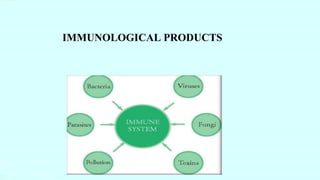
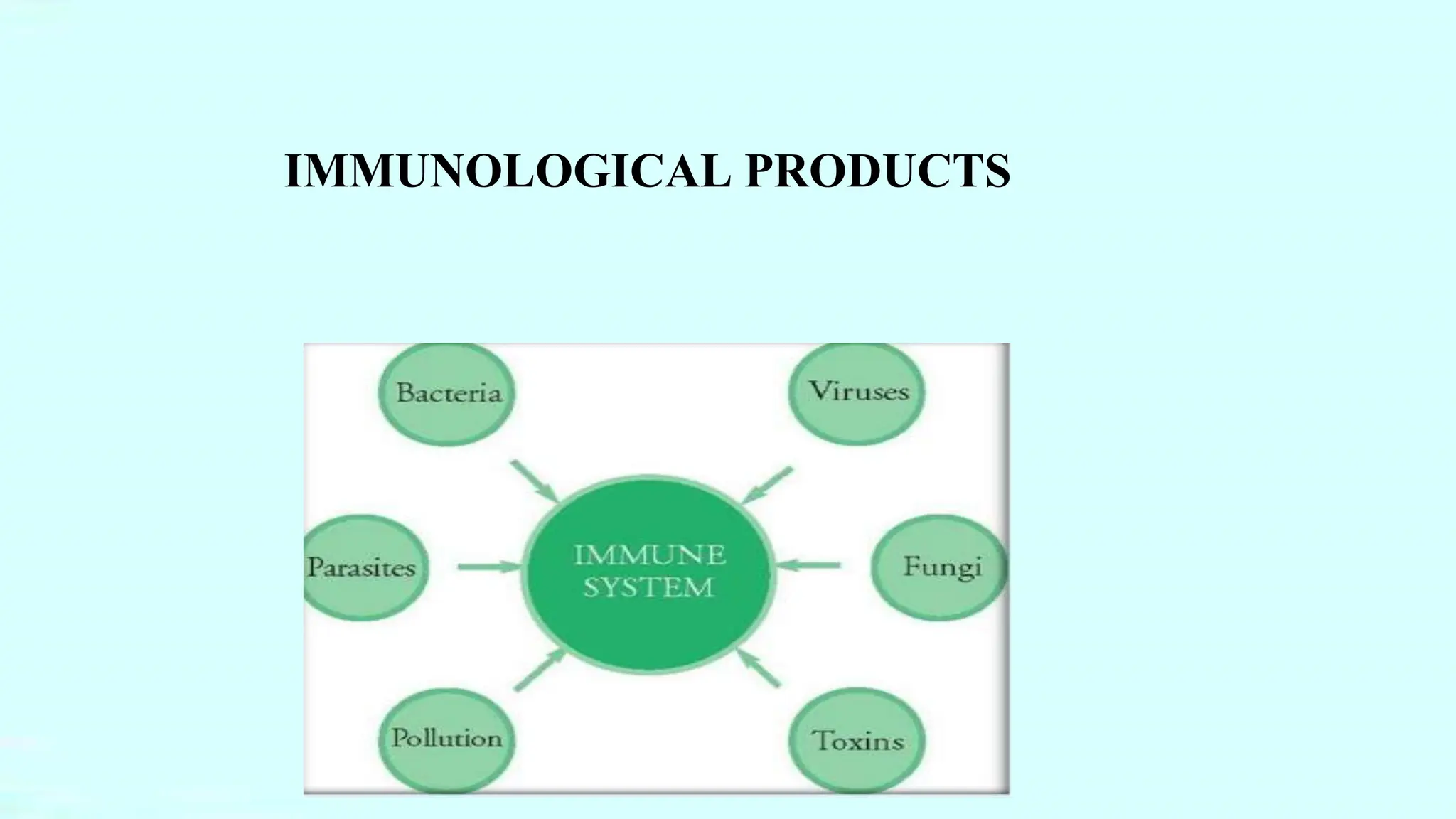
IMMUNOLOGICAL PRODUCTS
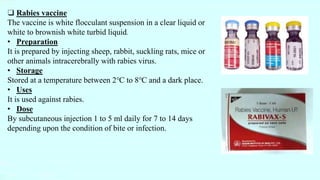
❑ Rabies vaccine
The vaccine is white flocculant suspension in a clear liquid or
white to brownish white turbid liquid.
• Preparation
It is prepared by injecting sheep, rabbit, suckling rats, mice or
other animals intracerebrally with rabies virus.
• Storage
Stored at a temperature between 2℃ to 8℃ and a dark place.
• Uses
It is used against rabies.
• Dose
By subcutaneous injection 1 to 5 ml daily for 7 to 14 days
depending upon the condition of bite or infection.
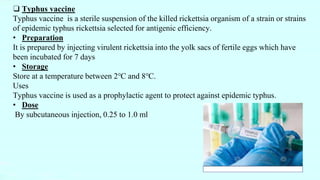
❑ Typhus vaccine
Typhus vaccine is a sterile suspension of the killed rickettsia organism of a strain or strains
of epidemic typhus rickettsia selected for antigenic efficiency.
• Preparation
It is prepared by injecting virulent rickettsia into the yolk sacs of fertile eggs which have
been incubated for 7 days
• Storage
Store at a temperature between 2℃ and 8℃.
Uses
Typhus vaccine is used as a prophylactic agent to protect against epidemic typhus.
• Dose
By subcutaneous injection, 0.25 to 1.0 ml
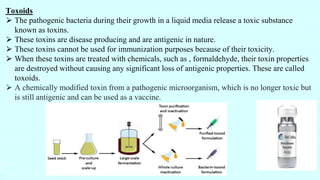
Toxoids
⮚ The pathogenic bacteria during their growth in a liquid media release a toxic substance
known as toxins.
⮚ These toxins are disease producing and are antigenic in nature.
⮚ These toxins cannot be used for immunization purposes because of their toxicity.
⮚ When these toxins are treated with chemicals, such as , formaldehyde, their toxin properties
are destroyed without causing any significant loss of antigenic properties. These are called
toxoids.
⮚ A chemically modified toxin from a pathogenic microorganism, which is no longer toxic but
is still antigenic and can be used as a vaccine.
❑ Diphtheria toxoid
It is modified from of exotoxin of coryne-bacterium diphtheria.
Preparation
A suitable strain of Corynebacterium diphtheria is grown on a liquid medium at 37℃ for 7-10
days or until the required toxin concentration is obtained.
Four type of official diphtheria toxoids are available
1. Formol toxoids
2. Toxoids antitoxin floccules
3. Alum precipitated toxoid
4. Purified toxoid aluminium phosphate
Tetanus toxoids
This is prepared from the exotoxin of clostridium tetani
This specific toxicity of which has been completely removed by the action of chemicals
substances in such a way that it retains its antigenic properties.
These are available in
1.Formal toxoid
2. Alum precipitated tetanus toxoids.
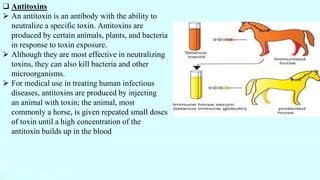
❑ Antitoxins
⮚ An antitoxin is an antibody with the ability to
neutralize a specific toxin. Antitoxins are
produced by certain animals, plants, and bacteria
in response to toxin exposure.
⮚ Although they are most effective in neutralizing
toxins, they can also kill bacteria and other
microorganisms.
⮚ For medical use in treating human infectious
diseases, antitoxins are produced by injecting
an animal with toxin; the animal, most
commonly a horse, is given repeated small doses
of toxin until a high concentration of the
antitoxin builds up in the blood
▪ Diphtheria antitoxin
▪ It is almost colourless, very faintly yellow or slightly opalescent liquid.
Preparation
1.Preparation of toxins for active immunization of the horse.
2.Selection of the horse
3. Active immunization of the horse
4.Separation of the serum from the horse
5.Concentration and refinement
Storage
It is stored in containers protected from light at a temperature between 2℃ to 8℃.
Dose
Administration by subcutaneous or intramuscular dose
❑ Tetanus antitoxin
It is almost colorless, very faintly yellow liquid.
Preparation
It is prepared by the same way as diphtheria antitoxin.
The toxin is obtained from clostridium tetani which is used to active immunization of horse.
Storage
It is stored in containers protected from light at a temperature between 2℃ to 8℃.
Dose
Administration by subcutaneous or intramuscular dose
Antiserum
⮚ It is human or nonhuman blood serum (yellow antisera's) containing monoclonal or polyclonal
antibodies that is used to spread passive immunity to many diseases.
⮚ The most common use of antiserum in humans is as antitoxin or antivenom to treat
envenomation.
⮚ Serum therapy, also known as serotherapy, describes the treatment of infectious disease using
the serum of animals that have been immunized against the specific organisms or their
product, to which the disease is supposedly referable.
⮚ Diluted snake venom is often used as an antiserum to give passive immunity to snake venom
itself.
Antiviral serum
❑ Rabies antiserum
⮚ It is almost colorless, very faintly yellow or slightly opalescent liquid free from suspended
particles.
▪ Preparation
⮚ The suspension of dead rabies viruses are injected to the healthy horse,
⮚ After a specified time period, the blood is collected and by a suitable method, the gamma
globulin is separated which contains antiviral antibodies
• Storage
⮚ It is stored in containers protected from light at a temperature between 2℃ to 8℃.
• Dose
Administration by subcutaneous or intramuscular dose.
Antibacterial serum
This type of serum is used to provide passive immunity to diseases caused by endotoxin
producing bacteria, e.g. pneumonia, meningitis and typhoid.
The serum contains antibacterial antibodies

Immunology Products, Immunological components

  • 1.
  • 2.
    ❑ Rabies vaccine Thevaccine is white flocculant suspension in a clear liquid or white to brownish white turbid liquid. • Preparation It is prepared by injecting sheep, rabbit, suckling rats, mice or other animals intracerebrally with rabies virus. • Storage Stored at a temperature between 2℃ to 8℃ and a dark place. • Uses It is used against rabies. • Dose By subcutaneous injection 1 to 5 ml daily for 7 to 14 days depending upon the condition of bite or infection.
  • 3.
    ❑ Typhus vaccine Typhusvaccine is a sterile suspension of the killed rickettsia organism of a strain or strains of epidemic typhus rickettsia selected for antigenic efficiency. • Preparation It is prepared by injecting virulent rickettsia into the yolk sacs of fertile eggs which have been incubated for 7 days • Storage Store at a temperature between 2℃ and 8℃. Uses Typhus vaccine is used as a prophylactic agent to protect against epidemic typhus. • Dose By subcutaneous injection, 0.25 to 1.0 ml
  • 4.
    Toxoids ⮚ The pathogenicbacteria during their growth in a liquid media release a toxic substance known as toxins. ⮚ These toxins are disease producing and are antigenic in nature. ⮚ These toxins cannot be used for immunization purposes because of their toxicity. ⮚ When these toxins are treated with chemicals, such as , formaldehyde, their toxin properties are destroyed without causing any significant loss of antigenic properties. These are called toxoids. ⮚ A chemically modified toxin from a pathogenic microorganism, which is no longer toxic but is still antigenic and can be used as a vaccine.
  • 5.
    ❑ Diphtheria toxoid Itis modified from of exotoxin of coryne-bacterium diphtheria. Preparation A suitable strain of Corynebacterium diphtheria is grown on a liquid medium at 37℃ for 7-10 days or until the required toxin concentration is obtained. Four type of official diphtheria toxoids are available 1. Formol toxoids 2. Toxoids antitoxin floccules 3. Alum precipitated toxoid 4. Purified toxoid aluminium phosphate Tetanus toxoids This is prepared from the exotoxin of clostridium tetani This specific toxicity of which has been completely removed by the action of chemicals substances in such a way that it retains its antigenic properties. These are available in 1.Formal toxoid 2. Alum precipitated tetanus toxoids.
  • 6.
    ❑ Antitoxins ⮚ Anantitoxin is an antibody with the ability to neutralize a specific toxin. Antitoxins are produced by certain animals, plants, and bacteria in response to toxin exposure. ⮚ Although they are most effective in neutralizing toxins, they can also kill bacteria and other microorganisms. ⮚ For medical use in treating human infectious diseases, antitoxins are produced by injecting an animal with toxin; the animal, most commonly a horse, is given repeated small doses of toxin until a high concentration of the antitoxin builds up in the blood
  • 7.
    ▪ Diphtheria antitoxin ▪It is almost colourless, very faintly yellow or slightly opalescent liquid. Preparation 1.Preparation of toxins for active immunization of the horse. 2.Selection of the horse 3. Active immunization of the horse 4.Separation of the serum from the horse 5.Concentration and refinement Storage It is stored in containers protected from light at a temperature between 2℃ to 8℃. Dose Administration by subcutaneous or intramuscular dose
  • 8.
    ❑ Tetanus antitoxin Itis almost colorless, very faintly yellow liquid. Preparation It is prepared by the same way as diphtheria antitoxin. The toxin is obtained from clostridium tetani which is used to active immunization of horse. Storage It is stored in containers protected from light at a temperature between 2℃ to 8℃. Dose Administration by subcutaneous or intramuscular dose
  • 9.
    Antiserum ⮚ It ishuman or nonhuman blood serum (yellow antisera's) containing monoclonal or polyclonal antibodies that is used to spread passive immunity to many diseases. ⮚ The most common use of antiserum in humans is as antitoxin or antivenom to treat envenomation. ⮚ Serum therapy, also known as serotherapy, describes the treatment of infectious disease using the serum of animals that have been immunized against the specific organisms or their product, to which the disease is supposedly referable. ⮚ Diluted snake venom is often used as an antiserum to give passive immunity to snake venom itself.
  • 10.
    Antiviral serum ❑ Rabiesantiserum ⮚ It is almost colorless, very faintly yellow or slightly opalescent liquid free from suspended particles. ▪ Preparation ⮚ The suspension of dead rabies viruses are injected to the healthy horse, ⮚ After a specified time period, the blood is collected and by a suitable method, the gamma globulin is separated which contains antiviral antibodies • Storage ⮚ It is stored in containers protected from light at a temperature between 2℃ to 8℃. • Dose Administration by subcutaneous or intramuscular dose. Antibacterial serum This type of serum is used to provide passive immunity to diseases caused by endotoxin producing bacteria, e.g. pneumonia, meningitis and typhoid. The serum contains antibacterial antibodies