Sarbaz. M. Abdalla
Lecturer
University of Sulaimani
College of Nursing
1
Out line of the lecture:
 Immunity
 Types of Immunity
 Cells and tissues of the Immune System
 Humoral response
 Cellular response
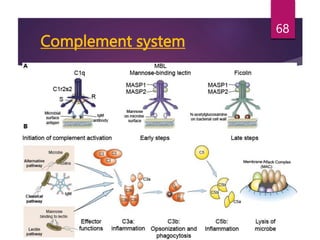
 Complement system
 Hypersensitivity reaction
 Autoimmune diseases
2
3
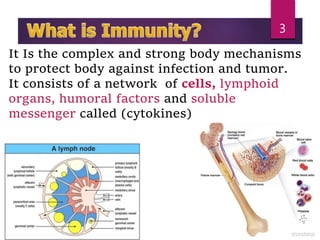
It Is the complex and strong body mechanisms
to protect body against infection and tumor.
It consists of a network of cells, lymphoid
organs, humoral factors and soluble
messenger called (cytokines)
Types of immunity:
A. Innate immunity
B. Adaptive immunity
Innate immunity
It consists of the immediately active (non-specific host
defense mechanism
(major parts of this type do not includes immune system
but involves it. why???)
4
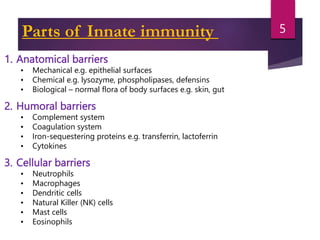
1. Anatomical barriers
• Mechanical e.g. epithelial surfaces
• Chemical e.g. lysozyme, phospholipases, defensins
• Biological – normal flora of body surfaces e.g. skin, gut
2. Humoral barriers
• Complement system
• Coagulation system
• Iron-sequestering proteins e.g. transferrin, lactoferrin
• Cytokines
3. Cellular barriers
• Neutrophils
• Macrophages
• Dendritic cells
• Natural Killer (NK) cells
• Mast cells
• Eosinophils
Parts of Innate immunity 5
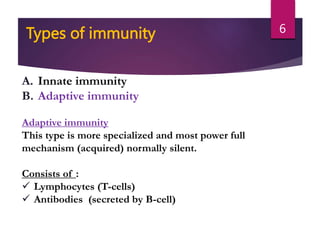
A. Innate immunity
B. Adaptive immunity
Adaptive immunity
This type is more specialized and most power full
mechanism (acquired) normally silent.
Consists of :
 Lymphocytes (T-cells)
 Antibodies (secreted by B-cell)
Types of immunity 6
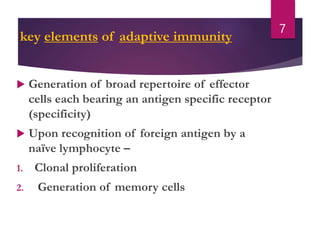
key elements of adaptive immunity
 Generation of broad repertoire of effector
cells each bearing an antigen specific receptor
(specificity)
 Upon recognition of foreign antigen by a
naïve lymphocyte –
1. Clonal proliferation
2. Generation of memory cells
7
8
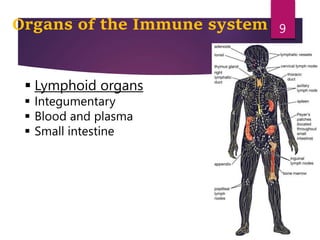
Organs of the Immune system
 Lymphoid organs
 Integumentary
 Blood and plasma
 Small intestine
9
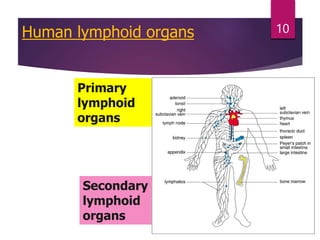
Human lymphoid organs
Primary
lymphoid
organs
Secondary
lymphoid
organs
10
Bone marrow
The major haemopoietic organ
primarily found in
cancellous (spongy) bone.
It produces all blood cell types (except mature
T cells). Contains - numerous blood vessels
a reticular stroma with macrophages
extracellular matrix
fat cells (yellow marrow)
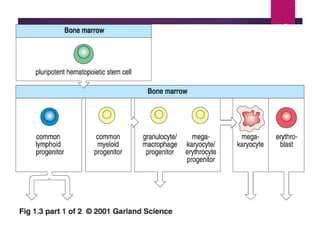
All the blood cell types come from a
totipotent
haematopoietic progenitor cell (or stem cell).
11
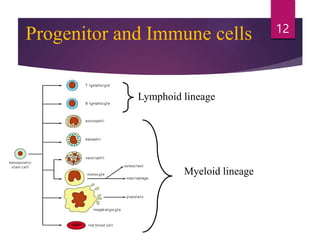
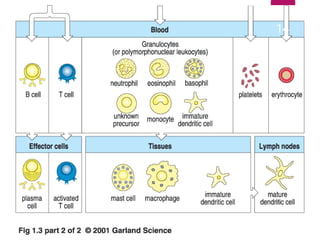
Lymphoid lineage
Myeloid lineage
12
Progenitor and Immune cells
13
14
15
16
17
18
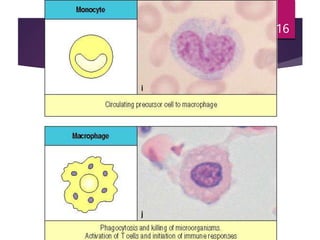
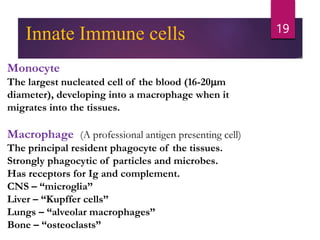
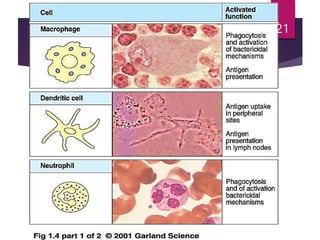
Monocyte
The largest nucleated cell of the blood (16-20mm
diameter), developing into a macrophage when it
migrates into the tissues.
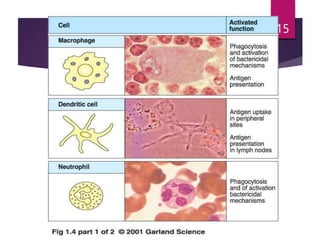
Macrophage (A professional antigen presenting cell)
The principal resident phagocyte of the tissues.
Strongly phagocytic of particles and microbes.
Has receptors for Ig and complement.
CNS – “microglia”
Liver – “Kupffer cells”
Lungs – “alveolar macrophages”
Bone – “osteoclasts”
19
Innate Immune cells
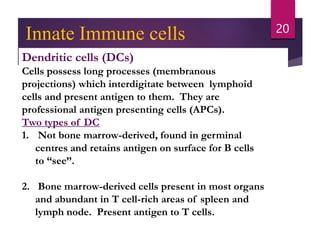
Dendritic cells (DCs)
Cells possess long processes (membranous
projections) which interdigitate between lymphoid
cells and present antigen to them. They are
professional antigen presenting cells (APCs).
Two types of DC
1. Not bone marrow-derived, found in germinal
centres and retains antigen on surface for B cells
to “see”.
2. Bone marrow-derived cells present in most organs
and abundant in T cell-rich areas of spleen and
lymph node. Present antigen to T cells.
20
Innate Immune cells
21
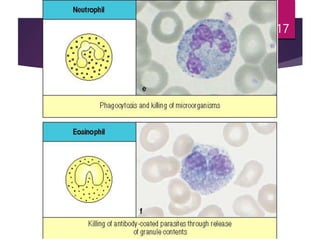
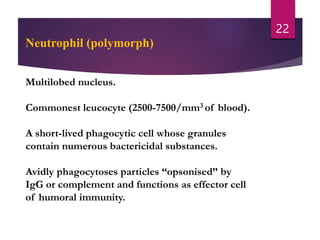
Neutrophil (polymorph)
Multilobed nucleus.
Commonest leucocyte (2500-7500/mm3 of blood).
A short-lived phagocytic cell whose granules
contain numerous bactericidal substances.
Avidly phagocytoses particles “opsonised” by
IgG or complement and functions as effector cell
of humoral immunity.
22
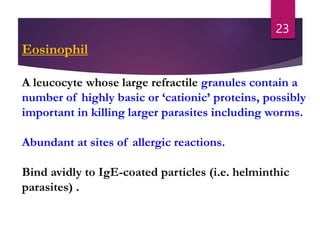
Eosinophil
A leucocyte whose large refractile granules contain a
number of highly basic or ‘cationic’ proteins, possibly
important in killing larger parasites including worms.
Abundant at sites of allergic reactions.
Bind avidly to IgE-coated particles (i.e. helminthic
parasites) .
23
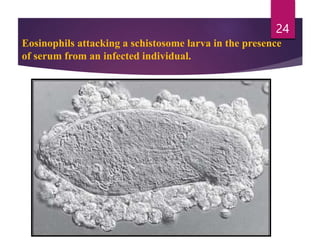
Eosinophils attacking a schistosome larva in the presence
of serum from an infected individual.
24
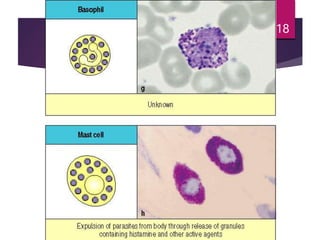
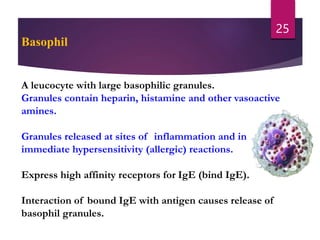
Basophil
A leucocyte with large basophilic granules.
Granules contain heparin, histamine and other vasoactive
amines.
Granules released at sites of inflammation and in
immediate hypersensitivity (allergic) reactions.
Express high affinity receptors for IgE (bind IgE).
Interaction of bound IgE with antigen causes release of
basophil granules.
25
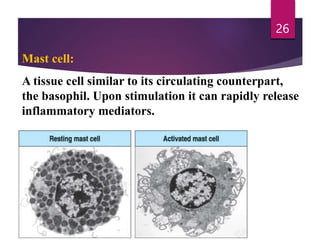
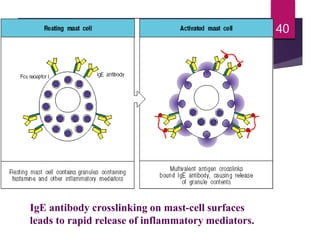
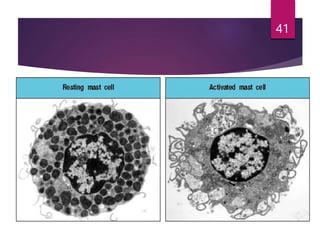
Mast cell:
A tissue cell similar to its circulating counterpart,
the basophil. Upon stimulation it can rapidly release
inflammatory mediators.
26
Natural killer cells (NK cells)
Type of lymphocyte able to kill virus infected
cells and certain types of cancer cells.
Act independently of antigen presentation
and recognition events required for cytotoxic
T cell killing.
Microscopically distinguishable by presence
of large cytoplasmic granules (large granular
lymphocytes).
27
28
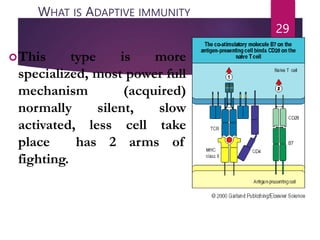
WHAT IS ADAPTIVE IMMUNITY
This type is more
specialized, most power full
mechanism (acquired)
normally silent, slow
activated, less cell take
place has 2 arms of
fighting.
29
THE 2 ARMS OF THE ADAPTIVE IMMUNE RESPONSE
I. Humoral Immunity ( mediated by
soluble protein called Antibodies
II. Cellular mediated Immunity (T-cells)
30
Forms of adaptive immunity
• Humoral Immunity
 Helper T cell recognize non
self antigen and stimulates
B cells to produce anti body
 B cell released anti bodies
bind to non self antigen on
infected cell
 Upon binding to antigens B
cell complete their
maturation and destroying
infected cell
• Cell mediated Immunity
 Macrophages phagocyte pathogens
 After phagocytosis macrophages
express non self antigen (NSA) on
their surface
 Helper T cell recognize NSA and
recruit Cytotoxic cells
 Cytotoxic T cell destroy infected
cell
31
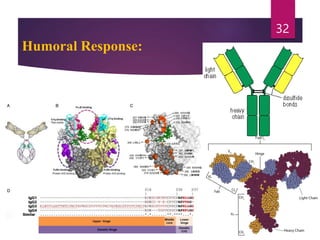
Humoral Response:
32
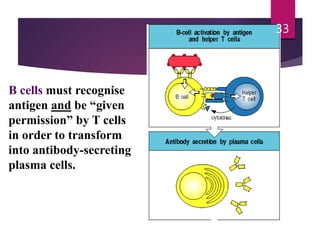
B cells must recognise
antigen and be “given
permission” by T cells
in order to transform
into antibody-secreting
plasma cells.
33
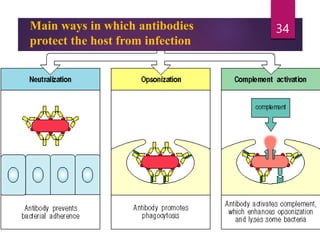
Main ways in which antibodies
protect the host from infection
34
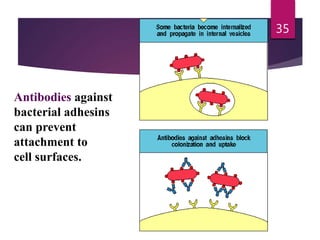
Antibodies against
bacterial adhesins
can prevent
attachment to
cell surfaces.
35
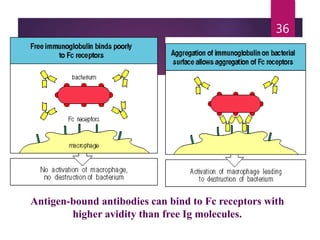
Antigen-bound antibodies can bind to Fc receptors with
higher avidity than free Ig molecules.
36
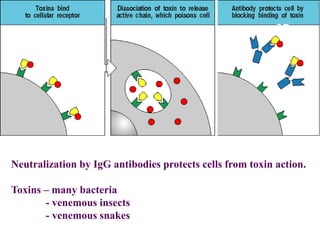
Neutralization by IgG antibodies protects cells from toxin action.
Toxins – many bacteria
- venemous insects
- venemous snakes
37
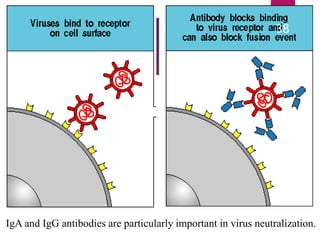
IgA and IgG antibodies are particularly important in virus neutralization.
38
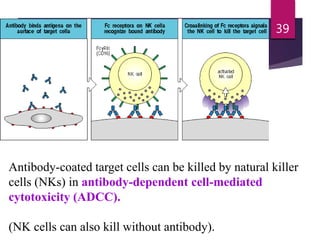
Antibody-coated target cells can be killed by natural killer
cells (NKs) in antibody-dependent cell-mediated
cytotoxicity (ADCC).
(NK cells can also kill without antibody).
39
IgE antibody crosslinking on mast-cell surfaces
leads to rapid release of inflammatory mediators.
40
41
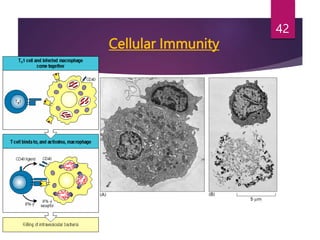
Cellular Immunity
42
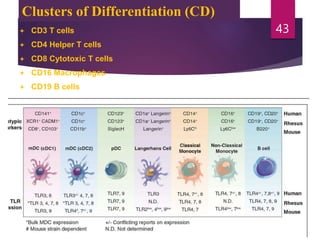
Clusters of Differentiation (CD)
 CD3 T cells
 CD4 Helper T cells
 CD8 Cytotoxic T cells
 CD16 Macrophages
 CD19 B cells
43
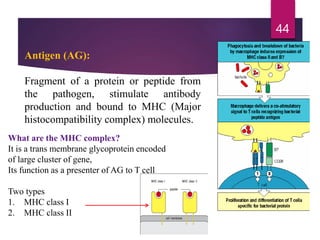
Antigen (AG):
Fragment of a protein or peptide from
the pathogen, stimulate antibody
production and bound to MHC (Major
histocompatibility complex) molecules.
What are the MHC complex?
It is a trans membrane glycoprotein encoded
of large cluster of gene,
Its function as a presenter of AG to T cell
Two types
1. MHC class I
2. MHC class II
44
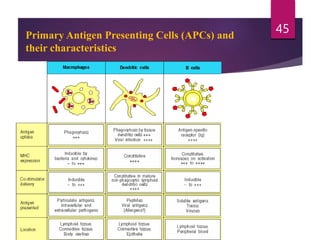
Primary Antigen Presenting Cells (APCs) and
their characteristics
45
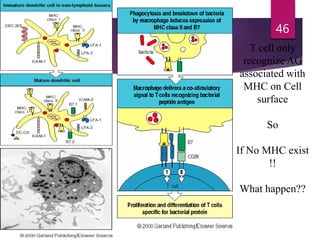
T cell only
recognize AG
associated with
MHC on Cell
surface
So
If No MHC exist
!!
What happen??
46
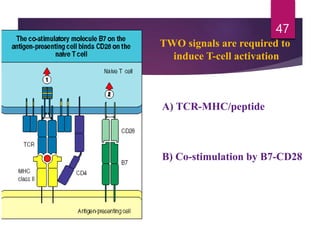
TWO signals are required to
induce T-cell activation
A) TCR-MHC/peptide
B) Co-stimulation by B7-CD28
47
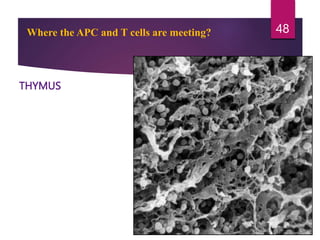
Where the APC and T cells are meeting?
THYMUS
48
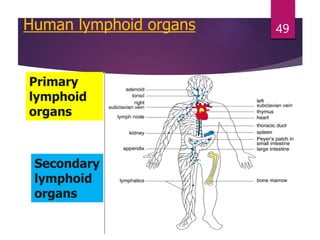
Human lymphoid organs
Primary
lymphoid
organs
Secondary
lymphoid
organs
49
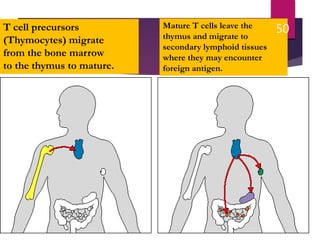
T cell precursors
(Thymocytes) migrate
from the bone marrow
to the thymus to mature.
Mature T cells leave the
thymus and migrate to
secondary lymphoid tissues
where they may encounter
foreign antigen.
50
51
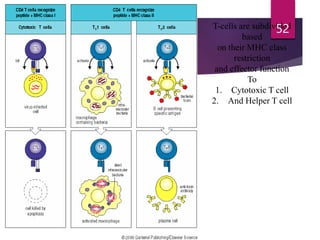
T-cells are subdivided
based
on their MHC class
restriction
and effector function
To
1. Cytotoxic T cell
2. And Helper T cell
52
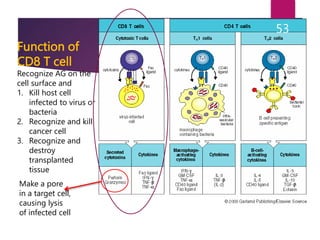
Function of
CD8 T cell
Recognize AG on the
cell surface and
1. Kill host cell
infected to virus or
bacteria
2. Recognize and kill
cancer cell
3. Recognize and
destroy
transplanted
tissue
Make a pore
in a target cell,
causing lysis
of infected cell
53
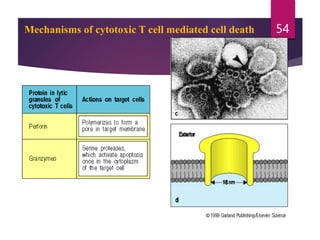
Mechanisms of cytotoxic T cell mediated cell death 54
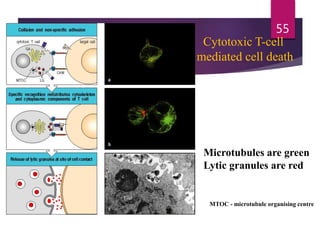
MTOC - microtubule organising centre
Microtubules are green
Lytic granules are red
Cytotoxic T-cell
mediated cell death
55
56
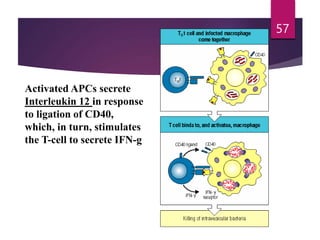
Activated APCs secrete
Interleukin 12 in response
to ligation of CD40,
which, in turn, stimulates
the T-cell to secrete IFN-g
57
58
59
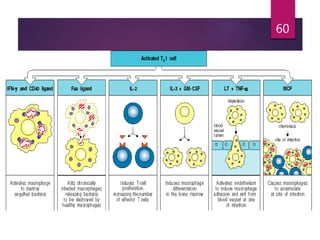
60
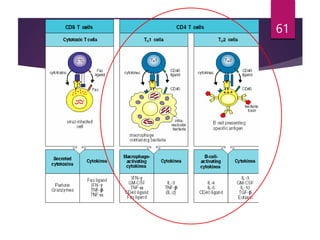
61
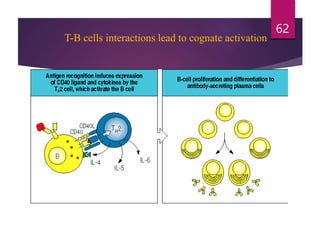
T-B cells interactions lead to cognate activation
62
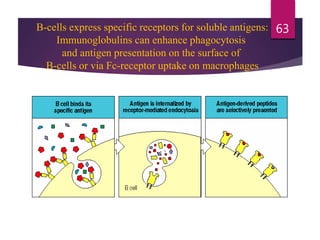
B-cells express specific receptors for soluble antigens:
Immunoglobulins can enhance phagocytosis
and antigen presentation on the surface of
B-cells or via Fc-receptor uptake on macrophages
63
Non specific Cellular Immunity
NK cells cytolysis of infected or transformed cells and
by secretion of potent immune mediators, including
cytokiens such as IFN-gamma, TNF-a
NK cells have a role in immunosurveillance of
spontaneous tumors, through direct cytolysis of infected
or transformed tumor cells and by secretion of potent
immune mediators
64
Summary 1
 The immune system comprises both innate and adaptive
immunity
 At the centre of adaptive immunity are T cells and
antibody producing B cells
65
Summary 2
 Antibodies can recognise antigens in solution
 T cells only recognise antigens (or peptides)
when presented to them by specialised antigen
presenting cells (APC)
 Peptides presented to T cells are associated with
molecules encoded in the major
histocompatibility complex (MHC) – MHC
class I or II molecules
66
67
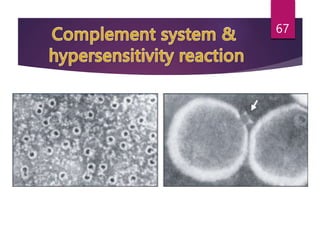
Complement system
68
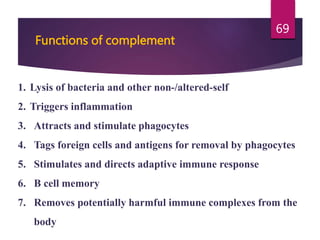
1. Lysis of bacteria and other non-/altered-self
2. Triggers inflammation
3. Attracts and stimulate phagocytes
4. Tags foreign cells and antigens for removal by phagocytes
5. Stimulates and directs adaptive immune response
6. B cell memory
7. Removes potentially harmful immune complexes from the
body
Functions of complement
69
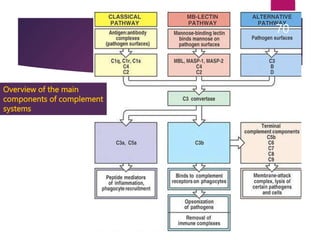
Overview of the main
components of complement
systems
70
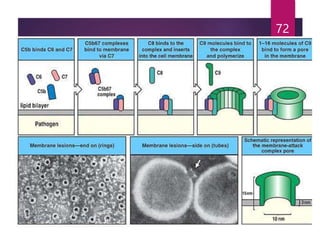
71
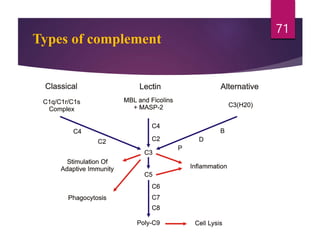
Types of complement
72
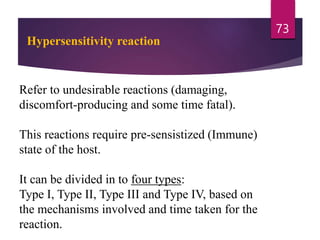
Hypersensitivity reaction
Refer to undesirable reactions (damaging,
discomfort-producing and some time fatal).
This reactions require pre-sensistized (Immune)
state of the host.
It can be divided in to four types:
Type I, Type II, Type III and Type IV, based on
the mechanisms involved and time taken for the
reaction.
73
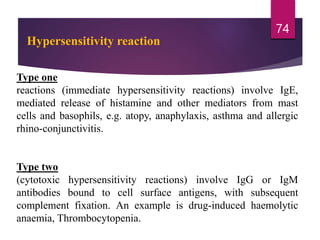
Type one
reactions (immediate hypersensitivity reactions) involve IgE,
mediated release of histamine and other mediators from mast
cells and basophils, e.g. atopy, anaphylaxis, asthma and allergic
rhino-conjunctivitis.
Type two
(cytotoxic hypersensitivity reactions) involve IgG or IgM
antibodies bound to cell surface antigens, with subsequent
complement fixation. An example is drug-induced haemolytic
anaemia, Thrombocytopenia.
74
Hypersensitivity reaction
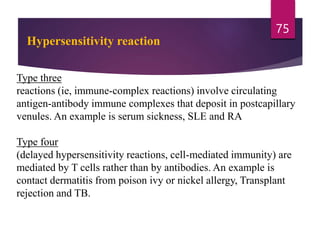
Type three
reactions (ie, immune-complex reactions) involve circulating
antigen-antibody immune complexes that deposit in postcapillary
venules. An example is serum sickness, SLE and RA
Type four
(delayed hypersensitivity reactions, cell-mediated immunity) are
mediated by T cells rather than by antibodies. An example is
contact dermatitis from poison ivy or nickel allergy, Transplant
rejection and TB.
75
Hypersensitivity reaction
Autoimmune diseases
• Failure of antibodies and T cell to recognize own cell.
• Antibodies and T cell launch attack against own cells
• Perhaps due to overactive or due to overabundance of
helper T lymphocytes.
76
Possible causes of autoimmune diseases
• Inefficient lymphocyte programming,
• Self proteins circulating without having been exposed to
system (thyroid, eye lens),
• Reaction between self antigen and antibody.
Examples :
 MS
 Myasthenia gravis
 Crohn’s disease
 Grave’s disease
 Type 1 DM
 RA
 Psoriasis
 SLE
77
Recommended Reading:
Books of..
• immunobiology
• inflammation
• The cell
78
79

Basic of Immunology and Immunity

  • 1.
    Sarbaz. M. Abdalla Lecturer Universityof Sulaimani College of Nursing 1
  • 2.
    Out line ofthe lecture:  Immunity  Types of Immunity  Cells and tissues of the Immune System  Humoral response  Cellular response  Complement system  Hypersensitivity reaction  Autoimmune diseases 2
  • 3.
    3 It Is thecomplex and strong body mechanisms to protect body against infection and tumor. It consists of a network of cells, lymphoid organs, humoral factors and soluble messenger called (cytokines)
  • 4.
    Types of immunity: A.Innate immunity B. Adaptive immunity Innate immunity It consists of the immediately active (non-specific host defense mechanism (major parts of this type do not includes immune system but involves it. why???) 4
  • 5.
    1. Anatomical barriers •Mechanical e.g. epithelial surfaces • Chemical e.g. lysozyme, phospholipases, defensins • Biological – normal flora of body surfaces e.g. skin, gut 2. Humoral barriers • Complement system • Coagulation system • Iron-sequestering proteins e.g. transferrin, lactoferrin • Cytokines 3. Cellular barriers • Neutrophils • Macrophages • Dendritic cells • Natural Killer (NK) cells • Mast cells • Eosinophils Parts of Innate immunity 5
  • 6.
    A. Innate immunity B.Adaptive immunity Adaptive immunity This type is more specialized and most power full mechanism (acquired) normally silent. Consists of :  Lymphocytes (T-cells)  Antibodies (secreted by B-cell) Types of immunity 6
  • 7.
    key elements ofadaptive immunity  Generation of broad repertoire of effector cells each bearing an antigen specific receptor (specificity)  Upon recognition of foreign antigen by a naïve lymphocyte – 1. Clonal proliferation 2. Generation of memory cells 7
  • 8.
  • 9.
    Organs of theImmune system  Lymphoid organs  Integumentary  Blood and plasma  Small intestine 9
  • 10.
  • 11.
    Bone marrow The majorhaemopoietic organ primarily found in cancellous (spongy) bone. It produces all blood cell types (except mature T cells). Contains - numerous blood vessels a reticular stroma with macrophages extracellular matrix fat cells (yellow marrow) All the blood cell types come from a totipotent haematopoietic progenitor cell (or stem cell). 11
  • 12.
  • 13.
  • 14.
  • 15.
  • 16.
  • 17.
  • 18.
  • 19.
    Monocyte The largest nucleatedcell of the blood (16-20mm diameter), developing into a macrophage when it migrates into the tissues. Macrophage (A professional antigen presenting cell) The principal resident phagocyte of the tissues. Strongly phagocytic of particles and microbes. Has receptors for Ig and complement. CNS – “microglia” Liver – “Kupffer cells” Lungs – “alveolar macrophages” Bone – “osteoclasts” 19 Innate Immune cells
  • 20.
    Dendritic cells (DCs) Cellspossess long processes (membranous projections) which interdigitate between lymphoid cells and present antigen to them. They are professional antigen presenting cells (APCs). Two types of DC 1. Not bone marrow-derived, found in germinal centres and retains antigen on surface for B cells to “see”. 2. Bone marrow-derived cells present in most organs and abundant in T cell-rich areas of spleen and lymph node. Present antigen to T cells. 20 Innate Immune cells
  • 21.
  • 22.
    Neutrophil (polymorph) Multilobed nucleus. Commonestleucocyte (2500-7500/mm3 of blood). A short-lived phagocytic cell whose granules contain numerous bactericidal substances. Avidly phagocytoses particles “opsonised” by IgG or complement and functions as effector cell of humoral immunity. 22
  • 23.
    Eosinophil A leucocyte whoselarge refractile granules contain a number of highly basic or ‘cationic’ proteins, possibly important in killing larger parasites including worms. Abundant at sites of allergic reactions. Bind avidly to IgE-coated particles (i.e. helminthic parasites) . 23
  • 24.
    Eosinophils attacking aschistosome larva in the presence of serum from an infected individual. 24
  • 25.
    Basophil A leucocyte withlarge basophilic granules. Granules contain heparin, histamine and other vasoactive amines. Granules released at sites of inflammation and in immediate hypersensitivity (allergic) reactions. Express high affinity receptors for IgE (bind IgE). Interaction of bound IgE with antigen causes release of basophil granules. 25
  • 26.
    Mast cell: A tissuecell similar to its circulating counterpart, the basophil. Upon stimulation it can rapidly release inflammatory mediators. 26
  • 27.
    Natural killer cells(NK cells) Type of lymphocyte able to kill virus infected cells and certain types of cancer cells. Act independently of antigen presentation and recognition events required for cytotoxic T cell killing. Microscopically distinguishable by presence of large cytoplasmic granules (large granular lymphocytes). 27
  • 28.
  • 29.
    WHAT IS ADAPTIVEIMMUNITY This type is more specialized, most power full mechanism (acquired) normally silent, slow activated, less cell take place has 2 arms of fighting. 29
  • 30.
    THE 2 ARMSOF THE ADAPTIVE IMMUNE RESPONSE I. Humoral Immunity ( mediated by soluble protein called Antibodies II. Cellular mediated Immunity (T-cells) 30
  • 31.
    Forms of adaptiveimmunity • Humoral Immunity  Helper T cell recognize non self antigen and stimulates B cells to produce anti body  B cell released anti bodies bind to non self antigen on infected cell  Upon binding to antigens B cell complete their maturation and destroying infected cell • Cell mediated Immunity  Macrophages phagocyte pathogens  After phagocytosis macrophages express non self antigen (NSA) on their surface  Helper T cell recognize NSA and recruit Cytotoxic cells  Cytotoxic T cell destroy infected cell 31
  • 32.
  • 33.
    B cells mustrecognise antigen and be “given permission” by T cells in order to transform into antibody-secreting plasma cells. 33
  • 34.
    Main ways inwhich antibodies protect the host from infection 34
  • 35.
    Antibodies against bacterial adhesins canprevent attachment to cell surfaces. 35
  • 36.
    Antigen-bound antibodies canbind to Fc receptors with higher avidity than free Ig molecules. 36
  • 37.
    Neutralization by IgGantibodies protects cells from toxin action. Toxins – many bacteria - venemous insects - venemous snakes 37
  • 38.
    IgA and IgGantibodies are particularly important in virus neutralization. 38
  • 39.
    Antibody-coated target cellscan be killed by natural killer cells (NKs) in antibody-dependent cell-mediated cytotoxicity (ADCC). (NK cells can also kill without antibody). 39
  • 40.
    IgE antibody crosslinkingon mast-cell surfaces leads to rapid release of inflammatory mediators. 40
  • 41.
  • 42.
  • 43.
    Clusters of Differentiation(CD)  CD3 T cells  CD4 Helper T cells  CD8 Cytotoxic T cells  CD16 Macrophages  CD19 B cells 43
  • 44.
    Antigen (AG): Fragment ofa protein or peptide from the pathogen, stimulate antibody production and bound to MHC (Major histocompatibility complex) molecules. What are the MHC complex? It is a trans membrane glycoprotein encoded of large cluster of gene, Its function as a presenter of AG to T cell Two types 1. MHC class I 2. MHC class II 44
  • 45.
    Primary Antigen PresentingCells (APCs) and their characteristics 45
  • 46.
    T cell only recognizeAG associated with MHC on Cell surface So If No MHC exist !! What happen?? 46
  • 47.
    TWO signals arerequired to induce T-cell activation A) TCR-MHC/peptide B) Co-stimulation by B7-CD28 47
  • 48.
    Where the APCand T cells are meeting? THYMUS 48
  • 49.
  • 50.
    T cell precursors (Thymocytes)migrate from the bone marrow to the thymus to mature. Mature T cells leave the thymus and migrate to secondary lymphoid tissues where they may encounter foreign antigen. 50
  • 51.
  • 52.
    T-cells are subdivided based ontheir MHC class restriction and effector function To 1. Cytotoxic T cell 2. And Helper T cell 52
  • 53.
    Function of CD8 Tcell Recognize AG on the cell surface and 1. Kill host cell infected to virus or bacteria 2. Recognize and kill cancer cell 3. Recognize and destroy transplanted tissue Make a pore in a target cell, causing lysis of infected cell 53
  • 54.
    Mechanisms of cytotoxicT cell mediated cell death 54
  • 55.
    MTOC - microtubuleorganising centre Microtubules are green Lytic granules are red Cytotoxic T-cell mediated cell death 55
  • 56.
  • 57.
    Activated APCs secrete Interleukin12 in response to ligation of CD40, which, in turn, stimulates the T-cell to secrete IFN-g 57
  • 58.
  • 59.
  • 60.
  • 61.
  • 62.
    T-B cells interactionslead to cognate activation 62
  • 63.
    B-cells express specificreceptors for soluble antigens: Immunoglobulins can enhance phagocytosis and antigen presentation on the surface of B-cells or via Fc-receptor uptake on macrophages 63
  • 64.
    Non specific CellularImmunity NK cells cytolysis of infected or transformed cells and by secretion of potent immune mediators, including cytokiens such as IFN-gamma, TNF-a NK cells have a role in immunosurveillance of spontaneous tumors, through direct cytolysis of infected or transformed tumor cells and by secretion of potent immune mediators 64
  • 65.
    Summary 1  Theimmune system comprises both innate and adaptive immunity  At the centre of adaptive immunity are T cells and antibody producing B cells 65
  • 66.
    Summary 2  Antibodiescan recognise antigens in solution  T cells only recognise antigens (or peptides) when presented to them by specialised antigen presenting cells (APC)  Peptides presented to T cells are associated with molecules encoded in the major histocompatibility complex (MHC) – MHC class I or II molecules 66
  • 67.
  • 68.
  • 69.
    1. Lysis ofbacteria and other non-/altered-self 2. Triggers inflammation 3. Attracts and stimulate phagocytes 4. Tags foreign cells and antigens for removal by phagocytes 5. Stimulates and directs adaptive immune response 6. B cell memory 7. Removes potentially harmful immune complexes from the body Functions of complement 69
  • 70.
    Overview of themain components of complement systems 70
  • 71.
  • 72.
  • 73.
    Hypersensitivity reaction Refer toundesirable reactions (damaging, discomfort-producing and some time fatal). This reactions require pre-sensistized (Immune) state of the host. It can be divided in to four types: Type I, Type II, Type III and Type IV, based on the mechanisms involved and time taken for the reaction. 73
  • 74.
    Type one reactions (immediatehypersensitivity reactions) involve IgE, mediated release of histamine and other mediators from mast cells and basophils, e.g. atopy, anaphylaxis, asthma and allergic rhino-conjunctivitis. Type two (cytotoxic hypersensitivity reactions) involve IgG or IgM antibodies bound to cell surface antigens, with subsequent complement fixation. An example is drug-induced haemolytic anaemia, Thrombocytopenia. 74 Hypersensitivity reaction
  • 75.
    Type three reactions (ie,immune-complex reactions) involve circulating antigen-antibody immune complexes that deposit in postcapillary venules. An example is serum sickness, SLE and RA Type four (delayed hypersensitivity reactions, cell-mediated immunity) are mediated by T cells rather than by antibodies. An example is contact dermatitis from poison ivy or nickel allergy, Transplant rejection and TB. 75 Hypersensitivity reaction
  • 76.
    Autoimmune diseases • Failureof antibodies and T cell to recognize own cell. • Antibodies and T cell launch attack against own cells • Perhaps due to overactive or due to overabundance of helper T lymphocytes. 76
  • 77.
    Possible causes ofautoimmune diseases • Inefficient lymphocyte programming, • Self proteins circulating without having been exposed to system (thyroid, eye lens), • Reaction between self antigen and antibody. Examples :  MS  Myasthenia gravis  Crohn’s disease  Grave’s disease  Type 1 DM  RA  Psoriasis  SLE 77
  • 78.
    Recommended Reading: Books of.. •immunobiology • inflammation • The cell 78
  • 79.