Image file format
• Each way of storing an image is called
a file format
• Each file format converts the image to a
corresponding string of bits differently in
order to store them on disk or transmit
them over the Internet
Preservation of Image Documents
Chinese-European Workshop on digital preservation. Beijing. July 14-16 2004
Images File formats
… - PCX – PBM – TGA – TIFF –
GIF – JPEG – PSD – DXF - CGM
– PNG – SVG – RAW – WPG –
FITS – BMP – PCD – RAS – TGA
– BPS – EPS – PDF – PCT –
WBM – FITS – XBM – VFF – RIB
– PCX – DMP – AVS – IMG – ICO
– JFIF – IFF – WMF - …
Common File Formats
Bitmap Formats
• GIF: graphics
interchange format
• JPEG: joint
photographic experts
group
• PNG: portable network
graphic
• BMP: Windows bitmap
• TIFF: tagged image file
format
Vector Formats
• SVG : scalable vector
graphics
• EPS: encapsulated
postscript
• CMX: Corel meta
exchange
• PICT: Macintosh
Picture
• WMF: Windows
metafile
Image types
• Black and white image
• Binary Image
• Bit map mage
• Gray scale image
• Raster image
• Multispectral Image
Preservation of Image Documents
Chinese-European Workshop on digital preservation. Beijing. July 14-16 2004
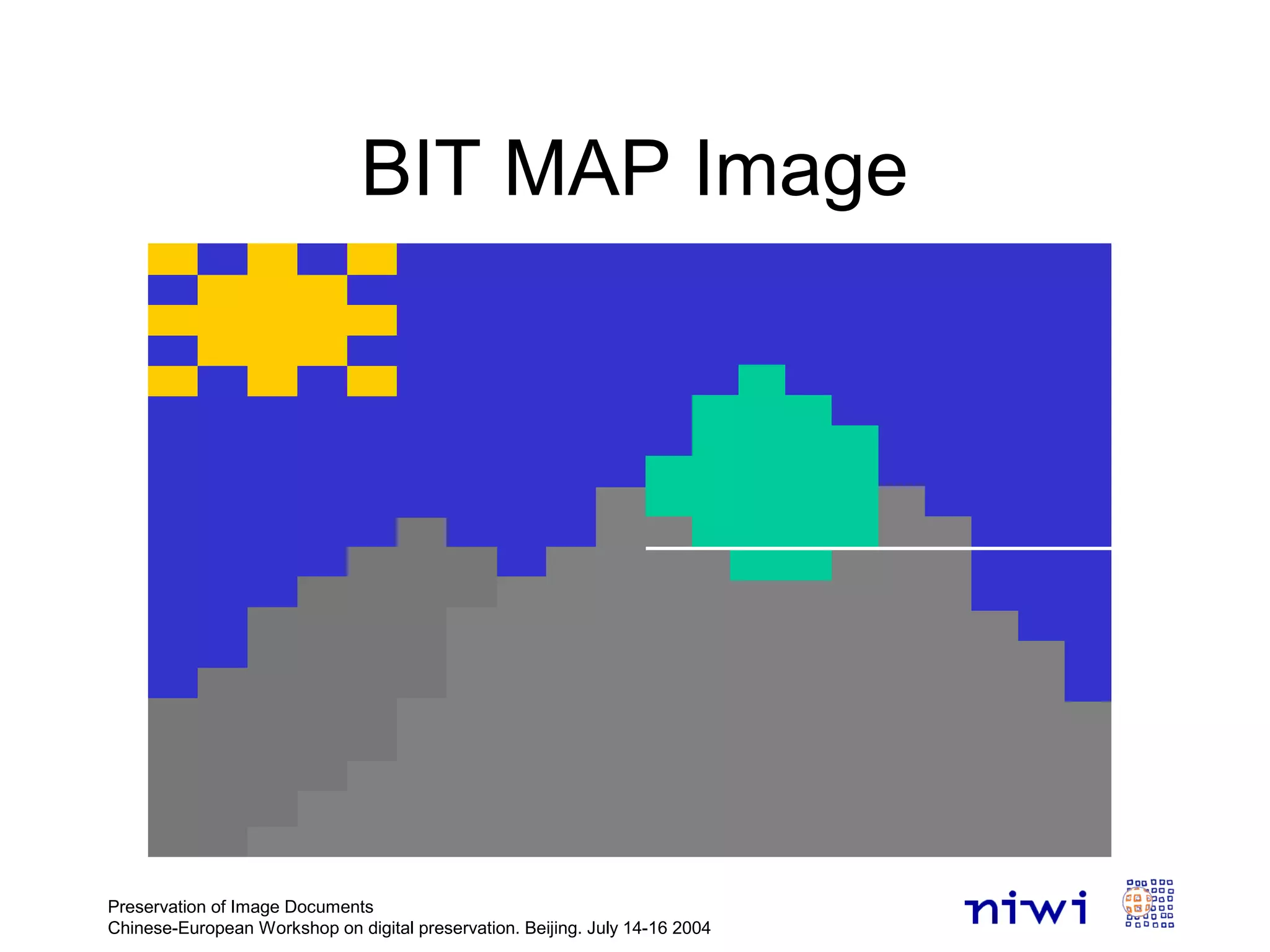
• A bit map (often spelled "bitmap")
defines a display space and the color
for each pixel or "bit" in the display
space. A Graphics Interchange Format
and a JPEG are examples of
graphic image file types that contain bit
maps.
Preservation of Image Documents
Chinese-European Workshop on digital preservation. Beijing. July 14-16 2004
BIT MAP Image
BIT MAP Image
Preservation of Image Documents
Chinese-European Workshop on digital preservation. Beijing. July 14-16 2004
Multi spectral image
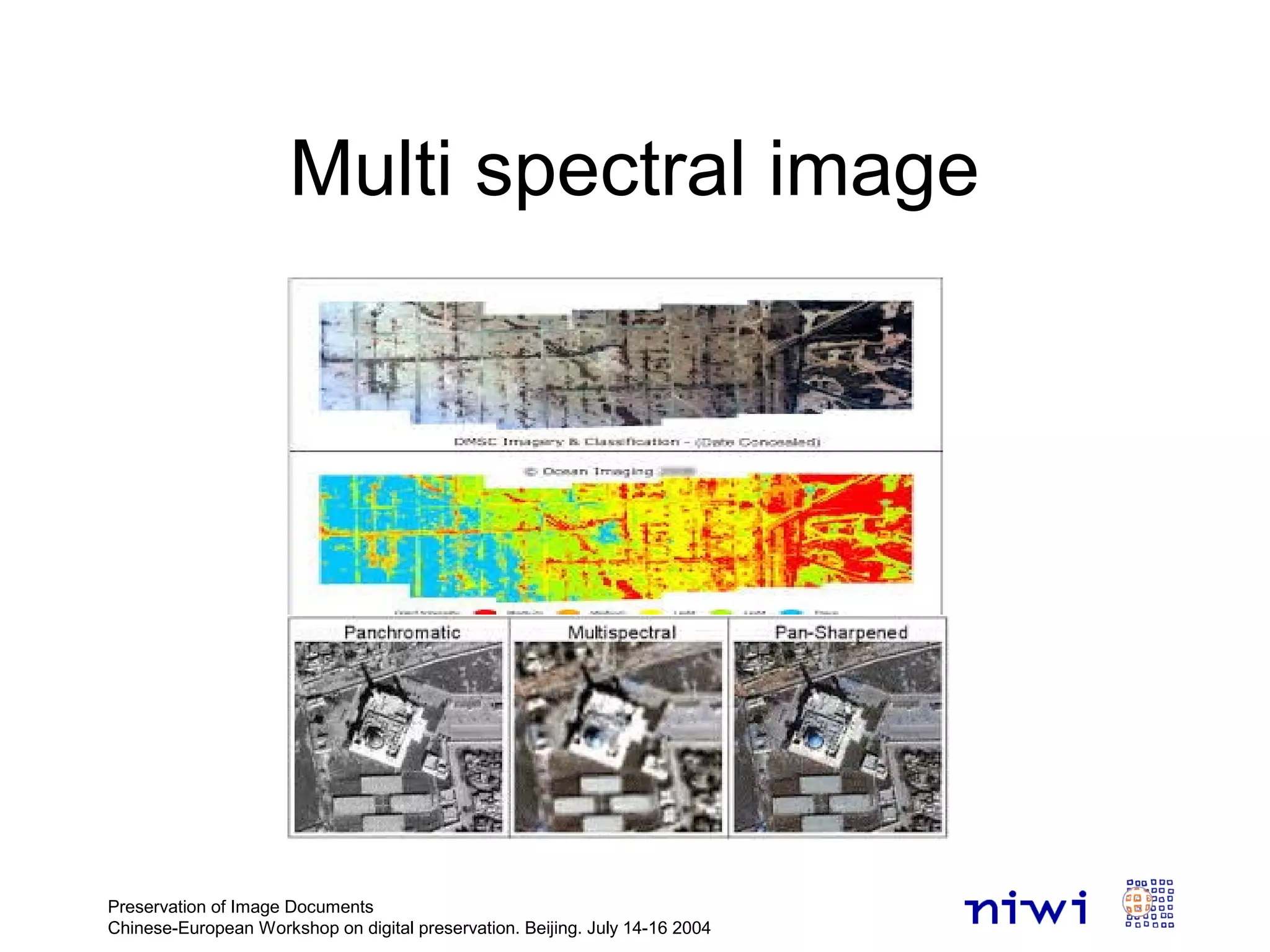
• A multispectral image is one that
captures image data within specific
wavelength ranges across the
electromagnetic spectrum.
Multispectral imaging measures light
in a small number (typically 3 to 15) of
spectral bands.
Preservation of Image Documents
Chinese-European Workshop on digital preservation. Beijing. July 14-16 2004
Multi spectral image
Preservation of Image Documents
Chinese-European Workshop on digital preservation. Beijing. July 14-16 2004
Raster image
Preservation of Image Documents
Chinese-European Workshop on digital preservation. Beijing. July 14-16 2004
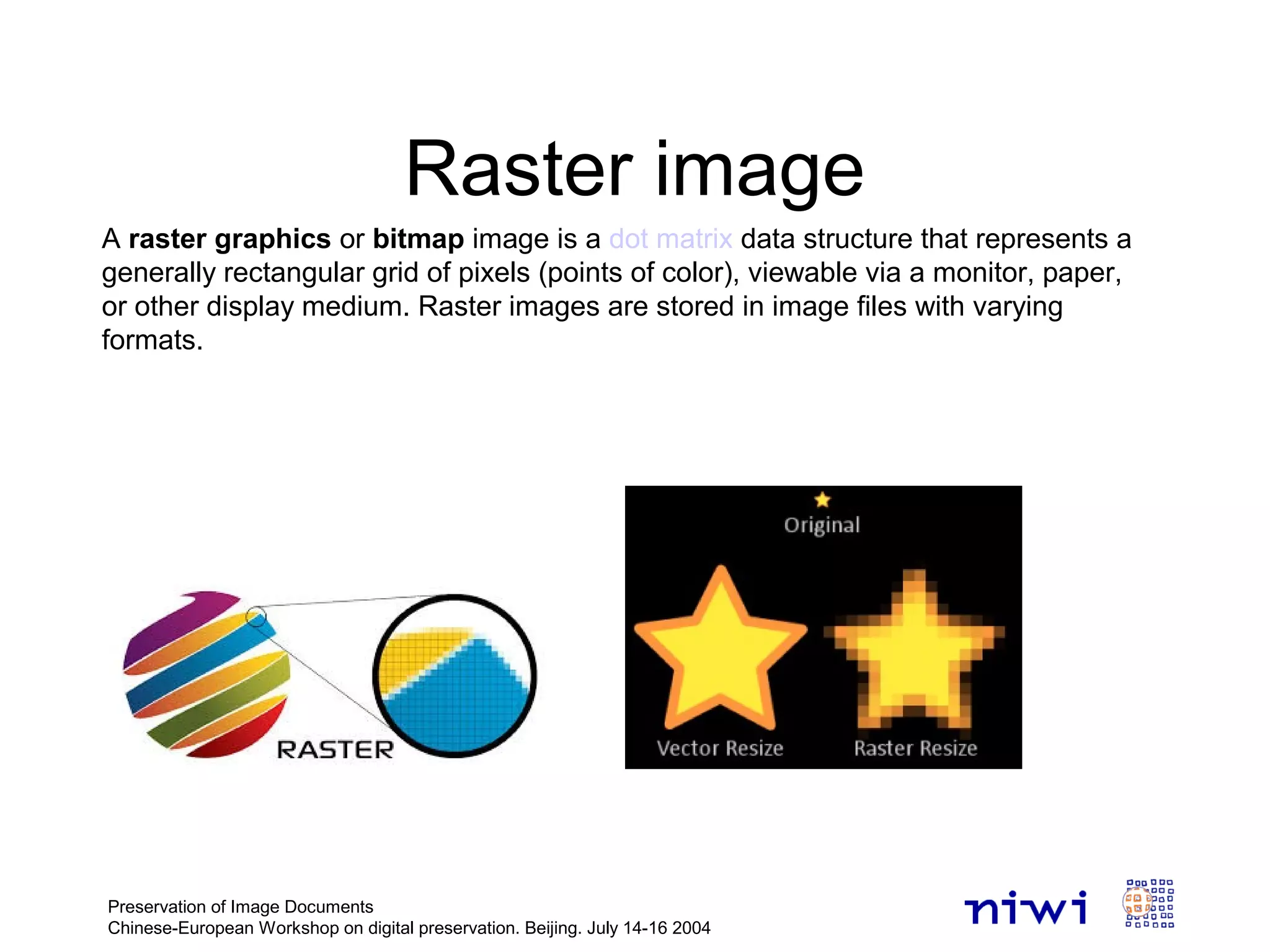
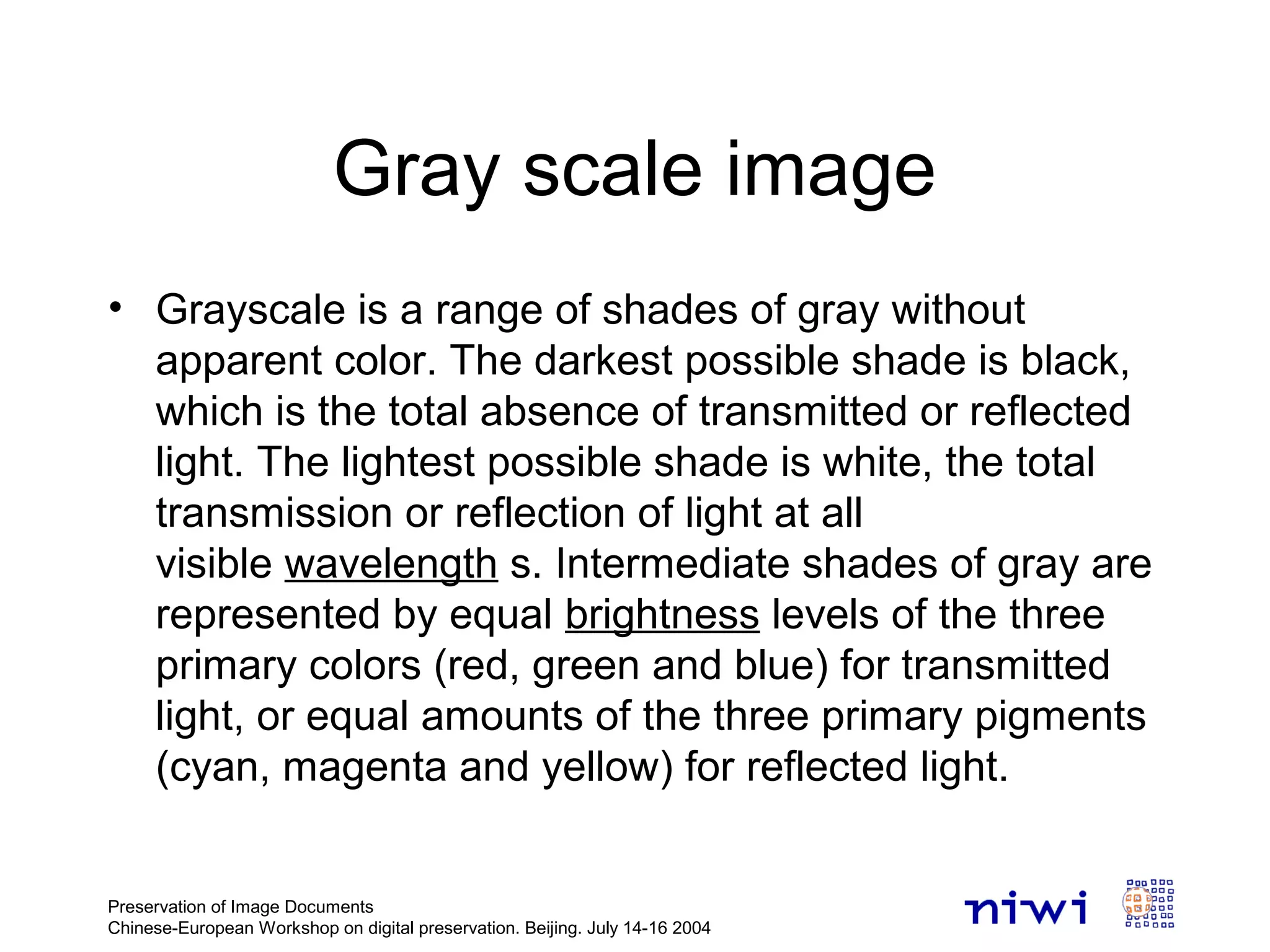
A raster graphics or bitmap image is a dot matrix data structure that represents a
generally rectangular grid of pixels (points of color), viewable via a monitor, paper,
or other display medium. Raster images are stored in image files with varying
formats.
Gray scale image
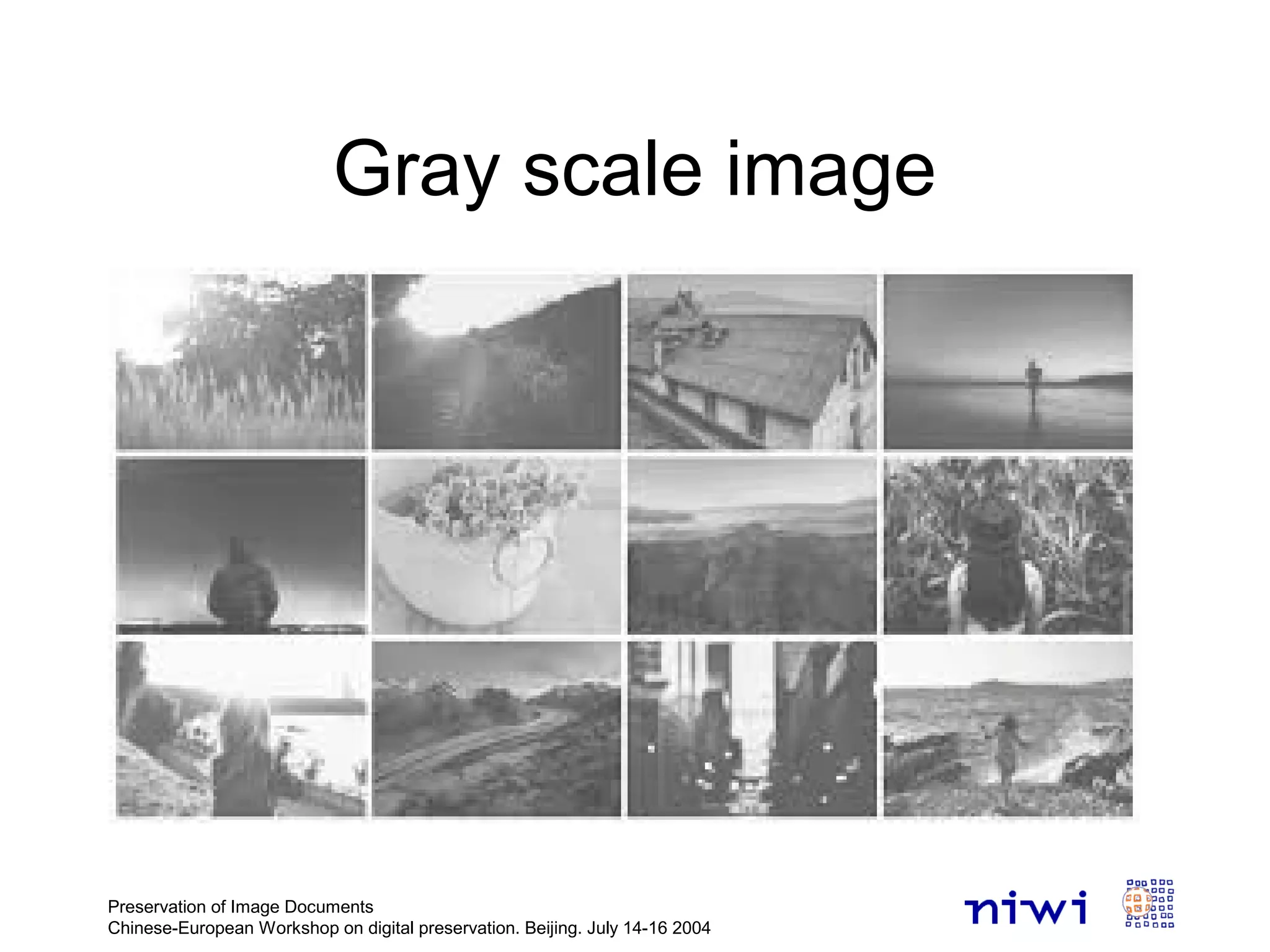
• Grayscale is a range of shades of gray without
apparent color. The darkest possible shade is black,
which is the total absence of transmitted or reflected
light. The lightest possible shade is white, the total
transmission or reflection of light at all
visible wavelength s. Intermediate shades of gray are
represented by equal brightness levels of the three
primary colors (red, green and blue) for transmitted
light, or equal amounts of the three primary pigments
(cyan, magenta and yellow) for reflected light.
Preservation of Image Documents
Chinese-European Workshop on digital preservation. Beijing. July 14-16 2004
Gray scale image
Preservation of Image Documents
Chinese-European Workshop on digital preservation. Beijing. July 14-16 2004
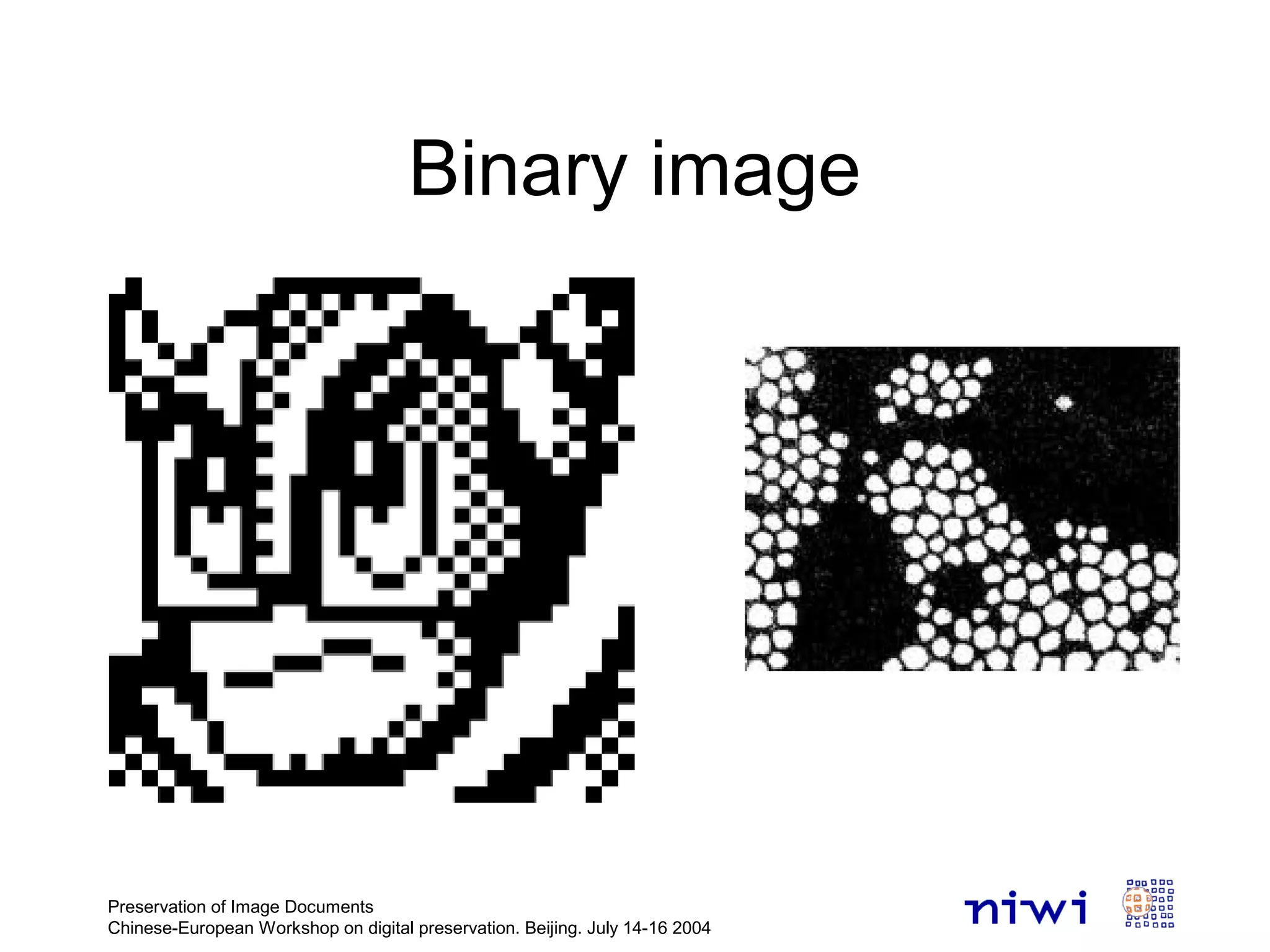
Binary Image
• A binary image is a digital image that
has only two possible values for each
pixel. Typically, the two colors used for
a binary image are black and white.
The color used for the object(s) in
the image is the foreground color while
the rest of the image is the background
color.
Preservation of Image Documents
Chinese-European Workshop on digital preservation. Beijing. July 14-16 2004
Binary image
Preservation of Image Documents
Chinese-European Workshop on digital preservation. Beijing. July 14-16 2004
Preservation of Image Documents
Chinese-European Workshop on digital preservation. Beijing. July 14-16 2004
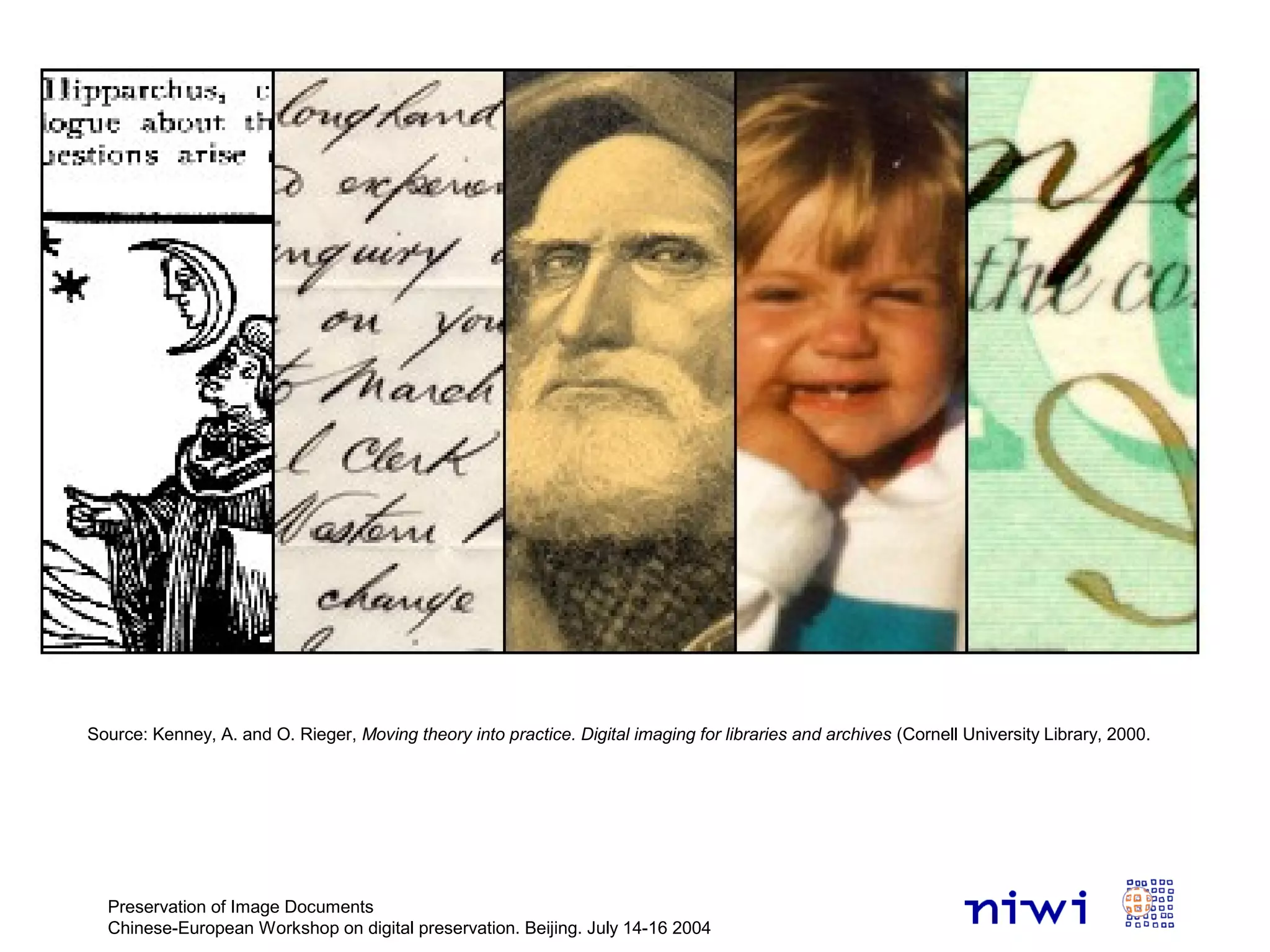
Source: Kenney, A. and O. Rieger, Moving theory into practice. Digital imaging for libraries and archives (Cornell University Library, 2000.
Preservation of Image Documents
Chinese-European Workshop on digital preservation. Beijing. July 14-16 2004
Graphic File Formats
… - PCX – PBM – TGA – TIFF – GIF –
JPEG – PSD – DXF - CGM – PNG –
SVG – RAW – WPG – FITS – BMP –
PCD – RAS – TGA – BPS – EPS – PDF
– PCT – WBM – FITS – XBM – VFF –
RIB – PCX – DMP – AVS – IMG – ICO –
JFIF – IFF – WMF - …
Preservation of Image Documents
Chinese-European Workshop on digital preservation. Beijing. July 14-16 2004
Why are there so many different graphic file
formats?
• There are a number of fundamental different
types of graphical data
– raster data (sampled values)
– geometry data (mathematical description of space)
– latent image data (data transformed into useful
images by some algorithmic process)
• To prevent usage beyond control of the
developer (Who remembers KodakPhoto CD?)
• Wide range of design principles (Mainly ‘speed’
and ‘memory’)
Preservation of Image Documents
Chinese-European Workshop on digital preservation. Beijing. July 14-16 2004
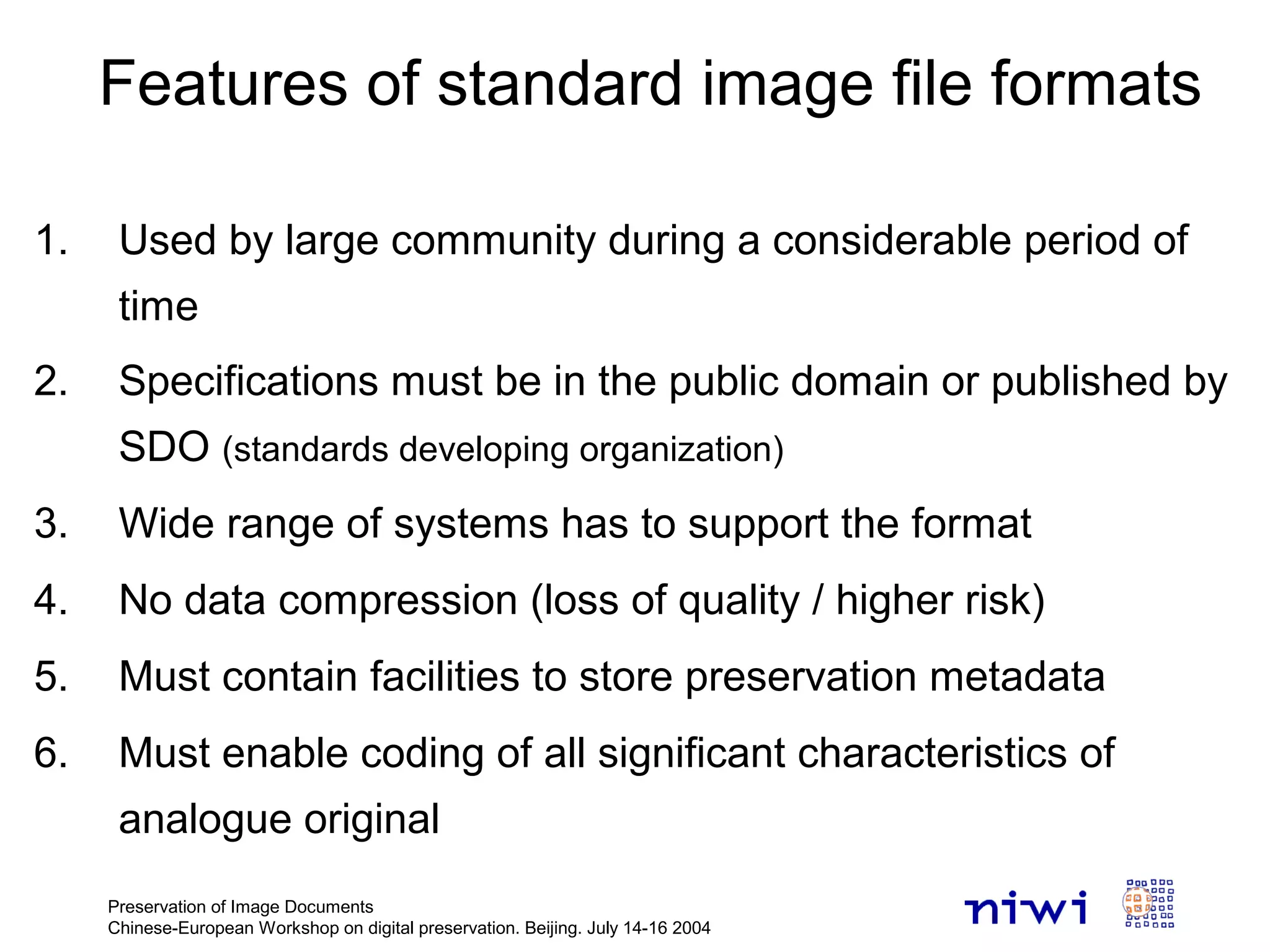
Features of standard image file formats
1. Used by large community during a considerable period of
time
2. Specifications must be in the public domain or published by
SDO (standards developing organization)
3. Wide range of systems has to support the format
4. No data compression (loss of quality / higher risk)
5. Must contain facilities to store preservation metadata
6. Must enable coding of all significant characteristics of
analogue original
Preservation of Image Documents
Chinese-European Workshop on digital preservation. Beijing. July 14-16 2004
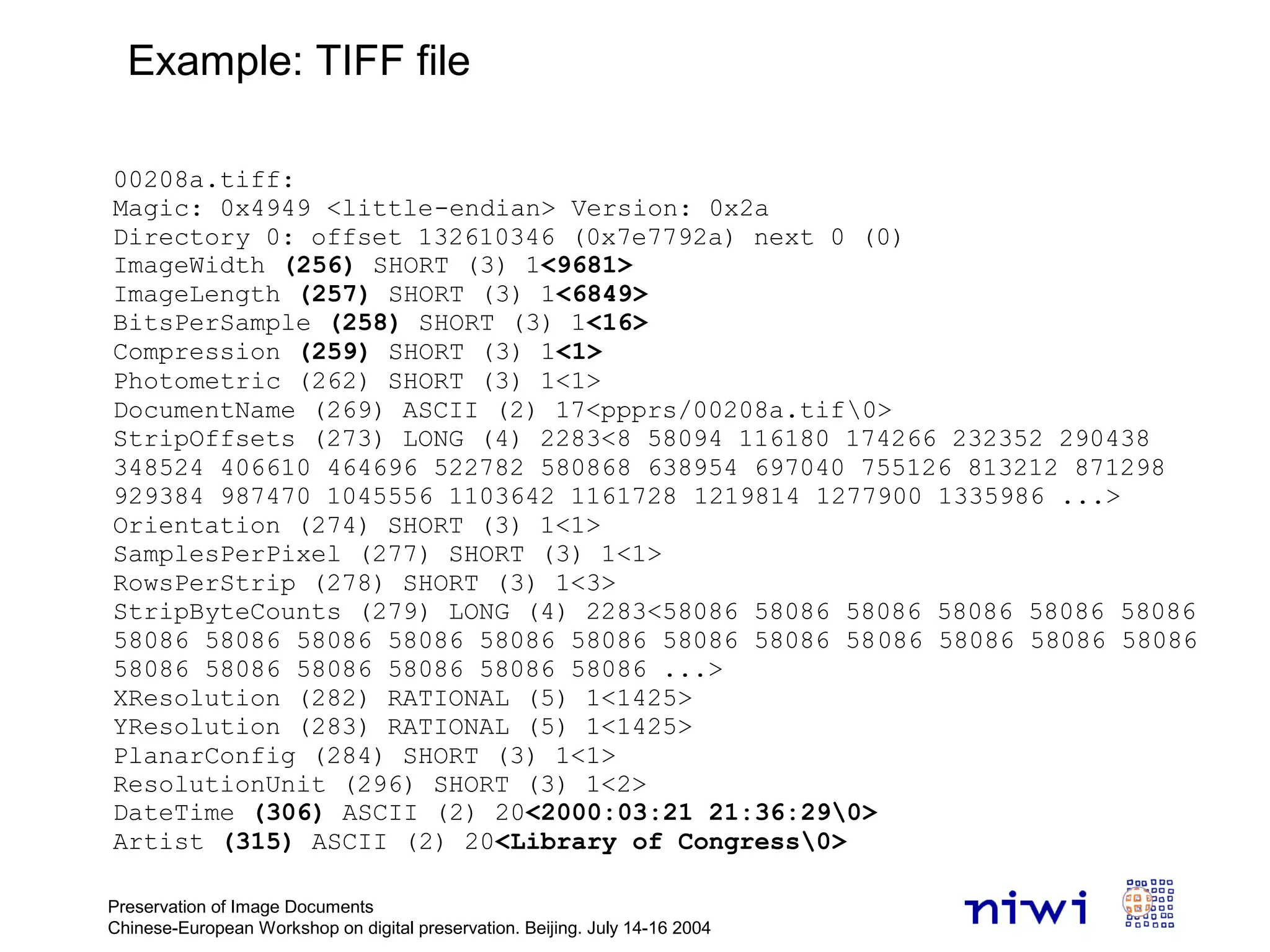
00208a.tiff:
Magic: 0x4949 <little-endian> Version: 0x2a
Directory 0: offset 132610346 (0x7e7792a) next 0 (0)
ImageWidth (256) SHORT (3) 1<9681>
ImageLength (257) SHORT (3) 1<6849>
BitsPerSample (258) SHORT (3) 1<16>
Compression (259) SHORT (3) 1<1>
Photometric (262) SHORT (3) 1<1>
DocumentName (269) ASCII (2) 17<ppprs/00208a.tif0>
StripOffsets (273) LONG (4) 2283<8 58094 116180 174266 232352 290438
348524 406610 464696 522782 580868 638954 697040 755126 813212 871298
929384 987470 1045556 1103642 1161728 1219814 1277900 1335986 ...>
Orientation (274) SHORT (3) 1<1>
SamplesPerPixel (277) SHORT (3) 1<1>
RowsPerStrip (278) SHORT (3) 1<3>
StripByteCounts (279) LONG (4) 2283<58086 58086 58086 58086 58086 58086
58086 58086 58086 58086 58086 58086 58086 58086 58086 58086 58086 58086
58086 58086 58086 58086 58086 58086 ...>
XResolution (282) RATIONAL (5) 1<1425>
YResolution (283) RATIONAL (5) 1<1425>
PlanarConfig (284) SHORT (3) 1<1>
ResolutionUnit (296) SHORT (3) 1<2>
DateTime (306) ASCII (2) 20<2000:03:21 21:36:290>
Artist (315) ASCII (2) 20<Library of Congress0>
Example: TIFF file
Preservation of Image Documents
Chinese-European Workshop on digital preservation. Beijing. July 14-16 2004
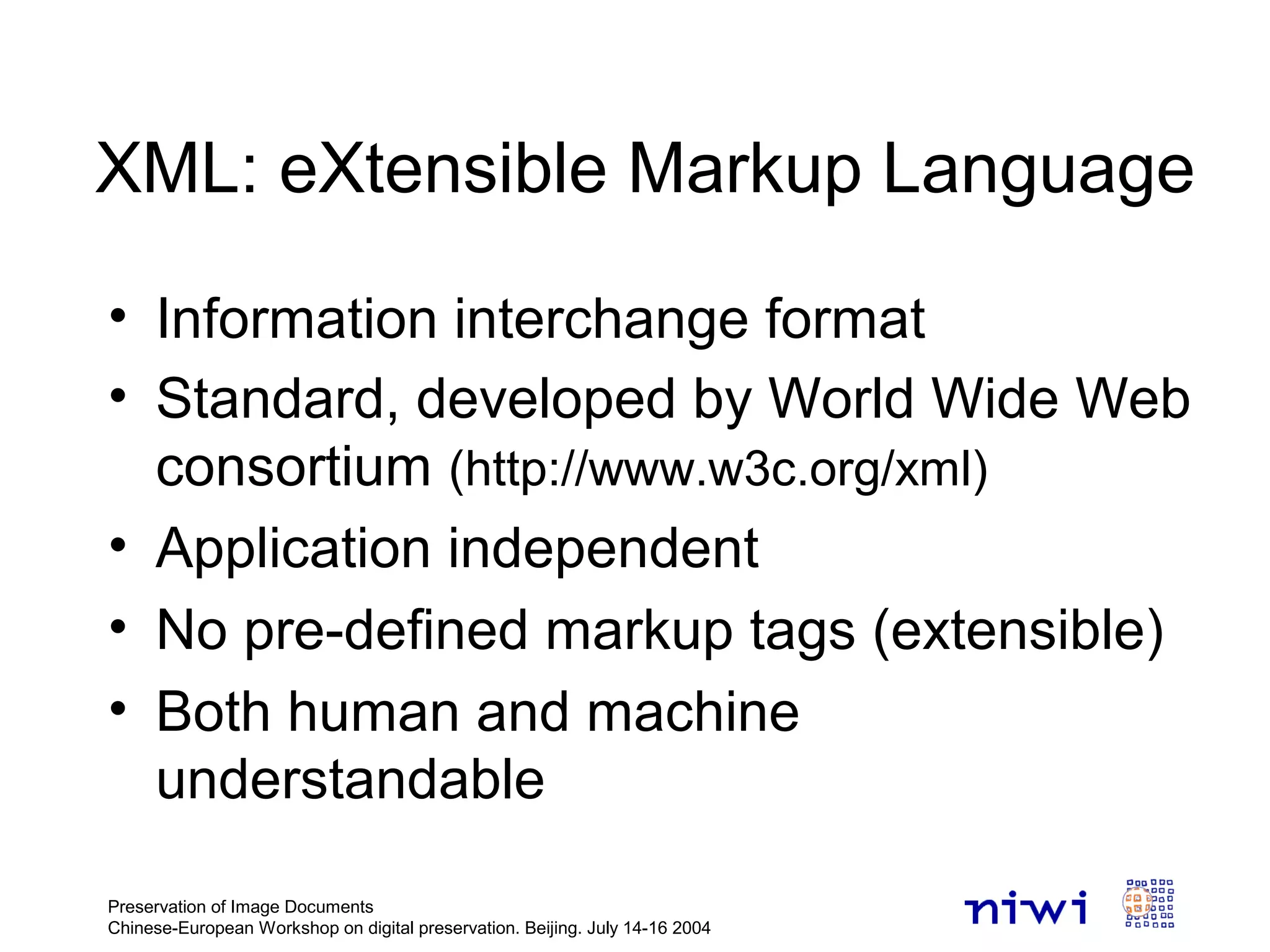
XML: eXtensible Markup Language
• Information interchange format
• Standard, developed by World Wide Web
consortium (http://www.w3c.org/xml)
• Application independent
• No pre-defined markup tags (extensible)
• Both human and machine
understandable
Preservation of Image Documents
Chinese-European Workshop on digital preservation. Beijing. July 14-16 2004
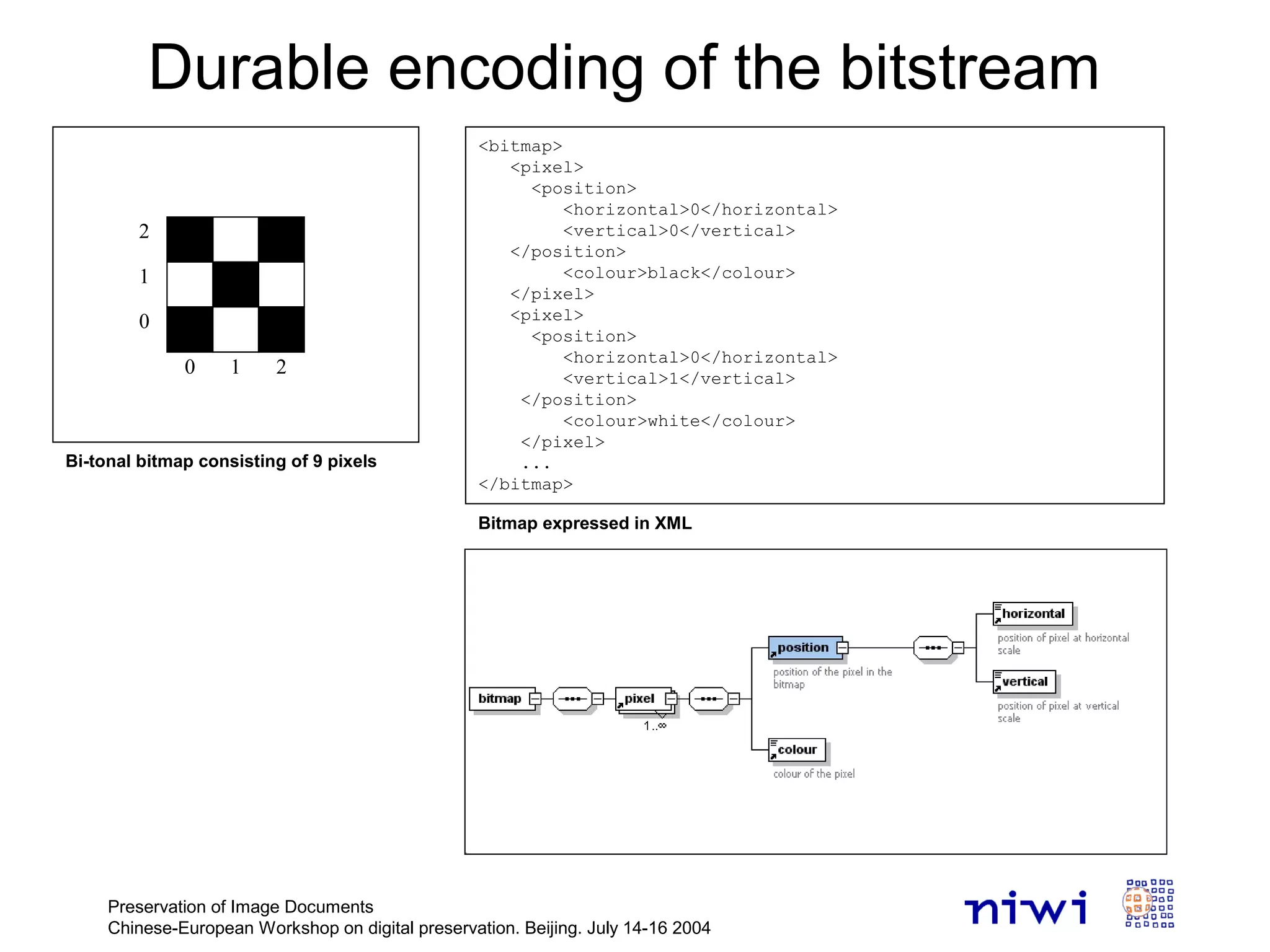
Durable encoding of the bitstream
0 1 2
2
0
1
Bi-tonal bitmap consisting of 9 pixels
<bitmap>
<pixel>
<position>
<horizontal>0</horizontal>
<vertical>0</vertical>
</position>
<colour>black</colour>
</pixel>
<pixel>
<position>
<horizontal>0</horizontal>
<vertical>1</vertical>
</position>
<colour>white</colour>
</pixel>
...
</bitmap>
Bitmap expressed in XML
Preservation of Image Documents
Chinese-European Workshop on digital preservation. Beijing. July 14-16 2004
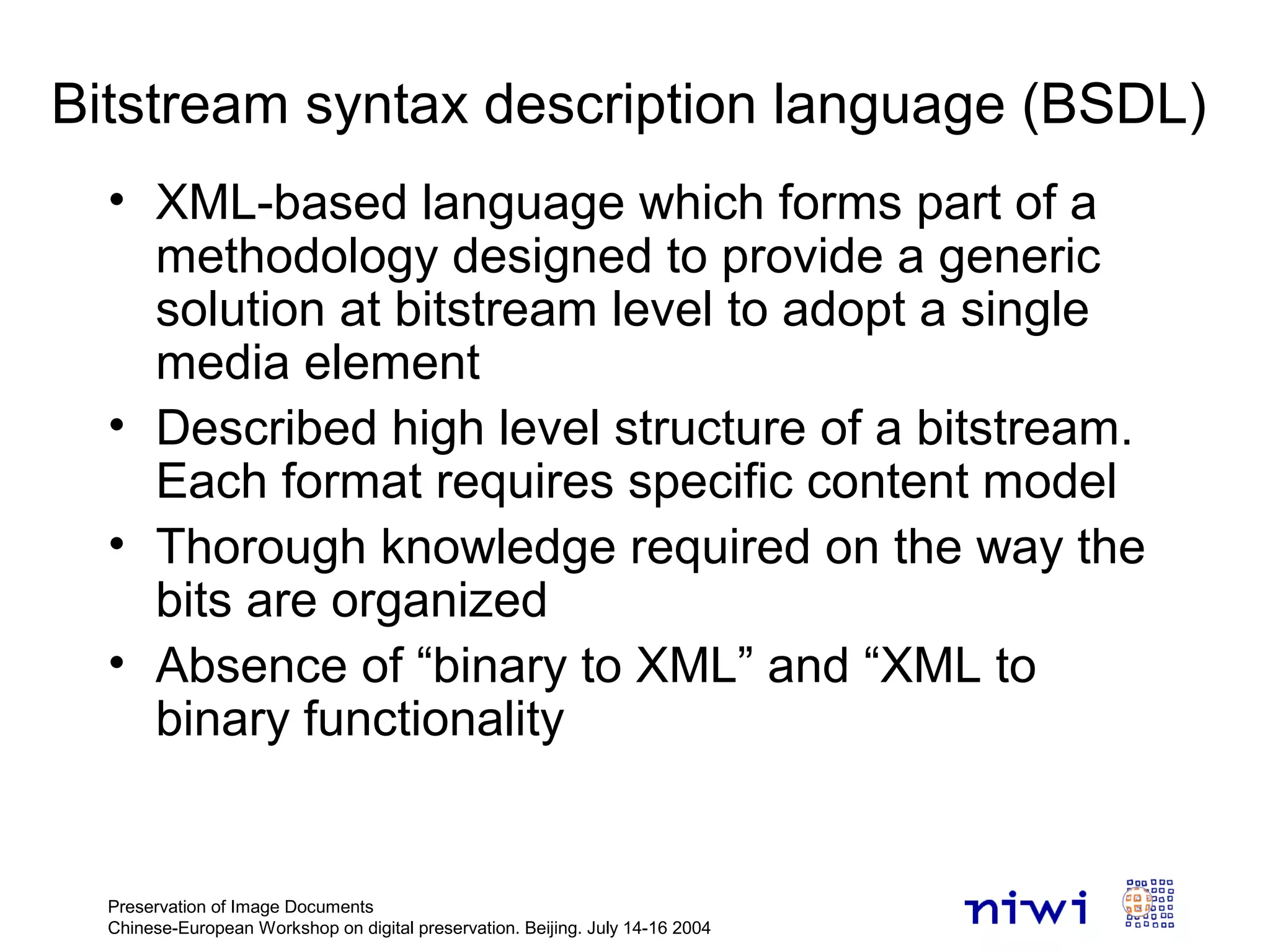
Digital image expressed in XML
• Expression of content model in XML
• Elements and attributes that are part of the
bitstream, e.g. standardized color coding of
pixels
• Binary to XML conversion
• Conversion of image format (e.g. TIFF) into
XML
• XML to binary conversion
• In the future
Preservation of Image Documents
Chinese-European Workshop on digital preservation. Beijing. July 14-16 2004
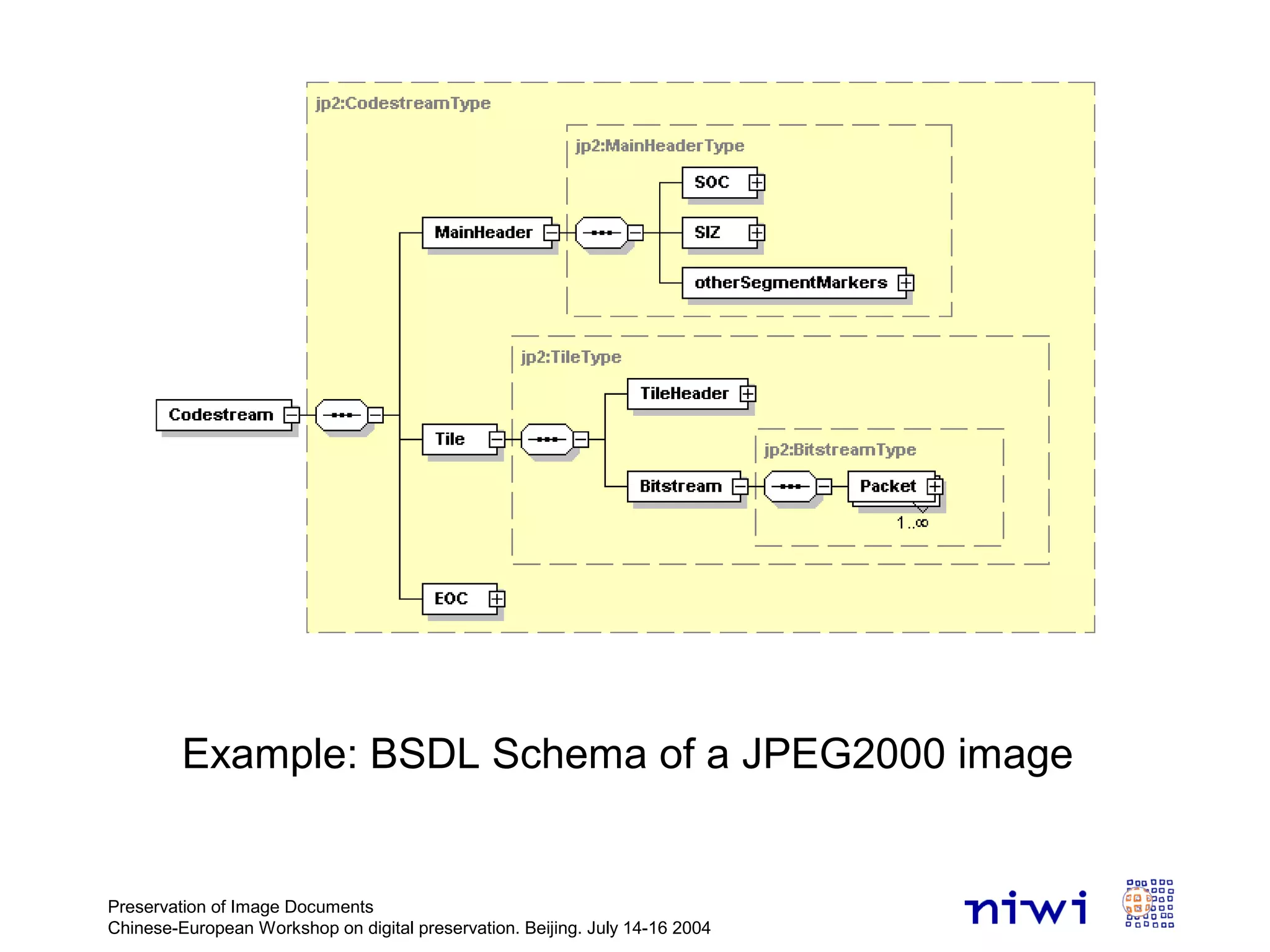
Bitstream syntax description language (BSDL)
• XML-based language which forms part of a
methodology designed to provide a generic
solution at bitstream level to adopt a single
media element
• Described high level structure of a bitstream.
Each format requires specific content model
• Thorough knowledge required on the way the
bits are organized
• Absence of “binary to XML” and “XML to
binary functionality
Preservation of Image Documents
Chinese-European Workshop on digital preservation. Beijing. July 14-16 2004
Example: BSDL Schema of a JPEG2000 image
Preservation of Image Documents
Chinese-European Workshop on digital preservation. Beijing. July 14-16 2004
Conclusions
• TIFF image file format often used as format
for digital master image (Adobe Systems Incorporated,
TIFF revision 6.0, Final – June 3, 1992
<http://partners.adobe.com/asn/developers/pdfs/tn/TIFF6.pdf>)
• Bitstream in XML format: more research
required
• Preservation metadata: application profiles &
registries help to ‘discriminate exactly what
we know vaguely’
Preservation of Image Documents
Chinese-European Workshop on digital preservation. Beijing. July 14-16 2004
"Theory without practice is empty.
Practice without theory is blind"
John Dewey

Image types &amp;fileformats

  • 1.
    Image file format •Each way of storing an image is called a file format • Each file format converts the image to a corresponding string of bits differently in order to store them on disk or transmit them over the Internet Preservation of Image Documents Chinese-European Workshop on digital preservation. Beijing. July 14-16 2004
  • 2.
    Images File formats …- PCX – PBM – TGA – TIFF – GIF – JPEG – PSD – DXF - CGM – PNG – SVG – RAW – WPG – FITS – BMP – PCD – RAS – TGA – BPS – EPS – PDF – PCT – WBM – FITS – XBM – VFF – RIB – PCX – DMP – AVS – IMG – ICO – JFIF – IFF – WMF - …
  • 3.
    Common File Formats BitmapFormats • GIF: graphics interchange format • JPEG: joint photographic experts group • PNG: portable network graphic • BMP: Windows bitmap • TIFF: tagged image file format Vector Formats • SVG : scalable vector graphics • EPS: encapsulated postscript • CMX: Corel meta exchange • PICT: Macintosh Picture • WMF: Windows metafile
  • 4.
    Image types • Blackand white image • Binary Image • Bit map mage • Gray scale image • Raster image • Multispectral Image Preservation of Image Documents Chinese-European Workshop on digital preservation. Beijing. July 14-16 2004
  • 5.
    • A bitmap (often spelled "bitmap") defines a display space and the color for each pixel or "bit" in the display space. A Graphics Interchange Format and a JPEG are examples of graphic image file types that contain bit maps. Preservation of Image Documents Chinese-European Workshop on digital preservation. Beijing. July 14-16 2004 BIT MAP Image
  • 6.
    BIT MAP Image Preservationof Image Documents Chinese-European Workshop on digital preservation. Beijing. July 14-16 2004
  • 7.
    Multi spectral image •A multispectral image is one that captures image data within specific wavelength ranges across the electromagnetic spectrum. Multispectral imaging measures light in a small number (typically 3 to 15) of spectral bands. Preservation of Image Documents Chinese-European Workshop on digital preservation. Beijing. July 14-16 2004
  • 8.
    Multi spectral image Preservationof Image Documents Chinese-European Workshop on digital preservation. Beijing. July 14-16 2004
  • 9.
    Raster image Preservation ofImage Documents Chinese-European Workshop on digital preservation. Beijing. July 14-16 2004 A raster graphics or bitmap image is a dot matrix data structure that represents a generally rectangular grid of pixels (points of color), viewable via a monitor, paper, or other display medium. Raster images are stored in image files with varying formats.
  • 10.
    Gray scale image •Grayscale is a range of shades of gray without apparent color. The darkest possible shade is black, which is the total absence of transmitted or reflected light. The lightest possible shade is white, the total transmission or reflection of light at all visible wavelength s. Intermediate shades of gray are represented by equal brightness levels of the three primary colors (red, green and blue) for transmitted light, or equal amounts of the three primary pigments (cyan, magenta and yellow) for reflected light. Preservation of Image Documents Chinese-European Workshop on digital preservation. Beijing. July 14-16 2004
  • 11.
    Gray scale image Preservationof Image Documents Chinese-European Workshop on digital preservation. Beijing. July 14-16 2004
  • 12.
    Binary Image • Abinary image is a digital image that has only two possible values for each pixel. Typically, the two colors used for a binary image are black and white. The color used for the object(s) in the image is the foreground color while the rest of the image is the background color. Preservation of Image Documents Chinese-European Workshop on digital preservation. Beijing. July 14-16 2004
  • 13.
    Binary image Preservation ofImage Documents Chinese-European Workshop on digital preservation. Beijing. July 14-16 2004
  • 14.
    Preservation of ImageDocuments Chinese-European Workshop on digital preservation. Beijing. July 14-16 2004 Source: Kenney, A. and O. Rieger, Moving theory into practice. Digital imaging for libraries and archives (Cornell University Library, 2000.
  • 15.
    Preservation of ImageDocuments Chinese-European Workshop on digital preservation. Beijing. July 14-16 2004 Graphic File Formats … - PCX – PBM – TGA – TIFF – GIF – JPEG – PSD – DXF - CGM – PNG – SVG – RAW – WPG – FITS – BMP – PCD – RAS – TGA – BPS – EPS – PDF – PCT – WBM – FITS – XBM – VFF – RIB – PCX – DMP – AVS – IMG – ICO – JFIF – IFF – WMF - …
  • 16.
    Preservation of ImageDocuments Chinese-European Workshop on digital preservation. Beijing. July 14-16 2004 Why are there so many different graphic file formats? • There are a number of fundamental different types of graphical data – raster data (sampled values) – geometry data (mathematical description of space) – latent image data (data transformed into useful images by some algorithmic process) • To prevent usage beyond control of the developer (Who remembers KodakPhoto CD?) • Wide range of design principles (Mainly ‘speed’ and ‘memory’)
  • 17.
    Preservation of ImageDocuments Chinese-European Workshop on digital preservation. Beijing. July 14-16 2004 Features of standard image file formats 1. Used by large community during a considerable period of time 2. Specifications must be in the public domain or published by SDO (standards developing organization) 3. Wide range of systems has to support the format 4. No data compression (loss of quality / higher risk) 5. Must contain facilities to store preservation metadata 6. Must enable coding of all significant characteristics of analogue original
  • 18.
    Preservation of ImageDocuments Chinese-European Workshop on digital preservation. Beijing. July 14-16 2004 00208a.tiff: Magic: 0x4949 <little-endian> Version: 0x2a Directory 0: offset 132610346 (0x7e7792a) next 0 (0) ImageWidth (256) SHORT (3) 1<9681> ImageLength (257) SHORT (3) 1<6849> BitsPerSample (258) SHORT (3) 1<16> Compression (259) SHORT (3) 1<1> Photometric (262) SHORT (3) 1<1> DocumentName (269) ASCII (2) 17<ppprs/00208a.tif0> StripOffsets (273) LONG (4) 2283<8 58094 116180 174266 232352 290438 348524 406610 464696 522782 580868 638954 697040 755126 813212 871298 929384 987470 1045556 1103642 1161728 1219814 1277900 1335986 ...> Orientation (274) SHORT (3) 1<1> SamplesPerPixel (277) SHORT (3) 1<1> RowsPerStrip (278) SHORT (3) 1<3> StripByteCounts (279) LONG (4) 2283<58086 58086 58086 58086 58086 58086 58086 58086 58086 58086 58086 58086 58086 58086 58086 58086 58086 58086 58086 58086 58086 58086 58086 58086 ...> XResolution (282) RATIONAL (5) 1<1425> YResolution (283) RATIONAL (5) 1<1425> PlanarConfig (284) SHORT (3) 1<1> ResolutionUnit (296) SHORT (3) 1<2> DateTime (306) ASCII (2) 20<2000:03:21 21:36:290> Artist (315) ASCII (2) 20<Library of Congress0> Example: TIFF file
  • 19.
    Preservation of ImageDocuments Chinese-European Workshop on digital preservation. Beijing. July 14-16 2004 XML: eXtensible Markup Language • Information interchange format • Standard, developed by World Wide Web consortium (http://www.w3c.org/xml) • Application independent • No pre-defined markup tags (extensible) • Both human and machine understandable
  • 20.
    Preservation of ImageDocuments Chinese-European Workshop on digital preservation. Beijing. July 14-16 2004 Durable encoding of the bitstream 0 1 2 2 0 1 Bi-tonal bitmap consisting of 9 pixels <bitmap> <pixel> <position> <horizontal>0</horizontal> <vertical>0</vertical> </position> <colour>black</colour> </pixel> <pixel> <position> <horizontal>0</horizontal> <vertical>1</vertical> </position> <colour>white</colour> </pixel> ... </bitmap> Bitmap expressed in XML
  • 21.
    Preservation of ImageDocuments Chinese-European Workshop on digital preservation. Beijing. July 14-16 2004 Digital image expressed in XML • Expression of content model in XML • Elements and attributes that are part of the bitstream, e.g. standardized color coding of pixels • Binary to XML conversion • Conversion of image format (e.g. TIFF) into XML • XML to binary conversion • In the future
  • 22.
    Preservation of ImageDocuments Chinese-European Workshop on digital preservation. Beijing. July 14-16 2004 Bitstream syntax description language (BSDL) • XML-based language which forms part of a methodology designed to provide a generic solution at bitstream level to adopt a single media element • Described high level structure of a bitstream. Each format requires specific content model • Thorough knowledge required on the way the bits are organized • Absence of “binary to XML” and “XML to binary functionality
  • 23.
    Preservation of ImageDocuments Chinese-European Workshop on digital preservation. Beijing. July 14-16 2004 Example: BSDL Schema of a JPEG2000 image
  • 24.
    Preservation of ImageDocuments Chinese-European Workshop on digital preservation. Beijing. July 14-16 2004 Conclusions • TIFF image file format often used as format for digital master image (Adobe Systems Incorporated, TIFF revision 6.0, Final – June 3, 1992 <http://partners.adobe.com/asn/developers/pdfs/tn/TIFF6.pdf>) • Bitstream in XML format: more research required • Preservation metadata: application profiles & registries help to ‘discriminate exactly what we know vaguely’
  • 25.
    Preservation of ImageDocuments Chinese-European Workshop on digital preservation. Beijing. July 14-16 2004 "Theory without practice is empty. Practice without theory is blind" John Dewey

Editor's Notes

  • #18 An obvious way to create durable digital objects is to use standardized file formats. A standard has the connotation of a well designed, widely used, and broad supported object. Empirically the requirements for standard data formats are given, followed by an assessment of existing data formats for digital raster files. A standard data format for digital objects must meet three conditions:  1.      A large community must use the data format during a considerable period of time. 2.      The specifications of the data format must be in the public domain or be published by a standards developing organization (SDO) such as ISO. 3.      A wide range of relevant systems has to support the format, such as image capture devices as well as image processing systems. For digital raster images acting as digital surrogates of historical photographs another three requirements for a standardized data format can be formulated:     Data compression should not be used due to a number of drawbacks. Most data compression leads to loss of image quality. Next to that a compressed image has a bigger risk to become unreadable in the future than an uncompressed digital image as a corrupt bit in a compressed image results in a “dead image”, chances are that a corrupt bit in an uncompressed image is just a “dead pixel”. 5.      A durable data format for digital surrogates of historical photographs should contain facilities to store preservation metadata. The quality and granularity of the metadata is an important factor for the future usage of the data format and thus its longevity. 6.      The image file format must enable the coding of all significant characteristics of the analogue original that it is based on. This means that all colors, details and the dynamic range of the original can be represented in the digital image.
  • #21 The fundamental unit of digital data is the binary digit or bit. A bit stream is the sequence of bits that make up a digital object such as a digital raster image. The specification of the data format prescribes the organization or the bit stream. By using non-proprietary data coding methods the data object will remain accessible in case new software or hardware is introduced. The correct interpretation of the bit stream is the most challenging problem to be solved. For this a durable data structure of the bit stream is required as well as a method to interpret the data in a sensible way. To a large extent the dependence on specific software and hardware for the processing of digital objects can be avoided by using the XML data format. This standardized data format is considered as self-descriptive and it does not require proprietary software to get access to the data. An essential requirement to access an XML formatted bit stream is to recognize the internal character encoding of the XML file. The auto detection or bootstrap mechanism of the XML encoding declaration is based on the ISO/IEC 10646 standard. This standard contains the legal binary codes that can be used for the markup codes or character data in the XML file. The XML markup codes are restricted in position and content to enable auto detecting the applied character encoding in use. According to the standard the first sequence of characters of an XML file must be &amp;lt;?xml&amp;gt;. The XML processor must detect this sequence of characters. After reading two or four octets the processor will be able to understand the byte ordering method and thus solve the bootstrapping problem.
  • #22 The following three functions are important regarding the creation and usage of a bit stream representing a digital image expressed in XML:   ·        Expression of the content model in XML. The determination of the elements and attributes that are part of the image bit stream. The quality of the image file formatted in XML improves if the content model on which the XML instantiation is based meets the features of a standardized rich image file format. ·        Binary to XML conversion. A generator is required that converts the binary image, e.g. in TIFF standard into an XML formatted file. This conversion process must of course take a content model into consideration. The content model must cover all features of the binary image file format. XML to binary conversion. The conversion of the XML formatted bit stream representing the digital image into a binary format that can be processed by a (future) computer platform. The archived, original binary format needs to be re-generated since it is the only understandable and usable format for the final user.
  • #23 BSDL is developed to enhance the interoperability between different multimedia formats. A main benefit of BSDL is that objects expressed in XML according to BSDL are easily accessible by text retrieval engines and that multi-layered multimedia objects can be manipulated on an individual layer basis. The XML representation of the bit stream enables the definition of editing operations on the XML document e.g. by modifying some element or attribute values. For each binary format a specific content model is required and adjusted for the specific features of the binary format. The application of BSDL requires thorough knowledge on the multimedia format with respect to the way the bits are organized. BSDL uses the W3C style sheet language XSLT to transform the XML descriptions of multimedia formats. This transformation does not result in a binary object. The XSLT transformation results in a “transformed XML description” and must be converted into a binary bit stream. An XSLT style sheet contains one or several templates defining the modifications to be applied to the elements or to the attributes matching a set of conditions. The result of the XSLT transformation is also an XML file “from which it is possible to re-generate an adapted and compliant bit stream from the resulting description”. The value of the BSDL approach for creating durable digital surrogates of historical photographs can be determined when the file format used for digital master images (e.g. TIFF 6.0) is expressed in BSDL and when the system as described in the system architecture is implemented. A strong point of BSDL is that it provides a framework for the expression of a binary format resulting in a durable expression of this format. The absence of “XML to binary” and “binary to XML” functionality is a drawback of this method in its current state.
  • #25 A number of quality requirements for durable digital surrogates of historical photographs are distinguished. The conversion process must be based on benchmarked settings. In case high quality digital master images are created the long-term access and usage requires special attention. Despite the fact that it is impossible to predict which method in the end will be the most efficient, some methods currently available can be assessed as building blocks for durable digital surrogates of historical photographs, or permanent pixels. These methods are: the application of image file format standards, the expression of the digital surrogate in the XML data format and the creation and employment of preservation metadata. This paper reports on research to what extent assessed durability building blocks can be realized in practical situations.