International Research Journal of Engineering and Technology (IRJET) e-ISSN: 2395-0056
Volume: 09 Issue: 06 | June 2022 www.irjet.net p-ISSN: 2395-0072
© 2022, IRJET | Impact Factor value: 7.529 | ISO 9001:2008 Certified Journal | Page 2105
Image Forgery / Tampering Detection Using Deep Learning and Cloud
Misbah Shaikh1, Dr. Dipak Patil 2
1Student, Department of Computer Engineering, Gokhale Education Society's, R. H. Sapat College of Engineering,
Management Studies and Research, Nashik, India
2 Professor ,Department of Computer Engineering, Gokhale Education Society's, R. H. Sapat College of Engineering,
Management Studies and Research, Nashik, India
---------------------------------------------------------------------***---------------------------------------------------------------------
Abstract - Cybercrime has becomemoreprevalentinrecent
years. With modern photo editing tools as widely available as
ever, it has been demonstrated that creating phony papers is
incredibly simple [1]. With the help of this tool, which offers
tools for doing so, documents can be scanned and forged in
minutes. While photo editing software is convenient and
widely available, there are also deft methods for investigating
these transformed documents. This study presents a
framework for investigating digitally modified documents as
well as a way of distinguishing between an original document
and a digitally morphing document. we created a web
application to detect digitally modified photos. This method
has more than 95.0 percent accuracy and has proven to be
efficient and useful. Recent work on forgery detection using
neural networks has proven to be very effective in detecting
image forgery additionally we are using Azure Form
recognizer service to read data from documents and verify it
on the server, this dual approach makes the systemrobustand
very accurate. Deep Learning methods are capable of
extracting complex features inanimage, resultinginincreased
accuracy. In contrast to traditional methods of forgery
detection, a deep learning model automatically builds the
required features, and as a result, it has emerged as a new
area of study in image forgery.
Key Words: morphed document, Azure form recognizer,
CNN, Deep learning, neural network.
1. INTRODUCTION
With the tremendous technological improvement that has
boosted the progress of every industry imaginable, one of
which is security, it has also become easier to break it [2].
Legal documents can be stolen and faked, but criminal
evidence, such as photographs and security footage,canalso
be easily tampered with. One may believe that checking IDs
at the front gate is sufficient for an institution, but they do
not comprehend how simple it is for a criminal to obtain
false IDs. Even for inexperienced crooks, posing as someone
else in public is a simple task. As previously stated, photo
editing tools are not only easily available but also incredibly
user-friendly. Even if you've never used picture editing
software before, you can master fundamental photo editing
techniques in a few hours. Photo editing is no longer
particularly advanced, and counterfeiting has grown even
more difficult to detect. Motives for generating forged
photographs might range from financial gain to spreading
rumors or making false claims in one's favor.
Deep learning is revolutionizing the fieldofcomputervision,
which is already expanding [3]. A CNN is a cutting-edgedeep
learning technology that learns high-level characteristics
from a vast collection of labelled images. Ink analysis in
document image processing allows for the determination of
ink age and forgery, as well as the identification ofthepen or
writer. Ink spectral information in hyperspectral document
pictures providesessential informationabouttheunderlying
material, assisting in the identification and discriminationof
inks based on their distinct spectral signatures, even though
they are the same hue.
1.1 LITERATURE REVIEW
A System Based on Intrinsic Properties for Fraudulent
Document Detection, the authors offer an automatic forgery
detection system based on the intrinsic features of the
document at the character level in this study [4]. This
method is based on outlier character detection in a
categorical feature space on the one hand, and strictly
similar character detection ontheother.Asa result,a feature
set is computed for each character. The character is then
classed as authentic or fraudulentdependingonthedistance
between characters of the same class. Local Binary Patterns
for Detecting Document Forgery.
The authors of this study [5] describe a classification-based
technique to forgery detection. The author employsuniform
Local Binary Patterns (LBP) to capturediscriminanttextural
characteristics seen in fabricated regions. Furthermore, the
author combines numerous descriptors from nearby
locations to simulate contextual information. The results of
patch classification using Support Vector Machines (SVM)
reveal that people canrecognizenumeroustypesofforgeries
in a wide range of document categories.
This study [6] introduces a new method for detecting fake
documents. The proposed method is based on network
science methodologies for assessing ink spectrums of
documents to determinewhethertheywerecounterfeitedor
fabricated. Laser-Induced Breakdown Spectroscopy is
utilized to extract the spectrums of the original and
International Research Journal of Engineering and Technology (IRJET) e-ISSN: 2395-0056
Volume: 09 Issue: 06 | June 2022 www.irjet.net p-ISSN: 2395-0072
© 2022, IRJET | Impact Factor value: 7.529 | ISO 9001:2008 Certified Journal | Page 2106
questioned documents for this purpose. The retrieved
spectrums are organized to produce a dataset with nodes
and edges. The dataset is then utilized to construct a
network of spectrums representing both the original and
disputed documents. The created network is then displayed
and grouped. The detection technique is primarily based on
data provided by network clusters (e.g., numberofclusters).
The results demonstrated that the proposed method was
effective at differentiating documents.
1.2 MODELING AND ANALYSIS
Its primary purpose is to create a trustworthy and effective
framework for detecting image forgeries. Figure 1 depicts
the overall framework of our approach. This structure is
classified into two sections.
The first section uses a cloud service (Azure form
recognizer) to grab data from uploaded documentsandthen
validate the data with the database. The second section
includes all image processing operations. In this section, we
also show how crucial it is to focus on the qualityoftheinput
data when tryingtoimproveresilience.Convolutional Neural
Networks are then used to explain the classification
approach for recognizing bogus documents. The following
section dives deep into our CNN, allowing us to better
understand and develop our framework. Finally, we used a
forgery detection application to put our proposed
framework to the test. CNN architecture is divided into two
parts: Feature-Extraction and Classification. CNN consists
following layers – An input layer, convolution layer, pooling
layer, and fully-connected layer. in the second phase, we are
using the azure form recognizer the fetch data from the
image and validate fetched data on the server. this approach
makes the proposed system very accurate. As a result, the
applicate is more resilient and precise than conventional
solutions. Form Recognizer inspects your documents and
forms, extracting text and data, mapping field relationships
as key-value pairs, and producing structured JSON output.
Without a lot of manual work or substantial data science
knowledge, you can get accurate answers quickly that are
tailored to your specific content.
2. RESULTS AND DISCUSSION
In this section, we presented the dataset we worked with
and demonstrated the results and visualization. We
evaluated our models using train accuracy, training loss,
validation accuracy, and validation loss to derive
conclusions.
a) Dataset - We used the CASIA V2.0 Image Tampering
Detection Evaluation Database in our research to
compare and evaluate tampering detection
techniques. This dataset is publicly and easily
available for research. It is a dataset for forgery
classification that is divided into two classes:
tampered/fake and real/original, as illustrated in
fig.5. It contains almost 12,000 coloredphotos,with
7000+ authentic and 5000+ altered images.
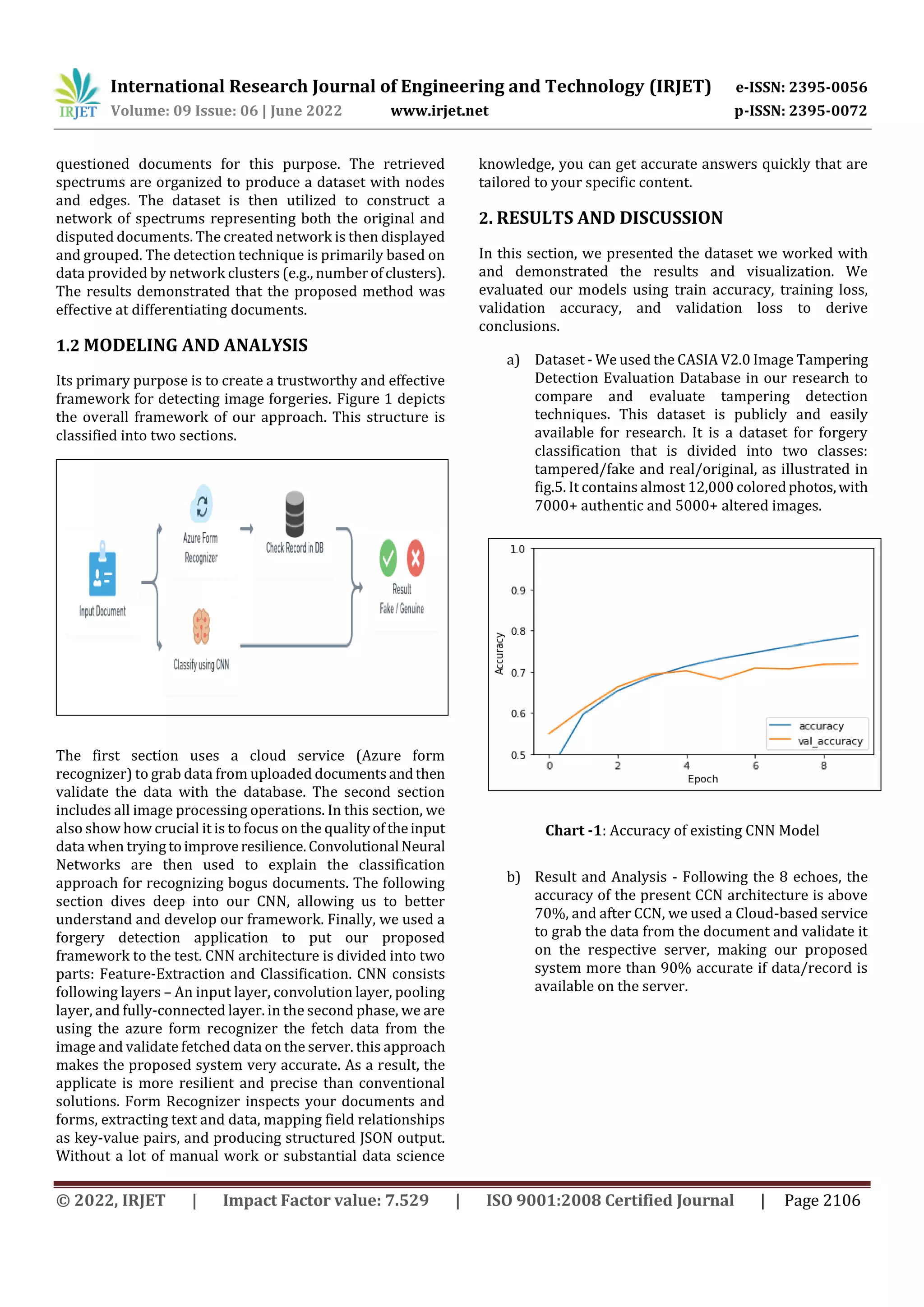
Chart -1: Accuracy of existing CNN Model
b) Result and Analysis - Following the 8 echoes, the
accuracy of the present CCN architecture is above
70%, and after CCN, we used a Cloud-based service
to grab the data from the document and validate it
on the respective server, making our proposed
system more than 90% accurate if data/record is
available on the server.
International Research Journal of Engineering and Technology (IRJET) e-ISSN: 2395-0056
Volume: 09 Issue: 06 | June 2022 www.irjet.net p-ISSN: 2395-0072
© 2022, IRJET | Impact Factor value: 7.529 | ISO 9001:2008 Certified Journal | Page 2107
Fig -1: Landing Page of Application
Fig -2: Landing Page of Application
3. CONCLUSION
According to the essential survey, there are two ways of
detecting tampering: (i) traditional and (ii) deep learning.
Traditional ways for detecting tampering include hand-
crafted qualities. According to the results of the survey,
traditional approaches do not operate consistently across
diverse tampering methods. Instead, Deep Learning-based
algorithms have been demonstrated to be capable of
automatically learning abstract and complicated attributes
required for the identification of tampered regions.
REFERENCES
[1] H. Benhamza, A. Djeffal and A. Cheddad, "Image
forgery detection review," 2021 International
Conference on Information Systems and Advanced
Technologies (ICISAT), 2021, pp. 1-7, doi:
10.1109/ICISAT54145.2021.9678207.
[2] Challenges: An Opportunity to Craft Smarter
Responses? CAMINO KAVANAGH, AUGUST 28, 2019
[Online], Available at: https://carnegieendowment.org
/ 2019 / 08 / 28 / new -tech -new-threats - and -new -
governance – challenges -opportunity -to-craft-smarter
-responses-pub-79736.
[3] Khan, Zohaib & Shafait,Faisal &Mian,Ajmal.(2013).
Hyperspectral Imaging for Ink Mismatch Detection.
Proceedings of the International Conference on
Document Analysis and Recognition, ICDAR. 877-881.
10.1109/ICDAR.2013.179.
[4] Bertrand, Romain & Gomez-Krämer, Petra &
Terrades, Oriol & Franco, Patrick & Ogier, Jean-Marc.
(2013). A System Based on Intrinsic Features for
Fraudulent Document Detection. Proceedings of the
International Conference on Document Analysis and
Recognition, ICDAR. 106-110. 10.1109/ICDAR.2013.29.
[5] F. Cruz, N. Sidère, M. Coustaty, V. P. D'Andecyand J. -
M. Ogier, "Local Binary Patterns for Document Forgery
Detection," 2017 14th IAPR International Conferenceon
Document Analysis and Recognition (ICDAR), 2017, pp.
1223-1228, doi: 10.1109/ICDAR.2017.202.
[6] A. Amjed, B. Mahmood and K. A. K. AlMukhtar,
"Network Science as a Forgery Detection Tool in Digital
Forensics," 2021 IEEE International Conference on
Communication, Networks and Satellite(COMNETSAT),
2021, pp. 200-205, doi:
10.1109/COMNETSAT53002.2021.9530776.
[7] Malvika Ranjan, Manasi RajivWeginwar, Neha Joshi
and Prof. A.B. Ingole Detection and Classification of Leaf
Disease Using Artificial Neural Network, 2019.
[8] Jaiswal, Garima & Sharma, Arun & Yadav, Sumit.
(2022). Deep feature extraction for document forgery
detection with convolutional autoencoders. Computers
& Electrical Engineering. 99. 107770.
10.1016/j.compeleceng.2022.107770.
[9] Bibi, Maryam & Hamid, Anmol & Moetesum,
Momina & Siddiqi, Imran. (2019). Document Forgery
Detection using Printer Source Identification—A Text-
Independent Approach. 7-12.
10.1109/ICDARW.2019.70134.
International Research Journal of Engineering and Technology (IRJET) e-ISSN: 2395-0056
Volume: 09 Issue: 06 | June 2022 www.irjet.net p-ISSN: 2395-0072
© 2022, IRJET | Impact Factor value: 7.529 | ISO 9001:2008 Certified Journal | Page 2108
[10] Khan, Muhammad&Yousaf, Adeel &Abbas,
Asad & Khurshid, Khurram. (2018). Deep Learning for
Automated Forgery Detection in Hyperspectral
Document Images. Journal of Electronic Imaging. 27.
053001. 10.1117/1.JEI.27.5.053001.
[11] Ahmed, Amr & Shafait, Faisal. (2014).
Forgery Detection Based on Intrinsic Document
Contents. Proceedings - 11th IAPR International
Workshop on Document Analysis Systems, DAS 2014.
252-256. 10.1109/DAS.2014.26.
[12] How to build a real-time live dashboard
with Streamlit, By AbdulMajedRaja RS, Posted in
Community, April 21 2022[Online] Available at:
https://blog.streamlit.io/how-to-build-a-real-time-live-
dashboard-with-streamlit/.
[13] A Beginner’s Guide to matplotlib for Data
Visualization and Exploration in Python, Aniruddha
Bhandari — February 28, 2020 [Online] Available at:
https://www.analyticsvidhya.com / blog / 2020 / 02/
beginner -guide -matplotlib -data – visualization -
exploration - python/.
[14] Srivastava, Sahima & Rastogi, Vrinda &
Jaiswal, Garima & Sharma, Arun. (2022). Hyperspectral
Imaging in Document Forgery. 10.1007/978-981-16-
6289-8_11.
[15] Khan, Muhammad&Yousaf, Adeel &Abbas,
Asad & Khurshid, Khurram. (2018). Deep Learning for
Automated Forgery Detection in Hyperspectral
Document Images. Journal of Electronic Imaging. 27.
053001. 10.1117/1.JEI.27.5.053001.
[16] Bashir, Alsadig & Fadlalla, Yahia. (2017).
Techniques in Detecting Forgery in IdentityDocuments.

Image Forgery / Tampering Detection Using Deep Learning and Cloud

  • 1.
    International Research Journalof Engineering and Technology (IRJET) e-ISSN: 2395-0056 Volume: 09 Issue: 06 | June 2022 www.irjet.net p-ISSN: 2395-0072 © 2022, IRJET | Impact Factor value: 7.529 | ISO 9001:2008 Certified Journal | Page 2105 Image Forgery / Tampering Detection Using Deep Learning and Cloud Misbah Shaikh1, Dr. Dipak Patil 2 1Student, Department of Computer Engineering, Gokhale Education Society's, R. H. Sapat College of Engineering, Management Studies and Research, Nashik, India 2 Professor ,Department of Computer Engineering, Gokhale Education Society's, R. H. Sapat College of Engineering, Management Studies and Research, Nashik, India ---------------------------------------------------------------------***--------------------------------------------------------------------- Abstract - Cybercrime has becomemoreprevalentinrecent years. With modern photo editing tools as widely available as ever, it has been demonstrated that creating phony papers is incredibly simple [1]. With the help of this tool, which offers tools for doing so, documents can be scanned and forged in minutes. While photo editing software is convenient and widely available, there are also deft methods for investigating these transformed documents. This study presents a framework for investigating digitally modified documents as well as a way of distinguishing between an original document and a digitally morphing document. we created a web application to detect digitally modified photos. This method has more than 95.0 percent accuracy and has proven to be efficient and useful. Recent work on forgery detection using neural networks has proven to be very effective in detecting image forgery additionally we are using Azure Form recognizer service to read data from documents and verify it on the server, this dual approach makes the systemrobustand very accurate. Deep Learning methods are capable of extracting complex features inanimage, resultinginincreased accuracy. In contrast to traditional methods of forgery detection, a deep learning model automatically builds the required features, and as a result, it has emerged as a new area of study in image forgery. Key Words: morphed document, Azure form recognizer, CNN, Deep learning, neural network. 1. INTRODUCTION With the tremendous technological improvement that has boosted the progress of every industry imaginable, one of which is security, it has also become easier to break it [2]. Legal documents can be stolen and faked, but criminal evidence, such as photographs and security footage,canalso be easily tampered with. One may believe that checking IDs at the front gate is sufficient for an institution, but they do not comprehend how simple it is for a criminal to obtain false IDs. Even for inexperienced crooks, posing as someone else in public is a simple task. As previously stated, photo editing tools are not only easily available but also incredibly user-friendly. Even if you've never used picture editing software before, you can master fundamental photo editing techniques in a few hours. Photo editing is no longer particularly advanced, and counterfeiting has grown even more difficult to detect. Motives for generating forged photographs might range from financial gain to spreading rumors or making false claims in one's favor. Deep learning is revolutionizing the fieldofcomputervision, which is already expanding [3]. A CNN is a cutting-edgedeep learning technology that learns high-level characteristics from a vast collection of labelled images. Ink analysis in document image processing allows for the determination of ink age and forgery, as well as the identification ofthepen or writer. Ink spectral information in hyperspectral document pictures providesessential informationabouttheunderlying material, assisting in the identification and discriminationof inks based on their distinct spectral signatures, even though they are the same hue. 1.1 LITERATURE REVIEW A System Based on Intrinsic Properties for Fraudulent Document Detection, the authors offer an automatic forgery detection system based on the intrinsic features of the document at the character level in this study [4]. This method is based on outlier character detection in a categorical feature space on the one hand, and strictly similar character detection ontheother.Asa result,a feature set is computed for each character. The character is then classed as authentic or fraudulentdependingonthedistance between characters of the same class. Local Binary Patterns for Detecting Document Forgery. The authors of this study [5] describe a classification-based technique to forgery detection. The author employsuniform Local Binary Patterns (LBP) to capturediscriminanttextural characteristics seen in fabricated regions. Furthermore, the author combines numerous descriptors from nearby locations to simulate contextual information. The results of patch classification using Support Vector Machines (SVM) reveal that people canrecognizenumeroustypesofforgeries in a wide range of document categories. This study [6] introduces a new method for detecting fake documents. The proposed method is based on network science methodologies for assessing ink spectrums of documents to determinewhethertheywerecounterfeitedor fabricated. Laser-Induced Breakdown Spectroscopy is utilized to extract the spectrums of the original and
  • 2.
    International Research Journalof Engineering and Technology (IRJET) e-ISSN: 2395-0056 Volume: 09 Issue: 06 | June 2022 www.irjet.net p-ISSN: 2395-0072 © 2022, IRJET | Impact Factor value: 7.529 | ISO 9001:2008 Certified Journal | Page 2106 questioned documents for this purpose. The retrieved spectrums are organized to produce a dataset with nodes and edges. The dataset is then utilized to construct a network of spectrums representing both the original and disputed documents. The created network is then displayed and grouped. The detection technique is primarily based on data provided by network clusters (e.g., numberofclusters). The results demonstrated that the proposed method was effective at differentiating documents. 1.2 MODELING AND ANALYSIS Its primary purpose is to create a trustworthy and effective framework for detecting image forgeries. Figure 1 depicts the overall framework of our approach. This structure is classified into two sections. The first section uses a cloud service (Azure form recognizer) to grab data from uploaded documentsandthen validate the data with the database. The second section includes all image processing operations. In this section, we also show how crucial it is to focus on the qualityoftheinput data when tryingtoimproveresilience.Convolutional Neural Networks are then used to explain the classification approach for recognizing bogus documents. The following section dives deep into our CNN, allowing us to better understand and develop our framework. Finally, we used a forgery detection application to put our proposed framework to the test. CNN architecture is divided into two parts: Feature-Extraction and Classification. CNN consists following layers – An input layer, convolution layer, pooling layer, and fully-connected layer. in the second phase, we are using the azure form recognizer the fetch data from the image and validate fetched data on the server. this approach makes the proposed system very accurate. As a result, the applicate is more resilient and precise than conventional solutions. Form Recognizer inspects your documents and forms, extracting text and data, mapping field relationships as key-value pairs, and producing structured JSON output. Without a lot of manual work or substantial data science knowledge, you can get accurate answers quickly that are tailored to your specific content. 2. RESULTS AND DISCUSSION In this section, we presented the dataset we worked with and demonstrated the results and visualization. We evaluated our models using train accuracy, training loss, validation accuracy, and validation loss to derive conclusions. a) Dataset - We used the CASIA V2.0 Image Tampering Detection Evaluation Database in our research to compare and evaluate tampering detection techniques. This dataset is publicly and easily available for research. It is a dataset for forgery classification that is divided into two classes: tampered/fake and real/original, as illustrated in fig.5. It contains almost 12,000 coloredphotos,with 7000+ authentic and 5000+ altered images. Chart -1: Accuracy of existing CNN Model b) Result and Analysis - Following the 8 echoes, the accuracy of the present CCN architecture is above 70%, and after CCN, we used a Cloud-based service to grab the data from the document and validate it on the respective server, making our proposed system more than 90% accurate if data/record is available on the server.
  • 3.
    International Research Journalof Engineering and Technology (IRJET) e-ISSN: 2395-0056 Volume: 09 Issue: 06 | June 2022 www.irjet.net p-ISSN: 2395-0072 © 2022, IRJET | Impact Factor value: 7.529 | ISO 9001:2008 Certified Journal | Page 2107 Fig -1: Landing Page of Application Fig -2: Landing Page of Application 3. CONCLUSION According to the essential survey, there are two ways of detecting tampering: (i) traditional and (ii) deep learning. Traditional ways for detecting tampering include hand- crafted qualities. According to the results of the survey, traditional approaches do not operate consistently across diverse tampering methods. Instead, Deep Learning-based algorithms have been demonstrated to be capable of automatically learning abstract and complicated attributes required for the identification of tampered regions. REFERENCES [1] H. Benhamza, A. Djeffal and A. Cheddad, "Image forgery detection review," 2021 International Conference on Information Systems and Advanced Technologies (ICISAT), 2021, pp. 1-7, doi: 10.1109/ICISAT54145.2021.9678207. [2] Challenges: An Opportunity to Craft Smarter Responses? CAMINO KAVANAGH, AUGUST 28, 2019 [Online], Available at: https://carnegieendowment.org / 2019 / 08 / 28 / new -tech -new-threats - and -new - governance – challenges -opportunity -to-craft-smarter -responses-pub-79736. [3] Khan, Zohaib & Shafait,Faisal &Mian,Ajmal.(2013). Hyperspectral Imaging for Ink Mismatch Detection. Proceedings of the International Conference on Document Analysis and Recognition, ICDAR. 877-881. 10.1109/ICDAR.2013.179. [4] Bertrand, Romain & Gomez-Krämer, Petra & Terrades, Oriol & Franco, Patrick & Ogier, Jean-Marc. (2013). A System Based on Intrinsic Features for Fraudulent Document Detection. Proceedings of the International Conference on Document Analysis and Recognition, ICDAR. 106-110. 10.1109/ICDAR.2013.29. [5] F. Cruz, N. Sidère, M. Coustaty, V. P. D'Andecyand J. - M. Ogier, "Local Binary Patterns for Document Forgery Detection," 2017 14th IAPR International Conferenceon Document Analysis and Recognition (ICDAR), 2017, pp. 1223-1228, doi: 10.1109/ICDAR.2017.202. [6] A. Amjed, B. Mahmood and K. A. K. AlMukhtar, "Network Science as a Forgery Detection Tool in Digital Forensics," 2021 IEEE International Conference on Communication, Networks and Satellite(COMNETSAT), 2021, pp. 200-205, doi: 10.1109/COMNETSAT53002.2021.9530776. [7] Malvika Ranjan, Manasi RajivWeginwar, Neha Joshi and Prof. A.B. Ingole Detection and Classification of Leaf Disease Using Artificial Neural Network, 2019. [8] Jaiswal, Garima & Sharma, Arun & Yadav, Sumit. (2022). Deep feature extraction for document forgery detection with convolutional autoencoders. Computers & Electrical Engineering. 99. 107770. 10.1016/j.compeleceng.2022.107770. [9] Bibi, Maryam & Hamid, Anmol & Moetesum, Momina & Siddiqi, Imran. (2019). Document Forgery Detection using Printer Source Identification—A Text- Independent Approach. 7-12. 10.1109/ICDARW.2019.70134.
  • 4.
    International Research Journalof Engineering and Technology (IRJET) e-ISSN: 2395-0056 Volume: 09 Issue: 06 | June 2022 www.irjet.net p-ISSN: 2395-0072 © 2022, IRJET | Impact Factor value: 7.529 | ISO 9001:2008 Certified Journal | Page 2108 [10] Khan, Muhammad&Yousaf, Adeel &Abbas, Asad & Khurshid, Khurram. (2018). Deep Learning for Automated Forgery Detection in Hyperspectral Document Images. Journal of Electronic Imaging. 27. 053001. 10.1117/1.JEI.27.5.053001. [11] Ahmed, Amr & Shafait, Faisal. (2014). Forgery Detection Based on Intrinsic Document Contents. Proceedings - 11th IAPR International Workshop on Document Analysis Systems, DAS 2014. 252-256. 10.1109/DAS.2014.26. [12] How to build a real-time live dashboard with Streamlit, By AbdulMajedRaja RS, Posted in Community, April 21 2022[Online] Available at: https://blog.streamlit.io/how-to-build-a-real-time-live- dashboard-with-streamlit/. [13] A Beginner’s Guide to matplotlib for Data Visualization and Exploration in Python, Aniruddha Bhandari — February 28, 2020 [Online] Available at: https://www.analyticsvidhya.com / blog / 2020 / 02/ beginner -guide -matplotlib -data – visualization - exploration - python/. [14] Srivastava, Sahima & Rastogi, Vrinda & Jaiswal, Garima & Sharma, Arun. (2022). Hyperspectral Imaging in Document Forgery. 10.1007/978-981-16- 6289-8_11. [15] Khan, Muhammad&Yousaf, Adeel &Abbas, Asad & Khurshid, Khurram. (2018). Deep Learning for Automated Forgery Detection in Hyperspectral Document Images. Journal of Electronic Imaging. 27. 053001. 10.1117/1.JEI.27.5.053001. [16] Bashir, Alsadig & Fadlalla, Yahia. (2017). Techniques in Detecting Forgery in IdentityDocuments.