CMPT365 Multimedia Systems 1
Media Compression
- Image
Spring 2015
CMPT 365 Multimedia Systems
CMPT365 Multimedia Systems 2
Facts about JPEG
 JPEG - Joint Photographic Experts Group
 International standard: 1992
 Most popular format
 Other formats (.bmp) use similar techniques
 Lossy image compression
 transform coding using the DCT
 JPEG 2000
 New generation of JPEG – well, never succeeds
 DWT (Discrete Wavelet Transform)
CMPT365 Multimedia Systems 3
Three Major Observations
 Observation 1:
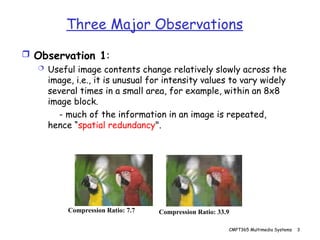
 Useful image contents change relatively slowly across the
image, i.e., it is unusual for intensity values to vary widely
several times in a small area, for example, within an 8x8
image block.
- much of the information in an image is repeated,
hence “spatial redundancy".
Compression Ratio: 7.7 Compression Ratio: 33.9
CMPT365 Multimedia Systems 4
Observations
 Observation 2:
 Psychophysical experiments suggest that humans are
much less likely to notice the loss of very high spatial
frequency components than the loss of lower frequency
components.
- the spatial redundancy can be reduced by largely
reducing the high spatial frequency contents.
Compression Ratio: 7.7 Compression Ratio: 33.9
CMPT365 Multimedia Systems 5
Observations
 Observation 3:
 Visual acuity (accuracy in distinguishing closely spaced
lines) is much greater for gray (black and white) than for
color.
- chroma subsampling (4:2:0) is used in JPEG.
CMPT365 Multimedia Systems 6
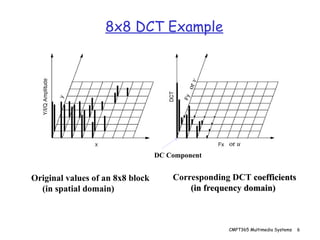
8x8 DCT Example
Original values of an 8x8 block
(in spatial domain)
Corresponding DCT coefficients
coefficients
(in frequency domain)
DC Component
or u
o
r
v
CMPT365 Multimedia Systems 7
JPEG Steps
1 Block Preparation
- RGB to YUV (YIQ) planes
2 Transform
- 2D Discrete Cosine Transform (DCT) on 8x8 blocks.
3 Quantization
- Quantized DCT Coefficients (lossy).
4 Encoding of Quantized Coefficients
Zigzag Scan
Differential Pulse Code Modulation (DPCM) on DC component
Run Length Encoding (RLE) on AC Components
Entropy Coding: Huffman or Arithmetic
CMPT365 Multimedia Systems 8
JPEG Diagram
CMPT365 Multimedia Systems 9
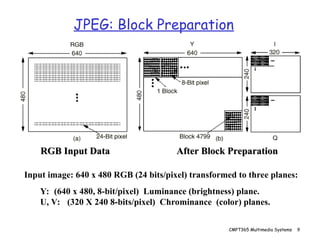
RGB Input Data
RGB Input Data After Block Preparation
After Block Preparation
JPEG: Block Preparation
Input image: 640 x 480 RGB (24 bits/pixel) transformed to three planes:
Y: (640 x 480, 8-bit/pixel) Luminance (brightness) plane.
U, V: (320 X 240 8-bits/pixel) Chrominance (color) planes.
CMPT365 Multimedia Systems 10
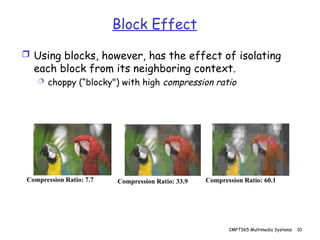
Block Effect
 Using blocks, however, has the effect of isolating
each block from its neighboring context.
 choppy (“blocky") with high compression ratio
Compression Ratio: 60.1
Compression Ratio: 7.7 Compression Ratio: 33.9
CMPT365 Multimedia Systems 11
JPEG: Quantized
DCT Coefficients
Uniform quantization:
Divide by constant N and round result.
In JPEG, each DCT F[u,v] is divided by
a constant q(u,v).
The table of q(u,v) is called quantization table.
q(u,v)
F[u,v]
Rounded
F[u,v]/ Q(u,v)
CMPT365 Multimedia Systems 12
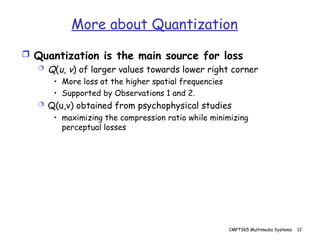
More about Quantization
 Quantization is the main source for loss
 Q(u, v) of larger values towards lower right corner
• More loss at the higher spatial frequencies
• Supported by Observations 1 and 2.
 Q(u,v) obtained from psychophysical studies
• maximizing the compression ratio while minimizing
perceptual losses
CMPT365 Multimedia Systems 13
CMPT365 Multimedia Systems 14
JPEG: Encoding of Quantized
DCT Coefficients
 DC Components (zero frequency)
 DC component of a block is large and varied, but often close
to the DC value of the previous block.
 Encode the difference from previous
• Differential Pulse Code Modulation (DPCM).
 AC components:
 Lots of zeros (or close to zero)
 Run Length Encoding (RLE, or RLC)
• encode as (skip, value) pairs
• Skip: number of zeros, value: next non-zero component
 (0,0) as end-of-block value.
CMPT365 Multimedia Systems 15
JPEG: Zigzag Scan
Maps an 8x8 block into a 1 x 64 vector
Zigzag pattern group low frequency coefficients in top of vector.
CMPT365 Multimedia Systems 16
Recall: 2-D DCT Basis Matrices
For 2-point DCT For 4-point DCT
CMPT365 Multimedia Systems 17
Recall: 2-D DCT Basis Matrices: 8-point DCT
CMPT365 Multimedia Systems 18
Why ZigZag Scan
 RLC aims to turn the block values into sets
<#-zeros-to-skip , next non-zero value>.
 ZigZag scan is more effective
CMPT365 Multimedia Systems 19
Runlength Encoding (RLE)
 Further compression: statistical (entropy) coding
A typical 8x8 block of quantized DCT coefficients.
Most of the higher order coefficients have been quantized to 0.
12 34 0 54 0 0 0 0
87 0 0 12 3 0 0 0
16 0 0 0 0 0 0 0
0 0 0 0 0 0 0 0
0 0 0 0 0 0 0 0
0 0 0 0 0 0 0 0
0 0 0 0 0 0 0 0
0 0 0 0 0 0 0 0
Zig-zag scan: the sequence of DCT coefficients to be transmitted:
12 34 87 16 0 0 54 0 0 0 0 0 0 12 0 0 3 0 0 0 .....
DC coefficient (12) is sent via a separate Huffman table.
Runlength coding remaining coefficients:
34 | 87 | 16 | 0 0 54 | 0 0 0 0 0 0 12 | 0 0 3 | 0 0 0 .....
CMPT365 Multimedia Systems 20
Entropy Coding
 Huffman/arithmetic coding
 Lossless
CMPT365 Multimedia Systems 21
JPEG Modes
 Sequential Mode
 default JPEG mode, implicitly assumed in the discussions
so far. Each graylevel image or color image component is
encoded in a single left-to-right, top-to-bottom scan.
 Progressive Mode.
 Hierarchical Mode.
 Lossless Mode
CMPT365 Multimedia Systems 22
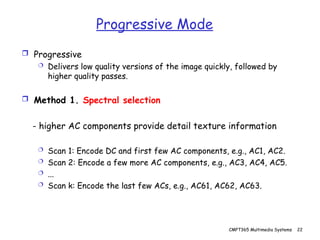
Progressive Mode
 Progressive
 Delivers low quality versions of the image quickly, followed by
higher quality passes.
 Method 1. Spectral selection
- higher AC components provide detail texture information
 Scan 1: Encode DC and first few AC components, e.g., AC1, AC2.
 Scan 2: Encode a few more AC components, e.g., AC3, AC4, AC5.
 ...
 Scan k: Encode the last few ACs, e.g., AC61, AC62, AC63.
CMPT365 Multimedia Systems 23
Progressive Mode cont’d
 Method 2: Successive approximation:
- Instead of gradually encoding spectral bands, all DCT
coefficients are encoded simultaneously but with their
most significant bits (MSBs) first
 Scan 1: Encode the rst few MSBs, e.g., Bits 7, 6, 5, 4.
 Scan 2: Encode a few more less signicant bits, e.g., Bit 3.
 ...
 Scan m: Encode the least signicant bit (LSB), Bit 0.
CMPT365 Multimedia Systems 24
Hierarchical Mode
 Encoding
 First, lowest resolution picture (using low-pass filter)
 Then, successively higher resolutions
• additional details (encoding differences)
 Transmission:
 transmitted in multiple passes
 progressively improving quality
 Similar to Progressive JPEG
CMPT365 Multimedia Systems 25
Lossless Mode
 Using prediction and entropy coding
 Forming a differential prediction:
 A predictor combines the values of up to three
neighboring pixels as the predicted value for the current
pixel
 Seven schemes for combination
 Encoding:
 The encoder compares the prediction with the actual
pixel value at the position `X' and encodes the
difference using entropy coding
CMPT365 Multimedia Systems 26
7 Predictors
CMPT365 Multimedia Systems 27
Comparison with Other Lossless
CMPT365 Multimedia Systems 28
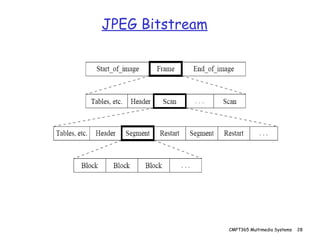
JPEG Bitstream
CMPT365 Multimedia Systems 29
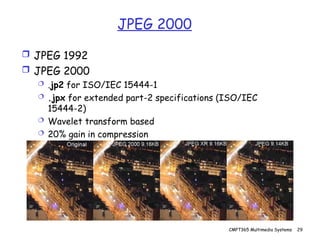
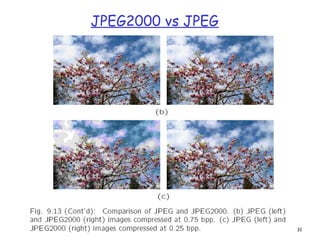
JPEG 2000
 JPEG 1992
 JPEG 2000
 .jp2 for ISO/IEC 15444-1
 .jpx for extended part-2 specifications (ISO/IEC
15444-2)
 Wavelet transform based
 20% gain in compression
CMPT365 Multimedia Systems 30
JPEG 2000 vs JPEG
 Original image
CMPT365 Multimedia Systems 31
JPEG2000 vs JPEG
CMPT365 Multimedia Systems 32
Further Exploration
 Textbook Chapter 9
 Other sources
 The JPEG Still Image Compression Standard by
Pennebaker and Mitchell
 JPEG2000: Image Compression Fundamentals, Standards,
and Practice by Taubman and Marcellin
 Image and Video Compression Standards: Algorithms and
Architectures, 2nd ed. by Bhaskaren and Konstantinides

Image Compression Digital Image processing

  • 1.
    CMPT365 Multimedia Systems1 Media Compression - Image Spring 2015 CMPT 365 Multimedia Systems
  • 2.
    CMPT365 Multimedia Systems2 Facts about JPEG  JPEG - Joint Photographic Experts Group  International standard: 1992  Most popular format  Other formats (.bmp) use similar techniques  Lossy image compression  transform coding using the DCT  JPEG 2000  New generation of JPEG – well, never succeeds  DWT (Discrete Wavelet Transform)
  • 3.
    CMPT365 Multimedia Systems3 Three Major Observations  Observation 1:  Useful image contents change relatively slowly across the image, i.e., it is unusual for intensity values to vary widely several times in a small area, for example, within an 8x8 image block. - much of the information in an image is repeated, hence “spatial redundancy". Compression Ratio: 7.7 Compression Ratio: 33.9
  • 4.
    CMPT365 Multimedia Systems4 Observations  Observation 2:  Psychophysical experiments suggest that humans are much less likely to notice the loss of very high spatial frequency components than the loss of lower frequency components. - the spatial redundancy can be reduced by largely reducing the high spatial frequency contents. Compression Ratio: 7.7 Compression Ratio: 33.9
  • 5.
    CMPT365 Multimedia Systems5 Observations  Observation 3:  Visual acuity (accuracy in distinguishing closely spaced lines) is much greater for gray (black and white) than for color. - chroma subsampling (4:2:0) is used in JPEG.
  • 6.
    CMPT365 Multimedia Systems6 8x8 DCT Example Original values of an 8x8 block (in spatial domain) Corresponding DCT coefficients coefficients (in frequency domain) (in frequency domain) DC Component or u o r v
  • 7.
    CMPT365 Multimedia Systems7 JPEG Steps 1 Block Preparation - RGB to YUV (YIQ) planes 2 Transform - 2D Discrete Cosine Transform (DCT) on 8x8 blocks. 3 Quantization - Quantized DCT Coefficients (lossy). 4 Encoding of Quantized Coefficients Zigzag Scan Differential Pulse Code Modulation (DPCM) on DC component Run Length Encoding (RLE) on AC Components Entropy Coding: Huffman or Arithmetic
  • 8.
  • 9.
    CMPT365 Multimedia Systems9 RGB Input Data RGB Input Data After Block Preparation After Block Preparation JPEG: Block Preparation Input image: 640 x 480 RGB (24 bits/pixel) transformed to three planes: Y: (640 x 480, 8-bit/pixel) Luminance (brightness) plane. U, V: (320 X 240 8-bits/pixel) Chrominance (color) planes.
  • 10.
    CMPT365 Multimedia Systems10 Block Effect  Using blocks, however, has the effect of isolating each block from its neighboring context.  choppy (“blocky") with high compression ratio Compression Ratio: 60.1 Compression Ratio: 7.7 Compression Ratio: 33.9
  • 11.
    CMPT365 Multimedia Systems11 JPEG: Quantized DCT Coefficients Uniform quantization: Divide by constant N and round result. In JPEG, each DCT F[u,v] is divided by a constant q(u,v). The table of q(u,v) is called quantization table. q(u,v) F[u,v] Rounded F[u,v]/ Q(u,v)
  • 12.
    CMPT365 Multimedia Systems12 More about Quantization  Quantization is the main source for loss  Q(u, v) of larger values towards lower right corner • More loss at the higher spatial frequencies • Supported by Observations 1 and 2.  Q(u,v) obtained from psychophysical studies • maximizing the compression ratio while minimizing perceptual losses
  • 13.
  • 14.
    CMPT365 Multimedia Systems14 JPEG: Encoding of Quantized DCT Coefficients  DC Components (zero frequency)  DC component of a block is large and varied, but often close to the DC value of the previous block.  Encode the difference from previous • Differential Pulse Code Modulation (DPCM).  AC components:  Lots of zeros (or close to zero)  Run Length Encoding (RLE, or RLC) • encode as (skip, value) pairs • Skip: number of zeros, value: next non-zero component  (0,0) as end-of-block value.
  • 15.
    CMPT365 Multimedia Systems15 JPEG: Zigzag Scan Maps an 8x8 block into a 1 x 64 vector Zigzag pattern group low frequency coefficients in top of vector.
  • 16.
    CMPT365 Multimedia Systems16 Recall: 2-D DCT Basis Matrices For 2-point DCT For 4-point DCT
  • 17.
    CMPT365 Multimedia Systems17 Recall: 2-D DCT Basis Matrices: 8-point DCT
  • 18.
    CMPT365 Multimedia Systems18 Why ZigZag Scan  RLC aims to turn the block values into sets <#-zeros-to-skip , next non-zero value>.  ZigZag scan is more effective
  • 19.
    CMPT365 Multimedia Systems19 Runlength Encoding (RLE)  Further compression: statistical (entropy) coding A typical 8x8 block of quantized DCT coefficients. Most of the higher order coefficients have been quantized to 0. 12 34 0 54 0 0 0 0 87 0 0 12 3 0 0 0 16 0 0 0 0 0 0 0 0 0 0 0 0 0 0 0 0 0 0 0 0 0 0 0 0 0 0 0 0 0 0 0 0 0 0 0 0 0 0 0 0 0 0 0 0 0 0 0 Zig-zag scan: the sequence of DCT coefficients to be transmitted: 12 34 87 16 0 0 54 0 0 0 0 0 0 12 0 0 3 0 0 0 ..... DC coefficient (12) is sent via a separate Huffman table. Runlength coding remaining coefficients: 34 | 87 | 16 | 0 0 54 | 0 0 0 0 0 0 12 | 0 0 3 | 0 0 0 .....
  • 20.
    CMPT365 Multimedia Systems20 Entropy Coding  Huffman/arithmetic coding  Lossless
  • 21.
    CMPT365 Multimedia Systems21 JPEG Modes  Sequential Mode  default JPEG mode, implicitly assumed in the discussions so far. Each graylevel image or color image component is encoded in a single left-to-right, top-to-bottom scan.  Progressive Mode.  Hierarchical Mode.  Lossless Mode
  • 22.
    CMPT365 Multimedia Systems22 Progressive Mode  Progressive  Delivers low quality versions of the image quickly, followed by higher quality passes.  Method 1. Spectral selection - higher AC components provide detail texture information  Scan 1: Encode DC and first few AC components, e.g., AC1, AC2.  Scan 2: Encode a few more AC components, e.g., AC3, AC4, AC5.  ...  Scan k: Encode the last few ACs, e.g., AC61, AC62, AC63.
  • 23.
    CMPT365 Multimedia Systems23 Progressive Mode cont’d  Method 2: Successive approximation: - Instead of gradually encoding spectral bands, all DCT coefficients are encoded simultaneously but with their most significant bits (MSBs) first  Scan 1: Encode the rst few MSBs, e.g., Bits 7, 6, 5, 4.  Scan 2: Encode a few more less signicant bits, e.g., Bit 3.  ...  Scan m: Encode the least signicant bit (LSB), Bit 0.
  • 24.
    CMPT365 Multimedia Systems24 Hierarchical Mode  Encoding  First, lowest resolution picture (using low-pass filter)  Then, successively higher resolutions • additional details (encoding differences)  Transmission:  transmitted in multiple passes  progressively improving quality  Similar to Progressive JPEG
  • 25.
    CMPT365 Multimedia Systems25 Lossless Mode  Using prediction and entropy coding  Forming a differential prediction:  A predictor combines the values of up to three neighboring pixels as the predicted value for the current pixel  Seven schemes for combination  Encoding:  The encoder compares the prediction with the actual pixel value at the position `X' and encodes the difference using entropy coding
  • 26.
  • 27.
    CMPT365 Multimedia Systems27 Comparison with Other Lossless
  • 28.
    CMPT365 Multimedia Systems28 JPEG Bitstream
  • 29.
    CMPT365 Multimedia Systems29 JPEG 2000  JPEG 1992  JPEG 2000  .jp2 for ISO/IEC 15444-1  .jpx for extended part-2 specifications (ISO/IEC 15444-2)  Wavelet transform based  20% gain in compression
  • 30.
    CMPT365 Multimedia Systems30 JPEG 2000 vs JPEG  Original image
  • 31.
    CMPT365 Multimedia Systems31 JPEG2000 vs JPEG
  • 32.
    CMPT365 Multimedia Systems32 Further Exploration  Textbook Chapter 9  Other sources  The JPEG Still Image Compression Standard by Pennebaker and Mitchell  JPEG2000: Image Compression Fundamentals, Standards, and Practice by Taubman and Marcellin  Image and Video Compression Standards: Algorithms and Architectures, 2nd ed. by Bhaskaren and Konstantinides