Critical Thinking and Article/Research Analysis Guidelines
(Based on: Paul R. & Elder, L. (2014) Critical Thinking:
Concepts & Tools. www.criticalthinking.org)

Why Critical Thinking?
The Problem:
Everyone thinks; it is our nature to do so. But much of our
thinking, left to itself, is biased, distorted, partial, uninformed,
or down-right prejudiced. Yet the quality of our life and that of
what we produce, make, or build depends precisely on the
quality of our though. Shoddy thinking is costly, both in money
and in quality of life. Excellence in thought, however, must be
systematically cultivated.
A Definition:
Critical thinking is the art of analyzing and evaluating thinking
with a view to improving it.
The Result:
A well cultivated critical thinker:
· Raises vital questions and problems, formulating them clearly
and precisely;
· Gathers and assesses relevant information, using abstract ideas
to interpret it effectively;
· Comes to well-reasoned conclusions and solutions, testing
them against relevant criteria and standards;
· Thinks open-mindedly within alternative systems of thought,
recognizing and assessing, as need be, their assumptions,
implications, and practical consequences; and
· Communicates effectively with others in figuring out solutions
to complex problems.
Critical thinking is, in short, self-directed, self-disciplined,
self-monitored, and self-corrective thinking. It requires rigorous
standards of excellence and mindful command of their use. It
entails effective communication and problem solving abilities
and a commitment to overcoming our native egocentrism and
sociocentrism.
Analyzing & Assessing Research
Use this template to assess the quality of any research project or
paper.
1. All research has a fundamental PURPOSE and goal.
· Research purposes and goals should be clearly stated.
· Related purposes should be explicitly distinguished.
· All segments of the research should be relevant to the purpose.
· All research purposes should be realistic and significant.
2. All research addresses a fundamental QUESTION, problem,
or issue.
· The fundamental question at issue should be clearly and
precisely stated.
· Related questions should be articulated and distinguished.
· All segments of the research should be relevant to the central
question.
· All research questions should be realistic and significant.
· All research questions should define clearly stated intellectual
tasks that, being fulfilled, settle the questions.
3. All research identifies data, INFORMATION, and evidence
relevant to its fundamental question and purpose.
· All information should be clear, accurate, and relevant to the
fundamental question at issue.
· Information gathered must be sufficient to settle the question
at issue.
· Information contrary to the main conclusions of the research
should be explained.
4. All research contains INFERENCES or interpretations by
which conclusions are drawn.
· All conclusions should be clear, accurate, and relevant to the
key question at issue.
· Conclusions drawn should not go beyond what the data imply.
· Conclusions should be consistent and reconcile discrepancies
in the data.
· Conclusions should explain how the key questions at issue
have been settled.
5. All research is conducted from some POINT OF VIEW or
frame of reference.
· All points of view in the research should be identified.
· Objections from competing points of view should be identified
and fairly addressed.
6. All research is based on ASSUMPTIONS.
· Clearly identify and assess major assumptions in research.
· Explain how the assumptions shape the research point of view.
7. All research is expressed through, and shaped by,
CONCEPTS and ideas.
· Assess for clarity the key concepts in the research.
· Asses the significance of the key concepts in the research.
8. All research leads somewhere (i.e., has IMPLICATIONS and
consequences).
· Trace the implications and consequences that follow from the
research.
· Search for negative as well as positive implications.
· Consider all significant implications and consequences.
Social Science Research: Designs, Methods
(Adapted from:
http://www.cliffsnotes.com/sciences/sociology/sociological-
research-methods/sociological-research-designs-methods)

Social Scientists use many different designs and methods to
study society and social behavior.
Three popular social research designs (models) are
· Cross‐sectional, in which scientists study a number of
individuals or cases at a single point in time
· Longitudinal, in which scientists study the same individuals or
cases repeatedly over a specified period of time (AKA Panel
Studies)
· Cross‐sequential, in which scientists test individuals or cases
in a cross‐sectional sample more than once over a specified
period of time (AKA Sequential)
Six of the most popular research methods (procedures) are
the case study, survey, observational, correlational,
experimental, and cross‐cultural methods, as well as working
with information already available.
1. Case study research
In case study research, an investigator studies an
individual/case or small group of individuals/cases in detail.
On the positive side, case studies obtain useful information
about the individuals or cases studied. On the negative side,
they tend to apply only to individuals/cases with similar
characteristics rather than to the general population. The small
number of subjects limits the generalizability of this method.
2. Survey research
Survey research involves interviewing or
administering questionnaires, or written surveys, to large
numbers of people. The investigator analyzes the data obtained
from surveys to learn about similarities, differences, and trends.
He or she then makes predictions about the population being
studied.
As with most research methods, survey research brings both
advantages and disadvantages. Advantages include obtaining
information from a large number of respondents, conducting
personal interviews at a time convenient for respondents, and
acquiring data as inexpensively as possible. Anonymous surveys
have the added advantage of ensuring anonymity and thus
prompting respondents to answer questions truthfully. Surveys
can be administered in-person, by mail, phone, or online.
Disadvantages of survey research include volunteer bias,
interviewer bias, and distortion. Volunteer bias occurs when a
sample of volunteers is not representative of the general
population. Subjects who are willing to talk about certain topics
may answer surveys differently than those who are not willing
to talk. Interviewer bias occurs when an interviewer's
expectations or insignificant gestures (for example,
frowning or smiling) inadvertently influence a subject's
responses one way or the other.
Distortion occurs when a subject does not respond to questions
honestly.
3. Observational research
Because distortion can be a serious limitation of
surveys, observational research involves directly observing
subjects' reactions, either in a laboratory (called laboratory
observation) or in a natural setting (called naturalistic
observation). Observational research reduces the possibility that
subjects will not give totally honest accounts of the
experiences, not take the study seriously, fail to remember, or
feel embarrassed.
Observational research has limitations, however. Subject bias is
common, because volunteer subjects may not be representative
of the general public. Individuals who agree to observation and
monitoring may function differently than those who do not.
They may also function differently in a laboratory setting than
they do in other settings.
4. Correlational research
A sociologist may also conduct correlational research.
A correlation is a relationship between two variables (or
“factors that change”). These factors can be characteristics,
attitudes, behaviors, or events. Correlational research attempts
to determine if a relationship exists between the two variables,
and the degree of that relationship.
A social researcher can use case studies, surveys, interviews,
and observational research to discover correlations. Correlations
are either positive, negative, or nonexistent. In a positive
correlation, the values of the variables increase or decrease
(“co‐vary”) together. In a negative correlation, one variable
increases as the other decreases. In a nonexistent correlation, no
relationship exists between the variables.
People commonly confuse correlation with causation.
Correlational data do not
indicate cause‐and‐effect relationships. When a correlation
exists, changes in the value of one variable reflect changes in
the value of the other. The correlation does not imply that one
variable causes the other, only that both variables somehow
relate to one another. To study the effects that variables have on
each other, an investigator must conduct an experiment.
5. Experimental research
Experimental research attempts to
determine how and why something happens. Experimental
research tests the way in which an independent variable (the
factor that the scientist manipulates) affects a dependent
variable (the factor that the scientist observes).
A number of factors can affect the outcome of any type of
experimental research. One is finding samples that are random
and representative of the population being studied. Another
is experimenter bias, in which the researcher's expectations
about what should or should not happen in the study sway the
results. Still another is controlling for extraneous variables,
such as room temperature or noise level, that may interfere with
the results of the experiment. Only when the experimenter
carefully controls for extraneous variables can she or he draw
valid conclusions about the effects of specific variables on other
variables.
6. Cross-cultural research
Sensitivity to others' norms, folkways, values, mores, attitudes,
customs, and practices necessitates knowledge of other societies
and cultures. Sociologists may conduct cross‐cultural research,
or research designed to reveal variations across different groups
of people. Most cross‐cultural research involves survey, direct
observation, and participant observation methods of research.
Participant observation requires that an “observer” become a
member of his or her subjects' community. An advantage of this
method of research is the opportunity it provides to study what
actually occurs within a community, and then consider that
information within the political, economic, social, and religious
systems of that community. Cross‐cultural research
demonstrates that Western cultural standards do not necessarily
apply to other societies. What may be “normal” or acceptable
for one group may be “abnormal” or unacceptable for another.
7. Research with existing data, or secondary analysis
Some sociologists conduct research by using data that other
social scientists have already collected. The use of publicly
accessible information is known as secondary analysis, and is
most common in situations in which collecting new data is
impractical or unnecessary. Sociologists may obtain statistical
data for analysis from businesses, academic institutions, and
governmental agencies, to name only a few sources. Or they
may use historical or library information to generate their
hypotheses.
Take an article you have been assigned to read for class and
complete the “logic” of it using the template below. Copy each
question and answer it fully in your assignment.
(Title = FULL CITATION OF ARTICLE)
1. The social science discipline of the article is
______________________. (The article falls within which of
the three disciplines?) How do you know this? (Clearly state the
evidence and reasoning you used to determine the discipline of
the article.)
2. The main purpose of the article is ______________________.
(State as accurately as possible the author’s purpose for writing
the article.) Explain.
3. The most important information in the article is
____________________. (Figure out the facts, experiences,
data the author is using to support her/his conclusions.)
Explain.
4. The main inferences/conclusions in this article are
______________________. (Identify the key conclusions the
author comes to and presents in the article.)
5. The key concept(s) we need to understand in this article is
(are) _________________. By these concepts the author means
_________________. (Figure out the most important ideas you
would have to understand in order to understand the author’s
line of reasoning and explain.)
6. If we take this line of reasoning seriously, the implications
are ___________________. (What consequences are likely to
follow if people take the author’s line of reasoning seriously?)
Explain.
7. The main hypothesis or hypotheses being tested is/are
___________________. (Clearly identify independent and
dependent variables and the predicted relationships between
them.)
8. The social science research design of the study is
___________________. (Which of the three methods are being
used by the researcher?) Explain.
9. The social scientific research method(s) being used is/are
___________________. (Which of the seven methods are being
used by the researcher? More than one may be used.) Explain.
6
Watch those video and answer the question
YouTube URL:http://www.youtube.com/watch?v=7qeehDLYa8g
YouTube URL:http://www.youtube.com/watch?v=H7x9nIFEyO4
Referring to the videos on Outsourcing and analyze whether it
makes sense for companies like Apple and Nike to bring
manufacturing home instead of their current practice of
outsourcing? Why or why not? What companies/industries are
most likely to use nearshoring or reshoring?
Globalisation and the decline of
national identity? An exploration
across sixty-three countries
GAL ARIELY
University of Haifa, Israel
ABSTRACT. The relationship between globalisation and
national identity is puz-
zling. While some observers have found that globalisation
reduces people’s identifi-
cation with their nation, others have reached the opposite
conclusion. This article
explores this conundrum by examining the relationship between
globalisation and
people’s feelings towards national identity. Using data from the
International Social
Survey Program National Identity II (2003) and the World
Values Survey (2005), it
analyses these relations across sixty-three countries. Employing
a multilevel approach,
it investigates how a country’s level of globalisation is related
to its public perceptions
towards different dimensions of national identity. The results
suggest that a country’s
level of globalisation is not related to national identification or
nationalism but it is
related negatively to patriotism, the willingness to fight for the
country and ethnic
conceptions of membership in the nation. An examination of
alternative explanations
indicates that globalisation has a distinct impact on national
identity.
KEYWORDS: globalisation; national identity; nationalism;
patriotism; cross-
national analysis; multi-level analysis
Introduction
The effect of globalisation on national identity is complex.
Some consider it a
force that undermines national identity, while others argue that
globalisation
trends reinforce national feelings (Calhoun 2007; Guibernau
2001; Kaldor
2004; Kymlicka 2003; Zuelow et al. 2007; Tønnesson 2004).
Inconsistent inter-
pretations of the nexus between globalisation and national
identity reflect not
only different theoretical predispositions regarding the meaning
of national-
ism but also the different methods used to examine that
relationship. While
some studies have found that the experience of globalisation
reduces identifi-
cation with the nation among the public (e.g. Norris and
Inglehart 2009),
others have reached the opposite conclusion (e.g. Jung 2008).
Interestingly,
despite the ongoing debate over the links between national
identity and glo-
balisation, few studies have undertaken systematic cross-
national research
concerning the way(s) in which globalisation is related to the
manner in which
people define and perceive national identity.
bs_bs_banner
EN
ASJ O U R N A L O F T H E A S S O C I AT I O N
F O R T H E S T U D Y O F E T H N I C I T Y
A N D N AT I O N A L I S M
NATIONS AND
NATIONALISM
Nations and Nationalism 18 (3), 2012, 461–482.
DOI: 10.1111/j.1469-8129.2011.00532.x
© The author(s) 2012. Nations and Nationalism ©
ASEN/Blackwell Publishing Ltd 2012
The aim of this study is to examine how globalisation is related
to people’s
feelings towards national identity. To that end, employing a
multilevel
approach, it explores the relationship between globalisation and
national iden-
tity across sixty-three countries. While most studies of national
identity have
focused on the individual level, this study links national-level
parameters of
globalisation with individual-level perceptions of national
identity. In other
words, it examines whether a country’s level of globalisation is
related to
individual-level attitudes towards national identity. Similarly,
while most
studies to date have focused on a single nation and cross-
national comparisons
have been limited primarily to Western cases, an analysis across
sixty-three
nations offers a more comprehensive account of the relationship
between
different dimensions of national identity and globalisation.
Before entering into the specific analysis, first I will review
briefly various
interpretations of the relationship between nationalism and
globalisation and
the empirical studies that have examined this relationship to
date. Employ-
ing data from two cross-national surveys – the International
Social Survey
Program (ISSP) National Identity II (2003) and the World
Values Survey
(WVS) (2005) – the present study explores the way(s) in which
a country’s level
of globalisation is related to different dimensions of national
identity. Special
attention will be paid to elucidating the logic of such cross-
national multilevel
analysis, as well as the limitations of this analysis. Analysing
the impact of
globalisation in comparison with other explanations -
modernisation, eco-
nomic development and political integration – is used to reveal
the distinctive
impact of globalisation.
Globalisation and national identity
Globalisation, defined as ‘increasing cross-border flows of
goods, services,
money, people, information, and culture’ (Held et al. 1999: 16),
is one of the
most hotly debated topics in contemporary social research
(Guillén 2001).
It constitutes a puzzling process of contradictory effects on
many aspects
of politics and society because of its multifaceted nature. Thus
it should be
understood as a process or a set of processes that do not follow
linear logic or
have equal impact on societies across the world (Held et al.
1999).
Globalisation is regarded by many as a force that redefines state
functions
and even decreases state power.1 In this study, I focus on the
impact of
globalisation on national identity and not on its impact on the
state as an
institution. The defining criteria for national identity are
differentiation from
other nations and continuity over time. The nation is a
collective identity
rooted in past symbols, memories and values as well as a body
that projects
into the future. This entity links symbols, memories and values
to a specific
territory while distinguishing itself from other nations
(Guibernau 2001).
Globalisation is seen as undermining national identity because,
put briefly,
the cross-border flow of information makes it harder for any
single national
462 Gal Ariely
© The author(s) 2012. Nations and Nationalism ©
ASEN/Blackwell Publishing Ltd 2012
identity to retain its unique significance and distinguish itself
from other
national identities. In the global village, the ability to produce
and maintain a
homogenous national identity is challenged as people become
global consum-
ers of goods and information. In a wired world, the government
no longer has
the exclusive capacity to exert cultural control over its citizens
and/or territory
(Barber 2003; Guibernau 2001; for a different view, see
Calhoun 2007).
Although the impact of globalisation on the state has long been
a subject of
study in general, theorists of nationalism have only recently
begun to investi-
gate the impact of globalisation (Delanty and Kumar 2006).2
The customary
distinction between primordial and modernist theories of
nationalism is also
reflected in conflicting interpretations of the influence of
globalisation on
national identity (Kaldor 2004; Tønnesson 2004).
The modernist approach posits that nationalism is the product of
a specific
historical period – modernity – rather than constituting a
permanent feature
of human society. Consequently, the transformation of social,
economic and
political aspects of modern society under globalisation changes
the meaning of
nationalism as an instrument of mass identification and
mobilisation. Eric
Hobsbawm argued that nationalism had become ‘historically
less important’,
predicting that, over the course of time, it would no longer be a
vital political
programme and that the world ‘will be largely supernational’
(Hobsbawm
1992: 191). Fifteen years later, he reached the same conclusion.
In his opinion,
the emergence of national movements and national claims in the
past twenty
years has not undermined the contention that nationalism’s role
as the main
force shaping politics is decreasing (Hobsbawm 2007).
The primordial account of nationalism emphasises that nations
are neither
a modern phenomenon nor social constructs created by changing
circum-
stances, as the modernist approach argues. Rather, nationalism
represents
the importance of identity and belonging, reaching far further
back than the
modern period. While the primordial account recognises that
modernity has
an important role to play in national mobilisation, nationalism
also embodies
pre-existing ethnic traditions (Smith 1995). In other words,
nationalism has
deeper roots in human society than the modern approach would
suggest. The
transformation of social, economic and political aspects of
human society
under globalisation does not, therefore, eradicate nationalism.
Anthony Smith
concludes his account of Nations and Nationalism in a Global
Era by rejecting
the modernist approach and suggesting that ‘it would be folly to
predict an
early supersession of nationalism and an imminent
transcendence of the nation
. . . For a global culture seems unable to offer the qualities of
collective
faith, dignity and hope that only a “religious surrogate” with its
promise of a
territorial cultural community across the generations can
provide’ (Smith
1995: 160). In a later account (2007), he argues not only that
global culture
cannot replace national culture but also that national identity
can in fact
withstand the force of globalisation. According to Smith, while
the existence
of culturally diverse waves of immigrants has reshaped the
meaning of
national identity, this process also leads members of the nation
to reflect on
Globalisation and the decline of national identity 463
© The author(s) 2012. Nations and Nationalism ©
ASEN/Blackwell Publishing Ltd 2012
their national identity and reinforce its meaning and functions
for the nation.
Therefore, he maintains that, despite globalisation, ‘self-
reflective and self-
celebrating communities, nations and nationalism are still very
much alive’
(Smith 2007: 30). Others view the continuation of national
identity in a
globalised world as a consequence of the necessity to organise
public life. The
influential perspective of Calhoun (2007) asserts that national
identity organ-
ises ordinary people’s ‘sense of belonging’. According to
Calhoun, globalisa-
tion makes the sense of belonging even more important than
previously.
The debate between modernist and primordial accounts of
nationalism
is related to another question about globalisation: is
globalisation distinct
from modernity? Is globalisation merely a continuation of the
trend towards
modernity, or is it the beginning of a new era? Some view
globalisation as
the expansion of modernity to a global scale while others
propose viewing it
as something totally different (Guillén 2001). While this debate
cannot be
addressed in this article, I do examine whether the relations
between a coun-
try’s level of globalisation and people’s national identity are
different from two
aspects of modernity – economic and urban development.
Beyond the debate between modernist and primordial accounts
of nation-
alism, many observers emphasise the dual impact of
globalisation on national
identity. While globalisation may push some part of the
population in a given
nation towards cosmopolitanism, other parts will develop
‘resistance identi-
ties’ (Castells 2004). National identity, primarily in its cultural
forms, is an
example of such resistance identity. Thus, for example, recent
studies have
found that young Muslims in Europe employ the internet –
considered a tool
of globalisation – to strengthen religious and national ties
(Shavit 2009). This
is true not only for Muslim youth. Despite the spread of the
internet and the
globalisation of television, most people surf domestic websites
and watch
programmes that reflect national culture on domestic channels
(e.g. Carolyn
and Kolko 2005; Waisbord 2004).
Globalisation and national identity: an empirical assessment
In addition to the various theoretical views concerning the
relationship
between globalisation and national identity, research efforts are
increasingly
attempting to assess its impact empirically. Given the
multidimensionality
of both globalisation and nationalism, it is not surprising to
learn that these
studies – whether conducted in a single nation or across several
– have pro-
duced mixed results. Thus, in Germany, for example, a study
conducted
among German citizens found that people with a higher level of
exposure to
globalisation (in terms of border-crossing experiences and
transnational social
relations) are more likely to adopt cosmopolitan attitudes with
respect to
foreigners and global governance than those less exposed (Mau
et al. 2008). In
Britain, the younger generations are less attached to and take
less pride in their
country than the older generations (Tilley and Heath 2007).
While this may be
464 Gal Ariely
© The author(s) 2012. Nations and Nationalism ©
ASEN/Blackwell Publishing Ltd 2012
because they are both more highly exposed to globalisation and
view it more
positively, it may also represent a life-cycle effect, meaning
that, in the long
run, no decline in national identity actually occurs (Jung 2008).
In Australia,
globalisation influences both people’s conceptions of their
national identity
and their perceptions of the indigenous population as forming
part of the
nation (Moran 2005).
While these studies support the argument that globalisation has
an impact
on national identity, other studies suggest that this influence is
relatively
limited. Thus, for example, the results of Tamar Ashuri’s (2005)
examination
of the way in which a co-produced television documentary on
the Arab–Israeli
conflict was framed differently among British, American and
Israeli viewers
indicate that each national network adapted the programme to
its own specific
national narrative and context. Likewise, a longitudinal study of
cosmopolitan
orientation among Swedish citizens found that protectionist,
rather than
cosmopolitan, attitudes tended to emerge (Olofsson and Öhman
2007).
The emergence of the European Union led to growing interest in
the
question of its impact on the national identity of citizens in the
member
states. While European integration is different from
globalisation, there are
some similar aspects, like the increasing communication beyond
the national
borders that led research to expect the decline of national
identity. Neverthe-
less, there is no clear evidence that any systematic decline of
national identity
is taking place. Some (e.g. Dogan 1994) have found that
national identification
is indeed declining in the older member states (EU-15), while
others (e.g. Citrin
and Sides 2004) found that attachment to one’s country has
remained strong
and relatively stable despite the increasing European identity. In
this article
I will examine the impact of membership in the older European
Union
member states on national identity, with comparison to
globalisation in order
to evaluate its distinctive impact.
While most studies have focused on single countries or on
Europe, others
have adopted a more global approach. The availability of cross-
national
survey data, such as the WVS and the National Identity modules
of the ISSP,
facilitates exploration of the interaction between globalisation
and national
identity. However, despite reliance on the same set of data,
researchers have
reached inconsistent conclusions. Using the WVS, Pippa Norris
and Ronald
Inglehart (2009) found support for the claim that supranational
identity and
cosmopolitan citizenship rates are on the increase, with the
additional result
that living in a cosmopolitan society is related strongly to less
nationalistic
attitudes. Also using the WVS, Jung (2008) reached a
completely different
conclusion: ‘it is a myth to expect cosmopolitan attitudes and
supranational
identities to increase significantly in the current globalising
world’ (Jung 2008:
600). An analysis of elite cosmopolitan orientations using the
same set of data
(Davidson et al. 2009) drew similar inferences.
Likewise, cross-national studies examining the impact of
globalisation on
civic and ethnic national identity have also obtained
contradictory results.
Jones and Smith (2001) analysed data across twenty-three
countries using
Globalisation and the decline of national identity 465
© The author(s) 2012. Nations and Nationalism ©
ASEN/Blackwell Publishing Ltd 2012
the ISSP National Identity I (1995). Initially distinguishing
between two
aspects of ethnic national identity – ascribed/objective (ethnic)
and civic/
voluntarist (civic) – they then proceeded to examine whether
globalisation
(measured by an index of import/export and international phone
calls) is
related to these two dimensions. Their results do not indicate
any significant
relationship. Robert Kunovich’s later study (2009) employed
virtually iden-
tical items from the ISSP National Identity II (2003) and
similarly distin-
guished between ethnic and civic national identity across thirty-
one
countries. Unlike Jones and Smith, however, Kunovich found
that globali-
sation is negatively related to ethnic national identity and
positively related
to civic identity. Hadler and Meyer (2009), who utilised data
from ISSP
National Identity I (1995) and II (2003), adduced mixed results
regarding the
impact of globalisation on people’s views of policies stressing
national
boundaries. One index of globalisation (the number of
international non-
governmental organisations) was negatively related to people’s
willingness to
highlight national boundaries, while the other index of
globalisation (the
number of international inter-governmental organisations) was
unrelated to
the attitudes under discussion.
The ambiguity of the findings is a function both of different
conceptualisa-
tions and of varying operationalisations of globalisation,
national identity
and cosmopolitanism.3 More importantly, while all the studies
reviewed here
address the nexus between globalisation and national identity,
they fail to
examine the various dimensions of national identity. The
current study looks
explicitly at different aspects of national identity and analyses
their relation-
ship to globalisation using both the ISSP and the WVS.
Data
Data were drawn from two sources: the ISSP National Identity
II (2003) and
WVS (2005). These cross-national surveys differ in
methodology (for a review,
see Haller et al. 2009). More importantly, while the ISSP
National Identity II
(2003) focuses solely on the issue of national identity, the WVS
examines other
topics as well. Given the fact that the surveys thus differ in
their contexts and
in their measurements, it appeared preferable to analyse each
set of data
separately rather than combining them. This step yielded
coverage of 116,562
respondents from sixty-three countries that represent various
regions of the
world.4 This cross-national variety further affords a relatively
robust exami-
nation of the country-level variable adopted herein – the level
of globalisation
– because the data-sets include both hyper-globalised countries,
such as the
UK and Canada, and countries such as Iran and Rwanda, which
are much less
exposed to globalisation. Such variance at the country level also
facilitates
examination of the alternative explanations for globalisation.
The countries
analysed and the number of respondents in each country are
detailed in
Appendix 1.5
466 Gal Ariely
© The author(s) 2012. Nations and Nationalism ©
ASEN/Blackwell Publishing Ltd 2012
Both the ISSP and the WVS collected data from a representative
sample of
the adult population in each country. As such, they include
respondents from
the ‘core national group’ (e.g. Slovakians in Slovakia) as well
as minorities
(e.g. Hungarians in Slovakia). While in some countries, like the
USA, percep-
tions of national identity among the majority are quite similar to
those of
minorities (Citrin and Sears 2009), across other countries there
are substantive
differences (Staerklé et al. 2010). However, the ability to
distinguish between
majority and minority in a systematic way across all the
countries in the
data-set is limited by the availability of relevant and identical
variables across
the surveys – especially as the countries in the data-set also
include multina-
tional states and not just nation-states in which a ‘core national
group’ can be
identified. Nevertheless, replicating the analysis after excluding
minorities
from the samples yields the same results.6
Measurements
Individual-level measurements: dimensions of national identity
The only consensus to have emerged from the research on
national identity
to date is that it constitutes a multidimensional concept. In
consequence,
little agreement exists among scholars regarding the
measurements of national
identity (Sapountzis 2008). Rather than constructing a single
scale to represent
‘national identity’ or presenting measurements of all aspects of
national iden-
tity, this analysis follows previous studies (Davidov 2009;
Kunovich 2009) in
adopting distinctions within and measures of different
dimensions of national
identity: national identification, patriotism, nationalism, ethnic
national
identity and the willingness to fight for the country.
National identification reflects the level of attachment to the
national com-
munity and was measured by the item ‘How close do you feel to
[country]?’
(Staerklé et al. 2010) in the ISSP. Nationalism – defined as a
sense that one’s
nation is superior to other nations – was measured only by the
ISSP data, via
a combination of two items: ‘Generally speaking, [respondent’s
country] is a
better country than most other countries’ and ‘The world would
be a better
place if people from other countries were more like the [country
of respond-
ent]’ (see Davidov 2009). Patriotism, which reflects love of and
pride in one’s
country, was measured by the item ‘How proud are you of being
[country]
member?’ in the ISSP and in the WVS. Ethnic national identity
reflects an
understanding of national membership based on ethnic criteria
(Kunovich
2009). To measure ethnic national identity, I used a single-item
measure relat-
ing to national kinship. Requirements for naturalisation in the
country were
taken from the WVS, the ethnic component being measured by
the item
‘Having ancestors from my country’, while in the ISSP it was
measured with
the item ‘To have [country] ancestry’ in order to be ‘A true
national member’.
The ISSP scale has been used in various studies that explore
national identity
(e.g. Wright 2011). The last dimension, which I labelled ‘fight
for country’, was
Globalisation and the decline of national identity 467
© The author(s) 2012. Nations and Nationalism ©
ASEN/Blackwell Publishing Ltd 2012
based on the question ‘Of course, we all hope that there will not
be another
war, but if it were to come to that, would you be willing to fight
for your
country?’. Appendix 2 summarises the individual-level
measures employed
and their scales.
Measuring dimensions of national identity in a survey is a
challenging task
(Sapountzis 2008). The task is even greater when national
identity is measured
cross-nationally (Sinnott 2006). It is not clear that the form of
national iden-
tification found in such a country as Canada is directly
comparable with that
found in Japan. For example, a study in Austria indicates that
respondents do
not understand the question items designed to measure national
identification
in the ISSP National Identity module (Latcheva 2010). Another
study has
shown how the meanings of civic and ethnic national identities
vary across
countries (Reskens and Hooghe 2010).
While comparisons of survey questions regarding national
identity must
therefore bear their limits in mind, this article is nonetheless
more cautious
than authors such as Smith (1992), who argues that utilising a
mass survey
to inquire about identity is virtually pointless. It follows scales
employed in
previous cross-national studies, including studies that explicitly
address the
issue of measurement equivalence (Davidov 2009; Staerklé et
al. 2010).
Davidov (2009) has recently demonstrated that a multiple-group
confirmatory
factor analysis can be used profitably to test the scales
measuring dimensions
of national identity across all the ISSP 2003 countries. Such
robust analyses
enable examination not only of empirical distinctiveness but
also of the com-
parability of cross-national significance. While ideally this
study would also
follow Davidov in conducting multiple-group confirmatory
factor analyses
in order to establish the equivalence of the scales, the fact that
it utilises
single-item scales excludes the application of a multiple-group
confirmatory
factor analysis here. Consequently, the assumption that one can
compare all
the dimensions of national identity (with the exception of
nationalism, follow-
ing Davidov 2009) is not established empirically in this study.
Correlation of the different dimensions across the pooled
samples indicates
positive significant relations across all these dimensions, which
vary between
r = 0.327 for patriotism and national identification and r =
0.108 for ethnic
national identity and willingness to fight for the country. While
these correla-
tions indicate that all of these dimensions are related to one
another, they
also imply that relations are not high enough to indicate a point
where there
is full overlapping among the dimensions. Again, the use of a
single-item
scale undermines the possibility of using a factor approach to
validate these
differences.
Country-level measurements
Globalisation: I used the KOF index of globalisation (Dreher et
al. 2008). This
index defines globalisation as the ‘process of creating networks
of connections
among actors at multicontinental distances, mediated through a
variety of flows
468 Gal Ariely
© The author(s) 2012. Nations and Nationalism ©
ASEN/Blackwell Publishing Ltd 2012
including people, information and ideas, capital and goods.
Globalisation is
conceptualised as a process that erodes national boundaries,
integrates national
economies, cultures, technologies and governance and produces
complex rela-
tions of mutual interdependence’.7 This conceptualisation is
consistent with my
effort to examine the relationship between the erosion of
national boundaries
and national identity. The KOF index was constructed from
various data, such
as the number of McDonald’s restaurants, internet hosts,
internet users, mem-
bership of international organisations and international trade.8
The index was
measured on a 100-point scale and I used the average of 2000–
5.
Alternative explanations for globalisation: I examined three
alternative
explanations for globalisation: economic development,
measured by the
2000–5 average gross domestic products (GDP) from the World
Bank data;
urbanisation, measured as the percentage of people living in
cities (for 2000–5
from the World Bank data); and membership of the 15-EU,
measured with a
dummy variable for the 15-EU states.
Results
The dimensions of national identity across countries
Before presenting the results of the multilevel models, I will
provide a descrip-
tive review of the support for the different dimensions of
national identity
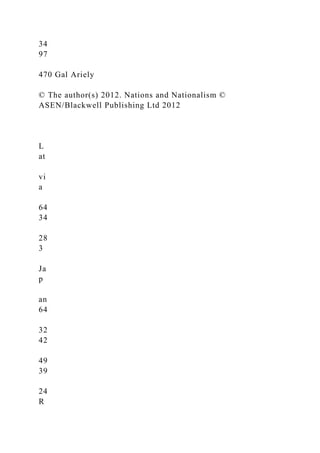
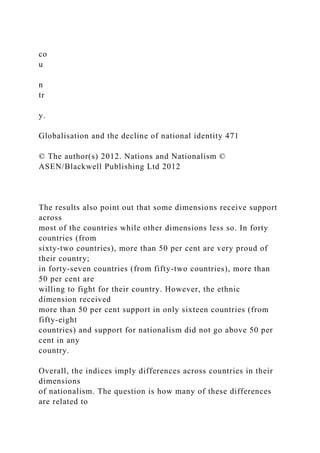
across the sixty-three countries. Table 1, in which countries are
sorted accord-
ing to their level of globalisation, indicates the dissimilarity
between the
dimensions of national identity in each country, the differences
between the
countries and the overall support for some dimensions of
national identity
across most of the countries.
The respondents’ answers indicate that while the different
dimensions of
national identity are correlated positively with one another there
are differ-
ences in the amount of support the respondents attribute to
them. In Finland,
for example, 55 per cent are ‘very proud of their country’ and
84 per cent are
‘willing to fight’ for their country, yet only 20 per cent ‘agree
strongly’ that
‘Generally speaking Finland is a better country than most other
countries’ and
only 26 per cent think that in order to be ‘true Finnish’ it is
‘very important’ to
‘have Finnish ancestry’.
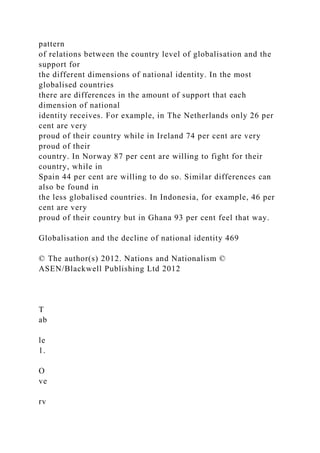
The indices in Table 1 also show that one cannot locate a clear
pattern
of relations between the country level of globalisation and the
support for
the different dimensions of national identity. In the most
globalised countries
there are differences in the amount of support that each
dimension of national
identity receives. For example, in The Netherlands only 26 per
cent are very
proud of their country while in Ireland 74 per cent are very
proud of their
country. In Norway 87 per cent are willing to fight for their
country, while in
Spain 44 per cent are willing to do so. Similar differences can
also be found in
the less globalised countries. In Indonesia, for example, 46 per
cent are very
proud of their country but in Ghana 93 per cent feel that way.
Globalisation and the decline of national identity 469
© The author(s) 2012. Nations and Nationalism ©
ASEN/Blackwell Publishing Ltd 2012
T
ab
le
1.
O
ve
rv
ie
w
of
su
pp
or
t
of
na
ti
on
al
id
en
ti
ty
di
m
en
si
on
s
C
ou
nt
ry
G
lo
ba
li
sa
ti
on
in
de
x
P
at
ri
ot
is
m
E
th
ni
c
na
ti
on
al
id
en
ti
ty
N
at
io
na
l
id
en
ti
fi
ca
ti
on
N
at
io
na
li
sm
F
ig
ht
fo
r
co
un
tr
y
A
u
st
ri
a
92
50
33
60
24
N
et
h
er
la
n
d
s
91
24
10
29
5
48
S
w
it
ze
rl
an
d
91
36
13
49
4
35
D
en
m
ar
k
89
32
32
54
29
S
w
ed
en
89
37
14
41
9
86
C
an
ad
a
88
70
26
47
30
59
F
in
la
n
d
87
49
26
48
20
84
Ir
el
an
d
87
74
47
54
10
F
ra
n
ce
87
30
25
57
11
60
G
er
m
an
y
85
18
21
25
6
34
S
p
ai
n
84
53
25
44
10
44
N
o
rw
ay
84
44
29
43
14
87
H
u
n
ga
ry
83
45
45
75
8
P
o
rt
u
ga
l
83
56
35
51
9
C
ze
ch
R
ep
u
b
li
c
83
39
39
39
6
84
U
n
it
ed
K
in
gd
o
m
83
50
30
33
14
62
A
u
st
ra
li
a
82
69
20
51
36
62
It
al
y
81
42
14
43
N
ew
Z
ea
la
n
d
80
70
34
61
28
82
U
S
A
80
73
32
52
41
64
S
lo
va
k
ia
78
33
21
39
3
P
o
la
n
d
75
55
48
45
7
74
M
al
ay
si
a
74
69
50
79
Is
ra
el
73
51
27
73
21
S
lo
ve
n
ia
72
55
24
46
6
74
C
yp
ru
s
71
90
C
h
il
e
71
68
31
58
58
Jo
rd
an
70
70
55
93
B
u
lg
ar
ia
67
37
27
66
15
60
R
u
ss
ia
n
F
ed
er
at
io
n
66
44
1
44
26
20
84
T
u
rk
ey
64
81
34
97
470 Gal Ariely
© The author(s) 2012. Nations and Nationalism ©
ASEN/Blackwell Publishing Ltd 2012
L
at
vi
a
64
34
28
3
Ja
p
an
64
32
42
49
39
24
R
o
m
an
ia
63
38
18
68
U
ru
gu
ay
63
74
35
56
13
63
A
rg
en
ti
n
a
63
60
21
51
S
o
u
th
K
o
re
a
63
22
51
40
10
72
S
o
u
th
A
fr
ic
a
63
74
57
61
26
70
U
k
ra
in
e
62
30
22
67
T
h
ai
la
n
d
61
85
54
90
V
en
ez
u
el
a
60
87
61
58
32
B
ra
zi
l
60
39
18
61
M
ex
ic
o
59
83
50
75
P
h
il
ip
p
in
es
58
80
71
36
22
C
h
in
a
58
21
56
16
87
T
ri
n
id
ad
an
d
T
o
b
ag
o
58
91
27
68
P
er
u
58
77
M
o
ro
cc
o
56
58
70
77
M
o
ld
o
va
56
18
20
68
E
gy
p
t
56
73
63
78
S
er
b
ia
54
48
24
61
Z
am
b
ia
54
63
42
64
In
d
o
n
es
ia
54
46
51
92
G
u
at
em
al
a
53
88
70
G
h
an
a
51
93
52
89
G
eo
rg
ia
49
76
46
70
In
d
ia
46
73
57
81
M
al
i
42
90
74
88
V
ie
tn
am
40
81
47
95
B
u
rk
in
a
F
as
o
39
83
62
65
Ir
an
38
63
81
E
th
io
p
ia
34
70
51
77
R
w
an
d
a
31
78
46
95
G
lo
b
al
is
at
io
n
in
d
ex
,
K
O
F
gl
o
b
al
is
at
io
n
in
d
ex
fo
r
20
00
–5
;
p
at
ri
o
ti
sm
,
p
er
ce
n
ta
ge
o
f
re
sp
o
n
d
en
ts
w
h
o
ar
e
‘v
er
y
p
ro
u
d
’
o
f
th
ei
r
co
u
n
tr
y
(W
V
S
an
d
IS
S
P
);
et
h
n
ic
n
at
io
n
al
id
en
ti
ty
,
p
er
ce
n
ta
ge
o
f
re
sp
o
n
d
en
ts
w
h
o
th
in
k
co
u
n
tr
y
an
ce
st
ry
is
‘v
er
y
im
p
o
rt
an
t’
to
b
ei
n
g
a
‘t
ru
e
co
u
n
tr
y
m
em
b
er
’
(I
S
S
P
)
o
r
fo
r
n
at
u
ra
li
sa
ti
o
n
(W
V
S
);
n
at
io
n
al
id
en
ti
fi
ca
ti
o
n
,
p
er
ce
n
ta
ge
o
f
re
sp
o
n
d
en
ts
w
h
o
‘f
ee
lv
er
y
cl
o
se
’t
o
th
ei
r
co
u
n
tr
y
(I
S
S
P
);
n
at
io
n
al
is
m
,p
er
ce
n
ta
ge
o
f
re
sp
o
n
d
en
ts
w
h
o
‘s
tr
o
n
gl
y
ag
re
e’
w
it
h
th
e
se
n
te
n
ce
‘g
en
er
al
ly
sp
ea
k
in
g,
[r
es
p
o
n
d
en
t’
s
co
u
n
tr
y]
is
a
b
et
te
r
co
u
n
tr
y
th
an
m
o
st
o
th
er
co
u
n
tr
ie
s’
;
fi
gh
t
fo
r
co
u
n
tr
y,
p
er
ce
n
ta
ge
o
f
re
sp
o
n
d
en
ts
w
h
o
ar
e
‘w
il
li
n
g
to
fi
gh
t
fo
r
yo
u
r
co
u
n
tr
y’
;
em
p
ty
ce
ll
s,
q
u
es
ti
o
n
w
as
n
o
t
as
k
ed
/
su
rv
ey
w
as
n
o
t
co
n
d
u
ct
ed
in
th
e
co
u
n
tr
y.
Globalisation and the decline of national identity 471
© The author(s) 2012. Nations and Nationalism ©
ASEN/Blackwell Publishing Ltd 2012
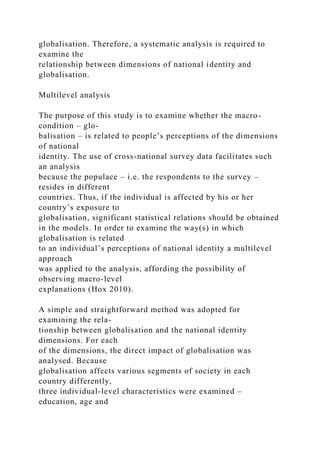
The results also point out that some dimensions receive support
across
most of the countries while other dimensions less so. In forty
countries (from
sixty-two countries), more than 50 per cent are very proud of
their country;
in forty-seven countries (from fifty-two countries), more than
50 per cent are
willing to fight for their country. However, the ethnic
dimension received
more than 50 per cent support in only sixteen countries (from
fifty-eight
countries) and support for nationalism did not go above 50 per
cent in any
country.
Overall, the indices imply differences across countries in their
dimensions
of nationalism. The question is how many of these differences
are related to
globalisation. Therefore, a systematic analysis is required to
examine the
relationship between dimensions of national identity and
globalisation.
Multilevel analysis
The purpose of this study is to examine whether the macro-
condition – glo-
balisation – is related to people’s perceptions of the dimensions
of national
identity. The use of cross-national survey data facilitates such
an analysis
because the populace – i.e. the respondents to the survey –
resides in different
countries. Thus, if the individual is affected by his or her
country’s exposure to
globalisation, significant statistical relations should be obtained
in the models. In order to examine the way(s) in which
globalisation is related
to an individual’s perceptions of national identity a multilevel
approach
was applied to the analysis, affording the possibility of
observing macro-level
explanations (Hox 2010).
A simple and straightforward method was adopted for
examining the rela-
tionship between globalisation and the national identity
dimensions. For each
of the dimensions, the direct impact of globalisation was
analysed. Because
globalisation affects various segments of society in each
country differently,
three individual-level characteristics were examined –
education, age and
gender. Overall, because younger and more well-educated
people react more
positively to globalisation than older and less educated people,
controlling
these individual-level variables provides a more precise
examination of the
relationship between globalisation and national identity.
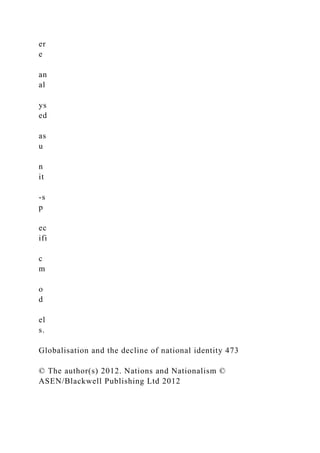
The results of the multilevel analysis indicate that there are
negative
relations between globalisation and three dimensions of national
identity:
patriotism, ethnic national identity and willingness to fight for
the country (see
Table 2). However, for national identification and nationalism,
such relations
are not evident from the results.
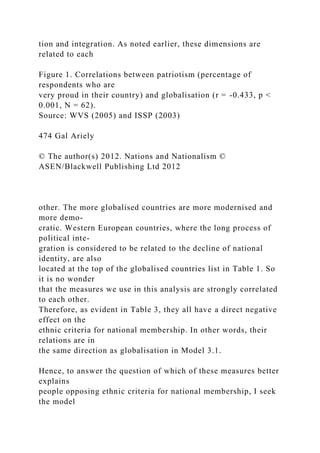
Figure 1 illustrates the findings with regard to patriotism. It
shows the
correlation between the level of globalisation and patriotism
across sixty-two
countries. Unlike in the multilevel model, the unit of analysis is
the state
(N = 62) and patriotism is measured in the aggregate level from
the respond-
ents’ answers. In line with the results of Models 2.2 and 2.5,
there is a negative
correlation (r = -0.433; p < 0.001) at the country level of
analysis between
472 Gal Ariely
© The author(s) 2012. Nations and Nationalism ©
ASEN/Blackwell Publishing Ltd 2012
T
ab
le
2.
M
ul
ti
le
ve
l
an
al
ys
is
fo
r
th
e
di
re
ct
ef
fe
ct
of
gl
ob
al
is
at
io
n
on
na
ti
on
al
id
en
ti
ty
di
m
en
si
on
s
M
od
el
s:
IS
S
P
W
V
S
2.
1
2.
2
2.
3
2.
4
2.
5
2.
6
2.
7
N
at
io
na
l
id
en
ti
fi
ca
ti
on
†
P
at
ri
ot
is
m
†
E
th
ni
c
na
ti
on
al
id
en
ti
ty
N
at
io
na
li
sm
P
at
ri
ot
is
m
†
E
th
ni
c
na
ti
on
al
id
en
ti
ty
F
ig
ht
fo
r
co
un
tr
y†
G
lo
b
al
is
at
io
n
d
ir
ec
t
ef
fe
ct
-0
.0
04
(0
.0
09
)
-0
.0
37
(0
.0
16
)*
0.
06
3
(0
.0
13
)*
**
0.
00
6
(0
.0
05
)
-0
.0
25
(0
.0
05
)*
**
-0
.0
43
(0
.0
06
)*
**
-0
.0
22
(0
.0
05
)*
*
N
u
m
b
er
o
f
re
sp
o
n
d
en
ts
39
,6
12
39
,6
12
39
,8
07
39
,6
12
72
,5
69
58
,3
36
63
,9
52
N
u
m
b
er
o
f
co
u
n
tr
ie
s
33
33
31
33
52
43
52
S
ou
rc
es
:
W
V
S
(2
00
5)
an
d
IS
S
P
(2
00
3)
.
U
n
st
an
d
ar
d
is
ed
co
ef
fi
ci
en
ts
.
R
o
b
u
st
st
an
d
ar
d
er
ro
rs
in
p
ar
en
th
es
es
.
*S
ig
n
ifi
ca
n
t
at
th
e
p
<
0.
05
le
ve
l;
**
si
gn
ifi
ca
n
t
at
th
e
p
<
0.
01
le
ve
l;
**
*s
ig
n
ifi
ca
n
t
at
th
e
p
<
0.
00
1
le
ve
l.
†D
u
m
m
y
va
ri
ab
le
s
w
er
e
an
al
ys
ed
as
u
n
it
-s
p
ec
ifi
c
m
o
d
el
s.
Globalisation and the decline of national identity 473
© The author(s) 2012. Nations and Nationalism ©
ASEN/Blackwell Publishing Ltd 2012
patriotism and globalisation. As Figure 1 illustrates, the results
do not imply
that nations with low rates of globalisation and low levels of
patriotism or vice
versa do not exist. There are countries (Ireland, Australia,
Canada, New
Zealand and the USA) with high levels of globalisation and high
levels of
patriotism. There are countries (Germany, The Netherlands and
Denmark)
with similar levels of globalisation and much lower levels of
patriotism. But,
on average, in countries with low levels of globalisation people
expressed
higher levels of patriotism. Therefore, the most that can be said
is that there is
a general pattern: there are negative, significant statistical
relationships
between a country’s level of globalisation, the expression of
national pride, the
willingness to fight for one’s country and support for ethnic
criteria for
national membership. For both nationalism - the belief that
one’s country is
better than others – and national identification, I do not find
support
for similar relations. It seems that other country-level factors
are related to
people’s feelings of nationalism (see Hjerm and Schnabel
2010).
Is it globalisation, or modernisation and political integration?
The last analysis compared the impact of globalisation to that of
modernisa-
tion and integration. As noted earlier, these dimensions are
related to each
Figure 1. Correlations between patriotism (percentage of
respondents who are
very proud in their country) and globalisation (r = -0.433, p <
0.001, N = 62).
Source: WVS (2005) and ISSP (2003)
474 Gal Ariely
© The author(s) 2012. Nations and Nationalism ©
ASEN/Blackwell Publishing Ltd 2012
other. The more globalised countries are more modernised and
more demo-
cratic. Western European countries, where the long process of
political inte-
gration is considered to be related to the decline of national
identity, are also
located at the top of the globalised countries list in Table 1. So
it is no wonder
that the measures we use in this analysis are strongly correlated
to each other.
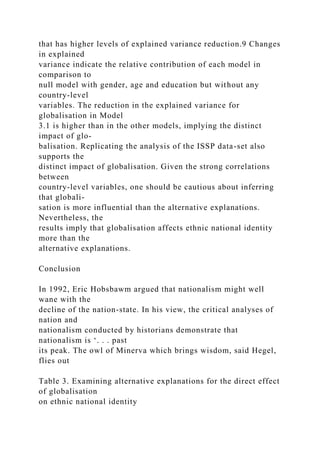
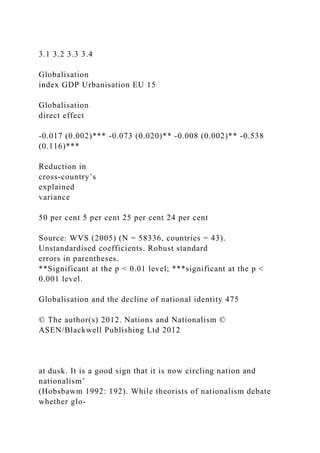
Therefore, as evident in Table 3, they all have a direct negative
effect on the
ethnic criteria for national membership. In other words, their
relations are in
the same direction as globalisation in Model 3.1.
Hence, to answer the question of which of these measures better
explains
people opposing ethnic criteria for national membership, I seek
the model
that has higher levels of explained variance reduction.9 Changes
in explained
variance indicate the relative contribution of each model in
comparison to
null model with gender, age and education but without any
country-level
variables. The reduction in the explained variance for
globalisation in Model
3.1 is higher than in the other models, implying the distinct
impact of glo-
balisation. Replicating the analysis of the ISSP data-set also
supports the
distinct impact of globalisation. Given the strong correlations
between
country-level variables, one should be cautious about inferring
that globali-
sation is more influential than the alternative explanations.
Nevertheless, the
results imply that globalisation affects ethnic national identity
more than the
alternative explanations.
Conclusion
In 1992, Eric Hobsbawm argued that nationalism might well
wane with the
decline of the nation-state. In his view, the critical analyses of
nation and
nationalism conducted by historians demonstrate that
nationalism is ‘. . . past
its peak. The owl of Minerva which brings wisdom, said Hegel,
flies out
Table 3. Examining alternative explanations for the direct effect
of globalisation
on ethnic national identity
3.1 3.2 3.3 3.4
Globalisation
index GDP Urbanisation EU 15
Globalisation
direct effect
-0.017 (0.002)*** -0.073 (0.020)** -0.008 (0.002)** -0.538
(0.116)***
Reduction in
cross-country’s
explained
variance
50 per cent 5 per cent 25 per cent 24 per cent
Source: WVS (2005) (N = 58336, countries = 43).
Unstandardised coefficients. Robust standard
errors in parentheses.
**Significant at the p < 0.01 level; ***significant at the p <
0.001 level.
Globalisation and the decline of national identity 475
© The author(s) 2012. Nations and Nationalism ©
ASEN/Blackwell Publishing Ltd 2012
at dusk. It is a good sign that it is now circling nation and
nationalism’
(Hobsbawm 1992: 192). While theorists of nationalism debate
whether glo-
balisation does indeed signify the ‘dusk of national identity’,
the aim of this
article has been far more moderate. Examining nationalism
‘from below’, it
has attempted to discern whether the ‘owl’s flight’ can be
adduced from the
relationship between globalisation and people’s perceptions of
national
identity. To this end, the study undertook a cross-country
analysis in an effort
to explain the relationship between levels of globalisation and
people’s per-
ceptions of different dimensions of national identity. I used data
from two
large cross-national surveys representing sixty-three countries,
employing a
multilevel approach in order to enable an examination of the
direct effects of
country level of globalisation on national identity dimensions
while control-
ling for gender, age and education.
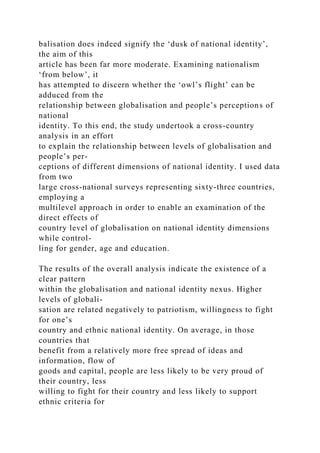
The results of the overall analysis indicate the existence of a
clear pattern
within the globalisation and national identity nexus. Higher
levels of globali-
sation are related negatively to patriotism, willingness to fight
for one’s
country and ethnic national identity. On average, in those
countries that
benefit from a relatively more free spread of ideas and
information, flow of
goods and capital, people are less likely to be very proud of
their country, less
willing to fight for their country and less likely to support
ethnic criteria for
national membership. Therefore, these results support the
argument that glo-
balisation is related to the decline of national identity. But the
analysis also
shows that high levels of national identification and nationalism
are not
related to a country’s level of globalisation. The spread of
globalisation does
not reduce people’s identification with their national group or
their view of
their country as better than other countries.
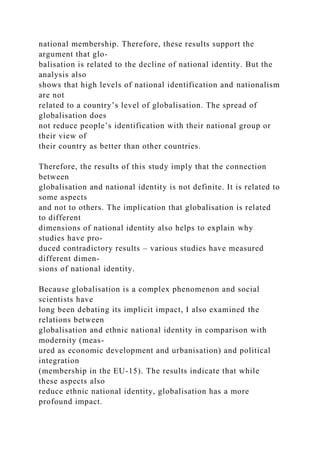
Therefore, the results of this study imply that the connection
between
globalisation and national identity is not definite. It is related to
some aspects
and not to others. The implication that globalisation is related
to different
dimensions of national identity also helps to explain why
studies have pro-
duced contradictory results – various studies have measured
different dimen-
sions of national identity.
Because globalisation is a complex phenomenon and social
scientists have
long been debating its implicit impact, I also examined the
relations between
globalisation and ethnic national identity in comparison with
modernity (meas-
ured as economic development and urbanisation) and political
integration
(membership in the EU-15). The results indicate that while
these aspects also
reduce ethnic national identity, globalisation has a more
profound impact.
The present findings should be viewed in light of the following
research
caveats, which are part of the attempt to analyse national
identity from a
cross-national perspective:
a) This is a cross-sectional study. It analyses the relations
between globalisa-
tion and national identity. From such relations, one cannot make
causal
inferences. Only longitudinal analysis that addresses the
element of time
476 Gal Ariely
© The author(s) 2012. Nations and Nationalism ©
ASEN/Blackwell Publishing Ltd 2012
can point to a causal relationship between globalisation and
national
identity.
b) As noted earlier, the use of survey data across countries to
address national
identity is inadequate to explore the complexity and
multidimensional
nature of national identity. Furthermore, different
operationalisations of
the scales that are used may lead to different results. For
example, this
study followed Davidov’s (2009) proposed nationalism scale.
The items
that were used address the feeling that one’s country is better
than others
and the results indicate the lack of connection to globalisation.
It might
well be that different operationalisations of nationalism that
address other
aspects (e.g. attitudes towards foreigners) might lead to
different results.
c) The problem of measurement comparability also applies to
the measure-
ment of globalisation. Thus, for example, while the presence of
McDon-
ald’s, among other measures, forms part of the KOF
globalisation index,
the perceptions of the chain differ across countries. While
McDonald’s
represents a symbol of globalisation in France, it is not
perceived as foreign
in Japan (Ritzer and Malone 2000).
d) Given the nature of the data, this study cannot offer a clear
distinction
between the nation and the state. While replication of the
analysis for a
sample that contains only the majority group of the ISSP 2003
displays
similar results, this approach is limited only to countries in
which there is
clear distinction between the majority and the minorities. For
multina-
tional states, this approach cannot be applied. In a similar
fashion, the
items that were used to construct the scales explicitly address
the state.
Using them to comprehend national identity might be relevant
only for
cases in which there is overlap between the two.
These caveats should be considered when the findings are
interpreted in the
context of the debate regarding globalisation and national
identity. This study
does not offer any definitive conclusions concerning the
relationship between
globalisation and national identity; nor does it suggest any
forecast for the
future of nationalism in a globalised world. It merely indicates
that the find-
ings hold true across the sixty-three countries examined, in the
ways globali-
sation and national identity were measured in this specific
study. As my review
of the literature illustrates, different operationalisations of
globalisation and
national identity yield different results. It may well be the case
that divergent
measures of national identity or globalisation will lead to
different findings.
More significantly, further research is also required in order to
determine
whether or not we are indeed approaching the ‘dusk of national
identity’.
Despite the limitations noted here, the results do appear to
indicate that
various aspects of national identity should be taken into
account. While the
impact of globalisation does not erode people’s national
identification or their
sense of nationalism, it seems that it does reduce their ethnic
conceptions of
membership in the nation as well as their explicit pride in their
country. It also
erodes their willingness to participate in one of the most
demanding tasks that
Globalisation and the decline of national identity 477
© The author(s) 2012. Nations and Nationalism ©
ASEN/Blackwell Publishing Ltd 2012
a nation can request – to participate in war. Thus, it seems that
claims for the
decline of national identity in the face of globalisation, as well
as the opposing
argument, should consider the multidimensional nature of
national identity.
Notes
1 See, for example, Hirst and Thompson (1999) and Holton
(2000).
2 See Pryke (2009) for an updated review of the literature
concerning globalisation and national
identity.
3 See Pichler (2009) for a review of cosmopolitanism
operationalisations in surveys.
4 The surveys included additional countries that were not
included in the research due to missing
data.
5 Details concerning data collection, sampling and response
rates can be found on the ISSP
(www.issp.org) and WVS (www.worldvaluessurvey.org)
websites.
6 For the ISSP data-set I excluded respondents with an
immigrant background (i.e. they or their
mother or father were immigrants), respondents who do not
identify with the majority group’s
ethnicity and respondents who do not speak the dominant
language at home as a first language.
Thus, for example, for Slovakia only respondents whose parents
(both mother and father) are not
from an immigrant background, who identify their ethnic group
as Slovak and who speak
Slovakian at home as their first language were included.
However, such data were not available for
all of the countries in the ISSP 2003 and WVS 2005.
7 See
http://globalization.kof.ethz.ch/static/pdf/method_2010.pdf.
8 For further details regarding the scale, see
http://globalization.kof.ethz.ch/.
9 This is explained variance at the national level.
References
Ashuri, T. 2005. ‘The nation remembers: national identity and
shared memory in television
documentaries’, Nations and Nationalism 11, 3: 423–42.
Barber, B. 2003. Jihad vs. Mcworld. How Globalism and
Tribalism are Reshaping the World. New
York: Ballantine.
Calhoun, C. J. 2007. Nations Matter: Culture, History, and the
Cosmopolitan Dream. London:
Routledge.
Carolyn, W. Y. and Kolko, B. E. 2005. ‘Resistance to
globalization: language and internet
diffusion patterns in Uzbekistan’, New Review of Hypermedia
and Multimedia 11, 2: 205–20.
Castells, M. 2004. The Power of Identity: the Information Age:
Economy, Society and Culture.
Malden, MA: Blackwell.
Citrin, J. and Sides, J. 2004. ‘Can there be Europe without
Europeans? Problems of identity in a
multinational community’ in R. Herrmann et al. (eds), Identities
in Europe and the Institutions
of the European Union. Lanham, MD: Rowman and Littlefield.
Citrin, J. and Sears, D. O. 2009. ‘Balancing national and ethnic
identities’ in R. Abdelal et al.
(eds), Measuring Identity: a Guide for Social Scientists. New
York: Cambridge University Press.
Davidov, E. 2009. ‘Measurement equivalence of nationalism
and constructive patriotism in the
ISSP: 34 countries in a comparative perspective’, Political
Analysis 17, 1: 64–82.
Davidson, R., Poor, N. and Williams, A. 2009. ‘Stratification
and global elite theory: a cross-
cultural and longitudinal analysis of public opinion’,
International Journal of Public Opinion
Research 21, 2: 165–86.
Delanty, G. and Kumar, K. 2006. ‘Introduction’ in G. Delanty
and K. Kumar (eds), The Sage
Handbook of Nations and Nationalism. London: Sage.
478 Gal Ariely
© The author(s) 2012. Nations and Nationalism ©
ASEN/Blackwell Publishing Ltd 2012
Dogan, M. 1994. ‘The decline of nationalism within Western
Europe’, Comparative Politics 26, 3:
281–305.
Dreher, A., Gaston, N. and Martens, P. 2008. Measuring
Globalization: Gauging its Consequences.
New York: Springer.
Guibernau, M. 2001. ‘Globalisation and the nation-state’ in M.
Guibernau and J. Hutchinson
(eds), Understanding Nationalism. Cambridge: Polity.
Guillén, M. F. 2001. ‘Is globalization civilizing, destructive or
feeble? A critique of five key debates
in the social science literature’, Annual Review of Sociology
27: 235–60.
Hadler, M. and Meyer, J. W. 2009. ‘Tangled paths to a world
culture’ in M. Haller et al. (eds),
The International Social Survey Program 1984–2009: Charting
the Globe. London: Routledge.
Haller, M., Jowell, R. and Smith, T. W. (eds) 2009. The
International Social Survey Program
1984–2009: Charting the Globe. London: Routledge.
Held, D. et al. 1999. Global Transformations. Cambridge:
Polity.
Hirst, P. Q. and Thompson, G. 1999. Globalization in Question:
the International Economy and the
Possibilities of Governance. Cambridge: Polity.
Hjerm, M. and Schnabel, A. 2010. ‘Mobilizing nationalist
sentiments: which factors affect nation-
alist sentiments in Europe?’ Social Science Research (online),
doi: 10.1016/j.ssresearch.
2010.03.006.
Hobsbawm, E. J. 1992. Nations and Nationalism since 1780.
Cambridge: Cambridge University
Press.
Hobsbawm, E. J. 2007. Globalization, Democracy and
Terrorism. London: Brown.
Holton, R. 2000. ‘Globalization’s cultural consequences’,
Annals of the American Academy of
Political and Social Science 570, 1: 140–52.
Hox, J. J. 2010. Multilevel Analysis: Techniques and
Applications. New York: Routledge.
ISSP Research Group. 2003. International Social Survey
Program (ISSP): National Identity II.
Cologne: ISSP Research Group / GESIS.
Jones, F. L. and Smith, P. 2001. ‘Individual and societal bases
of national identity. A comparative
multi-level analysis’, European Sociological Review 17, 2: 103–
18.
Jung, J. K. 2008. ‘Growing supranational identities in a
globalizing world? A multilevel analysis
of the World Values Surveys’, European Journal of Political
Research 47, 5: 578–609.
Kaldor, M. 2004. ‘Nationalism and globalization’, Nations and
Nationalism 10, 1–2: 161–77.
Kunovich, R. M. 2009. ‘The sources and consequences of
national identification’, American
Sociological Review 74, 4: 573–93.
Kymlicka, W. 2003. ‘Conclusion: the future of nationalism’ in
U. Özkirimli (ed.), Nationalism and
its Futures. New York: Palgrave.
Latcheva, R. 2010. ‘Cognitive interviewing and factor-analytic
techniques: a mixed method
approach to validity of survey items measuring national
identity’, Quality and Quantity (online),
doi: 10.1007/s11135-009-9285-0.
Mau, S., Mewes, J. and Zimmermann, A 2008. ‘Cosmopolitan
attitudes through transnational
social practices?’ Global Networks 8, 1: 1–24.
Moran, A. 2005. Australia: Nation, Belonging, and
Globalization. New York: Routledge.
Norris, P. and Inglehart, R. 2009. Cosmopolitan
Communications: Cultural Diversity in a
Globalized World. Cambridge: Cambridge University Press.
Olofsson, A. and Öhman, S. 2007. ‘Views of risk in Sweden:
global fatalism and local control – an
empirical investigation of Ulrich Beck’s theory of new risks’,
Journal of Risk Research 10, 2:
177–96.
Pichler, F. 2009. ‘ “Down-to-earth” cosmopolitanism’, Current
Sociology 57, 5: 704–32.
Pryke, S. 2009. Nationalism in a Global World. Basingstoke:
Palgrave Macmillan.
Reskens, T. and Hooghe, M. 2010 ‘Beyond the civic–ethnic
dichotomy: investigating the struc-
ture of citizenship concepts across thirty-three countries’,
Nations and Nationalism 16, 4:
579–97.
Ritzer G. and Malone, E. L. 2000. ‘Globalization theory:
lessons from the exportation of
McDonaldization and the new means of consumption’,
American Studies 41: 97–118.
Globalisation and the decline of national identity 479
© The author(s) 2012. Nations and Nationalism ©
ASEN/Blackwell Publishing Ltd 2012
Sapountzis, A. 2008. ‘Towards a critical social psychological
account of national sentiments:
patriotism and nationalism revisited’, Social and Personality
Psychology Compass 2, 1: 34–
50.
Shavit, U. 2009. The New Imagined Community: Global Media
and the Construction of National
and Religious Identities of Migrants. Eastbourne: Sussex
Academic Press.
Sinnott, R. 2006. ‘An evaluation of the measurement of
national, subnational and supranational
identity in cross-national surveys’, International Journal of
Public Opinion Research 18, 2:
211–23.
Smith, A. D. 1992. ‘National identity and the idea of European
unity’, International Affairs 68:
55–76.
Smith, A. D. 1995. Nations and Nationalism in a Global Era.
Cambridge: Polity.
Smith, A. D. 2007. ‘Nationalism in decline?’ in M. Young et al.
(eds), Nationalism in a Global Era.
New York: Routledge.
Staerklé, C. C. et al. 2010. ‘Ethnic minority–majority
asymmetry in national attitudes around the
world: a multilevel analysis’, Political Psychology 31, 4: 491–
519.
Tilley, J. and Heath, A. 2007. ‘The decline of British national
pride’, British Journal of Sociology
58, 4: 661–78.
Tønnesson, S. 2004. ‘Globalizing national states’, Nations and
Nationalism 10, 1–2: 179–94.
Waisbord, S. 2004. ‘McTV: understanding the global popularity
of television formats’, Television
New Media 5, 4: 359–83.
World Values Survey (WVS). 2005. World Values Survey 2005,
Official Data File v. 20090901.
Stockholm: World Values Survey Association.
Wright, M. 2011. ‘Policy regimes and normative conceptions of
nationalism in mass public
opinion’, Comparative Political Studies 44, 5: 598–624.
Zuelow, E., Young, M. and Strum, A. 2007. ‘The owl’s early
flight’ in E. Zuelow et al. (eds),
Nationalism in a Global Era. New York: Routledge.
480 Gal Ariely
© The author(s) 2012. Nations and Nationalism ©
ASEN/Blackwell Publishing Ltd 2012
A
pp
en
di
x
1.
C
ou
nt
ri
es
in
th
e
In
te
rn
at
io
na
lS
oc
ia
lS
ur
ve
y
P
ro
gr
am
(I
S
S
P
)
20
03
an
d
W
or
ld
V
al
ue
s
S
ur
ve
y
(W
V
S
)
20
05
th
at
w
er
e
us
ed
in
th
e
an
al
ys
is
IS
S
P
W
V
S
A
u
st
ra
li
a
(2
18
3)
S
w
ed
en
(1
18
6)
A
rg
en
ti
n
a
(1
00
2)
M
o
ro
cc
o
(1
20
0)
A
u
st
ri
a
(1
00
6)
S
w
it
ze
rl
an
d
(1
03
7)
A
u
st
ra
li
a
(1
42
1)
N
et
h
er
la
n
d
s
(1
05
0)
B
u
lg
ar
ia
(1
06
9)
U
n
it
ed
K
in
gd
o
m
(8
73
)
B
ra
zi
l
(1
50
0)
N
ew
Z
ea
la
n
d
(9
54
)
C
an
ad
a
(1
21
1)
U
S
A
(1
21
6)
B
u
lg
ar
ia
(1
00
1)
N
o
rw
ay
(1
02
5)
C
h
il
e
(1
50
5)
U
ru
gu
ay
(1
10
8)
B
u
rk
in
a
F
as
o
(1
53
4)
P
er
u
(1
50
0)
C
ze
ch
R
ep
u
b
li
c
(1
27
6)
V
en
ez
u
el
a
(1
19
9)
C
an
ad
a
(2
16
4)
P
o
la
n
d
(1
00
0)
D
en
m
ar
k
(1
32
2)
C
h
il
e
(1
00
0)
R
o
m
an
ia
(1
77
6)
F
in
la
n
d
(1
37
9)
C
h
in
a
(2
01
5)
R
u
ss
ia
(2
03
3)
F
ra
n
ce
(1
66
9)
C
yp
ru
s
(1
05
0)
R
w
an
d
a
(1
50
7)
G
er
m
an
y
(1
28
7)
E
gy
p
t
(3
05
1)
S
er
b
ia
(1
22
0)
H
u
n
ga
ry
(1
02
1)
E
th
io
p
ia
(1
50
0)
S
lo
ve
n
ia
(1
03
7)
Ir
el
an
d
(1
06
5)
F
in
la
n
d
(1
01
4)
S
o
u
th
A
fr
ic
a
(2
98
8)
Is
ra
el
(1
21
8)
F
ra
n
ce
(1
00
1)
S
o
u
th
K
o
re
a
(1
20
0)
Ja
p
an
(1
10
2)
G
eo
rg
ia
(1
50
0)
S
p
ai
n
(1
20
0)
L
at
vi
a
(1
00
0)
G
er
m
an
y
(2
06
4)
S
w
ed
en
(1
00
3)
N
et
h
er
la
n
d
s
(1
82
3)
G
h
an
a
(1
53
4)
S
w
it
ze
rl
an
d
(1
24
1)
N
ew
Z
ea
la
n
d
(1
03
6)
G
u
at
em
al
a
(1
00
0)
T
h
ai
la
n
d
(1
53
4)
N
o
rw
ay
(1
46
9)
In
d
ia
(2
00
1)
T
ri
n
id
ad
an
d
T
o
b
ag
o
(1
00
2)
P
h
il
ip
p
in
es
(1
20
0)
In
d
o
n
es
ia
(2
01
5)
T
u
rk
ey
(1
34
6)
P
o
la
n
d
(1
27
7)
Ir
an
(2
66
7)
U
k
ra
in
e
(1
00
0)
P
o
rt
u
ga
l
(1
60
2)
It
al
y
(1
01
2)
U
n
it
ed
K
in
gd
o
m
(1
04
1)
R
u
ss
ia
(2
38
3)
Ja
p
an
(1
09
6)
U
S
A
(1
24
9)
S
lo
va
k
ia
(1
15
2)
Jo
rd
an
(1
20
0)
U
ru
gu
ay
(1
00
0)
S
lo
ve
n
ia
(1
09
3)
M
al
ay
si
a
(1
20
1)
V
ie
tn
am
(1
49
5)
S
o
u
th
A
fr
ic
a
(2
48
3)
M
al
i
(1
53
4)
Z
am
b
ia
(1
50
0)
S
o
u
th
K
o
re
a
(1
31
5)
M
ex
ic
o
(1
56
0)
S
p
ai
n
(1
21
2)
M
o
ld
o
va
(1
04
6)
Globalisation and the decline of national identity 481
© The author(s) 2012. Nations and Nationalism ©
ASEN/Blackwell Publishing Ltd 2012
A
pp
en
di
x
2.
M
ea
su
ri
ng
di
m
en
si
on
s
of
na
ti
on
al
id
en
ti
ty
V
ar
ia
bl
e
Q
ue
st
io
n
w
or
di
ng
S
ca
le
N
at
io
n
al
id
en
ti
fi
ca
ti
o
n
(I
S
S
P
)*
•
H
o
w
cl
o
se
yo
u
fe
el
to
yo
u
r
co
u
n
ty
?
1
=
ve
ry
cl
o
se
,
2
=
cl
o
se
,
3
=
n
o
t
ve
ry
cl
o
se
,
4
=
n
o
t
cl
o
se
at
al
l
C
h
au
vi
n
is
m
(I
S
S
P
)
•
T
h
e
w
o
rl
d
w
o
u
ld
b
e
a
b
et
te
r
p
la
ce
if
p
eo
p
le
fr
o
m
o
th
er
co
u
n
tr
ie
s
w
er
e
m
o
re
li
k
e
th
e
[c
o
u
n
tr
y
n
at
io
n
al
it
y]
•
G
en
er
al
ly
sp
ea
k
in
g,
[r
es
p
o
n
d
en
t’
s
co
u
n
tr
y]
is
a
b
et
te
r
co
u
n
tr
y
th
an
m
o
st
o
th
er
co
u
n
tr
ie
s
1
=
ag
re
e
st
ro
n
gl
y,
2
=
ag
re
e,
3
=
n
ei
th
er
ag
re
e
n
o
r
d
is
ag
re
e,
4
=
d
is
ag
re
e,
5
=
d
is
ag
re
e
st
ro
n
gl
y
P
at
ri
o
ti
sm
(I
S
S
P
,
W
V
S
)*
*
•
H
o
w
p
ro
u
d
ar
e
yo
u
o
f
b
ei
n
g
[c
o
u
n
tr
y
n
at
io
n
al
]
(I
S
S
P
)
1
=
ve
ry
p
ro
u
d
,
2
=
so
m
ew
h
at
p
ro
u
d
,
3
=
n
o
t
ve
ry
p
ro
u
d
,
4
=
n
o
t
p
ro
u
d
at
al
l
E
th
n
ic
n
at
io
n
al
id
en
ti
ty
(I
S
S
P
,
W
V
S
)
•
T
o
h
av
e
[c
o
u
n
tr
y]
an
ce
st
ry
(r
eq
u
ir
em
en
ts
fo
r
b
ei
n
g
a
tr
u
ly
n
at
io
n
al
m
em
b
er
)
•
H
av
in
g
an
ce
st
o
rs
fr
o
m
th
e
co
u
n
tr
y
(r
eq
u
ir
em
en
ts
fo
r
n
at
u
ra
li
sa
ti
o
n
)
1
=
ve
ry
im
p
o
rt
an
t,
2
=
fa
ir
ly
im
p
o
rt
an
t,
3
=
n
o
t
ve
ry
im
p
o
rt
an
t,
4
=
n
o
t
im
p
o
rt
an
t
at
al
l
(I
S
S
P
);
1
=
ve
ry
im
p
o
rt
an
t,
2
=
ra
th
er
im
p
o
rt
an
t,
3
=
n
o
t
ve
ry
im
p
o
rt
an
t
(W
V
S
)
F
ig
h
t
fo
r
co
u
n
tr
y
(W
V
S
)*
*
•
O
f
co
u
rs
e,
w
e
al
l
h
o
p
e
th
at
th
er
e
w
il
l
n
o
t
b
e
an
o
th
er
w
ar
,
b
u
t
if
it
w
er
e
to
co
m
e
to
th
at
,
w
o
u
ld
yo
u
b
e
w
il
li
n
g
to
fi
gh
t
fo
r
yo
u
r
co
u
n
tr
y?
1
=
ye
s
2
=
n
o
*A
n
sw
er
s
w
er
e
sk
ew
ed
to
‘v
er
y
cl
o
se
’
o
r
‘c
lo
se
’,
so
th
e
sc
al
e
w
as
re
co
d
ed
as
a
d
u
m
m
y
va
ri
ab
le
.
**
A
n
sw
er
s
w
er
e
sk
ew
ed
to
‘v
er
y
p
ro
u
d
’,
so
th
e
sc
al
e
w
as
re
co
d
ed
as
a
d
u
m
m
y
va
ri
ab
le
.
A
lt
er
n
at
iv
e
sc
al
in
g
d
id
n
o
t
ch
an
ge
th
e
re
su
lt
s
o
f
th
e
an
al
ys
is
.
IS
S
P
,
In
te
rn
at
io
n
al
S
o
ci
al
S
u
rv
ey
P
ro
gr
am
;
W
V
S
,
W
o
rl
d
V
al
u
es
S
u
rv
ey
.
482 Gal Ariely
© The author(s) 2012. Nations and Nationalism ©
ASEN/Blackwell Publishing Ltd 2012
Copyright of Nations & Nationalism is the property of Wiley-
Blackwell and its content may not be copied or
emailed to multiple sites or posted to a listserv without the
copyright holder's express written permission.
However, users may print, download, or email articles for
individual use.

Critical Thinking and ArticleResearch Analysis Guidelines(Based.docx

  • 1.
    Critical Thinking andArticle/Research Analysis Guidelines (Based on: Paul R. & Elder, L. (2014) Critical Thinking: Concepts & Tools. www.criticalthinking.org) Why Critical Thinking? The Problem: Everyone thinks; it is our nature to do so. But much of our thinking, left to itself, is biased, distorted, partial, uninformed, or down-right prejudiced. Yet the quality of our life and that of what we produce, make, or build depends precisely on the quality of our though. Shoddy thinking is costly, both in money and in quality of life. Excellence in thought, however, must be systematically cultivated. A Definition: Critical thinking is the art of analyzing and evaluating thinking with a view to improving it. The Result: A well cultivated critical thinker: · Raises vital questions and problems, formulating them clearly and precisely; · Gathers and assesses relevant information, using abstract ideas to interpret it effectively; · Comes to well-reasoned conclusions and solutions, testing them against relevant criteria and standards; · Thinks open-mindedly within alternative systems of thought, recognizing and assessing, as need be, their assumptions, implications, and practical consequences; and · Communicates effectively with others in figuring out solutions to complex problems. Critical thinking is, in short, self-directed, self-disciplined, self-monitored, and self-corrective thinking. It requires rigorous standards of excellence and mindful command of their use. It entails effective communication and problem solving abilities
  • 2.
    and a commitmentto overcoming our native egocentrism and sociocentrism. Analyzing & Assessing Research Use this template to assess the quality of any research project or paper. 1. All research has a fundamental PURPOSE and goal. · Research purposes and goals should be clearly stated. · Related purposes should be explicitly distinguished. · All segments of the research should be relevant to the purpose. · All research purposes should be realistic and significant. 2. All research addresses a fundamental QUESTION, problem, or issue. · The fundamental question at issue should be clearly and precisely stated. · Related questions should be articulated and distinguished. · All segments of the research should be relevant to the central question. · All research questions should be realistic and significant. · All research questions should define clearly stated intellectual tasks that, being fulfilled, settle the questions. 3. All research identifies data, INFORMATION, and evidence relevant to its fundamental question and purpose. · All information should be clear, accurate, and relevant to the fundamental question at issue. · Information gathered must be sufficient to settle the question at issue. · Information contrary to the main conclusions of the research should be explained. 4. All research contains INFERENCES or interpretations by which conclusions are drawn. · All conclusions should be clear, accurate, and relevant to the key question at issue. · Conclusions drawn should not go beyond what the data imply.
  • 3.
    · Conclusions shouldbe consistent and reconcile discrepancies in the data. · Conclusions should explain how the key questions at issue have been settled. 5. All research is conducted from some POINT OF VIEW or frame of reference. · All points of view in the research should be identified. · Objections from competing points of view should be identified and fairly addressed. 6. All research is based on ASSUMPTIONS. · Clearly identify and assess major assumptions in research. · Explain how the assumptions shape the research point of view. 7. All research is expressed through, and shaped by, CONCEPTS and ideas. · Assess for clarity the key concepts in the research. · Asses the significance of the key concepts in the research. 8. All research leads somewhere (i.e., has IMPLICATIONS and consequences). · Trace the implications and consequences that follow from the research. · Search for negative as well as positive implications. · Consider all significant implications and consequences. Social Science Research: Designs, Methods (Adapted from: http://www.cliffsnotes.com/sciences/sociology/sociological- research-methods/sociological-research-designs-methods) Social Scientists use many different designs and methods to study society and social behavior. Three popular social research designs (models) are · Cross‐sectional, in which scientists study a number of individuals or cases at a single point in time · Longitudinal, in which scientists study the same individuals or cases repeatedly over a specified period of time (AKA Panel
  • 4.
    Studies) · Cross‐sequential, inwhich scientists test individuals or cases in a cross‐sectional sample more than once over a specified period of time (AKA Sequential) Six of the most popular research methods (procedures) are the case study, survey, observational, correlational, experimental, and cross‐cultural methods, as well as working with information already available. 1. Case study research In case study research, an investigator studies an individual/case or small group of individuals/cases in detail. On the positive side, case studies obtain useful information about the individuals or cases studied. On the negative side, they tend to apply only to individuals/cases with similar characteristics rather than to the general population. The small number of subjects limits the generalizability of this method. 2. Survey research Survey research involves interviewing or administering questionnaires, or written surveys, to large numbers of people. The investigator analyzes the data obtained from surveys to learn about similarities, differences, and trends. He or she then makes predictions about the population being studied. As with most research methods, survey research brings both advantages and disadvantages. Advantages include obtaining information from a large number of respondents, conducting personal interviews at a time convenient for respondents, and acquiring data as inexpensively as possible. Anonymous surveys have the added advantage of ensuring anonymity and thus prompting respondents to answer questions truthfully. Surveys can be administered in-person, by mail, phone, or online. Disadvantages of survey research include volunteer bias, interviewer bias, and distortion. Volunteer bias occurs when a sample of volunteers is not representative of the general
  • 5.
    population. Subjects whoare willing to talk about certain topics may answer surveys differently than those who are not willing to talk. Interviewer bias occurs when an interviewer's expectations or insignificant gestures (for example, frowning or smiling) inadvertently influence a subject's responses one way or the other. Distortion occurs when a subject does not respond to questions honestly. 3. Observational research Because distortion can be a serious limitation of surveys, observational research involves directly observing subjects' reactions, either in a laboratory (called laboratory observation) or in a natural setting (called naturalistic observation). Observational research reduces the possibility that subjects will not give totally honest accounts of the experiences, not take the study seriously, fail to remember, or feel embarrassed. Observational research has limitations, however. Subject bias is common, because volunteer subjects may not be representative of the general public. Individuals who agree to observation and monitoring may function differently than those who do not. They may also function differently in a laboratory setting than they do in other settings. 4. Correlational research A sociologist may also conduct correlational research. A correlation is a relationship between two variables (or “factors that change”). These factors can be characteristics, attitudes, behaviors, or events. Correlational research attempts to determine if a relationship exists between the two variables, and the degree of that relationship. A social researcher can use case studies, surveys, interviews, and observational research to discover correlations. Correlations are either positive, negative, or nonexistent. In a positive correlation, the values of the variables increase or decrease (“co‐vary”) together. In a negative correlation, one variable increases as the other decreases. In a nonexistent correlation, no
  • 6.
    relationship exists betweenthe variables. People commonly confuse correlation with causation. Correlational data do not indicate cause‐and‐effect relationships. When a correlation exists, changes in the value of one variable reflect changes in the value of the other. The correlation does not imply that one variable causes the other, only that both variables somehow relate to one another. To study the effects that variables have on each other, an investigator must conduct an experiment. 5. Experimental research Experimental research attempts to determine how and why something happens. Experimental research tests the way in which an independent variable (the factor that the scientist manipulates) affects a dependent variable (the factor that the scientist observes). A number of factors can affect the outcome of any type of experimental research. One is finding samples that are random and representative of the population being studied. Another is experimenter bias, in which the researcher's expectations about what should or should not happen in the study sway the results. Still another is controlling for extraneous variables, such as room temperature or noise level, that may interfere with the results of the experiment. Only when the experimenter carefully controls for extraneous variables can she or he draw valid conclusions about the effects of specific variables on other variables. 6. Cross-cultural research Sensitivity to others' norms, folkways, values, mores, attitudes, customs, and practices necessitates knowledge of other societies and cultures. Sociologists may conduct cross‐cultural research, or research designed to reveal variations across different groups of people. Most cross‐cultural research involves survey, direct observation, and participant observation methods of research. Participant observation requires that an “observer” become a member of his or her subjects' community. An advantage of this method of research is the opportunity it provides to study what
  • 7.
    actually occurs withina community, and then consider that information within the political, economic, social, and religious systems of that community. Cross‐cultural research demonstrates that Western cultural standards do not necessarily apply to other societies. What may be “normal” or acceptable for one group may be “abnormal” or unacceptable for another. 7. Research with existing data, or secondary analysis Some sociologists conduct research by using data that other social scientists have already collected. The use of publicly accessible information is known as secondary analysis, and is most common in situations in which collecting new data is impractical or unnecessary. Sociologists may obtain statistical data for analysis from businesses, academic institutions, and governmental agencies, to name only a few sources. Or they may use historical or library information to generate their hypotheses. Take an article you have been assigned to read for class and complete the “logic” of it using the template below. Copy each question and answer it fully in your assignment. (Title = FULL CITATION OF ARTICLE) 1. The social science discipline of the article is ______________________. (The article falls within which of the three disciplines?) How do you know this? (Clearly state the evidence and reasoning you used to determine the discipline of the article.) 2. The main purpose of the article is ______________________. (State as accurately as possible the author’s purpose for writing the article.) Explain. 3. The most important information in the article is ____________________. (Figure out the facts, experiences, data the author is using to support her/his conclusions.) Explain.
  • 8.
    4. The maininferences/conclusions in this article are ______________________. (Identify the key conclusions the author comes to and presents in the article.) 5. The key concept(s) we need to understand in this article is (are) _________________. By these concepts the author means _________________. (Figure out the most important ideas you would have to understand in order to understand the author’s line of reasoning and explain.) 6. If we take this line of reasoning seriously, the implications are ___________________. (What consequences are likely to follow if people take the author’s line of reasoning seriously?) Explain. 7. The main hypothesis or hypotheses being tested is/are ___________________. (Clearly identify independent and dependent variables and the predicted relationships between them.) 8. The social science research design of the study is ___________________. (Which of the three methods are being used by the researcher?) Explain. 9. The social scientific research method(s) being used is/are ___________________. (Which of the seven methods are being used by the researcher? More than one may be used.) Explain. 6 Watch those video and answer the question YouTube URL:http://www.youtube.com/watch?v=7qeehDLYa8g YouTube URL:http://www.youtube.com/watch?v=H7x9nIFEyO4 Referring to the videos on Outsourcing and analyze whether it
  • 9.
    makes sense forcompanies like Apple and Nike to bring manufacturing home instead of their current practice of outsourcing? Why or why not? What companies/industries are most likely to use nearshoring or reshoring? Globalisation and the decline of national identity? An exploration across sixty-three countries GAL ARIELY University of Haifa, Israel ABSTRACT. The relationship between globalisation and national identity is puz- zling. While some observers have found that globalisation reduces people’s identifi- cation with their nation, others have reached the opposite conclusion. This article explores this conundrum by examining the relationship between globalisation and people’s feelings towards national identity. Using data from the International Social Survey Program National Identity II (2003) and the World Values Survey (2005), it analyses these relations across sixty-three countries. Employing a multilevel approach, it investigates how a country’s level of globalisation is related
  • 10.
    to its publicperceptions towards different dimensions of national identity. The results suggest that a country’s level of globalisation is not related to national identification or nationalism but it is related negatively to patriotism, the willingness to fight for the country and ethnic conceptions of membership in the nation. An examination of alternative explanations indicates that globalisation has a distinct impact on national identity. KEYWORDS: globalisation; national identity; nationalism; patriotism; cross- national analysis; multi-level analysis Introduction The effect of globalisation on national identity is complex. Some consider it a force that undermines national identity, while others argue that globalisation trends reinforce national feelings (Calhoun 2007; Guibernau 2001; Kaldor 2004; Kymlicka 2003; Zuelow et al. 2007; Tønnesson 2004). Inconsistent inter- pretations of the nexus between globalisation and national identity reflect not only different theoretical predispositions regarding the meaning of national- ism but also the different methods used to examine that relationship. While some studies have found that the experience of globalisation reduces identifi- cation with the nation among the public (e.g. Norris and Inglehart 2009),
  • 11.
    others have reachedthe opposite conclusion (e.g. Jung 2008). Interestingly, despite the ongoing debate over the links between national identity and glo- balisation, few studies have undertaken systematic cross- national research concerning the way(s) in which globalisation is related to the manner in which people define and perceive national identity. bs_bs_banner EN ASJ O U R N A L O F T H E A S S O C I AT I O N F O R T H E S T U D Y O F E T H N I C I T Y A N D N AT I O N A L I S M NATIONS AND NATIONALISM Nations and Nationalism 18 (3), 2012, 461–482. DOI: 10.1111/j.1469-8129.2011.00532.x © The author(s) 2012. Nations and Nationalism © ASEN/Blackwell Publishing Ltd 2012 The aim of this study is to examine how globalisation is related to people’s feelings towards national identity. To that end, employing a multilevel approach, it explores the relationship between globalisation and national iden- tity across sixty-three countries. While most studies of national
  • 12.
    identity have focused onthe individual level, this study links national-level parameters of globalisation with individual-level perceptions of national identity. In other words, it examines whether a country’s level of globalisation is related to individual-level attitudes towards national identity. Similarly, while most studies to date have focused on a single nation and cross- national comparisons have been limited primarily to Western cases, an analysis across sixty-three nations offers a more comprehensive account of the relationship between different dimensions of national identity and globalisation. Before entering into the specific analysis, first I will review briefly various interpretations of the relationship between nationalism and globalisation and the empirical studies that have examined this relationship to date. Employ- ing data from two cross-national surveys – the International Social Survey Program (ISSP) National Identity II (2003) and the World Values Survey (WVS) (2005) – the present study explores the way(s) in which a country’s level of globalisation is related to different dimensions of national identity. Special attention will be paid to elucidating the logic of such cross- national multilevel analysis, as well as the limitations of this analysis. Analysing the impact of globalisation in comparison with other explanations -
  • 13.
    modernisation, eco- nomic developmentand political integration – is used to reveal the distinctive impact of globalisation. Globalisation and national identity Globalisation, defined as ‘increasing cross-border flows of goods, services, money, people, information, and culture’ (Held et al. 1999: 16), is one of the most hotly debated topics in contemporary social research (Guillén 2001). It constitutes a puzzling process of contradictory effects on many aspects of politics and society because of its multifaceted nature. Thus it should be understood as a process or a set of processes that do not follow linear logic or have equal impact on societies across the world (Held et al. 1999). Globalisation is regarded by many as a force that redefines state functions and even decreases state power.1 In this study, I focus on the impact of globalisation on national identity and not on its impact on the state as an institution. The defining criteria for national identity are differentiation from other nations and continuity over time. The nation is a collective identity rooted in past symbols, memories and values as well as a body that projects into the future. This entity links symbols, memories and values to a specific
  • 14.
    territory while distinguishingitself from other nations (Guibernau 2001). Globalisation is seen as undermining national identity because, put briefly, the cross-border flow of information makes it harder for any single national 462 Gal Ariely © The author(s) 2012. Nations and Nationalism © ASEN/Blackwell Publishing Ltd 2012 identity to retain its unique significance and distinguish itself from other national identities. In the global village, the ability to produce and maintain a homogenous national identity is challenged as people become global consum- ers of goods and information. In a wired world, the government no longer has the exclusive capacity to exert cultural control over its citizens and/or territory (Barber 2003; Guibernau 2001; for a different view, see Calhoun 2007). Although the impact of globalisation on the state has long been a subject of study in general, theorists of nationalism have only recently begun to investi- gate the impact of globalisation (Delanty and Kumar 2006).2 The customary distinction between primordial and modernist theories of nationalism is also reflected in conflicting interpretations of the influence of
  • 15.
    globalisation on national identity(Kaldor 2004; Tønnesson 2004). The modernist approach posits that nationalism is the product of a specific historical period – modernity – rather than constituting a permanent feature of human society. Consequently, the transformation of social, economic and political aspects of modern society under globalisation changes the meaning of nationalism as an instrument of mass identification and mobilisation. Eric Hobsbawm argued that nationalism had become ‘historically less important’, predicting that, over the course of time, it would no longer be a vital political programme and that the world ‘will be largely supernational’ (Hobsbawm 1992: 191). Fifteen years later, he reached the same conclusion. In his opinion, the emergence of national movements and national claims in the past twenty years has not undermined the contention that nationalism’s role as the main force shaping politics is decreasing (Hobsbawm 2007). The primordial account of nationalism emphasises that nations are neither a modern phenomenon nor social constructs created by changing circum- stances, as the modernist approach argues. Rather, nationalism represents the importance of identity and belonging, reaching far further back than the modern period. While the primordial account recognises that
  • 16.
    modernity has an importantrole to play in national mobilisation, nationalism also embodies pre-existing ethnic traditions (Smith 1995). In other words, nationalism has deeper roots in human society than the modern approach would suggest. The transformation of social, economic and political aspects of human society under globalisation does not, therefore, eradicate nationalism. Anthony Smith concludes his account of Nations and Nationalism in a Global Era by rejecting the modernist approach and suggesting that ‘it would be folly to predict an early supersession of nationalism and an imminent transcendence of the nation . . . For a global culture seems unable to offer the qualities of collective faith, dignity and hope that only a “religious surrogate” with its promise of a territorial cultural community across the generations can provide’ (Smith 1995: 160). In a later account (2007), he argues not only that global culture cannot replace national culture but also that national identity can in fact withstand the force of globalisation. According to Smith, while the existence of culturally diverse waves of immigrants has reshaped the meaning of national identity, this process also leads members of the nation to reflect on Globalisation and the decline of national identity 463
  • 17.
    © The author(s)2012. Nations and Nationalism © ASEN/Blackwell Publishing Ltd 2012 their national identity and reinforce its meaning and functions for the nation. Therefore, he maintains that, despite globalisation, ‘self- reflective and self- celebrating communities, nations and nationalism are still very much alive’ (Smith 2007: 30). Others view the continuation of national identity in a globalised world as a consequence of the necessity to organise public life. The influential perspective of Calhoun (2007) asserts that national identity organ- ises ordinary people’s ‘sense of belonging’. According to Calhoun, globalisa- tion makes the sense of belonging even more important than previously. The debate between modernist and primordial accounts of nationalism is related to another question about globalisation: is globalisation distinct from modernity? Is globalisation merely a continuation of the trend towards modernity, or is it the beginning of a new era? Some view globalisation as the expansion of modernity to a global scale while others propose viewing it as something totally different (Guillén 2001). While this debate cannot be addressed in this article, I do examine whether the relations between a coun-
  • 18.
    try’s level ofglobalisation and people’s national identity are different from two aspects of modernity – economic and urban development. Beyond the debate between modernist and primordial accounts of nation- alism, many observers emphasise the dual impact of globalisation on national identity. While globalisation may push some part of the population in a given nation towards cosmopolitanism, other parts will develop ‘resistance identi- ties’ (Castells 2004). National identity, primarily in its cultural forms, is an example of such resistance identity. Thus, for example, recent studies have found that young Muslims in Europe employ the internet – considered a tool of globalisation – to strengthen religious and national ties (Shavit 2009). This is true not only for Muslim youth. Despite the spread of the internet and the globalisation of television, most people surf domestic websites and watch programmes that reflect national culture on domestic channels (e.g. Carolyn and Kolko 2005; Waisbord 2004). Globalisation and national identity: an empirical assessment In addition to the various theoretical views concerning the relationship between globalisation and national identity, research efforts are increasingly attempting to assess its impact empirically. Given the multidimensionality
  • 19.
    of both globalisationand nationalism, it is not surprising to learn that these studies – whether conducted in a single nation or across several – have pro- duced mixed results. Thus, in Germany, for example, a study conducted among German citizens found that people with a higher level of exposure to globalisation (in terms of border-crossing experiences and transnational social relations) are more likely to adopt cosmopolitan attitudes with respect to foreigners and global governance than those less exposed (Mau et al. 2008). In Britain, the younger generations are less attached to and take less pride in their country than the older generations (Tilley and Heath 2007). While this may be 464 Gal Ariely © The author(s) 2012. Nations and Nationalism © ASEN/Blackwell Publishing Ltd 2012 because they are both more highly exposed to globalisation and view it more positively, it may also represent a life-cycle effect, meaning that, in the long run, no decline in national identity actually occurs (Jung 2008). In Australia, globalisation influences both people’s conceptions of their national identity and their perceptions of the indigenous population as forming part of the
  • 20.
    nation (Moran 2005). Whilethese studies support the argument that globalisation has an impact on national identity, other studies suggest that this influence is relatively limited. Thus, for example, the results of Tamar Ashuri’s (2005) examination of the way in which a co-produced television documentary on the Arab–Israeli conflict was framed differently among British, American and Israeli viewers indicate that each national network adapted the programme to its own specific national narrative and context. Likewise, a longitudinal study of cosmopolitan orientation among Swedish citizens found that protectionist, rather than cosmopolitan, attitudes tended to emerge (Olofsson and Öhman 2007). The emergence of the European Union led to growing interest in the question of its impact on the national identity of citizens in the member states. While European integration is different from globalisation, there are some similar aspects, like the increasing communication beyond the national borders that led research to expect the decline of national identity. Neverthe- less, there is no clear evidence that any systematic decline of national identity is taking place. Some (e.g. Dogan 1994) have found that national identification is indeed declining in the older member states (EU-15), while
  • 21.
    others (e.g. Citrin andSides 2004) found that attachment to one’s country has remained strong and relatively stable despite the increasing European identity. In this article I will examine the impact of membership in the older European Union member states on national identity, with comparison to globalisation in order to evaluate its distinctive impact. While most studies have focused on single countries or on Europe, others have adopted a more global approach. The availability of cross- national survey data, such as the WVS and the National Identity modules of the ISSP, facilitates exploration of the interaction between globalisation and national identity. However, despite reliance on the same set of data, researchers have reached inconsistent conclusions. Using the WVS, Pippa Norris and Ronald Inglehart (2009) found support for the claim that supranational identity and cosmopolitan citizenship rates are on the increase, with the additional result that living in a cosmopolitan society is related strongly to less nationalistic attitudes. Also using the WVS, Jung (2008) reached a completely different conclusion: ‘it is a myth to expect cosmopolitan attitudes and supranational identities to increase significantly in the current globalising world’ (Jung 2008: 600). An analysis of elite cosmopolitan orientations using the
  • 22.
    same set ofdata (Davidson et al. 2009) drew similar inferences. Likewise, cross-national studies examining the impact of globalisation on civic and ethnic national identity have also obtained contradictory results. Jones and Smith (2001) analysed data across twenty-three countries using Globalisation and the decline of national identity 465 © The author(s) 2012. Nations and Nationalism © ASEN/Blackwell Publishing Ltd 2012 the ISSP National Identity I (1995). Initially distinguishing between two aspects of ethnic national identity – ascribed/objective (ethnic) and civic/ voluntarist (civic) – they then proceeded to examine whether globalisation (measured by an index of import/export and international phone calls) is related to these two dimensions. Their results do not indicate any significant relationship. Robert Kunovich’s later study (2009) employed virtually iden- tical items from the ISSP National Identity II (2003) and similarly distin- guished between ethnic and civic national identity across thirty- one countries. Unlike Jones and Smith, however, Kunovich found that globali- sation is negatively related to ethnic national identity and
  • 23.
    positively related to civicidentity. Hadler and Meyer (2009), who utilised data from ISSP National Identity I (1995) and II (2003), adduced mixed results regarding the impact of globalisation on people’s views of policies stressing national boundaries. One index of globalisation (the number of international non- governmental organisations) was negatively related to people’s willingness to highlight national boundaries, while the other index of globalisation (the number of international inter-governmental organisations) was unrelated to the attitudes under discussion. The ambiguity of the findings is a function both of different conceptualisa- tions and of varying operationalisations of globalisation, national identity and cosmopolitanism.3 More importantly, while all the studies reviewed here address the nexus between globalisation and national identity, they fail to examine the various dimensions of national identity. The current study looks explicitly at different aspects of national identity and analyses their relation- ship to globalisation using both the ISSP and the WVS. Data Data were drawn from two sources: the ISSP National Identity II (2003) and WVS (2005). These cross-national surveys differ in
  • 24.
    methodology (for areview, see Haller et al. 2009). More importantly, while the ISSP National Identity II (2003) focuses solely on the issue of national identity, the WVS examines other topics as well. Given the fact that the surveys thus differ in their contexts and in their measurements, it appeared preferable to analyse each set of data separately rather than combining them. This step yielded coverage of 116,562 respondents from sixty-three countries that represent various regions of the world.4 This cross-national variety further affords a relatively robust exami- nation of the country-level variable adopted herein – the level of globalisation – because the data-sets include both hyper-globalised countries, such as the UK and Canada, and countries such as Iran and Rwanda, which are much less exposed to globalisation. Such variance at the country level also facilitates examination of the alternative explanations for globalisation. The countries analysed and the number of respondents in each country are detailed in Appendix 1.5 466 Gal Ariely © The author(s) 2012. Nations and Nationalism © ASEN/Blackwell Publishing Ltd 2012
  • 25.
    Both the ISSPand the WVS collected data from a representative sample of the adult population in each country. As such, they include respondents from the ‘core national group’ (e.g. Slovakians in Slovakia) as well as minorities (e.g. Hungarians in Slovakia). While in some countries, like the USA, percep- tions of national identity among the majority are quite similar to those of minorities (Citrin and Sears 2009), across other countries there are substantive differences (Staerklé et al. 2010). However, the ability to distinguish between majority and minority in a systematic way across all the countries in the data-set is limited by the availability of relevant and identical variables across the surveys – especially as the countries in the data-set also include multina- tional states and not just nation-states in which a ‘core national group’ can be identified. Nevertheless, replicating the analysis after excluding minorities from the samples yields the same results.6 Measurements Individual-level measurements: dimensions of national identity The only consensus to have emerged from the research on national identity to date is that it constitutes a multidimensional concept. In consequence, little agreement exists among scholars regarding the measurements of national
  • 26.
    identity (Sapountzis 2008).Rather than constructing a single scale to represent ‘national identity’ or presenting measurements of all aspects of national iden- tity, this analysis follows previous studies (Davidov 2009; Kunovich 2009) in adopting distinctions within and measures of different dimensions of national identity: national identification, patriotism, nationalism, ethnic national identity and the willingness to fight for the country. National identification reflects the level of attachment to the national com- munity and was measured by the item ‘How close do you feel to [country]?’ (Staerklé et al. 2010) in the ISSP. Nationalism – defined as a sense that one’s nation is superior to other nations – was measured only by the ISSP data, via a combination of two items: ‘Generally speaking, [respondent’s country] is a better country than most other countries’ and ‘The world would be a better place if people from other countries were more like the [country of respond- ent]’ (see Davidov 2009). Patriotism, which reflects love of and pride in one’s country, was measured by the item ‘How proud are you of being [country] member?’ in the ISSP and in the WVS. Ethnic national identity reflects an understanding of national membership based on ethnic criteria (Kunovich 2009). To measure ethnic national identity, I used a single-item measure relat-
  • 27.
    ing to nationalkinship. Requirements for naturalisation in the country were taken from the WVS, the ethnic component being measured by the item ‘Having ancestors from my country’, while in the ISSP it was measured with the item ‘To have [country] ancestry’ in order to be ‘A true national member’. The ISSP scale has been used in various studies that explore national identity (e.g. Wright 2011). The last dimension, which I labelled ‘fight for country’, was Globalisation and the decline of national identity 467 © The author(s) 2012. Nations and Nationalism © ASEN/Blackwell Publishing Ltd 2012 based on the question ‘Of course, we all hope that there will not be another war, but if it were to come to that, would you be willing to fight for your country?’. Appendix 2 summarises the individual-level measures employed and their scales. Measuring dimensions of national identity in a survey is a challenging task (Sapountzis 2008). The task is even greater when national identity is measured cross-nationally (Sinnott 2006). It is not clear that the form of national iden- tification found in such a country as Canada is directly comparable with that
  • 28.
    found in Japan.For example, a study in Austria indicates that respondents do not understand the question items designed to measure national identification in the ISSP National Identity module (Latcheva 2010). Another study has shown how the meanings of civic and ethnic national identities vary across countries (Reskens and Hooghe 2010). While comparisons of survey questions regarding national identity must therefore bear their limits in mind, this article is nonetheless more cautious than authors such as Smith (1992), who argues that utilising a mass survey to inquire about identity is virtually pointless. It follows scales employed in previous cross-national studies, including studies that explicitly address the issue of measurement equivalence (Davidov 2009; Staerklé et al. 2010). Davidov (2009) has recently demonstrated that a multiple-group confirmatory factor analysis can be used profitably to test the scales measuring dimensions of national identity across all the ISSP 2003 countries. Such robust analyses enable examination not only of empirical distinctiveness but also of the com- parability of cross-national significance. While ideally this study would also follow Davidov in conducting multiple-group confirmatory factor analyses in order to establish the equivalence of the scales, the fact that it utilises
  • 29.
    single-item scales excludesthe application of a multiple-group confirmatory factor analysis here. Consequently, the assumption that one can compare all the dimensions of national identity (with the exception of nationalism, follow- ing Davidov 2009) is not established empirically in this study. Correlation of the different dimensions across the pooled samples indicates positive significant relations across all these dimensions, which vary between r = 0.327 for patriotism and national identification and r = 0.108 for ethnic national identity and willingness to fight for the country. While these correla- tions indicate that all of these dimensions are related to one another, they also imply that relations are not high enough to indicate a point where there is full overlapping among the dimensions. Again, the use of a single-item scale undermines the possibility of using a factor approach to validate these differences. Country-level measurements Globalisation: I used the KOF index of globalisation (Dreher et al. 2008). This index defines globalisation as the ‘process of creating networks of connections among actors at multicontinental distances, mediated through a variety of flows 468 Gal Ariely
  • 30.
    © The author(s)2012. Nations and Nationalism © ASEN/Blackwell Publishing Ltd 2012 including people, information and ideas, capital and goods. Globalisation is conceptualised as a process that erodes national boundaries, integrates national economies, cultures, technologies and governance and produces complex rela- tions of mutual interdependence’.7 This conceptualisation is consistent with my effort to examine the relationship between the erosion of national boundaries and national identity. The KOF index was constructed from various data, such as the number of McDonald’s restaurants, internet hosts, internet users, mem- bership of international organisations and international trade.8 The index was measured on a 100-point scale and I used the average of 2000– 5. Alternative explanations for globalisation: I examined three alternative explanations for globalisation: economic development, measured by the 2000–5 average gross domestic products (GDP) from the World Bank data; urbanisation, measured as the percentage of people living in cities (for 2000–5 from the World Bank data); and membership of the 15-EU, measured with a dummy variable for the 15-EU states.
  • 31.
    Results The dimensions ofnational identity across countries Before presenting the results of the multilevel models, I will provide a descrip- tive review of the support for the different dimensions of national identity across the sixty-three countries. Table 1, in which countries are sorted accord- ing to their level of globalisation, indicates the dissimilarity between the dimensions of national identity in each country, the differences between the countries and the overall support for some dimensions of national identity across most of the countries. The respondents’ answers indicate that while the different dimensions of national identity are correlated positively with one another there are differ- ences in the amount of support the respondents attribute to them. In Finland, for example, 55 per cent are ‘very proud of their country’ and 84 per cent are ‘willing to fight’ for their country, yet only 20 per cent ‘agree strongly’ that ‘Generally speaking Finland is a better country than most other countries’ and only 26 per cent think that in order to be ‘true Finnish’ it is ‘very important’ to ‘have Finnish ancestry’. The indices in Table 1 also show that one cannot locate a clear
  • 32.
    pattern of relations betweenthe country level of globalisation and the support for the different dimensions of national identity. In the most globalised countries there are differences in the amount of support that each dimension of national identity receives. For example, in The Netherlands only 26 per cent are very proud of their country while in Ireland 74 per cent are very proud of their country. In Norway 87 per cent are willing to fight for their country, while in Spain 44 per cent are willing to do so. Similar differences can also be found in the less globalised countries. In Indonesia, for example, 46 per cent are very proud of their country but in Ghana 93 per cent feel that way. Globalisation and the decline of national identity 469 © The author(s) 2012. Nations and Nationalism © ASEN/Blackwell Publishing Ltd 2012 T ab le 1. O ve rv
  • 33.
  • 34.
  • 35.
  • 36.
  • 37.
  • 38.
  • 39.
  • 40.
  • 41.
  • 42.
  • 43.
  • 44.
  • 45.
  • 46.
  • 47.
  • 48.
  • 49.
  • 50.
    34 97 470 Gal Ariely ©The author(s) 2012. Nations and Nationalism © ASEN/Blackwell Publishing Ltd 2012 L at vi a 64 34 28 3 Ja p an 64 32 42 49 39 24 R
  • 51.
  • 52.
  • 53.
  • 54.
  • 55.
  • 56.
  • 57.
  • 58.
  • 59.
  • 60.
  • 61.
  • 62.
  • 63.
  • 64.
  • 65.
  • 66.
  • 67.
  • 68.
  • 69.
  • 70.
  • 71.
  • 72.
  • 73.
  • 74.
  • 75.
  • 76.
  • 77.
  • 78.
  • 79.
  • 80.
    co u n tr y. Globalisation and thedecline of national identity 471 © The author(s) 2012. Nations and Nationalism © ASEN/Blackwell Publishing Ltd 2012 The results also point out that some dimensions receive support across most of the countries while other dimensions less so. In forty countries (from sixty-two countries), more than 50 per cent are very proud of their country; in forty-seven countries (from fifty-two countries), more than 50 per cent are willing to fight for their country. However, the ethnic dimension received more than 50 per cent support in only sixteen countries (from fifty-eight countries) and support for nationalism did not go above 50 per cent in any country. Overall, the indices imply differences across countries in their dimensions of nationalism. The question is how many of these differences are related to
  • 81.
    globalisation. Therefore, asystematic analysis is required to examine the relationship between dimensions of national identity and globalisation. Multilevel analysis The purpose of this study is to examine whether the macro- condition – glo- balisation – is related to people’s perceptions of the dimensions of national identity. The use of cross-national survey data facilitates such an analysis because the populace – i.e. the respondents to the survey – resides in different countries. Thus, if the individual is affected by his or her country’s exposure to globalisation, significant statistical relations should be obtained in the models. In order to examine the way(s) in which globalisation is related to an individual’s perceptions of national identity a multilevel approach was applied to the analysis, affording the possibility of observing macro-level explanations (Hox 2010). A simple and straightforward method was adopted for examining the rela- tionship between globalisation and the national identity dimensions. For each of the dimensions, the direct impact of globalisation was analysed. Because globalisation affects various segments of society in each country differently, three individual-level characteristics were examined – education, age and
  • 82.
    gender. Overall, becauseyounger and more well-educated people react more positively to globalisation than older and less educated people, controlling these individual-level variables provides a more precise examination of the relationship between globalisation and national identity. The results of the multilevel analysis indicate that there are negative relations between globalisation and three dimensions of national identity: patriotism, ethnic national identity and willingness to fight for the country (see Table 2). However, for national identification and nationalism, such relations are not evident from the results. Figure 1 illustrates the findings with regard to patriotism. It shows the correlation between the level of globalisation and patriotism across sixty-two countries. Unlike in the multilevel model, the unit of analysis is the state (N = 62) and patriotism is measured in the aggregate level from the respond- ents’ answers. In line with the results of Models 2.2 and 2.5, there is a negative correlation (r = -0.433; p < 0.001) at the country level of analysis between 472 Gal Ariely © The author(s) 2012. Nations and Nationalism © ASEN/Blackwell Publishing Ltd 2012
  • 83.
  • 84.
  • 85.
  • 86.
  • 87.
  • 88.
  • 89.
  • 90.
  • 91.
  • 92.
  • 93.
  • 94.
  • 95.
  • 96.
  • 97.
  • 98.
  • 99.
    er e an al ys ed as u n it -s p ec ifi c m o d el s. Globalisation and thedecline of national identity 473 © The author(s) 2012. Nations and Nationalism © ASEN/Blackwell Publishing Ltd 2012
  • 100.
    patriotism and globalisation.As Figure 1 illustrates, the results do not imply that nations with low rates of globalisation and low levels of patriotism or vice versa do not exist. There are countries (Ireland, Australia, Canada, New Zealand and the USA) with high levels of globalisation and high levels of patriotism. There are countries (Germany, The Netherlands and Denmark) with similar levels of globalisation and much lower levels of patriotism. But, on average, in countries with low levels of globalisation people expressed higher levels of patriotism. Therefore, the most that can be said is that there is a general pattern: there are negative, significant statistical relationships between a country’s level of globalisation, the expression of national pride, the willingness to fight for one’s country and support for ethnic criteria for national membership. For both nationalism - the belief that one’s country is better than others – and national identification, I do not find support for similar relations. It seems that other country-level factors are related to people’s feelings of nationalism (see Hjerm and Schnabel 2010). Is it globalisation, or modernisation and political integration? The last analysis compared the impact of globalisation to that of modernisa-
  • 101.
    tion and integration.As noted earlier, these dimensions are related to each Figure 1. Correlations between patriotism (percentage of respondents who are very proud in their country) and globalisation (r = -0.433, p < 0.001, N = 62). Source: WVS (2005) and ISSP (2003) 474 Gal Ariely © The author(s) 2012. Nations and Nationalism © ASEN/Blackwell Publishing Ltd 2012 other. The more globalised countries are more modernised and more demo- cratic. Western European countries, where the long process of political inte- gration is considered to be related to the decline of national identity, are also located at the top of the globalised countries list in Table 1. So it is no wonder that the measures we use in this analysis are strongly correlated to each other. Therefore, as evident in Table 3, they all have a direct negative effect on the ethnic criteria for national membership. In other words, their relations are in the same direction as globalisation in Model 3.1. Hence, to answer the question of which of these measures better explains people opposing ethnic criteria for national membership, I seek the model
  • 102.
    that has higherlevels of explained variance reduction.9 Changes in explained variance indicate the relative contribution of each model in comparison to null model with gender, age and education but without any country-level variables. The reduction in the explained variance for globalisation in Model 3.1 is higher than in the other models, implying the distinct impact of glo- balisation. Replicating the analysis of the ISSP data-set also supports the distinct impact of globalisation. Given the strong correlations between country-level variables, one should be cautious about inferring that globali- sation is more influential than the alternative explanations. Nevertheless, the results imply that globalisation affects ethnic national identity more than the alternative explanations. Conclusion In 1992, Eric Hobsbawm argued that nationalism might well wane with the decline of the nation-state. In his view, the critical analyses of nation and nationalism conducted by historians demonstrate that nationalism is ‘. . . past its peak. The owl of Minerva which brings wisdom, said Hegel, flies out Table 3. Examining alternative explanations for the direct effect of globalisation on ethnic national identity
  • 103.
    3.1 3.2 3.33.4 Globalisation index GDP Urbanisation EU 15 Globalisation direct effect -0.017 (0.002)*** -0.073 (0.020)** -0.008 (0.002)** -0.538 (0.116)*** Reduction in cross-country’s explained variance 50 per cent 5 per cent 25 per cent 24 per cent Source: WVS (2005) (N = 58336, countries = 43). Unstandardised coefficients. Robust standard errors in parentheses. **Significant at the p < 0.01 level; ***significant at the p < 0.001 level. Globalisation and the decline of national identity 475 © The author(s) 2012. Nations and Nationalism © ASEN/Blackwell Publishing Ltd 2012 at dusk. It is a good sign that it is now circling nation and nationalism’ (Hobsbawm 1992: 192). While theorists of nationalism debate whether glo-
  • 104.
    balisation does indeedsignify the ‘dusk of national identity’, the aim of this article has been far more moderate. Examining nationalism ‘from below’, it has attempted to discern whether the ‘owl’s flight’ can be adduced from the relationship between globalisation and people’s perceptions of national identity. To this end, the study undertook a cross-country analysis in an effort to explain the relationship between levels of globalisation and people’s per- ceptions of different dimensions of national identity. I used data from two large cross-national surveys representing sixty-three countries, employing a multilevel approach in order to enable an examination of the direct effects of country level of globalisation on national identity dimensions while control- ling for gender, age and education. The results of the overall analysis indicate the existence of a clear pattern within the globalisation and national identity nexus. Higher levels of globali- sation are related negatively to patriotism, willingness to fight for one’s country and ethnic national identity. On average, in those countries that benefit from a relatively more free spread of ideas and information, flow of goods and capital, people are less likely to be very proud of their country, less willing to fight for their country and less likely to support ethnic criteria for
  • 105.
    national membership. Therefore,these results support the argument that glo- balisation is related to the decline of national identity. But the analysis also shows that high levels of national identification and nationalism are not related to a country’s level of globalisation. The spread of globalisation does not reduce people’s identification with their national group or their view of their country as better than other countries. Therefore, the results of this study imply that the connection between globalisation and national identity is not definite. It is related to some aspects and not to others. The implication that globalisation is related to different dimensions of national identity also helps to explain why studies have pro- duced contradictory results – various studies have measured different dimen- sions of national identity. Because globalisation is a complex phenomenon and social scientists have long been debating its implicit impact, I also examined the relations between globalisation and ethnic national identity in comparison with modernity (meas- ured as economic development and urbanisation) and political integration (membership in the EU-15). The results indicate that while these aspects also reduce ethnic national identity, globalisation has a more profound impact.
  • 106.
    The present findingsshould be viewed in light of the following research caveats, which are part of the attempt to analyse national identity from a cross-national perspective: a) This is a cross-sectional study. It analyses the relations between globalisa- tion and national identity. From such relations, one cannot make causal inferences. Only longitudinal analysis that addresses the element of time 476 Gal Ariely © The author(s) 2012. Nations and Nationalism © ASEN/Blackwell Publishing Ltd 2012 can point to a causal relationship between globalisation and national identity. b) As noted earlier, the use of survey data across countries to address national identity is inadequate to explore the complexity and multidimensional nature of national identity. Furthermore, different operationalisations of the scales that are used may lead to different results. For example, this study followed Davidov’s (2009) proposed nationalism scale. The items that were used address the feeling that one’s country is better
  • 107.
    than others and theresults indicate the lack of connection to globalisation. It might well be that different operationalisations of nationalism that address other aspects (e.g. attitudes towards foreigners) might lead to different results. c) The problem of measurement comparability also applies to the measure- ment of globalisation. Thus, for example, while the presence of McDon- ald’s, among other measures, forms part of the KOF globalisation index, the perceptions of the chain differ across countries. While McDonald’s represents a symbol of globalisation in France, it is not perceived as foreign in Japan (Ritzer and Malone 2000). d) Given the nature of the data, this study cannot offer a clear distinction between the nation and the state. While replication of the analysis for a sample that contains only the majority group of the ISSP 2003 displays similar results, this approach is limited only to countries in which there is clear distinction between the majority and the minorities. For multina- tional states, this approach cannot be applied. In a similar fashion, the items that were used to construct the scales explicitly address the state. Using them to comprehend national identity might be relevant only for
  • 108.
    cases in whichthere is overlap between the two. These caveats should be considered when the findings are interpreted in the context of the debate regarding globalisation and national identity. This study does not offer any definitive conclusions concerning the relationship between globalisation and national identity; nor does it suggest any forecast for the future of nationalism in a globalised world. It merely indicates that the find- ings hold true across the sixty-three countries examined, in the ways globali- sation and national identity were measured in this specific study. As my review of the literature illustrates, different operationalisations of globalisation and national identity yield different results. It may well be the case that divergent measures of national identity or globalisation will lead to different findings. More significantly, further research is also required in order to determine whether or not we are indeed approaching the ‘dusk of national identity’. Despite the limitations noted here, the results do appear to indicate that various aspects of national identity should be taken into account. While the impact of globalisation does not erode people’s national identification or their sense of nationalism, it seems that it does reduce their ethnic conceptions of membership in the nation as well as their explicit pride in their country. It also
  • 109.
    erodes their willingnessto participate in one of the most demanding tasks that Globalisation and the decline of national identity 477 © The author(s) 2012. Nations and Nationalism © ASEN/Blackwell Publishing Ltd 2012 a nation can request – to participate in war. Thus, it seems that claims for the decline of national identity in the face of globalisation, as well as the opposing argument, should consider the multidimensional nature of national identity. Notes 1 See, for example, Hirst and Thompson (1999) and Holton (2000). 2 See Pryke (2009) for an updated review of the literature concerning globalisation and national identity. 3 See Pichler (2009) for a review of cosmopolitanism operationalisations in surveys. 4 The surveys included additional countries that were not included in the research due to missing data. 5 Details concerning data collection, sampling and response rates can be found on the ISSP (www.issp.org) and WVS (www.worldvaluessurvey.org) websites. 6 For the ISSP data-set I excluded respondents with an immigrant background (i.e. they or their mother or father were immigrants), respondents who do not
  • 110.
    identify with themajority group’s ethnicity and respondents who do not speak the dominant language at home as a first language. Thus, for example, for Slovakia only respondents whose parents (both mother and father) are not from an immigrant background, who identify their ethnic group as Slovak and who speak Slovakian at home as their first language were included. However, such data were not available for all of the countries in the ISSP 2003 and WVS 2005. 7 See http://globalization.kof.ethz.ch/static/pdf/method_2010.pdf. 8 For further details regarding the scale, see http://globalization.kof.ethz.ch/. 9 This is explained variance at the national level. References Ashuri, T. 2005. ‘The nation remembers: national identity and shared memory in television documentaries’, Nations and Nationalism 11, 3: 423–42. Barber, B. 2003. Jihad vs. Mcworld. How Globalism and Tribalism are Reshaping the World. New York: Ballantine. Calhoun, C. J. 2007. Nations Matter: Culture, History, and the Cosmopolitan Dream. London: Routledge. Carolyn, W. Y. and Kolko, B. E. 2005. ‘Resistance to globalization: language and internet diffusion patterns in Uzbekistan’, New Review of Hypermedia and Multimedia 11, 2: 205–20. Castells, M. 2004. The Power of Identity: the Information Age:
  • 111.
    Economy, Society andCulture. Malden, MA: Blackwell. Citrin, J. and Sides, J. 2004. ‘Can there be Europe without Europeans? Problems of identity in a multinational community’ in R. Herrmann et al. (eds), Identities in Europe and the Institutions of the European Union. Lanham, MD: Rowman and Littlefield. Citrin, J. and Sears, D. O. 2009. ‘Balancing national and ethnic identities’ in R. Abdelal et al. (eds), Measuring Identity: a Guide for Social Scientists. New York: Cambridge University Press. Davidov, E. 2009. ‘Measurement equivalence of nationalism and constructive patriotism in the ISSP: 34 countries in a comparative perspective’, Political Analysis 17, 1: 64–82. Davidson, R., Poor, N. and Williams, A. 2009. ‘Stratification and global elite theory: a cross- cultural and longitudinal analysis of public opinion’, International Journal of Public Opinion Research 21, 2: 165–86. Delanty, G. and Kumar, K. 2006. ‘Introduction’ in G. Delanty and K. Kumar (eds), The Sage Handbook of Nations and Nationalism. London: Sage. 478 Gal Ariely © The author(s) 2012. Nations and Nationalism © ASEN/Blackwell Publishing Ltd 2012
  • 112.
    Dogan, M. 1994.‘The decline of nationalism within Western Europe’, Comparative Politics 26, 3: 281–305. Dreher, A., Gaston, N. and Martens, P. 2008. Measuring Globalization: Gauging its Consequences. New York: Springer. Guibernau, M. 2001. ‘Globalisation and the nation-state’ in M. Guibernau and J. Hutchinson (eds), Understanding Nationalism. Cambridge: Polity. Guillén, M. F. 2001. ‘Is globalization civilizing, destructive or feeble? A critique of five key debates in the social science literature’, Annual Review of Sociology 27: 235–60. Hadler, M. and Meyer, J. W. 2009. ‘Tangled paths to a world culture’ in M. Haller et al. (eds), The International Social Survey Program 1984–2009: Charting the Globe. London: Routledge. Haller, M., Jowell, R. and Smith, T. W. (eds) 2009. The International Social Survey Program 1984–2009: Charting the Globe. London: Routledge. Held, D. et al. 1999. Global Transformations. Cambridge: Polity. Hirst, P. Q. and Thompson, G. 1999. Globalization in Question: the International Economy and the Possibilities of Governance. Cambridge: Polity. Hjerm, M. and Schnabel, A. 2010. ‘Mobilizing nationalist sentiments: which factors affect nation- alist sentiments in Europe?’ Social Science Research (online),
  • 113.
    doi: 10.1016/j.ssresearch. 2010.03.006. Hobsbawm, E.J. 1992. Nations and Nationalism since 1780. Cambridge: Cambridge University Press. Hobsbawm, E. J. 2007. Globalization, Democracy and Terrorism. London: Brown. Holton, R. 2000. ‘Globalization’s cultural consequences’, Annals of the American Academy of Political and Social Science 570, 1: 140–52. Hox, J. J. 2010. Multilevel Analysis: Techniques and Applications. New York: Routledge. ISSP Research Group. 2003. International Social Survey Program (ISSP): National Identity II. Cologne: ISSP Research Group / GESIS. Jones, F. L. and Smith, P. 2001. ‘Individual and societal bases of national identity. A comparative multi-level analysis’, European Sociological Review 17, 2: 103– 18. Jung, J. K. 2008. ‘Growing supranational identities in a globalizing world? A multilevel analysis of the World Values Surveys’, European Journal of Political Research 47, 5: 578–609. Kaldor, M. 2004. ‘Nationalism and globalization’, Nations and Nationalism 10, 1–2: 161–77. Kunovich, R. M. 2009. ‘The sources and consequences of national identification’, American Sociological Review 74, 4: 573–93. Kymlicka, W. 2003. ‘Conclusion: the future of nationalism’ in
  • 114.
    U. Özkirimli (ed.),Nationalism and its Futures. New York: Palgrave. Latcheva, R. 2010. ‘Cognitive interviewing and factor-analytic techniques: a mixed method approach to validity of survey items measuring national identity’, Quality and Quantity (online), doi: 10.1007/s11135-009-9285-0. Mau, S., Mewes, J. and Zimmermann, A 2008. ‘Cosmopolitan attitudes through transnational social practices?’ Global Networks 8, 1: 1–24. Moran, A. 2005. Australia: Nation, Belonging, and Globalization. New York: Routledge. Norris, P. and Inglehart, R. 2009. Cosmopolitan Communications: Cultural Diversity in a Globalized World. Cambridge: Cambridge University Press. Olofsson, A. and Öhman, S. 2007. ‘Views of risk in Sweden: global fatalism and local control – an empirical investigation of Ulrich Beck’s theory of new risks’, Journal of Risk Research 10, 2: 177–96. Pichler, F. 2009. ‘ “Down-to-earth” cosmopolitanism’, Current Sociology 57, 5: 704–32. Pryke, S. 2009. Nationalism in a Global World. Basingstoke: Palgrave Macmillan. Reskens, T. and Hooghe, M. 2010 ‘Beyond the civic–ethnic dichotomy: investigating the struc- ture of citizenship concepts across thirty-three countries’, Nations and Nationalism 16, 4:
  • 115.
    579–97. Ritzer G. andMalone, E. L. 2000. ‘Globalization theory: lessons from the exportation of McDonaldization and the new means of consumption’, American Studies 41: 97–118. Globalisation and the decline of national identity 479 © The author(s) 2012. Nations and Nationalism © ASEN/Blackwell Publishing Ltd 2012 Sapountzis, A. 2008. ‘Towards a critical social psychological account of national sentiments: patriotism and nationalism revisited’, Social and Personality Psychology Compass 2, 1: 34– 50. Shavit, U. 2009. The New Imagined Community: Global Media and the Construction of National and Religious Identities of Migrants. Eastbourne: Sussex Academic Press. Sinnott, R. 2006. ‘An evaluation of the measurement of national, subnational and supranational identity in cross-national surveys’, International Journal of Public Opinion Research 18, 2: 211–23. Smith, A. D. 1992. ‘National identity and the idea of European unity’, International Affairs 68: 55–76. Smith, A. D. 1995. Nations and Nationalism in a Global Era.
  • 116.
    Cambridge: Polity. Smith, A.D. 2007. ‘Nationalism in decline?’ in M. Young et al. (eds), Nationalism in a Global Era. New York: Routledge. Staerklé, C. C. et al. 2010. ‘Ethnic minority–majority asymmetry in national attitudes around the world: a multilevel analysis’, Political Psychology 31, 4: 491– 519. Tilley, J. and Heath, A. 2007. ‘The decline of British national pride’, British Journal of Sociology 58, 4: 661–78. Tønnesson, S. 2004. ‘Globalizing national states’, Nations and Nationalism 10, 1–2: 179–94. Waisbord, S. 2004. ‘McTV: understanding the global popularity of television formats’, Television New Media 5, 4: 359–83. World Values Survey (WVS). 2005. World Values Survey 2005, Official Data File v. 20090901. Stockholm: World Values Survey Association. Wright, M. 2011. ‘Policy regimes and normative conceptions of nationalism in mass public opinion’, Comparative Political Studies 44, 5: 598–624. Zuelow, E., Young, M. and Strum, A. 2007. ‘The owl’s early flight’ in E. Zuelow et al. (eds), Nationalism in a Global Era. New York: Routledge. 480 Gal Ariely © The author(s) 2012. Nations and Nationalism ©
  • 117.
    ASEN/Blackwell Publishing Ltd2012 A pp en di x 1. C ou nt ri es in th e In te rn at io na lS oc
  • 118.
  • 119.
  • 120.
  • 121.
  • 122.
  • 123.
  • 124.
  • 125.
  • 126.
  • 127.
  • 128.
  • 129.
  • 130.
  • 131.
  • 132.
  • 133.
  • 134.
  • 135.
  • 136.
  • 137.
  • 138.
  • 139.
  • 140.
  • 141.
  • 142.
  • 143.
  • 144.
  • 145.
  • 146.
  • 147.
  • 148.
    M ex ic o (1 56 0) S p ai n (1 21 2) M o ld o va (1 04 6) Globalisation and thedecline of national identity 481 © The author(s) 2012. Nations and Nationalism ©
  • 149.
    ASEN/Blackwell Publishing Ltd2012 A pp en di x 2. M ea su ri ng di m en si on s of na ti on al
  • 150.
  • 151.
  • 152.
  • 153.
  • 154.
  • 155.
  • 156.
  • 157.
  • 158.
  • 159.
  • 160.
  • 161.
  • 162.
  • 163.
  • 164.
  • 165.
  • 166.
  • 167.
  • 168.
  • 169.
  • 170.
  • 171.
  • 172.
  • 173.
  • 174.
  • 175.
  • 176.
  • 177.
  • 178.
  • 179.
  • 180.
  • 181.
  • 182.
  • 183.
  • 184.
    am ; W V S , W o rl d V al u es S u rv ey . 482 Gal Ariely ©The author(s) 2012. Nations and Nationalism © ASEN/Blackwell Publishing Ltd 2012
  • 185.
    Copyright of Nations& Nationalism is the property of Wiley- Blackwell and its content may not be copied or emailed to multiple sites or posted to a listserv without the copyright holder's express written permission. However, users may print, download, or email articles for individual use.