lh[S Business School
fuosonts
FIRST D0CTORAL C0TT0QUIUM-2017
In Collaboration with
International Journal of Commerce and Management Research, New Delhi
2lst Janu ary,20l7
Influence of digitalization on communitv citizenship: A conceptual introspection
Debojl'oti De
Doctoral Felio*'. XLRI Xa" ier School of l4alragenlent. Jamsheclpur. lnclia
l. Introduction
Citizenship can typically be defined as the status of a person
recognized under the custom or law as being a legal rnernber
of a sovereign state. Citizenship can also be thought as an
aggregate sense of responsibility. a sense of ownership. the
values that inform and drive one's engagenlent with the
community. A community is commonly defined as a social
unit (a groLrp of people) who have sornething in like rnanner,
for example. standards. qualities, character. and frequently a
feeling of an area that is arranged in a given geography or in
the new era ofdigital groups.
Cornnrunity and organizations alike are welcoming the
digitalization in their system. Social networks via diversified
digital devices as platform has emerged as an ilnportant
avenue to engage government. organizations, common
society. and the loved ones. Individuals are no$' utilizing
',,ersatile. intuitive devices to figure out who to trust. where to
go and what to purchase. At the same time. organizatiorts are
atternpting their own digital evolution. re-examining what the
clients esteem most. designing and building operating rnodels
that would provide competitive edge over others. The test for
business is the way quick and how far to go on the way to
digitalization.
Leaders have. since a long tirne ago" had been utilizing data
innovation to enhance the profitability and productivity.
penetrate new markets and optirnized supply chains. What's
new is that client desires and expectations have er,'olved over
time. Now, individuals wherever are utilizing social networks
Digital foundation providers led the way in
data backbone to enhance effectiveness and
rvorkrng wrth the
elficiencl across
to look fbr ernployments and eateries. lost companions and
new partners and. as citizens" to accomplish basic politicai
objectives. They are utilizing the internet fbr amusernent.
shopping. rningling and various other common purposes.
From an organizational perspective. digitalization leading to
data analytics can be helpful in various purposes of decision
rnaking like:
l. In what capacity can organizations best react to this shifi?
2. I-low rnight they exploit the chance to innovate.
differentiate themselves and grow in a sustainable way'?
Furthermore.
3. How rnight they do this cost efficiently. utilizing and
irrproving the most current data innovations as a major
aspect of their physical operations?
The rnajor drivers among powers fbr change are tlre surge in
gadgets for poftable availability, for exarnple. PDAs and
tablets. and the creation of social networks, fbr example.
Facebook and Twitter. Both of these irnprovements are
making an exponential blast in information. rvhich. thus.
requires business analytics to comprehend the data and take
full advantage ofit.
Evolution of Digitalization
The concentration and effect of the Internet and worldwide
connectivity have rnoved (see Figure 1). In the 1990s, just
associations in select businesses-. for example. music.
entertainrnent and hardware-were exploring the digital
products and its adrninistrations.
particular capacities-like finance. supply chain man:9.:-:-
HR. etc. The Internet build-up ofthe late 1990s erpe::e:::: .
Evolution of digital transfomation
Pwasivc
Digital prcdrEts sid
e}frastnrctre
. Diqrtal Prodrcts
(6-0.. lm*.
sttrtarl'mS
.ln Eslnrctwe (a-S-
t€lmanrrx*lcdltrE.
sftwaE, m
Dagitd di3fibrrtjtrr
xrd $r€b strstegy
. l^kb strategy ard
effiIm(e-9.
rdal. el€ctrcnic)
. CrEstmS eficffiy
tfrqjon u,€b
slrat€€ry (€,9-
gEverffit)
E6
g
E'A
o:..--
E€E
t-FoP25}
:E86E c,
s€ao
o
EUgital
trttglorcUonot
lrrrsirEs modet3'
.lvlc'bile Bdl,im
. SGial m€dia
.'Ffyp€r
dbiti,trir:n-
. Fcn,€r gf
salytic
Umiled
Late lB9Os 2OOOs
Time
201 Os
_e: oqrm tlBdffiiff ot @eAe3 mdB lmPoG Eth puulc am pdEto ffir
orl6nEdioc.
sqtra: lffi lnattut€br &all.Eg k*
f'igax l: Digital trmsformation is becoming peruasive rcross
functions, indusiries and geographies.
T
major setback with an IT crash in 2000. However. because of
the consumer's interest for digital platform and its application
kept on developing on a positive trend line. As clients turned
out to be progressively engaged with inescapable access to
online data, alongside with multiple choices and channels,
their desires tightened skyward. The outcome was that clients
have now turned to be the primary drivers behind all digital
transformation in all organizations and sectors.
-{daptations
Organizations have dependably taken a gander at new data
and computerized innovation as far as what it can accomplish
for them, e.g., more prominent benefit and extended client
reach through web based shopping. Presently, clients
additionally have a scope of new options, a significant
number of which are past the domain of business. Choices
about what to concentrate on or purchase are progressively
educated through social networks, where individual and
business contacts. item determinations, favourite news iterns,
even real time location coordinates and area directions- are
shared in a split second and broadly.
Data shows that by the end of201 l. advanced mobile phones
and tablets had surpassed PC shipments. Downloads of
rnobile applications, or "apps," were projected upon to surge
from 1l billion in 2010 to 77 billion in 2014. These
applications utilize area sensors and cameras, combined with
broadband network, to enable the activities ranging from
videoconferencing to continuous coupon conveyance for
adjacent stores.
Portability has dispensed with the limits of space and time.
Clients are constantly associated, and organizations can
collaborate with them whenever and wherever. With data
about items getting to be as vital as the items themselves,
practically every organization is currently in the matter of
making and conveying "content" - data that is close to home,
applicable and convenient when accessed by the client.
The powers of versatility, web-based social networking and
hyper-digitization swell fiom the person through whole
ventures, as associated clients and workers move past
conventional limits. Whether they purchase from them or
work for them, individuals are telling organizations
Exactly what they want and need. This disturbance is pushing
all enterprises toward the computerized end of the
physical- advanced continuum (see Figure 2). Indeed, even
where offerings and purposes ofengagement are
Essentially physical, as in agribusiness or buyer white
products, business channels and client connections are being
reshaped.
With 2 billion individuals associated with the Internet, online
networking is rapidly turning into the essential means for
correspondence and cooperation. Youngsters may have led
the progressions, yet individuals of any age have joined the
virtual transformation: 89 percent of the millennial era
utilizes social networking sites, yet so do 72 percent of the
baby boomers. The gap is closing very fast.
Practical Impact of Digitization
The size of web-based social networking effect can be
astounding; realtime data increases the online networking
impact. Few instances would be like:
l. When Michelle Obama first shows up for a public
gathering, her fashion decisions are immediately picked
up by the bloggers who contend to find out the sources of
her shoes, dresses and other accessories. These web
joumals incorporate connections to stores and architects
that offer those things. The First Lady's financial effect on
the fashion business has been computed at 2 percent for
each day in stock valuations of apparel organizations
connected with her.
2. The music business was one of the first to feel the brunt of
the digitalization effect. With the institutionalized mp3
Dogrro ol prodrrot arld o.rvloa dlghizrtion
E
.u
6
Fo.
E
E
R
s
Hrrr dty FhfCo.l lrtrod cl[net rld Fltrr.rry clert l
eirtroao.l
o $trculnn o lro,r:pc td t F*t Afitfr.Const't*r cbtd7fl t@
god*tt o&iqr?Eir!,t e llre-
.rrld;rrrdprodtrcl.i r$antuag oSo1tr..
.Arererr tf,motry .c,o,l-rlr'ffi #i'ra. Strrrrccs .rL-rrorn,
. Wfrtt gDod cfficlrit*
rA6urirg, d,ffir
ptXt?o
' .trLol
oilicptrrnratixa
a
Er
6
tlrc Gll Lrcutr lq Bm tfa, !rlD
ligllcr 2: Olgtttl trrrrforrrr.Uon ttrlv;a rrD pirshang lrxlurtrl.ra
dofiC |tr. ph!/G lo.t-dlolbt oonltnuum.
I
arrange for digitized music and the accessibility of
broadband connectivity for Internet dispersion, the truth of
industry interruption got to be distinctly evident to all'
Conventional music organizations were expected to lose more
than 35 percent of significant worth somewhere between
2003 and 2012, w:rrh aggregate incomes for the period,
anticipated to would have dropped from US$12 billion to $8
billion. Yet, in the meantime, different parts of the music
community - all the more closely sensitive to their clients -
experienced substantial development. This comprises
.urto-". hardware organizations that make computerized
music piayers, event promoters and producers of other live
enteftainment.
Industry officials those who maintain a strategic distance
from the hard choices about digital transformation would
probably going to agonize a destiny like that ofconventional
music organizations.
In the year 2013, IBM came out with an extensive study and
coined a term E2E economy for the users. Their study
highlighted a profound economic shift over few decades'
Markets have evolved from a company centricity, in which
manufactwers and service providers by and large used to
define what to produce and market to customers; through
individual centricity, in which empowered consumers demand
insight driven, customized experiences; to a radically
different economic environment today, which their study
defined as the everyone-to-everyone (E2E) economy.
The E2E economy is logical, implying that client and the
partner encounters are aligned and pertinent to their particular
activities and necessities. Mobile innovations joined with
omnipresent availability fuel relevant abilities'
A typical instance would be the case of Monsanto, the US-
based worldwide agrochemical organization. Monsanto had
made some remarkable investments in mobile enabled big
data examination and analytics. Through its procurement of
Climate Corporation, Monsanto offers Field view, a cell
phone application that maps soil and atmosphere information
to a l0 by 10- meter determination. The application gives
continuous temperature, climate and soil dampness data. At
the point when clients enter information about which sorts of
seeds they've planted, the application gives proposals about
when to reap and what respect anticipate.
Quick irurovative change is in a general sense modifying
conventional business financial aspects. Conventional value
chains are dividing as innovation crumbles industry structures
and procedures into thin slices.
To contend and flourish even with disruptive changes,
companies and associations need to embrace digital
evolution. In the course ofrecent decades' organizations have
been working through an advanced digital development. As
digital innovations arise, organizations continuously digitized
procedures and capacities as they transitioned from simple to
advanced. The increase in the Internet business is a valid
example. Web-based or online shopping that started in the
mid-l990s as a basic procedure for click and brick businesses
or Internet immaculate plays, and developed more refined
over time.
In the mid-2000s, as advanced innovations turned out to be
more modern, organizations started to coordinate
digitalization across functions. This stage in digital evolution
affiliated nearly to the rise of the individual-focused
economy, in which organizations composed whole ranges of
digitized business procedures to better integration of client
encounters and involvements.
Transforming the business
The Rules of Business have changed forever.
Technological disruPtion
G. G- G
G
,3 G
G
.u*.r 'IJ4'el.alrktD, h,r1*r-',tc fr lrli l.-'rrrr -tdr
,ls,flr r.ti. .'ilJA
/|r, l rrFrrv,lir' ll.ll la,rurrr'-
T
The conventional components of large-scale manufacturing
and riches creation
- capital, labour, and crude materials
-are being re-imagined by digital, developing new value for
organizations. As anyone might expect, different enterprises
are attempting to keep pace with the change. For example,
perceiving that its customary business was contracting,
"Singapore Post" set up a different online business specialty
unit on the e-commerce platform, procured organizations to
support its worldwide presence, and propelled new digital
solutions to prevail in the "new" economy.
From customary traditionalist organizations to dynamic
organizations, all are hoping to influence and leverage digital
to make their future. Profiting with digitalization is not
Few of processes are summarized as follows:
. Products and administrations, data and client engagement
can be reshaped utilizing the new capacities for
portability, intuitiveness and data accessibility. The test
then turns out to be the challenge by which to adapt these
new client value propositions.
. The operating model can be realigned so that client
inclinations and necessities advise each action in the
advanced science, but rather it requires an adjustment in
mentality, organization structure, venture needs. and holistic
business approach.
Way Forward
What do organizations need to do to have a competitive edge
in this advanced digital evolution? In a more holistic view,
key measures will include: l. reconfiguring the client value
proposition (what is being offered) and 2. Reshaping the
existing operating model (how it is conveyed). Up to now,
most organizations have concentrated on one of these
segments through particular initiatives and activities, though
each has its own clusters of difficulties and possibilities.
buying and selling chain. This will require coordinating
all business exercises and advancing how information
identified with those exercises is overseen and
monitored. What are the business prerequisites for
accomplishing the highest level and full size of
advantage?
g
t
.}'
c
*.
it>€.-a
iob.c
tP
i/,
Elomxrta of diglt l trrnolcrnrtion
lrneora!e
t artragc
Credc
Er*rarce Exl.nd tlodcftr1f
rq-.-.yfrlE| tir :u:il7rfr t*-r ,rctr,(r.tt,fl'.
t?ro 1irr.?'
sol@ Gal laa ra hrE t*r rriq
msbdkftd d!.natao.t
!
p,E.
BI
eoG-e
Ia
#
O ?"t'r(Et€dnryded9dwdm
ft6t TtEeEt}Ed@wlE
p.opcrlm lo tu tt/l tBdlmtm
@ catrlz
EdBlr. exlsrd d dEFltE clc
vrfE p.Ac.tm wih denel drlot, a6Eh.
d drgEsEn TfEn tlru ff lntcOEtng
dglal(IErliE
@r"nsElurld a E d ol ce**nE @nd tlE
tlrctqrred qliffi v.tE p.WAm d
opqel.lo mod.i n loct d.fl
Lffiaea
Olaltd ffi6 -+iE.ffiOb &vdoFDrn orth. v.lo p.opod66.nd ih. oD.rdiE mdd.
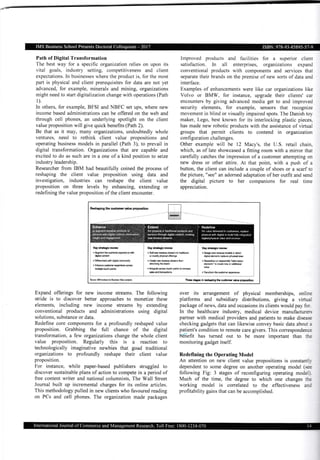
Path of Digital Transformation
The best way for a specific organization relies on upon its
vital goals, industry setting. competitiveness and client
expectations. In businesses where the product is, for the most
part is physical and client prerequisites for data are not yet
advanced, for example, minerals and mining, organizations
might need to start digitalization change with operations (Path
1).
In others, for example, BFSI and NBFC set ups, where new
income based administrations can be offered on the web and
through cell phones, an underlying spotiight on the client
value proposition will give quick benefits (Path 2).
Be that as it may, many organizations, undoubtedly whole
ventures, need to rethink client value propositions and
operating business models in parallel (Path 3), to prevail in
digital transformation. Organizations that are capable and
excited to do as such are in a one of a kind position to seize
industry leadership.
Researcher from IBM had beautifully coined the process of
reshaping the client value proposition using data and
investigation, industries can reshape the client value
proposition on three levels by enhancing, extending or
redefining the value proposition ofthe client encounter.
Expand offerings for new income streams. The following
stride is to discover better approaches to monetize these
elements, including new income streams by extending
conventional products and administrations using digital
solutions, substance or data.
Redefine core components for a profoundly reshaped value
proposition. Grabbing the full chance of the digital
transformation, a few organizations change the whole client
value proposition. Regularly this is a reaction to
technologically imaginative newbies that goad traditional
organizations to profoundly reshape their client value
proposition.
For instance, while paper-based publishers struggled to
discover sustainable plans of action to compete in a period of
free content writer and national columnists, The Wall Street
Joumal built up incremental charges for its online articles.
This methodology pulled in new clients who favoured reading
on PCs and cell phones. The organization made packages
Improved products and facilities for a superior client
satisfaction. In all enterprises, organizations expand
conventional products with components and services that
separate their brands on the premise of new sorts of data and
interface.
Examples of enhancements were like car organizations like
Volvo or BMW, for instance, upgrade their clients' car
encounters by giving advanced media get to and improved
security elements, for example, sensors that recognize
movement in blind or visually impaired spots. The Danish toy
maker, Lego, best known for its interlocking piastic pieces.
has made new robotic products with the assistance of virtual
groups that permit clients to contend in organization
confi guration challenges.
Other example will be 12 Macy's, the U.S. retail chain.
which, as of late showcased a fitting room with a mirror that
carefully catches the impression of a customer attempting on
new dress or other attire. At that point, with a push of a
button, the client can include a couple of shoes or a scarf to
the picture, "see" an adomed adaptation ofher outfit and send
the digital picture to her companions for real time
appreciation.
over its arrangement of physical memberships, online
platforms and subsidiary distributions, giving a virrual
package ofnews, data and occasions its clients would pay for.
In the healthcare industry, medical device manufacturers
partner with medical providers and patients to make disease
checking gadgets that can likewise convey basic data about a
patient's condition to remote care givers. This correspondence
benefit has tumed out to be more important than the
monitoring gadget itself.
Redefining the Operating Model
An attention on new client value propositions is constantly
dependent to some degree on another operating model (sc
following Fig: 3 stages of reconfiguring operating model)-
Much of the time, the degree to which one changes the
working model is correlated to the effectiveness and
profitability gains that can be accomplished.
Haharin! lhc oalffi vdw popoailion
ID .t..F h ndr.phf tlr. @dori.. vda prEpoalus.
Resrapino'lhe opeiating model
;'-. B'.f .. ..,' a*.-.,-.. J. --
The ;rgr? h mo.ngunD! sg optoing model
Step 1: Create new digital capabilities: Commonly,
organizations first make the essential structures to connect
with clients through online channels.
Burberry, for instance, utilized its iconic plaid trench coat
design to become a distinctly a high- fashion house. It then
made an imaginative online channel, outlined particularly for
young clients who are in youth, and gained more than 1
million followers on Facebook. It was a pacesetter in digitally
streaming fashion shows, empowering clients to order web
based amidst of the event. Customers can, whenever,
effectively tap on the site to connect with an agent by
telephone or a text message. On the operational side of the
business, inventory network ventures have compacted order
throughput time to weeks rather than the months regularly
required for top ofthe line fashion.
Step 2: Leverage information to oversee the organization;
At the next level of operational transformation, organizations
leverage data and connections across over channels, specialty
units and production supply chain partners' This makes it
conceivable to integrate digital and physical parts that give
the most importance - to enhance speed to showcase, for
instance, or to equip employees with data empowering them
to outperform client's expectations
Step 3: Integrate and enhance all digitized and physical
components:
Organizations concentrated on completely reshaping the
working model enhance all components of the esteem chain
around purposes of client engagement. Tesco, the third-
biggest retailer on the planet, has for quite some time been a
pioneer in imaginative employments of innovation - from
self-benefit checkouts to the production of its "Tesco in a
box" capability that empowers new stores to be set up rapidly
anyplace on the planet with institutionalized business
frameworks.
Coordinated data additionally benefits Tesco clients who need
versatile and intuitive shopping. Clients can utilize their smart
phones to examine barcodes of items they have comfortable -
as opposed to sitting at their PCs and looking through item
list to make a selection. The examined things are added to
clients'web based shopping crate for home conveyance.
Within a month of its launch, this shopping app was
downloaded with 400,000 hits. Tesco additionally gives an
application to track loyalty bonus, and in addition app for
locating stores in vicinity.
Discussions and Recommendations
How do organizations decide the best technique for
computerized change? An organized approach permits
associations to connect with clients, partners and workers at
each step along the change transformational operations guide'
Recognize transformational openings in light of an exhaustive
comprehension of digitization in the business and industry.
This relies on upon how much your items and services are -
or could be - digitized and how contenders are reacting to
new and quickly changing client needs and wants.
Reclassify the strategic offer in view of what existing and
imminent clients are probably going to pay for going ahead.
This requires taking a new and better approaches to utilize
innovation to differentiate offerings, reach existing clients
with new advanced offerings or connections and, at long last,
reclassifoing whole offerings for digital value.
Design the optimized operating model that combines
organizational capabilities and technology requirements.
Thinking through the "how" of value delivery requires
understanding of current capabilities and opportunities.
Operational design should support customer interaction as
part of cross-channel integration and supply chain
collaboration.
To execute the procedure, rethink the working model as
expected to bolster the new incentivized offer. Streamline
processes across over on the web and physical associations.
fabricating a new arrangement of advanced capacities for
client engagement, supply chain integration and a networked
and organized workforce.
Consistently develop utilizing client understanding and
advanced analyical techniques. Client prerequisites and
inclinations change as new markets are opened, as clients
grasp new advancements, for example, area based
applications, and abandon more seasoned channels, for
example, email. With the ability to analyse customer
interactions even at the micro-segment level a flesh source of
insights will always be available for innovation.
Conclusion
Organizations in each industry are under immense
competition to re-evaluate their client value proposition and
working model. However, few, assuming any, offerings and
operations will ever be altogether digitized: structures and
servers, and additionally clients and employees, will
dependabiy have physical prerequisites. Physical and
advanced procedures should be overseen together without
estranging clients and making superfluous levels of many-
sided quality. Integrating new and traditional Qperations will
require assessing the effect on clients of each business choice
and each touch points.
Organizations taking a proactive position in the digitalization
and utilizing the maximum capacity of disruptive
technologies are:
I1. Reshaping client value proposition
2. Re-structuring their business operations to convey new
client value proposition effectively, proficiently and in
inventive r,l,'ays
3. Doing both simultaneously. which will lead to the broadest
business transformation.
All of these transformation paths require clear vision, the
right skills in the right place and tenacity to overcome cultural
resistance to analyically based decisions across the extended
enterprise.
The path to digital transformation will vary by industry, as
will customer adoption and an organization's legacy
environment. However, every industry is under pressure to
change, and every organization needs to have a plan in place.
Those that do not take advantage of the new digital age may
drastically Iimit opportunities for fi.rture success. Those that
are able to overcome the challenge of optimizing both
physical and digital elements by implementing new business
models based on customer demand can win first choice of
talent, partners and resources. As industry leaders, they have
the opportunity to distance themselves from new and existing
competitors.
References
1. Ashman R, Solomon MR, Wolny J. An old model for. a
new age: Consumer decision making in participatory
digital culture. Journal of Customer Behaviour. 2015;
14(2):127 -146.
https://doi. org I 1 0. 1 3 62 I 147 5392 1 5X1 431 3 846805i 43
2. Bahl BM. (n.d.). The Future of Businesses and Jobs in
Asia Pacific's Digitat Economy the Center for the Future
of Work.
3. Bames S, Kingdom U, Pressey A, Kingdom U. Virtual
World Addiction and Problematic Consumption : public
Policy Implications for the New Marketing Landscape,
7.
2013-2014,2013-2015.
Bath P. Personalisation, 2016. 50-53.
Cramer T, Applying the Secrets of Gamification to Your
Digital Marketing Strategy: Walden University Library
Discovery Service, 2014. Retrieved fiom
http://eds.a.ebscohost.com.ezp.waldenulibrary.org/eds/pd
fviewer/pdfviewer?vid:2&sid: 1 89b6899-6edd-49a8-
805e-93 a 1 1 ad 1 00efl%40sessi onmgr4009&hid:4205
Dahiya R. Cracking the Digital Code : A Study of Indian
Car Market, 2015; 14(2):26-47.
Edelman DC. Branding in the Digital Age: You ' re
Spending Your Money in All the Wrong Places Block
That Metaphor Branding in the Digital Age : You 6€TM
re Spending Your Money in Al. The Joumey in Practice
Launching a Pilot, (December), 2010, l-6.
https://doi. org I 1 0. 1002I cmr .a
Giurea A. Proximity Market, the New Trend Approved
by the Consumer's Behavior. lnternational Journal of
Economic Practices and Theories, 20 I 5 ; 5(5):462-469.
Hassan M, Pervan S. Customer-to-Customer Helping
Behavior and Its Implications to the Marketers within
Brand Comrnunities of Facebook, 2014, 28-33.
Hayward M. Oops, your algorithm is showing, 2016, 50-
53.
9.
11. Hendrix PE. How Digital Technologies Are Enabling
Consumers and Transforming the Practice of Marketing.
Joumal of Marketing Theory & Practice, 2014:
22(2):149-150 https:i/doi.org I I 0.27 53 IMTP 1069 -
6679220209
12. IBM Institute for Business Value. Digital
Transformation. Digital Transformation, 2011, 17 .
https://doi.orgi I0.I i 1 1lj.1467 -8616.2008.00539.x
i3. Kahle D. The need to evolve, (December),2015.
14. Kim SJ. Viewpoint: A framework for advertising in the
digital age. Journal of Advertising Research. 2008;
48(3):3 1 0-3 12.
https://doi.org/1 0.250 1 /S002 1 849908080367
15. Kumar A, Bezawada R. Rishika R, Janakiraman R.
Kannan PK. From Social to Sale: The Effects of Firm
Generated Content in Social Media on Customer
Behavior. Joumal of Marketing, 2016; 80(1):7-25.
https://doi.org/ 1 0. 1 0 1 7/CBO 9t 81 t01 4 | 5324.004
16. Kumar Y, Zhang X (Alan), Luo A. Modeling Customer
Opt-In and Opt-Out in a Permission-Based Marketing
Context. Joumal of Marketing Research, 2014;
5 1 (4):403-4 1 9. https://doi.org/ 1 0. 1 509/jmr. 1 3.0 1 69
17. Market A. 86 Digital Marketing 2013; 86(1):500-506.
18. Miller. Washington. Chapter 83: Coupons. Consumer
Marketing 2013, 488-493 .
19. Page K, Mapstone M. How does the web make youth
feel? Exploring the positive digital native rhetoric.
Joumal of Marketing Management, 2010: 26(13-
l4):t345-t366.
https://doi.org I 1 0. I 080I 0267 257 X.20 1 0.5237 09
20. Puccinelli NM, Wilcox K, Grewal D. Consumers,
Response to Commercials : When the Energy Level in
the Commercial Conflicts with the Media Context.
Journal of Marketing, 2015; 79:1-18.
https://doi.orgl 1 0. 1 509/jm. 1 3.0026
21. Qualitative Analysis of the Digital Marketing Influence
on the Behaviour of the Organizational. (n.d.), I l{2):l7l-
184.
22. Quinton S. The community brand paradigm: A response
to brand management's dilemma in the digital era.
Joumal of Marketing Management, 2013; 29(7-8):912-
932. https://doi.org/ 1 0. I 0 80 I 0267 257 X20 1 2.i 290i 2
23. Robert B, Brown H. Birch P. (n.d.). What It Will Take
for Healthcare Organizations to Move into the Digital
Age the work ahead in.
24. Roehrig BP, Pring B. (n.d.). Mastering the Digital
Economy the Center for the Future of Work Mastering
the Digital Economy the Work Ahead is a research series
providing insight Five key themes emerged ftom our
research and analysis.
25. Stillman-Lowe C. Sugar consumption. British Dental
Journal, i998; 184(6):265. Retrieved fiom
http ://www.embase.com/searct"Jresults?subaction:v iewre
cord&from:export&id:L 1 2 82
6 19 22%5Cnhttp ://cy7sh3 vq3 t. search.serialssoluti ons.co
m'isid:EMBASE&issn:000706
I 0&id:doi : &atitle:Sugar+consumption. &stitle:Br+Den
t+J&title-British+dsn141-F.l.urnal &volume: 1 84&issue:
4.
5.
6.
t0.
I
26. Summers CA, Smith RW, Reczek RW. An audience of
one: Behaviorally targeted ads as implied social labels.
Joumal of Consumer Research, 2016; 43(l):156-179.
https://doi.org/ I 0. 1 093/j crlucwO I 2
27. Value B. Digital reinvention in action. IBM Institute for
Business Value, 2013, l-21.
2E. Wiedmann K, Fritz S, Langner S, Schmidt S. The effect
of Social Media unique relevance features on social
media brand perception and behavior. American
Marketing Association, 201 l, 153-155.
29. Wolny J. Behaviour, 2015; l4(2), 83-85.
30. Yadav MS, Pavlou PA. Marketing in Computer-
Mediated Environments: Research Synthesis and New
Directions. Journal of Marketing, 2014; 7g(l):2040.
https://doi.org/l 0. I 509/im. I 2.0020

Influence of digitalization on community citizenship: A conceptual introspection

  • 1.
    lh[S Business School fuosonts FIRSTD0CTORAL C0TT0QUIUM-2017 In Collaboration with International Journal of Commerce and Management Research, New Delhi 2lst Janu ary,20l7
  • 2.
    Influence of digitalizationon communitv citizenship: A conceptual introspection Debojl'oti De Doctoral Felio*'. XLRI Xa" ier School of l4alragenlent. Jamsheclpur. lnclia l. Introduction Citizenship can typically be defined as the status of a person recognized under the custom or law as being a legal rnernber of a sovereign state. Citizenship can also be thought as an aggregate sense of responsibility. a sense of ownership. the values that inform and drive one's engagenlent with the community. A community is commonly defined as a social unit (a groLrp of people) who have sornething in like rnanner, for example. standards. qualities, character. and frequently a feeling of an area that is arranged in a given geography or in the new era ofdigital groups. Cornnrunity and organizations alike are welcoming the digitalization in their system. Social networks via diversified digital devices as platform has emerged as an ilnportant avenue to engage government. organizations, common society. and the loved ones. Individuals are no$' utilizing ',,ersatile. intuitive devices to figure out who to trust. where to go and what to purchase. At the same time. organizatiorts are atternpting their own digital evolution. re-examining what the clients esteem most. designing and building operating rnodels that would provide competitive edge over others. The test for business is the way quick and how far to go on the way to digitalization. Leaders have. since a long tirne ago" had been utilizing data innovation to enhance the profitability and productivity. penetrate new markets and optirnized supply chains. What's new is that client desires and expectations have er,'olved over time. Now, individuals wherever are utilizing social networks Digital foundation providers led the way in data backbone to enhance effectiveness and rvorkrng wrth the elficiencl across to look fbr ernployments and eateries. lost companions and new partners and. as citizens" to accomplish basic politicai objectives. They are utilizing the internet fbr amusernent. shopping. rningling and various other common purposes. From an organizational perspective. digitalization leading to data analytics can be helpful in various purposes of decision rnaking like: l. In what capacity can organizations best react to this shifi? 2. I-low rnight they exploit the chance to innovate. differentiate themselves and grow in a sustainable way'? Furthermore. 3. How rnight they do this cost efficiently. utilizing and irrproving the most current data innovations as a major aspect of their physical operations? The rnajor drivers among powers fbr change are tlre surge in gadgets for poftable availability, for exarnple. PDAs and tablets. and the creation of social networks, fbr example. Facebook and Twitter. Both of these irnprovements are making an exponential blast in information. rvhich. thus. requires business analytics to comprehend the data and take full advantage ofit. Evolution of Digitalization The concentration and effect of the Internet and worldwide connectivity have rnoved (see Figure 1). In the 1990s, just associations in select businesses-. for example. music. entertainrnent and hardware-were exploring the digital products and its adrninistrations. particular capacities-like finance. supply chain man:9.:-:- HR. etc. The Internet build-up ofthe late 1990s erpe::e:::: . Evolution of digital transfomation Pwasivc Digital prcdrEts sid e}frastnrctre . Diqrtal Prodrcts (6-0.. lm*. sttrtarl'mS .ln Eslnrctwe (a-S- t€lmanrrx*lcdltrE. sftwaE, m Dagitd di3fibrrtjtrr xrd $r€b strstegy . l^kb strategy ard effiIm(e-9. rdal. el€ctrcnic) . CrEstmS eficffiy tfrqjon u,€b slrat€€ry (€,9- gEverffit) E6 g E'A o:..-- E€E t-FoP25} :E86E c, s€ao o EUgital trttglorcUonot lrrrsirEs modet3' .lvlc'bile Bdl,im . SGial m€dia .'Ffyp€r dbiti,trir:n- . Fcn,€r gf salytic Umiled Late lB9Os 2OOOs Time 201 Os _e: oqrm tlBdffiiff ot @eAe3 mdB lmPoG Eth puulc am pdEto ffir orl6nEdioc. sqtra: lffi lnattut€br &all.Eg k* f'igax l: Digital trmsformation is becoming peruasive rcross functions, indusiries and geographies.
  • 3.
    T major setback withan IT crash in 2000. However. because of the consumer's interest for digital platform and its application kept on developing on a positive trend line. As clients turned out to be progressively engaged with inescapable access to online data, alongside with multiple choices and channels, their desires tightened skyward. The outcome was that clients have now turned to be the primary drivers behind all digital transformation in all organizations and sectors. -{daptations Organizations have dependably taken a gander at new data and computerized innovation as far as what it can accomplish for them, e.g., more prominent benefit and extended client reach through web based shopping. Presently, clients additionally have a scope of new options, a significant number of which are past the domain of business. Choices about what to concentrate on or purchase are progressively educated through social networks, where individual and business contacts. item determinations, favourite news iterns, even real time location coordinates and area directions- are shared in a split second and broadly. Data shows that by the end of201 l. advanced mobile phones and tablets had surpassed PC shipments. Downloads of rnobile applications, or "apps," were projected upon to surge from 1l billion in 2010 to 77 billion in 2014. These applications utilize area sensors and cameras, combined with broadband network, to enable the activities ranging from videoconferencing to continuous coupon conveyance for adjacent stores. Portability has dispensed with the limits of space and time. Clients are constantly associated, and organizations can collaborate with them whenever and wherever. With data about items getting to be as vital as the items themselves, practically every organization is currently in the matter of making and conveying "content" - data that is close to home, applicable and convenient when accessed by the client. The powers of versatility, web-based social networking and hyper-digitization swell fiom the person through whole ventures, as associated clients and workers move past conventional limits. Whether they purchase from them or work for them, individuals are telling organizations Exactly what they want and need. This disturbance is pushing all enterprises toward the computerized end of the physical- advanced continuum (see Figure 2). Indeed, even where offerings and purposes ofengagement are Essentially physical, as in agribusiness or buyer white products, business channels and client connections are being reshaped. With 2 billion individuals associated with the Internet, online networking is rapidly turning into the essential means for correspondence and cooperation. Youngsters may have led the progressions, yet individuals of any age have joined the virtual transformation: 89 percent of the millennial era utilizes social networking sites, yet so do 72 percent of the baby boomers. The gap is closing very fast. Practical Impact of Digitization The size of web-based social networking effect can be astounding; realtime data increases the online networking impact. Few instances would be like: l. When Michelle Obama first shows up for a public gathering, her fashion decisions are immediately picked up by the bloggers who contend to find out the sources of her shoes, dresses and other accessories. These web joumals incorporate connections to stores and architects that offer those things. The First Lady's financial effect on the fashion business has been computed at 2 percent for each day in stock valuations of apparel organizations connected with her. 2. The music business was one of the first to feel the brunt of the digitalization effect. With the institutionalized mp3 Dogrro ol prodrrot arld o.rvloa dlghizrtion E .u 6 Fo. E E R s Hrrr dty FhfCo.l lrtrod cl[net rld Fltrr.rry clert l eirtroao.l o $trculnn o lro,r:pc td t F*t Afitfr.Const't*r cbtd7fl t@ god*tt o&iqr?Eir!,t e llre- .rrld;rrrdprodtrcl.i r$antuag oSo1tr.. .Arererr tf,motry .c,o,l-rlr'ffi #i'ra. Strrrrccs .rL-rrorn, . Wfrtt gDod cfficlrit* rA6urirg, d,ffir ptXt?o ' .trLol oilicptrrnratixa a Er 6 tlrc Gll Lrcutr lq Bm tfa, !rlD ligllcr 2: Olgtttl trrrrforrrr.Uon ttrlv;a rrD pirshang lrxlurtrl.ra dofiC |tr. ph!/G lo.t-dlolbt oonltnuum.
  • 4.
    I arrange for digitizedmusic and the accessibility of broadband connectivity for Internet dispersion, the truth of industry interruption got to be distinctly evident to all' Conventional music organizations were expected to lose more than 35 percent of significant worth somewhere between 2003 and 2012, w:rrh aggregate incomes for the period, anticipated to would have dropped from US$12 billion to $8 billion. Yet, in the meantime, different parts of the music community - all the more closely sensitive to their clients - experienced substantial development. This comprises .urto-". hardware organizations that make computerized music piayers, event promoters and producers of other live enteftainment. Industry officials those who maintain a strategic distance from the hard choices about digital transformation would probably going to agonize a destiny like that ofconventional music organizations. In the year 2013, IBM came out with an extensive study and coined a term E2E economy for the users. Their study highlighted a profound economic shift over few decades' Markets have evolved from a company centricity, in which manufactwers and service providers by and large used to define what to produce and market to customers; through individual centricity, in which empowered consumers demand insight driven, customized experiences; to a radically different economic environment today, which their study defined as the everyone-to-everyone (E2E) economy. The E2E economy is logical, implying that client and the partner encounters are aligned and pertinent to their particular activities and necessities. Mobile innovations joined with omnipresent availability fuel relevant abilities' A typical instance would be the case of Monsanto, the US- based worldwide agrochemical organization. Monsanto had made some remarkable investments in mobile enabled big data examination and analytics. Through its procurement of Climate Corporation, Monsanto offers Field view, a cell phone application that maps soil and atmosphere information to a l0 by 10- meter determination. The application gives continuous temperature, climate and soil dampness data. At the point when clients enter information about which sorts of seeds they've planted, the application gives proposals about when to reap and what respect anticipate. Quick irurovative change is in a general sense modifying conventional business financial aspects. Conventional value chains are dividing as innovation crumbles industry structures and procedures into thin slices. To contend and flourish even with disruptive changes, companies and associations need to embrace digital evolution. In the course ofrecent decades' organizations have been working through an advanced digital development. As digital innovations arise, organizations continuously digitized procedures and capacities as they transitioned from simple to advanced. The increase in the Internet business is a valid example. Web-based or online shopping that started in the mid-l990s as a basic procedure for click and brick businesses or Internet immaculate plays, and developed more refined over time. In the mid-2000s, as advanced innovations turned out to be more modern, organizations started to coordinate digitalization across functions. This stage in digital evolution affiliated nearly to the rise of the individual-focused economy, in which organizations composed whole ranges of digitized business procedures to better integration of client encounters and involvements. Transforming the business The Rules of Business have changed forever. Technological disruPtion G. G- G G ,3 G G .u*.r 'IJ4'el.alrktD, h,r1*r-',tc fr lrli l.-'rrrr -tdr ,ls,flr r.ti. .'ilJA /|r, l rrFrrv,lir' ll.ll la,rurrr'-
  • 5.
    T The conventional componentsof large-scale manufacturing and riches creation - capital, labour, and crude materials -are being re-imagined by digital, developing new value for organizations. As anyone might expect, different enterprises are attempting to keep pace with the change. For example, perceiving that its customary business was contracting, "Singapore Post" set up a different online business specialty unit on the e-commerce platform, procured organizations to support its worldwide presence, and propelled new digital solutions to prevail in the "new" economy. From customary traditionalist organizations to dynamic organizations, all are hoping to influence and leverage digital to make their future. Profiting with digitalization is not Few of processes are summarized as follows: . Products and administrations, data and client engagement can be reshaped utilizing the new capacities for portability, intuitiveness and data accessibility. The test then turns out to be the challenge by which to adapt these new client value propositions. . The operating model can be realigned so that client inclinations and necessities advise each action in the advanced science, but rather it requires an adjustment in mentality, organization structure, venture needs. and holistic business approach. Way Forward What do organizations need to do to have a competitive edge in this advanced digital evolution? In a more holistic view, key measures will include: l. reconfiguring the client value proposition (what is being offered) and 2. Reshaping the existing operating model (how it is conveyed). Up to now, most organizations have concentrated on one of these segments through particular initiatives and activities, though each has its own clusters of difficulties and possibilities. buying and selling chain. This will require coordinating all business exercises and advancing how information identified with those exercises is overseen and monitored. What are the business prerequisites for accomplishing the highest level and full size of advantage? g t .}' c *. it>€.-a iob.c tP i/, Elomxrta of diglt l trrnolcrnrtion lrneora!e t artragc Credc Er*rarce Exl.nd tlodcftr1f rq-.-.yfrlE| tir :u:il7rfr t*-r ,rctr,(r.tt,fl'. t?ro 1irr.?' sol@ Gal laa ra hrE t*r rriq msbdkftd d!.natao.t ! p,E. BI eoG-e Ia # O ?"t'r(Et€dnryded9dwdm ft6t TtEeEt}Ed@wlE p.opcrlm lo tu tt/l tBdlmtm @ catrlz EdBlr. exlsrd d dEFltE clc vrfE p.Ac.tm wih denel drlot, a6Eh. d drgEsEn TfEn tlru ff lntcOEtng dglal(IErliE @r"nsElurld a E d ol ce**nE @nd tlE tlrctqrred qliffi v.tE p.WAm d opqel.lo mod.i n loct d.fl Lffiaea Olaltd ffi6 -+iE.ffiOb &vdoFDrn orth. v.lo p.opod66.nd ih. oD.rdiE mdd.
  • 6.
    Path of DigitalTransformation The best way for a specific organization relies on upon its vital goals, industry setting. competitiveness and client expectations. In businesses where the product is, for the most part is physical and client prerequisites for data are not yet advanced, for example, minerals and mining, organizations might need to start digitalization change with operations (Path 1). In others, for example, BFSI and NBFC set ups, where new income based administrations can be offered on the web and through cell phones, an underlying spotiight on the client value proposition will give quick benefits (Path 2). Be that as it may, many organizations, undoubtedly whole ventures, need to rethink client value propositions and operating business models in parallel (Path 3), to prevail in digital transformation. Organizations that are capable and excited to do as such are in a one of a kind position to seize industry leadership. Researcher from IBM had beautifully coined the process of reshaping the client value proposition using data and investigation, industries can reshape the client value proposition on three levels by enhancing, extending or redefining the value proposition ofthe client encounter. Expand offerings for new income streams. The following stride is to discover better approaches to monetize these elements, including new income streams by extending conventional products and administrations using digital solutions, substance or data. Redefine core components for a profoundly reshaped value proposition. Grabbing the full chance of the digital transformation, a few organizations change the whole client value proposition. Regularly this is a reaction to technologically imaginative newbies that goad traditional organizations to profoundly reshape their client value proposition. For instance, while paper-based publishers struggled to discover sustainable plans of action to compete in a period of free content writer and national columnists, The Wall Street Joumal built up incremental charges for its online articles. This methodology pulled in new clients who favoured reading on PCs and cell phones. The organization made packages Improved products and facilities for a superior client satisfaction. In all enterprises, organizations expand conventional products with components and services that separate their brands on the premise of new sorts of data and interface. Examples of enhancements were like car organizations like Volvo or BMW, for instance, upgrade their clients' car encounters by giving advanced media get to and improved security elements, for example, sensors that recognize movement in blind or visually impaired spots. The Danish toy maker, Lego, best known for its interlocking piastic pieces. has made new robotic products with the assistance of virtual groups that permit clients to contend in organization confi guration challenges. Other example will be 12 Macy's, the U.S. retail chain. which, as of late showcased a fitting room with a mirror that carefully catches the impression of a customer attempting on new dress or other attire. At that point, with a push of a button, the client can include a couple of shoes or a scarf to the picture, "see" an adomed adaptation ofher outfit and send the digital picture to her companions for real time appreciation. over its arrangement of physical memberships, online platforms and subsidiary distributions, giving a virrual package ofnews, data and occasions its clients would pay for. In the healthcare industry, medical device manufacturers partner with medical providers and patients to make disease checking gadgets that can likewise convey basic data about a patient's condition to remote care givers. This correspondence benefit has tumed out to be more important than the monitoring gadget itself. Redefining the Operating Model An attention on new client value propositions is constantly dependent to some degree on another operating model (sc following Fig: 3 stages of reconfiguring operating model)- Much of the time, the degree to which one changes the working model is correlated to the effectiveness and profitability gains that can be accomplished. Haharin! lhc oalffi vdw popoailion ID .t..F h ndr.phf tlr. @dori.. vda prEpoalus.
  • 7.
    Resrapino'lhe opeiating model ;'-.B'.f .. ..,' a*.-.,-.. J. -- The ;rgr? h mo.ngunD! sg optoing model Step 1: Create new digital capabilities: Commonly, organizations first make the essential structures to connect with clients through online channels. Burberry, for instance, utilized its iconic plaid trench coat design to become a distinctly a high- fashion house. It then made an imaginative online channel, outlined particularly for young clients who are in youth, and gained more than 1 million followers on Facebook. It was a pacesetter in digitally streaming fashion shows, empowering clients to order web based amidst of the event. Customers can, whenever, effectively tap on the site to connect with an agent by telephone or a text message. On the operational side of the business, inventory network ventures have compacted order throughput time to weeks rather than the months regularly required for top ofthe line fashion. Step 2: Leverage information to oversee the organization; At the next level of operational transformation, organizations leverage data and connections across over channels, specialty units and production supply chain partners' This makes it conceivable to integrate digital and physical parts that give the most importance - to enhance speed to showcase, for instance, or to equip employees with data empowering them to outperform client's expectations Step 3: Integrate and enhance all digitized and physical components: Organizations concentrated on completely reshaping the working model enhance all components of the esteem chain around purposes of client engagement. Tesco, the third- biggest retailer on the planet, has for quite some time been a pioneer in imaginative employments of innovation - from self-benefit checkouts to the production of its "Tesco in a box" capability that empowers new stores to be set up rapidly anyplace on the planet with institutionalized business frameworks. Coordinated data additionally benefits Tesco clients who need versatile and intuitive shopping. Clients can utilize their smart phones to examine barcodes of items they have comfortable - as opposed to sitting at their PCs and looking through item list to make a selection. The examined things are added to clients'web based shopping crate for home conveyance. Within a month of its launch, this shopping app was downloaded with 400,000 hits. Tesco additionally gives an application to track loyalty bonus, and in addition app for locating stores in vicinity. Discussions and Recommendations How do organizations decide the best technique for computerized change? An organized approach permits associations to connect with clients, partners and workers at each step along the change transformational operations guide' Recognize transformational openings in light of an exhaustive comprehension of digitization in the business and industry. This relies on upon how much your items and services are - or could be - digitized and how contenders are reacting to new and quickly changing client needs and wants. Reclassify the strategic offer in view of what existing and imminent clients are probably going to pay for going ahead. This requires taking a new and better approaches to utilize innovation to differentiate offerings, reach existing clients with new advanced offerings or connections and, at long last, reclassifoing whole offerings for digital value. Design the optimized operating model that combines organizational capabilities and technology requirements. Thinking through the "how" of value delivery requires understanding of current capabilities and opportunities. Operational design should support customer interaction as part of cross-channel integration and supply chain collaboration. To execute the procedure, rethink the working model as expected to bolster the new incentivized offer. Streamline processes across over on the web and physical associations. fabricating a new arrangement of advanced capacities for client engagement, supply chain integration and a networked and organized workforce. Consistently develop utilizing client understanding and advanced analyical techniques. Client prerequisites and inclinations change as new markets are opened, as clients grasp new advancements, for example, area based applications, and abandon more seasoned channels, for example, email. With the ability to analyse customer interactions even at the micro-segment level a flesh source of insights will always be available for innovation. Conclusion Organizations in each industry are under immense competition to re-evaluate their client value proposition and working model. However, few, assuming any, offerings and operations will ever be altogether digitized: structures and servers, and additionally clients and employees, will dependabiy have physical prerequisites. Physical and advanced procedures should be overseen together without estranging clients and making superfluous levels of many- sided quality. Integrating new and traditional Qperations will require assessing the effect on clients of each business choice and each touch points. Organizations taking a proactive position in the digitalization and utilizing the maximum capacity of disruptive technologies are:
  • 8.
    I1. Reshaping clientvalue proposition 2. Re-structuring their business operations to convey new client value proposition effectively, proficiently and in inventive r,l,'ays 3. Doing both simultaneously. which will lead to the broadest business transformation. All of these transformation paths require clear vision, the right skills in the right place and tenacity to overcome cultural resistance to analyically based decisions across the extended enterprise. The path to digital transformation will vary by industry, as will customer adoption and an organization's legacy environment. However, every industry is under pressure to change, and every organization needs to have a plan in place. Those that do not take advantage of the new digital age may drastically Iimit opportunities for fi.rture success. Those that are able to overcome the challenge of optimizing both physical and digital elements by implementing new business models based on customer demand can win first choice of talent, partners and resources. As industry leaders, they have the opportunity to distance themselves from new and existing competitors. References 1. Ashman R, Solomon MR, Wolny J. An old model for. a new age: Consumer decision making in participatory digital culture. Journal of Customer Behaviour. 2015; 14(2):127 -146. https://doi. org I 1 0. 1 3 62 I 147 5392 1 5X1 431 3 846805i 43 2. Bahl BM. (n.d.). The Future of Businesses and Jobs in Asia Pacific's Digitat Economy the Center for the Future of Work. 3. Bames S, Kingdom U, Pressey A, Kingdom U. Virtual World Addiction and Problematic Consumption : public Policy Implications for the New Marketing Landscape, 7. 2013-2014,2013-2015. Bath P. Personalisation, 2016. 50-53. Cramer T, Applying the Secrets of Gamification to Your Digital Marketing Strategy: Walden University Library Discovery Service, 2014. Retrieved fiom http://eds.a.ebscohost.com.ezp.waldenulibrary.org/eds/pd fviewer/pdfviewer?vid:2&sid: 1 89b6899-6edd-49a8- 805e-93 a 1 1 ad 1 00efl%40sessi onmgr4009&hid:4205 Dahiya R. Cracking the Digital Code : A Study of Indian Car Market, 2015; 14(2):26-47. Edelman DC. Branding in the Digital Age: You ' re Spending Your Money in All the Wrong Places Block That Metaphor Branding in the Digital Age : You 6€TM re Spending Your Money in Al. The Joumey in Practice Launching a Pilot, (December), 2010, l-6. https://doi. org I 1 0. 1002I cmr .a Giurea A. Proximity Market, the New Trend Approved by the Consumer's Behavior. lnternational Journal of Economic Practices and Theories, 20 I 5 ; 5(5):462-469. Hassan M, Pervan S. Customer-to-Customer Helping Behavior and Its Implications to the Marketers within Brand Comrnunities of Facebook, 2014, 28-33. Hayward M. Oops, your algorithm is showing, 2016, 50- 53. 9. 11. Hendrix PE. How Digital Technologies Are Enabling Consumers and Transforming the Practice of Marketing. Joumal of Marketing Theory & Practice, 2014: 22(2):149-150 https:i/doi.org I I 0.27 53 IMTP 1069 - 6679220209 12. IBM Institute for Business Value. Digital Transformation. Digital Transformation, 2011, 17 . https://doi.orgi I0.I i 1 1lj.1467 -8616.2008.00539.x i3. Kahle D. The need to evolve, (December),2015. 14. Kim SJ. Viewpoint: A framework for advertising in the digital age. Journal of Advertising Research. 2008; 48(3):3 1 0-3 12. https://doi.org/1 0.250 1 /S002 1 849908080367 15. Kumar A, Bezawada R. Rishika R, Janakiraman R. Kannan PK. From Social to Sale: The Effects of Firm Generated Content in Social Media on Customer Behavior. Joumal of Marketing, 2016; 80(1):7-25. https://doi.org/ 1 0. 1 0 1 7/CBO 9t 81 t01 4 | 5324.004 16. Kumar Y, Zhang X (Alan), Luo A. Modeling Customer Opt-In and Opt-Out in a Permission-Based Marketing Context. Joumal of Marketing Research, 2014; 5 1 (4):403-4 1 9. https://doi.org/ 1 0. 1 509/jmr. 1 3.0 1 69 17. Market A. 86 Digital Marketing 2013; 86(1):500-506. 18. Miller. Washington. Chapter 83: Coupons. Consumer Marketing 2013, 488-493 . 19. Page K, Mapstone M. How does the web make youth feel? Exploring the positive digital native rhetoric. Joumal of Marketing Management, 2010: 26(13- l4):t345-t366. https://doi.org I 1 0. I 080I 0267 257 X.20 1 0.5237 09 20. Puccinelli NM, Wilcox K, Grewal D. Consumers, Response to Commercials : When the Energy Level in the Commercial Conflicts with the Media Context. Journal of Marketing, 2015; 79:1-18. https://doi.orgl 1 0. 1 509/jm. 1 3.0026 21. Qualitative Analysis of the Digital Marketing Influence on the Behaviour of the Organizational. (n.d.), I l{2):l7l- 184. 22. Quinton S. The community brand paradigm: A response to brand management's dilemma in the digital era. Joumal of Marketing Management, 2013; 29(7-8):912- 932. https://doi.org/ 1 0. I 0 80 I 0267 257 X20 1 2.i 290i 2 23. Robert B, Brown H. Birch P. (n.d.). What It Will Take for Healthcare Organizations to Move into the Digital Age the work ahead in. 24. Roehrig BP, Pring B. (n.d.). Mastering the Digital Economy the Center for the Future of Work Mastering the Digital Economy the Work Ahead is a research series providing insight Five key themes emerged ftom our research and analysis. 25. Stillman-Lowe C. Sugar consumption. British Dental Journal, i998; 184(6):265. Retrieved fiom http ://www.embase.com/searct"Jresults?subaction:v iewre cord&from:export&id:L 1 2 82 6 19 22%5Cnhttp ://cy7sh3 vq3 t. search.serialssoluti ons.co m'isid:EMBASE&issn:000706 I 0&id:doi : &atitle:Sugar+consumption. &stitle:Br+Den t+J&title-British+dsn141-F.l.urnal &volume: 1 84&issue: 4. 5. 6. t0. I
  • 9.
    26. Summers CA,Smith RW, Reczek RW. An audience of one: Behaviorally targeted ads as implied social labels. Joumal of Consumer Research, 2016; 43(l):156-179. https://doi.org/ I 0. 1 093/j crlucwO I 2 27. Value B. Digital reinvention in action. IBM Institute for Business Value, 2013, l-21. 2E. Wiedmann K, Fritz S, Langner S, Schmidt S. The effect of Social Media unique relevance features on social media brand perception and behavior. American Marketing Association, 201 l, 153-155. 29. Wolny J. Behaviour, 2015; l4(2), 83-85. 30. Yadav MS, Pavlou PA. Marketing in Computer- Mediated Environments: Research Synthesis and New Directions. Journal of Marketing, 2014; 7g(l):2040. https://doi.org/l 0. I 509/im. I 2.0020