














INDUSTRIALIZATION
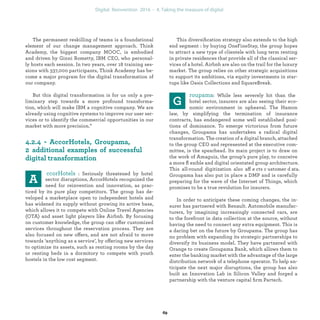
TABLE
OF
CONTENTS
1 :
Customer relationship, data and new players: the 3 battles for digital in 2016 p.
The level of digital disruption varies according to sectors p.
2 :
Faced with market standards set by pure plays, companies adapt by redoubling initiatives p.
Inertial forces still hinder traditional companies' scale-ups and their digital innovation is
less advanced than pure plays and customer expectations p.
3 :
Accelerationg scale-up, the IBM approach p.
The Data-Driven Company, or the overall improvement in competitiveness thanks to internal
and external data p.
Digital IT: a more agile and flexible IT architecture for surviving market change p.
Collaboration is a competitive lever: breaking internal silos and embracing open innovation p.
The BCG approach: An analytic framework for guiding transformation p.
A new chart of skills and job roles p.
More agile governance to transform the company p.
INTRO-
DUC-
TION
THE DIGITAL MARKET,
A MODEL FOR THE
ECONOMY AT LARGE.
delivery (AlloResto, TakeEatEasy), taxi/VTC hire.....
he explosion of the internet bubble in 2001 seems
like a distant memory: since then, the digital eco-
nomy has seen unprecedented growth and seems
to be immune to the crisis. In 2015, 83% of European
households had access to high-speed internet and 90%
of French under-35's owned a smartphone. We have also
seen an explosion in the number of connected devices
per person: the amount of French people using a mini-
mum of 3 devices rose by 25% in 2015. This has direct-
ly resulted in an unparalleled abundance of equipment
and ecommerce is going mobile, with the boom of
increasingly connected consumers. In Europe, 3G
mobile networks now have a 90% coverage rate.
E-CONSUMERS MORE AND
MORE ON THE MOVE
Online mobile usage is skyrocketing. Online sales from
smartphones and tablets in France, which accounts
for 6 billion Euros or 10% of national online sales, rose by
29% in 2015. This growth is greater than the total French
online sales market, which saw a 14.3% rise in the same
period! In 2015, almost 47% of French people connected
to the internet with the same frequency on their
smartphone as their computer, against only 37% in 2014.
This figure should continue to grow, given the potential
of connected devices. Geo-localized mobile devices
make new local services possible: home food
The connected customer no longer simply buys pro-
ducts, but increasingly exchanges services across plat-
forms. These services, following the Uber model, can
provoke polemics by disintermediating entire sectors
of the economy. "Disintermediation": the word signifies
great upheavals for certain long-standing professions,
but also promises great opportunities with the radical
reconfiguration of the economic landscape.
FROM TRANSFORMATION
TO DIGITAL INDUSTRIALIZATION
The range of disruptions at work creates untold new
business opportunities, for the keen eyes who can seize
them. "We can view digital as a threat, because it upsets
the established model and can weaken traditional powers
in the market", explains Séverin Cabannes, Chief
Operating Officer of Société Générale. "However, it is
primarily an opportunity, which we welcome openly
today".
And there are plenty of opportunities: today, digital
accounts for 5% of GDP in France, and 6% on average, in
OECD countries. European countries can expect to see a
2.1% rise in their GDP as a result of the digital economy.
Digital is paving the way for new levers of growth. Big
Data helps to customize off ers and services, enabling
greater proximity with the end customer. As the Internet
of Things creates new levels of interactivity, they
pave the way for new business models. These changes
directly impact traditional players. Should the old guard
choose to perish or simply surrender? There is
another choice: "Disrupt yourself, or be disrupted",
warned John Chambers, then CEO of Cisco in 2015.
PIndustrialization
METHODOLOGY OF
THE GUIDE
hat is the situational analysis of the digital
transformation of the economy in 2016?
Prepared by the EBG in collaboration with the Bos-
ton Consulting Group and IBM, the 2016 Guide answers
this question by drawing on 65 interviews with top de-
cision-makers (Chief Executive Officers, Chief Digital
Officers, Chief Operating Officers, etc.) of French and
international companies, including traditional, but also
pure plays.
The areas of activity have been arranged into 5 groups:
• Transport, Travel and Hotels,
• Telecom, Media, Energy, Gaming,
• Fashion, Distribution and Consumer Goods,
• Insurance,
• Banking.
By surveying these different B2C or B2B2C sectors, a
more global image of digital industrialization emerges,
beyond pilot programs. Several analytic tools used by
the Boston Consulting Group were applied to the ana-
lyses of this work:
The matrix of the digital disruption of the BCG eco-
nomic environment allows us to evaluate the intensity
of the disruption that affects these different sectors and
their level of transformation.
This is supplemented by zooming in on the sectors
with BCG experts and examining the intensity of the
5 disruptive forces: legislation, technology, the rising
power of data, changing customer behaviour and ultima-
tely new business models.
The Guide also calls upon figures taken from IBM's
"Digital Industrialization" study, an investigation into
1100 executives across 15 countries, as well as analyses
taken from the recent C-Suite Study, published in late
2015.
This study, which draws on over 5000 interviews
across 70 countries, reveals insights from the viewpoint
of 6 principal activities in 18 different sectors, with spe-
cial emphasis on the digital transformation they must
undertake.
IBM identifies 4 key factors to understand this "sca-
ling up":
-platforms,
-co-creation,
-delivery,
-change management.
industrialization
CHAP-
TER
1
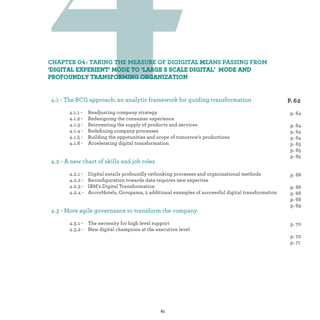
1 :
1.1 Customer relationship, data and new players: The 3 battles for Digital in 2016
1.1.1 Consumer relationships upset by new channels of communication and distribution p.
1.1.2 Data leads to a tenfold increase in a company’s competitiveness p.
1.1.3 Services and products disrupted by GAFA and new entrants p.
1.2 The Level of Digital Disruption Varies According to Sectors p.
1.2.1 The 5 criteria for the digitization of a sector: data, legal and regulatory,
new customer behavior, new entrants. p.
1.2.2 The transportation and hotel sectors : Victims of disruption p.
1.2.3 Telecom, Media, Energy, Gaming Sectors:
Technological progress is breaking established models p.
1.2.4 Fashion, Retail and Consumer Products sectors:
A comparative lull, but for how long? p.
1.2.5 Insurance Sector : When regulatory inertia maintains disruption p.
1.2.6 Banking Sector : A sector that remains protected from regulation p.
Not all companies will die, but they were all hit. What does digital ul-
timately mean: is it a complete cataclysm or the perfect opportunity
for digital industrialization ? In an economy undergoing complete
digital transformation, the rules have changed through relentless
technological advances, the growing power of online sales, increasing
competitive threats from 100% digital new players… Flung into the
great ocean of digital, the activities of all sectors are being re-confi
gured at breakneck pace, and must adapt to consumers whose
practices and expectations have changed. Some common trends
emerge, such as omnichannel, which help to simplify the customer
experience, while Big Data opens the way for personalized offers.
The functional economy also encourages companies to move from
selling products to selling services. The development of platforms
also helps to combat disintermediation. The quality of customer
relations and satisfaction has now become a crucial issue. That said,
not all economic sectors are affected to the same degree.
01.
The digitization of companies
in 2016: the new rules
ith the advent of online trading, purchasing
practices have changed dramatically. Bet-
ter equipped and better connected, today’s
customers are overloaded with information. For 56% of
customers the internet is the primary source of pre-pur-
chase information. Information outlets are multiplying,
through blogs and social networks, but most important-
ly aggregators and online comparison tools, that make
exhaustive comparisons possible at the click of a mouse.
Online reputation has become the critical issue for
companies!
THE RISE OF MOBILE
Parallel to this evolution - or revolution- purchasing
practices and customer interaction channels have ex-
panded with the unstoppable rise of mobile. 40% of Euro-
pean traffic measured on ecommerce sites already comes
from mobile devices. 90% of mobile users now stay wit-
hin a meter of their phone 100% of the time. Applications
are booming. 46% of French people used them in 2015,
against just 22% in 2011. Web retailers must adapt to this
change, or risk losing their market share. "
" says ffi
. For technical
teams, the challenge is to respond to customer needs in
a uniform way, across each of their connected devices.
OMNICHANNEL:
THE BEST OF BOTH WORLDS
Omnichannel and cross-channel refer to a revolution
in the customer relationship, in both the physical and
digital domains. Multi-channel orders had previously
been possible (for example both on the internet and in
store), but without the ability to move between them
in mid-stream. Omnichannel now allows for seamless
transitions between the real and virtual worlds, while
taking advantage of all existing channels for commu-
nication and distribution. This might seem a dizzying
prospect, but companies are on the right track: this ap-
proach has considerable potential for sales growth. "
," confirms
ffi
.
THE DIGITAL WAVE ALSO IMPACTS
THE PHYSICAL NETWORK
It seems that the irrepressible advance of digital is
transcending its conventional channels, and the envi-
ronment is now a cross-cut of the world of atoms and the
world of bytes. Digital enriches, without being a substi-
tute for, the physical relationship, as vendors and consul-
tants are just as connected as their clients.
Confronted by the digital tidal wave, companies have
the same reaction. Whatever their industries, they face
three common challenges: the industrialization of the
customer relationship, the data revolution, and fiinally,
the invasion of new entrants. The balance of power is
shifting and GAFA (Google, Apple, Facebook, Amazon)
are emerging as winners today.
industrialization 1. The Digitization of companies in 2016: The New Rules
CLICK AND COLLECT,
A WINNING COMBINATION
For the companies who combine traditional store-
fronts with ecommerce or online customer relations,
physical proximity plays a key role. "Click and Collect",
i.e. the pickup of orders made online, is becoming increa-
singly popular, especially in cities. But this model still
widely coexists with physical shops. "
,"
said
.
oday customer data is the lifeblood of a company.
Storing and updating customer knowledge with
tools such as CRM is becoming a crucial matter.
This means having the broadest possible vision of cus-
tomers and their identities. This also means understan-
ding their preferences, as a function of the market rela-
tionship. CRM data also proves to be particularly useful
in improving the customer relationship.
THE CUSTOMER IS BECOMING
A DATA ORIGINATOR
The consumer is now seen as a data generator, either
through their digital footprint (namely navigation data)
that provides information about their habits, or through
the new trend of the Internet of Things. All of this infor-
mation feeds the CRM and big data platforms and leads
to more personalized offers, using predictive algorithms.
"
" recalls
THE RUSH FOR THE INTERNET OF THINGS
The technological explosion of the Internet of Things
can be seen as a key to understanding customers or
providing new services: for example, Darty’s Button
that simplifies after-sales service, or ERDF and Engie’s
smart energy meters… “
", explains enthusiastically
. The Internet of Things can bring many new
advantages: “
” outlined
THE DATA WAR
In an increasingly open environment, control of
end customer knowledge becomes a strategic concern.
This is especially true for producers and distributors,
who cooperate to share data where they have mutually
beneficial opportunities. “
”, reveals
ffi
1. The Digitization of companies in 2016: The New Rules
”, extols
.
he effervescence of the fledgling Californian
startups of the 2000s eventually gave way in
2016 to a multipolar landscape dominated by
the 4 digital behemoths of Google, Apple, Facebook and
Amazon, as well as a nebula of start-ups and pure plays.
These sites profoundly influence the commercial expec-
tations of consumers by offering services that are faster,
cheaper and often better than traditional players. “
”, notes
. Big companies are not fooling themselves, and are
looking to stand out through strategic partnerships with
the two giants, in a win-win rationale. “
, argues
J
.
DISRUPTION: THE ENFANTS TERRIBLES
The arrival of new disruptors challenges the core bu-
sinesses of traditional players. Even more than Google
or Facebook, they are bringing about great changes in
the economy: keeping physical assets to a minimum ( the
‘asset light’ model), pressure on the margins due to re-
duced operational costs, the threat of disintermediation,
(as illustrated by Uber, who have a high media profile)...
developed a business model that reduces hidden costsfor
the customer: “
The collaboration of clients and suppliers primarily
takes place in the absence of any risk of direct compe-
tition. “
”, explains
. Incidentally, it
is often the company that conquers the distribution
network that can best collect customer data.
FROM PRODUCT TO SERVICE, THE IMPORTANCE
OF THE CUSTOMER EXPERIENCE
Consumption is an important element in the cur-
rent transition towards a functional economy, with the
advent of content streaming and the sharing economy.
For today’s customers services are more important than
products. For online operators, the customization of the
customer experience brings high hopes. “
”, notes
ffi Products have now
become services, and companies follow this principle,
according to the model ‘X as a service’.
THE ADVENT OF PROGRAMMATIC MARKETING
User data also provides the ability to target consu-
mers with unprecedented precision: programmatic plat-
forms allow businesses to automate the processes of
buying and selling ad space, while avoiding media agen-
cies, the traditional intermediaries between advertisers
and ad departments. While this approach often requires
expensive investment, including the establishment of a
Data Management Platform (DMP), the solution is pro-
mising: “ ffi
industrialization 1. The Digitization of companies in 2016: The New Rules
. "
On the other hand, new entrants can take advantage of
an unequal balance of power to forge stronger links with
business partners, who sometimes baulk at the all-power-
ful GAFA: "
", explains
ffi .
”
Limiting the costs associated with intermediaries also
allows them to increase competitiveness. "
”, de-
tailed
.
AN OPEN ROAD FOR DISINTERMEDIATION
Facing upheavals in terms of distribution as well as
customer relations, the value chain is inevitably being
reconfigured: clearing the way for disintermediation.
What salvation exists for traditional players in these
conditions? By contrast, certain companies are seeking
to integrate their value chain.
expands on this philosophy
: “
ff
”. By
contrast, market places are generated by relying on in-
termediation, placing themselves between the customer
and a wholesaler, ensuring profitability by commission
charges.
AN UNEQUAL BALANCE OF POWER
However, certain sectors are less exposed than
others, being protected by local market regulations,
which complicates their access to international players.
,
describes the situation: “
Senior Partner
«Digital channels are growing very rapidly and have
become the 'primary' channel for customer relations; tra-
ditional channels (stores, call centers ...) have now beco-
me 'secondary'."
industrialization 1. The Digitization of companies in 2016: The New Rules
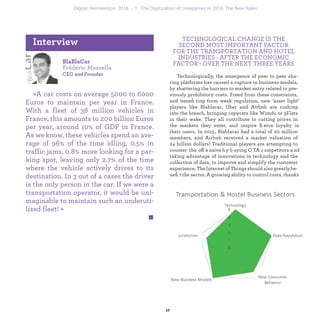
or a better understanding of sectoral develop-
ments, BCG experts developed a matrix to ex-
plore the level of disruption in each sector of
activity and the intensity of their transformation. These
developments are considered in a historical perspective,
from 2010 to a vision for 2020.
These changes must be placed in a broader economic
perspective. The value creation per sector can be exa-
mined via the Total Shareholder Return (TSR), which
combines the value of shares and dividends paid on an
annualized basis. The changes in TSR of European com-
panies from 2005 to 2016 show that the different sectors
- outside of insurance, exist in a context of value destruc-
tion.
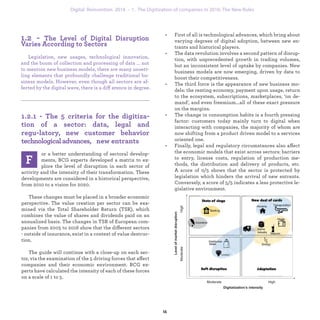
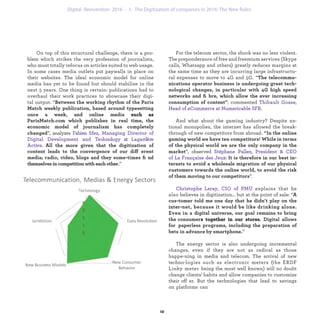
The guide will continue with a close-up on each sec-
tor, via the examination of the 5 driving forces that affect
companies and their economic environment. BCG ex-
perts have calculated the intensity of each of these forces
on a scale of 1 to 5.
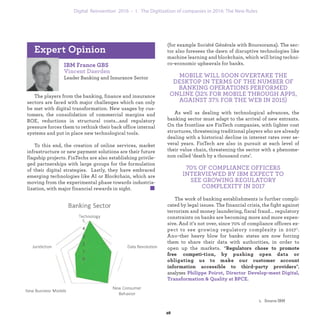
• First of all is technological advances, which bring about
varying degrees of digital adoption, between new en-
trants and historical players.
• The data revolution involves a second pattern of disrup-
tion, with unprecedented growth in trading volumes,
but an inconsistent level of uptake by companies. New
business models are now emerging, driven by data to
boost their competitiveness.
• The third force is the appearance of new business mo-
dels: the renting economy, payment upon usage, return
to the ecosystem, subscriptions, marketplaces, ‘on de-
mand’, and even freemium...all of these exact pressure
on the margins.
• The change in consumption habits is a fourth pressing
factor: customers today mainly turn to digital when
interacting with companies, the majority of whom are
now shifting from a product driven model to a services
oriented one.
• Finally, legal and regulatory circumstances also affect
the economic models that exist across sectors: barriers
to entry, license costs, regulation of production me-
thods, the distribution and delivery of products, etc.
A score of 0/5 shows that the sector is protected by
legislation which hinders the arrival of new entrants.
Conversely, a score of 5/5 indicates a less protective le-
gislative environment.
Legislation, new usages, technological innovation,
and the boom of collection and processing of data ... not
to mention new business models, there are many unsett-
ling elements that profoundly challenge traditional bu-
siness models. However, even though all sectors are af-
fected by the digital wave, there is a difference in degree.
industrialization 1. The Digitization of companies in 2016: The New Rules
he travel and transportation industry is the
most severely impacted by the disruptions sus-
tained in recent years in their respective eco-
nomic environments. They are expected to continue on
this same trajectory during the next five years. The main
factors behind the disruption sustained by these sectors
are pressure from the margins, the data revolution and
technological developments.
The fierce competition of online travel agencies (OTA)
brought about the creation of aggregators. By referencing
hotel and airline companies, these aggregators allow the
consumer to find the best prices and book their journey
without going through traditional intermediaries. Mar-
gins have been severely reduced since these players, by
increasing transparency, have managed to lower sales
prices while having a destructive effect on revenues (the
removal of traditional intermediary costs such as
reservation charges) and cultivating a more loyal
customer. This trend is expected to continue to
grow as these platforms advance rapidly. Some of
these aggregators, such as Rome2Rio, offer ‘door
to door’ services, which allow the user to book
flights, public transport and even taxis, all from
the same site. Traditional players are not sitting
on their laurels, and some are developing services
which connect transportation, the hotel sector and
customers: “
”,
explains
. “
”.
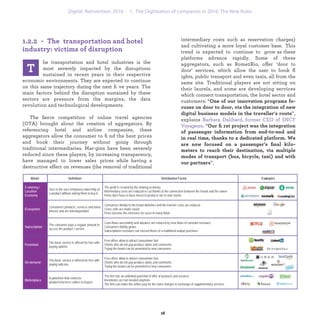
Model Definition Distribution Factor Ex mples
Ecosystem
Subscription
Freemium
On demand
Marketplace
E-sharing /
Location
Economy
Give to the user temporary ownership of
a product without asking them to buy it
The profit is created by the sharing economy
Intermediary costs are reduced or cut thanks to the connection between the tenant and the owner
Firms don't have to have invest in products nor to own stocks
Consumers products, services and datas
interact and are interdependant
Consumers fidelity to the brand dimishes and the transfer costs are reduced
Cross sells are made easier
Firms become the reference for users in many fields
The consumer pays a regular amount to
access the product / service
Cash-flows uncertainty and advance are reduced by new flows of constant revenues
Consumers fidelity grows
Subscriptions revenues can exceed those of a traditional unique purchase
The basic service is offered for free with
paying options
Free offers allow to attract consummer fast
Clients who do not pay produce datas and comments
Trying the brand can be promoted to new consumers
The basic service is offered for free with
paying add-ons
Free offers allow to attract consummer fast
Clients who do not pay produce datas and comments
Trying the brand can be promoted to new consumers
A plateform that connects
products/services sallers to buyers
The firm has an unlimited potential of offer of products and services
Inventories are not needed anymore
The firm can make the sellers pay for the extra charges in exchange of supplementary services
industrialization 1. The Digitization of companies in 2016: The New Rules
BlaBlaCar
Frédéric Mazzella
CEO and Founder
«A car costs on average 5000 to 6000
Euros to maintain per year in France.
With a fleet of 38 million vehicles in
France, this amounts to 200 billion Euros
per year, around 10% of GDP in France.
As we know, these vehicles spend an ave-
rage of 96% of the time idling, 0.5% in
traffic jams, 0.8% more looking for a par-
king spot, leaving only 2.7% of the time
where the vehicle actively drives to its
destination. In 3 out of 4 cases the driver
is the only person in the car. If we were a
transportation operator, it would be uni-
maginable to maintain such an underuti-
lized fleet! »
Interview TECHNOLOGICAL CHANGE IS THE
SECOND MOST IMPORTANT FACTOR
FOR THE TRAVEL AND TRANSPORTATION
INDUSTRY, AFTER THE ECONOMIC
FACTOR, OVER THE NEXT THREE YEARS.
Technologically, the emergence of peer to peer sha-
ring platforms has caused a rupture in business models,
by shattering the barriers to market entry related to pre-
viously prohibitory costs. Freed from these constraints,
and benefiting from weak regulation, new ‘asset light’
players like Blablacar, Uber and Airbnb are rushing
into the breach, bringing copycats like Wimdu or 9Flats
in their wake. They all contribute to cutting prices in
the markets they enter, and inspire fierce loyalty in
their users. In 2015, Blablacar had a total of 20 million
members, and Airbnb received a market valuation of
24 billion dollars! Traditional players are attempting to
counter the offensive by buying OTA competitors and
taking advantage of innovations in technology and the
collection of data, to improve and simplify the customer
experience. The Internet of Things should also greatly be-
nefit the sector. A growing ability to control costs, thanks
industrialization 1. The Digitization of companies in 2016: The New Rules
to the availability of real time information, is key. SNCF
hopes to develop sensors to improve maintenance in its
industrial sector. “We can even cross cut the sensors”,
evokes Yves Tyrode, Chief Digital Offi cer at SNCF. “For
example we could place sensors on infrastructure to
measure equipment wear, and vice-versa with accele-
rometers and cameras set up along rail tracks...”
The growing availability of all kinds of data has
brought about signifi cant changes. Companies now need
to track feedback that occurs on the web (analysis of
opinions voiced on social media, online marketing etc.)
in order to complement their customer knowledge, with
the ultimate ambition of 360° coverage. Diff erent players
can now exchange data with each other. This can lead to
consolidation, ‘plug & play’ services and using tertiary or
even in-house APIs. Nevertheless, caution must be exer-
cised!
The massifi cation of the culture of reviews and online
experience feedback led to a drastic increase in customer
demands, making it a double-edged phenomenon.
If negative opinions propagate on the internet
turnover can go into freefall! This is true to such a
degree that the feedback economy is considered one of
the most important evolutions in the hotel sector by
Vivek Badrinath, De-puty CEO in charge of
Marketing, Digital, Distribution and IT at
AccorHotels. “Digital particularly impacts the hotel
sector through the feedback economy and on-line
opinions, namely via players such as TripAdvisor,
Booking.com or social networks.”
Legislation has favored the appearance of new en-
trants. However, it hinders a total disruption of the sector
by leaning on the accessibility of procurement contract
data, and the protection of personal data by regulatory
authorities still inhibits the enthusiasm of
disruptors ... although bypasses to value creation
do exist. “I believe
T
he telecom, media, energy and gaming sectors
have seen big changes in recent years, changes
that are expected to continue. Although the role
to be played by personal data as well as new customer
demands are considerable, it is technology and the impe-
rative to remain competitive which will bring the biggest
upheavals. Traditional media have been totally disrup-
ted by the digital wave. Their margins have been da-
maged by the advent of real-time free information, co-
ming from social networks and blogs. They are also
feeling the full force of pure play competitors like the
Huffington Post, who have found a genuine economic ad-
vantage by using a voluntary contribution model. Media
publications must also face more and more low cost com-
petitors such as NextRadioTv, who have digitized all of
their channels (TV, radio, internet) in order to expand
their audience and increase advertising revenue by mul-
tiplying on-demand users.
in a general openness of data, and in its reusabi-
lity by third parties. If we decide not to make them
open, they would be accessible for many through
crowdsourcing”, puts in perspective Yann Leriche,
Chief Performance Offi cer at Transdev. The au -
thorities are increasingly worried to see these new
players impacting employment figures and their tax
revenues by competing with traditional players. In
April, Berlin struck out against online housing plat-
forms (with Airbnb as the figurehead) by introducing
mandatory district council permits for apartment
renting, and by banning the rental of more than 50% of
the surface area of housing available on the rental
market via these platforms.
1.2.3 - Telecom, Media, Energy,
Gamingsectors:Technologicalprogress
is breaking established models
industrialization 1. The Digitization of companies in 2016: The New Rules
For the telecom sector, the shock was no less violent.
The preponderance of free and freemium services (Skype
calls, Whatsapp and others) greatly reduces margins at
the same time as they are incurring large infrastructu-
ral expenses to move to 4G and 5G. “The telecommu-
nications operator business is undergoing great tech-
nological changes, in particular with 4G high speed
networks and fibre, which allow the ever increasing
consumption of content”, commented Thibault Gosse,
Head of eCommerce at Numericable SFR.
And what about the gaming industry? Despite na-
tional monopolies, the internet has allowed the break-
through of new competitors from abroad. “In the online
gaming world we have ten competitors! While in terms
of the physical world we are the only company in the
market”, observed Stéphane Pallez, President & CEO
of La Française des Jeux: It is therefore in our best in-
terests to avoid a wholesale migration of our physical
customers towards the online world, to avoid the risk
of them moving to our competitors”.
Christophe Leray, CIO of PMU explains that he also
believes in digitization… but at the point of sale: “A cus-
tomer told me one day that he didn’t play on the inter-
net, because it would be like drinking alone. Even in a
digital universe, our goal remains to bring the consu-
mer into a community sale point. Digital allows for
paperless programs, including the preparation of bets
in advance by smartphone.”
The energy sector is also undergoing incremental
changes, even if they are not as radical as those happe-
ning in media and telecom. The arrival of new techno-
logies such as electronic meters (the ERDF Linky meter
being the most well known) will no doubt change clients’
habits and allow companies to customize their offer. But
the technologies that lead to savings on platforms can
On top of this structural challenge, there is a pro-
blem which strikes the very profession of journalists,
who must totally refocus on articles suited to web usage.
In some cases media outlets put paywalls in place on
their websites. The ideal economic model for online
media has yet to be found but should stabilize in the
next 5 years. One thing is certain: publications had to
overhaul their work practices to showcase their digi-
tal output. “Between the working rhythm of the Paris
Match weekly publication, based around typesetting
once a week, and online media like ParisMatch.com
which publishes in real time, the economic model of
journalism has completely changed”, analyzes Fabien
Sfez, Managing Director of Digital Development and
Technology at Lardère Active. All the more given that
the digitization of content leads to the convergence of
our different media; radio, video, blogs and they some-
times find themselves in competition with each other.”
industrialization 1. The Digitization of companies in 2016: The New Rules
also indirectly affect the traditional value chain of ener-
gy players. “The classical model of the service station
is today being attacked head on by companies such as
Drop don’t park (a car valet service which parks and
takes care of your car), or Purple, in the USA (home
delivery of gasoline)”, illustrates Marc Gigon, VP Di-
gital Marketing & Services at Total “These startups
have taken a position close to our business models, and
could one day threaten them”.
The electricity market seems, however, to be protec-
ted from new entrants: “There are almost no interme-
diaries in the electricity market in Europe, with the
exception of the United Kingdom”, explains François
Gonczi, Digital Director, EDF Commerce. “In effect,
margins are low, and rates relatively close between
competitors. The cost structure therefore keeps us
safe: I do not see how an intermediary could be profi-
table under such conditions. The consequence is that
winning new customers does not happen in a price war,
but by the quality of associated services and customer
relations.”
The collection of data from the Internet of Things or
navigation devices leads to increased operational per-
formance. A/B testing, which allows for live comparison
of web features, is replacing traditional marketing tests.
“SFR traditionally performed several customer tests
before putting a new customer web service online”, de-
tails Thibault Gossé, Head of eCommerce at Numeri-
cable SFR. “But their profiles (students, unemployed…)
didn’t always match our targets, which were more
family orientated. This is why we have decided to in-
tensify our efforts with A/B testing and live customer
tests.”
The data captured by smart meters, for example,
should also lead to better targeting of consumers, to
ad-just the value proposition. “The final stage, on the
horizon for 2016 or 2017, is to give the technician every
means, at the end of his call-out, to promote a fitting
product for the customer”, foresees Hervé-Matthieu
Ricour, CEO France BtoC at Engie. “Between then and
now, we will be able to establish - using data cross refe-
rencing- the services a customer uses, especially those
which they have not yet availed of, but which would be
a useful complement.”
In these sectors as elsewhere, the consumer is smit-
ten with the great hope of digital tools, and expects to be
able to consume media (or connect to their own platform)
on every possible device (tablet, computer, mobile…).
“The web is a fundamental pillar of our client acquisi-
tion strategy and also allows easier access to support
services for our customers”, continues Hervé-Matthieu
Ricour, CEO France BtoC at Engie. The demand for real
time activity also greatly aff e cts c ustomer relations.
In the media sector, the dynamic of commentary from
on-line readers has also created the necessity for
modera-tion, and the possibility of a new form of
customer engagement.
It must be noted however, that the media, telecom
and gaming sectors are seeing a growing convergence
of their platforms and content. Thibault Gossé, Head of
eCommerce at Numéricable SFR explains : “We are in the
process of creating a range of products for multi-channel
distribution, through our VOD package, which allows us
to promote series produced within the group. This logic
does not stop at production, but will also incorporate
partnerships, particularly the retransmission of spor-
ting events”. Thus in reality, the services provided by the
operator “will be closer to Canal+, rather than traditional
competitors like Orange or Free.”
industrialization 1. The Digitization of companies in 2016: The New Rules
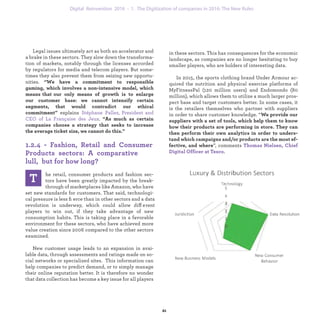
T he retail, consumer products and fashion sec-
tors have been greatly impacted by the break-
through of marketplaces like Amazon, who have
set new standards for customers. That said, technologi-
cal pressure is less fierce than in other sectors and a data
revolution is underway, which could allow different
players to win out, if they take advantage of new
consumption habits. This is taking place in a favorable
environment for these sectors, who have achieved more
value creation since 2006 compared to the other sectors
examined.
New customer usages leads to an expansion in avai-
lable data, through assessments and ratings made on so-
cial networks or specialized sites. This information can
help companies to predict demand, or to simply manage
their online reputation better. It is therefore no wonder
that data collection has become a key issue for all players
in these sectors. This has consequences for the economic
landscape, as companies are no longer hesitating to buy
smaller players, who are holders of interesting data.
In 2015, the sports clothing brand Under Armour ac-
quired the nutrition and physical exercise platforms of
MyFitnessPal (120 million users) and Endomondo (80
million), which allows them to utilize a much larger pros-
pect base and target customers better. In some cases, it
is the retailers themselves who partner with suppliers
in order to share customer knowledge. “We provide our
suppliers with a set of tools, which help them to know
how their products are performing in store. They can
then perform their own analytics in order to unders-
tand which campaigns and/or products are the most ef-
fective, and where”, comments Thomas Nielsen, Chief
Digital Officer at Tesco.
Legal issues ultimately act as both an accelerator and
a brake in these sectors. They slow down the transforma-
tion of markets, notably through the licenses accorded
by regulators for media and telecom players. But some-
times they also prevent them from seizing new opportu-
nities. “"We have a commitment to responsible gaming,
which involves a non-intensive model, which means that
our only means of growth is to enlarge our customer
base: we cannot intensify certain segments, that would
contradict our ethical commitment” explains Stéphane
Pallez, President and CEO of La Française des Jeux. “As
much as certain companies choose a strategy that seeks
to increase the average ticket size, we cannot do this.”
1.2.4 - Fashion, Retail and Consumer
Products sectors: A comparative lull,
but for how long?
industrialization 1. The Digitization of companies in 2016: The New Rules
IBM France
Rémi Lassiaille
Managing Director SNCF
Traditional players in the travel and transportation
sectors have seen competitors emerge from sectors of
activity which are sometimes diametrically opposed to
their own. These disruptors also bring with them new
technologies, new business models and innovative or-
ganization. Particularly, they introduce sales tools and
methods specially adapted to the ‘increasingly digital
behavior patterns’ of end customers. Moreover, the In-
ternet of Things will bring an improvement in the quality
of services and considerable gains in productivity, which
prove indispensable in this ‘disruptive’ period. The acti-
vity in these sectors generates a great deal of data which
must be utilized in the optimal manner. The challenge for
these companies is to integrate the necessary tools for
the gathering of data and its analysis, to then find their
place within traditional industrial processes and infor-
mation systems. To transform rapidly, profound changes
that put digital at the core of the company, are vital.
Expert Opinion
The 3 disruption trends observed in the
telecom sector:
• The seizing of power by users
• The explosion of mobile data usage
• A strong trend towards the concentra-
tion of the market to a limited number
of very powerful players
The IBM Zoom
Lagardère Active
Fabien Sfèz
Managing Director of Digital
Development and Technology
«We recently won a call for tender from
Nice airport. We are leveraging our ex-
perience in real time targeted mobile ad-
vertising, which was initially developed
for our sites. This allows us to reach
connected customers in the airport, with
relevant ads from businesses, in Engli-
sh, as 50% of Nice airport purchases are
made by foreign visitors..»
Interview
industrialization 1. The Digitization of companies in 2016: The New Rules
Inevitably, the digitization of sectors also puts pres-
sure on the margins, since new players are appearing,
who attack the market shares of traditional players.
Dollar Shave Club, an American company which offers
home delivered razors and other beauty products on a
subscription basis, with an entry level plan of one dollar
per month, has received a market valuation of 615 mil-
lion dollars.
IBM France
Lionel Vidart
Telecommunications Leader
The problems faced by companies in the telecom
sector are exciting, because they are being forced to
launch new digital services very quickly and this leads
to a growing demand for end customers. Operators are
therefore caught in the inescapable dynamic of a forced
march towards digital transformation. Furthermore, the
improvement of the customer experience through digital
is certainly a strategic priority for companies in this sec-
tor, whether this means client acquisition or improving
existing customer loyalty. The challenge for operators
also lies in the utilization of the huge amounts of data
generated by all objects which are part of the Internet
of Things, to create new sources of revenue. They must
also measure and manage the quality of the service ex-
perience by their customers, analyzed via the network
and the information provided by apps and device usage.
This can help improve customer satisfaction and loyalty.
Expert Opinion
In fashion and especially luxury goods, data proces-
sing from diverse sources has an even more paradoxi-
cal effect: “Big Data allows us to reintroduce customer
knowledge and therefore personalization, into what
has become a global industry that can no longer know
its customers individually, without the aid of techno-
logy”, explains Sébastien Hua, eCommerce & Omni-
channel Director at Kering. “So it is more like a return
to our roots than a real departure.”
As is the case in other sectors, consumption prac-
tices have profoundly changed with the digital wave.
More aware and demanding customers trust crowd-
sourcing rather than expert opinions, and prefer to
consult online reviews before buying a product, instead
of listening to salespeople. They also follow more and
more complex sales paths which mix online and offline
activity. 45% of consumers now prefer to grocery shop
online instead of in physical stores. (Source IBM).
“Click and collect” is the figurehead of this move-
ment for a complete overhaul of the supply chain, which
will develop in relation to different sales and distribu-
tion activities. “In the DIY industry, there is no point
in emulating the click and collect models of agri-food
brands”, remarks Christophe Verley, Chief Digital
Officer at Adeo. “Our challenges are very different:
in the food industry, the consumer seeks to avoid ha-
ving to enter a store. In DIY, however, clients often
come from far away to ensure the availability of pro-
ducts when they visit, and to then complete their pur-
chases upon entering the store”. It follows that there
is pressure for delivery times to be reduced. “With new
customers like Amazon, customer expectations are
changing, with new implicit norms being established,
for example in terms of delivery times and the choice
of time slots for delivery”, believe Christian Lou and
Yan Aubriet, Director of Direction Marketing & Digi-
tization and Director of Digital Development at Darty.
industrialization 1. The Digitization of companies in 2016: The New Rules
Retailers have not been spared either, with the arri-
val of giants like Alibaba and Amazon who, armed with
a technological advantage, benefit from efficient logis-
tics and low cost physical distribution, which leads to
the shrinking of already weak margins. “The grocery
market is a very competitive one, especially in the UK
with everything from pure plays such as Amazon Fresh
to the arrival of some discount competitors”, concedes
Thomas Nielsen, Chief Digital Officer at Tesco.
As a result, traditional players have to review their
supply chain from end to end in order to cut costs. They
may not be safe yet. In the future competition may even
come from suppliers themselves, who could be tempted
to disintermediate their distributors, and take control of
their customer relationships. Michael Aidan, Chief Digi-
tal Officer at Danone, gives a nuanced word of warning
: “We are experimenting with home delivery for Evian
water bottles, but it is impossible for us to deliver to bu-
sinesses such as bars or cafés.”
These sectors are ultimately prone to technologi-
cal evolution. Thanks to online sales, sellers lean more
and more on the theory of the long tail, to increase their
sales. This means expanding their catalogue as far as
possible by targeting less popular products, with an ex-
panded catalogue making up for lower sales per item.
The Internet of Things also contains a repository for in-
novation, with the future development of smart kitchen
equipment. “We could potentially see the advantage of
forging partnerships with sellers of connected refrigera-
tors”, imagines Florian Sauvin, Chief Digital Officer at
Bel Group and Director of Unibel.
Between now and this futurist outlook, digi-
tal showrooms are flourishing. “We created a 150m2
showroom to complement our digital sales channel”,
reveals Nathalie Balla, Co-Owner & CEO of La Redoute.
“For us it is a way to reinvent a new kind of physical store.
IBM France
Emmanuel de Saint Leger
Distribution Sector Leader
Of all the sectors, the retail sector was one of the har-
dest hit by the wave of digital transformation. Compe-
ting directly with online sales platforms and subject to
a strong change in customer relationships, the big retail
companies have seen their existing business models
challenged by new consumer practices.
Faced with these challenges and their huge impact
on business processes, the sector confronts three major
problems :
• The digitization of all or some of the activities of
companies in the sector, moving particularly towar-
ds the installation of online sales platforms.
• The optimization of customer knowledge and
pathway to ensure better customer relations.
• The establishment of integrated omnichannel and
supply chain management.
Expert Opinion
Physical sales are good, and the rate of web conversions
is exploding in surrounding areas”. On the legal front,
there are few changes however. The disparity between
national regulations limits international competition.
Nonetheless, by putting strict controls on stores’ ope-
ning hours, legislators hand the advantage to online dis-
tribution channels over physical retailers.
industrialization 1. The Digitization of companies in 2016: The New Rules
Boston Consulting Group
Nicolas de Bellefonds
Partner at BCG
Mass consumption faces the risk of soft
disruption
Immune to disruption until now, the mass consump-
tion industry is making use of the growing opportuni-
ties of the digital economy and is making up for lost time
with accelerated transformation programs.
The battle is being waged on four fronts :
• Transformation of marketing via earned media and
data, to reinforce brands and perform large scale tar-
geted advertising
• Development of direct or indirect ecommerce, which
accounts for 50% of growth at 5 years
• Digitization of operations to increase their efficacy
• Innovation in services to move value proposition
towards the experiential
The difficulty lies in bringing about this change in
historically decentralized and entrepreneurial cultures.
Organizations that are slow to adapt risk facing a softer
disruption, but this is not without danger. The relevance
of their message can fade, publicity costs can increase
and market shares in digital channels can be diluted.”
Expert Opinion
1.2.5 - Insurance sector: When regula-
tory inertia maintains disruption
T
he insurance sector was until now protected
from disruption by generally protective natio-
nal legislations, which limit the number of new
entrants. However, the growing use of data and technolo-
gical change suggest that profound transformations are
on the way. Value creation in 2016 is two times lower than
the S&P 500 average index. The situation is even more
troubling than the growing use of data, and technologi-
cal changes suggest that profound transformations are
on the way.
The benefit of new technologies to insurers is consi-
derable : Big Data tends towards the automatization of
processes and drastically reduces costs, opening the way
for new models of customized offers by capitalizing on
the Internet of Things. “ The Internet of Things has the
potential to measure the behavior of the insured more
industrialization 1. The Digitization of companies in 2016: The New Rules
accurately, and thus allow us to adjust our rates accor-
dingly”, asserts Isabelle Moins, Head of Direct Activi-
ties, Digital, Customer Marketing at Aviva.
“ We launched a behavioral auto insurance offer on
Amaguiz, based on data collected from a unit connec-
ted to the vehicle”, counters Thomas Vandeville, Di-
rector of Group Digital Transformation at Groupama.
“This model changes the rates for risks and leads to a
mechanistic reduction in premiums”. A mutual benefit:
insurers optimize their risk while customers pay lower
premiums. As a result, the combination of the IoT with
Big Data should earn $14 billion for insurers over the
next 10 years.
This promise should be tempered, because it implies
a profound challenge to the insurer's economic model. “If
the data is drawn directly from the insured’s environ-
ment, we might not own this data in the future”, alerts
Isabelle Moins, Head of Direct Activities, Digital, Cus-
tomer Marketing at Aviva. Automobile manufacturers
could choose to retain control of captured data: “The
connected car will revolutionize the structure of the
insurance market, giving more power to the manufac-
turer who would be in an ideal position to utilize the
data coming from vehicles”, warns Thomas Vandeville.
A REVOLUTION IN DISTRIBUTION
FOR INSURERS
Parallel to this, customers are becoming more deman-
ding and want to choose their mode of access (mobile,
web, telephone, physical). Insurers must readjust as a re-
sult. Carline Huslin, Head of Digital and Multichannel
Customer Experience at Generali France, underlines
this point: “The digital revolution also affects the dis-
tribution mode: it is no longer the provider who decides
what is proposed to the customer, it is the customer
who chooses the product that they will be provided”.
Boston Consulting Group
Nicolas Harlé
Senior Partner
Banks : changes are inevitable, faced
with FinTech and new customer expec-
tations
The digital transformation is one of the main challen-
ges to banks experiencing difficult regulatory and eco-
nomic conditions (negative interest rates). This is being
forced by today’s customers, who use digital channels
more intensively than ever. Nowadays, mobile applica-
tions and the web are the main contact channels, ahead
of traditional channels like the telephone or physical
bank branches. GAFA have set the standard for cus-
tomers and they have high expectations for the quality of
their digital interaction with banks. Furthermore, banks
now face multiform competition, friend-enemy, through
the emergence of more than 8000 FinTech companies
that have raised more than $75 billion since 2000, chiefly
in venture capital.
To transform themselves banks must revamp their
operational models, adapt their computer systems, en-
sure the evolution of their competency models to adapt
to digital, put in place ambitious data strategies, establi-
sh FinTech ecosystems and weigh the opportunities to
launch disruptive models.
Expert Opinion
industrialization 1. The Digitization of companies in 2016: The New Rules
1.2.6 - Banking sector: A sector that re-
mains protected from regulation
P
illars of the real economy, banks are underta-
king digital transformation programs…but they
are doing it in an environment of increasing re-
gulation, where their profitability is at its lowest. Their
value creation has since been significantly lower than in
other sectors, on a consistent basis. The trend may conti-
nue as banks are not safe from radical modifications of
their environment in the next 5 years. Even though they
are both under pressure, but also protected from their
competition by regulatory and license constraints, they
must also deal with heavy technological changes and
growing compliance costs for their systems. Technology
is a window of opportunity for bankers, allowing them to
reduce certain operational costs.
Today’s digital orientated consumers execute banking
operations from their mobile devices (or more rarely
their computers), which in the past would have required
the medium of a physical teller. This even includes com-
plex operations like mortgage applications. Banks who
are at the forefront of digital can reduce their costs by a
third.1 This source of savings can be up to $200 billion.2
But these technical changes are not always easy to
put in place. The integration of new technology parallel
to rigid, outmoded computer systems is a real challenge,
even if banks have generally strong technical competen-
cies. Much simpler evolutions nonetheless allow banks
to deal with growing customer demands, as the ergono-
mic features of interfaces are still open to much impro-
vement. Less than 1% of traditional mobile banking app
users would classify them as their favorite.1
Traditional banks are not missing this fact, and most
are developing 100% digital versions of their services
Just like the air travel sector a few years earlier, the in-
surance sector is dealing with strong marginal pressure
from aggregators like LeLynx.fr. By acting as the first
interface between customers and insurance companies,
they are waging war at the margins, which clears the way
for new players who interrupt the value chain and are
free from certain traditional costs (namely rent and phy-
sical employees). Nonetheless, not all entrants are pure
plays: Ford garage owners now provide their own brand
of auto-insurance and free themselves from the B2B ser-
vices of traditional insurers. The diversification of ser-
vices (insurers becoming bankers, or the reverse) leads
to increased competition with banking players.
Historical players are transforming to stay in the race.
AXA has implemented powerful digital governance and
launched numerous pilot programs with business lines.
Partnerships with startups, mainly Blablacar, are expec-
ted to accelerate with their two innovation labs and their
Strategic Venture. Groupama is also expanding strate-
gic collaborations: they have established partnerships
with Renault, to counter the disintermediation of auto-
mobile insurance, and with Orange to place themselves
in the payments market. Furthermore, the architecture
of the company has been recast in the style of the Ama-
guiz platform.
industrialization 1. The Digitization of companies in 2016: The New Rules
IBM France GBS
Vincent Daerden
Leading Banking and Insurance Sector
The players from the banking, finance and insurance
sectors are faced with major challenges which can only
be met with digital transformation. New usages by cus-
tomers, the consolidation of commercial margins and
ROE, reductions in structural costs...and regulatory
pressure forces them to rethink their back office internal
systems and put in place new technological tools.
To this end, the creation of online services, market
infrastructure or new payment solutions are their future
flagship projects. FinTechs are also establishing privile-
ged partnerships with large groups for the formulation
of their digital strategies. Lastly, they have embraced
emerging technologies like AI or Blockchain, which are
moving from the experimental phase towards industria-
lization, with major financial rewards in sight.
Expert Opinion
(for example Société Générale with Boursorama). The sec-
tor also foresees the dawn of disruptive technologies like
machine learning and blockchain, which will bring techni-
co-economic upheavals for banks.
MOBILE WILL SOON OVERTAKE THE
DESKTOP IN TERMS OF THE NUMBER OF
BANKING OPERATIONS PERFORMED
ONLINE (32% FOR MOBILE THROUGH APPS,
AGAINST 37% FOR THE WEB IN 2015)
As well as dealing with technological advances, the
banking sector must adapt to the arrival of new entrants.
On the frontline are FinTech companies, with lighter cost
structures, threatening traditional players who are already
dealing with a historical decline in interest rates over se-
veral years. FinTech are also in pursuit at each level of
their value chain, threatening the sector with a phenome-
non called ‘death by a thousand cuts’.
70% OF COMPLIANCE OFFICERS
INTERVIEWED BY IBM EXPECT TO
SEE GROWING REGULATORY
COMPLEXITY IN 2017
The work of banking establishments is further compli-
cated by legal issues. The financial crisis, the fight against
terrorism and money laundering, fiscal fraud... regulatory
constraints on banks are becoming more and more expen-
sive. And it’s not over, since 70% of compliance officers ex-
pect to see growing regulatory complexity in 20171. Ano-
ther heavy blow for banks: states are now forcing them to
share their data with authorities, in order to open up the
markets. “ Regulators chose to promote free competi-
tion, by pushing open data or obligating us to make our
customer account information accessible to third-party
providers”, analyzes Philippe Poirot, Director Develop-
ment Digital, Transformation & Quality at BPCE.
industrialization 1. The Digitization of companies in 2016: The New Rules
An example of a banking disruptor:
Compte Nickel
Founded in 2012, Compte Nickel offers a simple and in-
novative instant payment service, which guarantees free-
dom from overdraught and premium charges. With the
support of strategic partners in the card payment sector
(VISA, Mastercard, Gemalto) the startup has conquered
a niche market of individuals who have been abandoned
by banks and require a bank account number. They at-
tract young people and even traditional bank customers,
who are not afraid to try their services, while still keeping
their standard account. They have achieved success with
over 300,000 customers in May 2016, and 20,000 new ac-
counts created per month.Compte Nickel now challenges
traditional banks with their radical business model. While
traditional players are suffering from high distribution
costs, the startup has developed a partnership with tobac-
co stores, which guarantees a broad territorial base and a
mere 3€ customer acquisition cost. The fledgling company
hopes to establish itself internationally by 2017-2018, and
has ambitions of transforming itself into a banking plat-
form by collaborating with FinTech players.
Compte Nickel is seeing real success thanks to its pro-
mise of instant payments without hidden rates or charges,
much like peer to peer payment and funding platforms
between individuals. The threat is much more serious for
banks than FinTech companies, who are present in niche
markets, and are beginning to organize partnerships,
like Number 26 and TransferWise. The next disinterme-
diation will more than likely relate to mobile payments,
which grew by 40% in 2015 and 2016, and are expected to
reach over $1 billion between now and 2017.1 There are
upheavals to come, to be sure, and even more so if GAFA
take on the market, following the lead of Apple’s ApplePay.
Zoom on Compte Nickel
industrialization 1. The Digitization of companies in 2016: The New Rules
CHA -
2
2 :
2.1 - Faced with market standards set by pure plays, companies adapt by
redoubling initiatives
2.1.1 - Pure plays set the market standard p.
2.1.2 - Classical players begin their transformation with customer engagement p.
2.1.3 - Companies are learning to use data: increasing POCs and experimentation p.
2.1.4 - Companies innovate incrementally on products, services and processes p.
2.1.5 - Companies establish external innovation programs through venture capital,
accelerators and startup acquisitions p.
2.2 - Initial forces still hinder traditional companies' scale-ups and their
digital innovation is less advanced than pure plays and customer expectations p.
2.2.1 - Obstacles to reaching scale p.
2.2.2 - Traditional players remain short of the digital innovation levels set by pure plays
and customer expectations p.
In 2016, digital transformation must no longer be limited to the superficial
digitization of activities. Companies are catching on, which means redou-
bling digital initiatives for customer relations and data. “
”, posits ff
. There is, however, a big element which complicates things for esta-
blished players: public expectations for ergonomics, ease of usage, diversity
of services and reactivity, which come from the standards set by pure plays
and other new entrants. The benchmark for digitization is set by companies
from the digital revolution, who function like permanent innovation labs.
Their successes become standards for the entire sector. This environment
is inspiring digital renovations which affect individual companies as well
as entire sectors of activity. Companies are especially open to new modes
of innovation and are keeping a close eye on the best practices from other
sectors. They are opening up to the ecosystem of startups who are one-stop
shops for new technologies, new cultures and new working methods. Com-
panies are spurred by economic urgency, and the potential to reduce their
time-to-market by increasing synergies.
02.
Despite many experimental initia-
tives, both internal and external,
companies are still lagging behind
pure plays and customer expectations
p
On the road to digital transformation, companies are
expanding their initiatives, pursuing the belief that solu-
tions are to be found externally. In the economic world,
as elsewhere, there is strength in numbers.
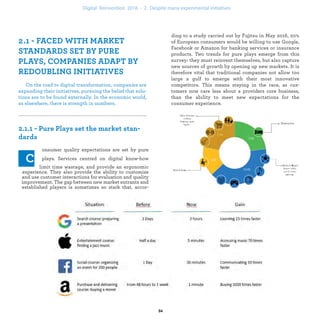
onsumer quality expectations are set by pure
plays. Services centred on digital know-how
limit time wastage, and provide an ergonomic
experience. They also provide the ability to customize
and use customer interactions for evaluation and quality
improvement. The gap between new market entrants and
established players is sometimes so stark that, accor-
ding to a study carried out by Fujitsu in May 2016, 20%
of European consumers would be willing to use Google,
Facebook or Amazon for banking services or insurance
products. Two trends for pure plays emerge from this
survey: they must reinvent themselves, but also capture
new sources of growth by opening up new markets. It is
therefore vital that traditional companies not allow too
large a gulf to emerge between their most innovative
competitors. This means staying in the race, with cus-
tomers who care less about the core of the business and
who their providers are, than the digital transformation
of the consumer experience.
industrialization .
”, assures
ffi .
This customer centric approach, with the customer
as the focus of all concerns, is crucial in establishing a
quality long-term relationship between a brand and its
customers. This is also known as relationship marketing.
“
”, describes
. This makes
it possible to increase performance through commercial
targeting. “
”, pursues
.
MORE INTELLIGENT COMMUNICATION
In line with this trend, all traditional marketing func-
tions are being digitized: “
”, clarifies
Offi Although large campaigns based on un-
differentiated advertising spots remain interesting for
FMCG players, communication is becoming more subt-
le. The focus is on social media buzz, in the wake of the
2015 recruitment campaign by Michel & Augustin, in
the Paris metro. Thanks to data collection, advertising
campaigns are becoming autonomous through program-
matic marketing as well as becoming more personalized
and efficient. They are also opening the way for hybrid
campaigns between digital and commercial promotions.
explains with an example : “
.” This approach
n a market led by new entrants, traditional
players are reinventing customer engagement
in order to stay in the race. The first commercial
challenge involves making products and services avai-
lable through online sales. Marketing is also following
suit, by evolving into digital marketing: today’s media
investments inevitably involve buying advertising space
on Facebook, or keywords at Google… and follow diverse
media policies according to devices (web, mobile…).
”, evokes
.
Companies must now cover all traditional professions
digitally, from sales to distribution, by way of media
communication. “
”, analyzes
.
Today, people spend up to 11 hours a day consuming
digital services, and screens play a central role in our li-
ves. This is a new paradigm for advertisers, who need to
review their marketing mix and adjust their sales strate-
gies. “
”, observes
. “
.” This concern
is shared by many B2C players, but also B2Bs. “
industrialization .
”, states
. “T
”
DIGITIZE ... WHILE MAINTAINING
CUSTOMER RELATIONS STANDARDS
Nonetheless, the digitization of customer relations
also has its limits. The quality of human relations re-
mains paramount, particularly for customer support
or after-sales service. “
”, confirms
. “
.” Digital is therefore an ingredient that must
be applied judiciously in the customer relations equa-
tion, at the risk of having negative effects. A realization
that is particularly true in demanding fields, like luxu-
ry items: “
”, observes
(formerly
Pinault-Printemps-Redoute). “
”
ore and more initiatives are tapping into
the mass of data generated by consumers
throughout their journey, including digital and
physical networks. This is a big challenge: in 2022 there
will be 50 connected objects per household, compared to
‘hardly’ 10 in 20151. “
is carried through to diversifying media campaigns:
“
.”
SUPPLEMENTING CATALOGUES
WITH MARKETPLACES
Companies are also focused on extending or diver-
sifying their catalogue of products, by looking to mar-
ketplaces. 73% of companies surveyed in our panel re-
vealed that they have launched alternative distribution
platforms. The challenge is selling products that are
not stored in-house, but available through wholesale
partners, who charge a commission. Darty is an ambi-
tious example.
provides the details
: “
” The approach
is extending to the provision of services, as seen by the
creation of an AccorHotels marketplace: “
”, describes
.
CUSTOMER-CENTRICITY: A BULKWARK
AGAINST DISINTERMEDIATION
Maintaining customer relationships can also help limit
disintermediation. “ i
- ”, analyzes once again
. This vision is shared by other
traditional players, like the SNCF. “
industrialization .
”, announces
.
The Internet of Things helps to further refine ana-
lyses, by finding new data sources. “
”, evokes
.
STARTING SMALL WITH POCS
The first step, before embarking on large scale expe-
rimentation, is to establish necessity and technical feasi-
bility. Pilot projects begin with POCs (Proof of Concept),
an essential first step before confronting the technical
or human related problems of growing to scale. Compa-
nies mostly take a pragmatic approach, known as ‘test
and learn’. “
ff ’", de-
tails
. “
.”
PILOT PROJECTS MUST MEET
CUSTOMER NEEDS
For these pilot projects, the main imperative re-
mains economic viability, which depends directly upon
customer adoption. Pure plays, who have grasped how
data can make considerable growth possible, often have
a head start. “
off
”, reveals
.
SCALING-UP: A QUESTION OF TIMING
The success or failure of an experiment also comes
from a delicate balance between the maturity of demand
and that of the stakeholders of the organization. The
external economic environment is also evolving, which
could remove possible partnerships with providers. This
brings the risk of creating an unusable pilot program.
Success also depends upon the level of urgency: “
”, analyzes
“ ”
BIG DATA: TOWARDS THE END OF
MASS STANDARDIZATION
In the Big Data era, the supply of services or marke-
ting campaigns is becoming highly customizable. This
ability to influence the end customer more accurately
can benefit all players that formerly followed B2B2C mo-
dels, and mass retail in particular.
DATA SERVICES
The growing importance of the Internet of Things
and Big Data is thereby directly influencing the evolu-
tion of products and services, and accounts today for one
of the foremost levers of innovation. Digital innovation
industrialization .
INCREMENTAL INNOVATION: OPTIMIZING
EXISTING MODELS THROUGH DIGITAL
For distributors who have physical stores, incremen-
tal innovation could mean developing new online func-
tionalities that extend web services to track consumption
and billing with smart meters. “
”, observes
. “
”.
In the world of sales, like the catering trade, promo-
ting customer loyalty is another example of incremental
innovation. “
”, reveals
The agribusiness
group Le Duff have hopes for a similar program: “
”, explains
ff.
Incremental innovation can also involve taking ad-
vantage of digital to move upmarket, by improving the
customer experience. “
”, indicates
Anne Browaeys-Level, Chief Marketing, Digital & Tech-
nology at Club Med. “
”
THE BURDEN OF OPERATIONAL
CONSTRAINTS
Companies often have a strong internal culture for
incremental innovation, through established processes
has brought changes such as the ‘Product as a Service’
model (deployed by 56% of the companies interviewed
for this guide) and service platforms.
For companies it is no longer simply about the once-
off sale of a product. They now sell services that can be
monetized according to the frequency of product usage.
For this, there is one key factor: a radical paradigm shift
for manufacturers and builders. “
’, attests
. This ap-
proach also makes it possible to broaden and diversify
traditional services.
Personal data collection nonetheless carries legal
risks, of which companies are wary: the customer must
be able to control their personal data. “
, warns
Offi . Companies can anticipate these kinds
of issues through proper organizational measures. “
f fi ”, clarifies
f fi .
he challenges of innovation are clear for all to
see. Companies are also accelerating the de-
velopment of incremental internal innovation.
Integrated into active operations, they rely upon inter-
nal resources, from the formulation of ideas to their im-
plementation. They do not change existing models, but
seek to optimize them. “
”, comments
ffi .
industrialization .
”, evokes
. This means accele-
rating the technological maturity of the disruptions de-
veloped, in order to reap the rewards early. Relationships
can be developed beyond simple partnerships, by way
of accelerators, incubators or investment funds...65% of
surveyed companies practice in-house incubation versus
48% externally.
CORPORATE VENTURES: A FINANCIAL
VEHICLE FOR INNOVATION
Company investment funds (or corporate ventures)
are formed to help intensify external innovation. There
are two complementary approaches: investment in a
specialized fund, like those managed by Partech Ven-
tures, as 45% of companies on our panel have done, or
the development of an in-house investment fund. Accor-
ding to a study performed by Insead1 and 500 startup
funds, 50% of the the 100 Forbes Global 500 now have
corporate funds. “
”, describes
.
According to CB insights1, these private funds contri-
buted to more than half of all startup financing in the
world in 2015. This was a 70% growth on the previous
year. This is a promising expansion, even though Europe
is less affected for the moment, receiving only 15% of to-
tal financing.
and practices. Organizations can sometimes be tempted
to over-experiment, without setting proper limits. “
,
asserts . “Test and learn” is
also an emergent trend. Aborted pilot projects are the-
refore not seen as deadweight, but as necessary trials.
“
”, reveals
.
e
o avoid being outpaced by pure plays, tradi-
tional companies must stay in the innovation
race. Big players now see startups as their
chosen partners to accelerate innovation, particular-
ly innovation that disrupts their traditional activities.
These partnerships often have a level of opportunism,
by exploiting an immediately available technology. “
”, underlines
ffi “
”.
Aware of what fledgling operations can bring to the table,
more and more companies are appointing executives to
orchestrate a culture of external innovation: the Chief
Disruption Officer.
CONNECTING TO THE ECOSYSTEM
Beyond this opportunistic mindset, more and more
companies are developing active links with the startup
ecosystem. This desire can be seen in large-scale pro-
grams: “
industrialization .
Member of the Executive Commitee -
Digital and Market Management
“We have a startup accelerator, which
helps us to stay as close as possible to this
ecosystem. That way we pay attention to
their methods and technologies. We help
them to grow, we provide administrative,
legal and financial support as well access
to a network, but we do not necessarily im-
pact their capital: we must not stifle their
development.”
Confronted with new paradigms introduced by pure
plays, trusted formulas no longer work as well as they
used to. Traditional companies are hindered by internal
inertial forces and are generally less digitally mature
than their markets.
ll companies, whether they are established
players or pure plays, face the burden of their
history. Vestiges of this heritage are found in
internal organization and are often a source of friction.
These obstacles are chiefly cultural, which can involve
a clash between traditional and digital teams. “
ffi
, recognizes
Offi .
At the heart of this problem, digital can be seen as a
threat by colleagues, particularly when performance in-
dicators for the physical sales networks and online sales
channels are poorly indexed and refl ect badly upon the
cross-channel systems in place. “
. ”, confiides
s
industrialization .
. “
.”
“
”, underlines
. “
” There is also the burden of
established processes which create sub-cultures that are
difficult to change: the famous silos. “
”, adds
.
“
”
The cultural change that needs to take place for most
players involves putting the customer at the heart of
the process. “
”
Beware of false steps however: digital transformation
can reveal longstanding dysfunctions, which partners
grew to tolerate. “
”, warns
. “
”
AN INEVITABLE LOSS OF CONTROL
These cultural obstacles are often combined with
static management, who must adapt to changing times
and take the plunge into the unknown. “
”, evokes
ffi
“
”
This is compounded by a fear of loss of control by
middle management. “
”, admits
. “
”.
shares this need
for transparency: "
”, insists “
”, analyzes ff
. “
diffi
.”
AN INTERNAL MANAGEMENT UPHEAVAL
Beyond human talent and management styles, digital
also modifies the traditional key performance indicators
(KPIs) of companies. These must be rethought, in order
industrialization .
to avoid any counter-productive eff ects on overall eco-
nomic performance. “
ffl ”, re cognizes
.
“
” under-
lines
. These performance indicators
become more granular as the organization collates more
and more internal data, sharpening its BI and Analytics
performance. “
”, warns
. “
.”
These phenomena have repercussions on company
structure, which must become more and and more trans-
versal. Historically sequestered divisions now find them-
selves working together, through increasingly matrix-or-
ganized fl ow systems or project platforms. “
”, advances
s
z .
New digital subjects naturally tear down certain si-
los. This idea is explained by
fficer of Adeo
Services : “
” This
activity directly impacts governance and we will return
to it in Chapter 4.
“
”, advances again
. “
”,
summarizes ff “
.”
ot all companies have the same awareness of the
magnitude of the transformation taking place.
Many are still waiting for the signal innovative
disruptions of their sectors to become more profitable
and are mostly sticking to the digitization of sales chan-
nels.
Even worse: only 25% of surveyed companies declare
earning more than 25% of their revenues via digital chan-
nels, with customer satisfaction still leaving a lot to be
desired1.
“
”, announces
industrialization .
PURE PLAYS HAVE A GREATER
DIGITAL MATURITY
With the growing power of online commerce, we ob-
serve the increasing coexistence of two models: full on-
line, which sees transactions coming exclusively from
digital channels, and a hybrid model, which combines
new online sales channels with the traditional physi-
cal network. It is no surprise that pure plays, digitally
mature masters of full online, often provide a fully di-
gital end-to-end customer experience with more acces-
sible, fun websites. By contrast, traditional players still
find themselves between steps 2 and 3 on our diagram,
between the development of online channels and the di-
gitization of processes.
.
Historical players mostly prefer to use proven business
models rather than taking risks, according to a BCG publi-
cation1. Even for the more audacious large scale innovators,
the impact on their turnover still remains modest. “
”, recognizes
.
Added to this lack of maturity is another problem: cus-
tomer perception. Despite all the efforts employed to digi-
tize, customer expectations are not being met1. Customers
complain of both a lack of choice and quality in the available
channels. This is a definite sign of a flawed transition to di-
gital activities.
industrialization .
Tangible proof of this trend: large ecommerce plat-
forms like Amazon, Ebay, Craigslist and Leboncoin.fr do-
minate the global rankings of most consulted sites, com-
piled by the online traffic analysis service SimilarWeb
(respectively placed 4th, 32nd, 49th and 109th). By
contrast, hybrid players are recording the humblest per-
formances. A study of sectorial digital maturity carried
out by BCG, using data from SimilarWeb, helps to un-
derstand how digitization affects players’ web presence.
It is based on traffic data from the principal European
transaction sites (content sites or commercial platforms).
BCG has used these figures to prepare an index of digital
maturity, along 3 axes of comparison:
1. The channel used (mobile or computer), which helps to
understand in which situations the consumer connects.
2. The bounce rate, otherwise known as the site’s capa-
city to retain the browsing user, which is based on 3 cri-
teria: the interface design, the relevance of content and/
or services provided, and the technical performance of
the page.
3. The source of traffic, in order to determine strategies
for site access.
In each of these indicators, the performance of histo-
rical players remains below the standards set by the best
pure plays. While today 58% of Amazon’s site hits are
from mobile devices, traditional players are still mainly
accessed from computers. The bounce rate is also higher
for traditional players, reaching nearly three times that
of Leboncoin.fr from a computer and 1.7 higher from a
mobile device. Traffic sources show strongly diverging
trends. Direct traffic is the main source of traffic for pure
plays, at 49.3%. For traditional sites it is search traffic, at
49.4%, which shows that they have succeeded in building
online brand recognition along with a traffic acquisition
strategy that makes them less dependant on interme-
diaries like Google. This is mainly achieved through in-
vestments in CRM and Social, leading to more accurate
targeting and a more advanced customization of promo-
tional communications.
OFFERS STILL FAIL TO MEET
CUSTOMER EXPECTATION
Featuring a less mature digital approach than pure
plays, traditional players still lag behind in customer
satisfaction. According to a BCG-Nice study on the
banking, insurance and telecom sectors, consumers re-
main very dissatisfied with available digital services.
Pure plays themselves must remain vigilant, as their di-
gital maturity runs the risk of shrinking over the years.
“
”, observes
ffi .
The threat is even more serious, because disruptive
startups are still outweighed by GAFA. In May 2016,
Google announced the addition of a car-sharing functio-
nality (Waze Rider) to its community vehicle guidance
application Waze, currently only available in the USA.
This brings direct competition to the car-sharing ser-
vices developed by fledglings like Blablacar, Uber and
Lyft.
industrialization .
CHA -
T
3
3 :
3.1 - Accelerating scale-up, the IBM approach
p.
3.1.2 - Scaling Up: digital industrialization p.
3.2 - The Data-driven company, or the overall improvement in competitiveness
thanks to internal and external data p.
3.2.1 - The Internet of Things and Big Data: 2 arguments for competitiveness and
innovative business models p.
3.2.2 - Open data, hackatons ... data to be utilized both inside and outside of the company p.
3.3 - Digital IT: a more agile and fl exible IT architecture for surviving market change p.
3.3.1 - IT is becoming more agile and is working closer with the other departments p.
3.3.2 - The IT role must be flexible, to maintain the running of operations p.
3.4 - Collaboration is a competitve lever: breaking internal silos and embracing
open innovation p.
3.4.1 - Greater transversality inside the organization p.
3.4.2 - Openess to major partnerships and external open innovation p.
33 :3 :
- Accelerating scale-up, the IBM approa- Accelerating scale-up, the IBM
33..11...11 -1 -- DDDiiigggiiitttaaalll::: fffrrrom tom tom trrraaannnsfsforormmaattiion toon t digitization
3
Digital is a springboard to competitive growth. Today, GAFA and pure
plays are leading by example. In a rapidly changing world, best in class
players accelerate their transformation through three levers: data analysis,
agile and flexible computer systems, and the arrival of new collaborative
and multidisciplinary work methods. Data utilization improves the overall
performance of a company beyond simply tweaking customer relations, and
creates a new model for data-driven companies. Digital transformation, by
influencing every profession, profoundly reconfigures the traditional role of
computer systems within organizations. ISDs are transformed into agile and
flexible teams in the pursuit of more transversal goals. Legacy systems are
being more easily accessed thanks to APIs. The catalyst for this transforma-
tion is clearly the human factor: collaborative methods are becoming more
transversal (agile methods, test and learn…) and they create a vital force that
transcends silos and even company walls. Interdependence with the ecosys-
tem is accentuated by open data, such as the open innovation model. The big
challenge? Appropriating disruptive innovations from ecosystems outside
of the company.
03.
Best practices for
accelerating scale-ups
industrialization
ver the past decades IT budgets have been mi-
nimized through ERPs, or centralized systems,
such as core-banking. Each company optimizes
its physical value in relation to its direct competitors, by
improving its operational excellence and therefore redu-
cing costs. However, in recent years new technologies
have emerged: the cloud, social media, mobility, the In-
ternet of Things and most recently, cognitive computing.
As a result we have seen huge developments in data utili-
zation. Parallel to this, new competitors and more impor-
tantly, new business models have materialized.
Hungry for success, new entrants aim for a disruptive
strategy. This means appropriating a new culture and
new working methods. Here again, traditional players
must draw on disruptive experiences, test new collabo-
rative ideas, and undertake the digital transformation
of their organizations. Otherwise, they risk meeting the
same demise as Kodak or Virgin Megastore.
Digital industrialization essentially involves
transforming the data available to companies to
reinvent disruptive services:
• Telecom operators are now offering banking services
• Connected Cars make new mobile services possible,
but also data collection and optimized maintenance
• The insurance sector is reinventing itself with the
development of the Internet of Things
This collaborative creation of digital value now takes
place in conjunction with the customer, and draws on
the methods of new entrants (Service platforms, Design
Thinking, Factory, Academy,...)
Take EMLyon, who dealt with the arrival of new en-
trants (mainly American) on their territory, by creating
the first ever digital campus. The management school
was able to combine transformation and new service
creation. This co-creation is a true differentiating fac-
tor for EMLyon. The vast majority of French companies
and organizations are now aware that the digital trans-
formation is taking place and will continue with or wi-
thout them. Nonetheless, they must also beware of the
opposite extreme, the creation of ‘digital excess’. Some
organizations are leading a competitive ‘race to POCs’
(Proof of Concept). By overdoing Design Thinking, some
companies have developed more POCs than they know
what to do with.
What obstacles need to be avoided and what good
practices need to be fostered in light of the digital
transformation? How can scale-ups be accelerated?
Here are IBM Interactive’s tips for successful digital
industrialization..
industrialization
here are 4 keys to success for scaling-up:
1. Platforms
New entrants have based their success on platforms,
which is why traditional companies need to react by buil-
ding 3 paired and complementary platforms:
• The industrial platform (System of Record) collects
transactional data. This company history will remain
in existence and become increasingly industrialized
and normalized.
• The digital platform (or System of Engagement) cap-
tures external data. It is becoming more and more
prevalent. It uses permanent innovation to improve
customer proximity (internal or external).
• The cognitive platform (or System of Insights) incor-
porates the analytics and big data functions of the
organization.
Combining these 3 platforms is crucial, and is done with
the most innovative tools such as APIs, the DevOps ap-
proach, and optimal planning for development cycles
both long and short.
Vice President - General Manager at IBM
The cognitive platforms that demonstrate the
idea of ‘augmented intelligence’ are distinguished
by 3 very particular and totally unique qualities:
• A profound comprehension of natural lan-
guage. This ability to understand the meaning
and context of information harnesses the entire
mass of unstructured information, internal or ex-
ternal.
• The formulation of arguments based on evi-
dence, which postulate a tree of hypotheses, that
respond to direct questions. Each of these hypo-
theses is presented with an index of statistical
relevance, accompanied by sources cited by Wat-
son, making it an excellent system for assisted
decision making.
• IBM Watson improves with use. The under-
lying technology is based on learning, and, like a
human being, IBM Watson learns and improves
from qualitative evaluations of its answers.
industrialization
2. Co-creation and creativity with customers Companies
must reinvent all of their front and back office processes
that deal with customer experience. The
participation of customers and the ecosystem is inva-
luable during these stages of Design Thinking. Living
Labs, Customer Data Lab and Pool UX/UI concepts then
appear. This is why a studio or digital agency that can
help the company to have a clearer understanding of cus-
tomers, can prove to be a useful ally.
3. Digital industrialization with different factories
Factories help with digital industrialization, by ensuring
the optimal delivery of web, mobile and even cognitive
applications, without neglecting integration with exis-
ting systems or initial test phases. They are actually cru-
cial and too often overlooked : “The more creative you
are in the Studio, the more industrial you should be in
the Factory.”
4. Managing change and the evolution of skills:
The Academy
Skills’ evolution and change management are essential
to helping this digital transformation. Management
methods must also adapt to these changes. The evolution
of internal skills leads to upskilling programs, such as
the organization of hackathons.
n Germany, Industry 4.0 could create producti-
vity gains of up to 8% and raise GDP by a point,
in the next ten years1. An industrial revolution
which now holds an extra lever for action: company and
customer data, which not only helps to create innovative
products and services, but also to optimize the assets
and internal processes of the company. The combination
of sensors and Big Data also helps companies with ope-
rational activities.
, illustrates this trend with an example :
.”
Sensors are nothing new for industry. They have been
used for many decades: the Internet of Things is simply
industrialization
another stage for them, that provides widespread inter-
connection through the internet.
Combined with Big Data techniques (data crunching)
and predictive analysis, captured data has the potential
to optimize professional processes. “
”, explains
Nonetheless, the Internet of
Things seems to have a much more significant disrup-
tive effect on customer relations than internal processes.
“
”, believes
“
.”
BIG DATA CREATES MARKET VALUE
Maintenance, internal processes...Big Data algorithms
help to value internal and external data and improve its
utilization. But outside of company walls, this is above all
a market value, and lends itself well to new B2B and B2C
offers. “
”, describes
. “
”.
,
describes his take : “
.” This enthusiasm is shared by
who
anticipates the customer data provided by Linky meters:
“
.”
French Division President
“For me, the race for Big Data looks more
and more like a race to data storage, which
seems irrelevant to me. I believe much
more in the real-time use of data than in
storage, which will also be extremely ex-
pensive and raises security problems. The
challenge is the utilization of data in real-
time. Analyzing the past is not enough to
predict the future.”
ETHICAL DATA TREATMENT, TO
MAINTAIN CUSTOMER CONFIDENCE
Although they have not yet been industrialized to
a large extent, IoT technologies are already an area of
exploration for all: “
”,
explains with enthusiasm
. “
”.
This influx of data drives new business models, but
requires ad hoc governance. The challenge is to define
this governance of data by adapting to local regulations
and maintaining customer confidence. “
industrialization
he security of user data is seen as a serious
imperative for all, and regulatory compliance
obligations are there to ensure they are pro-
tected. Though data can be seen as a war treasure to be
protected, it can often be more valuable for users outside
of the company. Companies are now beginning to make
their knowledge available through open data programs.
In fact the French government is leading by example in
making data public, with the opendata.gouv.fr platform
and the Jutand Report of March 2015, which invited
transport operators to share their data. Companies are
now following suit, tempted by the potential for innova-
tion which counterbalances the risk of revealing strate-
gic information. Hackathons are another valuable way to
explore possible innovations.
HACKATONS: A BRIDGE TOWARDS
INCUBATION
Of the companies on our panel, 39% declared having
organized open hackathons, to accelerate innovation
through collective intelligence. Hackathons should be
thought of as competitions for teams of external develo-
pers, designers and innovators, to innovate using com-
pany data. According to BeMyApp, a specialist in com-
pany developer relations, more than 70% of hackathons
have the goal of creating an innovative application1. In
over 70% of cases, the winners see their solutions pushed
to incubation, either internally (20%) or through an out-
side organization (50%).
Public hackathons are also developing: in 2013, they
mainly consisted of IT specialists and graphic designers,
with an opening up to business school students in 2014,
and the inclusion of startup creators in 20152. “
, declares
. The topics are also becoming more
specialized, dominated by leading technologies (such as
virtual reality) that are more and more advanced (from
up to 10% in 2013 compared to 40% in 2015), which gua-
rantees the participation of specialized developers, and
therefore the quality of the proposed technological solu-
tions.
A TOOL FOR COMPANY ACCULTURATION
45% of companies interviewed for this guide also
hold internal hackathons. “ ff
ff
”, argues
.
”, thinks
. “
”.
For this reason, some companies choose to limit the
scope of Big Data: ‘
”, tempers
. “
.” In the
UK, 20% of the population says they are willing to use ad-
blocking programs to avoid being tracked on the internet
and repel ultra-targeted ads. Transparency is therefore a
crucial component of high added-value services.
industrialization
We’ve come a long way from the ‘IT Doesn’t Matter’
mentalityespousedbyNicholas Carr,in an infamousHar-
vard Business Review article from May 2003. Long seen
as a support function, IT is one of the spearheads of the
digital transformation, even though not all information
systems are digitizing at the same speed. In greater proxi-
mity with the work being done, as well as being more agile
and flexible, IT teams are adjusting to become key drivers
of digitization, driven by their critical technical skills.
SD digitization is primarily driven by the va-
rious needs of the other departments, who steer
it to deal with new imperatives, most often in a
distinctly digital direction. This MO has clear implica-
tions on the distribution of roles within an organization,
as IT teams must work much closer with other depart-
ments than in the past. Today, marketing teams acquire
technological skills that are key to customer relations
based on the quality of front office applications. Parallel
to this, ISDs are opening up to new skillsets related to the
architecture and processing of data, which sometimes
entails separate teams from traditional IT departments,
under the supervision of a Chief Data Officer.
According to BeMyApp, motivations range from team
building (40%), and internal innovation (40%), to the dis-
covery of high-potential digital profiles within the com-
pany (20%). Accordingly, close ties with the IT team be-
come crucial. “
”, indicates
. “
”
industrialization
Strategy & Transformation Director
IBM Global Business Services
ISD transformation
"ISDs must transform their relationships
with other departments, as evoked during
many of our interviews. The long cycle ap-
proach must give way to more agile me-
thods such as DevOps. The day has gone
when information systems were very inte-
grated and difficult to change. Frameworks
like SCRUM provide the means to manage
iterative development methods. ISDs must
adapt to the demands of digital and trans-
form their models to better meet the needs
of each department. “
AGILE METHODS ARE THE NEW NORM
However, in order to work in a more transversal way, i.e.
increase the number of stakeholders without affecting
the time-to-market of projects, working methods are
evolving, and are becoming more collaborative. Agile
method bring together projects, domain experts and bat-
tle hardened developers, and are seeing great success.
This is a profound transformation for IT teams: develop-
ment cycles, known as V-Models, prove to be long and
expensive.
THE CHALLENGE OF WORKING CLOSELY
WITH ISDS TO MANAGE "DIGITAL" PROJECTS
The proliferation of projects earmarked as ‘digital’ no-
netheless runs the risk of ISDs losing their support func-
tion role, with internal functions given free rein over
the design of their own systems. The challenge for ISDs
lies in guaranteeing the ease and quality of maintaining
systems and applications which are not always built
to common standards. IT departments must therefore
contribute to establishing common rules for software de-
velopment, and enforce them in a centralized way.
industrialization
The main driver of digital transformation is first and
foremost human, through novel collaborative methods
that help organizations become more transversal. The
goal, inside the company, is to break away from traditio-
nal silos, in order to work more easily with each and eve-
ry department. Collaboration must also take place with
closer ties to the startup ecosystem.
igitization, by driving the evolution of work de-
vices, transforms the entire organization and
reconfigures it according to digital modalities.
This means acculturating the organization to digital, in
order to change attitudes. “
”, confides
Offi .
TRANSVERSAL COLLABORATION
BREAKS DOWN SILOS
It comes as no surprise that agile methods are a royal
road to destroying silos within a company and gaining
valuable time-to-market by accelerating innovation pro-
cesses. Nonetheless, the agilization movement is just
getting started. Only 14% of companies interviewed for
this guide declared running more than 35% of their pro-
jects in agile mode.
-speed IT’ is a recurring term, so much so that
57% of surveyed companies find themselves
in this situation. But is it a methodology to be
avoided or a crucial readjustment phase? The answers
are varied: “
”, declares
.
Others contrast two logics that are hard to compare: “
”, clarifies
. “
.” Even more so, consi-
dering certain legacy ERPs are ill-suited to agilization:
“
”,
confides ff
FOCUS ON MODULARITY WHEN INTEGRA-
TION IS A SHORT-TERM UNCERTAINTY
In practice, the budget allocation for digital is less than
35% for 68% of companies interviewed for our panel.
This is considerable, given that maintaining operational
conditions is the main expenditure for ISDs. Digital is
therefore a priority, but problems remain: insurers and
bankers, for example, have traditionally dealt with lega-
cy back office systems that are difficult to migrate, which
gives them greater constraints. The most common solu-
tion is APIs, which overcome technical inconsistencies to
access back office information. “
”, summarizes
ffi
industrialization
ff
President
Digitizing the façade without reviewing the ar-
chitecture is inefficient
"IT departments must also reorganize themselves
in order to deal with the demands of iterative develop-
ment, which could involve partnerships with a broa-
der ecosystem or newer, more agile ways of working.
That said, ISDs are not alone in the need to become
more agile, other departments are also implicated. It
is especially important to rethink the architecture
as well as the façade. Redoing the façade without
thinking to review back office systems and pro-
cesses is catastrophic and counter productive! Core
IT must also be modernized, but this doesn’t neces-
sarily mean that it must be replaced. In this respect,
IT architecture is becoming a key role, charged with
the heavy task of identifying suitable anchor points
between Core IT and Fast IT, to guarantee both
speed and durability. The fact remains that IT sys-
tem maturities vary considerably from one company
to another...they must find the strategic alignment
which guarantees them a Business Partner status. In
reality IT and marketing have a lot in common!
For both, digital industrialization is imperative.“
DIGITAL PROFESSIONAL COMMUNITIES
Improved communication is another lever for trans-
formation. “
”, feels
Leaders now
promote professional communities, which afford em-
ployees greater freedom and the opportunity to devote
themselves to new projects. Business social networking
is a good example. However, working transversally with
little hierarchy is not always easy in highly structured
organizations. Traditional methods such as the internal
information letter are still prevalent. “
”, explains
ffi
LEAVING TRADITIONAL
HIERARCHY BEHIND
To support these communities, organizations are
learning to adapt and hierarchies are changing, often
according to a matrix organization. “ diff
,” comments
Companies are putting in place more horizontal struc-
tures or divisions, to push competition between collea-
gues and carry the rest of the organization in their wake.
Some prefer to build on established forces: in this way
Groupama uses its Amaguiz subsidiary as an internal
innovation platform. “
”, considers
industrialization
ff . P layers w ho r oll o ut s truc-
tures designed specifi cally for internal innovation seem
to be in the best position.
At the other end of the spectrum, acquiring a startup
is a sure-fi re method of establishing innovative struc-
tures that already have the right skills and expertise.
This tactic is known as ‘acqui-hiring’. “
”, recognizes
PARTNERSHIPS BETWEEN
MAJOR PLAYERS
Traditional companies and startups also have other
kinds of collaborative relationships. They can extend to
strategic partnerships between major players. GAFA are
the preferred choice in this regard, because they unders-
tand the essence of major partnerships: “
”, confirms
.
ALIGNEMENT ON OPEN INNOVATION
Here is open innovation writ large by traditional
players: the enrichment of internal innovation pro-
cesses combined with a search for outside technologies
and know-how. The levers of open innovation adhere to
key laws: agility, APIs and Open Data, social networks,
partnerships with fledgling companies, corporate ven-
turing, hackathons… The big companies are keenly
aware of the importance of aligning with each other via
consortiums, to define new standards for the future
disruptive innovations in their sectors. “
”, reveals
A NETWORK OF DIGITAL EXPERTS TO
STIMULATE TRANSFORMATION
Digital skills are not only an IT concern. Companies
are now running wide ranging awareness campaigns:
“
”, enthuses
ffi
But beyond large scale training programs for all em-
ployees, digital requires new expertise. “
, describes
. “
.”
However, not all talents are necessarily available
internally: companies must often recruit. “
” announces
eyond collaboration within the company, the
most agile organizations also hold an external
advantage. Being open to the ecosystem is now
seen as a key element of digital transformation. The im-
perative for agility remains omnipresent: “
”, recognizes
industrialization
Digital Director
The 3 indispensable ingredients for digital
transversality
" The acceleration of transversal digital pro-
jects within the company requires a combination
of 3 key ingredients:
• Simplified access to the highest levels in the
hierarchy of decision making chains,
• The projects concerned must have internal
prominence, with great emphasis on commu-
nication. In reality, being recognized for their
true value is one of the main motivations for
employees to participate in transversal pro-
jects, who are often less visible outside of
their respective silos,
• A certain amount of funding to open a few
doors and lift barriers.“
Head of Digital and Multichannel
Customer Experience
Acculturating colleagues to the startup mind-
set without embarrassment, an internal challenge
"The importance of skills sponsorship (legal,
IT, HR…) is two-fold: beyond the stated goal of
creating startups to deal with particular business
issues, it is also a means of imbuing our own
experts with the culture of entrepreneurship! If
the schema was reversed, the message certainly
wouldn’t get through. But by putting them in the
role of instructors, there is reciprocal exchange
and acculturation. The goal is the demystifica-
tion of the startup mindset, which our colleagues
sometimes look down on. In the long run, it will
help our colleagues to escape silos and the limi-
tations that come from the burden of processes,
to achieve transversality. “
industrialization
CHA -
4
CHAPTER 04 : TAKING THE MEASURE OF DIGITAL MEANS PASSING FROM ‘DIGITAL EXPERI-
MENT’ MODE TO ‘LARGE SCALE DIGITAL’ MODE AND PROFOUNDLY TRANSFORMING ORGA-
NIZATIONS
4.1 - The BCG approach: an analytic framework for guiding transformation
4.1.1 - Readjusting company strategy
4.1.2 - Redesigning the comsumer experience
4.1.3 - Reinventing the supply of products and services
4.1.4 - Redefining company processes
4.1.5 - Building the opporutnities and scope of tomorrow's productions
4.1.6 - Accelerating digital transformation
4.2 - A new chart of skills and job roles
4.2.1 - Digital entails profoundly rethinking processes and organizational methods
4.2.2 - Reconfiguration towards data requires new expertise
4.2.3 - IBM's Digital Transformation
4.2.4 - AccorHotels, Groupama, 2 additional examples of successful digital transformation
4.3 - More agile governance to transform the company
4.3.1 - The necessity for high level support
4.3.2 - New digital champions at the executive level
4TER 04 : TAKING THE MEASURE OF DIGITAL MMEASURE OF
’ MODE TO ‘LARGE SCALE DIGITAL’ MODE ANALE DIGITAL’
TIONS
p.
p.
p.
p.
p.
p.
p.
p.
p.
p.
p.
p.
p.
p.
The digitization of products and services brings with it the inevitable re-
configuration of organizations. To complement these changes brought about
by the large scale development of digital innovations, organizations initiate
major in-house digital transformation programs. These are driven by the new
demands and new roles within companies, which signal the emergence of a
new model for data-driven companies. The mapping of processes and skills
are profoundly affected. Companies are being reorganized around more cus-
tomer centric models as well as the flow of data. The challenge is great, and
there are many obstacles to finding a winning strategy that reflects com-
pany culture and historical decisions. A general approach is best, which al-
lows companies to focus their efforts on a few major projects (see the BCG
approach). The economic environment is bustling with exemplary models,
such as IBM, who will present their own digital transformation in this chap-
ter. Nevertheless, these sometimes colossal projects should be directed from
a high level and should follow clearly defined strategies. The creation of new
executive directorships is a strong signal from high-level leaders of digital
adaptation, introducing new internal and external methods.
04.
Taking the measure of digital
means
projects (
with exemp
nsformation
cts should be d
rategies. The cre
om high-level leade
xternal methods.
he first indispensable stage in digital transfor-
mation is to clarify what it means, from which
the main areas for transformation will emerge.
Leaders see the importance of a clear strategy, which
could ultimately learn from the company’s history and
past errors. “
”, alerts
ff . The different floors
of the digital edifice allow for the review of each dimen-
sion of the company, which is an opportunity to remem-
ber some good practices.
ew standards of customer consumption, im-
posed by GAFA and pure plays, must be obser-
ved. Customer expectations are conditioned by
the methods of the most innovative companies, who also
have the highest customer satisfaction ratings. Compa-
nies must therefore adapt themselves to reinvent the
customer experience. A careful eye must be kept on cer-
tain metrics like the acquisition, retention or conversion
of customers, without overlooking their satisfaction and
level of engagement. The customer centric approach puts
the customer back at the heart of the process. Efforts are
then turned to creating a uniform customer pathway,
namely by eliminating the most painful aspects, and by
working on new responses to previously unfulfilled re-
quests.
o deal with the high expectations of the consu-
mer, it is important for companies to diversify
and make a radical shift to new paths. Products
are now being digitized to the point of personalization,
A
What strategy should be adopted to provide solid
foundations for the digitized company? BCG have deve-
loped an analytical framework to help leaders obtain a
general vision of their digital strategy and target primary
areas for transformation.
industrialization
thanks to the collection of customer data. Providing di-
gital services in the form of software is another approach
favored by consumers. This is particularly true given the
rising importance of mobile as a sales and interactive
channel : today's digital services must also be available
in the form of mobile apps. Banks have a hand in this do-
main, and have every interest in making the experience
as fluid as possible. Just as Facebook centralizes the
content and services of other sites in a single platform,
banks must simplify and centralize every aspect of the
banking transaction.
igital profoundly reconfigures organizational
processes and makes incredible productivity
gains possible. Companies must adapt in the
same way to remain competitive: the adoption of digi-
tal processes simplifies matters. The challenge, beyond
the reduction of costs and errors, is increased rapidity
of execution and innovation, in short, greater customer
satisfaction. This redefinition of processes affects the
entire company: sales channels and marketing services
that are adopting the customer centric approach, R&D
which is now focused on innovation. New importance is
given to after-sales service for greater customer satisfac-
tion, namely through automating the flow of customer
data to the company. HR and finance are also implicated
and must be automated: “
”, advances
This strategy is pro-
ving to be a winner. By digitizing their services, a large
insurer was able to reduce operational costs by 50%, re-
duce ancillary costs by 2 million euros and increase the
productivity of its agencies by 67%.
cale-up is in preparation: in terms of digitiza-
tion, its is better to start small before spreading
good practices as well as winning technologies.
Agile methods are having real success. Interaction with
an ecosystem of partners is also necessary to enrich the
innovative capacities of the company, by opening them
up to the outside world and and developing new skills
in the digital domain. In technological terms, platforms
are asserting themselves as the production tools of to-
morrow. Finally, data processing will certainly play the
most crucial role in building these production tools of
the future.
igital transformation is a process that could be-
nefit from various catalysts that accelerate its
effects. The goal is reduction of the time-to-mar-
ket of innovations, in order to outpace the competition.
This first concerns prototyping, which must be carried
out according to a continuous learning process. Attrac-
ting good digital talent clearly plays a key role in sustai-
ning organizations’ test and learn methods. Externally,
the incubation of startups and corporate ventures are a
lever for acceleration which companies no longer hesi-
tate to use. Internally, establishing digital governance
similarly helps acceleration.
industrialization
igital profoundly affects the mapping of a com-
pany’s processes and job roles. 61% of leaders
interviewed for this guide recognize that digital
transformation affects more than half of their colleagues
in their daily job performance. Several mechanisms are
at play: omnichannel brings with it the sharing of on-
line and traditional processes, while internal customer
centric concerns also rework these processes to render
them more fluid. This means integrating digital into tra-
ditional job processes and not keeping them separate.
A CUSTOMER CENTRIC REWORKING
OF OPERATIONS
As well as being integrated according to the omni-
channel model, job processes are being reorganized
around the customer, through what’s known as customer
centric strategies, in order to limit the painful aspects
of the customer pathway. Depending on the complexity
of pathways, for players such as bankers or insurers, the
projects can be of considerable size.
ffi
announces: “ ff
ff ”
SUPPORT FUNCTIONS ARE ALSO
AFFECTED
New collaborative working methods bring greater
transversality to the company, which can be seen not
only in operations, marketing and communication, but
also in support functions, like HR, finance and IT.
ob processes can also be rethought using the
flow of data between the different services of a
company. Well aware of the structuring nature
of data, companies are pursuing exhaustive mapping
procedures. In an environment of growing regulatory de-
mands (data portability, Safe Harbour…) for companies,
roles must be clearly defined. And with good reason, as
it is the company’s ability to take advantage of its data
which determines its success as a data driven company.
“
”, confirms
. The mapping of data is the first step before
the creation of special structures for data governance
(which can be supervised by a Chief Data Officer).
Digital upsets organizations by forcing them to reconfi-
gure their processes, job roles and skills within the com-
pany. Mastering the flow of data plays a key role, and re-
quires hiring new profiles.
industrialization
ESSENTIAL EXPERTISE FOR THE
INDUSTRIALIZATION OF DATA
The expertise related to the data sphere (data scien-
tists, data architects) must also be integrated at every
level, from head office to subsidiaries, which may require
the recruitment of data specialists. Big Data is also in-
corporated into traditional expertise, such as insurance
actuation. “
”, declares
DATA STORAGE:
FROM SQL TO DATA LAKES
These new skills are anchored in the IT Department,
the traditional domain of company databases. Data sto-
rage technologies have evolved considerably: structured
databases (SQL style) are ill-equipped for the storage of
non-predefined formats, which leads to greater creati-
vity in big data processing. To deal with this, companies
establish a new style of data warehouse: data lakes. The
purpose of these monumental databases is no longer ex-
ff
President
New modes of big data administration
“There is a lot of talk about the new Big Data
technologies which organize the storage and
analysis of data, such as Data Lakes, for example.
These tools are helpful in building an operatio-
nal management support system, which wasn’t
possible for previous technologies like data war-
ehouses. This new generation of data storage can
now support the provision of real-time services. IT
departments must invest in these new platforms,
by building them in partnership with the other
departments, and developing their expertise.”
General Director SNCF Technologies
The 3 new key IT skills and the danger of the
cloud for data management
“Digitization combines 3 aspects for IT : de-
velopment of computing, data, and operations.
The value of computing development is reco-
gnized more today than 5 years ago, but this un-
derstanding must also extend to operations and
infrastructure, who are currently seeing pressure
towards offshore externalization, similar to IT a
few years ago, mainly by way of the cloud. But the
cloud is not a miracle cure for infrastructure and
data management issues! In order to have good
exchange between technical partners, you must
properly understand their jobs and the common
issues you face.”
industrialization
perimental: they are totally operational, working in real-
time thanks to accelerated processing speeds. “
”, ad-
vances . Companies can
now free themselves from BI analysts who are not always
efficient in real time.
CLOUD VS BIG DATA: 2-SPEED DATA?
But not all data is intended to be stored internally!
There is a real challenge to supplying data lakes with
unstructured information for Big Data programs, and
companies are seeing the economic benefits of externali-
zing their classically structured data into the cloud. The
principle is based on volume effects: the more customers
there are, the lower the prices, due to the high level of
cost pooling. The maintenance of IT infrastructures is
seeing radical changes. Revenue generated by IBM’s
cloud activity accounts for 10.2 billion dollars, an in-
crease of 61% from the previous year1. The trend towards
cloud migration may be slow but it is irrepressible. All
companies have engaged in this approach, not always for
their core system, but for a growing number of professio-
nal applications (HR, messaging, CRM…).
CEO IBM France
A century-old company, IBM has continually rein-
vented itself to anticipate the evolutions of its market
and customer expectations
“On an organizational level, by making digital a
lever for operational excellence, we have highlighted
activities with strong potential for growth by creating
‘internal’ startups: Watson, Internet of Things, IBM Stu-
dios, ...These allow us to develop new expertise, expe-
riment with service platforms and accelerate our own
transformation. Thanks to IBM Studios Paris, created at
the end of 2014, we help customers to build their own
Studio by passing on our expertise and know-how.
The digital transformation has also had an unde-
niable impact on company culture. It inspires the evo-
lution of leadership expertise: focus on client and not
product, the ability to coach instead of monitoring,
collaborative skills...IBMers are collaborating to deve-
lop new cognitive services, like the Cognitive Build
initiative for example, which brought together
275,000 employees worldwide, who then deve-
loped more than 2,700 cognitive projects with
Watson, in less than 4 weeks. ”
industrialization
This diversification strategy also extends to the high
end segment : by buying OneFineStay, the group hopes
to attract a new type of clientele with long term renting
in private residences that provide all of the classical ser-
vices of a hotel. Airbnb are also on the trail for the luxury
market. The group relies on other strategic acquisitions
to support its ambitions, via equity investments in star-
tups like Oasis Collections and SquareBreak.
: While less severely hit than the
hotel sector, insurers are also seeing their eco-
nomic environment in upheaval. The Loi Ha-
mon law, by simplifying the termination of insurance
contracts, has endangered some well established posi-
tions of dominance. To emerge victorious from future
changes, Groupama has undertaken a radical digital
transformation. The creation of a digital branch, attached
to the group CEO and represented at the executive com-
mittee, is the spearhead. Its main project is to draw on
the work of Amaguiz, the group’s pure play, to conceive
a more flexible and digital orientated group architecture.
This all-round digitization also affects customer data.
Groupama has also put in place a DMP and is carefully
preparing for the wave of the Internet of Things, which
promises to be a true revolution for insurers.
In order to anticipate these coming changes, the in-
surer has partnered with Renault. Automobile manufac-
turers, by imagining increasingly connected cars, are
to the forefront in data collection at the source, without
having the need to connect any extra equipment. This is
a daring bet on the future by Groupama. The group has
no problem with expanding its strategic partnerships to
diversify its business model. They have partnered with
Orange to create Groupama Bank, which allows them to
enter the banking market with the advantage of the large
distribution network of a telephone operator. To help an-
ticipate the next major disruptions, the group has also
built an Innovation Lab in Silicon Valley and forged a
partnership with the venture capital firm Partech.
The permanent reskilling of teams is a foundational
element of our change management approach. Think
Academy, the biggest company MOOC, is embodied
and driven by Ginni Rometty, IBM CEO, who personal-
ly hosts each session. In two years, over 18 training ses-
sions with 337,000 participants, Think Academy has be-
come a major program for the digital transformation of
our company.
But this digital transformation is for us only a pre-
liminary step towards a more profound transforma-
tion, which will make IBM a cognitive company. We are
already using cognitive systems to improve our user ser-
vices or to identify the commercial opportunities in our
market with more precision.”
: Seriously threatened by hote
sector disruptions, AccorHotels recognized the
l
need for digitization and innovation, as prac-
ticed by its pure play competitors. The group has de-
veloped a marketplace open to independent hotels and
has widened its supply without growing its active base,
which allows it to compete with Online Travel Agencies
(OTA) and asset light players like Airbnb. By focusing
on customer knowledge, the group can offer customized
services throughout the reservation process. They are
also focused on new offers, and are not afraid to move
towards ‘anything as a service’, by offering new services
to optimize its assets, such as renting rooms by the day
or renting beds in a dormitory to compete with youth
hostels in the low cost segment.
industrialization
Project leader
More agile, transversal and simple gover-
nance methods for digital transformation
“5 year strategic plans are no longer adapted
to successful digital transformation.
• Governance must become more agile. The accele-
ration of technological change and usage habits
drives continuous strategic adaptations.
• Transversal governance is also a considerable
challenge. Digital reinforces the interdependence
between IT and other departments. In terms of
governance, this means collaboration with every
department, with a special eye on IT.
• But governance must also be simple. Deciding
upon a framework, and allowing freedom for exe-
cution without local interference, will guarantee
results.
The most advanced companies have met these
challenges with digital committees that involve Co-
mex, the use of test and learn, the creation of duos
between IT and job roles for pilot projects, and ear-
nings indexed on the implementation of these pro-
grams...But beware ‘agile’ does not mean disorga-
nized. Successful digital transformations are all
piloted by programs based on rigorous reporting
systems and report directly to Comex.”
The profound changes brought about by the digital
transformation within companies could not be sustained
without the full support of high level leadership. CEOs
and executive committee members steer the formation
of a digital vision for the company, which results in the
creation of new executive positions for the acceleration
of transformation.
or digital transformation to have its mark upon
an organization, it must have high level sup-
port, which is essential to creating a common
vision for the transformation and aligning the different
responses from each division. This is particularly crucial
for international players, who are by nature quite decen-
tralized.
THE EXECUTIVE COMMITTEE MUST BE
A DRIVER FOR TRANSFORMATION
This high level support can take different forms ac-
cording to the history of each company. In this respect
executive committees play a key role in the transmission
of a strategic vision: 72% of companies interviewed for
this guide push their transformation directly via their
CEO or a Comex member.
industrialization
Deputy CEO
Embarking leadership in the digital
transformation
“If there isn’t strong governance to tidy up,
digital transformation cannot work. The pro-
blem with our current project methods is that
everything is anchored, which means that if
even a little arbitrage is necessary, management
becomes reluctant and would prefer not to risk
green-lighting an imperfect project, for fear of
backlash from the powers that be...But the devil
is in the details. There is therefore a need for a
really strong engagement from a high level to
define the digital stance. Otherwise, everybody
stays in their silos and nobody understands each
other. We regularly bring digital to the Comex
level, even though the members have varying le-
vels of digital knowledge.”
A NEED FOR HIGH LEVEL ARBITRATION
Executive oversight ensures digital transformation KPIs
which help high level arbitration. Digital governance
also means making a detailed review of indicators, by
job role. “
”, declares
.
o link management committees and job roles,
companies are naturally led to creating digital
governance positions, which most often come in
the form of a Chief Digital Officer (CDO). 65% of compa-
nies interviewed for this guide have officially created the
position of CDO. The CDO’s job is not to bring about di-
gital transformation by themselves, outside of the pro-
fessional channels, but to stimulate the change and relay
it to the highest levels. These positions are often attached
to Comex (46% of surveyed companies), to the CEO (27%)
or to a member of the company who in turn reports to
Comex. “ ffi
ffi
”, relates .
Silo heavy organizations do not yet want to name CDOs
on the board. “
”, comments
Offi “
”
industrialization
ff
President
Company governance methods are at odds
“The governance of digital transformation is
at odds with the traditional functions of the com-
pany. There is no single model, but we can ob-
serve 3 main dimensions: the external dimension,
which is embodied by a function like the Chief
Disruption Officer, in charge of evaluating new
disruptive models from the ecosystem, which co-
mes with an internal dimension in the form of a
Chief Digital Officer, and ultimately is reinforced
by a Chief Data Officer. Their role is to communi-
cate the transformation and at times to be a cata-
lyst for it. They are not called to make the trans-
formation, but to stimulate and support it. The
more ‘traditional’ management still have a role to
play: the question of information management in
the wider sense is fundamental. Governance must
also be supported by a strategic vision at the hi-
ghest level. Each company has its own specific
forms of governance, with only one thing for cer-
tain: those who innovate compared to established
models are the ones who succeed..”
CHIEF DATA OFFICER:
THE MASTER OF INTERNAL DATA
Digital governance entails more and more data go-
vernance. Companies are faced with a data revolution of
increasingly exponential volume, as well as extensive re-
gulatory hurdles, to which they must react. This has ins-
pired the creation of the position of Chief Data Officer. This
profile is often under the supervision of the Chief Digital
Officer. “ f fi
”, reveals
. “
” He/She generally supervises a team of data scien-
tists.
ROLES MORE IMPORTANT THAN
THEIR TITLES
New digital positions, beyond the Chief Digital Officer
and the Chief Data Offic e r, are increasing, to meet the
new demands faced by companies in their digital trans-
formation. This imperative recently led to AccorHotels
creating the title of Chief Disruption & Growth Officer.
“
”, underlines
.
industrialization
CON-
CLU-
SION
igital transformation is first and foremost a
matter of digital maturation. In 2016, simply
conducting pilot projects in the digital domain
is not enough: companies must move forward, learn and
mature.
The economic rules of the game have changed.
GAFA and pure plays are totally committed to the digi-
tal industrialization of traditional activities and are
shattering existing conventions. Disintermediation,
platform economies, systematic data utilization,
automation, the multichannel approach, harnessing
mobile devices...all of these factors combine to reinvent
customer relations.
In this respect, consumer usage habits are the focus
of attention, much more than the products being sold.
Furthermore, competition is taking on new forms: en-
tire sectors of the industry which took decades to build
are being challenged by new entrants that drive
establi-shed business models to evolve.
As a result, companies are forced to profoundly
rethink their organization. This entails the digitization
of job processes and the use of omnichannel, as well as
untold customizations of off ers and services. The collec-
tion and processing of data in the Big Data model must
also be undertaken. New management functions are ap-
pearing: Chief Digital Officers, Chief Data Officers
and Chief Disruption Officers embody the need to
make quick and effective changes in response to
technological transformations.
DIGITAL INNOVATION BEGINS WITH
BEING OPEN
In this dynamic context, innovation is even more ines-
capable. Nonetheless, innovation is not a heroic or solita-
ry endeavor. Companies are inspired by the greatest exa-
mples to accelerate their transformation, and revise their
innovation strategies. Cooperation and open innovation
are the watchwords. Having an exclusive idea is less im-
portant than rendering it concrete at the right moment.
The challenges are nonetheless different: startups
must build a vision and develop it rapidly, while traditio-
nal companies must energize the organization with new
working methods and new expertise. These innovations
take two distinct forms. On the one hand incremental
changes serve and enrich existing business models. On
the other hand, economic models must be changed when
faced with disruptive innovations that can unsettle en-
tire sectors of the economy, like those of Uber, BlaBlacar
or Airbnb, who intend to completely reshape standard
models.
BUSINESS MODELS CHANGE,
TRANSFORMATION ENDURES
The ability to transform continuously promises to be
vital for the companies of the future. Those who don’t
keep up risk much more than just lagging behind. Nokia
was the world leader in the mobile phone market in 2007,
the year that Steve Jobs launched the first iPhone. It
seems that a new economic revolution is emerging. The
asset light model is clearly shaping the archetype.
"Thanks to the sharing economy, what was once indi-
vidual property can now be shared", asserts Frédéric Ma-
zzella, founder and CEO of BlaBlacar. The usage value of
property is now being optimized, by shifting to a model
based on intensifying the use of existing assets, rather
than mass production. This movement will also strike a
chord with growing environmental concerns.
CON-
TRIBU-
TORS
75
76
Vivek Badrinath AccorHotels Marketing, Distribution, Digital and
IT for the AccorHotels Group
Deputy CEO Travel & Transportation
Christophe Verley Adeo Services Chief Digital Officer Retail
Jean-Christophe
Lalanne
Air France-KLM EVP CIO Groupe Air France KLM Travel & Transportation
Nicolas Ferrary AirBnB France Country Manager Travel & Transportation
Virginie Fauvel Allianz France Digital and Market Management Member of the
Executive
Committee
Insurance
Isabelle Moins Aviva Head of Direct activities, Digital,
Customer Marketing
Member of the
Executive
Committee
Insurance
Amélie Oudéa-Castera Axa Group Chief Marketing & Digital Officer Insurance
Eric Bourriot Groupe Beaumanoir Head of Digital Business Retail
Florian Sauvin Groupe Bel Chief Digital Officer Member of the
Management Board
CPG
Frédéric Mazzella BlaBlaCar Founder & CEO Travel & Transportation
Cristina Cordovez de
Villeneuve
BNP-Paribas Chief Digital Transformation Officer Banking
Philippe Poirot Groupe BPCE Digital Development,
Transformation & Quality Director
Banking
Pascal Buffard CIGREF President Professional Club
Anne Browaeys-Level Club Méditerranée Chief Marketing, Digital and
Technology
Travel & Transportation
Magalie Noé Groupe CNP
Assurances
Chief Digital Officer Insurance
Hugues Le Bret Compte Nickel Founder & CEO Banking
Olivier Gavalda Crédit Agricole SA CEO Banking
Serge Magdeleine Crédit Agricole SA Chief Digital & Marketing Officer Banking
Jérome Hombourger Crédit Agricole
CACF
Development & Strategy Group Deputy CEO Banking
Christelle Le Berre Crédit Mutuel
Arkéa
Arkea Credit Mutuel Le Square
Director
Member of the
Executive
Committee
Banking
Michael Aidan Danone Group Global Head of Digital VP Digital Brand
Platforms
CPG
Christian Lou Darty Chief Marketing & Digitization
Officer
Retail
Yann Aubriet Darty Digital Development Director Retail
Simon Baldeyrou Deezer COO & Deputy CEO Medias & Entertainment
Venky Balakrishnan Iyer Diageo Global Vice-President Digital
Innovation
CPG
David de Amorim Docapost Innovation Director Professional Services
François Gonczi EDF Digital Director E&U
Hervé-Mathieu Ricour Engie BtoC CEO France E&U
Christian Buchel Enedis (Formerly
ERDF)
Chief Digital & International Officer E&U
Guillaume du Gardier Ferrero France Head of Digital CPG
Katia Hersard FNAC Global Chief eCommerce &
Marketing Officer
Retail
Stéphane Pallez Française des Jeux Chief Executive Officer Gaming Industry
Caroline Delorme Galeries Lafayette Omnicanal Director Retail
Eric Wepierre General Motors
France
CEO France Automotive
Carline Huslin Generali France Head of Digital and Multichannel
Customer Experience
Insurance
Thierry Benhaim Grosbill CEO Retail
Thomas Vandeville Groupama Head of Digital Transformation Member of the
Executive
Committee
Insurance
Soren Hagh Heineken Executive Director Global Marketing CPG
Albert Asséraf JC Decaux Head of Strategy, Studies and
Marketing
Medias &
Entertainement
Sébastien Hua Kering E-Business & Omnichannel Director Retail
Nathalie Balla La Redoute CEO Retail
Fabien Sfez Lagardère Active Head of Digital Development Medias & Entertainment
Stéphane Mariotto Le Duff Group CIO CPG
Romain Liberge MAIF Chief Digital Officer Insurance
Guillaume Sarkozy Malakoff Médéric Deputy CEO Insurance
Hicham Badreddine Malakoff Médéric Chief Digital Officer Member of the
Executive
Committee
Insurance
Jean-Noël Pénichon McDonald’s VP Information Technology Services
Arnaud Deschamps Nespresso CEO Member of the
Executive
Committee
CPG
Thibault Gossé Numéricable - SFR Head of e-commerce Telecom
Patrice Slupowski Orange Digital Innovation VP Telecom
Stéphanie Cabale Orange Digital Marketing VP Telecom
Guillaume Oreckin Pacifica Deputy CEO Banking
Antonia McCahon Pernod Ricard Global Digital Acceleration Director CPG
Christophe Leray PMU CIO Gaming industry
Tom Brady – SABMiller Group Head of Digital CPG
Gaël de Talhouet SCA Vice President Digital
Transformation
CPG
Yves Tyrode SNCF Chief Digital Officer Travel & Transportation
Barbara Dalibard SNCF Voyageurs CEO Travel & Transportation
Séverin Cabannes Société Généralenérale D CEO Banking
Jean-Pierre Rémy SoLocal Group CEO Professional Services
Roland Harste Swarovski Senior VP Global Marketing CPG
Thomas Nielsen Tesco Chief Digital Officer Retail
Marc Gigon Total Marketing &
Services
VP Digital Oil & Petroleum
Thierry Elkaim Transdev Senior VP Digital Transformation Travel & Transportation
Yann Leriche Transdevv C e Performanf ce Officer Member of the
Executive
Committee
Travel & Transportation
Catherine Spindel Vente-privee.com Chief Marketing Officer Retail
Gilles de Richemond VSC Technologies –
voyages-sncf.com
CEO Travel & Transportation
he Electronic Business Group is a professional
community of businesses active in the industry,
services, media, marketing, telecommunica-
tions and IT sectors.
The EBG comprises 600 member companies and 120,000
professionals, 4,000 of whom have VIP status, mea-
ning that they are CEOs, chairmen, managing direc-
tors, department directors and/or members of executive
committees. The EBG is the most important business
network centered around digital economy in France, and
its members include all CAC 40 listed companies and
97% of those listed on the SBF 120.
The EBG has hosted most Chief Executive Officers of
large French companies and a wide variety of internatio-
nal companies leaders such as Bill Gates, Gerhard Zeiler,
Michael Dell, Maurice Lévi and Luca di Montezemolo, as
well as many top-level politicians and scientists.
The EBG board of directors comprises top-level Euro-
pean, American and Chinese individuals:
o Stéphane Richard, CEO of France Télécom-Orange,
Chairman of the EBG
o Didier Quillot, President of French Professional Socker
League
o Jean-Bernard Levy, Chairman of EDF
o Steve Ballmer, Former CEO of Microsoft
o François-Henri Pinault, Chairman of Kering
o Sir Martin Sorrell, CEO of WPP
o Wu Janmin, Chairman of the Beijing Institute of Diplo-
macy, chairman of the International Office of Exhibitions
o Philippe Rodriguez, Treasurer
o Pierre Reboul, General Secretary
T A
ctivities: encourage innovation and movement
within companies
The EBG allows upper management to share their expe-
rience in France and now progressively abroad.
The Committees
The committees of the EBG are monthly meetings held
in Paris, open to all member companies staff, focused
on sixteen subject areas relating to internet, innovation,
new technologies and back-office topics (purchasing, hu-
man resources, business law, finance ...)
On average, each committee attracts between 50 and 250
people per month depending on the format. These com-
mittees come under two domains of activity: EBG Inter-
net & new Media, EBG Enterprise Management
EBG 500 VIP Dinners
The quarterly VIP dinners are attended by non-executive
directors of member companies. On average, 400 to 500
people come to these events to listen to top-level guest
speakers.
General Assembly
The EBG General Assembly is attended by leading people
from the world of business, politics and research. The
discussions are broadcast both in English and French si-
multaneously.
Brand University
Professional training sessions strictly reserved for ad-
vertisers and users, bringing together between 45 and 90
participants. Examples of discussed topics include: Fol-
lowing KPIs, SMO, Search, Affiliation, Social Networks,
Mobile strategy…
Partners
Ligia Rodrigues
Project lead of BtoB Studies & Research
Tel : +33 1 48 00 00 38
Mail : ligia.rodrigues@ebg.net
Renaud Bonnet
Head of BtoB Studies & Research
Tel : +33 1 48 01 65 61
Mail : renaud.bonnet@ebg.net
Sarah Sermondadaz
Analyst & Writer
Mail : sarah.sermondadaz@gmail.com
Philibert Adamon
Content Manager BtoB Studies & Research
Tel : +33 1 48 00 00 38
Mail: philibert.adamon@ebg.net
ublications
Since 1998, the EBG has published a variety of do-
cuments, books and reports that have sold tens of thou-
sands of copies.
Link for downloads: http://www.ebg.net/etudes/
P
Partners
he BCG, worldwide leader in business strategy,
helps its clients of all sectors all around the wor-
ld to identify the best development opportuni-
ties, to improve their performance and to transform their
business. The BCG provides a business dynamics vision
and expertise in order to better assist them to develop a
sustainable competitive advantage, and to be more per-
formant.
ow the BCG helps groups to respond to the digi-
tal challenge
Technology is deeply changing the story in all
sectors. It is now integrated to more and more products
and services, and has become an essential element for
the performance of internal processes and services pro-
vided by companies.
Consumers’ behavior has profoundly changed all over
the world. Connected, better informed and increasingly
demanding, they expect an end-to-end efficient service.
New tools achieve to better capture and analyze their
journey across all channels.
These upheavals encouraged all executives to ask new
crucial questions for the future of their organization:
How to think and manage the digital innovation? How
digitalize its core business by reducing the complexity
and the risk? How to accelerate the digital transforma-
tion? How to adapt the processes while focusing on the
clients? How to capitalize on the richness of data? How
the IT function can create value for today and for the fu-
ture?
T
BCG helps the executives to identify the best opportuni-
ties to enable their organization to transform itself and
to create value. It follows them to complete the different
projects:
Digitalization strategy (disruptive innovation/digitali-
zation of the core business)
Global agile transformation: CIO (agile, Devops, Digital
Architecture) and trades (agile, data driven, customer
journey)
Multichannel strategies « customer centric »
De-risking of major programs
Creation of a digital center of competences, in order to
accelerate the transformation
bout bcgperspectives.com
Bcgperpectives.com is the BCG editorial portal
which gives access to innovative thinking and
concepts of our experts in strategy and management.
Many leaders, academics and opinion leaders also give
their opinion about the current issues. The portal gives
an unlimited access to almost fifty years of the BCG re-
flections since the Bruce Henderson’s era, the BCG’s fon-
der and one of the consulting architect in modern ma-
nagement. All the content – videos, podcasts, comments
and reports – are available from PC or Mac, smartphone,
iPad, Facebook, Twitter and LinkedIn.
H
A
Partners
Guillaume Combastet
Project Leader
Nicolas de Bellefonds
Partner & Managing Director
Claude Czechowski
Senior Advisor
Nicolas Harlé
Senior Partner & Managing Director
Antoine Gourevitch
Senior Partner & Managing Director
Pierre Ménard
Associate
Andrei Lorman
Consultant
ey figures about the BCG
• Founded in 1963
• Presence in 48 countries
• 85 offices in the world
• 13 000 employees in the world
• 500 employees in Paris
• 3rd in the Fortune’s ranking of “The 100 best compa-
nies to work for”
• More information on http://www.bcg.fr/
K
Partners
t the service of an increasingly efficient digital
and cognitive world
Big data, social networks, mobile networks, cloud and
analytics are disrupting the ways of life, of work and of
interaction.
The digital transformation has redefined interac-
tions between clients, employees and partners, leading
companies to rethink the concepts of experience and
commitment. This leads to an explosion of the data that
become a new economic resource and consequently, an
opportunity to be seized.
For more than 100 years, IBM positions itself as the
privileged partner of companies who innovate, with
helping them to differentiate in a sustainable way in a
highly competitive environment. IBM makes available to
them the widest range of resources in the world: skills,
systems, software, services, financing and technologies.
reas of expertise
The development and differentiation projects are at
the hearth of strategies for the IBM business customers.
Thanks to the business knowledge and IT expertise of
our teams, IBM is able to guide organisations in their di-
gital transformation, as illustrated bellow.
A
Our approach to the digital transformation
In order to propose always more innovative offers,
IBM runs an acquisition program in order to adapt its
portfolio of offers and services to the jobs of tomorrow.
n offensive acquisition strategy
In progress:
• BlueWolf group Llc, within the IBM Interactive Expe-
rience practice
• Truven Health Analytics will join the IBM Watson
entity
In 2016:
• Resilient system in the area of security
• Several digital agencies ecx.io, Aperto, Resource
Ammirati
• The Weather Company has enriched the Analytics
entity
A
A
Partners
In 2015: Alchemy API, Aspera, Clearleap, Merge
Healthcare, Cleversafe, Explorys, Blekko, Phytel, Blue
Box…
In 2014: Lighthouse Security Group, CrossIdeas, Sil-
verpop, Cloudant…
In 2013: Fiberlink, Communications, Xtify Inc., The
Now Factory, Trusteer, SoftLayer, UrbanCode…
More than 200 companies are added to these acquisi-
tions since the early 2000, including Filenet, Cognos,
SPSS, Ilog, Unica, Coremetrics, Emptoris, DemandTec,
Curam Software, Algorithmics, i2, Tririga, Kenexa,
Tealeaf Technologies Inc., Vivisimo, Worklight…
permanent state of innovation and an une-
qualled research capacity
Research and innovation are at the hearth of the IBM
strategy.
KEY FIGURES:
• 3000 researchers in the world
• A worldwide and annual Research & Development
budget of more than $5.8 billion, which is more than
$63 billion in 10 years
• 12 laboratories in the world: United States (Almaden,
Austin & Watson), Austin (US), Watson (US), Chi-
na (Bejing & Shangaï), India (Delhi & Bangladore),
Japan (Tokyo), Israël (Haïfa), Switzerland (Zürich),
Brazil (Sao Paolo & Rio de Janeiro), Kenya (Nairobi),
Australia (Melbourne), and Ireland (Dublin)
• 5 IBM researchers won the Nobel Prize in Physics
• IBM is number 1 in terms of patents obtained for the
23rd consecutive year, with 7 355 patents issued in
2015
• Thanks to more than 8 500 IBM inventors in US and
in 43 countries in the world.
• From 1993 to 2014, IBM inventors have registered
more than 81 500 patents in US.
• 1/3 of this patents materializes into marketed pro-
ducts or services the following year
• 10% of the patents are developed with the customers
he cognitive: a differentiation factor
IBM is one of the only companies of its sector, which
was able to reinvent itself while crossing many techno-
logical eras and economic cycles. This transformation is
happening in order to create a differentiating value for
its customers. IBM does it even more in this rapidly res-
tructuring IT sector.
Today, IBM is more than a hardware, software and
services business. IBM is becoming a company offering
cognitive solutions and a Cloud platform.
Indeed, the digital transformation is a step on the
way of a deeper disruption, where cognitive will play a
key role. The benefits of the digital transformation as-
sociated with the power of Watson and its capacities to
correlate information from millions of documents within
a very short time, are opening the way to a new era: the
cognitive one. “The artificial intelligence is now dedi-
cated to assist human in the daily life. Instead, let’s talk
about augmented intelligence!” states Nicolas Sekkaki,
President of IBM France.
Obviously, the digital transformation is an important
step, but it is not the purpose of the process. The next
decade will consider how to combine these elements and
become a cognitive company. This will be the beginning
of a new era, the 4th industrial revolution, as outlined the
findings of the Davos Forum 2016.
A
T
Partners
Pierre-Charles Parsy
Strategy & Transformation Director,IBMGlobalBusinessServices,France
Mail : @fr.ibm.com Twitter: @
Lucile Hyon-Le Gourrierec
Senior Advisor - Analytics Unit - Market Development & Insights - IBM Europe
Lucile's mission is to carry IBM vision on the topics of cognitive, big data, client engagement and
digital transformation
Mail : lucile.hyon@fr.ibm.com Twitter: @LucileHLG
Marc Bensoussan
Executive Director IBM Global Business Services France – President of IBM Interactive France
Marc Bensoussan is in charge of the consulting, solutions integration and technologies, staffing
and application management activities, and of the Business Process Outsourcing for IBM France.
Mail : mbensoussan@fr.ibm.com Twitter: @MBensoussanIBM
Nicolas Sekkaki
President of IBM France
Previously Vice-President System & Technology Group Europe since 2012, Nicolas Sekkaki has
been appointed President of IBM France the 1st of July 2015.
Mail : sekkaki2@fr.ibm.com Twitter: @nsekkaki
Partners
Guillaume Ferrand
Marketing Director - IBM Global Business Services France
With more than 15 years of experience in consulting and strategic marketing, Guillaume
Ferrand is the Marketing Director of IBM France GBS.
Mail : guillaume.ferrand@fr.ibm.com Twitter: @_Guillaume_F
Lionel Vidart
Associate Partner, Telecom & Medias - IBM Global Business Services France
The mission of Lionel Vidart is to conceive and implement transformation projects for
clients of the Telecom and Medias sectors.
Mail : lionel.vidart@fr.ibm.com Twitter: @LionelVidart
Vincent Daerden
Senior Partner, Banking & Insurance – IBM Global Business Services France
Previously Associate Partner in Insurance at Ernst & Young consulting and Partner
responsible for the Insurance sector at PriceWaterCoopers, Vincent Daerden is now in
charge of the Banking and Insurance sector at IBM Global Business Services.
Mail : vincent.daerden@fr.ibm.com Twitter: @vdaerden
Emmanuel de Saint-Léger
Executive Partner, Distribution Leader -IBM Global Business Services France
Since 2013, Emmanuel de Saint-Léger is Executive Partner, leader of the retail sector of
IBM Global Business Services France.
Mail : emmanuel.de.saint.leger@fr.ibm.com
Partners

Digital industrialization 2016 - International version

  • 1.
  • 2.
  • 3.
    1 : Customer relationship,data and new players: the 3 battles for digital in 2016 p. The level of digital disruption varies according to sectors p. 2 : Faced with market standards set by pure plays, companies adapt by redoubling initiatives p. Inertial forces still hinder traditional companies' scale-ups and their digital innovation is less advanced than pure plays and customer expectations p. 3 : Accelerationg scale-up, the IBM approach p. The Data-Driven Company, or the overall improvement in competitiveness thanks to internal and external data p. Digital IT: a more agile and flexible IT architecture for surviving market change p. Collaboration is a competitive lever: breaking internal silos and embracing open innovation p. The BCG approach: An analytic framework for guiding transformation p. A new chart of skills and job roles p. More agile governance to transform the company p.
  • 4.
  • 5.
    THE DIGITAL MARKET, AMODEL FOR THE ECONOMY AT LARGE. delivery (AlloResto, TakeEatEasy), taxi/VTC hire..... he explosion of the internet bubble in 2001 seems like a distant memory: since then, the digital eco- nomy has seen unprecedented growth and seems to be immune to the crisis. In 2015, 83% of European households had access to high-speed internet and 90% of French under-35's owned a smartphone. We have also seen an explosion in the number of connected devices per person: the amount of French people using a mini- mum of 3 devices rose by 25% in 2015. This has direct- ly resulted in an unparalleled abundance of equipment and ecommerce is going mobile, with the boom of increasingly connected consumers. In Europe, 3G mobile networks now have a 90% coverage rate. E-CONSUMERS MORE AND MORE ON THE MOVE Online mobile usage is skyrocketing. Online sales from smartphones and tablets in France, which accounts for 6 billion Euros or 10% of national online sales, rose by 29% in 2015. This growth is greater than the total French online sales market, which saw a 14.3% rise in the same period! In 2015, almost 47% of French people connected to the internet with the same frequency on their smartphone as their computer, against only 37% in 2014. This figure should continue to grow, given the potential of connected devices. Geo-localized mobile devices make new local services possible: home food The connected customer no longer simply buys pro- ducts, but increasingly exchanges services across plat- forms. These services, following the Uber model, can provoke polemics by disintermediating entire sectors of the economy. "Disintermediation": the word signifies great upheavals for certain long-standing professions, but also promises great opportunities with the radical reconfiguration of the economic landscape. FROM TRANSFORMATION TO DIGITAL INDUSTRIALIZATION The range of disruptions at work creates untold new business opportunities, for the keen eyes who can seize them. "We can view digital as a threat, because it upsets the established model and can weaken traditional powers in the market", explains Séverin Cabannes, Chief Operating Officer of Société Générale. "However, it is primarily an opportunity, which we welcome openly today". And there are plenty of opportunities: today, digital accounts for 5% of GDP in France, and 6% on average, in OECD countries. European countries can expect to see a 2.1% rise in their GDP as a result of the digital economy. Digital is paving the way for new levers of growth. Big Data helps to customize off ers and services, enabling greater proximity with the end customer. As the Internet of Things creates new levels of interactivity, they pave the way for new business models. These changes directly impact traditional players. Should the old guard choose to perish or simply surrender? There is another choice: "Disrupt yourself, or be disrupted", warned John Chambers, then CEO of Cisco in 2015. PIndustrialization
  • 6.
    METHODOLOGY OF THE GUIDE hatis the situational analysis of the digital transformation of the economy in 2016? Prepared by the EBG in collaboration with the Bos- ton Consulting Group and IBM, the 2016 Guide answers this question by drawing on 65 interviews with top de- cision-makers (Chief Executive Officers, Chief Digital Officers, Chief Operating Officers, etc.) of French and international companies, including traditional, but also pure plays. The areas of activity have been arranged into 5 groups: • Transport, Travel and Hotels, • Telecom, Media, Energy, Gaming, • Fashion, Distribution and Consumer Goods, • Insurance, • Banking. By surveying these different B2C or B2B2C sectors, a more global image of digital industrialization emerges, beyond pilot programs. Several analytic tools used by the Boston Consulting Group were applied to the ana- lyses of this work: The matrix of the digital disruption of the BCG eco- nomic environment allows us to evaluate the intensity of the disruption that affects these different sectors and their level of transformation. This is supplemented by zooming in on the sectors with BCG experts and examining the intensity of the 5 disruptive forces: legislation, technology, the rising power of data, changing customer behaviour and ultima- tely new business models. The Guide also calls upon figures taken from IBM's "Digital Industrialization" study, an investigation into 1100 executives across 15 countries, as well as analyses taken from the recent C-Suite Study, published in late 2015. This study, which draws on over 5000 interviews across 70 countries, reveals insights from the viewpoint of 6 principal activities in 18 different sectors, with spe- cial emphasis on the digital transformation they must undertake. IBM identifies 4 key factors to understand this "sca- ling up": -platforms, -co-creation, -delivery, -change management. industrialization
  • 7.
  • 8.
    1 : 1.1 Customerrelationship, data and new players: The 3 battles for Digital in 2016 1.1.1 Consumer relationships upset by new channels of communication and distribution p. 1.1.2 Data leads to a tenfold increase in a company’s competitiveness p. 1.1.3 Services and products disrupted by GAFA and new entrants p. 1.2 The Level of Digital Disruption Varies According to Sectors p. 1.2.1 The 5 criteria for the digitization of a sector: data, legal and regulatory, new customer behavior, new entrants. p. 1.2.2 The transportation and hotel sectors : Victims of disruption p. 1.2.3 Telecom, Media, Energy, Gaming Sectors: Technological progress is breaking established models p. 1.2.4 Fashion, Retail and Consumer Products sectors: A comparative lull, but for how long? p. 1.2.5 Insurance Sector : When regulatory inertia maintains disruption p. 1.2.6 Banking Sector : A sector that remains protected from regulation p.
  • 9.
    Not all companieswill die, but they were all hit. What does digital ul- timately mean: is it a complete cataclysm or the perfect opportunity for digital industrialization ? In an economy undergoing complete digital transformation, the rules have changed through relentless technological advances, the growing power of online sales, increasing competitive threats from 100% digital new players… Flung into the great ocean of digital, the activities of all sectors are being re-confi gured at breakneck pace, and must adapt to consumers whose practices and expectations have changed. Some common trends emerge, such as omnichannel, which help to simplify the customer experience, while Big Data opens the way for personalized offers. The functional economy also encourages companies to move from selling products to selling services. The development of platforms also helps to combat disintermediation. The quality of customer relations and satisfaction has now become a crucial issue. That said, not all economic sectors are affected to the same degree. 01. The digitization of companies in 2016: the new rules
  • 11.
    ith the adventof online trading, purchasing practices have changed dramatically. Bet- ter equipped and better connected, today’s customers are overloaded with information. For 56% of customers the internet is the primary source of pre-pur- chase information. Information outlets are multiplying, through blogs and social networks, but most important- ly aggregators and online comparison tools, that make exhaustive comparisons possible at the click of a mouse. Online reputation has become the critical issue for companies! THE RISE OF MOBILE Parallel to this evolution - or revolution- purchasing practices and customer interaction channels have ex- panded with the unstoppable rise of mobile. 40% of Euro- pean traffic measured on ecommerce sites already comes from mobile devices. 90% of mobile users now stay wit- hin a meter of their phone 100% of the time. Applications are booming. 46% of French people used them in 2015, against just 22% in 2011. Web retailers must adapt to this change, or risk losing their market share. " " says ffi . For technical teams, the challenge is to respond to customer needs in a uniform way, across each of their connected devices. OMNICHANNEL: THE BEST OF BOTH WORLDS Omnichannel and cross-channel refer to a revolution in the customer relationship, in both the physical and digital domains. Multi-channel orders had previously been possible (for example both on the internet and in store), but without the ability to move between them in mid-stream. Omnichannel now allows for seamless transitions between the real and virtual worlds, while taking advantage of all existing channels for commu- nication and distribution. This might seem a dizzying prospect, but companies are on the right track: this ap- proach has considerable potential for sales growth. " ," confirms ffi . THE DIGITAL WAVE ALSO IMPACTS THE PHYSICAL NETWORK It seems that the irrepressible advance of digital is transcending its conventional channels, and the envi- ronment is now a cross-cut of the world of atoms and the world of bytes. Digital enriches, without being a substi- tute for, the physical relationship, as vendors and consul- tants are just as connected as their clients. Confronted by the digital tidal wave, companies have the same reaction. Whatever their industries, they face three common challenges: the industrialization of the customer relationship, the data revolution, and fiinally, the invasion of new entrants. The balance of power is shifting and GAFA (Google, Apple, Facebook, Amazon) are emerging as winners today. industrialization 1. The Digitization of companies in 2016: The New Rules
  • 12.
    CLICK AND COLLECT, AWINNING COMBINATION For the companies who combine traditional store- fronts with ecommerce or online customer relations, physical proximity plays a key role. "Click and Collect", i.e. the pickup of orders made online, is becoming increa- singly popular, especially in cities. But this model still widely coexists with physical shops. " ," said . oday customer data is the lifeblood of a company. Storing and updating customer knowledge with tools such as CRM is becoming a crucial matter. This means having the broadest possible vision of cus- tomers and their identities. This also means understan- ding their preferences, as a function of the market rela- tionship. CRM data also proves to be particularly useful in improving the customer relationship. THE CUSTOMER IS BECOMING A DATA ORIGINATOR The consumer is now seen as a data generator, either through their digital footprint (namely navigation data) that provides information about their habits, or through the new trend of the Internet of Things. All of this infor- mation feeds the CRM and big data platforms and leads to more personalized offers, using predictive algorithms. " " recalls THE RUSH FOR THE INTERNET OF THINGS The technological explosion of the Internet of Things can be seen as a key to understanding customers or providing new services: for example, Darty’s Button that simplifies after-sales service, or ERDF and Engie’s smart energy meters… “ ", explains enthusiastically . The Internet of Things can bring many new advantages: “ ” outlined THE DATA WAR In an increasingly open environment, control of end customer knowledge becomes a strategic concern. This is especially true for producers and distributors, who cooperate to share data where they have mutually beneficial opportunities. “ ”, reveals ffi 1. The Digitization of companies in 2016: The New Rules
  • 13.
    ”, extols . he effervescenceof the fledgling Californian startups of the 2000s eventually gave way in 2016 to a multipolar landscape dominated by the 4 digital behemoths of Google, Apple, Facebook and Amazon, as well as a nebula of start-ups and pure plays. These sites profoundly influence the commercial expec- tations of consumers by offering services that are faster, cheaper and often better than traditional players. “ ”, notes . Big companies are not fooling themselves, and are looking to stand out through strategic partnerships with the two giants, in a win-win rationale. “ , argues J . DISRUPTION: THE ENFANTS TERRIBLES The arrival of new disruptors challenges the core bu- sinesses of traditional players. Even more than Google or Facebook, they are bringing about great changes in the economy: keeping physical assets to a minimum ( the ‘asset light’ model), pressure on the margins due to re- duced operational costs, the threat of disintermediation, (as illustrated by Uber, who have a high media profile)... developed a business model that reduces hidden costsfor the customer: “ The collaboration of clients and suppliers primarily takes place in the absence of any risk of direct compe- tition. “ ”, explains . Incidentally, it is often the company that conquers the distribution network that can best collect customer data. FROM PRODUCT TO SERVICE, THE IMPORTANCE OF THE CUSTOMER EXPERIENCE Consumption is an important element in the cur- rent transition towards a functional economy, with the advent of content streaming and the sharing economy. For today’s customers services are more important than products. For online operators, the customization of the customer experience brings high hopes. “ ”, notes ffi Products have now become services, and companies follow this principle, according to the model ‘X as a service’. THE ADVENT OF PROGRAMMATIC MARKETING User data also provides the ability to target consu- mers with unprecedented precision: programmatic plat- forms allow businesses to automate the processes of buying and selling ad space, while avoiding media agen- cies, the traditional intermediaries between advertisers and ad departments. While this approach often requires expensive investment, including the establishment of a Data Management Platform (DMP), the solution is pro- mising: “ ffi industrialization 1. The Digitization of companies in 2016: The New Rules
  • 14.
    . " On theother hand, new entrants can take advantage of an unequal balance of power to forge stronger links with business partners, who sometimes baulk at the all-power- ful GAFA: " ", explains ffi . ” Limiting the costs associated with intermediaries also allows them to increase competitiveness. " ”, de- tailed . AN OPEN ROAD FOR DISINTERMEDIATION Facing upheavals in terms of distribution as well as customer relations, the value chain is inevitably being reconfigured: clearing the way for disintermediation. What salvation exists for traditional players in these conditions? By contrast, certain companies are seeking to integrate their value chain. expands on this philosophy : “ ff ”. By contrast, market places are generated by relying on in- termediation, placing themselves between the customer and a wholesaler, ensuring profitability by commission charges. AN UNEQUAL BALANCE OF POWER However, certain sectors are less exposed than others, being protected by local market regulations, which complicates their access to international players. , describes the situation: “ Senior Partner «Digital channels are growing very rapidly and have become the 'primary' channel for customer relations; tra- ditional channels (stores, call centers ...) have now beco- me 'secondary'." industrialization 1. The Digitization of companies in 2016: The New Rules
  • 15.
    or a betterunderstanding of sectoral develop- ments, BCG experts developed a matrix to ex- plore the level of disruption in each sector of activity and the intensity of their transformation. These developments are considered in a historical perspective, from 2010 to a vision for 2020. These changes must be placed in a broader economic perspective. The value creation per sector can be exa- mined via the Total Shareholder Return (TSR), which combines the value of shares and dividends paid on an annualized basis. The changes in TSR of European com- panies from 2005 to 2016 show that the different sectors - outside of insurance, exist in a context of value destruc- tion. The guide will continue with a close-up on each sec- tor, via the examination of the 5 driving forces that affect companies and their economic environment. BCG ex- perts have calculated the intensity of each of these forces on a scale of 1 to 5. • First of all is technological advances, which bring about varying degrees of digital adoption, between new en- trants and historical players. • The data revolution involves a second pattern of disrup- tion, with unprecedented growth in trading volumes, but an inconsistent level of uptake by companies. New business models are now emerging, driven by data to boost their competitiveness. • The third force is the appearance of new business mo- dels: the renting economy, payment upon usage, return to the ecosystem, subscriptions, marketplaces, ‘on de- mand’, and even freemium...all of these exact pressure on the margins. • The change in consumption habits is a fourth pressing factor: customers today mainly turn to digital when interacting with companies, the majority of whom are now shifting from a product driven model to a services oriented one. • Finally, legal and regulatory circumstances also affect the economic models that exist across sectors: barriers to entry, license costs, regulation of production me- thods, the distribution and delivery of products, etc. A score of 0/5 shows that the sector is protected by legislation which hinders the arrival of new entrants. Conversely, a score of 5/5 indicates a less protective le- gislative environment. Legislation, new usages, technological innovation, and the boom of collection and processing of data ... not to mention new business models, there are many unsett- ling elements that profoundly challenge traditional bu- siness models. However, even though all sectors are af- fected by the digital wave, there is a difference in degree. industrialization 1. The Digitization of companies in 2016: The New Rules
  • 16.
    he travel andtransportation industry is the most severely impacted by the disruptions sus- tained in recent years in their respective eco- nomic environments. They are expected to continue on this same trajectory during the next five years. The main factors behind the disruption sustained by these sectors are pressure from the margins, the data revolution and technological developments. The fierce competition of online travel agencies (OTA) brought about the creation of aggregators. By referencing hotel and airline companies, these aggregators allow the consumer to find the best prices and book their journey without going through traditional intermediaries. Mar- gins have been severely reduced since these players, by increasing transparency, have managed to lower sales prices while having a destructive effect on revenues (the removal of traditional intermediary costs such as reservation charges) and cultivating a more loyal customer. This trend is expected to continue to grow as these platforms advance rapidly. Some of these aggregators, such as Rome2Rio, offer ‘door to door’ services, which allow the user to book flights, public transport and even taxis, all from the same site. Traditional players are not sitting on their laurels, and some are developing services which connect transportation, the hotel sector and customers: “ ”, explains . “ ”. Model Definition Distribution Factor Ex mples Ecosystem Subscription Freemium On demand Marketplace E-sharing / Location Economy Give to the user temporary ownership of a product without asking them to buy it The profit is created by the sharing economy Intermediary costs are reduced or cut thanks to the connection between the tenant and the owner Firms don't have to have invest in products nor to own stocks Consumers products, services and datas interact and are interdependant Consumers fidelity to the brand dimishes and the transfer costs are reduced Cross sells are made easier Firms become the reference for users in many fields The consumer pays a regular amount to access the product / service Cash-flows uncertainty and advance are reduced by new flows of constant revenues Consumers fidelity grows Subscriptions revenues can exceed those of a traditional unique purchase The basic service is offered for free with paying options Free offers allow to attract consummer fast Clients who do not pay produce datas and comments Trying the brand can be promoted to new consumers The basic service is offered for free with paying add-ons Free offers allow to attract consummer fast Clients who do not pay produce datas and comments Trying the brand can be promoted to new consumers A plateform that connects products/services sallers to buyers The firm has an unlimited potential of offer of products and services Inventories are not needed anymore The firm can make the sellers pay for the extra charges in exchange of supplementary services industrialization 1. The Digitization of companies in 2016: The New Rules
  • 17.
    BlaBlaCar Frédéric Mazzella CEO andFounder «A car costs on average 5000 to 6000 Euros to maintain per year in France. With a fleet of 38 million vehicles in France, this amounts to 200 billion Euros per year, around 10% of GDP in France. As we know, these vehicles spend an ave- rage of 96% of the time idling, 0.5% in traffic jams, 0.8% more looking for a par- king spot, leaving only 2.7% of the time where the vehicle actively drives to its destination. In 3 out of 4 cases the driver is the only person in the car. If we were a transportation operator, it would be uni- maginable to maintain such an underuti- lized fleet! » Interview TECHNOLOGICAL CHANGE IS THE SECOND MOST IMPORTANT FACTOR FOR THE TRAVEL AND TRANSPORTATION INDUSTRY, AFTER THE ECONOMIC FACTOR, OVER THE NEXT THREE YEARS. Technologically, the emergence of peer to peer sha- ring platforms has caused a rupture in business models, by shattering the barriers to market entry related to pre- viously prohibitory costs. Freed from these constraints, and benefiting from weak regulation, new ‘asset light’ players like Blablacar, Uber and Airbnb are rushing into the breach, bringing copycats like Wimdu or 9Flats in their wake. They all contribute to cutting prices in the markets they enter, and inspire fierce loyalty in their users. In 2015, Blablacar had a total of 20 million members, and Airbnb received a market valuation of 24 billion dollars! Traditional players are attempting to counter the offensive by buying OTA competitors and taking advantage of innovations in technology and the collection of data, to improve and simplify the customer experience. The Internet of Things should also greatly be- nefit the sector. A growing ability to control costs, thanks industrialization 1. The Digitization of companies in 2016: The New Rules
  • 18.
    to the availabilityof real time information, is key. SNCF hopes to develop sensors to improve maintenance in its industrial sector. “We can even cross cut the sensors”, evokes Yves Tyrode, Chief Digital Offi cer at SNCF. “For example we could place sensors on infrastructure to measure equipment wear, and vice-versa with accele- rometers and cameras set up along rail tracks...” The growing availability of all kinds of data has brought about signifi cant changes. Companies now need to track feedback that occurs on the web (analysis of opinions voiced on social media, online marketing etc.) in order to complement their customer knowledge, with the ultimate ambition of 360° coverage. Diff erent players can now exchange data with each other. This can lead to consolidation, ‘plug & play’ services and using tertiary or even in-house APIs. Nevertheless, caution must be exer- cised! The massifi cation of the culture of reviews and online experience feedback led to a drastic increase in customer demands, making it a double-edged phenomenon. If negative opinions propagate on the internet turnover can go into freefall! This is true to such a degree that the feedback economy is considered one of the most important evolutions in the hotel sector by Vivek Badrinath, De-puty CEO in charge of Marketing, Digital, Distribution and IT at AccorHotels. “Digital particularly impacts the hotel sector through the feedback economy and on-line opinions, namely via players such as TripAdvisor, Booking.com or social networks.” Legislation has favored the appearance of new en- trants. However, it hinders a total disruption of the sector by leaning on the accessibility of procurement contract data, and the protection of personal data by regulatory authorities still inhibits the enthusiasm of disruptors ... although bypasses to value creation do exist. “I believe T he telecom, media, energy and gaming sectors have seen big changes in recent years, changes that are expected to continue. Although the role to be played by personal data as well as new customer demands are considerable, it is technology and the impe- rative to remain competitive which will bring the biggest upheavals. Traditional media have been totally disrup- ted by the digital wave. Their margins have been da- maged by the advent of real-time free information, co- ming from social networks and blogs. They are also feeling the full force of pure play competitors like the Huffington Post, who have found a genuine economic ad- vantage by using a voluntary contribution model. Media publications must also face more and more low cost com- petitors such as NextRadioTv, who have digitized all of their channels (TV, radio, internet) in order to expand their audience and increase advertising revenue by mul- tiplying on-demand users. in a general openness of data, and in its reusabi- lity by third parties. If we decide not to make them open, they would be accessible for many through crowdsourcing”, puts in perspective Yann Leriche, Chief Performance Offi cer at Transdev. The au - thorities are increasingly worried to see these new players impacting employment figures and their tax revenues by competing with traditional players. In April, Berlin struck out against online housing plat- forms (with Airbnb as the figurehead) by introducing mandatory district council permits for apartment renting, and by banning the rental of more than 50% of the surface area of housing available on the rental market via these platforms. 1.2.3 - Telecom, Media, Energy, Gamingsectors:Technologicalprogress is breaking established models industrialization 1. The Digitization of companies in 2016: The New Rules
  • 19.
    For the telecomsector, the shock was no less violent. The preponderance of free and freemium services (Skype calls, Whatsapp and others) greatly reduces margins at the same time as they are incurring large infrastructu- ral expenses to move to 4G and 5G. “The telecommu- nications operator business is undergoing great tech- nological changes, in particular with 4G high speed networks and fibre, which allow the ever increasing consumption of content”, commented Thibault Gosse, Head of eCommerce at Numericable SFR. And what about the gaming industry? Despite na- tional monopolies, the internet has allowed the break- through of new competitors from abroad. “In the online gaming world we have ten competitors! While in terms of the physical world we are the only company in the market”, observed Stéphane Pallez, President & CEO of La Française des Jeux: It is therefore in our best in- terests to avoid a wholesale migration of our physical customers towards the online world, to avoid the risk of them moving to our competitors”. Christophe Leray, CIO of PMU explains that he also believes in digitization… but at the point of sale: “A cus- tomer told me one day that he didn’t play on the inter- net, because it would be like drinking alone. Even in a digital universe, our goal remains to bring the consu- mer into a community sale point. Digital allows for paperless programs, including the preparation of bets in advance by smartphone.” The energy sector is also undergoing incremental changes, even if they are not as radical as those happe- ning in media and telecom. The arrival of new techno- logies such as electronic meters (the ERDF Linky meter being the most well known) will no doubt change clients’ habits and allow companies to customize their offer. But the technologies that lead to savings on platforms can On top of this structural challenge, there is a pro- blem which strikes the very profession of journalists, who must totally refocus on articles suited to web usage. In some cases media outlets put paywalls in place on their websites. The ideal economic model for online media has yet to be found but should stabilize in the next 5 years. One thing is certain: publications had to overhaul their work practices to showcase their digi- tal output. “Between the working rhythm of the Paris Match weekly publication, based around typesetting once a week, and online media like ParisMatch.com which publishes in real time, the economic model of journalism has completely changed”, analyzes Fabien Sfez, Managing Director of Digital Development and Technology at Lardère Active. All the more given that the digitization of content leads to the convergence of our different media; radio, video, blogs and they some- times find themselves in competition with each other.” industrialization 1. The Digitization of companies in 2016: The New Rules
  • 20.
    also indirectly affectthe traditional value chain of ener- gy players. “The classical model of the service station is today being attacked head on by companies such as Drop don’t park (a car valet service which parks and takes care of your car), or Purple, in the USA (home delivery of gasoline)”, illustrates Marc Gigon, VP Di- gital Marketing & Services at Total “These startups have taken a position close to our business models, and could one day threaten them”. The electricity market seems, however, to be protec- ted from new entrants: “There are almost no interme- diaries in the electricity market in Europe, with the exception of the United Kingdom”, explains François Gonczi, Digital Director, EDF Commerce. “In effect, margins are low, and rates relatively close between competitors. The cost structure therefore keeps us safe: I do not see how an intermediary could be profi- table under such conditions. The consequence is that winning new customers does not happen in a price war, but by the quality of associated services and customer relations.” The collection of data from the Internet of Things or navigation devices leads to increased operational per- formance. A/B testing, which allows for live comparison of web features, is replacing traditional marketing tests. “SFR traditionally performed several customer tests before putting a new customer web service online”, de- tails Thibault Gossé, Head of eCommerce at Numeri- cable SFR. “But their profiles (students, unemployed…) didn’t always match our targets, which were more family orientated. This is why we have decided to in- tensify our efforts with A/B testing and live customer tests.” The data captured by smart meters, for example, should also lead to better targeting of consumers, to ad-just the value proposition. “The final stage, on the horizon for 2016 or 2017, is to give the technician every means, at the end of his call-out, to promote a fitting product for the customer”, foresees Hervé-Matthieu Ricour, CEO France BtoC at Engie. “Between then and now, we will be able to establish - using data cross refe- rencing- the services a customer uses, especially those which they have not yet availed of, but which would be a useful complement.” In these sectors as elsewhere, the consumer is smit- ten with the great hope of digital tools, and expects to be able to consume media (or connect to their own platform) on every possible device (tablet, computer, mobile…). “The web is a fundamental pillar of our client acquisi- tion strategy and also allows easier access to support services for our customers”, continues Hervé-Matthieu Ricour, CEO France BtoC at Engie. The demand for real time activity also greatly aff e cts c ustomer relations. In the media sector, the dynamic of commentary from on-line readers has also created the necessity for modera-tion, and the possibility of a new form of customer engagement. It must be noted however, that the media, telecom and gaming sectors are seeing a growing convergence of their platforms and content. Thibault Gossé, Head of eCommerce at Numéricable SFR explains : “We are in the process of creating a range of products for multi-channel distribution, through our VOD package, which allows us to promote series produced within the group. This logic does not stop at production, but will also incorporate partnerships, particularly the retransmission of spor- ting events”. Thus in reality, the services provided by the operator “will be closer to Canal+, rather than traditional competitors like Orange or Free.” industrialization 1. The Digitization of companies in 2016: The New Rules
  • 21.
    T he retail,consumer products and fashion sec- tors have been greatly impacted by the break- through of marketplaces like Amazon, who have set new standards for customers. That said, technologi- cal pressure is less fierce than in other sectors and a data revolution is underway, which could allow different players to win out, if they take advantage of new consumption habits. This is taking place in a favorable environment for these sectors, who have achieved more value creation since 2006 compared to the other sectors examined. New customer usages leads to an expansion in avai- lable data, through assessments and ratings made on so- cial networks or specialized sites. This information can help companies to predict demand, or to simply manage their online reputation better. It is therefore no wonder that data collection has become a key issue for all players in these sectors. This has consequences for the economic landscape, as companies are no longer hesitating to buy smaller players, who are holders of interesting data. In 2015, the sports clothing brand Under Armour ac- quired the nutrition and physical exercise platforms of MyFitnessPal (120 million users) and Endomondo (80 million), which allows them to utilize a much larger pros- pect base and target customers better. In some cases, it is the retailers themselves who partner with suppliers in order to share customer knowledge. “We provide our suppliers with a set of tools, which help them to know how their products are performing in store. They can then perform their own analytics in order to unders- tand which campaigns and/or products are the most ef- fective, and where”, comments Thomas Nielsen, Chief Digital Officer at Tesco. Legal issues ultimately act as both an accelerator and a brake in these sectors. They slow down the transforma- tion of markets, notably through the licenses accorded by regulators for media and telecom players. But some- times they also prevent them from seizing new opportu- nities. “"We have a commitment to responsible gaming, which involves a non-intensive model, which means that our only means of growth is to enlarge our customer base: we cannot intensify certain segments, that would contradict our ethical commitment” explains Stéphane Pallez, President and CEO of La Française des Jeux. “As much as certain companies choose a strategy that seeks to increase the average ticket size, we cannot do this.” 1.2.4 - Fashion, Retail and Consumer Products sectors: A comparative lull, but for how long? industrialization 1. The Digitization of companies in 2016: The New Rules
  • 22.
    IBM France Rémi Lassiaille ManagingDirector SNCF Traditional players in the travel and transportation sectors have seen competitors emerge from sectors of activity which are sometimes diametrically opposed to their own. These disruptors also bring with them new technologies, new business models and innovative or- ganization. Particularly, they introduce sales tools and methods specially adapted to the ‘increasingly digital behavior patterns’ of end customers. Moreover, the In- ternet of Things will bring an improvement in the quality of services and considerable gains in productivity, which prove indispensable in this ‘disruptive’ period. The acti- vity in these sectors generates a great deal of data which must be utilized in the optimal manner. The challenge for these companies is to integrate the necessary tools for the gathering of data and its analysis, to then find their place within traditional industrial processes and infor- mation systems. To transform rapidly, profound changes that put digital at the core of the company, are vital. Expert Opinion The 3 disruption trends observed in the telecom sector: • The seizing of power by users • The explosion of mobile data usage • A strong trend towards the concentra- tion of the market to a limited number of very powerful players The IBM Zoom Lagardère Active Fabien Sfèz Managing Director of Digital Development and Technology «We recently won a call for tender from Nice airport. We are leveraging our ex- perience in real time targeted mobile ad- vertising, which was initially developed for our sites. This allows us to reach connected customers in the airport, with relevant ads from businesses, in Engli- sh, as 50% of Nice airport purchases are made by foreign visitors..» Interview industrialization 1. The Digitization of companies in 2016: The New Rules
  • 23.
    Inevitably, the digitizationof sectors also puts pres- sure on the margins, since new players are appearing, who attack the market shares of traditional players. Dollar Shave Club, an American company which offers home delivered razors and other beauty products on a subscription basis, with an entry level plan of one dollar per month, has received a market valuation of 615 mil- lion dollars. IBM France Lionel Vidart Telecommunications Leader The problems faced by companies in the telecom sector are exciting, because they are being forced to launch new digital services very quickly and this leads to a growing demand for end customers. Operators are therefore caught in the inescapable dynamic of a forced march towards digital transformation. Furthermore, the improvement of the customer experience through digital is certainly a strategic priority for companies in this sec- tor, whether this means client acquisition or improving existing customer loyalty. The challenge for operators also lies in the utilization of the huge amounts of data generated by all objects which are part of the Internet of Things, to create new sources of revenue. They must also measure and manage the quality of the service ex- perience by their customers, analyzed via the network and the information provided by apps and device usage. This can help improve customer satisfaction and loyalty. Expert Opinion In fashion and especially luxury goods, data proces- sing from diverse sources has an even more paradoxi- cal effect: “Big Data allows us to reintroduce customer knowledge and therefore personalization, into what has become a global industry that can no longer know its customers individually, without the aid of techno- logy”, explains Sébastien Hua, eCommerce & Omni- channel Director at Kering. “So it is more like a return to our roots than a real departure.” As is the case in other sectors, consumption prac- tices have profoundly changed with the digital wave. More aware and demanding customers trust crowd- sourcing rather than expert opinions, and prefer to consult online reviews before buying a product, instead of listening to salespeople. They also follow more and more complex sales paths which mix online and offline activity. 45% of consumers now prefer to grocery shop online instead of in physical stores. (Source IBM). “Click and collect” is the figurehead of this move- ment for a complete overhaul of the supply chain, which will develop in relation to different sales and distribu- tion activities. “In the DIY industry, there is no point in emulating the click and collect models of agri-food brands”, remarks Christophe Verley, Chief Digital Officer at Adeo. “Our challenges are very different: in the food industry, the consumer seeks to avoid ha- ving to enter a store. In DIY, however, clients often come from far away to ensure the availability of pro- ducts when they visit, and to then complete their pur- chases upon entering the store”. It follows that there is pressure for delivery times to be reduced. “With new customers like Amazon, customer expectations are changing, with new implicit norms being established, for example in terms of delivery times and the choice of time slots for delivery”, believe Christian Lou and Yan Aubriet, Director of Direction Marketing & Digi- tization and Director of Digital Development at Darty. industrialization 1. The Digitization of companies in 2016: The New Rules
  • 24.
    Retailers have notbeen spared either, with the arri- val of giants like Alibaba and Amazon who, armed with a technological advantage, benefit from efficient logis- tics and low cost physical distribution, which leads to the shrinking of already weak margins. “The grocery market is a very competitive one, especially in the UK with everything from pure plays such as Amazon Fresh to the arrival of some discount competitors”, concedes Thomas Nielsen, Chief Digital Officer at Tesco. As a result, traditional players have to review their supply chain from end to end in order to cut costs. They may not be safe yet. In the future competition may even come from suppliers themselves, who could be tempted to disintermediate their distributors, and take control of their customer relationships. Michael Aidan, Chief Digi- tal Officer at Danone, gives a nuanced word of warning : “We are experimenting with home delivery for Evian water bottles, but it is impossible for us to deliver to bu- sinesses such as bars or cafés.” These sectors are ultimately prone to technologi- cal evolution. Thanks to online sales, sellers lean more and more on the theory of the long tail, to increase their sales. This means expanding their catalogue as far as possible by targeting less popular products, with an ex- panded catalogue making up for lower sales per item. The Internet of Things also contains a repository for in- novation, with the future development of smart kitchen equipment. “We could potentially see the advantage of forging partnerships with sellers of connected refrigera- tors”, imagines Florian Sauvin, Chief Digital Officer at Bel Group and Director of Unibel. Between now and this futurist outlook, digi- tal showrooms are flourishing. “We created a 150m2 showroom to complement our digital sales channel”, reveals Nathalie Balla, Co-Owner & CEO of La Redoute. “For us it is a way to reinvent a new kind of physical store. IBM France Emmanuel de Saint Leger Distribution Sector Leader Of all the sectors, the retail sector was one of the har- dest hit by the wave of digital transformation. Compe- ting directly with online sales platforms and subject to a strong change in customer relationships, the big retail companies have seen their existing business models challenged by new consumer practices. Faced with these challenges and their huge impact on business processes, the sector confronts three major problems : • The digitization of all or some of the activities of companies in the sector, moving particularly towar- ds the installation of online sales platforms. • The optimization of customer knowledge and pathway to ensure better customer relations. • The establishment of integrated omnichannel and supply chain management. Expert Opinion Physical sales are good, and the rate of web conversions is exploding in surrounding areas”. On the legal front, there are few changes however. The disparity between national regulations limits international competition. Nonetheless, by putting strict controls on stores’ ope- ning hours, legislators hand the advantage to online dis- tribution channels over physical retailers. industrialization 1. The Digitization of companies in 2016: The New Rules
  • 25.
    Boston Consulting Group Nicolasde Bellefonds Partner at BCG Mass consumption faces the risk of soft disruption Immune to disruption until now, the mass consump- tion industry is making use of the growing opportuni- ties of the digital economy and is making up for lost time with accelerated transformation programs. The battle is being waged on four fronts : • Transformation of marketing via earned media and data, to reinforce brands and perform large scale tar- geted advertising • Development of direct or indirect ecommerce, which accounts for 50% of growth at 5 years • Digitization of operations to increase their efficacy • Innovation in services to move value proposition towards the experiential The difficulty lies in bringing about this change in historically decentralized and entrepreneurial cultures. Organizations that are slow to adapt risk facing a softer disruption, but this is not without danger. The relevance of their message can fade, publicity costs can increase and market shares in digital channels can be diluted.” Expert Opinion 1.2.5 - Insurance sector: When regula- tory inertia maintains disruption T he insurance sector was until now protected from disruption by generally protective natio- nal legislations, which limit the number of new entrants. However, the growing use of data and technolo- gical change suggest that profound transformations are on the way. Value creation in 2016 is two times lower than the S&P 500 average index. The situation is even more troubling than the growing use of data, and technologi- cal changes suggest that profound transformations are on the way. The benefit of new technologies to insurers is consi- derable : Big Data tends towards the automatization of processes and drastically reduces costs, opening the way for new models of customized offers by capitalizing on the Internet of Things. “ The Internet of Things has the potential to measure the behavior of the insured more industrialization 1. The Digitization of companies in 2016: The New Rules
  • 26.
    accurately, and thusallow us to adjust our rates accor- dingly”, asserts Isabelle Moins, Head of Direct Activi- ties, Digital, Customer Marketing at Aviva. “ We launched a behavioral auto insurance offer on Amaguiz, based on data collected from a unit connec- ted to the vehicle”, counters Thomas Vandeville, Di- rector of Group Digital Transformation at Groupama. “This model changes the rates for risks and leads to a mechanistic reduction in premiums”. A mutual benefit: insurers optimize their risk while customers pay lower premiums. As a result, the combination of the IoT with Big Data should earn $14 billion for insurers over the next 10 years. This promise should be tempered, because it implies a profound challenge to the insurer's economic model. “If the data is drawn directly from the insured’s environ- ment, we might not own this data in the future”, alerts Isabelle Moins, Head of Direct Activities, Digital, Cus- tomer Marketing at Aviva. Automobile manufacturers could choose to retain control of captured data: “The connected car will revolutionize the structure of the insurance market, giving more power to the manufac- turer who would be in an ideal position to utilize the data coming from vehicles”, warns Thomas Vandeville. A REVOLUTION IN DISTRIBUTION FOR INSURERS Parallel to this, customers are becoming more deman- ding and want to choose their mode of access (mobile, web, telephone, physical). Insurers must readjust as a re- sult. Carline Huslin, Head of Digital and Multichannel Customer Experience at Generali France, underlines this point: “The digital revolution also affects the dis- tribution mode: it is no longer the provider who decides what is proposed to the customer, it is the customer who chooses the product that they will be provided”. Boston Consulting Group Nicolas Harlé Senior Partner Banks : changes are inevitable, faced with FinTech and new customer expec- tations The digital transformation is one of the main challen- ges to banks experiencing difficult regulatory and eco- nomic conditions (negative interest rates). This is being forced by today’s customers, who use digital channels more intensively than ever. Nowadays, mobile applica- tions and the web are the main contact channels, ahead of traditional channels like the telephone or physical bank branches. GAFA have set the standard for cus- tomers and they have high expectations for the quality of their digital interaction with banks. Furthermore, banks now face multiform competition, friend-enemy, through the emergence of more than 8000 FinTech companies that have raised more than $75 billion since 2000, chiefly in venture capital. To transform themselves banks must revamp their operational models, adapt their computer systems, en- sure the evolution of their competency models to adapt to digital, put in place ambitious data strategies, establi- sh FinTech ecosystems and weigh the opportunities to launch disruptive models. Expert Opinion industrialization 1. The Digitization of companies in 2016: The New Rules
  • 27.
    1.2.6 - Bankingsector: A sector that re- mains protected from regulation P illars of the real economy, banks are underta- king digital transformation programs…but they are doing it in an environment of increasing re- gulation, where their profitability is at its lowest. Their value creation has since been significantly lower than in other sectors, on a consistent basis. The trend may conti- nue as banks are not safe from radical modifications of their environment in the next 5 years. Even though they are both under pressure, but also protected from their competition by regulatory and license constraints, they must also deal with heavy technological changes and growing compliance costs for their systems. Technology is a window of opportunity for bankers, allowing them to reduce certain operational costs. Today’s digital orientated consumers execute banking operations from their mobile devices (or more rarely their computers), which in the past would have required the medium of a physical teller. This even includes com- plex operations like mortgage applications. Banks who are at the forefront of digital can reduce their costs by a third.1 This source of savings can be up to $200 billion.2 But these technical changes are not always easy to put in place. The integration of new technology parallel to rigid, outmoded computer systems is a real challenge, even if banks have generally strong technical competen- cies. Much simpler evolutions nonetheless allow banks to deal with growing customer demands, as the ergono- mic features of interfaces are still open to much impro- vement. Less than 1% of traditional mobile banking app users would classify them as their favorite.1 Traditional banks are not missing this fact, and most are developing 100% digital versions of their services Just like the air travel sector a few years earlier, the in- surance sector is dealing with strong marginal pressure from aggregators like LeLynx.fr. By acting as the first interface between customers and insurance companies, they are waging war at the margins, which clears the way for new players who interrupt the value chain and are free from certain traditional costs (namely rent and phy- sical employees). Nonetheless, not all entrants are pure plays: Ford garage owners now provide their own brand of auto-insurance and free themselves from the B2B ser- vices of traditional insurers. The diversification of ser- vices (insurers becoming bankers, or the reverse) leads to increased competition with banking players. Historical players are transforming to stay in the race. AXA has implemented powerful digital governance and launched numerous pilot programs with business lines. Partnerships with startups, mainly Blablacar, are expec- ted to accelerate with their two innovation labs and their Strategic Venture. Groupama is also expanding strate- gic collaborations: they have established partnerships with Renault, to counter the disintermediation of auto- mobile insurance, and with Orange to place themselves in the payments market. Furthermore, the architecture of the company has been recast in the style of the Ama- guiz platform. industrialization 1. The Digitization of companies in 2016: The New Rules
  • 28.
    IBM France GBS VincentDaerden Leading Banking and Insurance Sector The players from the banking, finance and insurance sectors are faced with major challenges which can only be met with digital transformation. New usages by cus- tomers, the consolidation of commercial margins and ROE, reductions in structural costs...and regulatory pressure forces them to rethink their back office internal systems and put in place new technological tools. To this end, the creation of online services, market infrastructure or new payment solutions are their future flagship projects. FinTechs are also establishing privile- ged partnerships with large groups for the formulation of their digital strategies. Lastly, they have embraced emerging technologies like AI or Blockchain, which are moving from the experimental phase towards industria- lization, with major financial rewards in sight. Expert Opinion (for example Société Générale with Boursorama). The sec- tor also foresees the dawn of disruptive technologies like machine learning and blockchain, which will bring techni- co-economic upheavals for banks. MOBILE WILL SOON OVERTAKE THE DESKTOP IN TERMS OF THE NUMBER OF BANKING OPERATIONS PERFORMED ONLINE (32% FOR MOBILE THROUGH APPS, AGAINST 37% FOR THE WEB IN 2015) As well as dealing with technological advances, the banking sector must adapt to the arrival of new entrants. On the frontline are FinTech companies, with lighter cost structures, threatening traditional players who are already dealing with a historical decline in interest rates over se- veral years. FinTech are also in pursuit at each level of their value chain, threatening the sector with a phenome- non called ‘death by a thousand cuts’. 70% OF COMPLIANCE OFFICERS INTERVIEWED BY IBM EXPECT TO SEE GROWING REGULATORY COMPLEXITY IN 2017 The work of banking establishments is further compli- cated by legal issues. The financial crisis, the fight against terrorism and money laundering, fiscal fraud... regulatory constraints on banks are becoming more and more expen- sive. And it’s not over, since 70% of compliance officers ex- pect to see growing regulatory complexity in 20171. Ano- ther heavy blow for banks: states are now forcing them to share their data with authorities, in order to open up the markets. “ Regulators chose to promote free competi- tion, by pushing open data or obligating us to make our customer account information accessible to third-party providers”, analyzes Philippe Poirot, Director Develop- ment Digital, Transformation & Quality at BPCE. industrialization 1. The Digitization of companies in 2016: The New Rules
  • 29.
    An example ofa banking disruptor: Compte Nickel Founded in 2012, Compte Nickel offers a simple and in- novative instant payment service, which guarantees free- dom from overdraught and premium charges. With the support of strategic partners in the card payment sector (VISA, Mastercard, Gemalto) the startup has conquered a niche market of individuals who have been abandoned by banks and require a bank account number. They at- tract young people and even traditional bank customers, who are not afraid to try their services, while still keeping their standard account. They have achieved success with over 300,000 customers in May 2016, and 20,000 new ac- counts created per month.Compte Nickel now challenges traditional banks with their radical business model. While traditional players are suffering from high distribution costs, the startup has developed a partnership with tobac- co stores, which guarantees a broad territorial base and a mere 3€ customer acquisition cost. The fledgling company hopes to establish itself internationally by 2017-2018, and has ambitions of transforming itself into a banking plat- form by collaborating with FinTech players. Compte Nickel is seeing real success thanks to its pro- mise of instant payments without hidden rates or charges, much like peer to peer payment and funding platforms between individuals. The threat is much more serious for banks than FinTech companies, who are present in niche markets, and are beginning to organize partnerships, like Number 26 and TransferWise. The next disinterme- diation will more than likely relate to mobile payments, which grew by 40% in 2015 and 2016, and are expected to reach over $1 billion between now and 2017.1 There are upheavals to come, to be sure, and even more so if GAFA take on the market, following the lead of Apple’s ApplePay. Zoom on Compte Nickel industrialization 1. The Digitization of companies in 2016: The New Rules
  • 30.
  • 31.
    2 : 2.1 -Faced with market standards set by pure plays, companies adapt by redoubling initiatives 2.1.1 - Pure plays set the market standard p. 2.1.2 - Classical players begin their transformation with customer engagement p. 2.1.3 - Companies are learning to use data: increasing POCs and experimentation p. 2.1.4 - Companies innovate incrementally on products, services and processes p. 2.1.5 - Companies establish external innovation programs through venture capital, accelerators and startup acquisitions p. 2.2 - Initial forces still hinder traditional companies' scale-ups and their digital innovation is less advanced than pure plays and customer expectations p. 2.2.1 - Obstacles to reaching scale p. 2.2.2 - Traditional players remain short of the digital innovation levels set by pure plays and customer expectations p.
  • 32.
    In 2016, digitaltransformation must no longer be limited to the superficial digitization of activities. Companies are catching on, which means redou- bling digital initiatives for customer relations and data. “ ”, posits ff . There is, however, a big element which complicates things for esta- blished players: public expectations for ergonomics, ease of usage, diversity of services and reactivity, which come from the standards set by pure plays and other new entrants. The benchmark for digitization is set by companies from the digital revolution, who function like permanent innovation labs. Their successes become standards for the entire sector. This environment is inspiring digital renovations which affect individual companies as well as entire sectors of activity. Companies are especially open to new modes of innovation and are keeping a close eye on the best practices from other sectors. They are opening up to the ecosystem of startups who are one-stop shops for new technologies, new cultures and new working methods. Com- panies are spurred by economic urgency, and the potential to reduce their time-to-market by increasing synergies. 02. Despite many experimental initia- tives, both internal and external, companies are still lagging behind pure plays and customer expectations p
  • 34.
    On the roadto digital transformation, companies are expanding their initiatives, pursuing the belief that solu- tions are to be found externally. In the economic world, as elsewhere, there is strength in numbers. onsumer quality expectations are set by pure plays. Services centred on digital know-how limit time wastage, and provide an ergonomic experience. They also provide the ability to customize and use customer interactions for evaluation and quality improvement. The gap between new market entrants and established players is sometimes so stark that, accor- ding to a study carried out by Fujitsu in May 2016, 20% of European consumers would be willing to use Google, Facebook or Amazon for banking services or insurance products. Two trends for pure plays emerge from this survey: they must reinvent themselves, but also capture new sources of growth by opening up new markets. It is therefore vital that traditional companies not allow too large a gulf to emerge between their most innovative competitors. This means staying in the race, with cus- tomers who care less about the core of the business and who their providers are, than the digital transformation of the consumer experience. industrialization .
  • 35.
    ”, assures ffi . Thiscustomer centric approach, with the customer as the focus of all concerns, is crucial in establishing a quality long-term relationship between a brand and its customers. This is also known as relationship marketing. “ ”, describes . This makes it possible to increase performance through commercial targeting. “ ”, pursues . MORE INTELLIGENT COMMUNICATION In line with this trend, all traditional marketing func- tions are being digitized: “ ”, clarifies Offi Although large campaigns based on un- differentiated advertising spots remain interesting for FMCG players, communication is becoming more subt- le. The focus is on social media buzz, in the wake of the 2015 recruitment campaign by Michel & Augustin, in the Paris metro. Thanks to data collection, advertising campaigns are becoming autonomous through program- matic marketing as well as becoming more personalized and efficient. They are also opening the way for hybrid campaigns between digital and commercial promotions. explains with an example : “ .” This approach n a market led by new entrants, traditional players are reinventing customer engagement in order to stay in the race. The first commercial challenge involves making products and services avai- lable through online sales. Marketing is also following suit, by evolving into digital marketing: today’s media investments inevitably involve buying advertising space on Facebook, or keywords at Google… and follow diverse media policies according to devices (web, mobile…). ”, evokes . Companies must now cover all traditional professions digitally, from sales to distribution, by way of media communication. “ ”, analyzes . Today, people spend up to 11 hours a day consuming digital services, and screens play a central role in our li- ves. This is a new paradigm for advertisers, who need to review their marketing mix and adjust their sales strate- gies. “ ”, observes . “ .” This concern is shared by many B2C players, but also B2Bs. “ industrialization .
  • 36.
    ”, states . “T ” DIGITIZE... WHILE MAINTAINING CUSTOMER RELATIONS STANDARDS Nonetheless, the digitization of customer relations also has its limits. The quality of human relations re- mains paramount, particularly for customer support or after-sales service. “ ”, confirms . “ .” Digital is therefore an ingredient that must be applied judiciously in the customer relations equa- tion, at the risk of having negative effects. A realization that is particularly true in demanding fields, like luxu- ry items: “ ”, observes (formerly Pinault-Printemps-Redoute). “ ” ore and more initiatives are tapping into the mass of data generated by consumers throughout their journey, including digital and physical networks. This is a big challenge: in 2022 there will be 50 connected objects per household, compared to ‘hardly’ 10 in 20151. “ is carried through to diversifying media campaigns: “ .” SUPPLEMENTING CATALOGUES WITH MARKETPLACES Companies are also focused on extending or diver- sifying their catalogue of products, by looking to mar- ketplaces. 73% of companies surveyed in our panel re- vealed that they have launched alternative distribution platforms. The challenge is selling products that are not stored in-house, but available through wholesale partners, who charge a commission. Darty is an ambi- tious example. provides the details : “ ” The approach is extending to the provision of services, as seen by the creation of an AccorHotels marketplace: “ ”, describes . CUSTOMER-CENTRICITY: A BULKWARK AGAINST DISINTERMEDIATION Maintaining customer relationships can also help limit disintermediation. “ i - ”, analyzes once again . This vision is shared by other traditional players, like the SNCF. “ industrialization .
  • 37.
    ”, announces . The Internetof Things helps to further refine ana- lyses, by finding new data sources. “ ”, evokes . STARTING SMALL WITH POCS The first step, before embarking on large scale expe- rimentation, is to establish necessity and technical feasi- bility. Pilot projects begin with POCs (Proof of Concept), an essential first step before confronting the technical or human related problems of growing to scale. Compa- nies mostly take a pragmatic approach, known as ‘test and learn’. “ ff ’", de- tails . “ .” PILOT PROJECTS MUST MEET CUSTOMER NEEDS For these pilot projects, the main imperative re- mains economic viability, which depends directly upon customer adoption. Pure plays, who have grasped how data can make considerable growth possible, often have a head start. “ off ”, reveals . SCALING-UP: A QUESTION OF TIMING The success or failure of an experiment also comes from a delicate balance between the maturity of demand and that of the stakeholders of the organization. The external economic environment is also evolving, which could remove possible partnerships with providers. This brings the risk of creating an unusable pilot program. Success also depends upon the level of urgency: “ ”, analyzes “ ” BIG DATA: TOWARDS THE END OF MASS STANDARDIZATION In the Big Data era, the supply of services or marke- ting campaigns is becoming highly customizable. This ability to influence the end customer more accurately can benefit all players that formerly followed B2B2C mo- dels, and mass retail in particular. DATA SERVICES The growing importance of the Internet of Things and Big Data is thereby directly influencing the evolu- tion of products and services, and accounts today for one of the foremost levers of innovation. Digital innovation industrialization .
  • 38.
    INCREMENTAL INNOVATION: OPTIMIZING EXISTINGMODELS THROUGH DIGITAL For distributors who have physical stores, incremen- tal innovation could mean developing new online func- tionalities that extend web services to track consumption and billing with smart meters. “ ”, observes . “ ”. In the world of sales, like the catering trade, promo- ting customer loyalty is another example of incremental innovation. “ ”, reveals The agribusiness group Le Duff have hopes for a similar program: “ ”, explains ff. Incremental innovation can also involve taking ad- vantage of digital to move upmarket, by improving the customer experience. “ ”, indicates Anne Browaeys-Level, Chief Marketing, Digital & Tech- nology at Club Med. “ ” THE BURDEN OF OPERATIONAL CONSTRAINTS Companies often have a strong internal culture for incremental innovation, through established processes has brought changes such as the ‘Product as a Service’ model (deployed by 56% of the companies interviewed for this guide) and service platforms. For companies it is no longer simply about the once- off sale of a product. They now sell services that can be monetized according to the frequency of product usage. For this, there is one key factor: a radical paradigm shift for manufacturers and builders. “ ’, attests . This ap- proach also makes it possible to broaden and diversify traditional services. Personal data collection nonetheless carries legal risks, of which companies are wary: the customer must be able to control their personal data. “ , warns Offi . Companies can anticipate these kinds of issues through proper organizational measures. “ f fi ”, clarifies f fi . he challenges of innovation are clear for all to see. Companies are also accelerating the de- velopment of incremental internal innovation. Integrated into active operations, they rely upon inter- nal resources, from the formulation of ideas to their im- plementation. They do not change existing models, but seek to optimize them. “ ”, comments ffi . industrialization .
  • 39.
    ”, evokes . Thismeans accele- rating the technological maturity of the disruptions de- veloped, in order to reap the rewards early. Relationships can be developed beyond simple partnerships, by way of accelerators, incubators or investment funds...65% of surveyed companies practice in-house incubation versus 48% externally. CORPORATE VENTURES: A FINANCIAL VEHICLE FOR INNOVATION Company investment funds (or corporate ventures) are formed to help intensify external innovation. There are two complementary approaches: investment in a specialized fund, like those managed by Partech Ven- tures, as 45% of companies on our panel have done, or the development of an in-house investment fund. Accor- ding to a study performed by Insead1 and 500 startup funds, 50% of the the 100 Forbes Global 500 now have corporate funds. “ ”, describes . According to CB insights1, these private funds contri- buted to more than half of all startup financing in the world in 2015. This was a 70% growth on the previous year. This is a promising expansion, even though Europe is less affected for the moment, receiving only 15% of to- tal financing. and practices. Organizations can sometimes be tempted to over-experiment, without setting proper limits. “ , asserts . “Test and learn” is also an emergent trend. Aborted pilot projects are the- refore not seen as deadweight, but as necessary trials. “ ”, reveals . e o avoid being outpaced by pure plays, tradi- tional companies must stay in the innovation race. Big players now see startups as their chosen partners to accelerate innovation, particular- ly innovation that disrupts their traditional activities. These partnerships often have a level of opportunism, by exploiting an immediately available technology. “ ”, underlines ffi “ ”. Aware of what fledgling operations can bring to the table, more and more companies are appointing executives to orchestrate a culture of external innovation: the Chief Disruption Officer. CONNECTING TO THE ECOSYSTEM Beyond this opportunistic mindset, more and more companies are developing active links with the startup ecosystem. This desire can be seen in large-scale pro- grams: “ industrialization .
  • 40.
    Member of theExecutive Commitee - Digital and Market Management “We have a startup accelerator, which helps us to stay as close as possible to this ecosystem. That way we pay attention to their methods and technologies. We help them to grow, we provide administrative, legal and financial support as well access to a network, but we do not necessarily im- pact their capital: we must not stifle their development.” Confronted with new paradigms introduced by pure plays, trusted formulas no longer work as well as they used to. Traditional companies are hindered by internal inertial forces and are generally less digitally mature than their markets. ll companies, whether they are established players or pure plays, face the burden of their history. Vestiges of this heritage are found in internal organization and are often a source of friction. These obstacles are chiefly cultural, which can involve a clash between traditional and digital teams. “ ffi , recognizes Offi . At the heart of this problem, digital can be seen as a threat by colleagues, particularly when performance in- dicators for the physical sales networks and online sales channels are poorly indexed and refl ect badly upon the cross-channel systems in place. “ . ”, confiides s industrialization .
  • 41.
    . “ .” “ ”, underlines .“ ” There is also the burden of established processes which create sub-cultures that are difficult to change: the famous silos. “ ”, adds . “ ” The cultural change that needs to take place for most players involves putting the customer at the heart of the process. “ ” Beware of false steps however: digital transformation can reveal longstanding dysfunctions, which partners grew to tolerate. “ ”, warns . “ ” AN INEVITABLE LOSS OF CONTROL These cultural obstacles are often combined with static management, who must adapt to changing times and take the plunge into the unknown. “ ”, evokes ffi “ ” This is compounded by a fear of loss of control by middle management. “ ”, admits . “ ”. shares this need for transparency: " ”, insists “ ”, analyzes ff . “ diffi .” AN INTERNAL MANAGEMENT UPHEAVAL Beyond human talent and management styles, digital also modifies the traditional key performance indicators (KPIs) of companies. These must be rethought, in order industrialization .
  • 42.
    to avoid anycounter-productive eff ects on overall eco- nomic performance. “ ffl ”, re cognizes . “ ” under- lines . These performance indicators become more granular as the organization collates more and more internal data, sharpening its BI and Analytics performance. “ ”, warns . “ .” These phenomena have repercussions on company structure, which must become more and and more trans- versal. Historically sequestered divisions now find them- selves working together, through increasingly matrix-or- ganized fl ow systems or project platforms. “ ”, advances s z . New digital subjects naturally tear down certain si- los. This idea is explained by fficer of Adeo Services : “ ” This activity directly impacts governance and we will return to it in Chapter 4. “ ”, advances again . “ ”, summarizes ff “ .” ot all companies have the same awareness of the magnitude of the transformation taking place. Many are still waiting for the signal innovative disruptions of their sectors to become more profitable and are mostly sticking to the digitization of sales chan- nels. Even worse: only 25% of surveyed companies declare earning more than 25% of their revenues via digital chan- nels, with customer satisfaction still leaving a lot to be desired1. “ ”, announces industrialization .
  • 43.
    PURE PLAYS HAVEA GREATER DIGITAL MATURITY With the growing power of online commerce, we ob- serve the increasing coexistence of two models: full on- line, which sees transactions coming exclusively from digital channels, and a hybrid model, which combines new online sales channels with the traditional physi- cal network. It is no surprise that pure plays, digitally mature masters of full online, often provide a fully di- gital end-to-end customer experience with more acces- sible, fun websites. By contrast, traditional players still find themselves between steps 2 and 3 on our diagram, between the development of online channels and the di- gitization of processes. . Historical players mostly prefer to use proven business models rather than taking risks, according to a BCG publi- cation1. Even for the more audacious large scale innovators, the impact on their turnover still remains modest. “ ”, recognizes . Added to this lack of maturity is another problem: cus- tomer perception. Despite all the efforts employed to digi- tize, customer expectations are not being met1. Customers complain of both a lack of choice and quality in the available channels. This is a definite sign of a flawed transition to di- gital activities. industrialization .
  • 44.
    Tangible proof ofthis trend: large ecommerce plat- forms like Amazon, Ebay, Craigslist and Leboncoin.fr do- minate the global rankings of most consulted sites, com- piled by the online traffic analysis service SimilarWeb (respectively placed 4th, 32nd, 49th and 109th). By contrast, hybrid players are recording the humblest per- formances. A study of sectorial digital maturity carried out by BCG, using data from SimilarWeb, helps to un- derstand how digitization affects players’ web presence. It is based on traffic data from the principal European transaction sites (content sites or commercial platforms). BCG has used these figures to prepare an index of digital maturity, along 3 axes of comparison: 1. The channel used (mobile or computer), which helps to understand in which situations the consumer connects. 2. The bounce rate, otherwise known as the site’s capa- city to retain the browsing user, which is based on 3 cri- teria: the interface design, the relevance of content and/ or services provided, and the technical performance of the page. 3. The source of traffic, in order to determine strategies for site access. In each of these indicators, the performance of histo- rical players remains below the standards set by the best pure plays. While today 58% of Amazon’s site hits are from mobile devices, traditional players are still mainly accessed from computers. The bounce rate is also higher for traditional players, reaching nearly three times that of Leboncoin.fr from a computer and 1.7 higher from a mobile device. Traffic sources show strongly diverging trends. Direct traffic is the main source of traffic for pure plays, at 49.3%. For traditional sites it is search traffic, at 49.4%, which shows that they have succeeded in building online brand recognition along with a traffic acquisition strategy that makes them less dependant on interme- diaries like Google. This is mainly achieved through in- vestments in CRM and Social, leading to more accurate targeting and a more advanced customization of promo- tional communications. OFFERS STILL FAIL TO MEET CUSTOMER EXPECTATION Featuring a less mature digital approach than pure plays, traditional players still lag behind in customer satisfaction. According to a BCG-Nice study on the banking, insurance and telecom sectors, consumers re- main very dissatisfied with available digital services. Pure plays themselves must remain vigilant, as their di- gital maturity runs the risk of shrinking over the years. “ ”, observes ffi . The threat is even more serious, because disruptive startups are still outweighed by GAFA. In May 2016, Google announced the addition of a car-sharing functio- nality (Waze Rider) to its community vehicle guidance application Waze, currently only available in the USA. This brings direct competition to the car-sharing ser- vices developed by fledglings like Blablacar, Uber and Lyft. industrialization .
  • 45.
  • 46.
    3 : 3.1 -Accelerating scale-up, the IBM approach p. 3.1.2 - Scaling Up: digital industrialization p. 3.2 - The Data-driven company, or the overall improvement in competitiveness thanks to internal and external data p. 3.2.1 - The Internet of Things and Big Data: 2 arguments for competitiveness and innovative business models p. 3.2.2 - Open data, hackatons ... data to be utilized both inside and outside of the company p. 3.3 - Digital IT: a more agile and fl exible IT architecture for surviving market change p. 3.3.1 - IT is becoming more agile and is working closer with the other departments p. 3.3.2 - The IT role must be flexible, to maintain the running of operations p. 3.4 - Collaboration is a competitve lever: breaking internal silos and embracing open innovation p. 3.4.1 - Greater transversality inside the organization p. 3.4.2 - Openess to major partnerships and external open innovation p. 33 :3 : - Accelerating scale-up, the IBM approa- Accelerating scale-up, the IBM 33..11...11 -1 -- DDDiiigggiiitttaaalll::: fffrrrom tom tom trrraaannnsfsforormmaattiion toon t digitization 3
  • 47.
    Digital is aspringboard to competitive growth. Today, GAFA and pure plays are leading by example. In a rapidly changing world, best in class players accelerate their transformation through three levers: data analysis, agile and flexible computer systems, and the arrival of new collaborative and multidisciplinary work methods. Data utilization improves the overall performance of a company beyond simply tweaking customer relations, and creates a new model for data-driven companies. Digital transformation, by influencing every profession, profoundly reconfigures the traditional role of computer systems within organizations. ISDs are transformed into agile and flexible teams in the pursuit of more transversal goals. Legacy systems are being more easily accessed thanks to APIs. The catalyst for this transforma- tion is clearly the human factor: collaborative methods are becoming more transversal (agile methods, test and learn…) and they create a vital force that transcends silos and even company walls. Interdependence with the ecosys- tem is accentuated by open data, such as the open innovation model. The big challenge? Appropriating disruptive innovations from ecosystems outside of the company. 03. Best practices for accelerating scale-ups
  • 49.
    industrialization ver the pastdecades IT budgets have been mi- nimized through ERPs, or centralized systems, such as core-banking. Each company optimizes its physical value in relation to its direct competitors, by improving its operational excellence and therefore redu- cing costs. However, in recent years new technologies have emerged: the cloud, social media, mobility, the In- ternet of Things and most recently, cognitive computing. As a result we have seen huge developments in data utili- zation. Parallel to this, new competitors and more impor- tantly, new business models have materialized. Hungry for success, new entrants aim for a disruptive strategy. This means appropriating a new culture and new working methods. Here again, traditional players must draw on disruptive experiences, test new collabo- rative ideas, and undertake the digital transformation of their organizations. Otherwise, they risk meeting the same demise as Kodak or Virgin Megastore. Digital industrialization essentially involves transforming the data available to companies to reinvent disruptive services: • Telecom operators are now offering banking services • Connected Cars make new mobile services possible, but also data collection and optimized maintenance • The insurance sector is reinventing itself with the development of the Internet of Things This collaborative creation of digital value now takes place in conjunction with the customer, and draws on the methods of new entrants (Service platforms, Design Thinking, Factory, Academy,...) Take EMLyon, who dealt with the arrival of new en- trants (mainly American) on their territory, by creating the first ever digital campus. The management school was able to combine transformation and new service creation. This co-creation is a true differentiating fac- tor for EMLyon. The vast majority of French companies and organizations are now aware that the digital trans- formation is taking place and will continue with or wi- thout them. Nonetheless, they must also beware of the opposite extreme, the creation of ‘digital excess’. Some organizations are leading a competitive ‘race to POCs’ (Proof of Concept). By overdoing Design Thinking, some companies have developed more POCs than they know what to do with. What obstacles need to be avoided and what good practices need to be fostered in light of the digital transformation? How can scale-ups be accelerated? Here are IBM Interactive’s tips for successful digital industrialization.. industrialization
  • 50.
    here are 4keys to success for scaling-up: 1. Platforms New entrants have based their success on platforms, which is why traditional companies need to react by buil- ding 3 paired and complementary platforms: • The industrial platform (System of Record) collects transactional data. This company history will remain in existence and become increasingly industrialized and normalized. • The digital platform (or System of Engagement) cap- tures external data. It is becoming more and more prevalent. It uses permanent innovation to improve customer proximity (internal or external). • The cognitive platform (or System of Insights) incor- porates the analytics and big data functions of the organization. Combining these 3 platforms is crucial, and is done with the most innovative tools such as APIs, the DevOps ap- proach, and optimal planning for development cycles both long and short. Vice President - General Manager at IBM The cognitive platforms that demonstrate the idea of ‘augmented intelligence’ are distinguished by 3 very particular and totally unique qualities: • A profound comprehension of natural lan- guage. This ability to understand the meaning and context of information harnesses the entire mass of unstructured information, internal or ex- ternal. • The formulation of arguments based on evi- dence, which postulate a tree of hypotheses, that respond to direct questions. Each of these hypo- theses is presented with an index of statistical relevance, accompanied by sources cited by Wat- son, making it an excellent system for assisted decision making. • IBM Watson improves with use. The under- lying technology is based on learning, and, like a human being, IBM Watson learns and improves from qualitative evaluations of its answers. industrialization
  • 51.
    2. Co-creation andcreativity with customers Companies must reinvent all of their front and back office processes that deal with customer experience. The participation of customers and the ecosystem is inva- luable during these stages of Design Thinking. Living Labs, Customer Data Lab and Pool UX/UI concepts then appear. This is why a studio or digital agency that can help the company to have a clearer understanding of cus- tomers, can prove to be a useful ally. 3. Digital industrialization with different factories Factories help with digital industrialization, by ensuring the optimal delivery of web, mobile and even cognitive applications, without neglecting integration with exis- ting systems or initial test phases. They are actually cru- cial and too often overlooked : “The more creative you are in the Studio, the more industrial you should be in the Factory.” 4. Managing change and the evolution of skills: The Academy Skills’ evolution and change management are essential to helping this digital transformation. Management methods must also adapt to these changes. The evolution of internal skills leads to upskilling programs, such as the organization of hackathons. n Germany, Industry 4.0 could create producti- vity gains of up to 8% and raise GDP by a point, in the next ten years1. An industrial revolution which now holds an extra lever for action: company and customer data, which not only helps to create innovative products and services, but also to optimize the assets and internal processes of the company. The combination of sensors and Big Data also helps companies with ope- rational activities. , illustrates this trend with an example : .” Sensors are nothing new for industry. They have been used for many decades: the Internet of Things is simply industrialization
  • 52.
    another stage forthem, that provides widespread inter- connection through the internet. Combined with Big Data techniques (data crunching) and predictive analysis, captured data has the potential to optimize professional processes. “ ”, explains Nonetheless, the Internet of Things seems to have a much more significant disrup- tive effect on customer relations than internal processes. “ ”, believes “ .” BIG DATA CREATES MARKET VALUE Maintenance, internal processes...Big Data algorithms help to value internal and external data and improve its utilization. But outside of company walls, this is above all a market value, and lends itself well to new B2B and B2C offers. “ ”, describes . “ ”. , describes his take : “ .” This enthusiasm is shared by who anticipates the customer data provided by Linky meters: “ .” French Division President “For me, the race for Big Data looks more and more like a race to data storage, which seems irrelevant to me. I believe much more in the real-time use of data than in storage, which will also be extremely ex- pensive and raises security problems. The challenge is the utilization of data in real- time. Analyzing the past is not enough to predict the future.” ETHICAL DATA TREATMENT, TO MAINTAIN CUSTOMER CONFIDENCE Although they have not yet been industrialized to a large extent, IoT technologies are already an area of exploration for all: “ ”, explains with enthusiasm . “ ”. This influx of data drives new business models, but requires ad hoc governance. The challenge is to define this governance of data by adapting to local regulations and maintaining customer confidence. “ industrialization
  • 53.
    he security ofuser data is seen as a serious imperative for all, and regulatory compliance obligations are there to ensure they are pro- tected. Though data can be seen as a war treasure to be protected, it can often be more valuable for users outside of the company. Companies are now beginning to make their knowledge available through open data programs. In fact the French government is leading by example in making data public, with the opendata.gouv.fr platform and the Jutand Report of March 2015, which invited transport operators to share their data. Companies are now following suit, tempted by the potential for innova- tion which counterbalances the risk of revealing strate- gic information. Hackathons are another valuable way to explore possible innovations. HACKATONS: A BRIDGE TOWARDS INCUBATION Of the companies on our panel, 39% declared having organized open hackathons, to accelerate innovation through collective intelligence. Hackathons should be thought of as competitions for teams of external develo- pers, designers and innovators, to innovate using com- pany data. According to BeMyApp, a specialist in com- pany developer relations, more than 70% of hackathons have the goal of creating an innovative application1. In over 70% of cases, the winners see their solutions pushed to incubation, either internally (20%) or through an out- side organization (50%). Public hackathons are also developing: in 2013, they mainly consisted of IT specialists and graphic designers, with an opening up to business school students in 2014, and the inclusion of startup creators in 20152. “ , declares . The topics are also becoming more specialized, dominated by leading technologies (such as virtual reality) that are more and more advanced (from up to 10% in 2013 compared to 40% in 2015), which gua- rantees the participation of specialized developers, and therefore the quality of the proposed technological solu- tions. A TOOL FOR COMPANY ACCULTURATION 45% of companies interviewed for this guide also hold internal hackathons. “ ff ff ”, argues . ”, thinks . “ ”. For this reason, some companies choose to limit the scope of Big Data: ‘ ”, tempers . “ .” In the UK, 20% of the population says they are willing to use ad- blocking programs to avoid being tracked on the internet and repel ultra-targeted ads. Transparency is therefore a crucial component of high added-value services. industrialization
  • 54.
    We’ve come along way from the ‘IT Doesn’t Matter’ mentalityespousedbyNicholas Carr,in an infamousHar- vard Business Review article from May 2003. Long seen as a support function, IT is one of the spearheads of the digital transformation, even though not all information systems are digitizing at the same speed. In greater proxi- mity with the work being done, as well as being more agile and flexible, IT teams are adjusting to become key drivers of digitization, driven by their critical technical skills. SD digitization is primarily driven by the va- rious needs of the other departments, who steer it to deal with new imperatives, most often in a distinctly digital direction. This MO has clear implica- tions on the distribution of roles within an organization, as IT teams must work much closer with other depart- ments than in the past. Today, marketing teams acquire technological skills that are key to customer relations based on the quality of front office applications. Parallel to this, ISDs are opening up to new skillsets related to the architecture and processing of data, which sometimes entails separate teams from traditional IT departments, under the supervision of a Chief Data Officer. According to BeMyApp, motivations range from team building (40%), and internal innovation (40%), to the dis- covery of high-potential digital profiles within the com- pany (20%). Accordingly, close ties with the IT team be- come crucial. “ ”, indicates . “ ” industrialization
  • 55.
    Strategy & TransformationDirector IBM Global Business Services ISD transformation "ISDs must transform their relationships with other departments, as evoked during many of our interviews. The long cycle ap- proach must give way to more agile me- thods such as DevOps. The day has gone when information systems were very inte- grated and difficult to change. Frameworks like SCRUM provide the means to manage iterative development methods. ISDs must adapt to the demands of digital and trans- form their models to better meet the needs of each department. “ AGILE METHODS ARE THE NEW NORM However, in order to work in a more transversal way, i.e. increase the number of stakeholders without affecting the time-to-market of projects, working methods are evolving, and are becoming more collaborative. Agile method bring together projects, domain experts and bat- tle hardened developers, and are seeing great success. This is a profound transformation for IT teams: develop- ment cycles, known as V-Models, prove to be long and expensive. THE CHALLENGE OF WORKING CLOSELY WITH ISDS TO MANAGE "DIGITAL" PROJECTS The proliferation of projects earmarked as ‘digital’ no- netheless runs the risk of ISDs losing their support func- tion role, with internal functions given free rein over the design of their own systems. The challenge for ISDs lies in guaranteeing the ease and quality of maintaining systems and applications which are not always built to common standards. IT departments must therefore contribute to establishing common rules for software de- velopment, and enforce them in a centralized way. industrialization
  • 56.
    The main driverof digital transformation is first and foremost human, through novel collaborative methods that help organizations become more transversal. The goal, inside the company, is to break away from traditio- nal silos, in order to work more easily with each and eve- ry department. Collaboration must also take place with closer ties to the startup ecosystem. igitization, by driving the evolution of work de- vices, transforms the entire organization and reconfigures it according to digital modalities. This means acculturating the organization to digital, in order to change attitudes. “ ”, confides Offi . TRANSVERSAL COLLABORATION BREAKS DOWN SILOS It comes as no surprise that agile methods are a royal road to destroying silos within a company and gaining valuable time-to-market by accelerating innovation pro- cesses. Nonetheless, the agilization movement is just getting started. Only 14% of companies interviewed for this guide declared running more than 35% of their pro- jects in agile mode. -speed IT’ is a recurring term, so much so that 57% of surveyed companies find themselves in this situation. But is it a methodology to be avoided or a crucial readjustment phase? The answers are varied: “ ”, declares . Others contrast two logics that are hard to compare: “ ”, clarifies . “ .” Even more so, consi- dering certain legacy ERPs are ill-suited to agilization: “ ”, confides ff FOCUS ON MODULARITY WHEN INTEGRA- TION IS A SHORT-TERM UNCERTAINTY In practice, the budget allocation for digital is less than 35% for 68% of companies interviewed for our panel. This is considerable, given that maintaining operational conditions is the main expenditure for ISDs. Digital is therefore a priority, but problems remain: insurers and bankers, for example, have traditionally dealt with lega- cy back office systems that are difficult to migrate, which gives them greater constraints. The most common solu- tion is APIs, which overcome technical inconsistencies to access back office information. “ ”, summarizes ffi industrialization
  • 57.
    ff President Digitizing the façadewithout reviewing the ar- chitecture is inefficient "IT departments must also reorganize themselves in order to deal with the demands of iterative develop- ment, which could involve partnerships with a broa- der ecosystem or newer, more agile ways of working. That said, ISDs are not alone in the need to become more agile, other departments are also implicated. It is especially important to rethink the architecture as well as the façade. Redoing the façade without thinking to review back office systems and pro- cesses is catastrophic and counter productive! Core IT must also be modernized, but this doesn’t neces- sarily mean that it must be replaced. In this respect, IT architecture is becoming a key role, charged with the heavy task of identifying suitable anchor points between Core IT and Fast IT, to guarantee both speed and durability. The fact remains that IT sys- tem maturities vary considerably from one company to another...they must find the strategic alignment which guarantees them a Business Partner status. In reality IT and marketing have a lot in common! For both, digital industrialization is imperative.“ DIGITAL PROFESSIONAL COMMUNITIES Improved communication is another lever for trans- formation. “ ”, feels Leaders now promote professional communities, which afford em- ployees greater freedom and the opportunity to devote themselves to new projects. Business social networking is a good example. However, working transversally with little hierarchy is not always easy in highly structured organizations. Traditional methods such as the internal information letter are still prevalent. “ ”, explains ffi LEAVING TRADITIONAL HIERARCHY BEHIND To support these communities, organizations are learning to adapt and hierarchies are changing, often according to a matrix organization. “ diff ,” comments Companies are putting in place more horizontal struc- tures or divisions, to push competition between collea- gues and carry the rest of the organization in their wake. Some prefer to build on established forces: in this way Groupama uses its Amaguiz subsidiary as an internal innovation platform. “ ”, considers industrialization
  • 58.
    ff . Players w ho r oll o ut s truc- tures designed specifi cally for internal innovation seem to be in the best position. At the other end of the spectrum, acquiring a startup is a sure-fi re method of establishing innovative struc- tures that already have the right skills and expertise. This tactic is known as ‘acqui-hiring’. “ ”, recognizes PARTNERSHIPS BETWEEN MAJOR PLAYERS Traditional companies and startups also have other kinds of collaborative relationships. They can extend to strategic partnerships between major players. GAFA are the preferred choice in this regard, because they unders- tand the essence of major partnerships: “ ”, confirms . ALIGNEMENT ON OPEN INNOVATION Here is open innovation writ large by traditional players: the enrichment of internal innovation pro- cesses combined with a search for outside technologies and know-how. The levers of open innovation adhere to key laws: agility, APIs and Open Data, social networks, partnerships with fledgling companies, corporate ven- turing, hackathons… The big companies are keenly aware of the importance of aligning with each other via consortiums, to define new standards for the future disruptive innovations in their sectors. “ ”, reveals A NETWORK OF DIGITAL EXPERTS TO STIMULATE TRANSFORMATION Digital skills are not only an IT concern. Companies are now running wide ranging awareness campaigns: “ ”, enthuses ffi But beyond large scale training programs for all em- ployees, digital requires new expertise. “ , describes . “ .” However, not all talents are necessarily available internally: companies must often recruit. “ ” announces eyond collaboration within the company, the most agile organizations also hold an external advantage. Being open to the ecosystem is now seen as a key element of digital transformation. The im- perative for agility remains omnipresent: “ ”, recognizes industrialization
  • 59.
    Digital Director The 3indispensable ingredients for digital transversality " The acceleration of transversal digital pro- jects within the company requires a combination of 3 key ingredients: • Simplified access to the highest levels in the hierarchy of decision making chains, • The projects concerned must have internal prominence, with great emphasis on commu- nication. In reality, being recognized for their true value is one of the main motivations for employees to participate in transversal pro- jects, who are often less visible outside of their respective silos, • A certain amount of funding to open a few doors and lift barriers.“ Head of Digital and Multichannel Customer Experience Acculturating colleagues to the startup mind- set without embarrassment, an internal challenge "The importance of skills sponsorship (legal, IT, HR…) is two-fold: beyond the stated goal of creating startups to deal with particular business issues, it is also a means of imbuing our own experts with the culture of entrepreneurship! If the schema was reversed, the message certainly wouldn’t get through. But by putting them in the role of instructors, there is reciprocal exchange and acculturation. The goal is the demystifica- tion of the startup mindset, which our colleagues sometimes look down on. In the long run, it will help our colleagues to escape silos and the limi- tations that come from the burden of processes, to achieve transversality. “ industrialization
  • 60.
  • 61.
    CHAPTER 04 :TAKING THE MEASURE OF DIGITAL MEANS PASSING FROM ‘DIGITAL EXPERI- MENT’ MODE TO ‘LARGE SCALE DIGITAL’ MODE AND PROFOUNDLY TRANSFORMING ORGA- NIZATIONS 4.1 - The BCG approach: an analytic framework for guiding transformation 4.1.1 - Readjusting company strategy 4.1.2 - Redesigning the comsumer experience 4.1.3 - Reinventing the supply of products and services 4.1.4 - Redefining company processes 4.1.5 - Building the opporutnities and scope of tomorrow's productions 4.1.6 - Accelerating digital transformation 4.2 - A new chart of skills and job roles 4.2.1 - Digital entails profoundly rethinking processes and organizational methods 4.2.2 - Reconfiguration towards data requires new expertise 4.2.3 - IBM's Digital Transformation 4.2.4 - AccorHotels, Groupama, 2 additional examples of successful digital transformation 4.3 - More agile governance to transform the company 4.3.1 - The necessity for high level support 4.3.2 - New digital champions at the executive level 4TER 04 : TAKING THE MEASURE OF DIGITAL MMEASURE OF ’ MODE TO ‘LARGE SCALE DIGITAL’ MODE ANALE DIGITAL’ TIONS p. p. p. p. p. p. p. p. p. p. p. p. p. p.
  • 62.
    The digitization ofproducts and services brings with it the inevitable re- configuration of organizations. To complement these changes brought about by the large scale development of digital innovations, organizations initiate major in-house digital transformation programs. These are driven by the new demands and new roles within companies, which signal the emergence of a new model for data-driven companies. The mapping of processes and skills are profoundly affected. Companies are being reorganized around more cus- tomer centric models as well as the flow of data. The challenge is great, and there are many obstacles to finding a winning strategy that reflects com- pany culture and historical decisions. A general approach is best, which al- lows companies to focus their efforts on a few major projects (see the BCG approach). The economic environment is bustling with exemplary models, such as IBM, who will present their own digital transformation in this chap- ter. Nevertheless, these sometimes colossal projects should be directed from a high level and should follow clearly defined strategies. The creation of new executive directorships is a strong signal from high-level leaders of digital adaptation, introducing new internal and external methods. 04. Taking the measure of digital means projects ( with exemp nsformation cts should be d rategies. The cre om high-level leade xternal methods.
  • 64.
    he first indispensablestage in digital transfor- mation is to clarify what it means, from which the main areas for transformation will emerge. Leaders see the importance of a clear strategy, which could ultimately learn from the company’s history and past errors. “ ”, alerts ff . The different floors of the digital edifice allow for the review of each dimen- sion of the company, which is an opportunity to remem- ber some good practices. ew standards of customer consumption, im- posed by GAFA and pure plays, must be obser- ved. Customer expectations are conditioned by the methods of the most innovative companies, who also have the highest customer satisfaction ratings. Compa- nies must therefore adapt themselves to reinvent the customer experience. A careful eye must be kept on cer- tain metrics like the acquisition, retention or conversion of customers, without overlooking their satisfaction and level of engagement. The customer centric approach puts the customer back at the heart of the process. Efforts are then turned to creating a uniform customer pathway, namely by eliminating the most painful aspects, and by working on new responses to previously unfulfilled re- quests. o deal with the high expectations of the consu- mer, it is important for companies to diversify and make a radical shift to new paths. Products are now being digitized to the point of personalization, A What strategy should be adopted to provide solid foundations for the digitized company? BCG have deve- loped an analytical framework to help leaders obtain a general vision of their digital strategy and target primary areas for transformation. industrialization
  • 65.
    thanks to thecollection of customer data. Providing di- gital services in the form of software is another approach favored by consumers. This is particularly true given the rising importance of mobile as a sales and interactive channel : today's digital services must also be available in the form of mobile apps. Banks have a hand in this do- main, and have every interest in making the experience as fluid as possible. Just as Facebook centralizes the content and services of other sites in a single platform, banks must simplify and centralize every aspect of the banking transaction. igital profoundly reconfigures organizational processes and makes incredible productivity gains possible. Companies must adapt in the same way to remain competitive: the adoption of digi- tal processes simplifies matters. The challenge, beyond the reduction of costs and errors, is increased rapidity of execution and innovation, in short, greater customer satisfaction. This redefinition of processes affects the entire company: sales channels and marketing services that are adopting the customer centric approach, R&D which is now focused on innovation. New importance is given to after-sales service for greater customer satisfac- tion, namely through automating the flow of customer data to the company. HR and finance are also implicated and must be automated: “ ”, advances This strategy is pro- ving to be a winner. By digitizing their services, a large insurer was able to reduce operational costs by 50%, re- duce ancillary costs by 2 million euros and increase the productivity of its agencies by 67%. cale-up is in preparation: in terms of digitiza- tion, its is better to start small before spreading good practices as well as winning technologies. Agile methods are having real success. Interaction with an ecosystem of partners is also necessary to enrich the innovative capacities of the company, by opening them up to the outside world and and developing new skills in the digital domain. In technological terms, platforms are asserting themselves as the production tools of to- morrow. Finally, data processing will certainly play the most crucial role in building these production tools of the future. igital transformation is a process that could be- nefit from various catalysts that accelerate its effects. The goal is reduction of the time-to-mar- ket of innovations, in order to outpace the competition. This first concerns prototyping, which must be carried out according to a continuous learning process. Attrac- ting good digital talent clearly plays a key role in sustai- ning organizations’ test and learn methods. Externally, the incubation of startups and corporate ventures are a lever for acceleration which companies no longer hesi- tate to use. Internally, establishing digital governance similarly helps acceleration. industrialization
  • 66.
    igital profoundly affectsthe mapping of a com- pany’s processes and job roles. 61% of leaders interviewed for this guide recognize that digital transformation affects more than half of their colleagues in their daily job performance. Several mechanisms are at play: omnichannel brings with it the sharing of on- line and traditional processes, while internal customer centric concerns also rework these processes to render them more fluid. This means integrating digital into tra- ditional job processes and not keeping them separate. A CUSTOMER CENTRIC REWORKING OF OPERATIONS As well as being integrated according to the omni- channel model, job processes are being reorganized around the customer, through what’s known as customer centric strategies, in order to limit the painful aspects of the customer pathway. Depending on the complexity of pathways, for players such as bankers or insurers, the projects can be of considerable size. ffi announces: “ ff ff ” SUPPORT FUNCTIONS ARE ALSO AFFECTED New collaborative working methods bring greater transversality to the company, which can be seen not only in operations, marketing and communication, but also in support functions, like HR, finance and IT. ob processes can also be rethought using the flow of data between the different services of a company. Well aware of the structuring nature of data, companies are pursuing exhaustive mapping procedures. In an environment of growing regulatory de- mands (data portability, Safe Harbour…) for companies, roles must be clearly defined. And with good reason, as it is the company’s ability to take advantage of its data which determines its success as a data driven company. “ ”, confirms . The mapping of data is the first step before the creation of special structures for data governance (which can be supervised by a Chief Data Officer). Digital upsets organizations by forcing them to reconfi- gure their processes, job roles and skills within the com- pany. Mastering the flow of data plays a key role, and re- quires hiring new profiles. industrialization
  • 67.
    ESSENTIAL EXPERTISE FORTHE INDUSTRIALIZATION OF DATA The expertise related to the data sphere (data scien- tists, data architects) must also be integrated at every level, from head office to subsidiaries, which may require the recruitment of data specialists. Big Data is also in- corporated into traditional expertise, such as insurance actuation. “ ”, declares DATA STORAGE: FROM SQL TO DATA LAKES These new skills are anchored in the IT Department, the traditional domain of company databases. Data sto- rage technologies have evolved considerably: structured databases (SQL style) are ill-equipped for the storage of non-predefined formats, which leads to greater creati- vity in big data processing. To deal with this, companies establish a new style of data warehouse: data lakes. The purpose of these monumental databases is no longer ex- ff President New modes of big data administration “There is a lot of talk about the new Big Data technologies which organize the storage and analysis of data, such as Data Lakes, for example. These tools are helpful in building an operatio- nal management support system, which wasn’t possible for previous technologies like data war- ehouses. This new generation of data storage can now support the provision of real-time services. IT departments must invest in these new platforms, by building them in partnership with the other departments, and developing their expertise.” General Director SNCF Technologies The 3 new key IT skills and the danger of the cloud for data management “Digitization combines 3 aspects for IT : de- velopment of computing, data, and operations. The value of computing development is reco- gnized more today than 5 years ago, but this un- derstanding must also extend to operations and infrastructure, who are currently seeing pressure towards offshore externalization, similar to IT a few years ago, mainly by way of the cloud. But the cloud is not a miracle cure for infrastructure and data management issues! In order to have good exchange between technical partners, you must properly understand their jobs and the common issues you face.” industrialization
  • 68.
    perimental: they aretotally operational, working in real- time thanks to accelerated processing speeds. “ ”, ad- vances . Companies can now free themselves from BI analysts who are not always efficient in real time. CLOUD VS BIG DATA: 2-SPEED DATA? But not all data is intended to be stored internally! There is a real challenge to supplying data lakes with unstructured information for Big Data programs, and companies are seeing the economic benefits of externali- zing their classically structured data into the cloud. The principle is based on volume effects: the more customers there are, the lower the prices, due to the high level of cost pooling. The maintenance of IT infrastructures is seeing radical changes. Revenue generated by IBM’s cloud activity accounts for 10.2 billion dollars, an in- crease of 61% from the previous year1. The trend towards cloud migration may be slow but it is irrepressible. All companies have engaged in this approach, not always for their core system, but for a growing number of professio- nal applications (HR, messaging, CRM…). CEO IBM France A century-old company, IBM has continually rein- vented itself to anticipate the evolutions of its market and customer expectations “On an organizational level, by making digital a lever for operational excellence, we have highlighted activities with strong potential for growth by creating ‘internal’ startups: Watson, Internet of Things, IBM Stu- dios, ...These allow us to develop new expertise, expe- riment with service platforms and accelerate our own transformation. Thanks to IBM Studios Paris, created at the end of 2014, we help customers to build their own Studio by passing on our expertise and know-how. The digital transformation has also had an unde- niable impact on company culture. It inspires the evo- lution of leadership expertise: focus on client and not product, the ability to coach instead of monitoring, collaborative skills...IBMers are collaborating to deve- lop new cognitive services, like the Cognitive Build initiative for example, which brought together 275,000 employees worldwide, who then deve- loped more than 2,700 cognitive projects with Watson, in less than 4 weeks. ” industrialization
  • 69.
    This diversification strategyalso extends to the high end segment : by buying OneFineStay, the group hopes to attract a new type of clientele with long term renting in private residences that provide all of the classical ser- vices of a hotel. Airbnb are also on the trail for the luxury market. The group relies on other strategic acquisitions to support its ambitions, via equity investments in star- tups like Oasis Collections and SquareBreak. : While less severely hit than the hotel sector, insurers are also seeing their eco- nomic environment in upheaval. The Loi Ha- mon law, by simplifying the termination of insurance contracts, has endangered some well established posi- tions of dominance. To emerge victorious from future changes, Groupama has undertaken a radical digital transformation. The creation of a digital branch, attached to the group CEO and represented at the executive com- mittee, is the spearhead. Its main project is to draw on the work of Amaguiz, the group’s pure play, to conceive a more flexible and digital orientated group architecture. This all-round digitization also affects customer data. Groupama has also put in place a DMP and is carefully preparing for the wave of the Internet of Things, which promises to be a true revolution for insurers. In order to anticipate these coming changes, the in- surer has partnered with Renault. Automobile manufac- turers, by imagining increasingly connected cars, are to the forefront in data collection at the source, without having the need to connect any extra equipment. This is a daring bet on the future by Groupama. The group has no problem with expanding its strategic partnerships to diversify its business model. They have partnered with Orange to create Groupama Bank, which allows them to enter the banking market with the advantage of the large distribution network of a telephone operator. To help an- ticipate the next major disruptions, the group has also built an Innovation Lab in Silicon Valley and forged a partnership with the venture capital firm Partech. The permanent reskilling of teams is a foundational element of our change management approach. Think Academy, the biggest company MOOC, is embodied and driven by Ginni Rometty, IBM CEO, who personal- ly hosts each session. In two years, over 18 training ses- sions with 337,000 participants, Think Academy has be- come a major program for the digital transformation of our company. But this digital transformation is for us only a pre- liminary step towards a more profound transforma- tion, which will make IBM a cognitive company. We are already using cognitive systems to improve our user ser- vices or to identify the commercial opportunities in our market with more precision.” : Seriously threatened by hote sector disruptions, AccorHotels recognized the l need for digitization and innovation, as prac- ticed by its pure play competitors. The group has de- veloped a marketplace open to independent hotels and has widened its supply without growing its active base, which allows it to compete with Online Travel Agencies (OTA) and asset light players like Airbnb. By focusing on customer knowledge, the group can offer customized services throughout the reservation process. They are also focused on new offers, and are not afraid to move towards ‘anything as a service’, by offering new services to optimize its assets, such as renting rooms by the day or renting beds in a dormitory to compete with youth hostels in the low cost segment. industrialization
  • 70.
    Project leader More agile,transversal and simple gover- nance methods for digital transformation “5 year strategic plans are no longer adapted to successful digital transformation. • Governance must become more agile. The accele- ration of technological change and usage habits drives continuous strategic adaptations. • Transversal governance is also a considerable challenge. Digital reinforces the interdependence between IT and other departments. In terms of governance, this means collaboration with every department, with a special eye on IT. • But governance must also be simple. Deciding upon a framework, and allowing freedom for exe- cution without local interference, will guarantee results. The most advanced companies have met these challenges with digital committees that involve Co- mex, the use of test and learn, the creation of duos between IT and job roles for pilot projects, and ear- nings indexed on the implementation of these pro- grams...But beware ‘agile’ does not mean disorga- nized. Successful digital transformations are all piloted by programs based on rigorous reporting systems and report directly to Comex.” The profound changes brought about by the digital transformation within companies could not be sustained without the full support of high level leadership. CEOs and executive committee members steer the formation of a digital vision for the company, which results in the creation of new executive positions for the acceleration of transformation. or digital transformation to have its mark upon an organization, it must have high level sup- port, which is essential to creating a common vision for the transformation and aligning the different responses from each division. This is particularly crucial for international players, who are by nature quite decen- tralized. THE EXECUTIVE COMMITTEE MUST BE A DRIVER FOR TRANSFORMATION This high level support can take different forms ac- cording to the history of each company. In this respect executive committees play a key role in the transmission of a strategic vision: 72% of companies interviewed for this guide push their transformation directly via their CEO or a Comex member. industrialization
  • 71.
    Deputy CEO Embarking leadershipin the digital transformation “If there isn’t strong governance to tidy up, digital transformation cannot work. The pro- blem with our current project methods is that everything is anchored, which means that if even a little arbitrage is necessary, management becomes reluctant and would prefer not to risk green-lighting an imperfect project, for fear of backlash from the powers that be...But the devil is in the details. There is therefore a need for a really strong engagement from a high level to define the digital stance. Otherwise, everybody stays in their silos and nobody understands each other. We regularly bring digital to the Comex level, even though the members have varying le- vels of digital knowledge.” A NEED FOR HIGH LEVEL ARBITRATION Executive oversight ensures digital transformation KPIs which help high level arbitration. Digital governance also means making a detailed review of indicators, by job role. “ ”, declares . o link management committees and job roles, companies are naturally led to creating digital governance positions, which most often come in the form of a Chief Digital Officer (CDO). 65% of compa- nies interviewed for this guide have officially created the position of CDO. The CDO’s job is not to bring about di- gital transformation by themselves, outside of the pro- fessional channels, but to stimulate the change and relay it to the highest levels. These positions are often attached to Comex (46% of surveyed companies), to the CEO (27%) or to a member of the company who in turn reports to Comex. “ ffi ffi ”, relates . Silo heavy organizations do not yet want to name CDOs on the board. “ ”, comments Offi “ ” industrialization
  • 72.
    ff President Company governance methodsare at odds “The governance of digital transformation is at odds with the traditional functions of the com- pany. There is no single model, but we can ob- serve 3 main dimensions: the external dimension, which is embodied by a function like the Chief Disruption Officer, in charge of evaluating new disruptive models from the ecosystem, which co- mes with an internal dimension in the form of a Chief Digital Officer, and ultimately is reinforced by a Chief Data Officer. Their role is to communi- cate the transformation and at times to be a cata- lyst for it. They are not called to make the trans- formation, but to stimulate and support it. The more ‘traditional’ management still have a role to play: the question of information management in the wider sense is fundamental. Governance must also be supported by a strategic vision at the hi- ghest level. Each company has its own specific forms of governance, with only one thing for cer- tain: those who innovate compared to established models are the ones who succeed..” CHIEF DATA OFFICER: THE MASTER OF INTERNAL DATA Digital governance entails more and more data go- vernance. Companies are faced with a data revolution of increasingly exponential volume, as well as extensive re- gulatory hurdles, to which they must react. This has ins- pired the creation of the position of Chief Data Officer. This profile is often under the supervision of the Chief Digital Officer. “ f fi ”, reveals . “ ” He/She generally supervises a team of data scien- tists. ROLES MORE IMPORTANT THAN THEIR TITLES New digital positions, beyond the Chief Digital Officer and the Chief Data Offic e r, are increasing, to meet the new demands faced by companies in their digital trans- formation. This imperative recently led to AccorHotels creating the title of Chief Disruption & Growth Officer. “ ”, underlines . industrialization
  • 73.
  • 74.
    igital transformation isfirst and foremost a matter of digital maturation. In 2016, simply conducting pilot projects in the digital domain is not enough: companies must move forward, learn and mature. The economic rules of the game have changed. GAFA and pure plays are totally committed to the digi- tal industrialization of traditional activities and are shattering existing conventions. Disintermediation, platform economies, systematic data utilization, automation, the multichannel approach, harnessing mobile devices...all of these factors combine to reinvent customer relations. In this respect, consumer usage habits are the focus of attention, much more than the products being sold. Furthermore, competition is taking on new forms: en- tire sectors of the industry which took decades to build are being challenged by new entrants that drive establi-shed business models to evolve. As a result, companies are forced to profoundly rethink their organization. This entails the digitization of job processes and the use of omnichannel, as well as untold customizations of off ers and services. The collec- tion and processing of data in the Big Data model must also be undertaken. New management functions are ap- pearing: Chief Digital Officers, Chief Data Officers and Chief Disruption Officers embody the need to make quick and effective changes in response to technological transformations. DIGITAL INNOVATION BEGINS WITH BEING OPEN In this dynamic context, innovation is even more ines- capable. Nonetheless, innovation is not a heroic or solita- ry endeavor. Companies are inspired by the greatest exa- mples to accelerate their transformation, and revise their innovation strategies. Cooperation and open innovation are the watchwords. Having an exclusive idea is less im- portant than rendering it concrete at the right moment. The challenges are nonetheless different: startups must build a vision and develop it rapidly, while traditio- nal companies must energize the organization with new working methods and new expertise. These innovations take two distinct forms. On the one hand incremental changes serve and enrich existing business models. On the other hand, economic models must be changed when faced with disruptive innovations that can unsettle en- tire sectors of the economy, like those of Uber, BlaBlacar or Airbnb, who intend to completely reshape standard models. BUSINESS MODELS CHANGE, TRANSFORMATION ENDURES The ability to transform continuously promises to be vital for the companies of the future. Those who don’t keep up risk much more than just lagging behind. Nokia was the world leader in the mobile phone market in 2007, the year that Steve Jobs launched the first iPhone. It seems that a new economic revolution is emerging. The asset light model is clearly shaping the archetype. "Thanks to the sharing economy, what was once indi- vidual property can now be shared", asserts Frédéric Ma- zzella, founder and CEO of BlaBlacar. The usage value of property is now being optimized, by shifting to a model based on intensifying the use of existing assets, rather than mass production. This movement will also strike a chord with growing environmental concerns.
  • 75.
  • 76.
    76 Vivek Badrinath AccorHotelsMarketing, Distribution, Digital and IT for the AccorHotels Group Deputy CEO Travel & Transportation Christophe Verley Adeo Services Chief Digital Officer Retail Jean-Christophe Lalanne Air France-KLM EVP CIO Groupe Air France KLM Travel & Transportation Nicolas Ferrary AirBnB France Country Manager Travel & Transportation Virginie Fauvel Allianz France Digital and Market Management Member of the Executive Committee Insurance Isabelle Moins Aviva Head of Direct activities, Digital, Customer Marketing Member of the Executive Committee Insurance Amélie Oudéa-Castera Axa Group Chief Marketing & Digital Officer Insurance Eric Bourriot Groupe Beaumanoir Head of Digital Business Retail Florian Sauvin Groupe Bel Chief Digital Officer Member of the Management Board CPG Frédéric Mazzella BlaBlaCar Founder & CEO Travel & Transportation Cristina Cordovez de Villeneuve BNP-Paribas Chief Digital Transformation Officer Banking Philippe Poirot Groupe BPCE Digital Development, Transformation & Quality Director Banking Pascal Buffard CIGREF President Professional Club Anne Browaeys-Level Club Méditerranée Chief Marketing, Digital and Technology Travel & Transportation Magalie Noé Groupe CNP Assurances Chief Digital Officer Insurance Hugues Le Bret Compte Nickel Founder & CEO Banking Olivier Gavalda Crédit Agricole SA CEO Banking Serge Magdeleine Crédit Agricole SA Chief Digital & Marketing Officer Banking Jérome Hombourger Crédit Agricole CACF Development & Strategy Group Deputy CEO Banking Christelle Le Berre Crédit Mutuel Arkéa Arkea Credit Mutuel Le Square Director Member of the Executive Committee Banking Michael Aidan Danone Group Global Head of Digital VP Digital Brand Platforms CPG Christian Lou Darty Chief Marketing & Digitization Officer Retail
  • 77.
    Yann Aubriet DartyDigital Development Director Retail Simon Baldeyrou Deezer COO & Deputy CEO Medias & Entertainment Venky Balakrishnan Iyer Diageo Global Vice-President Digital Innovation CPG David de Amorim Docapost Innovation Director Professional Services François Gonczi EDF Digital Director E&U Hervé-Mathieu Ricour Engie BtoC CEO France E&U Christian Buchel Enedis (Formerly ERDF) Chief Digital & International Officer E&U Guillaume du Gardier Ferrero France Head of Digital CPG Katia Hersard FNAC Global Chief eCommerce & Marketing Officer Retail Stéphane Pallez Française des Jeux Chief Executive Officer Gaming Industry Caroline Delorme Galeries Lafayette Omnicanal Director Retail Eric Wepierre General Motors France CEO France Automotive Carline Huslin Generali France Head of Digital and Multichannel Customer Experience Insurance Thierry Benhaim Grosbill CEO Retail Thomas Vandeville Groupama Head of Digital Transformation Member of the Executive Committee Insurance Soren Hagh Heineken Executive Director Global Marketing CPG Albert Asséraf JC Decaux Head of Strategy, Studies and Marketing Medias & Entertainement Sébastien Hua Kering E-Business & Omnichannel Director Retail Nathalie Balla La Redoute CEO Retail Fabien Sfez Lagardère Active Head of Digital Development Medias & Entertainment Stéphane Mariotto Le Duff Group CIO CPG Romain Liberge MAIF Chief Digital Officer Insurance Guillaume Sarkozy Malakoff Médéric Deputy CEO Insurance Hicham Badreddine Malakoff Médéric Chief Digital Officer Member of the Executive Committee Insurance Jean-Noël Pénichon McDonald’s VP Information Technology Services Arnaud Deschamps Nespresso CEO Member of the Executive Committee CPG
  • 78.
    Thibault Gossé Numéricable- SFR Head of e-commerce Telecom Patrice Slupowski Orange Digital Innovation VP Telecom Stéphanie Cabale Orange Digital Marketing VP Telecom Guillaume Oreckin Pacifica Deputy CEO Banking Antonia McCahon Pernod Ricard Global Digital Acceleration Director CPG Christophe Leray PMU CIO Gaming industry Tom Brady – SABMiller Group Head of Digital CPG Gaël de Talhouet SCA Vice President Digital Transformation CPG Yves Tyrode SNCF Chief Digital Officer Travel & Transportation Barbara Dalibard SNCF Voyageurs CEO Travel & Transportation Séverin Cabannes Société Généralenérale D CEO Banking Jean-Pierre Rémy SoLocal Group CEO Professional Services Roland Harste Swarovski Senior VP Global Marketing CPG Thomas Nielsen Tesco Chief Digital Officer Retail Marc Gigon Total Marketing & Services VP Digital Oil & Petroleum Thierry Elkaim Transdev Senior VP Digital Transformation Travel & Transportation Yann Leriche Transdevv C e Performanf ce Officer Member of the Executive Committee Travel & Transportation Catherine Spindel Vente-privee.com Chief Marketing Officer Retail Gilles de Richemond VSC Technologies – voyages-sncf.com CEO Travel & Transportation
  • 79.
    he Electronic BusinessGroup is a professional community of businesses active in the industry, services, media, marketing, telecommunica- tions and IT sectors. The EBG comprises 600 member companies and 120,000 professionals, 4,000 of whom have VIP status, mea- ning that they are CEOs, chairmen, managing direc- tors, department directors and/or members of executive committees. The EBG is the most important business network centered around digital economy in France, and its members include all CAC 40 listed companies and 97% of those listed on the SBF 120. The EBG has hosted most Chief Executive Officers of large French companies and a wide variety of internatio- nal companies leaders such as Bill Gates, Gerhard Zeiler, Michael Dell, Maurice Lévi and Luca di Montezemolo, as well as many top-level politicians and scientists. The EBG board of directors comprises top-level Euro- pean, American and Chinese individuals: o Stéphane Richard, CEO of France Télécom-Orange, Chairman of the EBG o Didier Quillot, President of French Professional Socker League o Jean-Bernard Levy, Chairman of EDF o Steve Ballmer, Former CEO of Microsoft o François-Henri Pinault, Chairman of Kering o Sir Martin Sorrell, CEO of WPP o Wu Janmin, Chairman of the Beijing Institute of Diplo- macy, chairman of the International Office of Exhibitions o Philippe Rodriguez, Treasurer o Pierre Reboul, General Secretary T A ctivities: encourage innovation and movement within companies The EBG allows upper management to share their expe- rience in France and now progressively abroad. The Committees The committees of the EBG are monthly meetings held in Paris, open to all member companies staff, focused on sixteen subject areas relating to internet, innovation, new technologies and back-office topics (purchasing, hu- man resources, business law, finance ...) On average, each committee attracts between 50 and 250 people per month depending on the format. These com- mittees come under two domains of activity: EBG Inter- net & new Media, EBG Enterprise Management EBG 500 VIP Dinners The quarterly VIP dinners are attended by non-executive directors of member companies. On average, 400 to 500 people come to these events to listen to top-level guest speakers. General Assembly The EBG General Assembly is attended by leading people from the world of business, politics and research. The discussions are broadcast both in English and French si- multaneously. Brand University Professional training sessions strictly reserved for ad- vertisers and users, bringing together between 45 and 90 participants. Examples of discussed topics include: Fol- lowing KPIs, SMO, Search, Affiliation, Social Networks, Mobile strategy… Partners
  • 80.
    Ligia Rodrigues Project leadof BtoB Studies & Research Tel : +33 1 48 00 00 38 Mail : ligia.rodrigues@ebg.net Renaud Bonnet Head of BtoB Studies & Research Tel : +33 1 48 01 65 61 Mail : renaud.bonnet@ebg.net Sarah Sermondadaz Analyst & Writer Mail : sarah.sermondadaz@gmail.com Philibert Adamon Content Manager BtoB Studies & Research Tel : +33 1 48 00 00 38 Mail: philibert.adamon@ebg.net ublications Since 1998, the EBG has published a variety of do- cuments, books and reports that have sold tens of thou- sands of copies. Link for downloads: http://www.ebg.net/etudes/ P Partners
  • 81.
    he BCG, worldwideleader in business strategy, helps its clients of all sectors all around the wor- ld to identify the best development opportuni- ties, to improve their performance and to transform their business. The BCG provides a business dynamics vision and expertise in order to better assist them to develop a sustainable competitive advantage, and to be more per- formant. ow the BCG helps groups to respond to the digi- tal challenge Technology is deeply changing the story in all sectors. It is now integrated to more and more products and services, and has become an essential element for the performance of internal processes and services pro- vided by companies. Consumers’ behavior has profoundly changed all over the world. Connected, better informed and increasingly demanding, they expect an end-to-end efficient service. New tools achieve to better capture and analyze their journey across all channels. These upheavals encouraged all executives to ask new crucial questions for the future of their organization: How to think and manage the digital innovation? How digitalize its core business by reducing the complexity and the risk? How to accelerate the digital transforma- tion? How to adapt the processes while focusing on the clients? How to capitalize on the richness of data? How the IT function can create value for today and for the fu- ture? T BCG helps the executives to identify the best opportuni- ties to enable their organization to transform itself and to create value. It follows them to complete the different projects: Digitalization strategy (disruptive innovation/digitali- zation of the core business) Global agile transformation: CIO (agile, Devops, Digital Architecture) and trades (agile, data driven, customer journey) Multichannel strategies « customer centric » De-risking of major programs Creation of a digital center of competences, in order to accelerate the transformation bout bcgperspectives.com Bcgperpectives.com is the BCG editorial portal which gives access to innovative thinking and concepts of our experts in strategy and management. Many leaders, academics and opinion leaders also give their opinion about the current issues. The portal gives an unlimited access to almost fifty years of the BCG re- flections since the Bruce Henderson’s era, the BCG’s fon- der and one of the consulting architect in modern ma- nagement. All the content – videos, podcasts, comments and reports – are available from PC or Mac, smartphone, iPad, Facebook, Twitter and LinkedIn. H A Partners
  • 82.
    Guillaume Combastet Project Leader Nicolasde Bellefonds Partner & Managing Director Claude Czechowski Senior Advisor Nicolas Harlé Senior Partner & Managing Director Antoine Gourevitch Senior Partner & Managing Director Pierre Ménard Associate Andrei Lorman Consultant ey figures about the BCG • Founded in 1963 • Presence in 48 countries • 85 offices in the world • 13 000 employees in the world • 500 employees in Paris • 3rd in the Fortune’s ranking of “The 100 best compa- nies to work for” • More information on http://www.bcg.fr/ K Partners
  • 83.
    t the serviceof an increasingly efficient digital and cognitive world Big data, social networks, mobile networks, cloud and analytics are disrupting the ways of life, of work and of interaction. The digital transformation has redefined interac- tions between clients, employees and partners, leading companies to rethink the concepts of experience and commitment. This leads to an explosion of the data that become a new economic resource and consequently, an opportunity to be seized. For more than 100 years, IBM positions itself as the privileged partner of companies who innovate, with helping them to differentiate in a sustainable way in a highly competitive environment. IBM makes available to them the widest range of resources in the world: skills, systems, software, services, financing and technologies. reas of expertise The development and differentiation projects are at the hearth of strategies for the IBM business customers. Thanks to the business knowledge and IT expertise of our teams, IBM is able to guide organisations in their di- gital transformation, as illustrated bellow. A Our approach to the digital transformation In order to propose always more innovative offers, IBM runs an acquisition program in order to adapt its portfolio of offers and services to the jobs of tomorrow. n offensive acquisition strategy In progress: • BlueWolf group Llc, within the IBM Interactive Expe- rience practice • Truven Health Analytics will join the IBM Watson entity In 2016: • Resilient system in the area of security • Several digital agencies ecx.io, Aperto, Resource Ammirati • The Weather Company has enriched the Analytics entity A A Partners
  • 84.
    In 2015: AlchemyAPI, Aspera, Clearleap, Merge Healthcare, Cleversafe, Explorys, Blekko, Phytel, Blue Box… In 2014: Lighthouse Security Group, CrossIdeas, Sil- verpop, Cloudant… In 2013: Fiberlink, Communications, Xtify Inc., The Now Factory, Trusteer, SoftLayer, UrbanCode… More than 200 companies are added to these acquisi- tions since the early 2000, including Filenet, Cognos, SPSS, Ilog, Unica, Coremetrics, Emptoris, DemandTec, Curam Software, Algorithmics, i2, Tririga, Kenexa, Tealeaf Technologies Inc., Vivisimo, Worklight… permanent state of innovation and an une- qualled research capacity Research and innovation are at the hearth of the IBM strategy. KEY FIGURES: • 3000 researchers in the world • A worldwide and annual Research & Development budget of more than $5.8 billion, which is more than $63 billion in 10 years • 12 laboratories in the world: United States (Almaden, Austin & Watson), Austin (US), Watson (US), Chi- na (Bejing & Shangaï), India (Delhi & Bangladore), Japan (Tokyo), Israël (Haïfa), Switzerland (Zürich), Brazil (Sao Paolo & Rio de Janeiro), Kenya (Nairobi), Australia (Melbourne), and Ireland (Dublin) • 5 IBM researchers won the Nobel Prize in Physics • IBM is number 1 in terms of patents obtained for the 23rd consecutive year, with 7 355 patents issued in 2015 • Thanks to more than 8 500 IBM inventors in US and in 43 countries in the world. • From 1993 to 2014, IBM inventors have registered more than 81 500 patents in US. • 1/3 of this patents materializes into marketed pro- ducts or services the following year • 10% of the patents are developed with the customers he cognitive: a differentiation factor IBM is one of the only companies of its sector, which was able to reinvent itself while crossing many techno- logical eras and economic cycles. This transformation is happening in order to create a differentiating value for its customers. IBM does it even more in this rapidly res- tructuring IT sector. Today, IBM is more than a hardware, software and services business. IBM is becoming a company offering cognitive solutions and a Cloud platform. Indeed, the digital transformation is a step on the way of a deeper disruption, where cognitive will play a key role. The benefits of the digital transformation as- sociated with the power of Watson and its capacities to correlate information from millions of documents within a very short time, are opening the way to a new era: the cognitive one. “The artificial intelligence is now dedi- cated to assist human in the daily life. Instead, let’s talk about augmented intelligence!” states Nicolas Sekkaki, President of IBM France. Obviously, the digital transformation is an important step, but it is not the purpose of the process. The next decade will consider how to combine these elements and become a cognitive company. This will be the beginning of a new era, the 4th industrial revolution, as outlined the findings of the Davos Forum 2016. A T Partners
  • 85.
    Pierre-Charles Parsy Strategy &Transformation Director,IBMGlobalBusinessServices,France Mail : @fr.ibm.com Twitter: @ Lucile Hyon-Le Gourrierec Senior Advisor - Analytics Unit - Market Development & Insights - IBM Europe Lucile's mission is to carry IBM vision on the topics of cognitive, big data, client engagement and digital transformation Mail : lucile.hyon@fr.ibm.com Twitter: @LucileHLG Marc Bensoussan Executive Director IBM Global Business Services France – President of IBM Interactive France Marc Bensoussan is in charge of the consulting, solutions integration and technologies, staffing and application management activities, and of the Business Process Outsourcing for IBM France. Mail : mbensoussan@fr.ibm.com Twitter: @MBensoussanIBM Nicolas Sekkaki President of IBM France Previously Vice-President System & Technology Group Europe since 2012, Nicolas Sekkaki has been appointed President of IBM France the 1st of July 2015. Mail : sekkaki2@fr.ibm.com Twitter: @nsekkaki Partners
  • 86.
    Guillaume Ferrand Marketing Director- IBM Global Business Services France With more than 15 years of experience in consulting and strategic marketing, Guillaume Ferrand is the Marketing Director of IBM France GBS. Mail : guillaume.ferrand@fr.ibm.com Twitter: @_Guillaume_F Lionel Vidart Associate Partner, Telecom & Medias - IBM Global Business Services France The mission of Lionel Vidart is to conceive and implement transformation projects for clients of the Telecom and Medias sectors. Mail : lionel.vidart@fr.ibm.com Twitter: @LionelVidart Vincent Daerden Senior Partner, Banking & Insurance – IBM Global Business Services France Previously Associate Partner in Insurance at Ernst & Young consulting and Partner responsible for the Insurance sector at PriceWaterCoopers, Vincent Daerden is now in charge of the Banking and Insurance sector at IBM Global Business Services. Mail : vincent.daerden@fr.ibm.com Twitter: @vdaerden Emmanuel de Saint-Léger Executive Partner, Distribution Leader -IBM Global Business Services France Since 2013, Emmanuel de Saint-Léger is Executive Partner, leader of the retail sector of IBM Global Business Services France. Mail : emmanuel.de.saint.leger@fr.ibm.com Partners