E-COMMERCE
DISTRIBUTION OF
GOODS and SERVICESS
from PRODUCERS to
CONSUMERS called as
COMMERCE
USING OF ELETRONIC
DEVICES and NETWORKS
in COMMERCIAL
TRANSACTIONS CALLED
as E-COMMERCE
DEFINITIONS
of
ECOMMERCE:
“E-COMMERCE IS
ABOUT DOING
BUSINESS
ELETRONICALLY”
“E-COMMERCE DESCRIBE
THE BUYING AND
SELLING OF PRODUCTS,
SERVICES AND
INFORMATION VIA
COMPUTER NETWORKS
INCLUDING INTERNET”
“ELETRONIC COMMERCE
(EC) IS WHERE BUSINESS
TRANSACTIONS TAKE
PLACE VIA
TELECOMMUNICATIONS
NETWORKS, ESPECIALLY
THE INTERNET”
Non-Cash Payment
24X7 SERVICE AVALIBILITY
Advertising / Marketing
Improved Sales
Support
Inventory Management
Communication improvement
 Global Market
 Lower Transaction Cost
 Higher Margins
 24X7 working
 Wide Choice
 Customer Convenience
 Direct Contact between Business and
Consumer
 Customer Satisfaction
Security
System and Data Integrity
Costs
Products People won’t buy
Online
Corporate vulnerability Web
farming
Problem of
customer loyalty
Shortage of Talent
Fulfillment
Problems
Returning goods
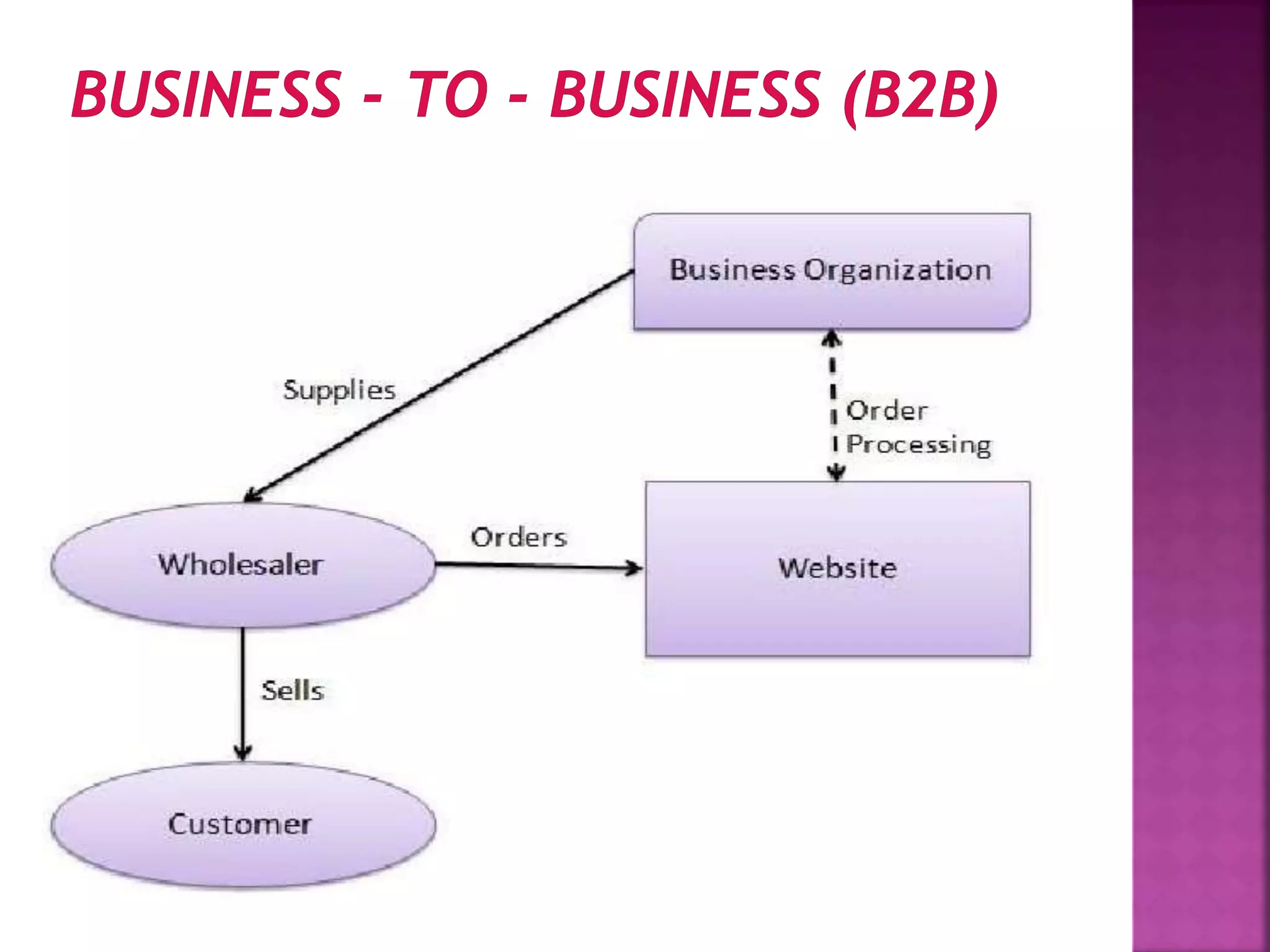
Business - to - Business (B2B)
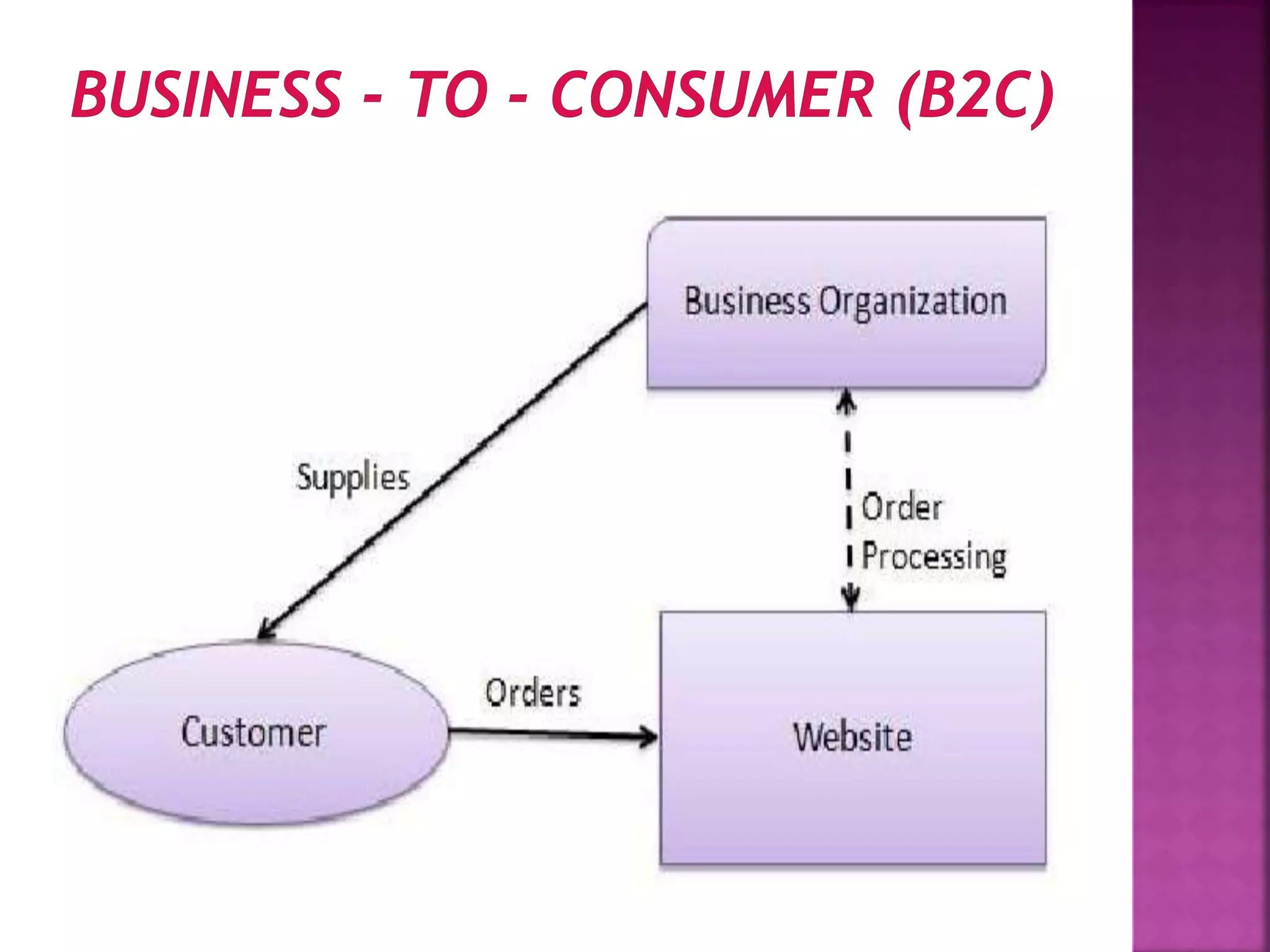
Business - to - Consumer (B2C)
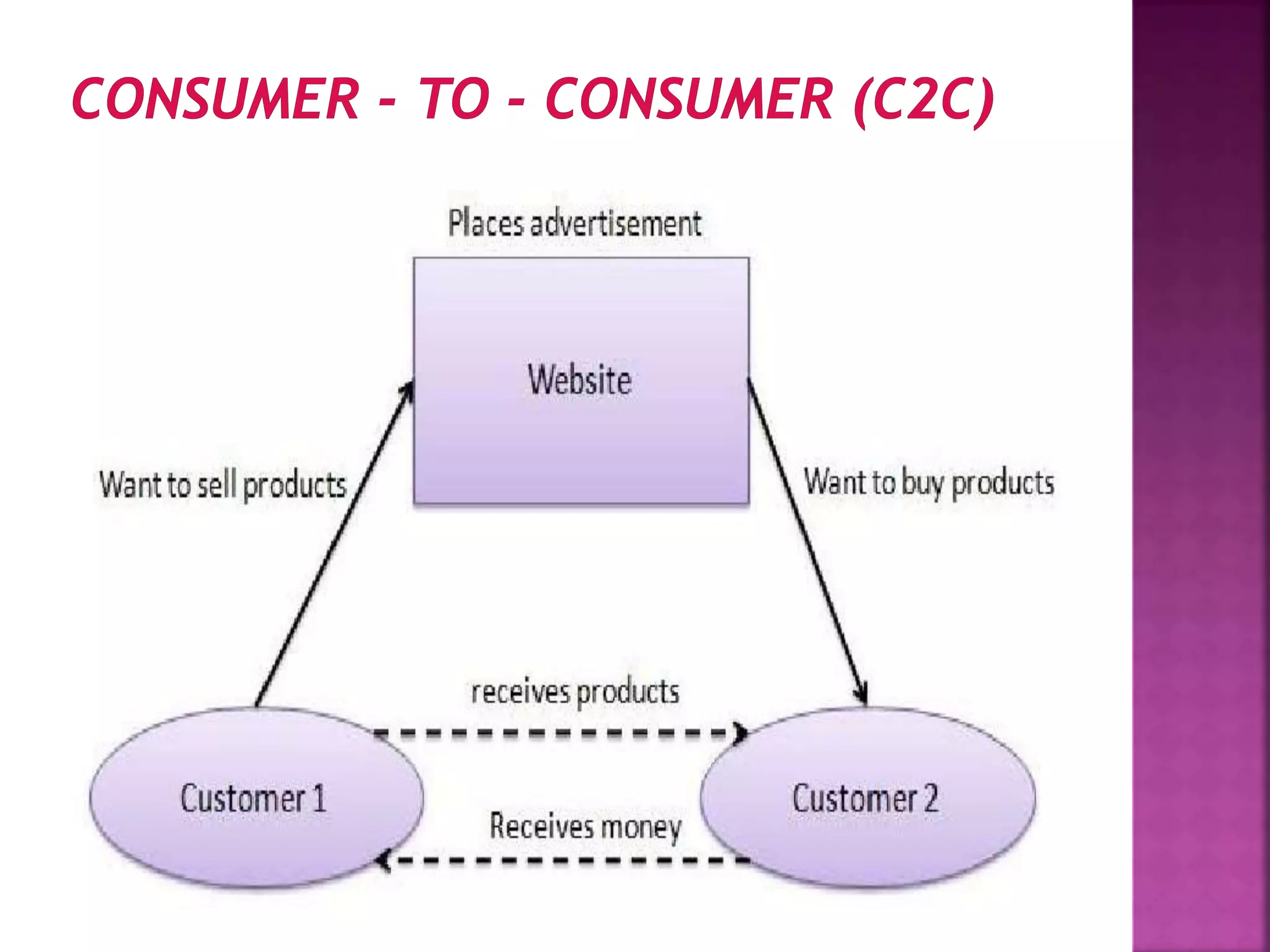
Consumer - to - Consumer (C2C)
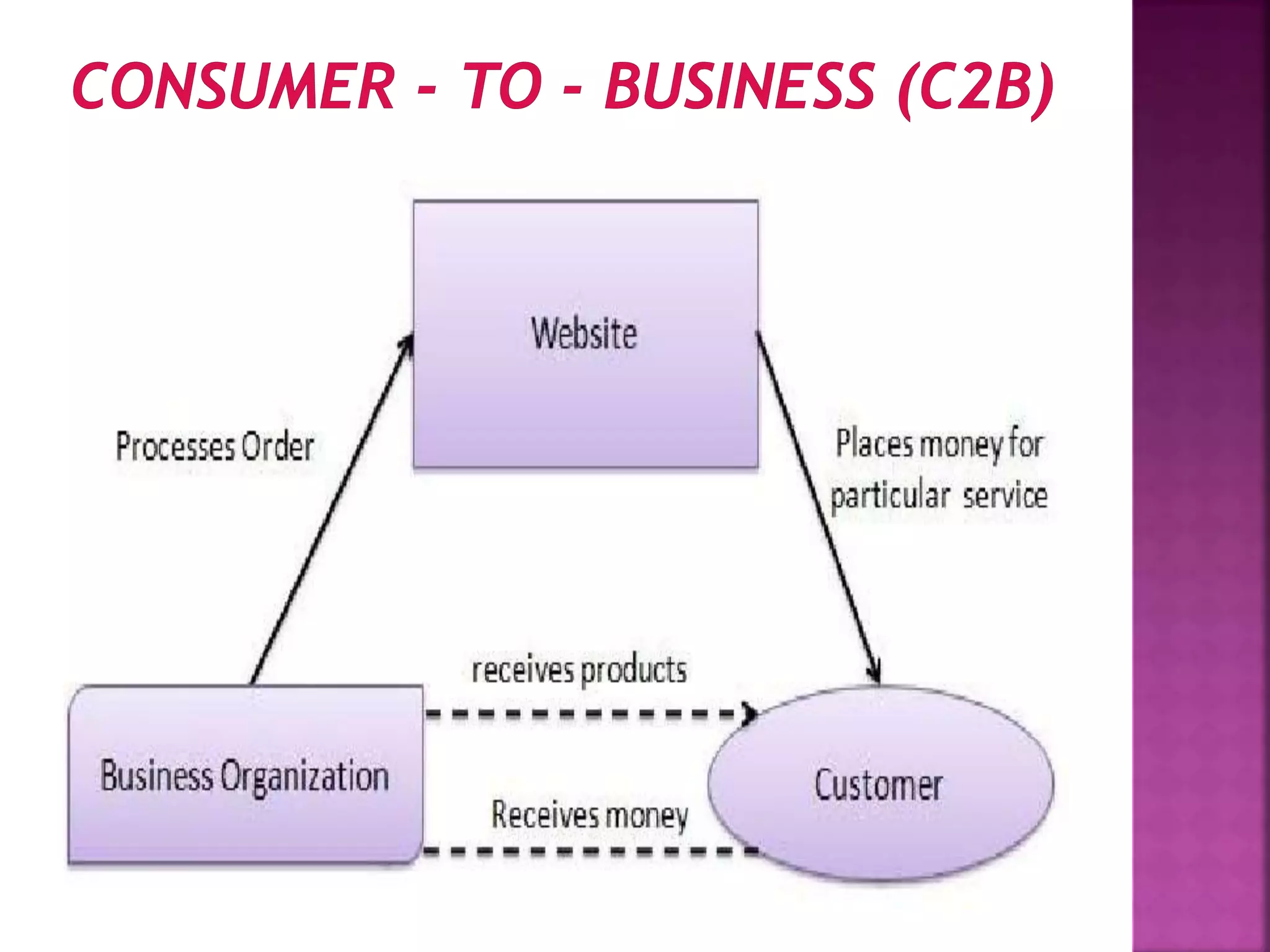
Consumer - to - Business (C2B)
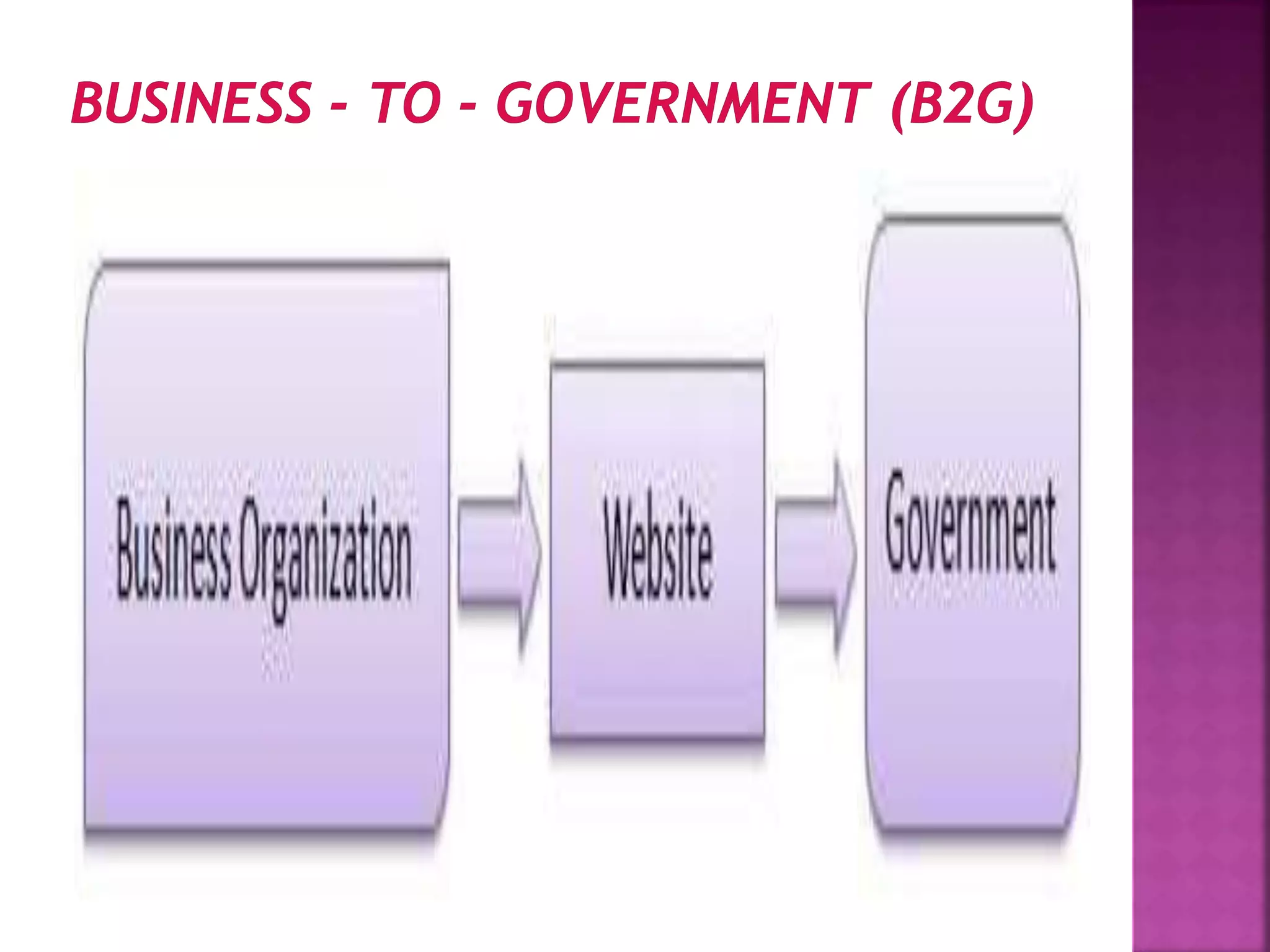
Business - to - Government
(B2G)
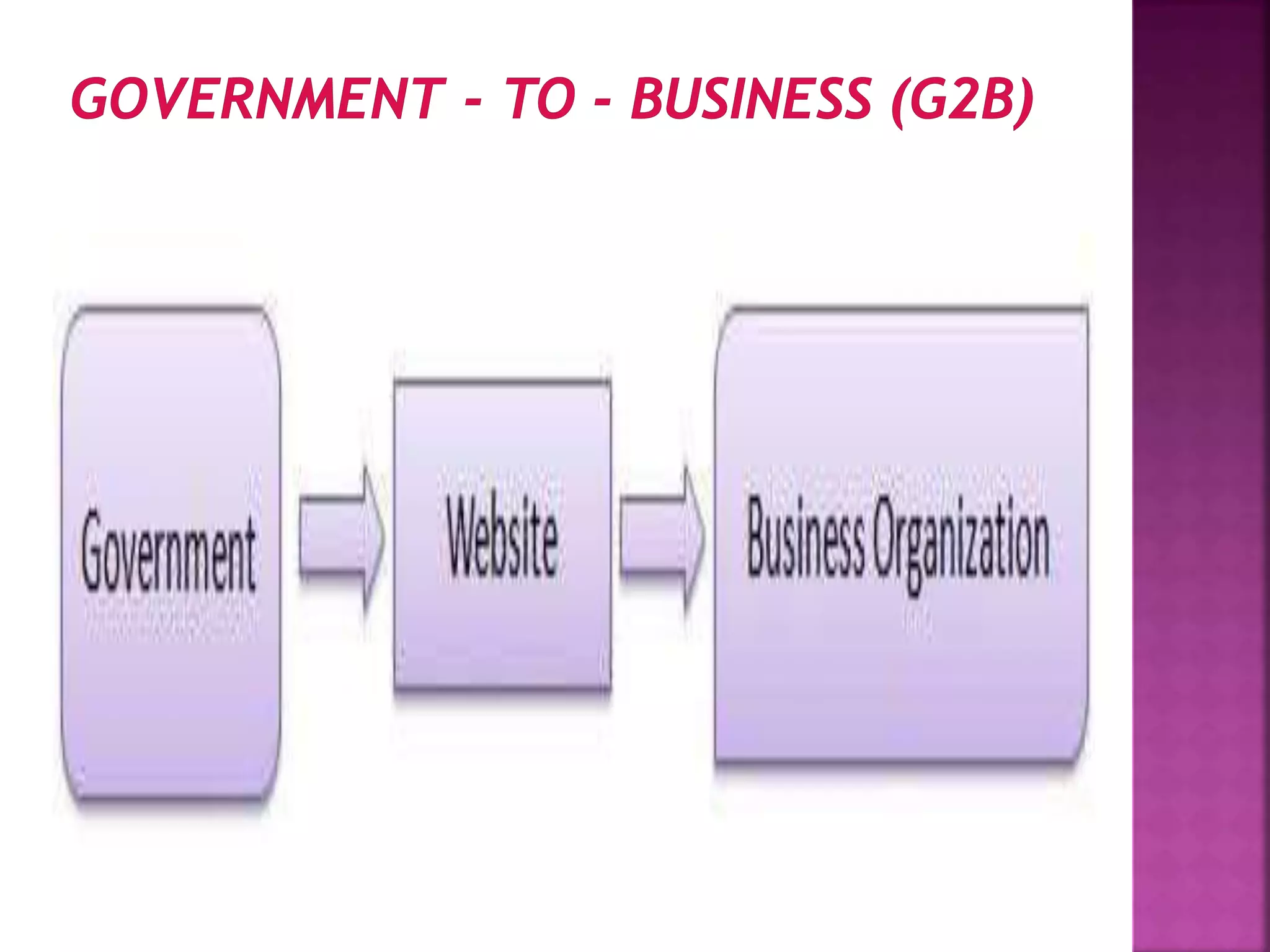
Government - to - Business
(G2B)
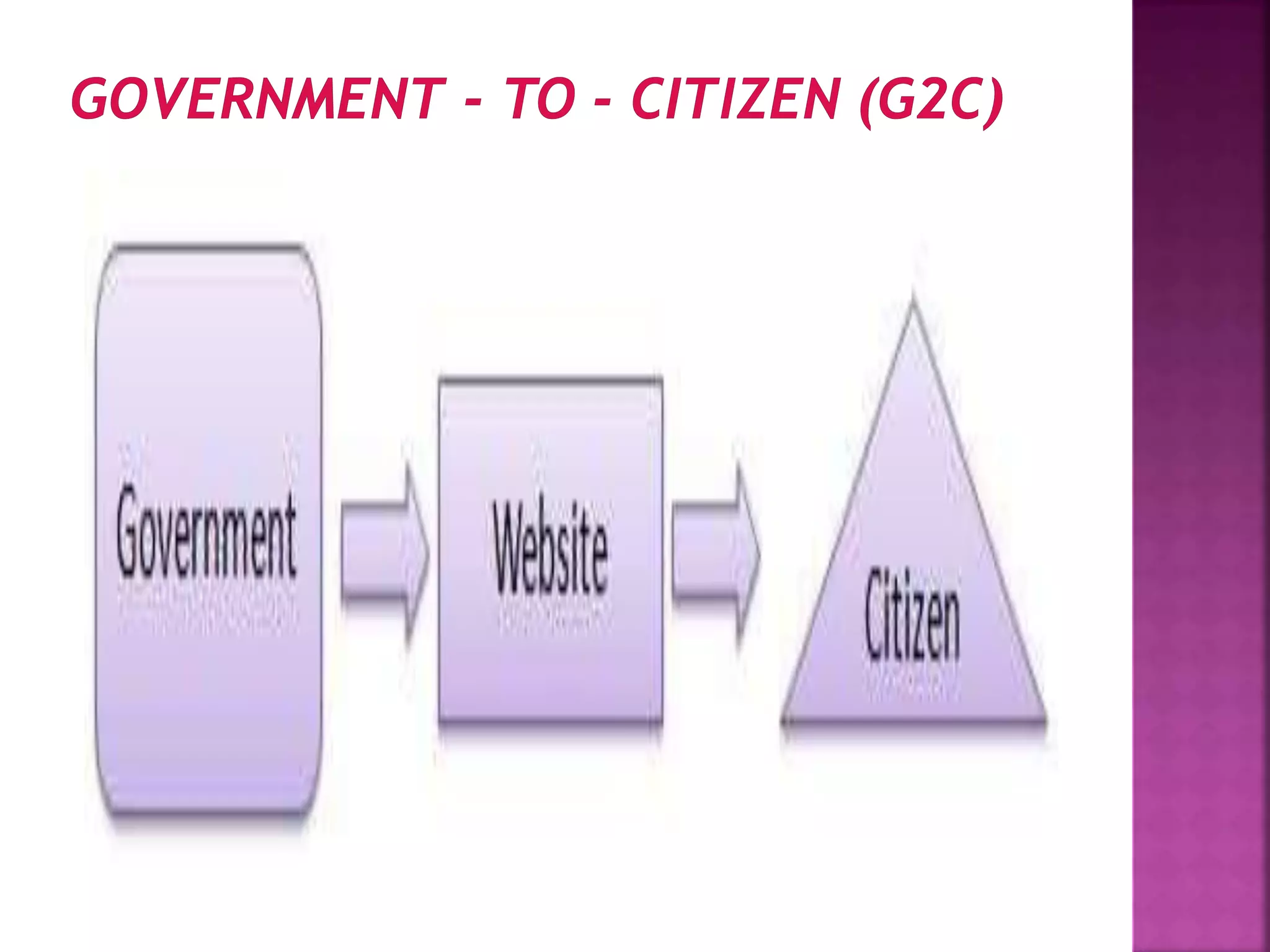
Government - to - Citizen (G2C)
Resources
required for
successful
implementatio
n of
E-Commerce:
Well designed Website
Adequate Computer
Hardware
Adequate Computer
Software
Effective
Telecommunication System
Technically Qualified and
Responsive Workforce
Business Service
Infrastructure
FRAME WORK OF
E – COMMERCE:
Basic Framework
1. The First layer: Network
Infrastructure
2. The Second Layer: Multimedia
Content and Network Publishing
3. The Third layer: Messaging and
Information Dissemination
3 (a) Communicating non-formatted
data:
3 (b) Communicating formatted data:
3 (c) Hyper Text Transfer Protocol
(HTTP):
3 (d) Uniform Resource Locator
(URL):
4. The Fourth layer:
Security Protection in
Business Services
5. The Fifth layer: Practical
Application of E-commerce
The Last Word
ELETRONIC MARKETS :
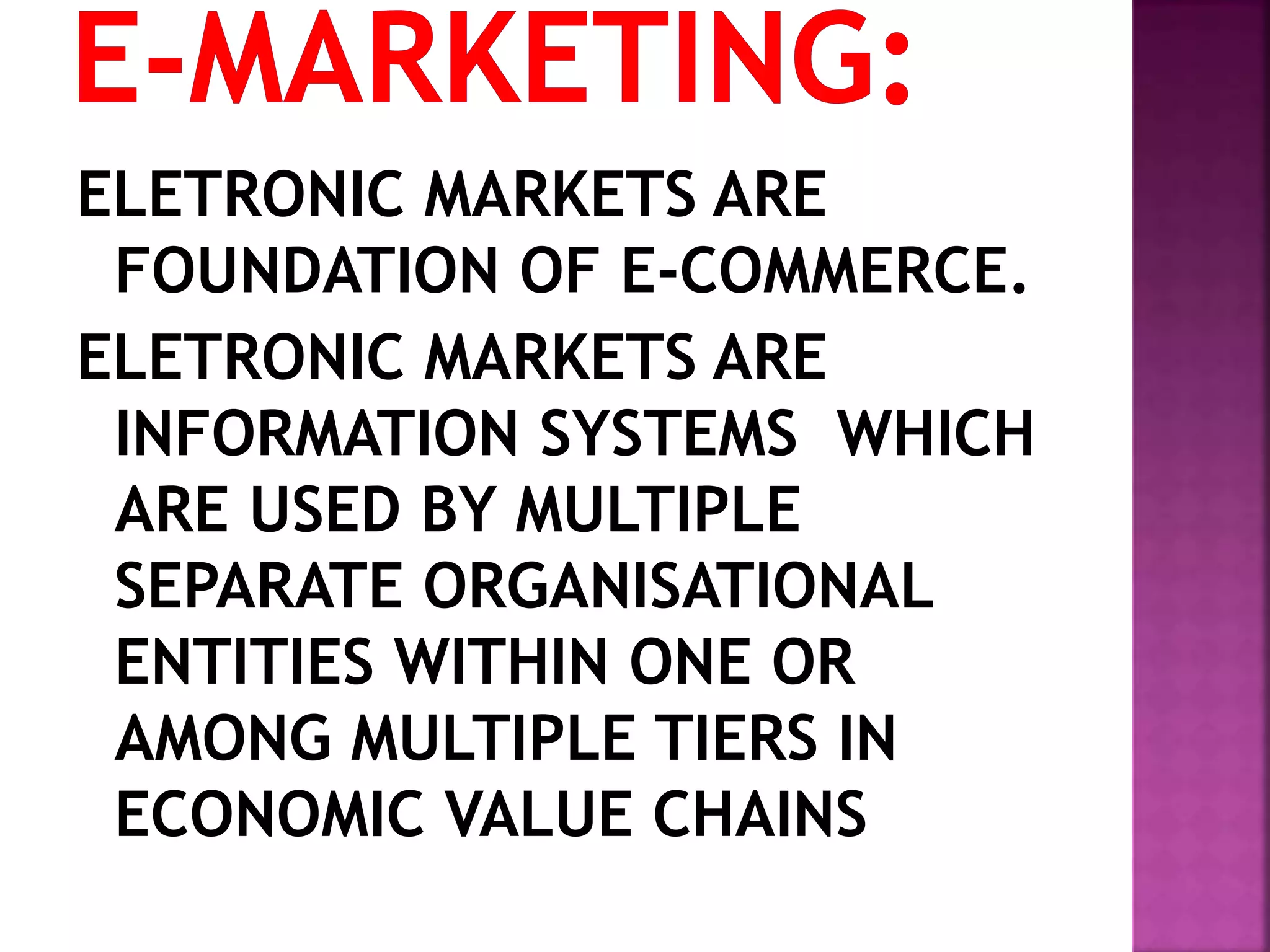
ELETRONIC MARKETS ARE
FOUNDATION OF E-COMMERCE.
ELETRONIC MARKETS ARE
INFORMATION SYSTEMS WHICH
ARE USED BY MULTIPLE
SEPARATE ORGANISATIONAL
ENTITIES WITHIN ONE OR
AMONG MULTIPLE TIERS IN
ECONOMIC VALUE CHAINS
E-MARKETS PROVIDE AN
ELETRONIC, OR ONLINE,
METHOD TO FACILITATE
TRANSACTIONS BETWEEN
BUYERS AND SELLERS THAT
POTENTIALLY PROVIDE
SUPPORT FOR ALL OF THE
STEPS IN THE ENTIRE ORDER
FULLFILLMENT PROCESS.
UNIT-II
THE
INTERNET
The Internet is a
worldwide collection of
networks that links
millions of businesses,
government offices,
educational institutions,
and individuals.
Internet is a
world-wide global
system of
interconnected
computer
networks.
EVOLUTION
OF
INTERNET:
Evolution The concept of Internet
was originated in 1969 and has
undergone several technological
& Infrastructural changes as
discussed below:
The origin of Internet devised
from the concept of Advanced
Research Project Agency Network
(ARPANET).
ARPANET was developed by
United States Department of
Defense.
Basic purpose of ARPANET was
to provide communication
among the various bodies of
government.
Initially, there were only four
nodes, formally called Hosts.
In 1972, the ARPANET spread
over the globe with 23 nodes
located at different countries
and thus became known as
Internet.
SOCIAL
NETWORKING
EDUCATION AND
TECHNONOLOGY
ENTERTAINMENT
ONLINE SERVICES
THREAT TO
PERSONAL
INFORMATION
SPAMMING
CYBER CRIME
VIRUS ATTACKS
INTERNET
FOR
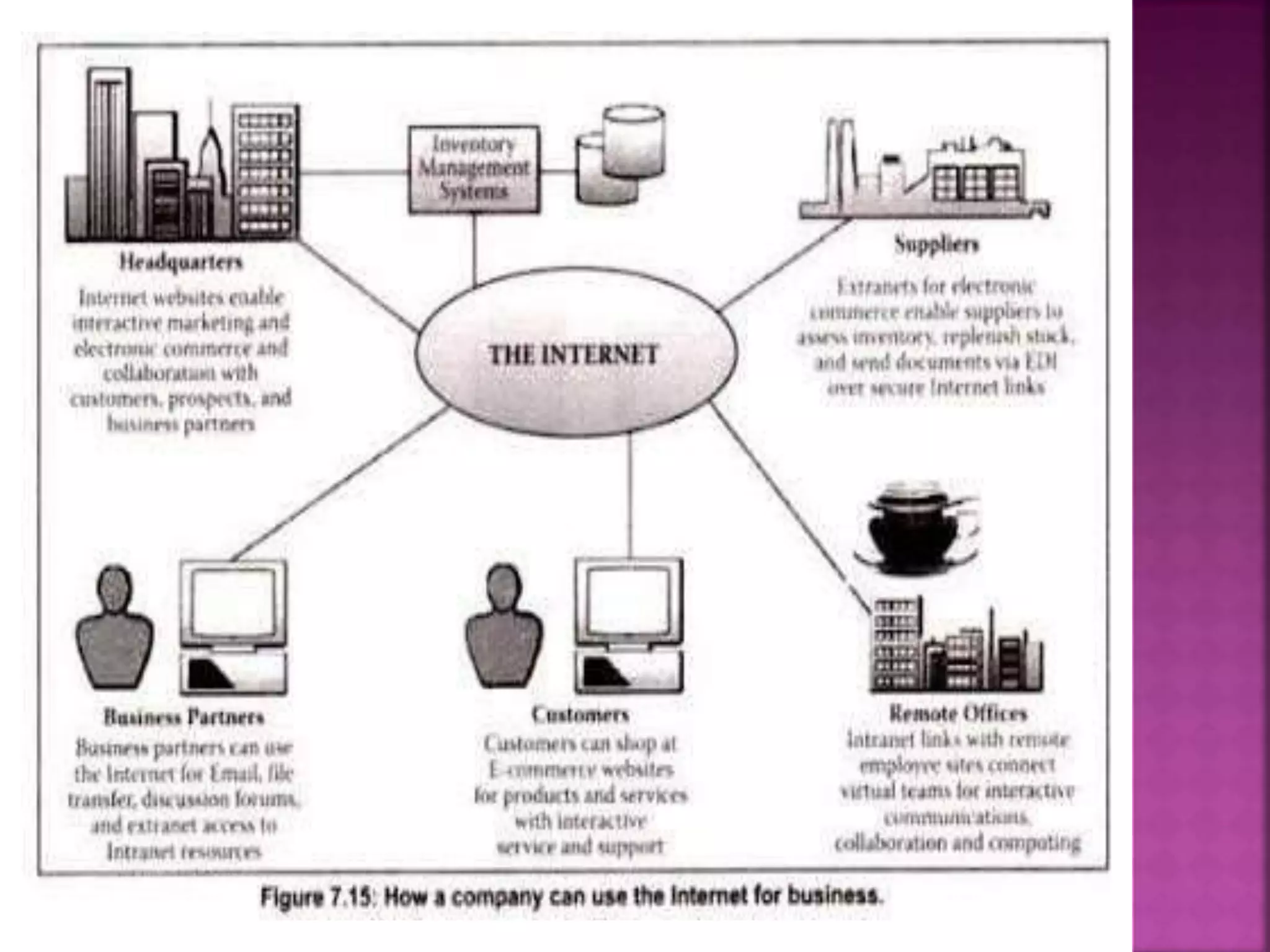
BUSINESS
Internet and the web
together enable companies:
To create a dialog with
customers through:
 Online discussion groups
 Bulletin boards
 Electronic questionnaires
 Mailing Lists
 Newsletters
 E- Mail Exchanges.
TYPES
OF
NETWORKS
Some of the different
networks based on size are:
 Personal area network, or
PAN
 Local area network, or LAN
 Metropolitan area network,
or MAN
 Wide area network, or WAN
 Wireless local area Network
 Campus area Network
INTERNET
SERVICES
Electronic Mail
Telnet
Newsgroup
Internet Relay Chat (IRC)
Mailing Lists
Internet Telephony
Instant Messaging
File Transfer Protocol
(FTP)
Archie
Gopher
Very Easy Rodent Oriented
Netwide Index to Computer
Achieved (VERONICA)
Web services allow exchange
of information between
applications on the web.
Using web services,
applications can easily
interact with each other. The
web services are offered using
concept of Utility Computing.
WWW is also known as W3. It offers
a way to access documents spread
over the several servers over the
internet. These documents may
contain texts, graphics, audio,
video, hyperlinks. The hyperlinks
allow the users to navigate
between the documents.
CONCERNS
ABOUT
INTERNET
1. Robustness
2. Reliability
3. Band Width
4. Security
 Inventor “Tim Berners-Lee” helped found,
the World Wide Web
 WWW stands for World Wide Web. A technical
definition of the World Wide Web is : all the
resources and users on the Internet that are using
the Hypertext Transfer Protocol (HTTP).
 The World Wide Web is the universe of network-
accessible information, an embodiment of human
knowledge.
 In simple terms, The World Wide Web is a way of
exchanging information between computers on the
Internet, tying them together into a vast
collection of interactive multimedia resources.
BUILDING
OF
OWN WEBSITE
E-MARKETING
ELETRONIC MARKETS ARE
FOUNDATION OF E-COMMERCE.
ELETRONIC MARKETS ARE
INFORMATION SYSTEMS WHICH
ARE USED BY MULTIPLE
SEPARATE ORGANISATIONAL
ENTITIES WITHIN ONE OR
AMONG MULTIPLE TIERS IN
ECONOMIC VALUE CHAINS
E-MAIL MARKETING
SERCH ENGINE
OPTIMIZATION (SEO)
PAID ADVERTISMENT
SOCIAL MEDIA
CHANNELS
STEPS INVOLVED IN WEB
ADVERTISING:
1. AD PLANNING
2. CREAT AD SPACE CATALOG
3. SCHEDULE AD SPACE
4. MATERIALIZE AD SPACE
5. MEASURE AD SPACE
6. AD CLOSURE
OR
PROCEDURE OF INTERNET SHOPPING
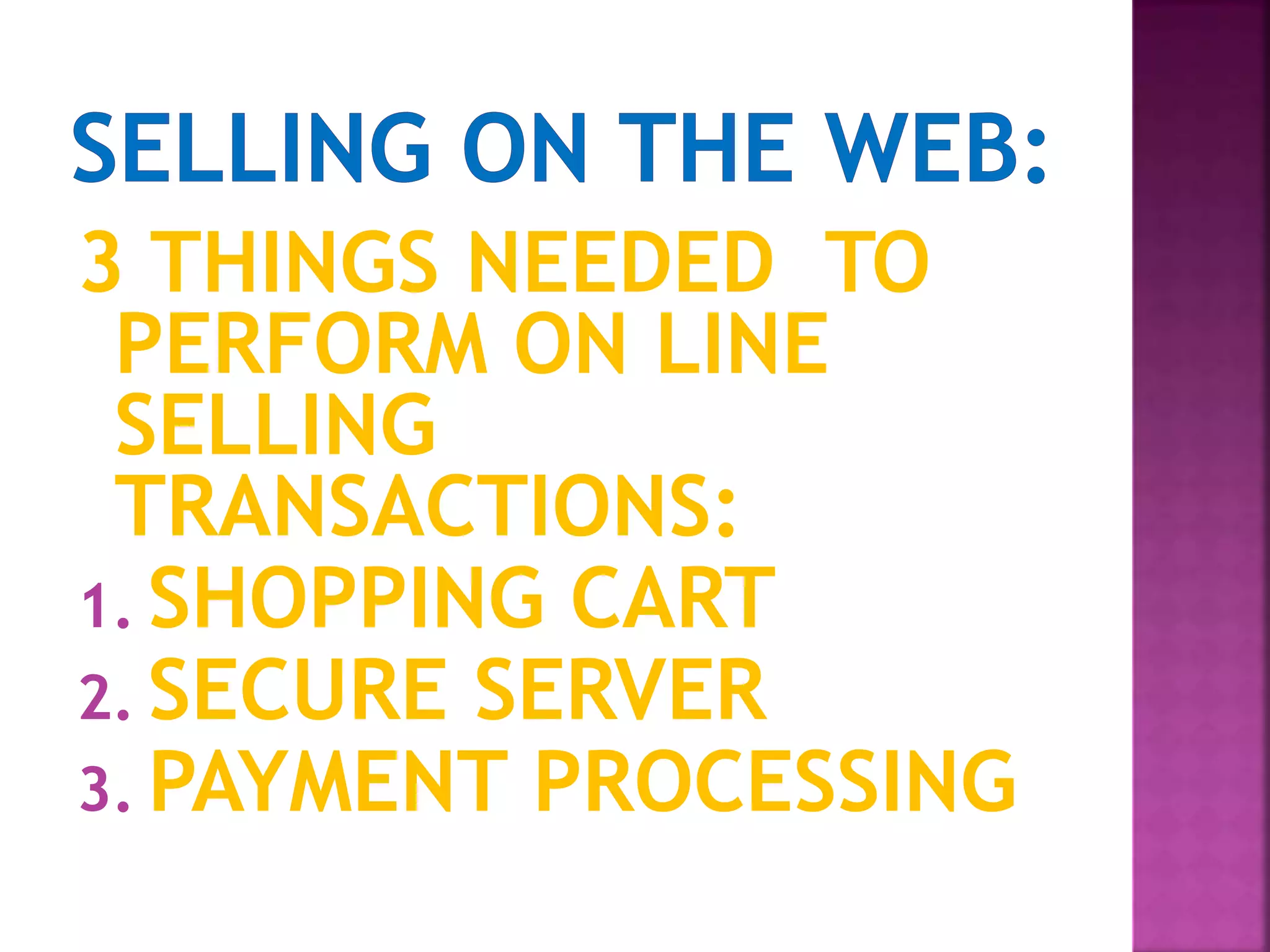
3 THINGS NEEDED TO
PERFORM ON LINE
SELLING
TRANSACTIONS:
1. SHOPPING CART
2. SECURE SERVER
3. PAYMENT PROCESSING
BROKER BASED SERVICES
TRAVEL AND TOURISUM
SERVICE
EMPLOYMENT PLACEMENT
ELEMENT THE JOB MARKET
TRADING STOCK ON LINE
ELETRONIC
PAYMENT
SYSTEM
E.P.S IS THE ALTERNATIVE TO
THE COIN OR PAPER BASED
CASH PAYMENT SYSTEM TO
EASY THE USER TO MAKE
PAYMENT FOR THEIR
PURCHASED GOODS OR
SERVICES OVER THE
NETWORK OR INTERNET
SCHEMES
OF
ELETRONIC
PAYMENT
SYSTEM:
1.A LAYERED
PROTOCAL MODEL
2.PAYMENT
PROTOCAL MODEL
1. A LAYERED PROTOCAL
MODEL
 POLICY
 DATA FLOW
 MECHANISM
2. PAYMENT PROTOCAL
MODEL
 CASH
 CHEQUE
 CARD
A stored-value card is a credit-card-
sized device that is implanted with
a computer chip with stored
money value.
A reloadable stored-value card can
be reused by transferring a money
value to it from an automated
teller machine or other device.
A disposable card cannot be
reloaded.
A METHOD USED TO
TRANSFER FUNDS
OVER THE INTERNET
AS PAYMENT FOR
GOODS AND SERVICES.
ALSO COMMONLY
REFERRED AS E-CASH.
E-SECURITY
(ELETRONIC
SECURITY)
INTERNET SECURTY REFERS TO
SECURING COMMUNICATION
OVER THE INTERNET. IT
INCLUDES THE SPECIFIC
SECURITY PROTOCALS SUCH
AS:
1. INTERNET SECURITY
PROTOCAL (IPSec)
2. SECURE SOCKET LAYER
(S.S.L)
INTERNET PROTOCAL
(IP) IS THE METHOD
OR PROTOCAL BY
WHICH DATA IS SENT
FORM ONE COMPUTER
TO ANOTHER
TCP: TRANSMISSION
CONTROL PROTOCAL
IP: INTERNET
PROTOCAL
UDP:USER DATAGRAME
PROTOCAL
FTP: FILE TRANSFER
PROTOCAL
TFTP: TRIVIEL FILE
TRANSFER PROTOCAL
TELNET:
HTTP:HYPER TEXT
TRANSFER PPROTOCAL
 SET is an open encryption and security
specification designed to protect credit
card transactions on the Internet. The
current version, SETv1, emerged from a
call for security standards by MasterCard
and Visa in February 1996. A wide range of
companies were involved in developing the
initial specification, including IBM,
Microsoft, Netscape, RSA, Terisa, and
Verisign. Beginning in 1996.
SET provides three services:
• Provides a secure
communications channel among
all parties involved in a
transaction
• Provides trust by the use of
X.509v3 digital certificates
• Ensures privacy because the
information is only available to
parties in a transaction when and
where necessary.
The SET specification lists
the following business
requirements for secure
payment processing with
credit cards over the
Internet and other
networks:
Provide confidentiality of
payment and ordering
information
Ensure the integrity of all
transmitted data
Provide authentication that
a cardholder is a legitimate
user of a credit card
account
Provide authentication that a
merchant can accept credit card
transactions through its
relationship with a financial
institution
Create a protocol that neither
depends on transport security
mechanisms nor prevents their
use
Facilitate and encourage
interoperability among software
and network Providers
Confidentiality of
information
Integrity of data
Cardholder account
authentication
Merchant authentication
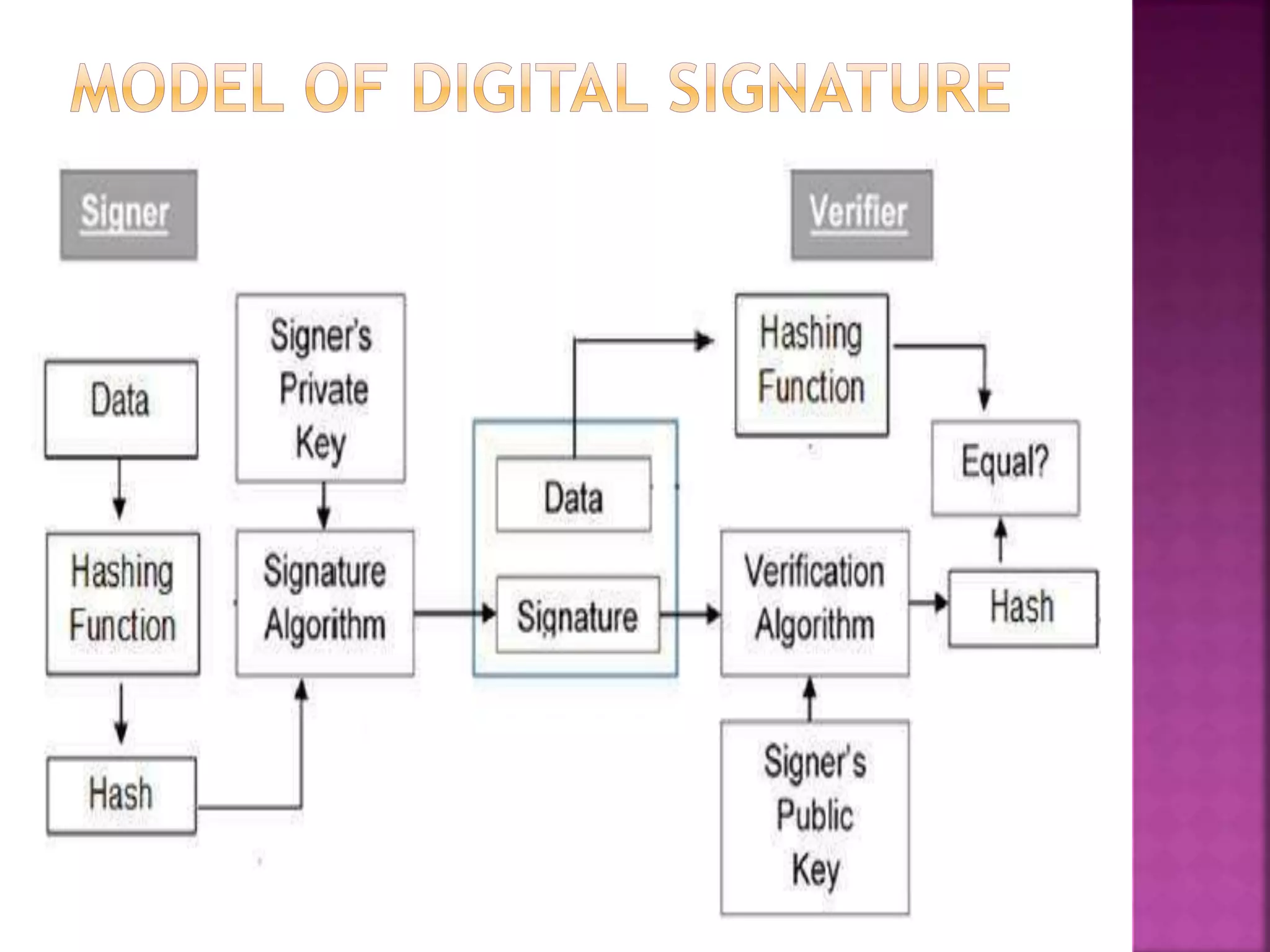
 A digital signature is a mathematical
technique used to validate the
authenticity and integrity of a message,
software or digital document. It's the
digital equivalent of a handwritten
signature or stamped seal, but it offers
far more inherent security. A digital
signature is intended to solve the
problem of tampering and
impersonation in digital
communications.
Digital signatures can
provide evidence of
origin, identity and status
of electronic documents,
transactions or digital
messages. Signers can
also use them to
acknowledge informed
consent.
ENCRIPTION:
Encryption or Data
encryption is a common
and effective security
method—a sound choice
for protecting an
organization’s
information.

Authentication
Privacy
Regulatory
Compliance
Security
Symmetric
Encryption Method
Asymmetric
Encryption Method
Hashing
The ability to allow only authorized users,
programs or processes system or resource access
– The granting or denying, according to a
particular security model, of certain permissions
to access a resource – An entire set of
procedures performed by hardware, software
and administrators, to monitor access, identify
users requesting access, record access attempts,
and grant or deny access based on pre-
established rules. – Access control is the heart of
security.
– Social Networks
– Web Browsers
 – Operating
Systems
– Firewalls
Firewall is a barrier
between Local Area
Network (LAN) and the
Internet.
It allows keeping private
resources confidential and
minimizes the security
risks.
It controls network
traffic, in both
directions.
Both hardware and
the software can be
used at this point to
filter network traffic
There are two types of
Firewall system: One
works by using filters at
the network layer and
 The other works by
using proxy servers at
the user, application, or
network layer.
Firewall management must be
addressed by both system
managers and the network
managers.
The amount of filtering a
firewall varies. For the same
firewall, the amount of
filtering may be different in
different directions

III B.COM E-COMMERCE

  • 1.
  • 2.
    DISTRIBUTION OF GOODS andSERVICESS from PRODUCERS to CONSUMERS called as COMMERCE
  • 3.
    USING OF ELETRONIC DEVICESand NETWORKS in COMMERCIAL TRANSACTIONS CALLED as E-COMMERCE
  • 4.
  • 5.
  • 6.
    “E-COMMERCE DESCRIBE THE BUYINGAND SELLING OF PRODUCTS, SERVICES AND INFORMATION VIA COMPUTER NETWORKS INCLUDING INTERNET”
  • 7.
    “ELETRONIC COMMERCE (EC) ISWHERE BUSINESS TRANSACTIONS TAKE PLACE VIA TELECOMMUNICATIONS NETWORKS, ESPECIALLY THE INTERNET”
  • 8.
    Non-Cash Payment 24X7 SERVICEAVALIBILITY Advertising / Marketing Improved Sales Support Inventory Management Communication improvement
  • 9.
     Global Market Lower Transaction Cost  Higher Margins  24X7 working  Wide Choice  Customer Convenience  Direct Contact between Business and Consumer  Customer Satisfaction
  • 10.
    Security System and DataIntegrity Costs Products People won’t buy Online Corporate vulnerability Web farming
  • 11.
    Problem of customer loyalty Shortageof Talent Fulfillment Problems Returning goods
  • 12.
    Business - to- Business (B2B) Business - to - Consumer (B2C) Consumer - to - Consumer (C2C) Consumer - to - Business (C2B) Business - to - Government (B2G) Government - to - Business (G2B) Government - to - Citizen (G2C)
  • 20.
  • 21.
    Well designed Website AdequateComputer Hardware Adequate Computer Software Effective Telecommunication System Technically Qualified and Responsive Workforce Business Service Infrastructure
  • 22.
    FRAME WORK OF E– COMMERCE:
  • 23.
    Basic Framework 1. TheFirst layer: Network Infrastructure 2. The Second Layer: Multimedia Content and Network Publishing 3. The Third layer: Messaging and Information Dissemination 3 (a) Communicating non-formatted data: 3 (b) Communicating formatted data: 3 (c) Hyper Text Transfer Protocol (HTTP): 3 (d) Uniform Resource Locator (URL):
  • 24.
    4. The Fourthlayer: Security Protection in Business Services 5. The Fifth layer: Practical Application of E-commerce The Last Word
  • 25.
    ELETRONIC MARKETS : ELETRONICMARKETS ARE FOUNDATION OF E-COMMERCE. ELETRONIC MARKETS ARE INFORMATION SYSTEMS WHICH ARE USED BY MULTIPLE SEPARATE ORGANISATIONAL ENTITIES WITHIN ONE OR AMONG MULTIPLE TIERS IN ECONOMIC VALUE CHAINS
  • 26.
    E-MARKETS PROVIDE AN ELETRONIC,OR ONLINE, METHOD TO FACILITATE TRANSACTIONS BETWEEN BUYERS AND SELLERS THAT POTENTIALLY PROVIDE SUPPORT FOR ALL OF THE STEPS IN THE ENTIRE ORDER FULLFILLMENT PROCESS.
  • 27.
  • 28.
    The Internet isa worldwide collection of networks that links millions of businesses, government offices, educational institutions, and individuals.
  • 29.
    Internet is a world-wideglobal system of interconnected computer networks.
  • 30.
  • 31.
    Evolution The conceptof Internet was originated in 1969 and has undergone several technological & Infrastructural changes as discussed below: The origin of Internet devised from the concept of Advanced Research Project Agency Network (ARPANET). ARPANET was developed by United States Department of Defense.
  • 32.
    Basic purpose ofARPANET was to provide communication among the various bodies of government. Initially, there were only four nodes, formally called Hosts. In 1972, the ARPANET spread over the globe with 23 nodes located at different countries and thus became known as Internet.
  • 33.
  • 34.
  • 35.
  • 37.
    Internet and theweb together enable companies: To create a dialog with customers through:  Online discussion groups  Bulletin boards  Electronic questionnaires  Mailing Lists  Newsletters  E- Mail Exchanges.
  • 38.
  • 39.
    Some of thedifferent networks based on size are:  Personal area network, or PAN  Local area network, or LAN  Metropolitan area network, or MAN  Wide area network, or WAN  Wireless local area Network  Campus area Network
  • 40.
  • 42.
    Electronic Mail Telnet Newsgroup Internet RelayChat (IRC) Mailing Lists Internet Telephony Instant Messaging
  • 43.
    File Transfer Protocol (FTP) Archie Gopher VeryEasy Rodent Oriented Netwide Index to Computer Achieved (VERONICA)
  • 44.
    Web services allowexchange of information between applications on the web. Using web services, applications can easily interact with each other. The web services are offered using concept of Utility Computing.
  • 45.
    WWW is alsoknown as W3. It offers a way to access documents spread over the several servers over the internet. These documents may contain texts, graphics, audio, video, hyperlinks. The hyperlinks allow the users to navigate between the documents.
  • 46.
  • 47.
  • 48.
     Inventor “TimBerners-Lee” helped found, the World Wide Web  WWW stands for World Wide Web. A technical definition of the World Wide Web is : all the resources and users on the Internet that are using the Hypertext Transfer Protocol (HTTP).  The World Wide Web is the universe of network- accessible information, an embodiment of human knowledge.  In simple terms, The World Wide Web is a way of exchanging information between computers on the Internet, tying them together into a vast collection of interactive multimedia resources.
  • 49.
  • 52.
  • 53.
    ELETRONIC MARKETS ARE FOUNDATIONOF E-COMMERCE. ELETRONIC MARKETS ARE INFORMATION SYSTEMS WHICH ARE USED BY MULTIPLE SEPARATE ORGANISATIONAL ENTITIES WITHIN ONE OR AMONG MULTIPLE TIERS IN ECONOMIC VALUE CHAINS
  • 54.
    E-MAIL MARKETING SERCH ENGINE OPTIMIZATION(SEO) PAID ADVERTISMENT SOCIAL MEDIA CHANNELS
  • 55.
    STEPS INVOLVED INWEB ADVERTISING: 1. AD PLANNING 2. CREAT AD SPACE CATALOG 3. SCHEDULE AD SPACE 4. MATERIALIZE AD SPACE 5. MEASURE AD SPACE 6. AD CLOSURE
  • 56.
  • 57.
    3 THINGS NEEDEDTO PERFORM ON LINE SELLING TRANSACTIONS: 1. SHOPPING CART 2. SECURE SERVER 3. PAYMENT PROCESSING
  • 58.
    BROKER BASED SERVICES TRAVELAND TOURISUM SERVICE EMPLOYMENT PLACEMENT ELEMENT THE JOB MARKET TRADING STOCK ON LINE
  • 59.
  • 60.
    E.P.S IS THEALTERNATIVE TO THE COIN OR PAPER BASED CASH PAYMENT SYSTEM TO EASY THE USER TO MAKE PAYMENT FOR THEIR PURCHASED GOODS OR SERVICES OVER THE NETWORK OR INTERNET
  • 61.
  • 62.
  • 63.
    1. A LAYEREDPROTOCAL MODEL  POLICY  DATA FLOW  MECHANISM 2. PAYMENT PROTOCAL MODEL  CASH  CHEQUE  CARD
  • 64.
    A stored-value cardis a credit-card- sized device that is implanted with a computer chip with stored money value. A reloadable stored-value card can be reused by transferring a money value to it from an automated teller machine or other device. A disposable card cannot be reloaded.
  • 65.
    A METHOD USEDTO TRANSFER FUNDS OVER THE INTERNET AS PAYMENT FOR GOODS AND SERVICES. ALSO COMMONLY REFERRED AS E-CASH.
  • 66.
  • 67.
    INTERNET SECURTY REFERSTO SECURING COMMUNICATION OVER THE INTERNET. IT INCLUDES THE SPECIFIC SECURITY PROTOCALS SUCH AS: 1. INTERNET SECURITY PROTOCAL (IPSec) 2. SECURE SOCKET LAYER (S.S.L)
  • 68.
    INTERNET PROTOCAL (IP) ISTHE METHOD OR PROTOCAL BY WHICH DATA IS SENT FORM ONE COMPUTER TO ANOTHER
  • 69.
    TCP: TRANSMISSION CONTROL PROTOCAL IP:INTERNET PROTOCAL UDP:USER DATAGRAME PROTOCAL
  • 70.
    FTP: FILE TRANSFER PROTOCAL TFTP:TRIVIEL FILE TRANSFER PROTOCAL TELNET: HTTP:HYPER TEXT TRANSFER PPROTOCAL
  • 71.
     SET isan open encryption and security specification designed to protect credit card transactions on the Internet. The current version, SETv1, emerged from a call for security standards by MasterCard and Visa in February 1996. A wide range of companies were involved in developing the initial specification, including IBM, Microsoft, Netscape, RSA, Terisa, and Verisign. Beginning in 1996.
  • 72.
    SET provides threeservices: • Provides a secure communications channel among all parties involved in a transaction • Provides trust by the use of X.509v3 digital certificates • Ensures privacy because the information is only available to parties in a transaction when and where necessary.
  • 73.
    The SET specificationlists the following business requirements for secure payment processing with credit cards over the Internet and other networks:
  • 74.
    Provide confidentiality of paymentand ordering information Ensure the integrity of all transmitted data Provide authentication that a cardholder is a legitimate user of a credit card account
  • 75.
    Provide authentication thata merchant can accept credit card transactions through its relationship with a financial institution Create a protocol that neither depends on transport security mechanisms nor prevents their use Facilitate and encourage interoperability among software and network Providers
  • 76.
    Confidentiality of information Integrity ofdata Cardholder account authentication Merchant authentication
  • 77.
     A digitalsignature is a mathematical technique used to validate the authenticity and integrity of a message, software or digital document. It's the digital equivalent of a handwritten signature or stamped seal, but it offers far more inherent security. A digital signature is intended to solve the problem of tampering and impersonation in digital communications.
  • 78.
    Digital signatures can provideevidence of origin, identity and status of electronic documents, transactions or digital messages. Signers can also use them to acknowledge informed consent.
  • 83.
    ENCRIPTION: Encryption or Data encryptionis a common and effective security method—a sound choice for protecting an organization’s information.
  • 84.
  • 85.
  • 86.
    The ability toallow only authorized users, programs or processes system or resource access – The granting or denying, according to a particular security model, of certain permissions to access a resource – An entire set of procedures performed by hardware, software and administrators, to monitor access, identify users requesting access, record access attempts, and grant or deny access based on pre- established rules. – Access control is the heart of security.
  • 87.
    – Social Networks –Web Browsers  – Operating Systems – Firewalls
  • 88.
    Firewall is abarrier between Local Area Network (LAN) and the Internet. It allows keeping private resources confidential and minimizes the security risks.
  • 89.
    It controls network traffic,in both directions. Both hardware and the software can be used at this point to filter network traffic
  • 90.
    There are twotypes of Firewall system: One works by using filters at the network layer and  The other works by using proxy servers at the user, application, or network layer.
  • 91.
    Firewall management mustbe addressed by both system managers and the network managers. The amount of filtering a firewall varies. For the same firewall, the amount of filtering may be different in different directions