Salford City College
Eccles Sixth Form Centre
BTEC Extended Diploma in GAMES DESIGN
Unit 73: Sound For Computer Games
IG2 Task 1
1
Produce a glossary of terms specific to the methods and principles of sound design and production. Using a provided template, you must
research and gather definitions specific to provided glossary terms. Any definitions must be referenced with the URL link of the website you
have obtained the definition.
You must also, where possible, provide specific details of how researched definitions relate to your own production practice.
Name: Stuart Preston RESEARCHED DEFINITION (provide short internet researched definition and URL link) DESCRIBE THE
RELEVANCE OF THE
RESEARCHED TERM TO
YOUR OWN
PRODUCTION
PRACTICE?
SOUND DESIGN
METHODOLOGY
Foley Artistry A Foley Artist is a person who creates (or re-creates) sounds for movies. For example, if the sound of
an actor's footsteps were not recorded well or lost when the voice was re-recorded, a Foley artist will
recreate them. In fact, except for dialogue and music, almost all the sounds you hear in Hollywood
films is Foley sound
http://www.mediacollege.com/employment/film/foley-artist.htm
Sound Libraries a collection of sounds stored on file (for example on CDs, DVDs, or as digital audio files)
http://www.collinsdictionary.com/dictionary/english/sound-library
SOUND FILE FORMATS Uncompressed There is one major uncompressed audio format, PCM, which is usually stored in a .wav file on
Windows or in a .aiff file on Mac OS. The AIFF format is based on the Interchange File Format (IFF).
The WAV format is based on the Resource Interchange File Format (RIFF), which is similar to IFF.
WAV and AIFF are flexible file formats designed to store more or less any combination of sampling
rates or bitrates. This makes them suitable file formats for storing and archiving an original recording
http://en.wikipedia.org/wiki/Uncompressed_audio#Uncompressed_audio_format
.wav Waveform Audio File Format (WAVE, or more commonly known as WAV due to its filename
extension) (rarely, Audio for Windows[9]) is a Microsoft and IBM audio file format standard for
storing an audio bitstream on PCs. It is an application of the Resource Interchange File Format (RIFF)
bitstreamformat method for storing data in "chunks", and thus is also close to the 8SVX and the AIFF
format used on Amiga and Macintosh computers, respectively. It is the main format used on
Windows systems for raw and typically uncompressed audio. The usual bitstream encoding is the
Salford City College
Eccles Sixth Form Centre
BTEC Extended Diploma in GAMES DESIGN
Unit 73: Sound For Computer Games
IG2 Task 1
2
linear pulse-code modulation (LPCM) format.
http://en.wikipedia.org/wiki/.wav
.aiff The Advanced Authoring Format (AAF) is a professional file interchange format designed for the
video post production and authoring environment. The AAF was created by the Advanced Media
Workflow Association (AMWA). The AMWA develops specifications and technologies to facilitate the
deployment and operation of efficient media workflows. The AMWA works closely with standards
bodies like the SMPTE
http://en.wikipedia.org/wiki/Advanced_Authoring_Format
.au The Au file format is a simple audio file format introduced by Sun Microsystems. The format was
common on NeXT systems and on early Web pages. Originally it was leaderless, being simply 8-bit µ-
law-encoded data at an 8000 Hz sample rate. Hardware from other vendors often used sample rates
as high as 8192 Hz, often integer factors of video clock signals. Newer files have a header that
consists of six unsigned 32-bit words, an optional information chunk and then the data (in big endian
format).
http://en.wikipedia.org/wiki/Au_file_format
.smp An ".smp" file may be one of several different types of audio file. For example, it could be a
SampleVision audio sample file. This 16-bit audio file was originally used by Turtle Beach
SampleVision; you can open it with Adobe Auction, Sound Forge Pro or Awave Studio. It could also be
a sample file for AdLib Gold, a PC sound card released in 1992; Scream Tracker, a mid-1990s music
editing program; or Swell. Reason, a music recording and production program, uses the ".smp"
extension for sampler instrument patches.
http://www.ehow.com/info_12198596_file-smp.html
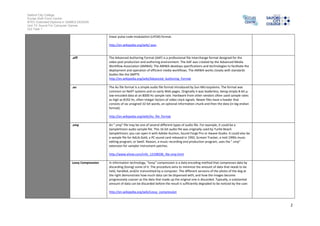
Lossy Compression In information technology, "lossy" compression is a data encoding method that compresses data by
discarding (losing) some of it. The procedure aims to minimize the amount of data that needs to be
held, handled, and/or transmitted by a computer. The different versions of the photo of the dog at
the right demonstrate how much data can be dispensed with, and how the images become
progressively coarser as the data that made up the original one is discarded. Typically, a substantial
amount of data can be discarded before the result is sufficiently degraded to be noticed by the user.
http://en.wikipedia.org/wiki/Lossy_compression
Salford City College
Eccles Sixth Form Centre
BTEC Extended Diploma in GAMES DESIGN
Unit 73: Sound For Computer Games
IG2 Task 1
3
.mp3 MPEG-1 or MPEG-2 Audio Layer III, more commonly referred to as MP3, is an encoding format for
digital audio which uses a form of lossy data compression. It is a common audio format for consumer
audio streaming or storage, as well as a de facto standard of digital audio compression for the
transfer and playback of music on most digital audio players
http://en.wikipedia.org/wiki/.mp3
AUDIO LIMITATIONS Sound Processor Unit
(SPU)
A sound card (also known as an audio card) is an internal computer expansion card that facilitates
the input and output of audio signals to and from a computer under control of computer programs.
The term sound card is also applied to external audio interfaces that use software to generate sound,
as opposed to using hardware inside the PC. Typical uses of sound cards include providing the audio
component for multimedia applications such as music composition, editing video or audio,
presentation, education and entertainment (games) and video projection.
http://en.wikipedia.org/wiki/Sound_processing_unit
Digital Sound
Processor (DSP)
Digital sound processing means that the sound is represented and processed mathematically. Sound
is encoded as a series of numbers that measure its pitch and volume at a given instant in time. ...
https://www.google.co.uk/#q=define+digital+sound+processing
Random Access
Memory (RAM)
RAM (pronounced ramm) is an acronym for random access memory, a type of computer memory
that can be accessed randomly; that is, any byte of memory can be accessed without touching the
preceding bytes. RAM is the most common type of memory found in computers and other devices,
such as printers
http://www.webopedia.com/TERM/R/RAM.html
Mono Audio Designating sound transmission or recording or reproduction over a single channel
http://www.audioenglish.org/dictionary/mono.htm
Stereo Audio Stereophonic sound or, more commonly, stereo, is a method of sound reproduction that creates an
illusion of directionality and audible perspective. This is usually achieved by using two or more
independent audio channels through a configuration of two or more loudspeakers (or stereo
headphones)in such a way as to create the impression of sound heard from various directions, as in
natural hearing.[1] Thus the term "stereophonic" applies to so-called "quadraphonic" and "surround-
sound" systems as well as the more common two-channel, two-speaker systems. It is often
contrasted with monophonic, or "mono" sound, where audio is in the form of one channel, often
centered in the sound field (analogous to a visual field). Stereo sound is now common in
entertainment systems such as broadcast radio and TV, recorded music and the cinema.
Salford City College
Eccles Sixth Form Centre
BTEC Extended Diploma in GAMES DESIGN
Unit 73: Sound For Computer Games
IG2 Task 1
4
http://en.wikipedia.org/wiki/Stereo_audio
Surround Sound Surround sound is a technique for enriching the sound reproduction quality of an audio source with
additional audio channels from speakers that surround the listener (surround channels), providing
sound from a 360° radius in the horizontal plane (2D) as opposed to "screen channels" (centre,
[front] left, and [front] right) originating only from the listener's forward arc.
Surround sound is characterized by a listener location or sweet spot where the audio effects work
best, and presents a fixed or forward perspective of the sound field to the listener at this location.
The technique enhances the perception of sound spatialization by exploiting sound localization; a
listener's ability to identify the location or origin of a detected sound in direction and distance.
Typically this is achieved by using multiple discrete audio channels routed to an array of
loudspeakers.
http://en.wikipedia.org/wiki/Surround_sound
Direct Audio (Pulse
Code Modulation –
PCM)
PCM audio or pulse code modulation audio is a high fidelity and uncompressed digital sampling
technique of an analogue audio signal. PCM is a technique used to represent sampled analogue
signals in digital form.
http://uk.ask.com/question/what-is-pcm-audio
AUDIO RECORDING
SYSTEMS
Analogue Relating to or using signals or information represented by a continuously variable physical quantity
such as spatial position, voltage, etc.: ‘analogue signals’ ‘the information on a gramophone record is
analogue’ Often contrasted with digital
http://www.oxforddictionaries.com/definition/english/analogue
Digital Mini Disc The MiniDisc (MD) is an obsolete magneto-optical disc-based data storage device for 74 minutes and,
later, 80 minutes, of digitized audio or 1 gigabyte of Hi-MD data. The Sony brand audio players were
on the market from September 1992 until March 2013.
http://en.wikipedia.org/wiki/MiniDisc
Compact Disc (CD) a small plastic disc on which music or other digital information is stored in the form of a pattern of
metal-coated pits from which it can be read using laser light reflected off the disc.
https://www.google.co.uk/search?q=define+digtal+media+disk&sourceid=ie7&rls=com.microsoft:en-
us:IE-Address&ie=&oe=&gfe_rd=cr&ei=X2w-
U8a4JILR8gfZ7oGYCA#q=define+compact+disk&rls=com.microsoft:en-us:IE-Address
Digital Audio Tape
(DAT)
Digital Audio Tape (DAT or R-DAT) is a signal recording and playback medium developed by Sony and
introduced in 1987.[1] In appearance it is similar to a Compact Cassette, using 4 mm magnetic tape
Salford City College
Eccles Sixth Form Centre
BTEC Extended Diploma in GAMES DESIGN
Unit 73: Sound For Computer Games
IG2 Task 1
5
enclosed in a protective shell, but is roughly half the size at 73 mm × 54 mm × 10.5 mm. As the name
suggests, the recording is digital rather than analog. DAT has the ability to record at higher, equal or
lower sampling rates than a CD (48, 44.1 or 32 kHz sampling rate respectively) at 16 bits quantization.
If a digital source is copied then the DAT will produce an exact clone, unlike other digital media such
as Digital Compact Cassette or non-Hi-MD MiniDisc, both of which use a lossy data reduction system.
http://en.wikipedia.org/wiki/Digital_Audio_Tape
MIDI MIDI (/ˈmɪdi/; short for Musical Instrument Digital Interface) is a technical standard that describes a
protocol, digital interface and connectors and allows a wide variety of electronic musical
instruments, computers and other related devices to connect and communicate with one another.[1]
A single MIDI link can carry up to sixteen channels of information, each of which can be routed to a
separate device.
http://en.wikipedia.org/wiki/MIDI
Software Sequencers A sequencing software package designed to be loaded into a computer. Software sequencers usually
have more features and have the advantage of showing you a lot more information at once because
they use the computer's screen and aren't locked into the knobs or buttons or display of a hardware
se
http://www.wannaplaymusic.com/get-started/keyboard-terminology
Software Plug-ins All 3 of these categories are sometimes referred to as "plugins". They are called that because these
are little computer applications that run inside a "host" application, i.e., a sequencer, typically. These
plugin devices are very important, as they have led the software revolution towards our virtual
studios which is changing all recording studios, both home and pro. Today there are few hardware
devices left that cannot be emulated by plugins and software. As you see from this page, software
based synthesizers, effects processors, samplers and multi-track recorders can all work together on
one single computer.
http://tweakheadz.com/software-plugins/
MIDI Keyboard
Instruments
A MIDI keyboard is typically a piano-style user interface keyboard device used for sending MIDI
signals or commands over a USB or MIDI cable to other devices connected and operating on the
same MIDI protocol interface. This could also be a personal computer running software such as a
digital audio workstation (DAW) that listens to and sends MIDI information to other MIDI devices
connected by cable or running internal to the personal computer system. The basic MIDI keyboard
does not produce sound. Instead, MIDI information is sent to an electronic module capable of
reproducing an array of digital sounds or samples that resemble traditional analog musical
instruments. These samples or waveforms are also referred to as voices or timbres.
http://en.wikipedia.org/wiki/MIDI_keyboard
Salford City College
Eccles Sixth Form Centre
BTEC Extended Diploma in GAMES DESIGN
Unit 73: Sound For Computer Games
IG2 Task 1
6
AUDIO SAMPLING File Size Constraints -
Bit-depth
In digital audio using pulse-code modulation (PCM), bit depth is the number of bits of information in
each sample, and it directly corresponds to the resolution of each sample. Examples of bit depth
include Compact Disc Digital Audio, which uses 16 bits per sample, and DVD-Audio and Blu-ray Disc
which can support up to 24 bits per sample.
In basic implementations, variations in bit depth primarily affect the noise level from quantization
error—thus the signal-to-noise ratio (SNR) and dynamic range. However, techniques such as
dithering, noise shaping and oversampling mitigate these effects without changing the bit depth. Bit
depth also affects bit rate and file size.
Bit depth is only meaningful in reference to a PCM digital signal. Non-PCM formats, such as lossy
compression formats like MP3, AAC and Vorbis, do not have associated bit depths. For example, in
MP3, quantization is performed on PCM samples that have been transformed into the frequency
domain.
http://en.wikipedia.org/wiki/Audio_bit_depth
File Size Constraints -
Sample Rate
n signal processing, sampling is the reduction of a continuous signal to a discrete signal. A common
example is the conversion of a sound wave (a continuous signal) to a sequence of samples (a
discrete-time signal).
A sample refers to a value or set of values at a point in time and/or space.
A sampler is a subsystem or operation that extracts samples from a continuous signal.
A theoretical ideal sampler produces samples equivalent to the instantaneous value of the
continuous signal at the desired points.
http://en.wikipedia.org/wiki/Sampling_(signal_processing)

Ig2 task 1 work sheet

  • 1.
    Salford City College EcclesSixth Form Centre BTEC Extended Diploma in GAMES DESIGN Unit 73: Sound For Computer Games IG2 Task 1 1 Produce a glossary of terms specific to the methods and principles of sound design and production. Using a provided template, you must research and gather definitions specific to provided glossary terms. Any definitions must be referenced with the URL link of the website you have obtained the definition. You must also, where possible, provide specific details of how researched definitions relate to your own production practice. Name: Stuart Preston RESEARCHED DEFINITION (provide short internet researched definition and URL link) DESCRIBE THE RELEVANCE OF THE RESEARCHED TERM TO YOUR OWN PRODUCTION PRACTICE? SOUND DESIGN METHODOLOGY Foley Artistry A Foley Artist is a person who creates (or re-creates) sounds for movies. For example, if the sound of an actor's footsteps were not recorded well or lost when the voice was re-recorded, a Foley artist will recreate them. In fact, except for dialogue and music, almost all the sounds you hear in Hollywood films is Foley sound http://www.mediacollege.com/employment/film/foley-artist.htm Sound Libraries a collection of sounds stored on file (for example on CDs, DVDs, or as digital audio files) http://www.collinsdictionary.com/dictionary/english/sound-library SOUND FILE FORMATS Uncompressed There is one major uncompressed audio format, PCM, which is usually stored in a .wav file on Windows or in a .aiff file on Mac OS. The AIFF format is based on the Interchange File Format (IFF). The WAV format is based on the Resource Interchange File Format (RIFF), which is similar to IFF. WAV and AIFF are flexible file formats designed to store more or less any combination of sampling rates or bitrates. This makes them suitable file formats for storing and archiving an original recording http://en.wikipedia.org/wiki/Uncompressed_audio#Uncompressed_audio_format .wav Waveform Audio File Format (WAVE, or more commonly known as WAV due to its filename extension) (rarely, Audio for Windows[9]) is a Microsoft and IBM audio file format standard for storing an audio bitstream on PCs. It is an application of the Resource Interchange File Format (RIFF) bitstreamformat method for storing data in "chunks", and thus is also close to the 8SVX and the AIFF format used on Amiga and Macintosh computers, respectively. It is the main format used on Windows systems for raw and typically uncompressed audio. The usual bitstream encoding is the
  • 2.
    Salford City College EcclesSixth Form Centre BTEC Extended Diploma in GAMES DESIGN Unit 73: Sound For Computer Games IG2 Task 1 2 linear pulse-code modulation (LPCM) format. http://en.wikipedia.org/wiki/.wav .aiff The Advanced Authoring Format (AAF) is a professional file interchange format designed for the video post production and authoring environment. The AAF was created by the Advanced Media Workflow Association (AMWA). The AMWA develops specifications and technologies to facilitate the deployment and operation of efficient media workflows. The AMWA works closely with standards bodies like the SMPTE http://en.wikipedia.org/wiki/Advanced_Authoring_Format .au The Au file format is a simple audio file format introduced by Sun Microsystems. The format was common on NeXT systems and on early Web pages. Originally it was leaderless, being simply 8-bit µ- law-encoded data at an 8000 Hz sample rate. Hardware from other vendors often used sample rates as high as 8192 Hz, often integer factors of video clock signals. Newer files have a header that consists of six unsigned 32-bit words, an optional information chunk and then the data (in big endian format). http://en.wikipedia.org/wiki/Au_file_format .smp An ".smp" file may be one of several different types of audio file. For example, it could be a SampleVision audio sample file. This 16-bit audio file was originally used by Turtle Beach SampleVision; you can open it with Adobe Auction, Sound Forge Pro or Awave Studio. It could also be a sample file for AdLib Gold, a PC sound card released in 1992; Scream Tracker, a mid-1990s music editing program; or Swell. Reason, a music recording and production program, uses the ".smp" extension for sampler instrument patches. http://www.ehow.com/info_12198596_file-smp.html Lossy Compression In information technology, "lossy" compression is a data encoding method that compresses data by discarding (losing) some of it. The procedure aims to minimize the amount of data that needs to be held, handled, and/or transmitted by a computer. The different versions of the photo of the dog at the right demonstrate how much data can be dispensed with, and how the images become progressively coarser as the data that made up the original one is discarded. Typically, a substantial amount of data can be discarded before the result is sufficiently degraded to be noticed by the user. http://en.wikipedia.org/wiki/Lossy_compression
  • 3.
    Salford City College EcclesSixth Form Centre BTEC Extended Diploma in GAMES DESIGN Unit 73: Sound For Computer Games IG2 Task 1 3 .mp3 MPEG-1 or MPEG-2 Audio Layer III, more commonly referred to as MP3, is an encoding format for digital audio which uses a form of lossy data compression. It is a common audio format for consumer audio streaming or storage, as well as a de facto standard of digital audio compression for the transfer and playback of music on most digital audio players http://en.wikipedia.org/wiki/.mp3 AUDIO LIMITATIONS Sound Processor Unit (SPU) A sound card (also known as an audio card) is an internal computer expansion card that facilitates the input and output of audio signals to and from a computer under control of computer programs. The term sound card is also applied to external audio interfaces that use software to generate sound, as opposed to using hardware inside the PC. Typical uses of sound cards include providing the audio component for multimedia applications such as music composition, editing video or audio, presentation, education and entertainment (games) and video projection. http://en.wikipedia.org/wiki/Sound_processing_unit Digital Sound Processor (DSP) Digital sound processing means that the sound is represented and processed mathematically. Sound is encoded as a series of numbers that measure its pitch and volume at a given instant in time. ... https://www.google.co.uk/#q=define+digital+sound+processing Random Access Memory (RAM) RAM (pronounced ramm) is an acronym for random access memory, a type of computer memory that can be accessed randomly; that is, any byte of memory can be accessed without touching the preceding bytes. RAM is the most common type of memory found in computers and other devices, such as printers http://www.webopedia.com/TERM/R/RAM.html Mono Audio Designating sound transmission or recording or reproduction over a single channel http://www.audioenglish.org/dictionary/mono.htm Stereo Audio Stereophonic sound or, more commonly, stereo, is a method of sound reproduction that creates an illusion of directionality and audible perspective. This is usually achieved by using two or more independent audio channels through a configuration of two or more loudspeakers (or stereo headphones)in such a way as to create the impression of sound heard from various directions, as in natural hearing.[1] Thus the term "stereophonic" applies to so-called "quadraphonic" and "surround- sound" systems as well as the more common two-channel, two-speaker systems. It is often contrasted with monophonic, or "mono" sound, where audio is in the form of one channel, often centered in the sound field (analogous to a visual field). Stereo sound is now common in entertainment systems such as broadcast radio and TV, recorded music and the cinema.
  • 4.
    Salford City College EcclesSixth Form Centre BTEC Extended Diploma in GAMES DESIGN Unit 73: Sound For Computer Games IG2 Task 1 4 http://en.wikipedia.org/wiki/Stereo_audio Surround Sound Surround sound is a technique for enriching the sound reproduction quality of an audio source with additional audio channels from speakers that surround the listener (surround channels), providing sound from a 360° radius in the horizontal plane (2D) as opposed to "screen channels" (centre, [front] left, and [front] right) originating only from the listener's forward arc. Surround sound is characterized by a listener location or sweet spot where the audio effects work best, and presents a fixed or forward perspective of the sound field to the listener at this location. The technique enhances the perception of sound spatialization by exploiting sound localization; a listener's ability to identify the location or origin of a detected sound in direction and distance. Typically this is achieved by using multiple discrete audio channels routed to an array of loudspeakers. http://en.wikipedia.org/wiki/Surround_sound Direct Audio (Pulse Code Modulation – PCM) PCM audio or pulse code modulation audio is a high fidelity and uncompressed digital sampling technique of an analogue audio signal. PCM is a technique used to represent sampled analogue signals in digital form. http://uk.ask.com/question/what-is-pcm-audio AUDIO RECORDING SYSTEMS Analogue Relating to or using signals or information represented by a continuously variable physical quantity such as spatial position, voltage, etc.: ‘analogue signals’ ‘the information on a gramophone record is analogue’ Often contrasted with digital http://www.oxforddictionaries.com/definition/english/analogue Digital Mini Disc The MiniDisc (MD) is an obsolete magneto-optical disc-based data storage device for 74 minutes and, later, 80 minutes, of digitized audio or 1 gigabyte of Hi-MD data. The Sony brand audio players were on the market from September 1992 until March 2013. http://en.wikipedia.org/wiki/MiniDisc Compact Disc (CD) a small plastic disc on which music or other digital information is stored in the form of a pattern of metal-coated pits from which it can be read using laser light reflected off the disc. https://www.google.co.uk/search?q=define+digtal+media+disk&sourceid=ie7&rls=com.microsoft:en- us:IE-Address&ie=&oe=&gfe_rd=cr&ei=X2w- U8a4JILR8gfZ7oGYCA#q=define+compact+disk&rls=com.microsoft:en-us:IE-Address Digital Audio Tape (DAT) Digital Audio Tape (DAT or R-DAT) is a signal recording and playback medium developed by Sony and introduced in 1987.[1] In appearance it is similar to a Compact Cassette, using 4 mm magnetic tape
  • 5.
    Salford City College EcclesSixth Form Centre BTEC Extended Diploma in GAMES DESIGN Unit 73: Sound For Computer Games IG2 Task 1 5 enclosed in a protective shell, but is roughly half the size at 73 mm × 54 mm × 10.5 mm. As the name suggests, the recording is digital rather than analog. DAT has the ability to record at higher, equal or lower sampling rates than a CD (48, 44.1 or 32 kHz sampling rate respectively) at 16 bits quantization. If a digital source is copied then the DAT will produce an exact clone, unlike other digital media such as Digital Compact Cassette or non-Hi-MD MiniDisc, both of which use a lossy data reduction system. http://en.wikipedia.org/wiki/Digital_Audio_Tape MIDI MIDI (/ˈmɪdi/; short for Musical Instrument Digital Interface) is a technical standard that describes a protocol, digital interface and connectors and allows a wide variety of electronic musical instruments, computers and other related devices to connect and communicate with one another.[1] A single MIDI link can carry up to sixteen channels of information, each of which can be routed to a separate device. http://en.wikipedia.org/wiki/MIDI Software Sequencers A sequencing software package designed to be loaded into a computer. Software sequencers usually have more features and have the advantage of showing you a lot more information at once because they use the computer's screen and aren't locked into the knobs or buttons or display of a hardware se http://www.wannaplaymusic.com/get-started/keyboard-terminology Software Plug-ins All 3 of these categories are sometimes referred to as "plugins". They are called that because these are little computer applications that run inside a "host" application, i.e., a sequencer, typically. These plugin devices are very important, as they have led the software revolution towards our virtual studios which is changing all recording studios, both home and pro. Today there are few hardware devices left that cannot be emulated by plugins and software. As you see from this page, software based synthesizers, effects processors, samplers and multi-track recorders can all work together on one single computer. http://tweakheadz.com/software-plugins/ MIDI Keyboard Instruments A MIDI keyboard is typically a piano-style user interface keyboard device used for sending MIDI signals or commands over a USB or MIDI cable to other devices connected and operating on the same MIDI protocol interface. This could also be a personal computer running software such as a digital audio workstation (DAW) that listens to and sends MIDI information to other MIDI devices connected by cable or running internal to the personal computer system. The basic MIDI keyboard does not produce sound. Instead, MIDI information is sent to an electronic module capable of reproducing an array of digital sounds or samples that resemble traditional analog musical instruments. These samples or waveforms are also referred to as voices or timbres. http://en.wikipedia.org/wiki/MIDI_keyboard
  • 6.
    Salford City College EcclesSixth Form Centre BTEC Extended Diploma in GAMES DESIGN Unit 73: Sound For Computer Games IG2 Task 1 6 AUDIO SAMPLING File Size Constraints - Bit-depth In digital audio using pulse-code modulation (PCM), bit depth is the number of bits of information in each sample, and it directly corresponds to the resolution of each sample. Examples of bit depth include Compact Disc Digital Audio, which uses 16 bits per sample, and DVD-Audio and Blu-ray Disc which can support up to 24 bits per sample. In basic implementations, variations in bit depth primarily affect the noise level from quantization error—thus the signal-to-noise ratio (SNR) and dynamic range. However, techniques such as dithering, noise shaping and oversampling mitigate these effects without changing the bit depth. Bit depth also affects bit rate and file size. Bit depth is only meaningful in reference to a PCM digital signal. Non-PCM formats, such as lossy compression formats like MP3, AAC and Vorbis, do not have associated bit depths. For example, in MP3, quantization is performed on PCM samples that have been transformed into the frequency domain. http://en.wikipedia.org/wiki/Audio_bit_depth File Size Constraints - Sample Rate n signal processing, sampling is the reduction of a continuous signal to a discrete signal. A common example is the conversion of a sound wave (a continuous signal) to a sequence of samples (a discrete-time signal). A sample refers to a value or set of values at a point in time and/or space. A sampler is a subsystem or operation that extracts samples from a continuous signal. A theoretical ideal sampler produces samples equivalent to the instantaneous value of the continuous signal at the desired points. http://en.wikipedia.org/wiki/Sampling_(signal_processing)