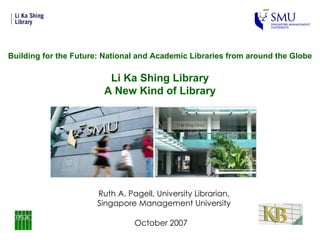
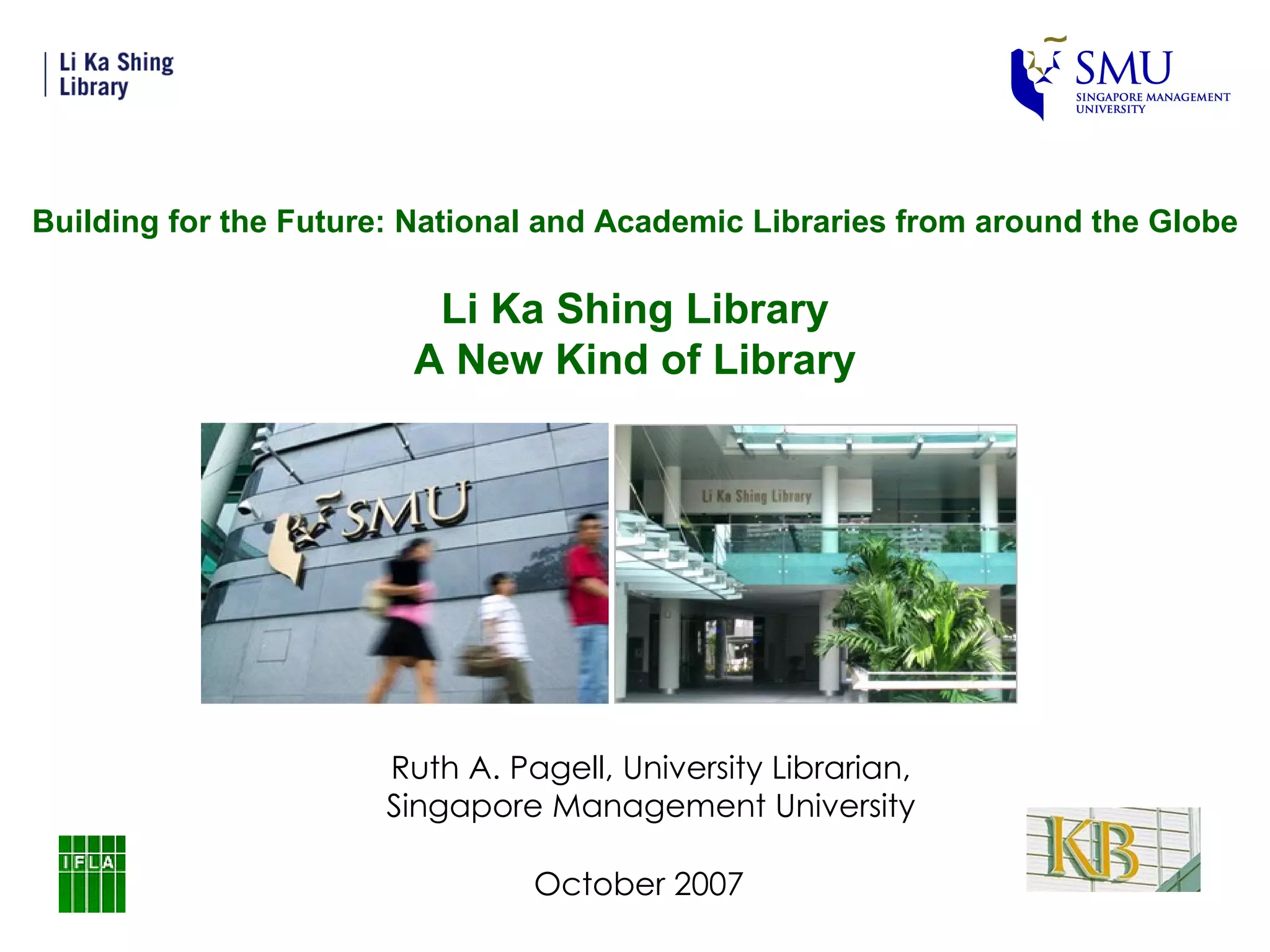
October 2007 Ruth A. Pagell, University Librarian, Singapore Management University Building for the Future: National and Academic Libraries from around the Globe Li Ka Shing Library A New Kind of Library
Designing Your  Library FORM  follows  FUNCTION FUNCTION  follows  STRATEGY STRATEGY  follows   VISION
SMU CASE STUDY Chronology Singapore government conceives SMU SMU signs agreement with Wharton School SMU opens to 300 students in Buket Timah 2000  SMU signs 5 year contract with NLB to run the    library (May) SMU appoints architect, Edward Cullinan (Dec) SMU hires a librarian to start in June 2005  SMU moves into its Bras Basah campus with four   school building and a library (end June) 2005  SMU opens new campus to 3500 students (July)
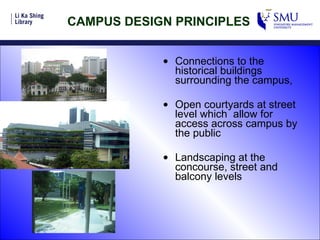
CAMPUS DESIGN PRINCIPLES Connections to the historical buildings surrounding the campus,  Open courtyards at street level which  allow for access across campus by the public Landscaping at the concourse, street and balcony levels
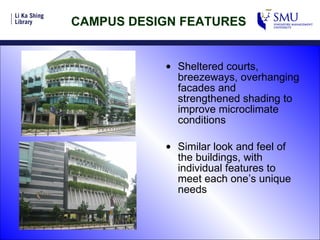
CAMPUS DESIGN FEATURES Sheltered courts, breezeways, overhanging facades and strengthened shading to improve microclimate conditions Similar look and feel of the buildings, with individual features to meet each one’s unique needs
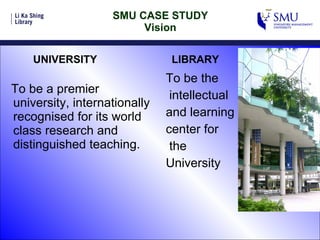
SMU CASE STUDY Vision To be a premier university, internationally recognised for its world class research and distinguished teaching. To be the intellectual  and learning  center for the  University UNIVERSITY  LIBRARY
MISSION SMU aspires to generate leading edge research with global impact as well as to produce broad-based, creative and entrepreneurial leaders for the knowledge-based economy. SMU is committed to an  interactive, participative and technologically-enabled learning experience .   ..  the connector to the information resources that are necessary for the growth of research…  The focus will be on providing services and access to information  more than on providing access to large collections of hard materials… The relationship between information technology and the Library is… critical. President Howard Hunter, August 2005 UNIVERSITY  LIBRARY
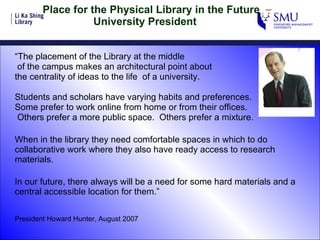
Place for the Physical Library in the Future    University President  “ The placement of the Library at the middle of the campus makes an architectural point about  the centrality of ideas to the life  of a university. Students and scholars have varying habits and preferences.  Some prefer to work online from home or from their offices.   Others prefer a more public space.  Others prefer a mixture. When in the library they need comfortable spaces in which to do collaborative work where they also have ready access to research materials. In our future, there always will be a need for some hard materials and a central accessible location for them.” President Howard Hunter, August 2007
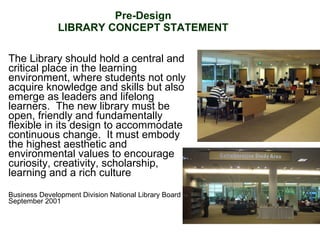
Pre-Design LIBRARY CONCEPT STATEMENT The Library should hold a central and critical place in the learning environment, where students not only acquire knowledge and skills but also emerge as leaders and lifelong learners.  The new library must be open, friendly and fundamentally flexible in its design to accommodate continuous change.  It must embody the highest aesthetic and environmental values to encourage curiosity, creativity, scholarship, learning and a rich culture Business Development Division National Library Board September 2001
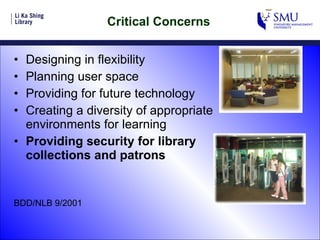
Critical Concerns Designing in flexibility Planning user space Providing for future technology Creating a diversity of appropriate environments for learning Providing security for library collections and patrons BDD/NLB 9/2001
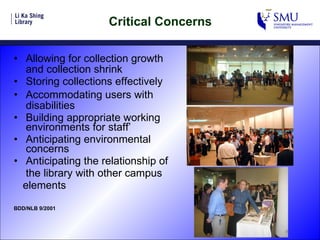
Critical Concerns Allowing for collection growth and collection shrink Storing collections effectively Accommodating users with disabilities Building appropriate working environments for staff’ Anticipating environmental concerns Anticipating the relationship of the library with other campus elements BDD/NLB 9/2001
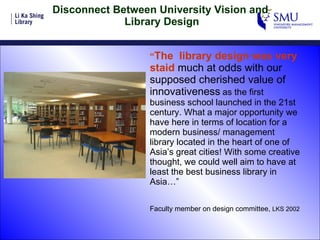
Disconnect Between University Vision and  Library Design “ The  library design was very staid  much at odds with our supposed cherished value of innovativeness   as the first business school launched in the 21st century. What a major opportunity we have here in terms of location for a modern business/ management library located in the heart of one of Asia’s great cities! With some creative thought, we could well aim to have at least the best business library in Asia…” Faculty member on design committee,  LKS 2002
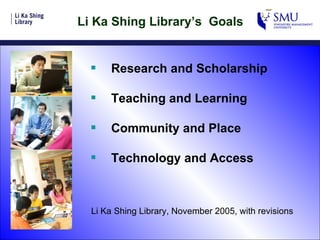
Li Ka Shing Library’s  Goals Research and Scholarship Teaching and Learning Community and Place Technology and Access Li Ka Shing Library, November 2005, with revisions
  Impact of Research Services on Building Expanded ejournal collection Addition of Schools of Law and Social Sciences  Specialized research staff Balance of access vs ownership Support for graduate students Less need for periodical shelves More demand for print in these areas; Law Library Special use computers Creation of new unit (Course Support Services)  Need for different work areas
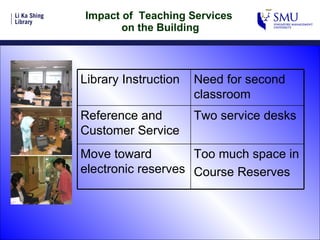
Impact of  Teaching Services  on the Building Too much space in Course Reserves Move toward electronic reserves Two service desks Reference and Customer Service Need for second classroom Library Instruction
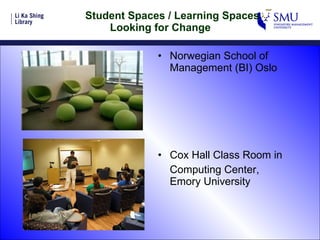
Student Spaces / Learning Spaces Looking for Change Norwegian School of Management (BI) Oslo Cox Hall Class Room in Computing Center, Emory University
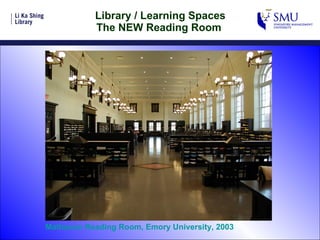
Library / Learning Spaces The NEW Reading Room  Matheson Reading Room, Emory University, 2003
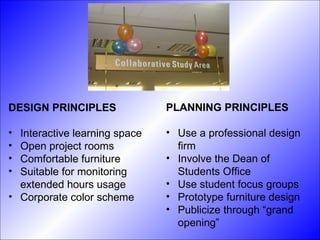
DESIGN PRINCIPLES Interactive learning space Open project rooms Comfortable furniture Suitable for monitoring extended hours usage Corporate color scheme PLANNING PRINCIPLES Use a professional design firm Involve the Dean of Students Office Use student focus groups Prototype furniture design Publicize through “grand opening”
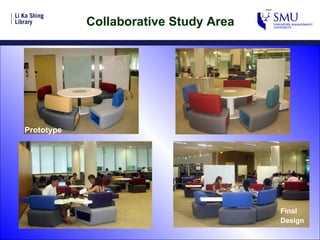
Collaborative Study Area Prototype Final Design
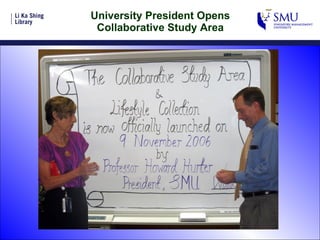
University President Opens Collaborative Study Area
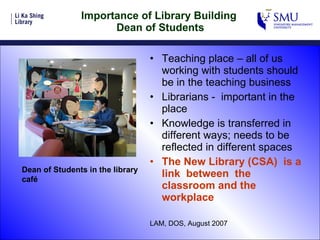
Importance of Library Building  Dean of Students Teaching place – all of us working with students should be in the teaching business Librarians -  important in the place Knowledge is transferred in different ways; needs to be reflected in different spaces The New Library (CSA)  is a link  between  the classroom and the workplace LAM, DOS, August 2007 Dean of Students in the library café
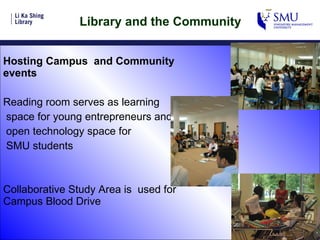
Library and the Community Hosting Campus  and Community events Reading room serves as learning  space for young entrepreneurs and open technology space for  SMU students Collaborative Study Area is  used for Campus Blood Drive
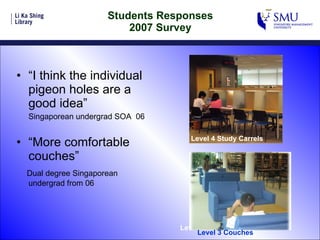
Students Responses 2007 Survey “ I think the individual pigeon holes are a good idea”  Singaporean undergrad SOA  06 “ More comfortable couches” Dual degree Singaporean  undergrad from 06 Level 2 Lounge Area Level 4 Study Carrels Le Level 3 Couches
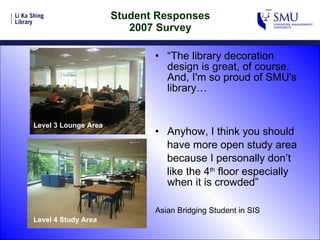
Student Responses 2007 Survey “ The library decoration design is great, of course. And, I'm so proud of SMU's library…   Anyhow, I think you should have more open study area because I personally don’t like the 4 th  floor especially when it is crowded” Asian Bridging Student in SIS Level 4 Study Area Level 3 Lounge Area
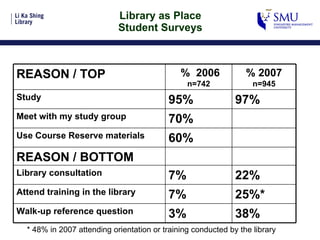
Library as Place Student Surveys Level 4 Study Area Level 2 Lounge Area * 48% in 2007 attending orientation or training conducted by the library 3% 7% 7% 60% 70% 95% %  2006  n=742 38% 25%* 22% 97% % 2007  n=945 Library consultation Walk-up reference question Attend training in the library REASON / BOTTOM Use Course Reserve materials Meet with my study group Study REASON / TOP
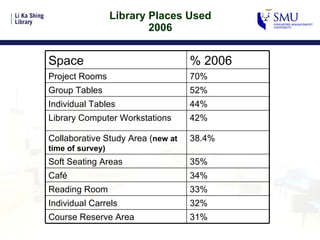
Library Places Used 2006 31% 32% 33% 34% 35% 38.4% 42% 44% 52% 70% % 2006 Course Reserve Area Individual Carrels Reading Room Café Soft Seating Areas Collaborative Study Area ( new at time of survey) Library Computer Workstations Individual Tables Group Tables Project Rooms Space
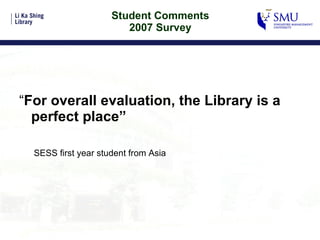
Student Comments 2007 Survey “ For overall evaluation, the Library is a perfect place”   SESS first year student from Asia
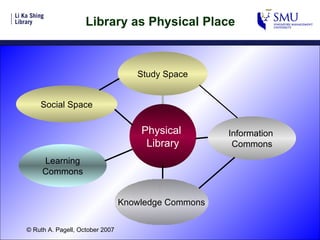
Library as Physical Place Physical  Library Study Space Learning Commons Social Space Information  Commons Knowledge Commons © Ruth A. Pagell, October 2007
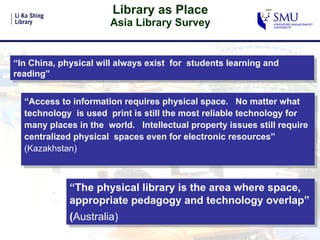
Library as Place Asia Library Survey “ In China, physical will always exist  for  students learning and reading” “ Access to information requires physical space.  No matter what technology  is used  print is still the most reliable technology for many places in the  world.  Intellectual property issues still require centralized physical  spaces even for electronic resources”  (Kazakhstan) “ The physical library is the area where space, appropriate pedagogy and technology overlap” ( Australia)
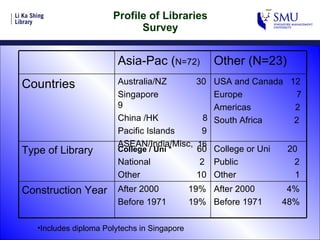
Profile of Libraries Survey Includes diploma Polytechs in Singapore After 2000  4% Before 1971  48% After 2000  19% Before 1971  19%  Construction Year College or Uni  20 Public  2 Other  1 College / Uni *  60 National  2 Other  10 Type of Library USA and Canada  12 Europe  7 Americas  2 South Africa  2 Australia/NZ  30 Singapore  9 China /HK  8 Pacific Islands  9 ASEAN/India/Misc,  16   Countries Other (N=23) Asia-Pac ( N=72)
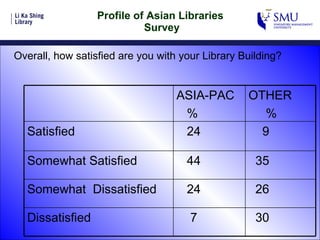
Profile of Asian Libraries  Survey Overall, how satisfied are you with your Library Building? OTHER % ASIA-PAC % 7 24 44 24 30 Dissatisfied 26 Somewhat  Dissatisfied 35 Somewhat Satisfied 9 Satisfied
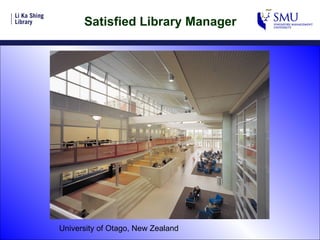
Satisfied Library Manager University of Otago, New Zealand
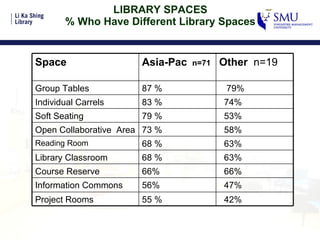
LIBRARY SPACES % Who Have Different Library Spaces   55 % 56% 66% 68 % 68 % 73 % 79 % 83 %  87 % Asia-Pac  n=71 79% Group Tables 53% Soft Seating 58%  Open Collaborative  Area 63% Reading Room 63% Library Classroom 66% Course Reserve 47% Information Commons 42% 74% Other  n=19 Project Rooms Individual Carrels Space
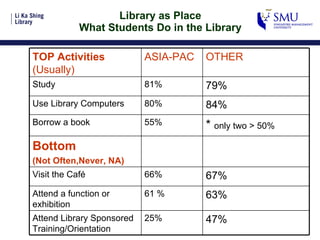
Library as Place What Students Do in the Library 25% 61 % 66% 55% 80% 81% ASIA-PAC 47% 63% 67% *  only two > 50% 84% 79% OTHER Borrow a book Visit the Café Attend a function or exhibition Attend Library Sponsored Training/Orientation Bottom  (Not Often,Never, NA) Use Library Computers Study TOP Activities  (Usually)
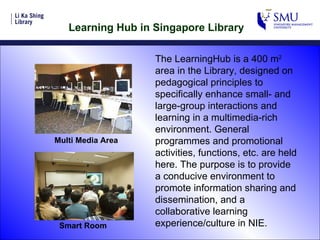
  Learning Hub in Singapore Library Multi Media Area Smart Room The LearningHub is a 400 m 2  area in the Library, designed on pedagogical principles to specifically enhance small- and large-group interactions and learning in a multimedia-rich environment. General programmes and promotional activities, functions, etc. are held here. The purpose is to provide a conducive environment to promote information sharing and dissemination, and a collaborative learning experience/culture in NIE.
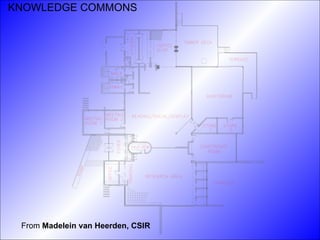
KNOWLEDGE COMMONS From  Madelein van Heerden, CSIR
Contact Information http://library.smu.edu.sg/ Email:  [email_address] Tel: +65 6828 0355

Ifla Buildings

  • 1.
    October 2007 RuthA. Pagell, University Librarian, Singapore Management University Building for the Future: National and Academic Libraries from around the Globe Li Ka Shing Library A New Kind of Library
  • 2.
    Designing Your Library FORM follows FUNCTION FUNCTION follows STRATEGY STRATEGY follows VISION
  • 3.
    SMU CASE STUDYChronology Singapore government conceives SMU SMU signs agreement with Wharton School SMU opens to 300 students in Buket Timah 2000 SMU signs 5 year contract with NLB to run the library (May) SMU appoints architect, Edward Cullinan (Dec) SMU hires a librarian to start in June 2005 SMU moves into its Bras Basah campus with four school building and a library (end June) 2005 SMU opens new campus to 3500 students (July)
  • 4.
    CAMPUS DESIGN PRINCIPLESConnections to the historical buildings surrounding the campus, Open courtyards at street level which allow for access across campus by the public Landscaping at the concourse, street and balcony levels
  • 5.
    CAMPUS DESIGN FEATURESSheltered courts, breezeways, overhanging facades and strengthened shading to improve microclimate conditions Similar look and feel of the buildings, with individual features to meet each one’s unique needs
  • 6.
    SMU CASE STUDYVision To be a premier university, internationally recognised for its world class research and distinguished teaching. To be the intellectual and learning center for the University UNIVERSITY LIBRARY
  • 7.
    MISSION SMU aspiresto generate leading edge research with global impact as well as to produce broad-based, creative and entrepreneurial leaders for the knowledge-based economy. SMU is committed to an interactive, participative and technologically-enabled learning experience . .. the connector to the information resources that are necessary for the growth of research… The focus will be on providing services and access to information more than on providing access to large collections of hard materials… The relationship between information technology and the Library is… critical. President Howard Hunter, August 2005 UNIVERSITY LIBRARY
  • 8.
    Place for thePhysical Library in the Future University President “ The placement of the Library at the middle of the campus makes an architectural point about the centrality of ideas to the life of a university. Students and scholars have varying habits and preferences.  Some prefer to work online from home or from their offices.   Others prefer a more public space.  Others prefer a mixture. When in the library they need comfortable spaces in which to do collaborative work where they also have ready access to research materials. In our future, there always will be a need for some hard materials and a central accessible location for them.” President Howard Hunter, August 2007
  • 9.
    Pre-Design LIBRARY CONCEPTSTATEMENT The Library should hold a central and critical place in the learning environment, where students not only acquire knowledge and skills but also emerge as leaders and lifelong learners. The new library must be open, friendly and fundamentally flexible in its design to accommodate continuous change. It must embody the highest aesthetic and environmental values to encourage curiosity, creativity, scholarship, learning and a rich culture Business Development Division National Library Board September 2001
  • 10.
    Critical Concerns Designingin flexibility Planning user space Providing for future technology Creating a diversity of appropriate environments for learning Providing security for library collections and patrons BDD/NLB 9/2001
  • 11.
    Critical Concerns Allowingfor collection growth and collection shrink Storing collections effectively Accommodating users with disabilities Building appropriate working environments for staff’ Anticipating environmental concerns Anticipating the relationship of the library with other campus elements BDD/NLB 9/2001
  • 12.
    Disconnect Between UniversityVision and Library Design “ The library design was very staid much at odds with our supposed cherished value of innovativeness as the first business school launched in the 21st century. What a major opportunity we have here in terms of location for a modern business/ management library located in the heart of one of Asia’s great cities! With some creative thought, we could well aim to have at least the best business library in Asia…” Faculty member on design committee, LKS 2002
  • 13.
    Li Ka ShingLibrary’s Goals Research and Scholarship Teaching and Learning Community and Place Technology and Access Li Ka Shing Library, November 2005, with revisions
  • 14.
    Impactof Research Services on Building Expanded ejournal collection Addition of Schools of Law and Social Sciences Specialized research staff Balance of access vs ownership Support for graduate students Less need for periodical shelves More demand for print in these areas; Law Library Special use computers Creation of new unit (Course Support Services) Need for different work areas
  • 15.
    Impact of Teaching Services on the Building Too much space in Course Reserves Move toward electronic reserves Two service desks Reference and Customer Service Need for second classroom Library Instruction
  • 16.
    Student Spaces /Learning Spaces Looking for Change Norwegian School of Management (BI) Oslo Cox Hall Class Room in Computing Center, Emory University
  • 17.
    Library / LearningSpaces The NEW Reading Room Matheson Reading Room, Emory University, 2003
  • 18.
    DESIGN PRINCIPLES Interactivelearning space Open project rooms Comfortable furniture Suitable for monitoring extended hours usage Corporate color scheme PLANNING PRINCIPLES Use a professional design firm Involve the Dean of Students Office Use student focus groups Prototype furniture design Publicize through “grand opening”
  • 19.
    Collaborative Study AreaPrototype Final Design
  • 20.
    University President OpensCollaborative Study Area
  • 21.
    Importance of LibraryBuilding Dean of Students Teaching place – all of us working with students should be in the teaching business Librarians - important in the place Knowledge is transferred in different ways; needs to be reflected in different spaces The New Library (CSA) is a link between the classroom and the workplace LAM, DOS, August 2007 Dean of Students in the library café
  • 22.
    Library and theCommunity Hosting Campus and Community events Reading room serves as learning space for young entrepreneurs and open technology space for SMU students Collaborative Study Area is used for Campus Blood Drive
  • 23.
    Students Responses 2007Survey “ I think the individual pigeon holes are a good idea” Singaporean undergrad SOA 06 “ More comfortable couches” Dual degree Singaporean undergrad from 06 Level 2 Lounge Area Level 4 Study Carrels Le Level 3 Couches
  • 24.
    Student Responses 2007Survey “ The library decoration design is great, of course. And, I'm so proud of SMU's library… Anyhow, I think you should have more open study area because I personally don’t like the 4 th floor especially when it is crowded” Asian Bridging Student in SIS Level 4 Study Area Level 3 Lounge Area
  • 25.
    Library as PlaceStudent Surveys Level 4 Study Area Level 2 Lounge Area * 48% in 2007 attending orientation or training conducted by the library 3% 7% 7% 60% 70% 95% % 2006 n=742 38% 25%* 22% 97% % 2007 n=945 Library consultation Walk-up reference question Attend training in the library REASON / BOTTOM Use Course Reserve materials Meet with my study group Study REASON / TOP
  • 26.
    Library Places Used2006 31% 32% 33% 34% 35% 38.4% 42% 44% 52% 70% % 2006 Course Reserve Area Individual Carrels Reading Room Café Soft Seating Areas Collaborative Study Area ( new at time of survey) Library Computer Workstations Individual Tables Group Tables Project Rooms Space
  • 27.
    Student Comments 2007Survey “ For overall evaluation, the Library is a perfect place” SESS first year student from Asia
  • 28.
    Library as PhysicalPlace Physical Library Study Space Learning Commons Social Space Information Commons Knowledge Commons © Ruth A. Pagell, October 2007
  • 29.
    Library as PlaceAsia Library Survey “ In China, physical will always exist for students learning and reading” “ Access to information requires physical space. No matter what technology is used print is still the most reliable technology for many places in the world. Intellectual property issues still require centralized physical spaces even for electronic resources” (Kazakhstan) “ The physical library is the area where space, appropriate pedagogy and technology overlap” ( Australia)
  • 30.
    Profile of LibrariesSurvey Includes diploma Polytechs in Singapore After 2000 4% Before 1971 48% After 2000 19% Before 1971 19% Construction Year College or Uni 20 Public 2 Other 1 College / Uni * 60 National 2 Other 10 Type of Library USA and Canada 12 Europe 7 Americas 2 South Africa 2 Australia/NZ 30 Singapore 9 China /HK 8 Pacific Islands 9 ASEAN/India/Misc, 16 Countries Other (N=23) Asia-Pac ( N=72)
  • 31.
    Profile of AsianLibraries Survey Overall, how satisfied are you with your Library Building? OTHER % ASIA-PAC % 7 24 44 24 30 Dissatisfied 26 Somewhat Dissatisfied 35 Somewhat Satisfied 9 Satisfied
  • 32.
    Satisfied Library ManagerUniversity of Otago, New Zealand
  • 33.
    LIBRARY SPACES %Who Have Different Library Spaces 55 % 56% 66% 68 % 68 % 73 % 79 % 83 % 87 % Asia-Pac n=71 79% Group Tables 53% Soft Seating 58% Open Collaborative Area 63% Reading Room 63% Library Classroom 66% Course Reserve 47% Information Commons 42% 74% Other n=19 Project Rooms Individual Carrels Space
  • 34.
    Library as PlaceWhat Students Do in the Library 25% 61 % 66% 55% 80% 81% ASIA-PAC 47% 63% 67% * only two > 50% 84% 79% OTHER Borrow a book Visit the Café Attend a function or exhibition Attend Library Sponsored Training/Orientation Bottom (Not Often,Never, NA) Use Library Computers Study TOP Activities (Usually)
  • 35.
    LearningHub in Singapore Library Multi Media Area Smart Room The LearningHub is a 400 m 2 area in the Library, designed on pedagogical principles to specifically enhance small- and large-group interactions and learning in a multimedia-rich environment. General programmes and promotional activities, functions, etc. are held here. The purpose is to provide a conducive environment to promote information sharing and dissemination, and a collaborative learning experience/culture in NIE.
  • 36.
    KNOWLEDGE COMMONS From Madelein van Heerden, CSIR
  • 37.
    Contact Information http://library.smu.edu.sg/Email: [email_address] Tel: +65 6828 0355