Starlink Protocol
Performance
Geoff Huston
APNIC
Low Earth Orbit
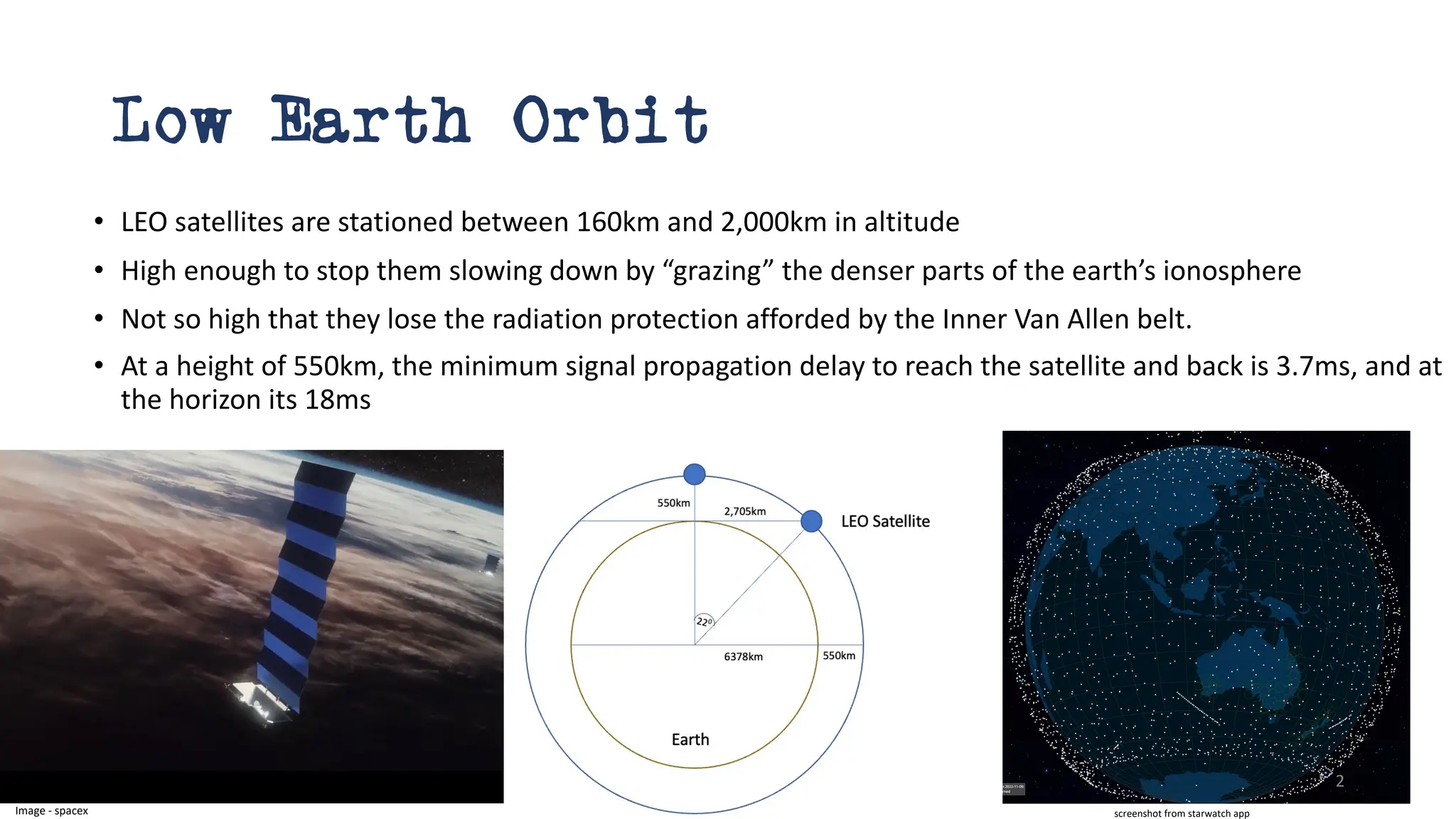
• LEO satellites are stationed between 160km and 2,000km in altitude
• High enough to stop them slowing down by “grazing” the denser parts of the earth’s ionosphere
• Not so high that they lose the radiation protection afforded by the Inner Van Allen belt.
• At a height of 550km, the minimum signal propagation delay to reach the satellite and back is 3.7ms, and at
the horizon its 18ms
screenshot from starwatch app
Image - spacex
2
Starlink Constellation
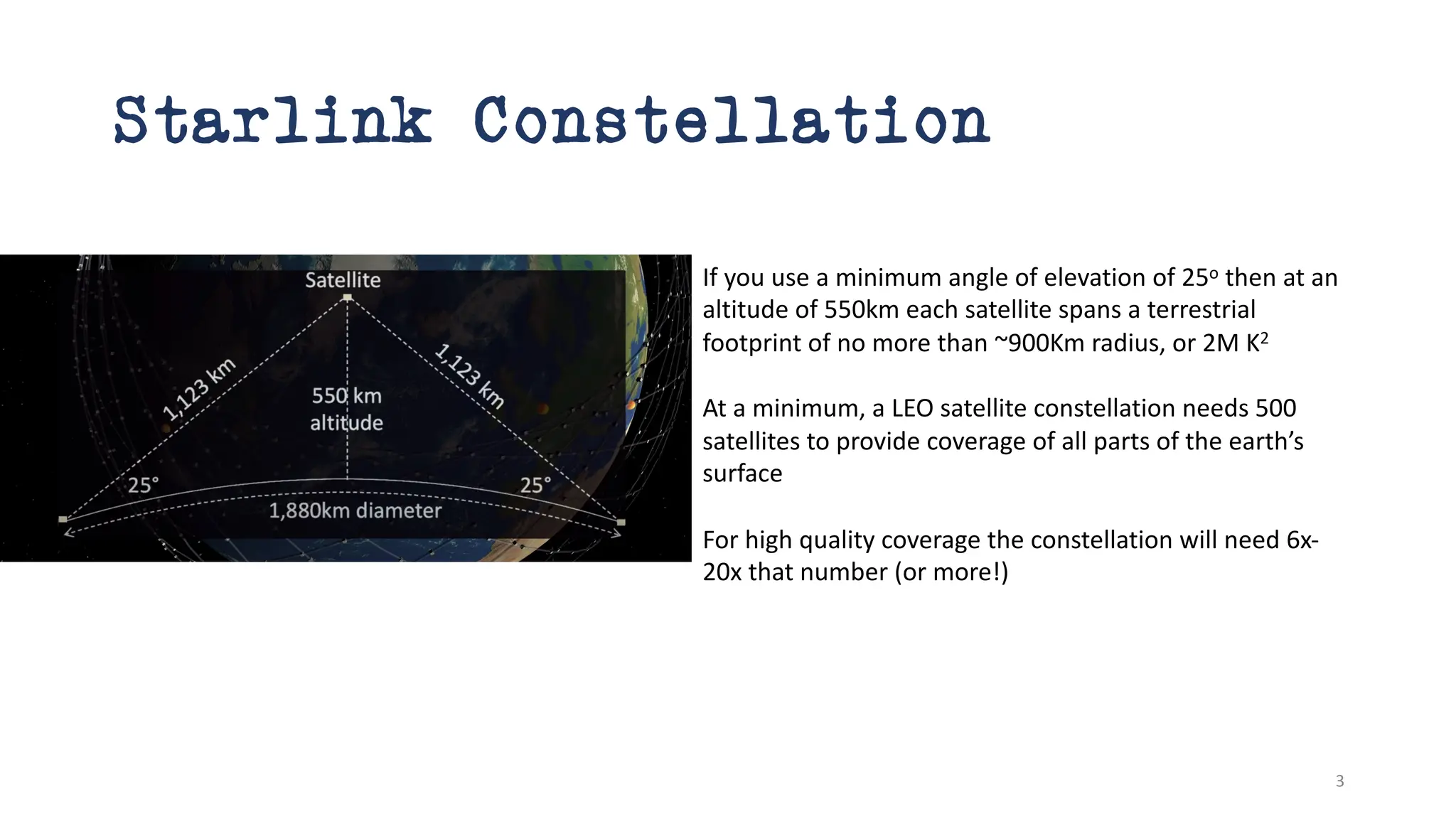
If you use a minimum angle of elevation of 25o then at an
altitude of 550km each satellite spans a terrestrial
footprint of no more than ~900Km radius, or 2M K2
At a minimum, a LEO satellite constellation needs 500
satellites to provide coverage of all parts of the earth’s
surface
For high quality coverage the constellation will need 6x-
20x that number (or more!)
3
Starlink Constellation
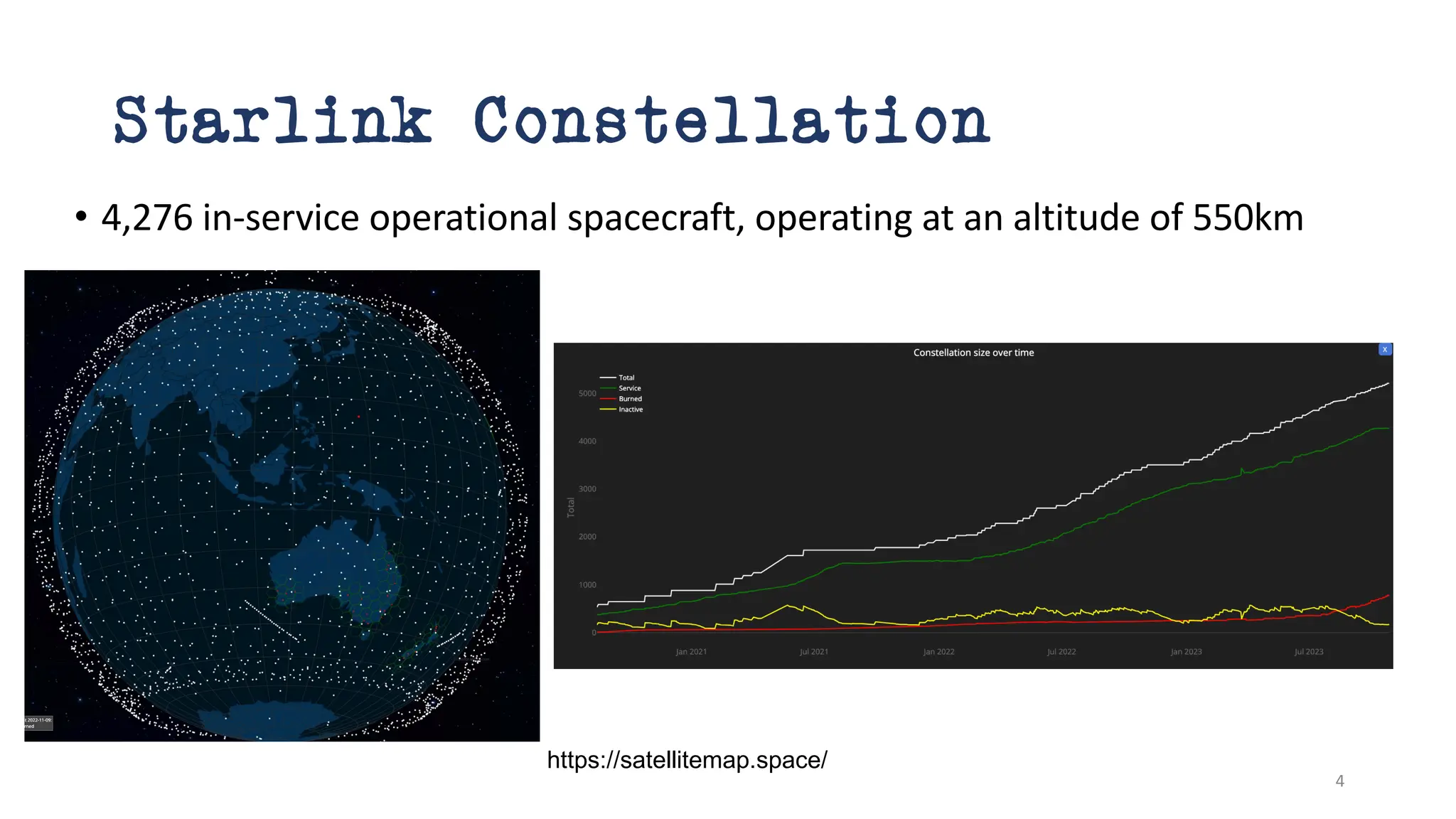
• 4,276 in-service operational spacecraft, operating at an altitude of 550km
https://satellitemap.space/
4
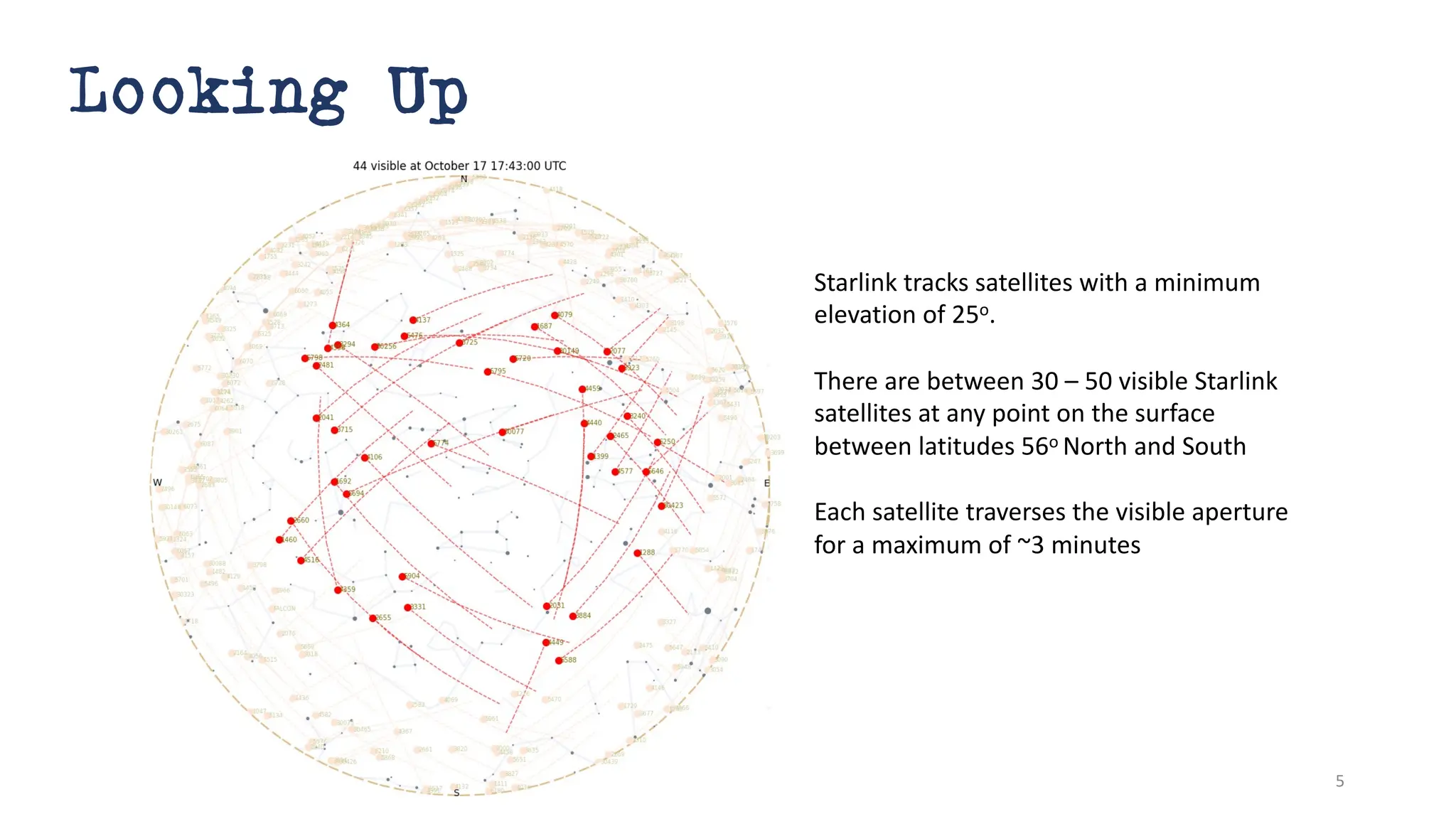
Looking Up
Starlink tracks satellites with a minimum
elevation of 25o.
There are between 30 – 50 visible Starlink
satellites at any point on the surface
between latitudes 56o North and South
Each satellite traverses the visible aperture
for a maximum of ~3 minutes
5
Starlink Scheduling
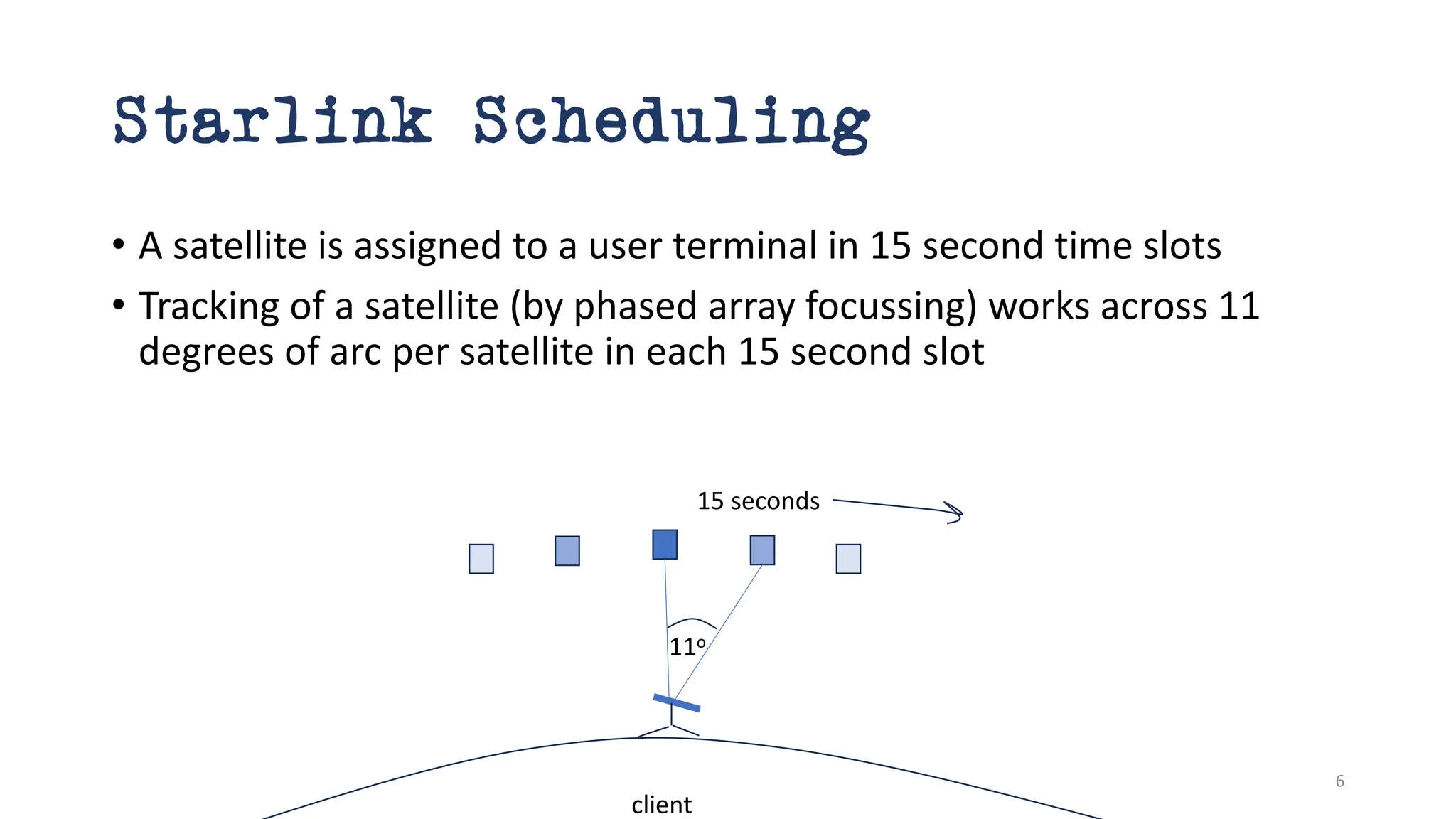
• A satellite is assigned to a user terminal in 15 second time slots
• Tracking of a satellite (by phased array focussing) works across 11
degrees of arc per satellite in each 15 second slot
client
11o
15 seconds
6
Starlink Scheduling
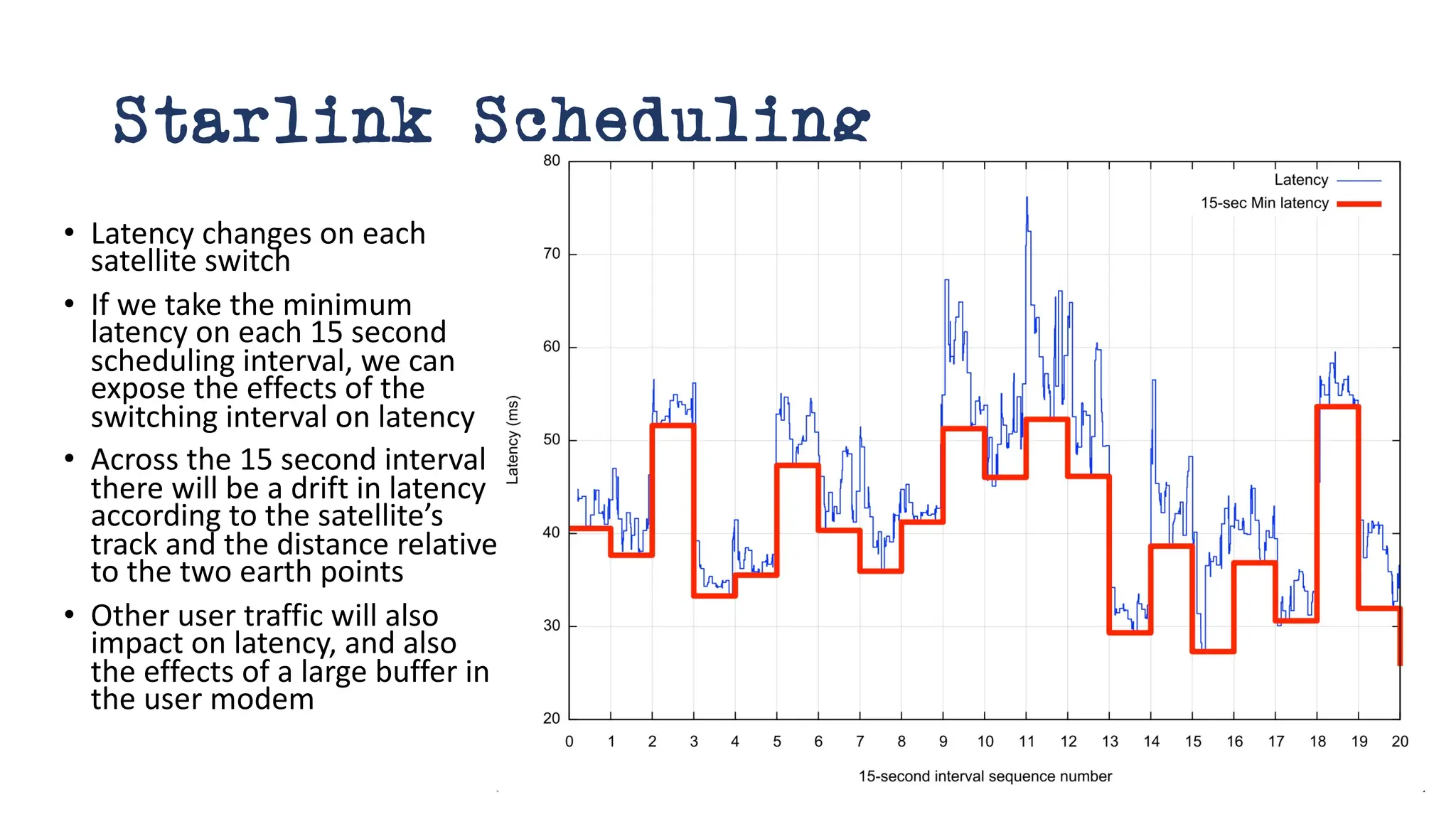
• Latency changes on each
satellite switch
• If we take the minimum
latency on each 15 second
scheduling interval, we can
expose the effects of the
switching interval on latency
• Across the 15 second interval
there will be a drift in latency
according to the satellite’s
track and the distance relative
to the two earth points
• Other user traffic will also
impact on latency, and also
the effects of a large buffer in
the user modem
Starlink Spot Beams
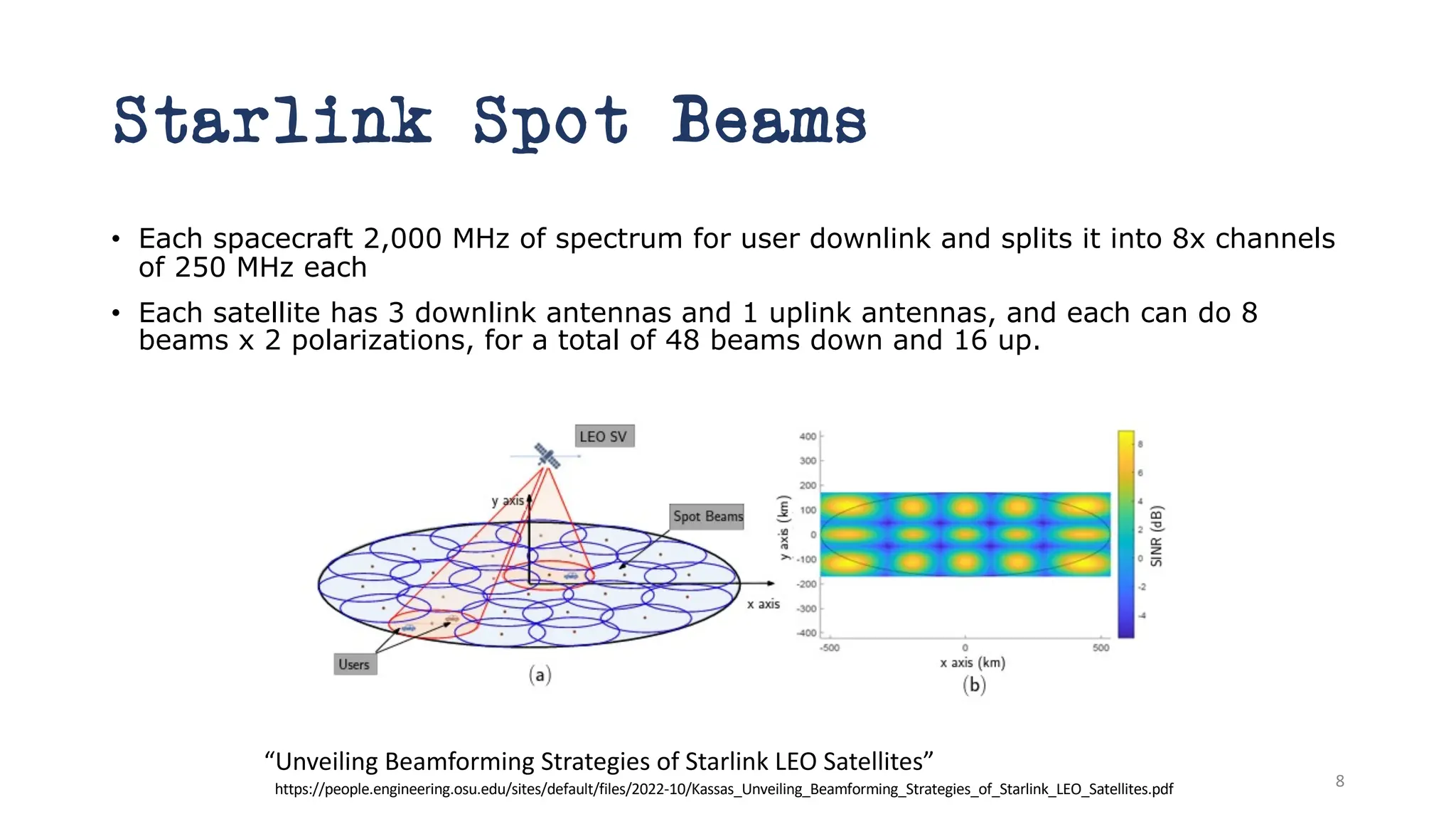
• Each spacecraft 2,000 MHz of spectrum for user downlink and splits it into 8x channels
of 250 MHz each
• Each satellite has 3 downlink antennas and 1 uplink antennas, and each can do 8
beams x 2 polarizations, for a total of 48 beams down and 16 up.
8
“Unveiling Beamforming Strategies of Starlink LEO Satellites”
https://people.engineering.osu.edu/sites/default/files/2022-10/Kassas_Unveiling_Beamforming_Strategies_of_Starlink_LEO_Satellites.pdf
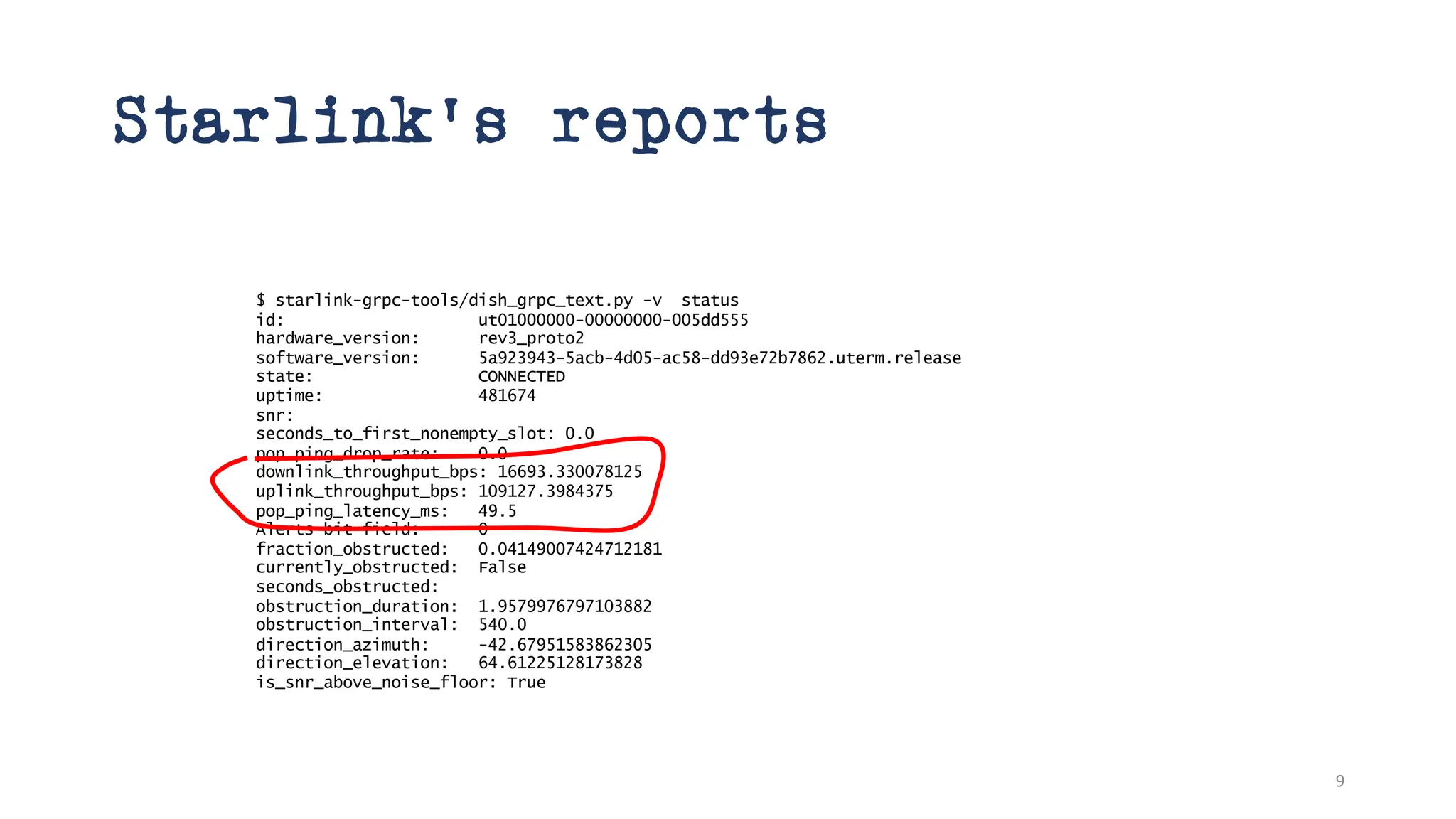
Starlink’s reports
$ starlink-grpc-tools/dish_grpc_text.py -v status
id: ut01000000-00000000-005dd555
hardware_version: rev3_proto2
software_version: 5a923943-5acb-4d05-ac58-dd93e72b7862.uterm.release
state: CONNECTED
uptime: 481674
snr:
seconds_to_first_nonempty_slot: 0.0
pop_ping_drop_rate: 0.0
downlink_throughput_bps: 16693.330078125
uplink_throughput_bps: 109127.3984375
pop_ping_latency_ms: 49.5
Alerts bit field: 0
fraction_obstructed: 0.04149007424712181
currently_obstructed: False
seconds_obstructed:
obstruction_duration: 1.9579976797103882
obstruction_interval: 540.0
direction_azimuth: -42.67951583862305
direction_elevation: 64.61225128173828
is_snr_above_noise_floor: True
9
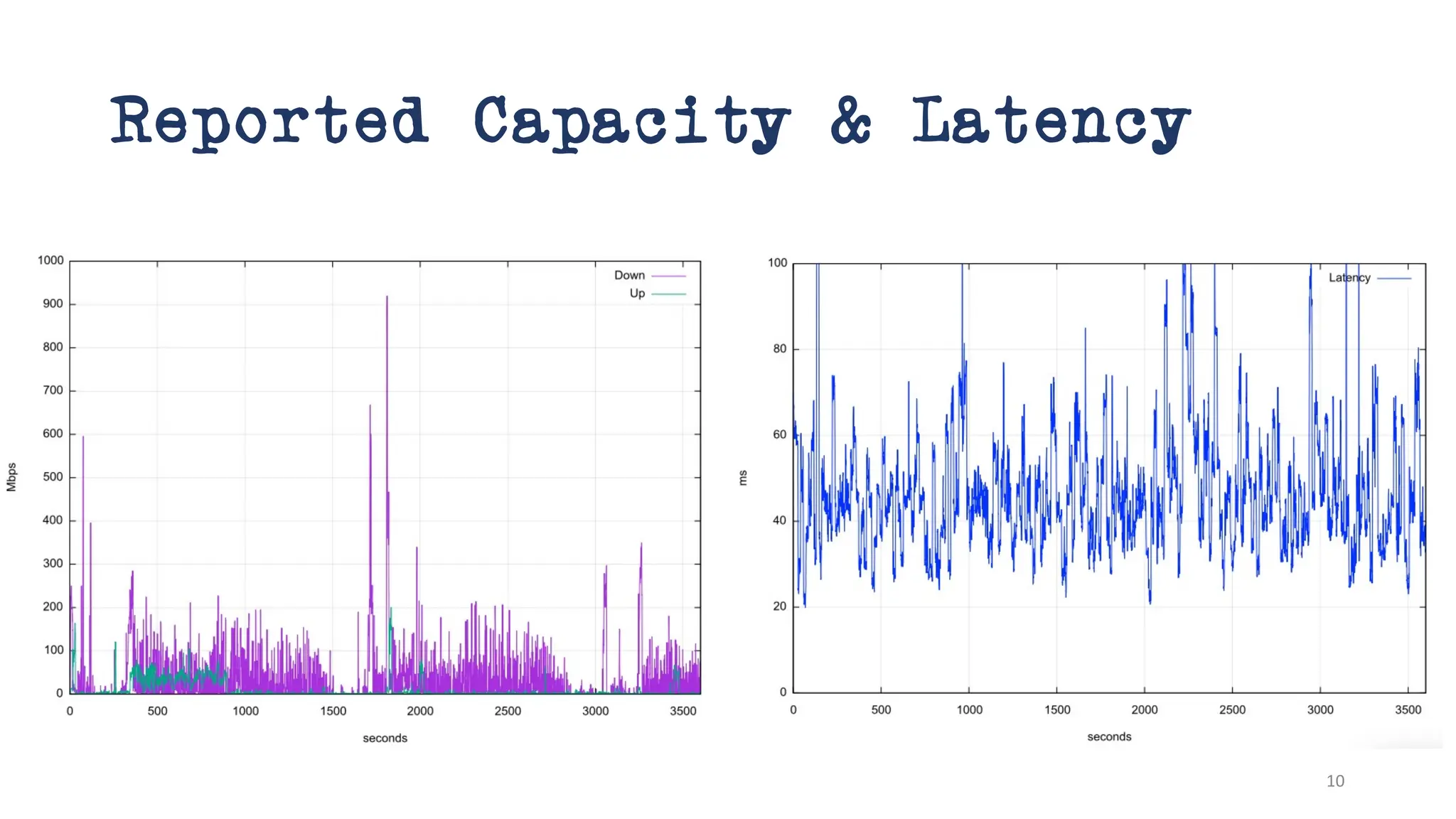
Reported Capacity & Latency
10
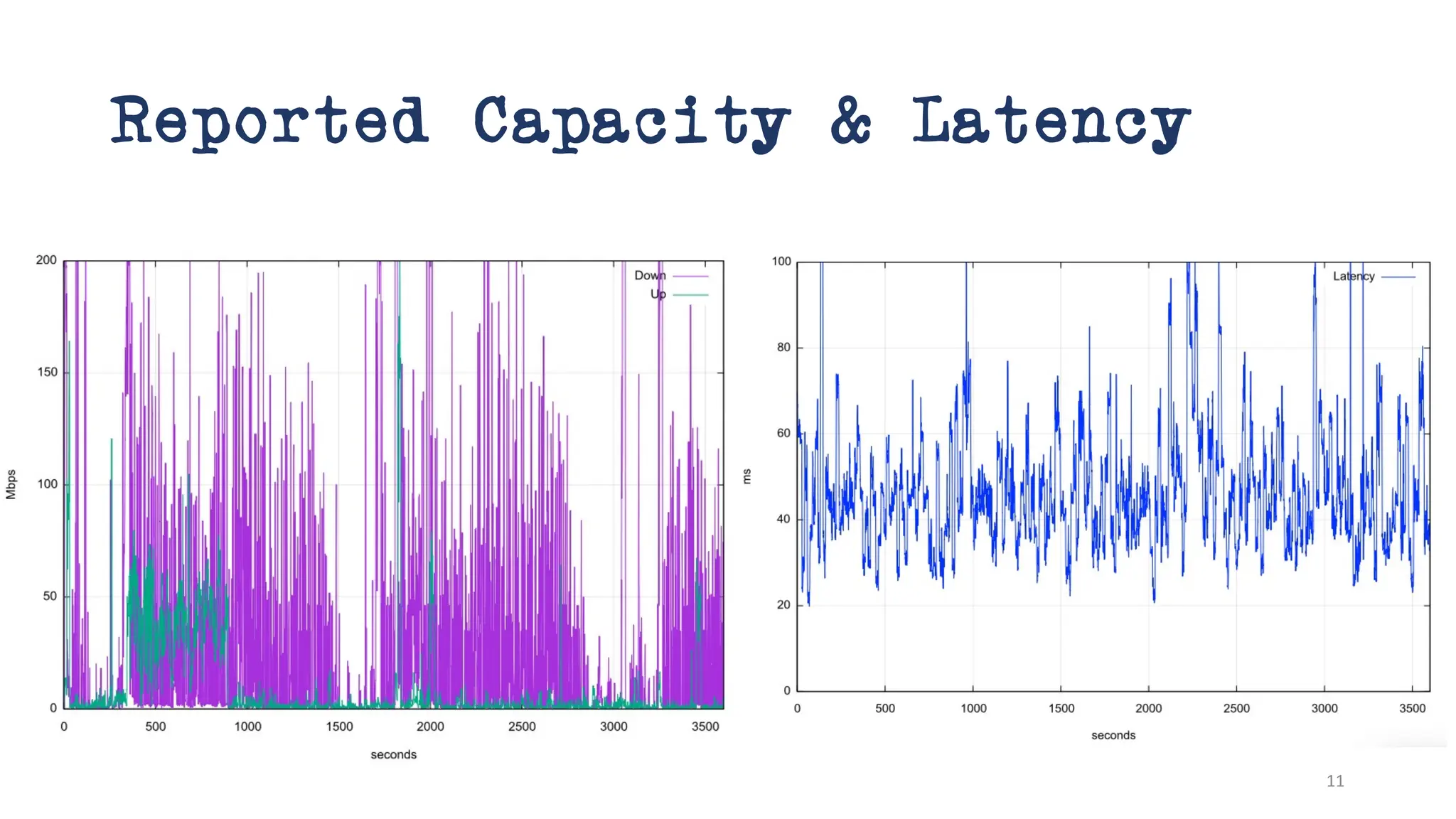
Reported Capacity & Latency
11
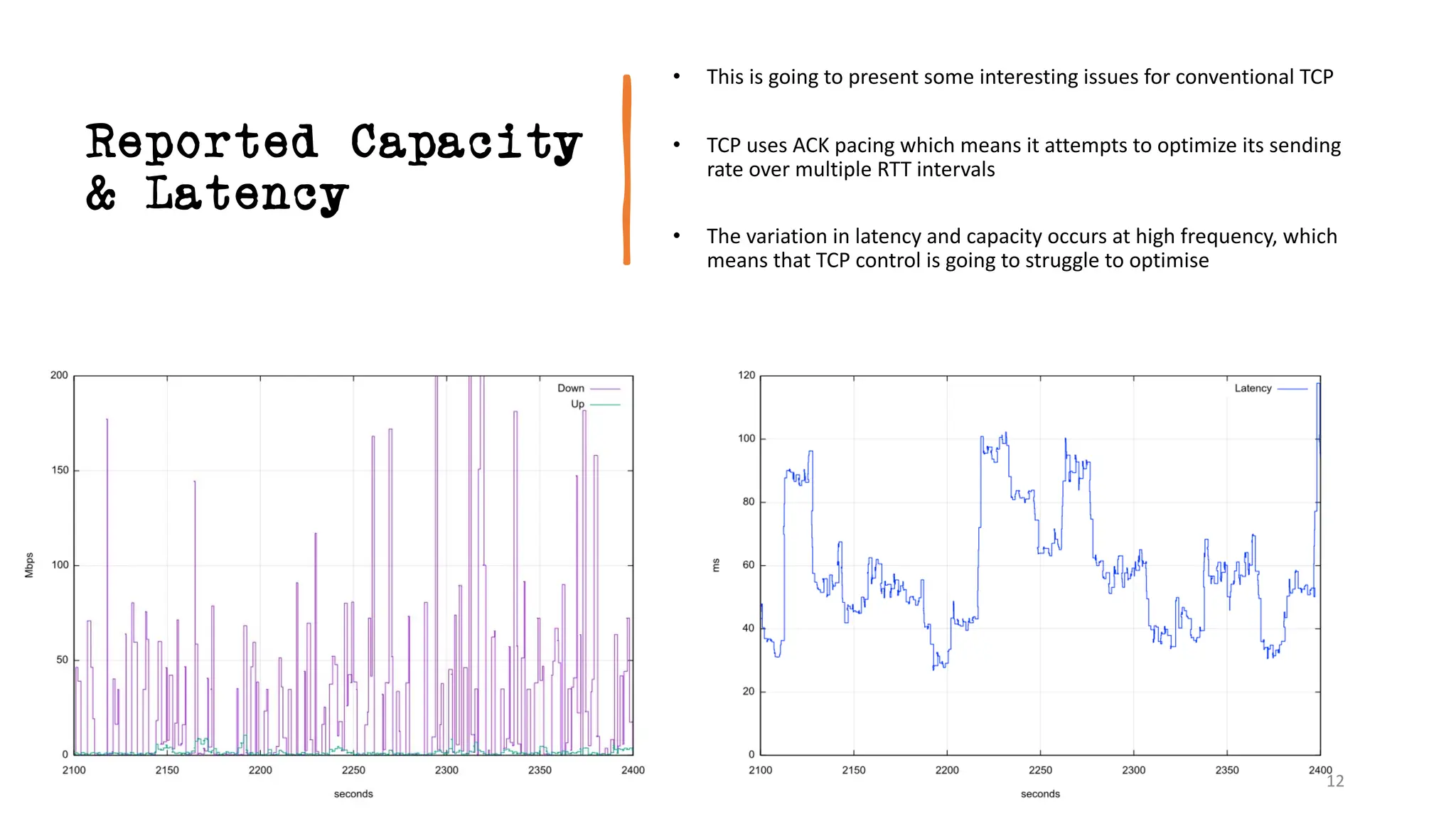
Reported Capacity
& Latency
• This is going to present some interesting issues for conventional TCP
• TCP uses ACK pacing which means it attempts to optimize its sending
rate over multiple RTT intervals
• The variation in latency and capacity occurs at high frequency, which
means that TCP control is going to struggle to optimise
12
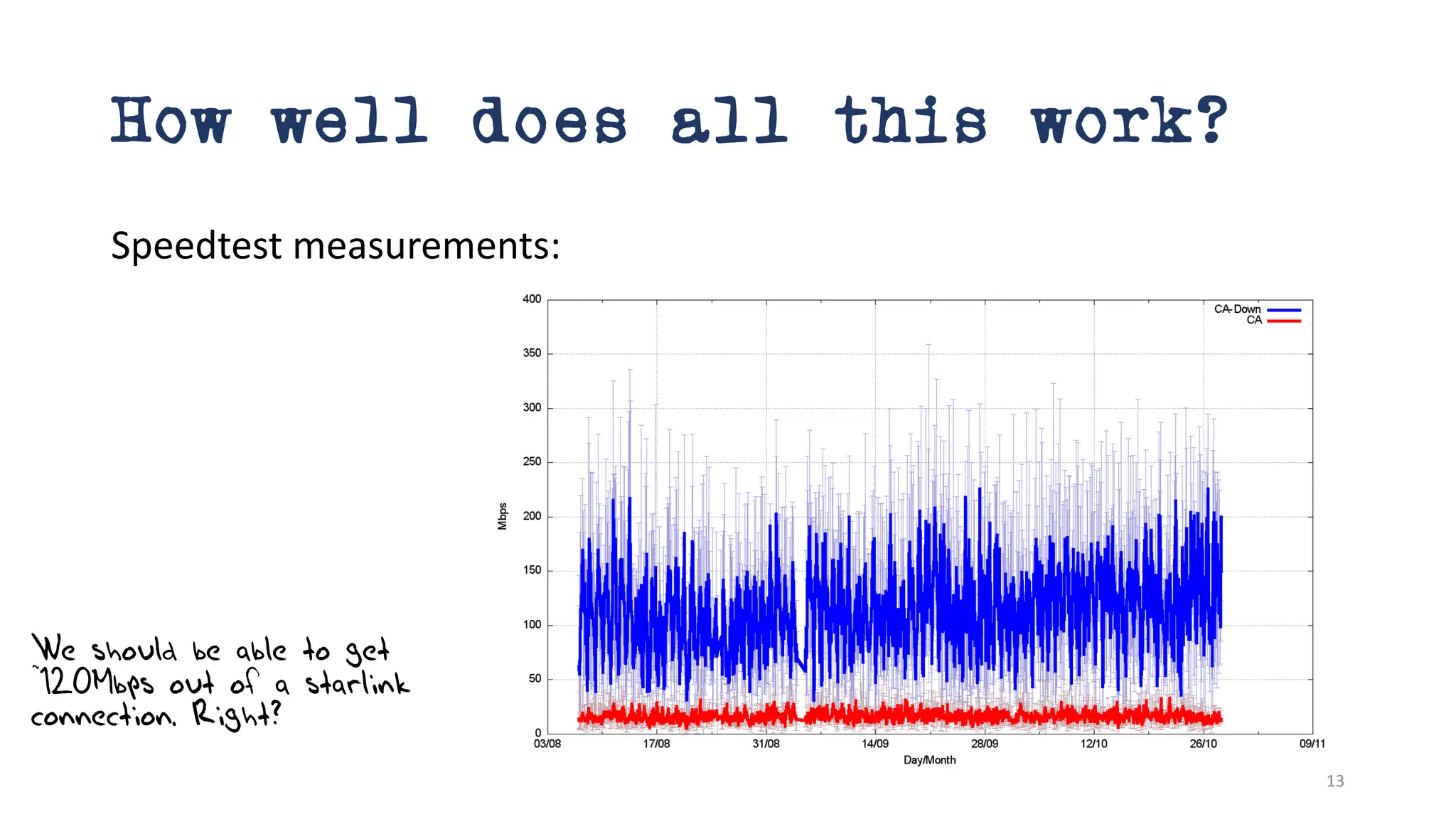
How well does all this work?
Speedtest measurements:
We should be able to get
~120Mbps out of a starlink
connection. Right?
13
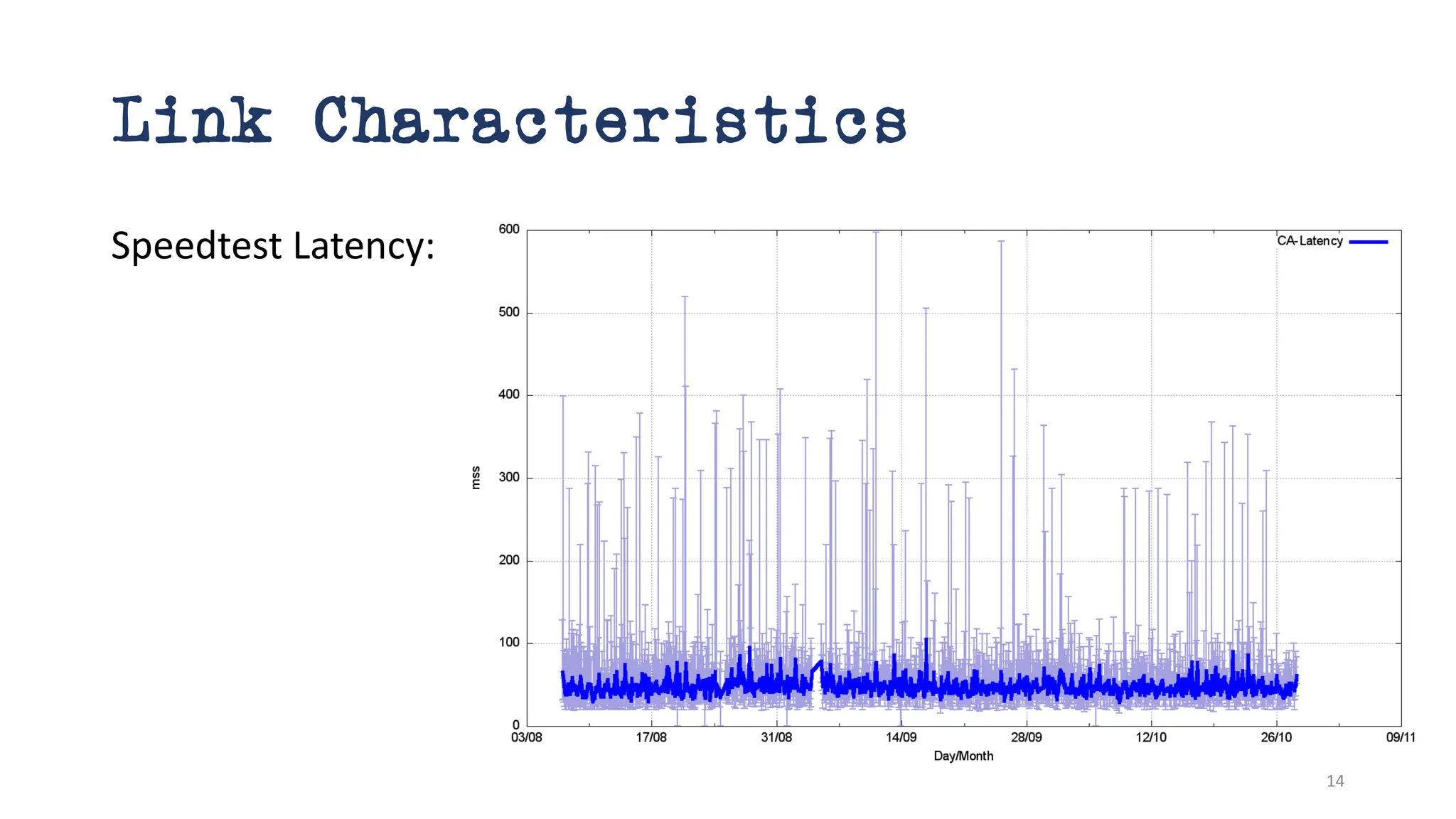
Link Characteristics
Speedtest Latency:
14
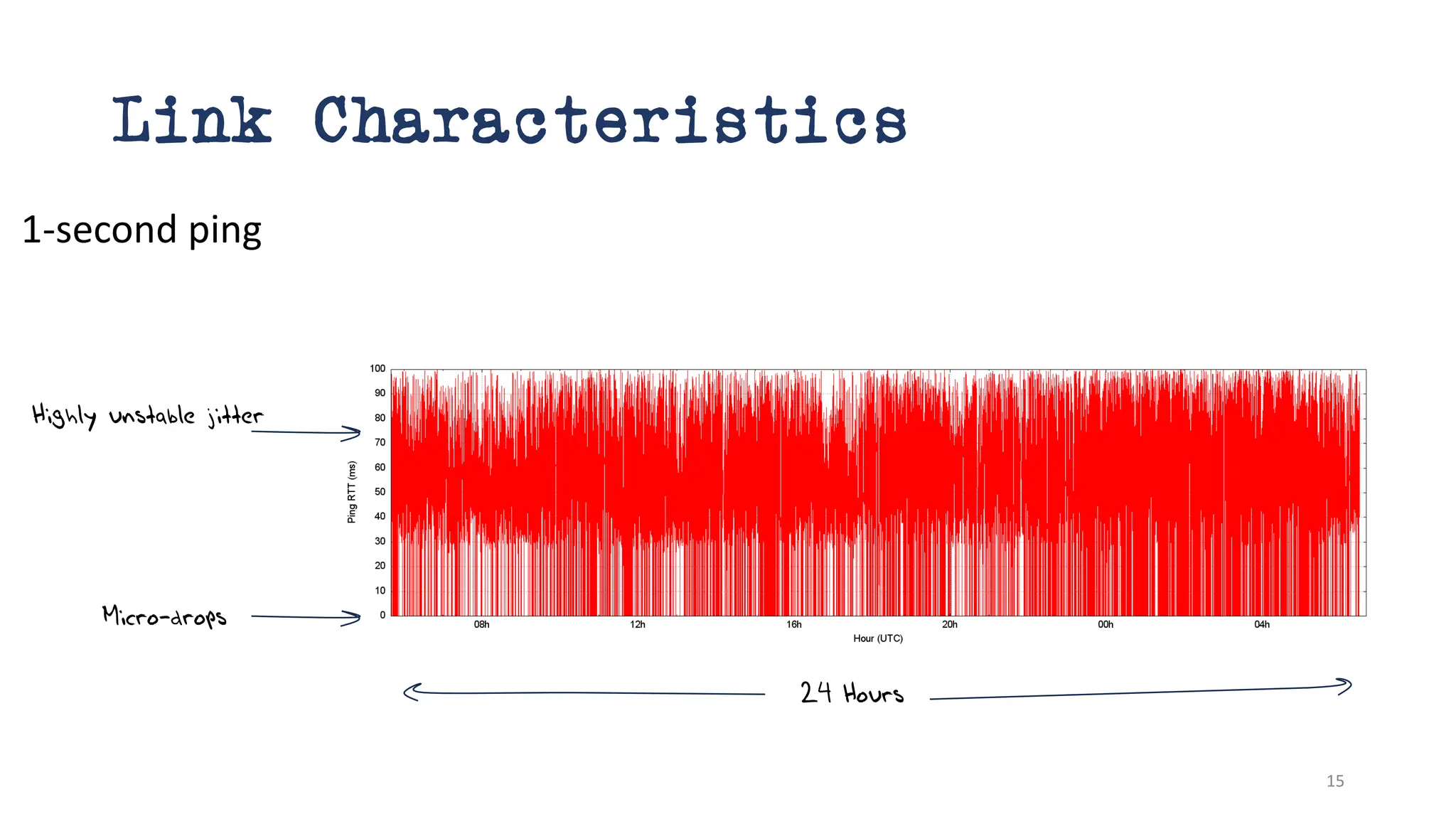
Link Characteristics
1-second ping
Micro-drops
Highly unstable jitter
24 Hours
15
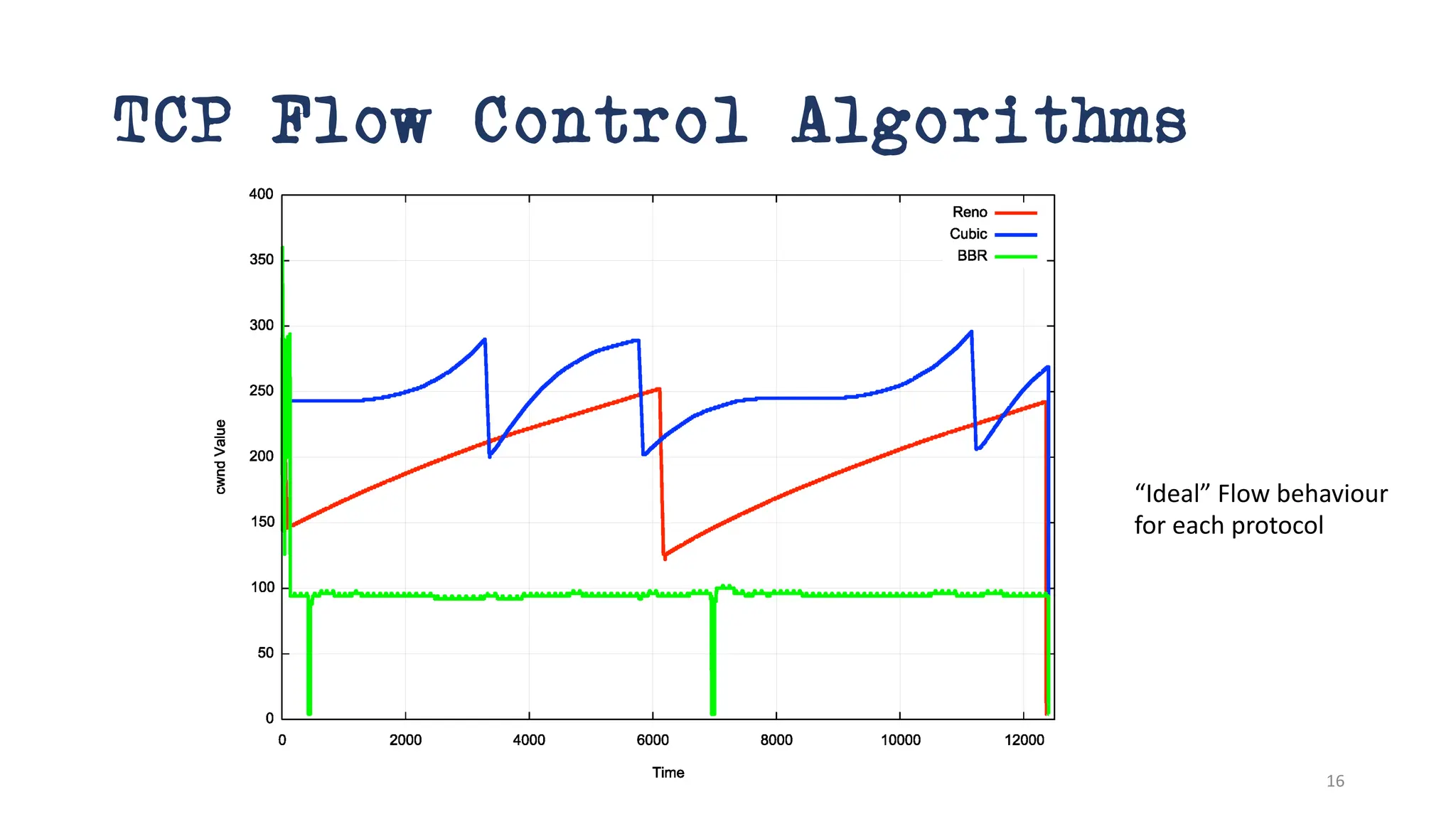
TCP Flow Control Algorithms
“Ideal” Flow behaviour
for each protocol
16
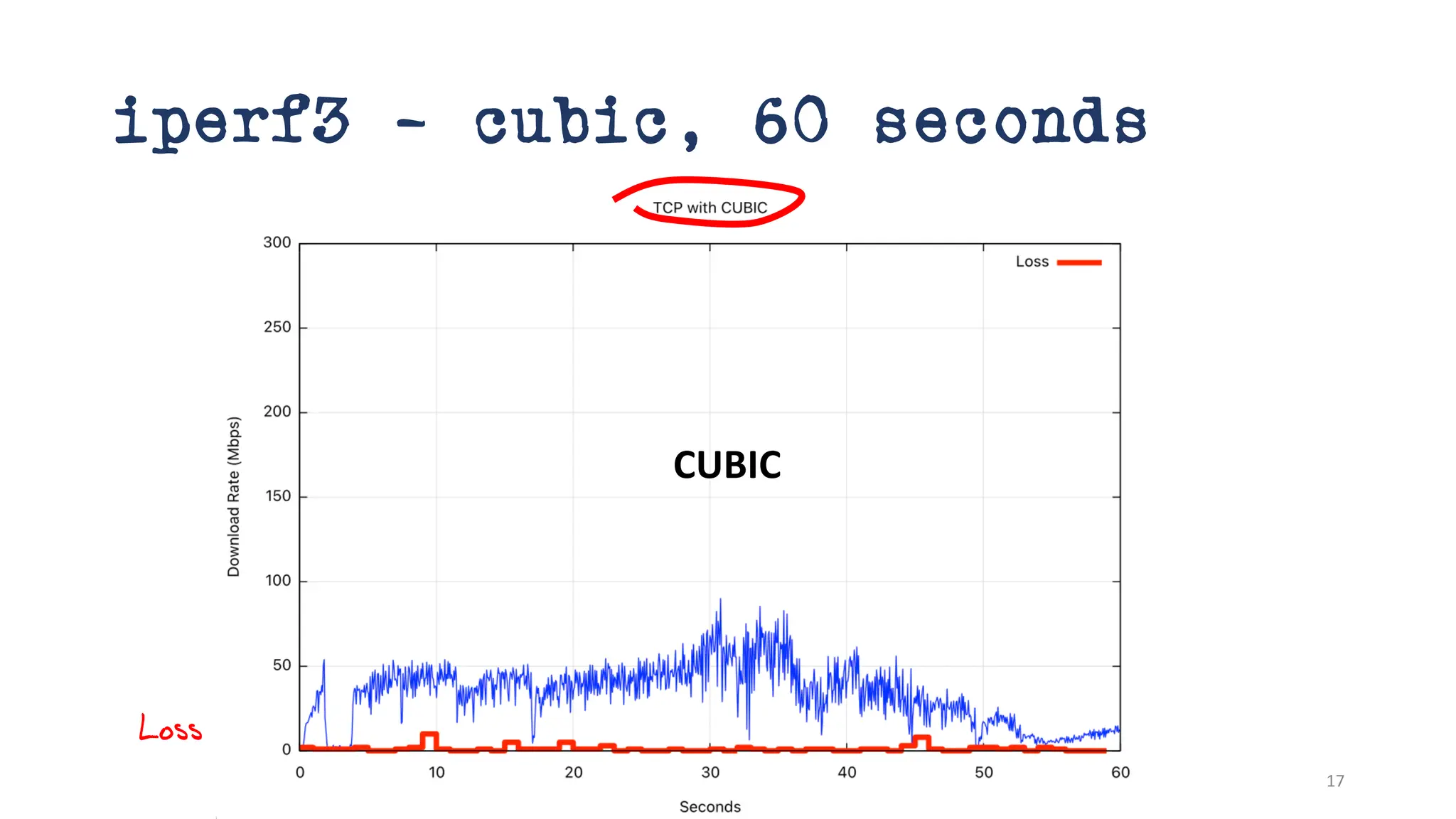
iperf3 – cubic, 60 seconds
CUBIC
Loss
17
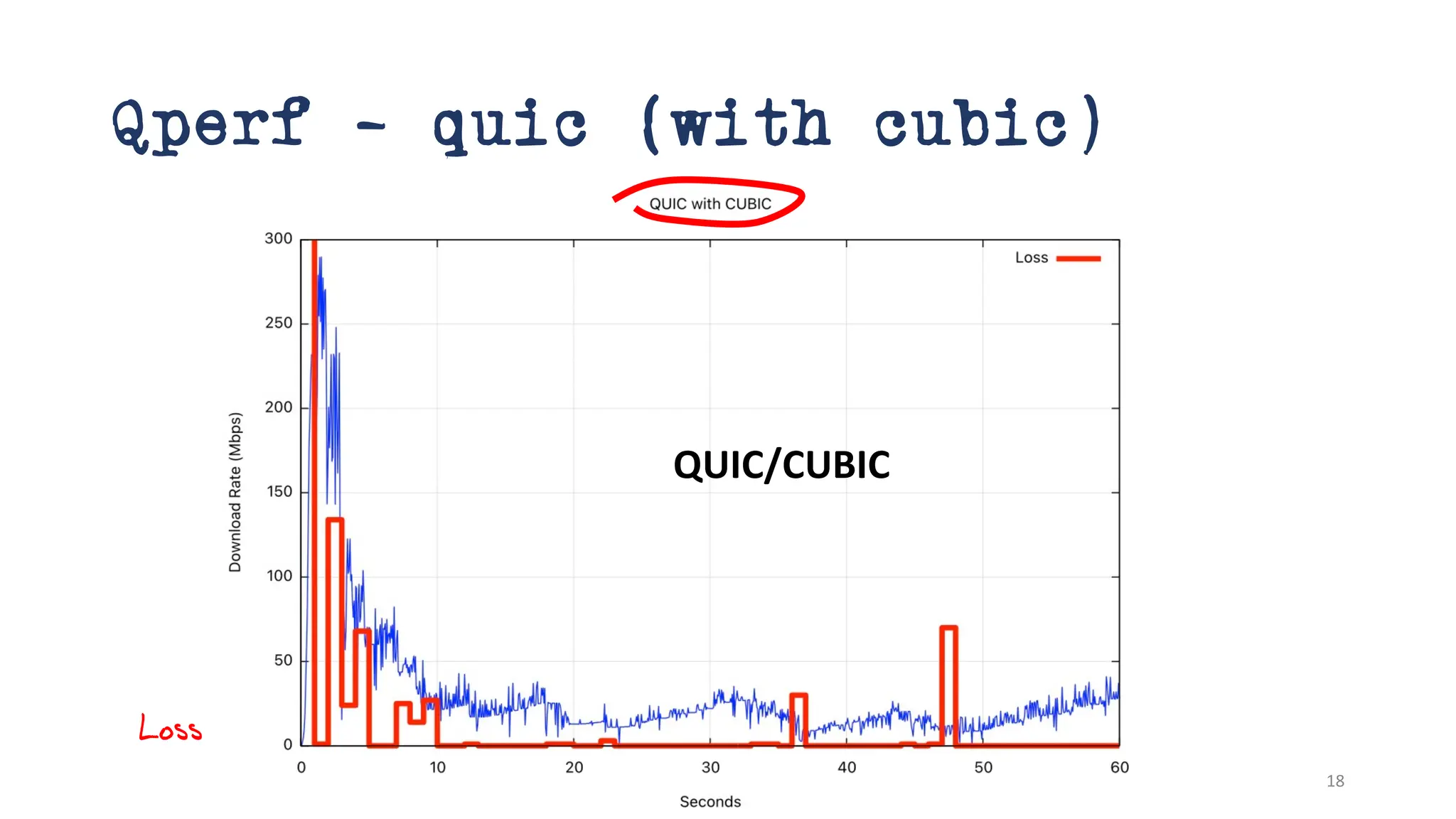
Qperf – quic (with cubic)
QUIC/CUBIC
Loss
18
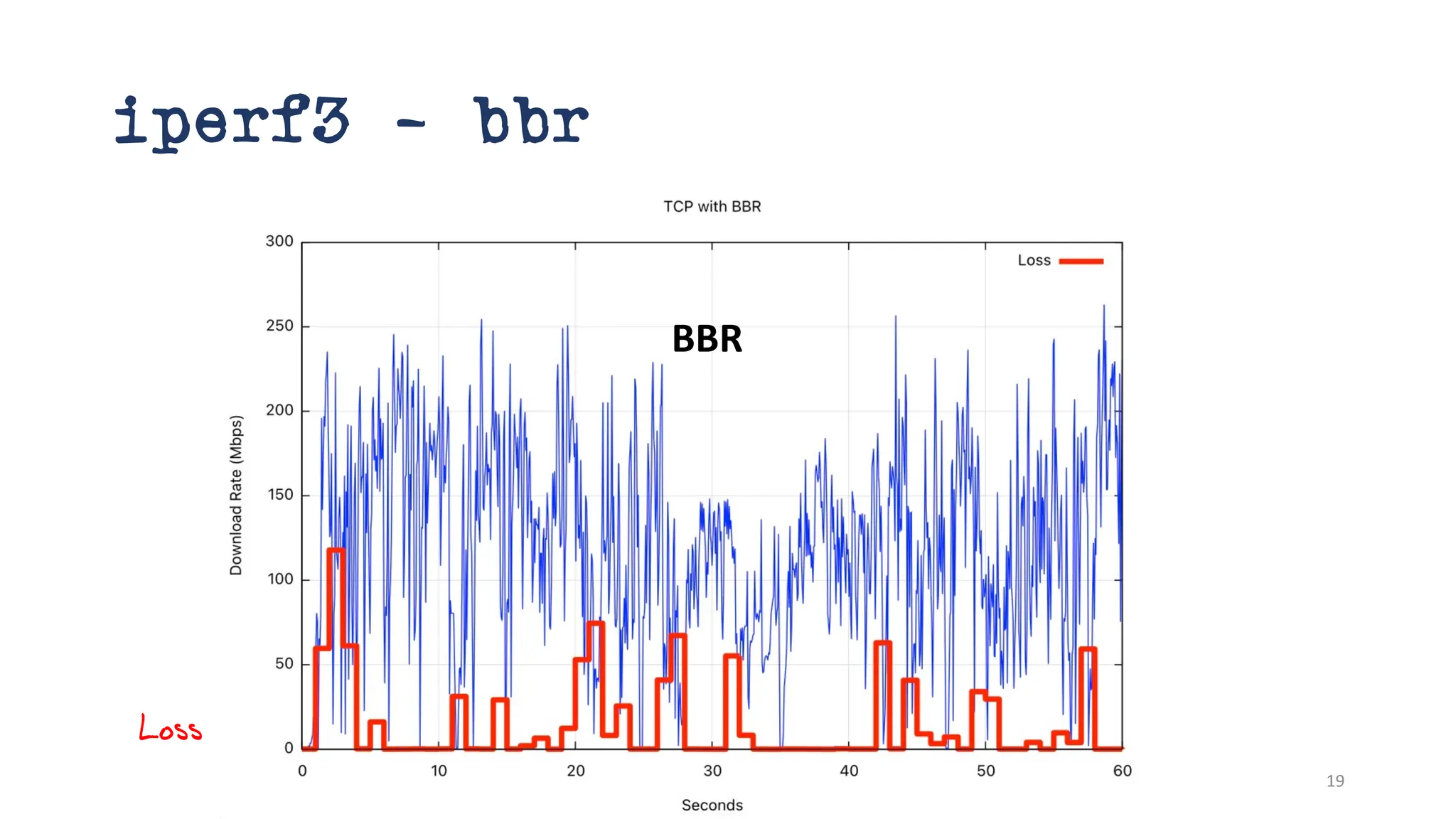
iperf3 - bbr
BBR
Loss
19
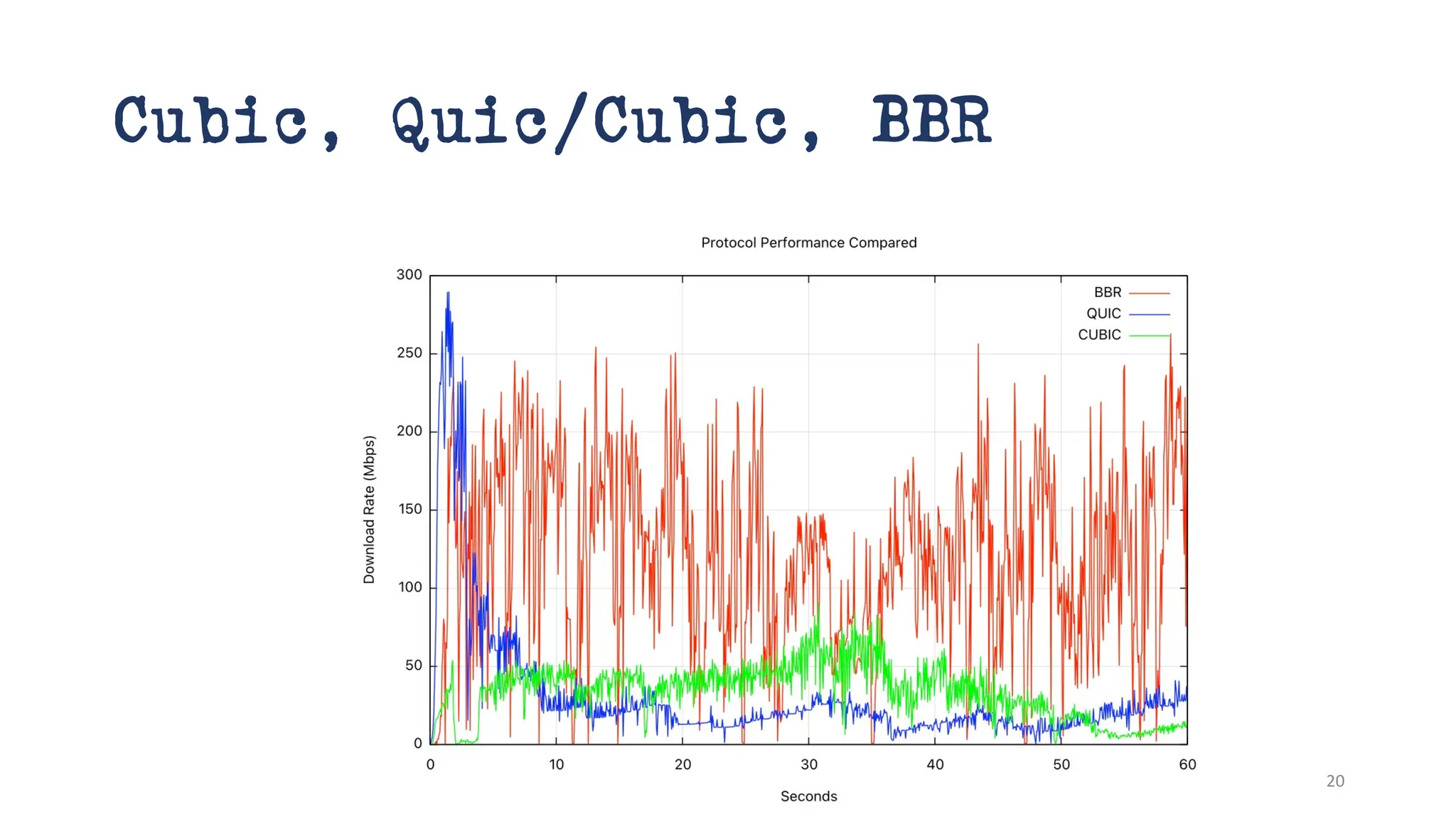
Cubic, Quic/Cubic, BBR
20
Protocol Considerations
• Starlink services have two issues for transport protocols:
• Very high jitter rates
• High levels of micro-loss
• Loss-based flow control algorithms will over-react and pull back the
sending rate
• Short transactions work well
• Paced connections (voice, zoom) tend to work well most of the time
• Bulk data transfer not so much
• It’s better to use a conventional TCP control with a large SACK window
or use loss-insensitive flow control algorithms, such as BBR, to get
high transfer rate performance out of this service
21
Questions?
22

IETF 118: Starlink Protocol Performance

  • 1.
  • 2.
    Low Earth Orbit •LEO satellites are stationed between 160km and 2,000km in altitude • High enough to stop them slowing down by “grazing” the denser parts of the earth’s ionosphere • Not so high that they lose the radiation protection afforded by the Inner Van Allen belt. • At a height of 550km, the minimum signal propagation delay to reach the satellite and back is 3.7ms, and at the horizon its 18ms screenshot from starwatch app Image - spacex 2
  • 3.
    Starlink Constellation If youuse a minimum angle of elevation of 25o then at an altitude of 550km each satellite spans a terrestrial footprint of no more than ~900Km radius, or 2M K2 At a minimum, a LEO satellite constellation needs 500 satellites to provide coverage of all parts of the earth’s surface For high quality coverage the constellation will need 6x- 20x that number (or more!) 3
  • 4.
    Starlink Constellation • 4,276in-service operational spacecraft, operating at an altitude of 550km https://satellitemap.space/ 4
  • 5.
    Looking Up Starlink trackssatellites with a minimum elevation of 25o. There are between 30 – 50 visible Starlink satellites at any point on the surface between latitudes 56o North and South Each satellite traverses the visible aperture for a maximum of ~3 minutes 5
  • 6.
    Starlink Scheduling • Asatellite is assigned to a user terminal in 15 second time slots • Tracking of a satellite (by phased array focussing) works across 11 degrees of arc per satellite in each 15 second slot client 11o 15 seconds 6
  • 7.
    Starlink Scheduling • Latencychanges on each satellite switch • If we take the minimum latency on each 15 second scheduling interval, we can expose the effects of the switching interval on latency • Across the 15 second interval there will be a drift in latency according to the satellite’s track and the distance relative to the two earth points • Other user traffic will also impact on latency, and also the effects of a large buffer in the user modem
  • 8.
    Starlink Spot Beams •Each spacecraft 2,000 MHz of spectrum for user downlink and splits it into 8x channels of 250 MHz each • Each satellite has 3 downlink antennas and 1 uplink antennas, and each can do 8 beams x 2 polarizations, for a total of 48 beams down and 16 up. 8 “Unveiling Beamforming Strategies of Starlink LEO Satellites” https://people.engineering.osu.edu/sites/default/files/2022-10/Kassas_Unveiling_Beamforming_Strategies_of_Starlink_LEO_Satellites.pdf
  • 9.
    Starlink’s reports $ starlink-grpc-tools/dish_grpc_text.py-v status id: ut01000000-00000000-005dd555 hardware_version: rev3_proto2 software_version: 5a923943-5acb-4d05-ac58-dd93e72b7862.uterm.release state: CONNECTED uptime: 481674 snr: seconds_to_first_nonempty_slot: 0.0 pop_ping_drop_rate: 0.0 downlink_throughput_bps: 16693.330078125 uplink_throughput_bps: 109127.3984375 pop_ping_latency_ms: 49.5 Alerts bit field: 0 fraction_obstructed: 0.04149007424712181 currently_obstructed: False seconds_obstructed: obstruction_duration: 1.9579976797103882 obstruction_interval: 540.0 direction_azimuth: -42.67951583862305 direction_elevation: 64.61225128173828 is_snr_above_noise_floor: True 9
  • 10.
  • 11.
  • 12.
    Reported Capacity & Latency •This is going to present some interesting issues for conventional TCP • TCP uses ACK pacing which means it attempts to optimize its sending rate over multiple RTT intervals • The variation in latency and capacity occurs at high frequency, which means that TCP control is going to struggle to optimise 12
  • 13.
    How well doesall this work? Speedtest measurements: We should be able to get ~120Mbps out of a starlink connection. Right? 13
  • 14.
  • 15.
  • 16.
    TCP Flow ControlAlgorithms “Ideal” Flow behaviour for each protocol 16
  • 17.
    iperf3 – cubic,60 seconds CUBIC Loss 17
  • 18.
    Qperf – quic(with cubic) QUIC/CUBIC Loss 18
  • 19.
  • 20.
  • 21.
    Protocol Considerations • Starlinkservices have two issues for transport protocols: • Very high jitter rates • High levels of micro-loss • Loss-based flow control algorithms will over-react and pull back the sending rate • Short transactions work well • Paced connections (voice, zoom) tend to work well most of the time • Bulk data transfer not so much • It’s better to use a conventional TCP control with a large SACK window or use loss-insensitive flow control algorithms, such as BBR, to get high transfer rate performance out of this service 21
  • 22.