Landscape uses of shrubs
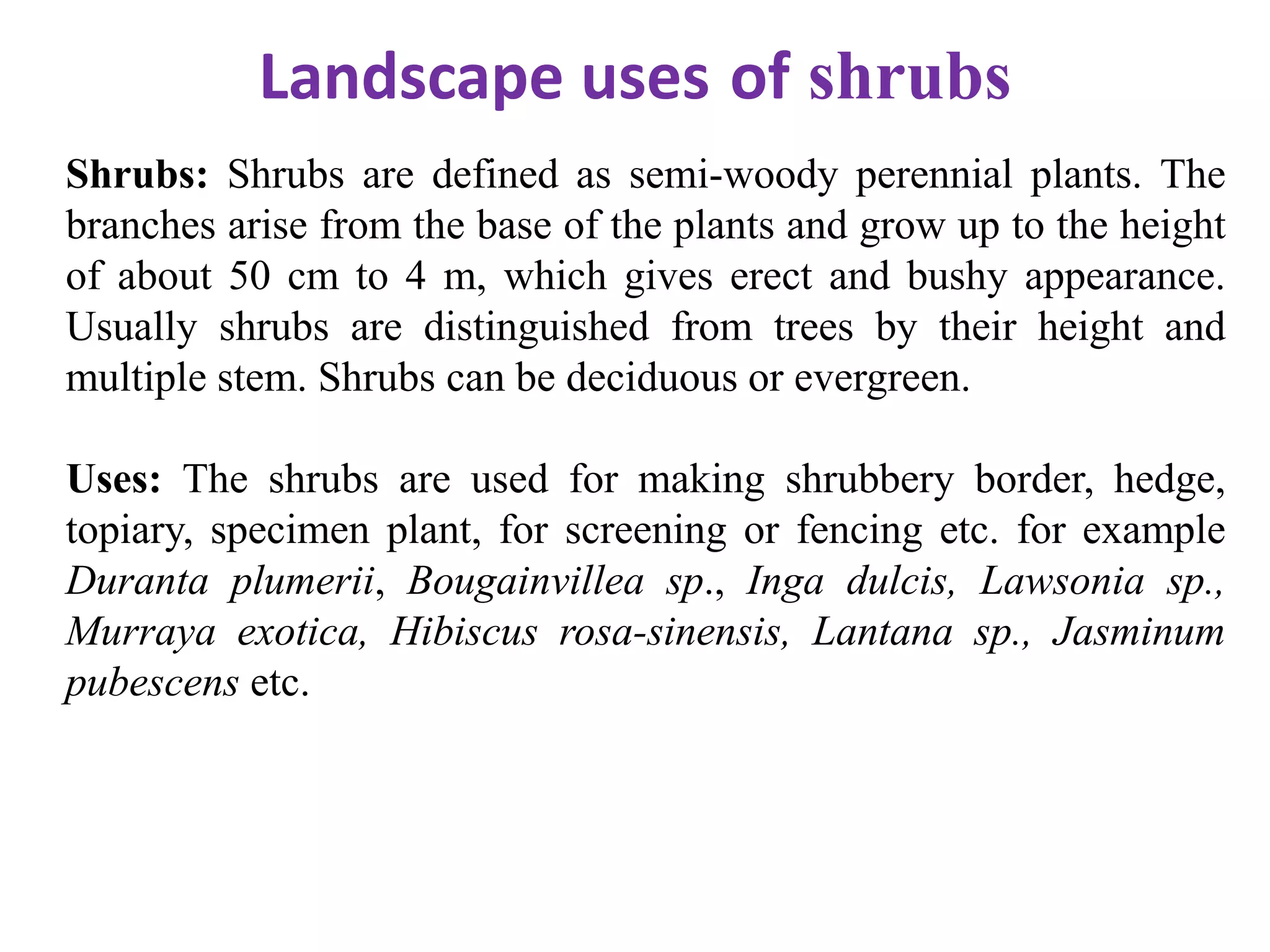
Shrubs: Shrubs are defined as semi-woody perennial plants. The
branches arise from the base of the plants and grow up to the height
of about 50 cm to 4 m, which gives erect and bushy appearance.
Usually shrubs are distinguished from trees by their height and
multiple stem. Shrubs can be deciduous or evergreen.
Uses: The shrubs are used for making shrubbery border, hedge,
topiary, specimen plant, for screening or fencing etc. for example
Duranta plumerii, Bougainvillea sp., Inga dulcis, Lawsonia sp.,
Murraya exotica, Hibiscus rosa-sinensis, Lantana sp., Jasminum
pubescens etc.
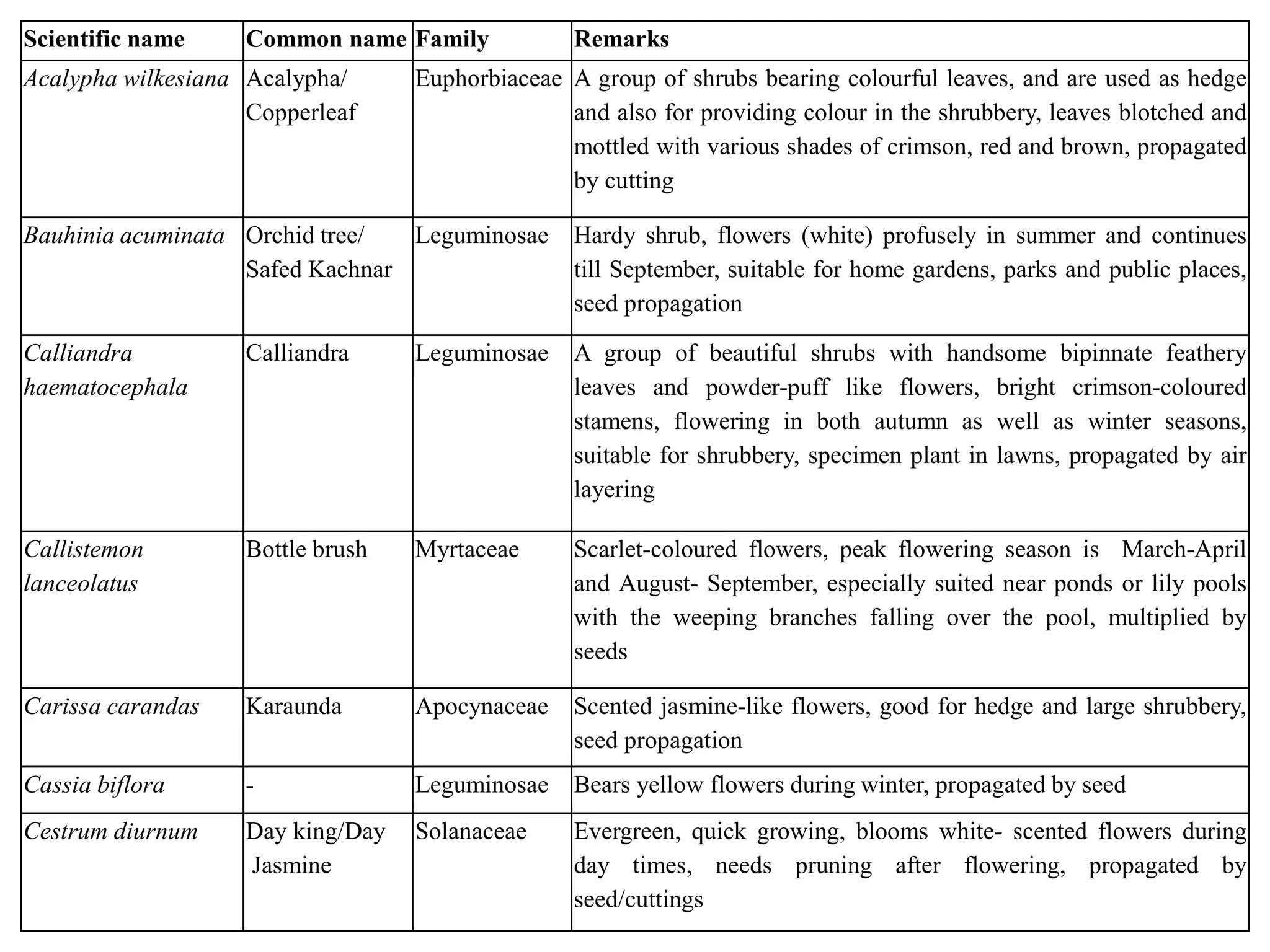
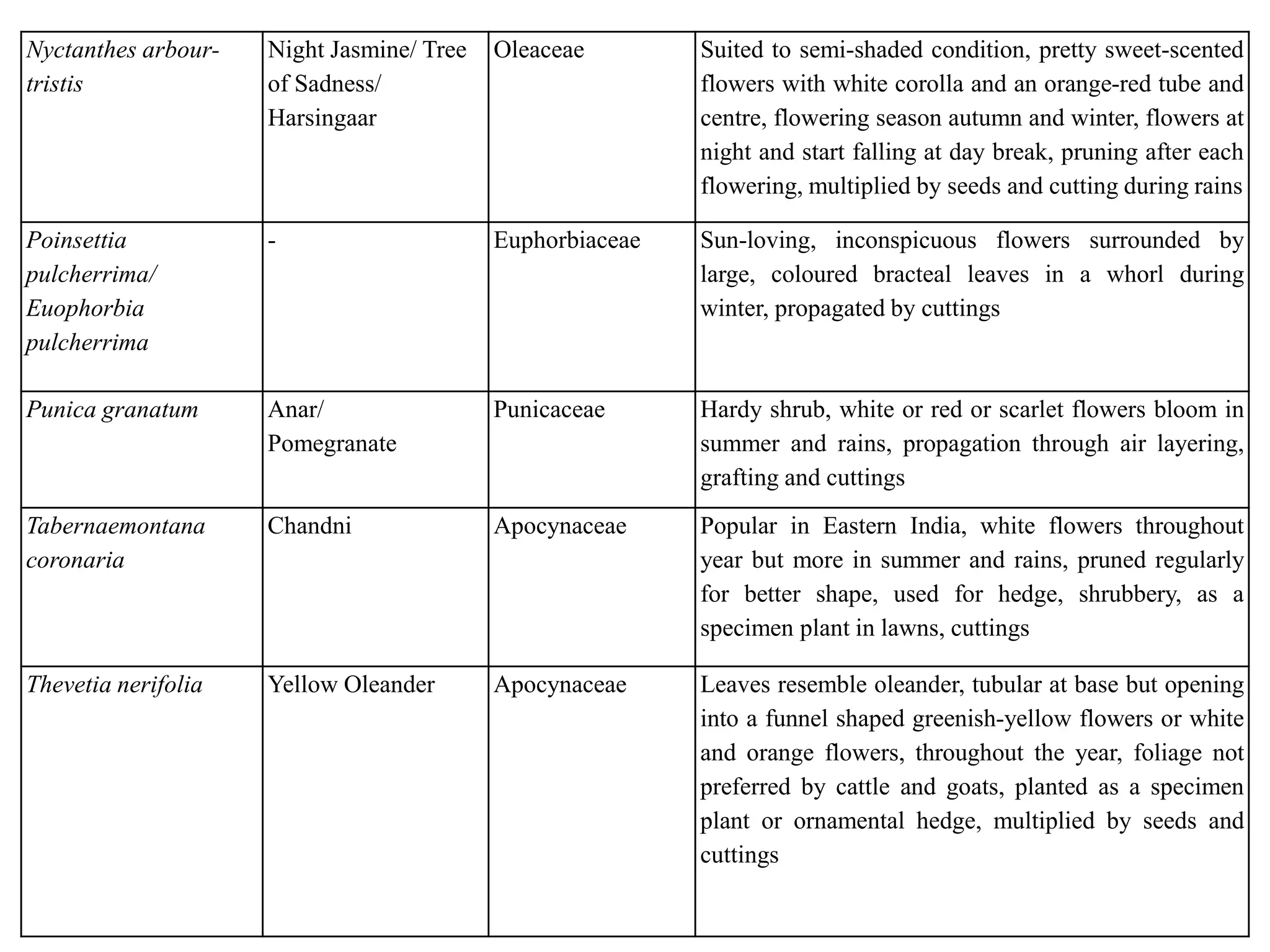
Scientific name Common name Family Remarks
Acalypha wilkesiana Acalypha/
Copperleaf
Euphorbiaceae A group of shrubs bearing colourful leaves, and are used as hedge
and also for providing colour in the shrubbery, leaves blotched and
mottled with various shades of crimson, red and brown, propagated
by cutting
Bauhinia acuminata Orchid tree/
Safed Kachnar
Leguminosae Hardy shrub, flowers (white) profusely in summer and continues
till September, suitable for home gardens, parks and public places,
seed propagation
Calliandra
haematocephala
Calliandra Leguminosae A group of beautiful shrubs with handsome bipinnate feathery
leaves and powder-puff like flowers, bright crimson-coloured
stamens, flowering in both autumn as well as winter seasons,
suitable for shrubbery, specimen plant in lawns, propagated by air
layering
Callistemon
lanceolatus
Bottle brush Myrtaceae Scarlet-coloured flowers, peak flowering season is March-April
and August- September, especially suited near ponds or lily pools
with the weeping branches falling over the pool, multiplied by
seeds
Carissa carandas Karaunda Apocynaceae Scented jasmine-like flowers, good for hedge and large shrubbery,
seed propagation
Cassia biflora - Leguminosae Bears yellow flowers during winter, propagated by seed
Cestrum diurnum Day king/Day
Jasmine
Solanaceae Evergreen, quick growing, blooms white- scented flowers during
day times, needs pruning after flowering, propagated by
seed/cuttings
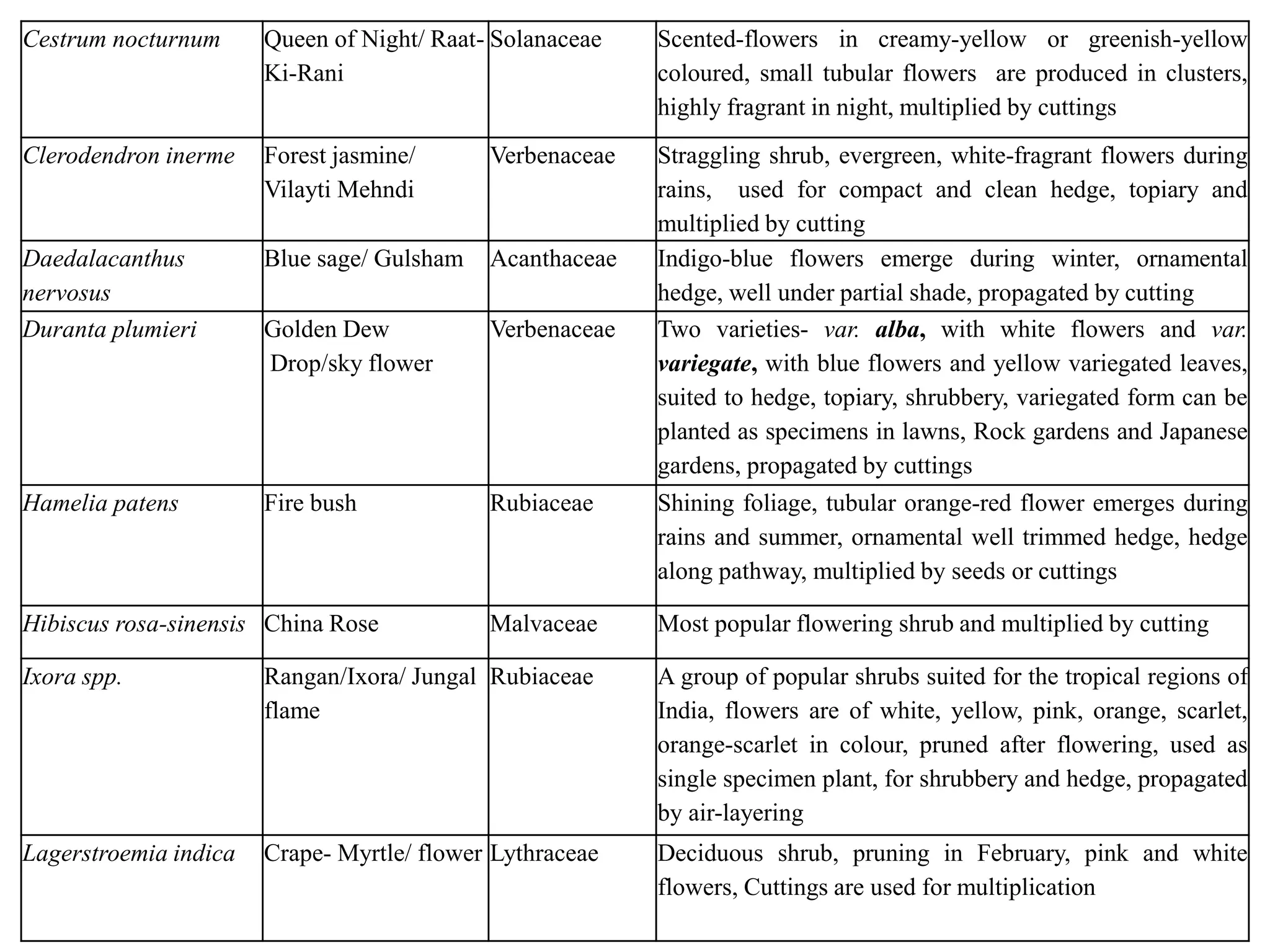
Cestrum nocturnum Queen of Night/ Raat-
Ki-Rani
Solanaceae Scented-flowers in creamy-yellow or greenish-yellow
coloured, small tubular flowers are produced in clusters,
highly fragrant in night, multiplied by cuttings
Clerodendron inerme Forest jasmine/
Vilayti Mehndi
Verbenaceae Straggling shrub, evergreen, white-fragrant flowers during
rains, used for compact and clean hedge, topiary and
multiplied by cutting
Daedalacanthus
nervosus
Blue sage/ Gulsham Acanthaceae Indigo-blue flowers emerge during winter, ornamental
hedge, well under partial shade, propagated by cutting
Duranta plumieri Golden Dew
Drop/sky flower
Verbenaceae Two varieties- var. alba, with white flowers and var.
variegate, with blue flowers and yellow variegated leaves,
suited to hedge, topiary, shrubbery, variegated form can be
planted as specimens in lawns, Rock gardens and Japanese
gardens, propagated by cuttings
Hamelia patens Fire bush Rubiaceae Shining foliage, tubular orange-red flower emerges during
rains and summer, ornamental well trimmed hedge, hedge
along pathway, multiplied by seeds or cuttings
Hibiscus rosa-sinensis China Rose Malvaceae Most popular flowering shrub and multiplied by cutting
Ixora spp. Rangan/Ixora/ Jungal
flame
Rubiaceae A group of popular shrubs suited for the tropical regions of
India, flowers are of white, yellow, pink, orange, scarlet,
orange-scarlet in colour, pruned after flowering, used as
single specimen plant, for shrubbery and hedge, propagated
by air-layering
Lagerstroemia indica Crape- Myrtle/ flower Lythraceae Deciduous shrub, pruning in February, pink and white
flowers, Cuttings are used for multiplication
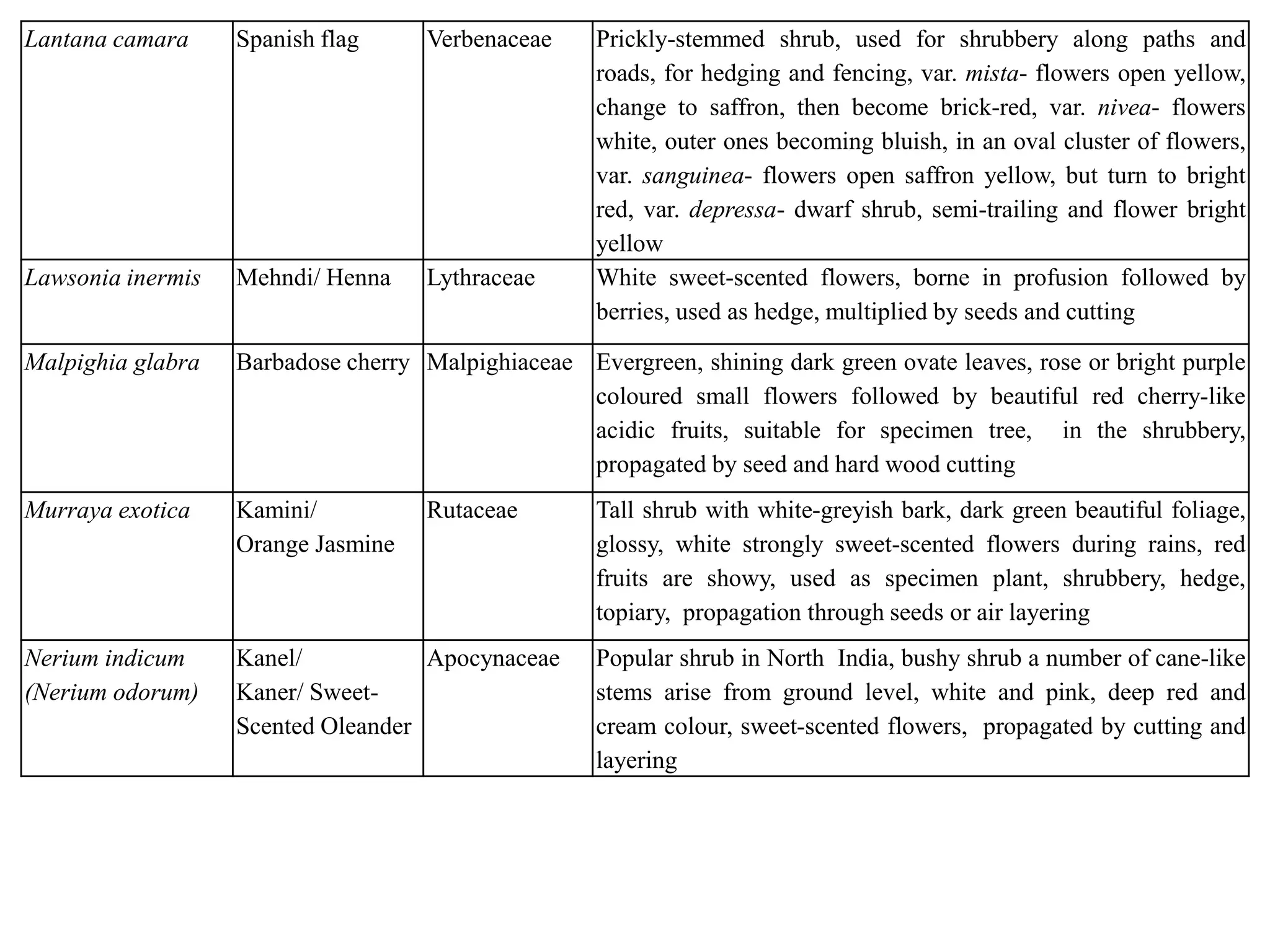
Lantana camara Spanish flag Verbenaceae Prickly-stemmed shrub, used for shrubbery along paths and
roads, for hedging and fencing, var. mista- flowers open yellow,
change to saffron, then become brick-red, var. nivea- flowers
white, outer ones becoming bluish, in an oval cluster of flowers,
var. sanguinea- flowers open saffron yellow, but turn to bright
red, var. depressa- dwarf shrub, semi-trailing and flower bright
yellow
Lawsonia inermis Mehndi/ Henna Lythraceae White sweet-scented flowers, borne in profusion followed by
berries, used as hedge, multiplied by seeds and cutting
Malpighia glabra Barbadose cherry Malpighiaceae Evergreen, shining dark green ovate leaves, rose or bright purple
coloured small flowers followed by beautiful red cherry-like
acidic fruits, suitable for specimen tree, in the shrubbery,
propagated by seed and hard wood cutting
Murraya exotica Kamini/
Orange Jasmine
Rutaceae Tall shrub with white-greyish bark, dark green beautiful foliage,
glossy, white strongly sweet-scented flowers during rains, red
fruits are showy, used as specimen plant, shrubbery, hedge,
topiary, propagation through seeds or air layering
Nerium indicum
(Nerium odorum)
Kanel/
Kaner/ Sweet-
Scented Oleander
Apocynaceae Popular shrub in North India, bushy shrub a number of cane-like
stems arise from ground level, white and pink, deep red and
cream colour, sweet-scented flowers, propagated by cutting and
layering
Nyctanthes arbour-
tristis
Night Jasmine/ Tree
of Sadness/
Harsingaar
Oleaceae Suited to semi-shaded condition, pretty sweet-scented
flowers with white corolla and an orange-red tube and
centre, flowering season autumn and winter, flowers at
night and start falling at day break, pruning after each
flowering, multiplied by seeds and cutting during rains
Poinsettia
pulcherrima/
Euophorbia
pulcherrima
- Euphorbiaceae Sun-loving, inconspicuous flowers surrounded by
large, coloured bracteal leaves in a whorl during
winter, propagated by cuttings
Punica granatum Anar/
Pomegranate
Punicaceae Hardy shrub, white or red or scarlet flowers bloom in
summer and rains, propagation through air layering,
grafting and cuttings
Tabernaemontana
coronaria
Chandni Apocynaceae Popular in Eastern India, white flowers throughout
year but more in summer and rains, pruned regularly
for better shape, used for hedge, shrubbery, as a
specimen plant in lawns, cuttings
Thevetia nerifolia Yellow Oleander Apocynaceae Leaves resemble oleander, tubular at base but opening
into a funnel shaped greenish-yellow flowers or white
and orange flowers, throughout the year, foliage not
preferred by cattle and goats, planted as a specimen
plant or ornamental hedge, multiplied by seeds and
cuttings
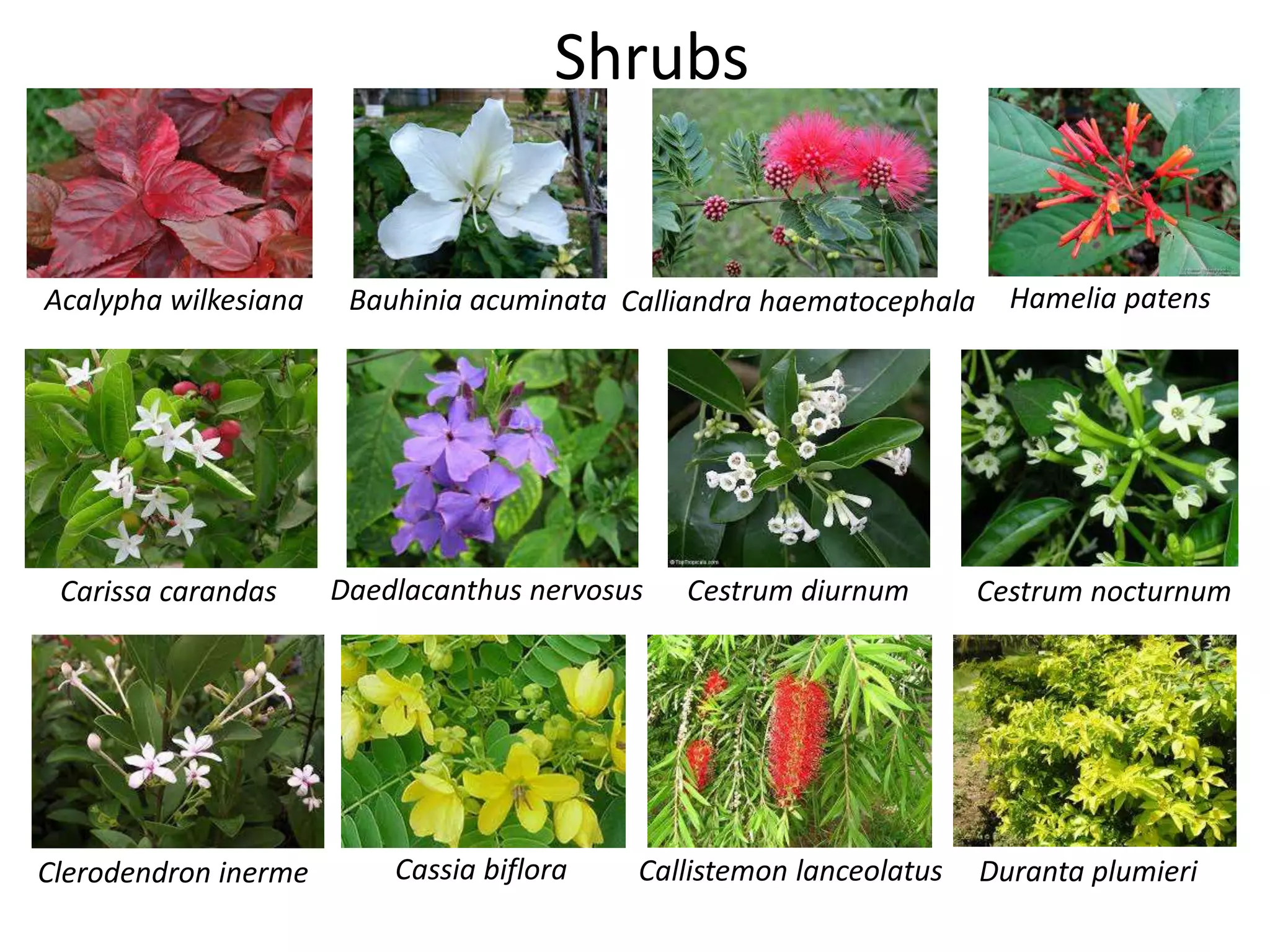
Shrubs
Acalypha wilkesiana Bauhinia acuminata Calliandra haematocephala
Callistemon lanceolatus
Carissa carandas
Cassia biflora
Cestrum diurnum Cestrum nocturnum
Clerodendron inerme
Daedlacanthus nervosus
Duranta plumieri
Hamelia patens
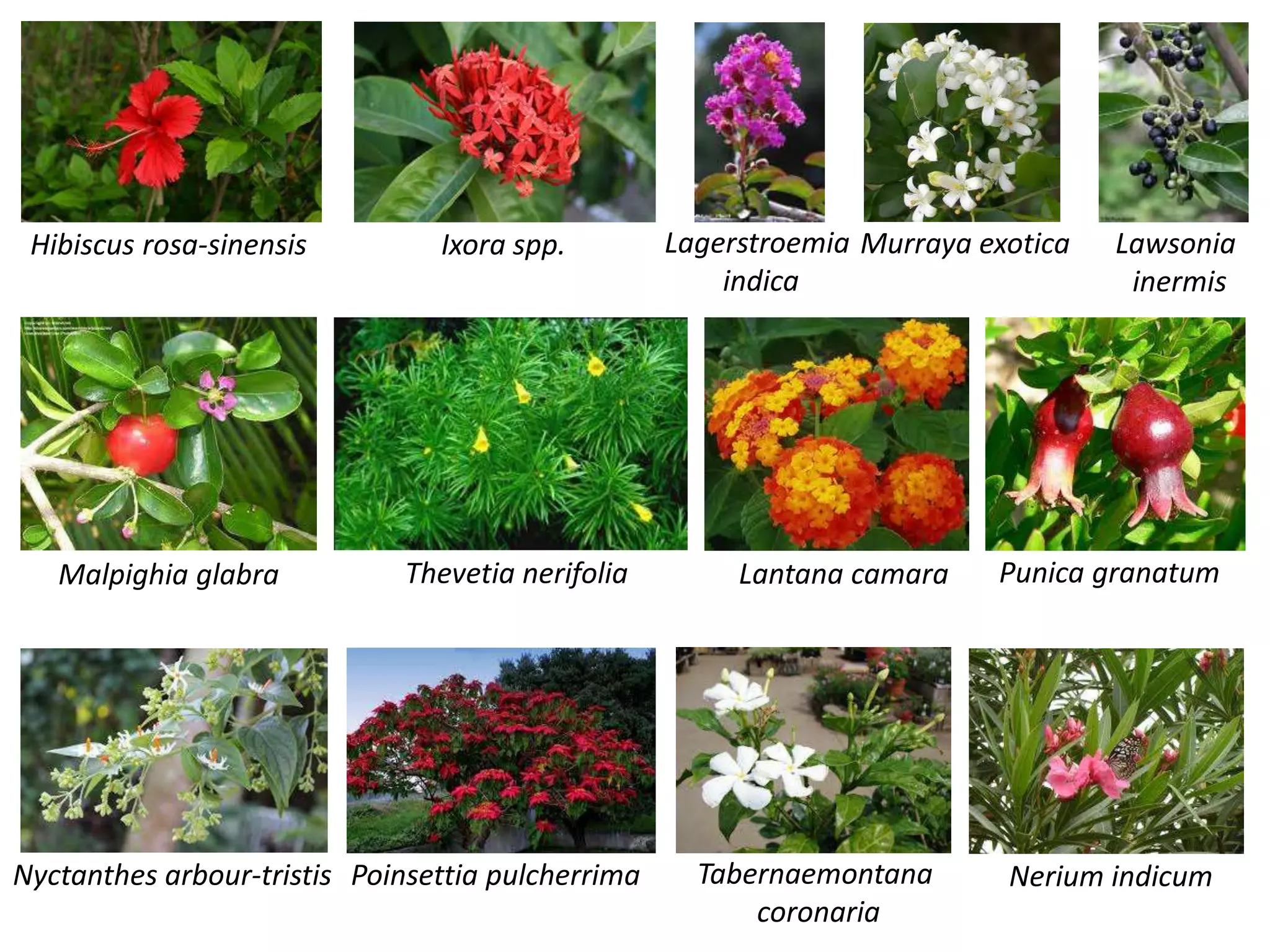
Hibiscus rosa-sinensis Ixora spp. Lagerstroemia
indica
Lantana camara
Lawsonia
inermis
Malpighia glabra
Murraya exotica
Nerium indicum
Nyctanthes arbour-tristis Poinsettia pulcherrima
Punica granatum
Tabernaemontana
coronaria
Thevetia nerifolia

Identification of Shrubs

  • 1.
    Landscape uses ofshrubs Shrubs: Shrubs are defined as semi-woody perennial plants. The branches arise from the base of the plants and grow up to the height of about 50 cm to 4 m, which gives erect and bushy appearance. Usually shrubs are distinguished from trees by their height and multiple stem. Shrubs can be deciduous or evergreen. Uses: The shrubs are used for making shrubbery border, hedge, topiary, specimen plant, for screening or fencing etc. for example Duranta plumerii, Bougainvillea sp., Inga dulcis, Lawsonia sp., Murraya exotica, Hibiscus rosa-sinensis, Lantana sp., Jasminum pubescens etc.
  • 2.
    Scientific name Commonname Family Remarks Acalypha wilkesiana Acalypha/ Copperleaf Euphorbiaceae A group of shrubs bearing colourful leaves, and are used as hedge and also for providing colour in the shrubbery, leaves blotched and mottled with various shades of crimson, red and brown, propagated by cutting Bauhinia acuminata Orchid tree/ Safed Kachnar Leguminosae Hardy shrub, flowers (white) profusely in summer and continues till September, suitable for home gardens, parks and public places, seed propagation Calliandra haematocephala Calliandra Leguminosae A group of beautiful shrubs with handsome bipinnate feathery leaves and powder-puff like flowers, bright crimson-coloured stamens, flowering in both autumn as well as winter seasons, suitable for shrubbery, specimen plant in lawns, propagated by air layering Callistemon lanceolatus Bottle brush Myrtaceae Scarlet-coloured flowers, peak flowering season is March-April and August- September, especially suited near ponds or lily pools with the weeping branches falling over the pool, multiplied by seeds Carissa carandas Karaunda Apocynaceae Scented jasmine-like flowers, good for hedge and large shrubbery, seed propagation Cassia biflora - Leguminosae Bears yellow flowers during winter, propagated by seed Cestrum diurnum Day king/Day Jasmine Solanaceae Evergreen, quick growing, blooms white- scented flowers during day times, needs pruning after flowering, propagated by seed/cuttings
  • 3.
    Cestrum nocturnum Queenof Night/ Raat- Ki-Rani Solanaceae Scented-flowers in creamy-yellow or greenish-yellow coloured, small tubular flowers are produced in clusters, highly fragrant in night, multiplied by cuttings Clerodendron inerme Forest jasmine/ Vilayti Mehndi Verbenaceae Straggling shrub, evergreen, white-fragrant flowers during rains, used for compact and clean hedge, topiary and multiplied by cutting Daedalacanthus nervosus Blue sage/ Gulsham Acanthaceae Indigo-blue flowers emerge during winter, ornamental hedge, well under partial shade, propagated by cutting Duranta plumieri Golden Dew Drop/sky flower Verbenaceae Two varieties- var. alba, with white flowers and var. variegate, with blue flowers and yellow variegated leaves, suited to hedge, topiary, shrubbery, variegated form can be planted as specimens in lawns, Rock gardens and Japanese gardens, propagated by cuttings Hamelia patens Fire bush Rubiaceae Shining foliage, tubular orange-red flower emerges during rains and summer, ornamental well trimmed hedge, hedge along pathway, multiplied by seeds or cuttings Hibiscus rosa-sinensis China Rose Malvaceae Most popular flowering shrub and multiplied by cutting Ixora spp. Rangan/Ixora/ Jungal flame Rubiaceae A group of popular shrubs suited for the tropical regions of India, flowers are of white, yellow, pink, orange, scarlet, orange-scarlet in colour, pruned after flowering, used as single specimen plant, for shrubbery and hedge, propagated by air-layering Lagerstroemia indica Crape- Myrtle/ flower Lythraceae Deciduous shrub, pruning in February, pink and white flowers, Cuttings are used for multiplication
  • 4.
    Lantana camara Spanishflag Verbenaceae Prickly-stemmed shrub, used for shrubbery along paths and roads, for hedging and fencing, var. mista- flowers open yellow, change to saffron, then become brick-red, var. nivea- flowers white, outer ones becoming bluish, in an oval cluster of flowers, var. sanguinea- flowers open saffron yellow, but turn to bright red, var. depressa- dwarf shrub, semi-trailing and flower bright yellow Lawsonia inermis Mehndi/ Henna Lythraceae White sweet-scented flowers, borne in profusion followed by berries, used as hedge, multiplied by seeds and cutting Malpighia glabra Barbadose cherry Malpighiaceae Evergreen, shining dark green ovate leaves, rose or bright purple coloured small flowers followed by beautiful red cherry-like acidic fruits, suitable for specimen tree, in the shrubbery, propagated by seed and hard wood cutting Murraya exotica Kamini/ Orange Jasmine Rutaceae Tall shrub with white-greyish bark, dark green beautiful foliage, glossy, white strongly sweet-scented flowers during rains, red fruits are showy, used as specimen plant, shrubbery, hedge, topiary, propagation through seeds or air layering Nerium indicum (Nerium odorum) Kanel/ Kaner/ Sweet- Scented Oleander Apocynaceae Popular shrub in North India, bushy shrub a number of cane-like stems arise from ground level, white and pink, deep red and cream colour, sweet-scented flowers, propagated by cutting and layering
  • 5.
    Nyctanthes arbour- tristis Night Jasmine/Tree of Sadness/ Harsingaar Oleaceae Suited to semi-shaded condition, pretty sweet-scented flowers with white corolla and an orange-red tube and centre, flowering season autumn and winter, flowers at night and start falling at day break, pruning after each flowering, multiplied by seeds and cutting during rains Poinsettia pulcherrima/ Euophorbia pulcherrima - Euphorbiaceae Sun-loving, inconspicuous flowers surrounded by large, coloured bracteal leaves in a whorl during winter, propagated by cuttings Punica granatum Anar/ Pomegranate Punicaceae Hardy shrub, white or red or scarlet flowers bloom in summer and rains, propagation through air layering, grafting and cuttings Tabernaemontana coronaria Chandni Apocynaceae Popular in Eastern India, white flowers throughout year but more in summer and rains, pruned regularly for better shape, used for hedge, shrubbery, as a specimen plant in lawns, cuttings Thevetia nerifolia Yellow Oleander Apocynaceae Leaves resemble oleander, tubular at base but opening into a funnel shaped greenish-yellow flowers or white and orange flowers, throughout the year, foliage not preferred by cattle and goats, planted as a specimen plant or ornamental hedge, multiplied by seeds and cuttings
  • 6.
    Shrubs Acalypha wilkesiana Bauhiniaacuminata Calliandra haematocephala Callistemon lanceolatus Carissa carandas Cassia biflora Cestrum diurnum Cestrum nocturnum Clerodendron inerme Daedlacanthus nervosus Duranta plumieri Hamelia patens
  • 7.
    Hibiscus rosa-sinensis Ixoraspp. Lagerstroemia indica Lantana camara Lawsonia inermis Malpighia glabra Murraya exotica Nerium indicum Nyctanthes arbour-tristis Poinsettia pulcherrima Punica granatum Tabernaemontana coronaria Thevetia nerifolia