EEEE----SERVICES STATEGIC PLANSERVICES STATEGIC PLANSERVICES STATEGIC PLANSERVICES STATEGIC PLAN
Thinking Boxes for E-Service Strategic Value
johnmacasio@onecitizen.net
Essential Question
How to strategically view the
change requirement of the
enterprise, and to integrate the
aligned value of e-services to
deliver the strategic intent of the
johnmacasio@onecitizen.net
aligned value of e-services to
deliver the strategic intent of the
business?
Essential Question
What are the framework,
metrics, process and tools to
understand the bigger picture
of the enterprise, and to draw
the models that elaborate the
johnmacasio@onecitizen.net
the models that elaborate the
distinction and relationship of
performance, function,
information and technology of
the organization?
Essential Question
How to facilitate and draft the
formulation of strategic plan
which clearly defines the
alignment of enterprise’s
baseline information and
johnmacasio@onecitizen.net
baseline information and
change requirements to
purpose, stakeholders,
organization, resources,
programs, time and funds?
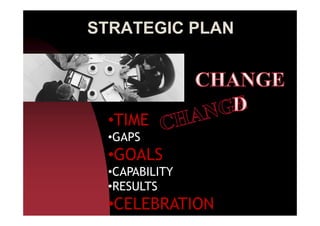
STRATEGIC PLAN
•TIME•TIME
•GAPS
•GOALS
•CAPABILITY
•RESULTS
•CELEBRATION
AgendaAgendaAgendaAgenda
Strategic Intent
Strategic Value of ICT
Strategic Planning
johnmacasio@onecitizen.net
Strategic Planning
Template
Software
Strategic IntentStrategic IntentStrategic IntentStrategic Intent ––––
The End PointsThe End PointsThe End PointsThe End Points
The striving for performance is directed
towards the defined strategic intent of
the organization’s stakeholders. The
functions, process, information,
technology are evolved to the planned
and agreed end points:and agreed end points:
Position (direction)
Diffentiator (discovery)
Destiny (destiny)
-Gary Hammel & C.K. Prahalad
Strategic IntentStrategic IntentStrategic IntentStrategic Intent ––––
The End PointsThe End PointsThe End PointsThe End Points
Critical Attributes
Sense of Direction -point of view on
long term market or competitive
position
-Gary Hammel & C.K. Prahalad
Strategic IntentStrategic IntentStrategic IntentStrategic Intent ––––
The End PointsThe End PointsThe End PointsThe End Points
Critical Attributes
Sense of Discovery -point of view on
what differentiate -unique point of view
about the future
-Gary Hammel & C.K. Prahalad
Strategic IntentStrategic IntentStrategic IntentStrategic Intent ––––
The End PointsThe End PointsThe End PointsThe End Points
Critical Attributes
Sense of Destiny – perceive goal as
inherently valuable
-Gary Hammel & C.K. Prahalad
Defining Strategic Value of ICT
Services
Important Questions
– What is the strategic alignment
of ICT services to the business
strategy of the organization?strategy of the organization?
Defining Strategic Value of ICT
Services
Important Question
– Which strategic alignment
models, decision domains, the
functional responsibilities willfunctional responsibilities will
bring strategic value of ICT
services in the organization?
Key Issues:
Lack of alignment between the business
strategy and the ICT service strategy of
the organization making investments
Defining Strategic Value of ICT
Services
strategy and the ICT service strategy of
the organization making investments
Lack of dynamic administrative process
to ensure continuous alignment
between the business domain and ICT
domain.
-Venkatraman, Henderson & Oldach
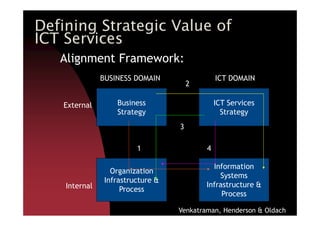
Business
Strategy
ICT Services
Strategy
BUSINESS DOMAIN ICT DOMAIN
External
2
Defining Strategic Value of
ICT Services
Alignment Framework:
Strategy
Information
Systems
Infrastructure &
Process
Organization
Infrastructure &
Process
Strategy
Internal
1
3
4
Venkatraman, Henderson & Oldach
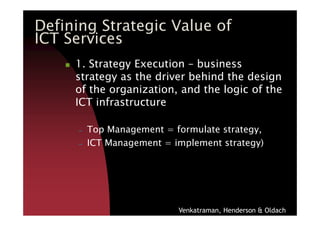
1. Strategy Execution – business
strategy as the driver behind the design
of the organization, and the logic of the
ICT infrastructure
Defining Strategic Value of
ICT Services
– Top Management = formulate strategy,
– ICT Management = implement strategy)
Venkatraman, Henderson & Oldach
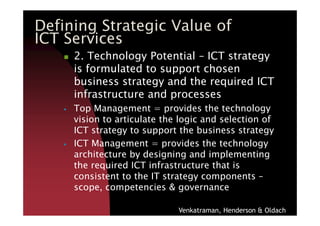
2. Technology Potential – ICT strategy
is formulated to support chosen
business strategy and the required ICT
infrastructure and processes
Top Management = provides the technology
Defining Strategic Value of
ICT Services
Top Management = provides the technology
vision to articulate the logic and selection of
ICT strategy to support the business strategy
ICT Management = provides the technology
architecture by designing and implementing
the required ICT infrastructure that is
consistent to the IT strategy components –
scope, competencies & governance
Venkatraman, Henderson & Oldach
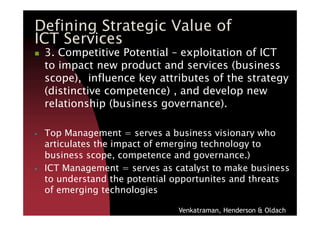
3. Competitive Potential – exploitation of ICT
to impact new product and services (business
scope), influence key attributes of the strategy
(distinctive competence) , and develop new
relationship (business governance).
Defining Strategic Value of
ICT Services
Top Management = serves a business visionary who
articulates the impact of emerging technology to
business scope, competence and governance.)
ICT Management = serves as catalyst to make business
to understand the potential opportunites and threats
of emerging technologies
Venkatraman, Henderson & Oldach
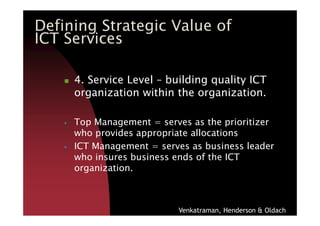
4. Service Level – building quality ICT
organization within the organization.
Defining Strategic Value of
ICT Services
Top Management = serves as the prioritizer
who provides appropriate allocations
ICT Management = serves as business leader
who insures business ends of the ICT
organization.
Venkatraman, Henderson & Oldach
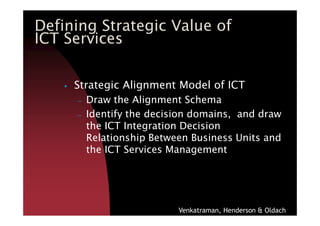
Strategic Alignment Model of ICT
– Draw the Alignment Schema
– Identify the decision domains, and draw
Defining Strategic Value of
ICT Services
– Identify the decision domains, and draw
the ICT Integration Decision
Relationship Between Business Units and
the ICT Services Management
Venkatraman, Henderson & Oldach
Strategic PlanningStrategic PlanningStrategic PlanningStrategic Planning
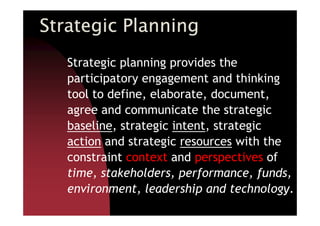
Strategic planning provides the
participatory engagement and thinking
tool to define, elaborate, document,
agree and communicate the strategicagree and communicate the strategic
baseline, strategic intent, strategic
action and strategic resources with the
constraint context and perspectives of
time, stakeholders, performance, funds,
environment, leadership and technology.
Strategic PlanningStrategic PlanningStrategic PlanningStrategic Planning
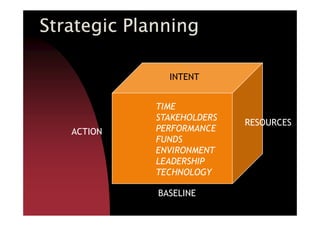
INTENT
TIME
STAKEHOLDERS
BASELINE
ACTION
RESOURCES
STAKEHOLDERS
PERFORMANCE
FUNDS
ENVIRONMENT
LEADERSHIP
TECHNOLOGY
Strategic IntentStrategic IntentStrategic IntentStrategic Intent
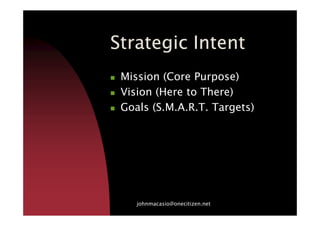
Mission (Core Purpose)
Vision (Here to There)
Goals (S.M.A.R.T. Targets)Goals (S.M.A.R.T. Targets)
johnmacasio@onecitizen.net
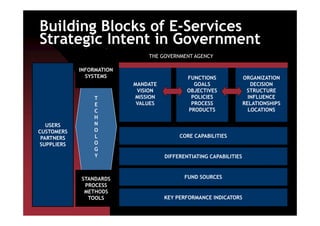
Building Blocks of E-Services
Strategic Intent in Government
MANDATE
VISION
MISSION
VALUES
T
E
C
FUNCTIONS
GOALS
OBJECTIVES
POLICIES
PROCESS
PRODUCTS
ORGANIZATION
DECISION
STRUCTURE
INFLUENCE
RELATIONSHIPS
LOCATIONS
THE GOVERNMENT AGENCY
INFORMATION
SYSTEMS
C
H
N
O
L
O
G
Y
USERS
CUSTOMERS
PARTNERS
SUPPLIERS
CORE CAPABILITIES
DIFFERENTIATING CAPABILITIES
KEY PERFORMANCE INDICATORS
FUND SOURCESSTANDARDS
PROCESS
METHODS
TOOLS
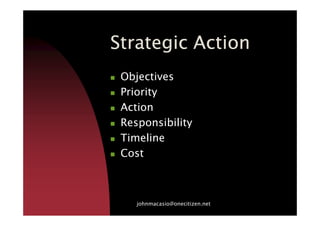
Strategic ActionStrategic ActionStrategic ActionStrategic Action
Objectives
Priority
ActionAction
Responsibility
Timeline
Cost
johnmacasio@onecitizen.net
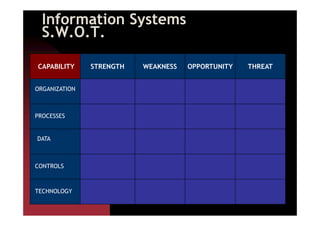
CAPABILITY STRENGTH WEAKNESS OPPORTUNITY THREAT
ORGANIZATION
PROCESSES
Information Systems
S.W.O.T.
PROCESSES
DATA
CONTROLS
TECHNOLOGY
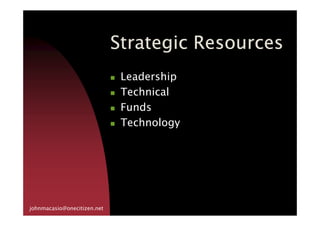
Strategic ResourcesStrategic ResourcesStrategic ResourcesStrategic Resources
Leadership
Technical
FundsFunds
Technology
johnmacasio@onecitizen.net
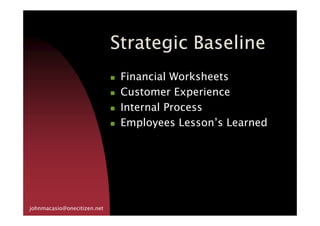
Strategic BaselineStrategic BaselineStrategic BaselineStrategic Baseline
Financial Worksheets
Customer Experience
Internal ProcessInternal Process
Employees Lesson’s Learned
johnmacasio@onecitizen.net
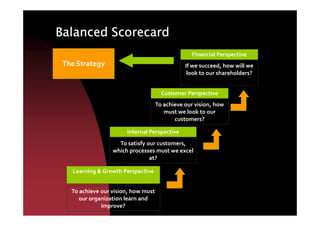
BalancedBalancedBalancedBalancedBalancedBalancedBalancedBalanced ScorecardScorecardScorecardScorecardScorecardScorecardScorecardScorecard
If we succeed, how will we
look to our shareholders?
Financial Perspective
To achieve our vision, how
must we look to our
Customer Perspective
The Strategy
must we look to our
customers?
To satisfy our customers,
which processes must we excel
at?
Internal Perspective
To achieve our vision, how must
our organization learn and
improve?
Learning & Growth Perspective
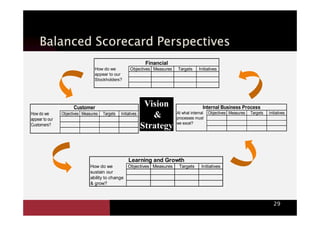
Balanced Scorecard PerspectivesBalanced Scorecard PerspectivesBalanced Scorecard PerspectivesBalanced Scorecard Perspectives
How do we Objectives Measures Targets Initiatives
appear to our
Stockholders?
Financial
How do we Objectives Measures Targets Initiatives
Customer
At what internal Objectives Measures Targets Initiatives
Internal Business ProcessVision
&
29
How do we Objectives Measures Targets Initiatives
appear to our
Customers?
At what internal Objectives Measures Targets Initiatives
processes must
we excel?
&
Strategy
How do we Objectives Measures Targets Initiatives
sustain our
ability to change
& grow?
Learning and Growth
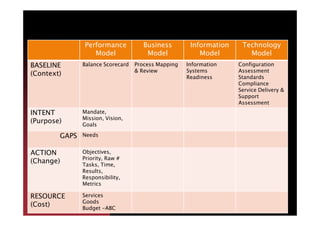
Performance
Model
Business
Model
Information
Model
Technology
Model
BASELINE
(Context)
Balance Scorecard Process Mapping
& Review
Information
Systems
Readiness
Configuration
Assessment
Standards
Compliance
Service Delivery &
Support
Assessment
INTENT Mandate,INTENT
(Purpose)
Mandate,
Mission, Vision,
Goals
GAPS Needs
ACTION
(Change)
Objectives,
Priority, Raw #
Tasks, Time,
Results,
Responsibility,
Metrics
RESOURCE
(Cost)
Services
Goods
Budget -ABC
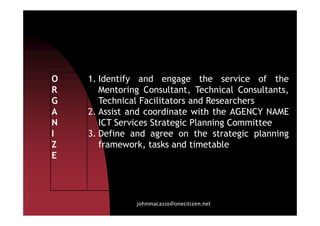
O
R
G
A
1. Identify and engage the service of the
Mentoring Consultant, Technical Consultants,
Technical Facilitators and Researchers
2. Assist and coordinate with the AGENCY NAME
johnmacasio@onecitizen.net
A
N
I
Z
E
2. Assist and coordinate with the AGENCY NAME
ICT Services Strategic Planning Committee
3. Define and agree on the strategic planning
framework, tasks and timetable
D
I
S
C
O
V
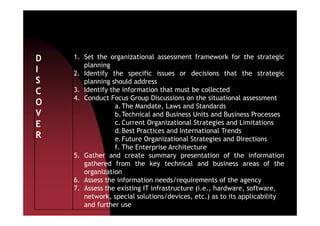
1. Set the organizational assessment framework for the strategic
planning
2. Identify the specific issues or decisions that the strategic
planning should address
3. Identify the information that must be collected
4. Conduct Focus Group Discussions on the situational assessment
a.The Mandate, Laws and Standards
b.Technical and Business Units and Business ProcessesV
E
R
b.Technical and Business Units and Business Processes
c.Current Organizational Strategies and Limitations
d.Best Practices and International Trends
e.Future Organizational Strategies and Directions
f. The Enterprise Architecture
5. Gather and create summary presentation of the information
gathered from the key technical and business areas of the
organization
6. Assess the information needs/requirements of the agency
7. Assess the existing IT infrastructure (i.e., hardware, software,
network, special solutions/devices, etc.) as to its applicability
and further use
D
E
F
I
N
E
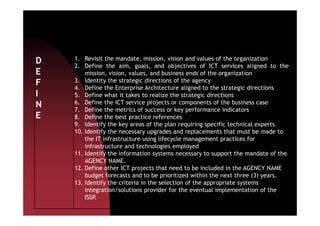
1. Revisit the mandate, mission, vision and values of the organization
2. Define the aim, goals, and objectives of ICT services aligned to the
mission, vision, values, and business ends of the organization
3. Identity the strategic directions of the agency
4. Define the Enterprise Architecture aligned to the strategic directions
5. Define what it takes to realize the strategic directions
6. Define the ICT service projects or components of the business case
7. Define the metrics of success or key performance indicators
E
7. Define the metrics of success or key performance indicators
8. Define the best practice references
9. Identify the key areas of the plan requiring specific technical experts
10. Identify the necessary upgrades and replacements that must be made to
the IT infrastructure using lifecycle management practices for
infrastructure and technologies employed
11. Identify the information systems necessary to support the mandate of the
AGENCY NAME.
12. Define other ICT projects that need to be included in the AGENCY NAME
budget forecasts and to be prioritized within the next three (3) years.
13. Identify the criteria in the selection of the appropriate systems
integration/solutions provider for the eventual implementation of the
ISSP.
D
R
A
F
T
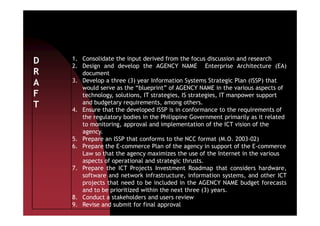
1. Consolidate the input derived from the focus discussion and research
2. Design and develop the AGENCY NAME Enterprise Architecture (EA)
document
3. Develop a three (3) year Information Systems Strategic Plan (ISSP) that
would serve as the “blueprint” of AGENCY NAME in the various aspects of
technology, solutions, IT strategies, IS strategies, IT manpower support
and budgetary requirements, among others.
4. Ensure that the developed ISSP is in conformance to the requirements of4. Ensure that the developed ISSP is in conformance to the requirements of
the regulatory bodies in the Philippine Government primarily as it related
to monitoring, approval and implementation of the ICT vision of the
agency.
5. Prepare an ISSP that conforms to the NCC format (M.O. 2003-02)
6. Prepare the E-commerce Plan of the agency in support of the E-commerce
Law so that the agency maximizes the use of the Internet in the various
aspects of operational and strategic thrusts.
7. Prepare the ICT Projects Investment Roadmap that considers hardware,
software and network infrastructure, information systems, and other ICT
projects that need to be included in the AGENCY NAME budget forecasts
and to be prioritized within the next three (3) years.
8. Conduct a stakeholders and users review
9. Revise and submit for final approval
I
M
P
L
E
M
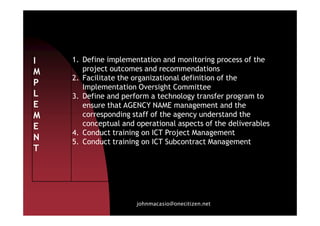
1. Define implementation and monitoring process of the
project outcomes and recommendations
2. Facilitate the organizational definition of the
Implementation Oversight Committee
3. Define and perform a technology transfer program to
ensure that AGENCY NAME management and the
corresponding staff of the agency understand the
johnmacasio@onecitizen.net
M
E
N
T
corresponding staff of the agency understand the
conceptual and operational aspects of the deliverables
4. Conduct training on ICT Project Management
5. Conduct training on ICT Subcontract Management
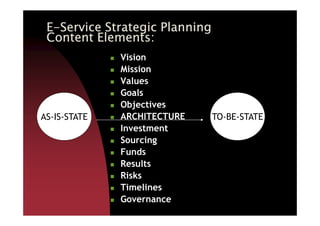
EEEE----Service Strategic PlanningService Strategic PlanningService Strategic PlanningService Strategic Planning
Content Elements:Content Elements:Content Elements:Content Elements:
Vision
Mission
Values
Goals
Objectives
ARCHITECTUREAS-IS-STATE TO-BE-STATEARCHITECTURE
Investment
Sourcing
Funds
Results
Risks
Timelines
Governance
AS-IS-STATE TO-BE-STATE
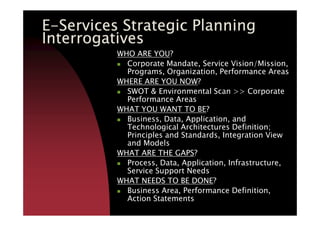
EEEE----Services Strategic PlanningServices Strategic PlanningServices Strategic PlanningServices Strategic Planning
InterrogativesInterrogativesInterrogativesInterrogatives
WHO ARE YOU?
Corporate Mandate, Service Vision/Mission,
Programs, Organization, Performance Areas
WHERE ARE YOU NOW?
SWOT & Environmental Scan >> Corporate
Performance Areas
WHAT YOU WANT TO BE?WHAT YOU WANT TO BE?
Business, Data, Application, and
Technological Architectures Definition;
Principles and Standards, Integration View
and Models
WHAT ARE THE GAPS?
Process, Data, Application, Infrastructure,
Service Support Needs
WHAT NEEDS TO BE DONE?
Business Area, Performance Definition,
Action Statements
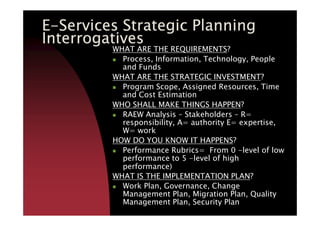
WHAT ARE THE REQUIREMENTS?
Process, Information, Technology, People
and Funds
WHAT ARE THE STRATEGIC INVESTMENT?
Program Scope, Assigned Resources, Time
and Cost Estimation
WHO SHALL MAKE THINGS HAPPEN?
RAEW Analysis – Stakeholders – R=
EEEE----Services Strategic PlanningServices Strategic PlanningServices Strategic PlanningServices Strategic Planning
InterrogativesInterrogativesInterrogativesInterrogatives
RAEW Analysis – Stakeholders – R=
responsibility, A= authority E= expertise,
W= work
HOW DO YOU KNOW IT HAPPENS?
Performance Rubrics= From 0 -level of low
performance to 5 -level of high
performance)
WHAT IS THE IMPLEMENTATION PLAN?
Work Plan, Governance, Change
Management Plan, Migration Plan, Quality
Management Plan, Security Plan
STRATEGIC INFORMATION SYSTEMSTRATEGIC INFORMATION SYSTEMSTRATEGIC INFORMATION SYSTEMSTRATEGIC INFORMATION SYSTEM
PLANNINGPLANNINGPLANNINGPLANNING
Strategic Architecture:Strategic Architecture:Strategic Architecture:Strategic Architecture:
– The statement of the to-be-
state or desired models of the
following
1. Business Architecture1. Business Architecture
- Function and Process
2. Information Architecture
– Data & Application
3. Technology Architecture
- Standards, Network, Apps
Dev, Database etc.
STRATEGIC INFORMATION SYSTEMSTRATEGIC INFORMATION SYSTEMSTRATEGIC INFORMATION SYSTEMSTRATEGIC INFORMATION SYSTEM
PLANNINGPLANNINGPLANNINGPLANNING
Strategic InvestmentStrategic InvestmentStrategic InvestmentStrategic Investment
– A listing of actions and resource requirements
to support the strategic goals, objectives, and
architecture
1. People Capability
2. Process Improvement
3. Infrastructure Building3. Infrastructure Building
4. Hardware Acquisition
5. Software Acquisition
6. Database Requirements
7. Service Acquisition
8. Business Continuity
9. Continual Improvement
STRATEGIC INFORMATION SYSTEMSTRATEGIC INFORMATION SYSTEMSTRATEGIC INFORMATION SYSTEMSTRATEGIC INFORMATION SYSTEM
PLANNINGPLANNINGPLANNINGPLANNING
Strategic Sourcing:Strategic Sourcing:Strategic Sourcing:Strategic Sourcing:
– Definition of the sourcing strategy
to acquire the resources and
services to support the planned
actions.actions.
1. In-Source
2. Out-Source
3. Mixed-Source
STRATEGIC INFORMATION SYSTEMSTRATEGIC INFORMATION SYSTEMSTRATEGIC INFORMATION SYSTEMSTRATEGIC INFORMATION SYSTEM
PLANNINGPLANNINGPLANNINGPLANNING
Strategic Fund Sources:Strategic Fund Sources:Strategic Fund Sources:Strategic Fund Sources:
– An identification of financial
sourcing to support the strategic
investment
1. GAA
2. ODA
3. Internal Funds
4. Generated Income
STRATEGIC INFORMATION SYSTEMSTRATEGIC INFORMATION SYSTEMSTRATEGIC INFORMATION SYSTEMSTRATEGIC INFORMATION SYSTEM
PLANNINGPLANNINGPLANNINGPLANNING
Success Indicators:Success Indicators:Success Indicators:Success Indicators:
• Indicative items to be
measured quantitatively and
experienced qualitatively to
speak of results.speak of results.
• List of expected key
performance indicators to be
realized by the selected
strategic actions.
STRATEGIC INFORMATION SYSTEMSTRATEGIC INFORMATION SYSTEMSTRATEGIC INFORMATION SYSTEMSTRATEGIC INFORMATION SYSTEM
PLANNINGPLANNINGPLANNINGPLANNING
Risks to Mitigate:Risks to Mitigate:Risks to Mitigate:Risks to Mitigate:
• Statement of “What If”, the
potential to occur and the
mitigating measures
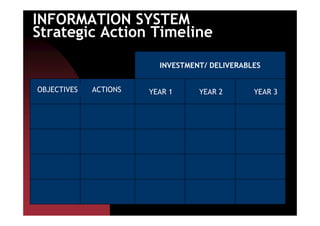
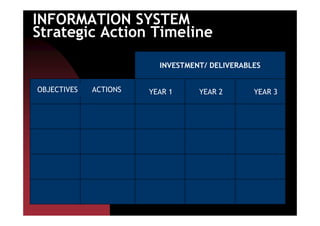
INFORMATION SYSTEM
Strategic Action Timeline
INVESTMENT/ DELIVERABLES
YEAR 1 YEAR 2 YEAR 3OBJECTIVES ACTIONS
STRATEGIC INFORMATION SYSTEMSTRATEGIC INFORMATION SYSTEMSTRATEGIC INFORMATION SYSTEMSTRATEGIC INFORMATION SYSTEM
PLANNINGPLANNINGPLANNINGPLANNING
Strategic Architecture:Strategic Architecture:Strategic Architecture:Strategic Architecture:
– The statement of the to-be-
state or desired models of the
following
1. Business Architecture1. Business Architecture
- Function and Process
2. Information Architecture
– Data & Application
3. Technology Architecture
- Standards, Network, Apps
Dev, Database etc.
STRATEGIC INFORMATION SYSTEMSTRATEGIC INFORMATION SYSTEMSTRATEGIC INFORMATION SYSTEMSTRATEGIC INFORMATION SYSTEM
PLANNINGPLANNINGPLANNINGPLANNING
Strategic InvestmentStrategic InvestmentStrategic InvestmentStrategic Investment
– A listing of actions and resource requirements
to support the strategic goals, objectives, and
architecture
1. People Capability
2. Process Improvement
3. Infrastructure Building3. Infrastructure Building
4. Hardware Acquisition
5. Software Acquisition
6. Database Requirements
7. Service Acquisition
8. Business Continuity
9. Continual Improvement
STRATEGIC INFORMATION SYSTEMSTRATEGIC INFORMATION SYSTEMSTRATEGIC INFORMATION SYSTEMSTRATEGIC INFORMATION SYSTEM
PLANNINGPLANNINGPLANNINGPLANNING
Strategic Sourcing:Strategic Sourcing:Strategic Sourcing:Strategic Sourcing:
– Definition of the sourcing strategy
to acquire the resources and
services to support the planned
actions.actions.
1. In-Source
2. Out-Source
3. Mixed-Source
STRATEGIC INFORMATION SYSTEMSTRATEGIC INFORMATION SYSTEMSTRATEGIC INFORMATION SYSTEMSTRATEGIC INFORMATION SYSTEM
PLANNINGPLANNINGPLANNINGPLANNING
Strategic Fund Sources:Strategic Fund Sources:Strategic Fund Sources:Strategic Fund Sources:
– An identification of financial
sourcing to support the strategic
investment
1. GAA
2. ODA
3. Internal Funds
4. Generated Income
STRATEGIC INFORMATION SYSTEMSTRATEGIC INFORMATION SYSTEMSTRATEGIC INFORMATION SYSTEMSTRATEGIC INFORMATION SYSTEM
PLANNINGPLANNINGPLANNINGPLANNING
Success Indicators:Success Indicators:Success Indicators:Success Indicators:
• Indicative items to be
measured quantitatively and
experienced qualitatively to
speak of results.speak of results.
• List of expected key
performance indicators to be
realized by the selected
strategic actions.
STRATEGIC INFORMATION SYSTEMSTRATEGIC INFORMATION SYSTEMSTRATEGIC INFORMATION SYSTEMSTRATEGIC INFORMATION SYSTEM
PLANNINGPLANNINGPLANNINGPLANNING
Risks to Mitigate:Risks to Mitigate:Risks to Mitigate:Risks to Mitigate:
• Statement of “What If”, the
potential to occur and the
mitigating measures
INFORMATION SYSTEM
Strategic Action Timeline
INVESTMENT/ DELIVERABLES
YEAR 1 YEAR 2 YEAR 3OBJECTIVES ACTIONS

Ict4gov eservices strategic_planning

  • 1.
    EEEE----SERVICES STATEGIC PLANSERVICESSTATEGIC PLANSERVICES STATEGIC PLANSERVICES STATEGIC PLAN Thinking Boxes for E-Service Strategic Value johnmacasio@onecitizen.net
  • 2.
    Essential Question How tostrategically view the change requirement of the enterprise, and to integrate the aligned value of e-services to deliver the strategic intent of the johnmacasio@onecitizen.net aligned value of e-services to deliver the strategic intent of the business?
  • 3.
    Essential Question What arethe framework, metrics, process and tools to understand the bigger picture of the enterprise, and to draw the models that elaborate the johnmacasio@onecitizen.net the models that elaborate the distinction and relationship of performance, function, information and technology of the organization?
  • 4.
    Essential Question How tofacilitate and draft the formulation of strategic plan which clearly defines the alignment of enterprise’s baseline information and johnmacasio@onecitizen.net baseline information and change requirements to purpose, stakeholders, organization, resources, programs, time and funds?
  • 5.
  • 6.
    AgendaAgendaAgendaAgenda Strategic Intent Strategic Valueof ICT Strategic Planning johnmacasio@onecitizen.net Strategic Planning Template Software
  • 7.
    Strategic IntentStrategic IntentStrategicIntentStrategic Intent –––– The End PointsThe End PointsThe End PointsThe End Points The striving for performance is directed towards the defined strategic intent of the organization’s stakeholders. The functions, process, information, technology are evolved to the planned and agreed end points:and agreed end points: Position (direction) Diffentiator (discovery) Destiny (destiny) -Gary Hammel & C.K. Prahalad
  • 8.
    Strategic IntentStrategic IntentStrategicIntentStrategic Intent –––– The End PointsThe End PointsThe End PointsThe End Points Critical Attributes Sense of Direction -point of view on long term market or competitive position -Gary Hammel & C.K. Prahalad
  • 9.
    Strategic IntentStrategic IntentStrategicIntentStrategic Intent –––– The End PointsThe End PointsThe End PointsThe End Points Critical Attributes Sense of Discovery -point of view on what differentiate -unique point of view about the future -Gary Hammel & C.K. Prahalad
  • 10.
    Strategic IntentStrategic IntentStrategicIntentStrategic Intent –––– The End PointsThe End PointsThe End PointsThe End Points Critical Attributes Sense of Destiny – perceive goal as inherently valuable -Gary Hammel & C.K. Prahalad
  • 11.
    Defining Strategic Valueof ICT Services Important Questions – What is the strategic alignment of ICT services to the business strategy of the organization?strategy of the organization?
  • 12.
    Defining Strategic Valueof ICT Services Important Question – Which strategic alignment models, decision domains, the functional responsibilities willfunctional responsibilities will bring strategic value of ICT services in the organization?
  • 13.
    Key Issues: Lack ofalignment between the business strategy and the ICT service strategy of the organization making investments Defining Strategic Value of ICT Services strategy and the ICT service strategy of the organization making investments Lack of dynamic administrative process to ensure continuous alignment between the business domain and ICT domain. -Venkatraman, Henderson & Oldach
  • 14.
    Business Strategy ICT Services Strategy BUSINESS DOMAINICT DOMAIN External 2 Defining Strategic Value of ICT Services Alignment Framework: Strategy Information Systems Infrastructure & Process Organization Infrastructure & Process Strategy Internal 1 3 4 Venkatraman, Henderson & Oldach
  • 15.
    1. Strategy Execution– business strategy as the driver behind the design of the organization, and the logic of the ICT infrastructure Defining Strategic Value of ICT Services – Top Management = formulate strategy, – ICT Management = implement strategy) Venkatraman, Henderson & Oldach
  • 16.
    2. Technology Potential– ICT strategy is formulated to support chosen business strategy and the required ICT infrastructure and processes Top Management = provides the technology Defining Strategic Value of ICT Services Top Management = provides the technology vision to articulate the logic and selection of ICT strategy to support the business strategy ICT Management = provides the technology architecture by designing and implementing the required ICT infrastructure that is consistent to the IT strategy components – scope, competencies & governance Venkatraman, Henderson & Oldach
  • 17.
    3. Competitive Potential– exploitation of ICT to impact new product and services (business scope), influence key attributes of the strategy (distinctive competence) , and develop new relationship (business governance). Defining Strategic Value of ICT Services Top Management = serves a business visionary who articulates the impact of emerging technology to business scope, competence and governance.) ICT Management = serves as catalyst to make business to understand the potential opportunites and threats of emerging technologies Venkatraman, Henderson & Oldach
  • 18.
    4. Service Level– building quality ICT organization within the organization. Defining Strategic Value of ICT Services Top Management = serves as the prioritizer who provides appropriate allocations ICT Management = serves as business leader who insures business ends of the ICT organization. Venkatraman, Henderson & Oldach
  • 19.
    Strategic Alignment Modelof ICT – Draw the Alignment Schema – Identify the decision domains, and draw Defining Strategic Value of ICT Services – Identify the decision domains, and draw the ICT Integration Decision Relationship Between Business Units and the ICT Services Management Venkatraman, Henderson & Oldach
  • 20.
    Strategic PlanningStrategic PlanningStrategicPlanningStrategic Planning Strategic planning provides the participatory engagement and thinking tool to define, elaborate, document, agree and communicate the strategicagree and communicate the strategic baseline, strategic intent, strategic action and strategic resources with the constraint context and perspectives of time, stakeholders, performance, funds, environment, leadership and technology.
  • 21.
    Strategic PlanningStrategic PlanningStrategicPlanningStrategic Planning INTENT TIME STAKEHOLDERS BASELINE ACTION RESOURCES STAKEHOLDERS PERFORMANCE FUNDS ENVIRONMENT LEADERSHIP TECHNOLOGY
  • 22.
    Strategic IntentStrategic IntentStrategicIntentStrategic Intent Mission (Core Purpose) Vision (Here to There) Goals (S.M.A.R.T. Targets)Goals (S.M.A.R.T. Targets) johnmacasio@onecitizen.net
  • 23.
    Building Blocks ofE-Services Strategic Intent in Government MANDATE VISION MISSION VALUES T E C FUNCTIONS GOALS OBJECTIVES POLICIES PROCESS PRODUCTS ORGANIZATION DECISION STRUCTURE INFLUENCE RELATIONSHIPS LOCATIONS THE GOVERNMENT AGENCY INFORMATION SYSTEMS C H N O L O G Y USERS CUSTOMERS PARTNERS SUPPLIERS CORE CAPABILITIES DIFFERENTIATING CAPABILITIES KEY PERFORMANCE INDICATORS FUND SOURCESSTANDARDS PROCESS METHODS TOOLS
  • 24.
    Strategic ActionStrategic ActionStrategicActionStrategic Action Objectives Priority ActionAction Responsibility Timeline Cost johnmacasio@onecitizen.net
  • 25.
    CAPABILITY STRENGTH WEAKNESSOPPORTUNITY THREAT ORGANIZATION PROCESSES Information Systems S.W.O.T. PROCESSES DATA CONTROLS TECHNOLOGY
  • 26.
    Strategic ResourcesStrategic ResourcesStrategicResourcesStrategic Resources Leadership Technical FundsFunds Technology johnmacasio@onecitizen.net
  • 27.
    Strategic BaselineStrategic BaselineStrategicBaselineStrategic Baseline Financial Worksheets Customer Experience Internal ProcessInternal Process Employees Lesson’s Learned johnmacasio@onecitizen.net
  • 28.
    BalancedBalancedBalancedBalancedBalancedBalancedBalancedBalanced ScorecardScorecardScorecardScorecardScorecardScorecardScorecardScorecard If wesucceed, how will we look to our shareholders? Financial Perspective To achieve our vision, how must we look to our Customer Perspective The Strategy must we look to our customers? To satisfy our customers, which processes must we excel at? Internal Perspective To achieve our vision, how must our organization learn and improve? Learning & Growth Perspective
  • 29.
    Balanced Scorecard PerspectivesBalancedScorecard PerspectivesBalanced Scorecard PerspectivesBalanced Scorecard Perspectives How do we Objectives Measures Targets Initiatives appear to our Stockholders? Financial How do we Objectives Measures Targets Initiatives Customer At what internal Objectives Measures Targets Initiatives Internal Business ProcessVision & 29 How do we Objectives Measures Targets Initiatives appear to our Customers? At what internal Objectives Measures Targets Initiatives processes must we excel? & Strategy How do we Objectives Measures Targets Initiatives sustain our ability to change & grow? Learning and Growth
  • 30.
    Performance Model Business Model Information Model Technology Model BASELINE (Context) Balance Scorecard ProcessMapping & Review Information Systems Readiness Configuration Assessment Standards Compliance Service Delivery & Support Assessment INTENT Mandate,INTENT (Purpose) Mandate, Mission, Vision, Goals GAPS Needs ACTION (Change) Objectives, Priority, Raw # Tasks, Time, Results, Responsibility, Metrics RESOURCE (Cost) Services Goods Budget -ABC
  • 31.
    O R G A 1. Identify andengage the service of the Mentoring Consultant, Technical Consultants, Technical Facilitators and Researchers 2. Assist and coordinate with the AGENCY NAME johnmacasio@onecitizen.net A N I Z E 2. Assist and coordinate with the AGENCY NAME ICT Services Strategic Planning Committee 3. Define and agree on the strategic planning framework, tasks and timetable
  • 32.
    D I S C O V 1. Set theorganizational assessment framework for the strategic planning 2. Identify the specific issues or decisions that the strategic planning should address 3. Identify the information that must be collected 4. Conduct Focus Group Discussions on the situational assessment a.The Mandate, Laws and Standards b.Technical and Business Units and Business ProcessesV E R b.Technical and Business Units and Business Processes c.Current Organizational Strategies and Limitations d.Best Practices and International Trends e.Future Organizational Strategies and Directions f. The Enterprise Architecture 5. Gather and create summary presentation of the information gathered from the key technical and business areas of the organization 6. Assess the information needs/requirements of the agency 7. Assess the existing IT infrastructure (i.e., hardware, software, network, special solutions/devices, etc.) as to its applicability and further use
  • 33.
    D E F I N E 1. Revisit themandate, mission, vision and values of the organization 2. Define the aim, goals, and objectives of ICT services aligned to the mission, vision, values, and business ends of the organization 3. Identity the strategic directions of the agency 4. Define the Enterprise Architecture aligned to the strategic directions 5. Define what it takes to realize the strategic directions 6. Define the ICT service projects or components of the business case 7. Define the metrics of success or key performance indicators E 7. Define the metrics of success or key performance indicators 8. Define the best practice references 9. Identify the key areas of the plan requiring specific technical experts 10. Identify the necessary upgrades and replacements that must be made to the IT infrastructure using lifecycle management practices for infrastructure and technologies employed 11. Identify the information systems necessary to support the mandate of the AGENCY NAME. 12. Define other ICT projects that need to be included in the AGENCY NAME budget forecasts and to be prioritized within the next three (3) years. 13. Identify the criteria in the selection of the appropriate systems integration/solutions provider for the eventual implementation of the ISSP.
  • 34.
    D R A F T 1. Consolidate theinput derived from the focus discussion and research 2. Design and develop the AGENCY NAME Enterprise Architecture (EA) document 3. Develop a three (3) year Information Systems Strategic Plan (ISSP) that would serve as the “blueprint” of AGENCY NAME in the various aspects of technology, solutions, IT strategies, IS strategies, IT manpower support and budgetary requirements, among others. 4. Ensure that the developed ISSP is in conformance to the requirements of4. Ensure that the developed ISSP is in conformance to the requirements of the regulatory bodies in the Philippine Government primarily as it related to monitoring, approval and implementation of the ICT vision of the agency. 5. Prepare an ISSP that conforms to the NCC format (M.O. 2003-02) 6. Prepare the E-commerce Plan of the agency in support of the E-commerce Law so that the agency maximizes the use of the Internet in the various aspects of operational and strategic thrusts. 7. Prepare the ICT Projects Investment Roadmap that considers hardware, software and network infrastructure, information systems, and other ICT projects that need to be included in the AGENCY NAME budget forecasts and to be prioritized within the next three (3) years. 8. Conduct a stakeholders and users review 9. Revise and submit for final approval
  • 35.
    I M P L E M 1. Define implementationand monitoring process of the project outcomes and recommendations 2. Facilitate the organizational definition of the Implementation Oversight Committee 3. Define and perform a technology transfer program to ensure that AGENCY NAME management and the corresponding staff of the agency understand the johnmacasio@onecitizen.net M E N T corresponding staff of the agency understand the conceptual and operational aspects of the deliverables 4. Conduct training on ICT Project Management 5. Conduct training on ICT Subcontract Management
  • 36.
    EEEE----Service Strategic PlanningServiceStrategic PlanningService Strategic PlanningService Strategic Planning Content Elements:Content Elements:Content Elements:Content Elements: Vision Mission Values Goals Objectives ARCHITECTUREAS-IS-STATE TO-BE-STATEARCHITECTURE Investment Sourcing Funds Results Risks Timelines Governance AS-IS-STATE TO-BE-STATE
  • 37.
    EEEE----Services Strategic PlanningServicesStrategic PlanningServices Strategic PlanningServices Strategic Planning InterrogativesInterrogativesInterrogativesInterrogatives WHO ARE YOU? Corporate Mandate, Service Vision/Mission, Programs, Organization, Performance Areas WHERE ARE YOU NOW? SWOT & Environmental Scan >> Corporate Performance Areas WHAT YOU WANT TO BE?WHAT YOU WANT TO BE? Business, Data, Application, and Technological Architectures Definition; Principles and Standards, Integration View and Models WHAT ARE THE GAPS? Process, Data, Application, Infrastructure, Service Support Needs WHAT NEEDS TO BE DONE? Business Area, Performance Definition, Action Statements
  • 38.
    WHAT ARE THEREQUIREMENTS? Process, Information, Technology, People and Funds WHAT ARE THE STRATEGIC INVESTMENT? Program Scope, Assigned Resources, Time and Cost Estimation WHO SHALL MAKE THINGS HAPPEN? RAEW Analysis – Stakeholders – R= EEEE----Services Strategic PlanningServices Strategic PlanningServices Strategic PlanningServices Strategic Planning InterrogativesInterrogativesInterrogativesInterrogatives RAEW Analysis – Stakeholders – R= responsibility, A= authority E= expertise, W= work HOW DO YOU KNOW IT HAPPENS? Performance Rubrics= From 0 -level of low performance to 5 -level of high performance) WHAT IS THE IMPLEMENTATION PLAN? Work Plan, Governance, Change Management Plan, Migration Plan, Quality Management Plan, Security Plan
  • 39.
    STRATEGIC INFORMATION SYSTEMSTRATEGICINFORMATION SYSTEMSTRATEGIC INFORMATION SYSTEMSTRATEGIC INFORMATION SYSTEM PLANNINGPLANNINGPLANNINGPLANNING Strategic Architecture:Strategic Architecture:Strategic Architecture:Strategic Architecture: – The statement of the to-be- state or desired models of the following 1. Business Architecture1. Business Architecture - Function and Process 2. Information Architecture – Data & Application 3. Technology Architecture - Standards, Network, Apps Dev, Database etc.
  • 40.
    STRATEGIC INFORMATION SYSTEMSTRATEGICINFORMATION SYSTEMSTRATEGIC INFORMATION SYSTEMSTRATEGIC INFORMATION SYSTEM PLANNINGPLANNINGPLANNINGPLANNING Strategic InvestmentStrategic InvestmentStrategic InvestmentStrategic Investment – A listing of actions and resource requirements to support the strategic goals, objectives, and architecture 1. People Capability 2. Process Improvement 3. Infrastructure Building3. Infrastructure Building 4. Hardware Acquisition 5. Software Acquisition 6. Database Requirements 7. Service Acquisition 8. Business Continuity 9. Continual Improvement
  • 41.
    STRATEGIC INFORMATION SYSTEMSTRATEGICINFORMATION SYSTEMSTRATEGIC INFORMATION SYSTEMSTRATEGIC INFORMATION SYSTEM PLANNINGPLANNINGPLANNINGPLANNING Strategic Sourcing:Strategic Sourcing:Strategic Sourcing:Strategic Sourcing: – Definition of the sourcing strategy to acquire the resources and services to support the planned actions.actions. 1. In-Source 2. Out-Source 3. Mixed-Source
  • 42.
    STRATEGIC INFORMATION SYSTEMSTRATEGICINFORMATION SYSTEMSTRATEGIC INFORMATION SYSTEMSTRATEGIC INFORMATION SYSTEM PLANNINGPLANNINGPLANNINGPLANNING Strategic Fund Sources:Strategic Fund Sources:Strategic Fund Sources:Strategic Fund Sources: – An identification of financial sourcing to support the strategic investment 1. GAA 2. ODA 3. Internal Funds 4. Generated Income
  • 43.
    STRATEGIC INFORMATION SYSTEMSTRATEGICINFORMATION SYSTEMSTRATEGIC INFORMATION SYSTEMSTRATEGIC INFORMATION SYSTEM PLANNINGPLANNINGPLANNINGPLANNING Success Indicators:Success Indicators:Success Indicators:Success Indicators: • Indicative items to be measured quantitatively and experienced qualitatively to speak of results.speak of results. • List of expected key performance indicators to be realized by the selected strategic actions.
  • 44.
    STRATEGIC INFORMATION SYSTEMSTRATEGICINFORMATION SYSTEMSTRATEGIC INFORMATION SYSTEMSTRATEGIC INFORMATION SYSTEM PLANNINGPLANNINGPLANNINGPLANNING Risks to Mitigate:Risks to Mitigate:Risks to Mitigate:Risks to Mitigate: • Statement of “What If”, the potential to occur and the mitigating measures
  • 45.
    INFORMATION SYSTEM Strategic ActionTimeline INVESTMENT/ DELIVERABLES YEAR 1 YEAR 2 YEAR 3OBJECTIVES ACTIONS
  • 46.
    STRATEGIC INFORMATION SYSTEMSTRATEGICINFORMATION SYSTEMSTRATEGIC INFORMATION SYSTEMSTRATEGIC INFORMATION SYSTEM PLANNINGPLANNINGPLANNINGPLANNING Strategic Architecture:Strategic Architecture:Strategic Architecture:Strategic Architecture: – The statement of the to-be- state or desired models of the following 1. Business Architecture1. Business Architecture - Function and Process 2. Information Architecture – Data & Application 3. Technology Architecture - Standards, Network, Apps Dev, Database etc.
  • 47.
    STRATEGIC INFORMATION SYSTEMSTRATEGICINFORMATION SYSTEMSTRATEGIC INFORMATION SYSTEMSTRATEGIC INFORMATION SYSTEM PLANNINGPLANNINGPLANNINGPLANNING Strategic InvestmentStrategic InvestmentStrategic InvestmentStrategic Investment – A listing of actions and resource requirements to support the strategic goals, objectives, and architecture 1. People Capability 2. Process Improvement 3. Infrastructure Building3. Infrastructure Building 4. Hardware Acquisition 5. Software Acquisition 6. Database Requirements 7. Service Acquisition 8. Business Continuity 9. Continual Improvement
  • 48.
    STRATEGIC INFORMATION SYSTEMSTRATEGICINFORMATION SYSTEMSTRATEGIC INFORMATION SYSTEMSTRATEGIC INFORMATION SYSTEM PLANNINGPLANNINGPLANNINGPLANNING Strategic Sourcing:Strategic Sourcing:Strategic Sourcing:Strategic Sourcing: – Definition of the sourcing strategy to acquire the resources and services to support the planned actions.actions. 1. In-Source 2. Out-Source 3. Mixed-Source
  • 49.
    STRATEGIC INFORMATION SYSTEMSTRATEGICINFORMATION SYSTEMSTRATEGIC INFORMATION SYSTEMSTRATEGIC INFORMATION SYSTEM PLANNINGPLANNINGPLANNINGPLANNING Strategic Fund Sources:Strategic Fund Sources:Strategic Fund Sources:Strategic Fund Sources: – An identification of financial sourcing to support the strategic investment 1. GAA 2. ODA 3. Internal Funds 4. Generated Income
  • 50.
    STRATEGIC INFORMATION SYSTEMSTRATEGICINFORMATION SYSTEMSTRATEGIC INFORMATION SYSTEMSTRATEGIC INFORMATION SYSTEM PLANNINGPLANNINGPLANNINGPLANNING Success Indicators:Success Indicators:Success Indicators:Success Indicators: • Indicative items to be measured quantitatively and experienced qualitatively to speak of results.speak of results. • List of expected key performance indicators to be realized by the selected strategic actions.
  • 51.
    STRATEGIC INFORMATION SYSTEMSTRATEGICINFORMATION SYSTEMSTRATEGIC INFORMATION SYSTEMSTRATEGIC INFORMATION SYSTEM PLANNINGPLANNINGPLANNINGPLANNING Risks to Mitigate:Risks to Mitigate:Risks to Mitigate:Risks to Mitigate: • Statement of “What If”, the potential to occur and the mitigating measures
  • 52.
    INFORMATION SYSTEM Strategic ActionTimeline INVESTMENT/ DELIVERABLES YEAR 1 YEAR 2 YEAR 3OBJECTIVES ACTIONS