Basic ICT Skills
Summer Camp
Session - 1 (03.00 pm to 04.15 pm)
Agenda
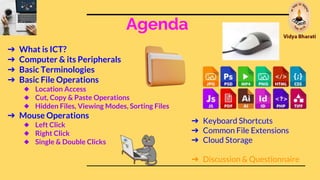
➔ What is ICT?
➔ Computer & its Peripherals
➔ Basic Terminologies
➔ Basic File Operations
◆ Location Access
◆ Cut, Copy & Paste Operations
◆ Hidden Files, Viewing Modes, Sorting Files
➔ Mouse Operations
◆ Left Click
◆ Right Click
◆ Single & Double Clicks
➔ Keyboard Shortcuts
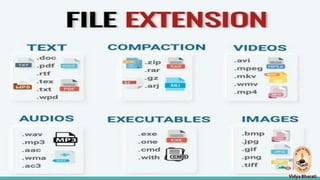
➔ Common File Extensions
➔ Cloud Storage
➔ Discussion & Questionnaire
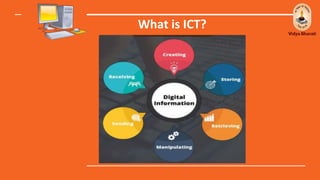
What is ICT?
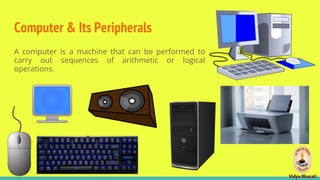
Computer & Its Peripherals
A computer is a machine that can be performed to
carry out sequences of arithmetic or logical
operations.
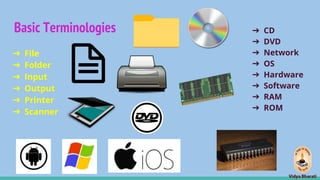
Basic Terminologies
➔ File
➔ Folder
➔ Input
➔ Output
➔ Printer
➔ Scanner
➔ CD
➔ DVD
➔ Network
➔ OS
➔ Hardware
➔ Software
➔ RAM
➔ ROM
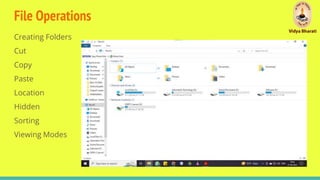
File Operations
Creating Folders
Cut
Copy
Paste
Location
Hidden
Sorting
Viewing Modes
File Operations
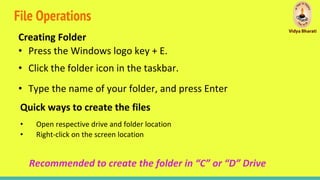
Creating Folder
• Press the Windows logo key + E.
• Click the folder icon in the taskbar.
• Type the name of your folder, and press Enter
Quick ways to create the files
• Open respective drive and folder location
• Right-click on the screen location
Recommended to create the folder in “C” or “D” Drive
File Operations
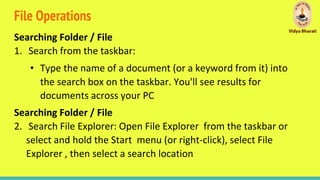
Searching Folder / File
1. Search from the taskbar:
• Type the name of a document (or a keyword from it) into
the search box on the taskbar. You'll see results for
documents across your PC
Searching Folder / File
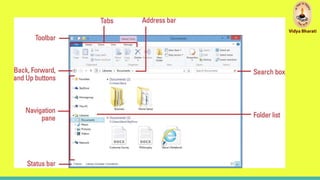
2. Search File Explorer: Open File Explorer from the taskbar or
select and hold the Start menu (or right-click), select File
Explorer , then select a search location
File Operations
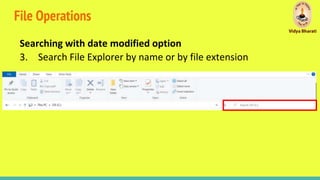
Searching with date modified option
3. Search File Explorer by name or by file extension
File Operations - Hidden Files
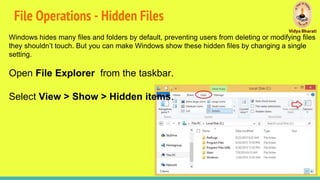
Windows hides many files and folders by default, preventing users from deleting or modifying files
they shouldn’t touch. But you can make Windows show these hidden files by changing a single
setting.
Open File Explorer from the taskbar.
Select View > Show > Hidden items.
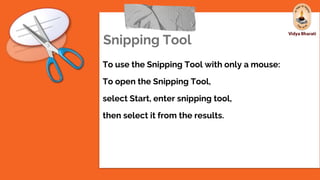
Snipping Tool
To use the Snipping Tool with only a mouse:
To open the Snipping Tool,
select Start, enter snipping tool,
then select it from the results.
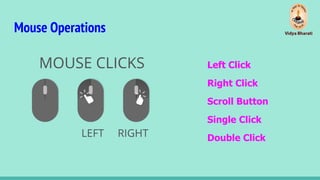
Mouse Operations
Left Click
Right Click
Scroll Button
Single Click
Double Click
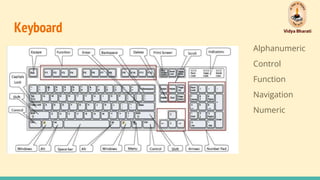
Keyboard
Alphanumeric
Control
Function
Navigation
Numeric
Keyboard Shortcuts
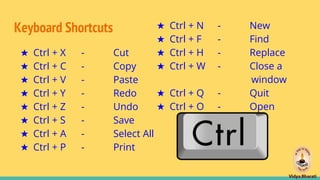
★ Ctrl + X - Cut
★ Ctrl + C - Copy
★ Ctrl + V - Paste
★ Ctrl + Y - Redo
★ Ctrl + Z - Undo
★ Ctrl + S - Save
★ Ctrl + A - Select All
★ Ctrl + P - Print
★ Ctrl + N - New
★ Ctrl + F - Find
★ Ctrl + H - Replace
★ Ctrl + W - Close a
window
★ Ctrl + Q - Quit
★ Ctrl + O - Open
Keyboard Shortcuts
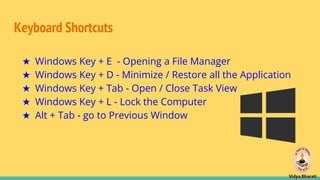
★ Windows Key + E - Opening a File Manager
★ Windows Key + D - Minimize / Restore all the Application
★ Windows Key + Tab - Open / Close Task View
★ Windows Key + L - Lock the Computer
★ Alt + Tab - go to Previous Window
Keyboard Shortcuts
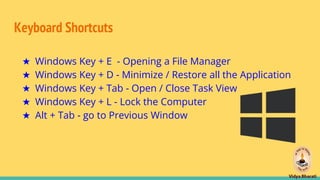
★ Windows Key + E - Opening a File Manager
★ Windows Key + D - Minimize / Restore all the Application
★ Windows Key + Tab - Open / Close Task View
★ Windows Key + L - Lock the Computer
★ Alt + Tab - go to Previous Window
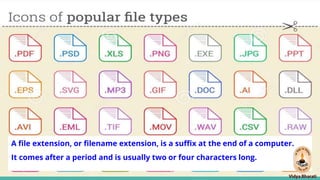
A file extension, or filename extension, is a suffix at the end of a computer.
It comes after a period and is usually two or four characters long.
Good luck!
We hope you’ll use
these tips to go out and
deliver a memorable
pitch to enhance your
Teaching Process
Good luck!
We hope you’ll use
these tips to go out and
deliver a memorable
pitch to enhance your
Teaching Process

ICT .pptx

  • 1.
    Basic ICT Skills SummerCamp Session - 1 (03.00 pm to 04.15 pm)
  • 2.
    Agenda ➔ What isICT? ➔ Computer & its Peripherals ➔ Basic Terminologies ➔ Basic File Operations ◆ Location Access ◆ Cut, Copy & Paste Operations ◆ Hidden Files, Viewing Modes, Sorting Files ➔ Mouse Operations ◆ Left Click ◆ Right Click ◆ Single & Double Clicks ➔ Keyboard Shortcuts ➔ Common File Extensions ➔ Cloud Storage ➔ Discussion & Questionnaire
  • 4.
  • 7.
    Computer & ItsPeripherals A computer is a machine that can be performed to carry out sequences of arithmetic or logical operations.
  • 8.
    Basic Terminologies ➔ File ➔Folder ➔ Input ➔ Output ➔ Printer ➔ Scanner ➔ CD ➔ DVD ➔ Network ➔ OS ➔ Hardware ➔ Software ➔ RAM ➔ ROM
  • 10.
  • 11.
    File Operations Creating Folder •Press the Windows logo key + E. • Click the folder icon in the taskbar. • Type the name of your folder, and press Enter Quick ways to create the files • Open respective drive and folder location • Right-click on the screen location Recommended to create the folder in “C” or “D” Drive
  • 12.
    File Operations Searching Folder/ File 1. Search from the taskbar: • Type the name of a document (or a keyword from it) into the search box on the taskbar. You'll see results for documents across your PC Searching Folder / File 2. Search File Explorer: Open File Explorer from the taskbar or select and hold the Start menu (or right-click), select File Explorer , then select a search location
  • 13.
    File Operations Searching withdate modified option 3. Search File Explorer by name or by file extension
  • 14.
    File Operations -Hidden Files Windows hides many files and folders by default, preventing users from deleting or modifying files they shouldn’t touch. But you can make Windows show these hidden files by changing a single setting. Open File Explorer from the taskbar. Select View > Show > Hidden items.
  • 15.
    Snipping Tool To usethe Snipping Tool with only a mouse: To open the Snipping Tool, select Start, enter snipping tool, then select it from the results.
  • 16.
    Mouse Operations Left Click RightClick Scroll Button Single Click Double Click
  • 17.
  • 19.
    Keyboard Shortcuts ★ Ctrl+ X - Cut ★ Ctrl + C - Copy ★ Ctrl + V - Paste ★ Ctrl + Y - Redo ★ Ctrl + Z - Undo ★ Ctrl + S - Save ★ Ctrl + A - Select All ★ Ctrl + P - Print ★ Ctrl + N - New ★ Ctrl + F - Find ★ Ctrl + H - Replace ★ Ctrl + W - Close a window ★ Ctrl + Q - Quit ★ Ctrl + O - Open
  • 20.
    Keyboard Shortcuts ★ WindowsKey + E - Opening a File Manager ★ Windows Key + D - Minimize / Restore all the Application ★ Windows Key + Tab - Open / Close Task View ★ Windows Key + L - Lock the Computer ★ Alt + Tab - go to Previous Window
  • 21.
    Keyboard Shortcuts ★ WindowsKey + E - Opening a File Manager ★ Windows Key + D - Minimize / Restore all the Application ★ Windows Key + Tab - Open / Close Task View ★ Windows Key + L - Lock the Computer ★ Alt + Tab - go to Previous Window
  • 22.
    A file extension,or filename extension, is a suffix at the end of a computer. It comes after a period and is usually two or four characters long.
  • 24.
    Good luck! We hopeyou’ll use these tips to go out and deliver a memorable pitch to enhance your Teaching Process
  • 25.
    Good luck! We hopeyou’ll use these tips to go out and deliver a memorable pitch to enhance your Teaching Process