INFORMATION AND COMMUNICATION TECHNOLOGIES
Database systems
Lecture content
1. Concept of DBMS
2. Database System
3. Database classification
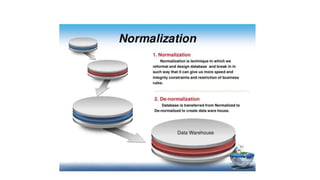
4. Normalization
5. Data integrity
6. Optimizing Queries and their processing
7. Fundamentals of SQL
8. The parallel databases
9. Technology of programming of ORM
10. Control questions
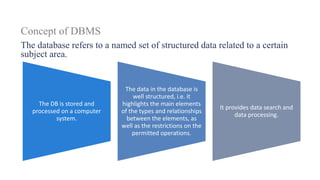
Concept of DBMS
The database refers to a named set of structured data related to a certain
subject area.
The DB is stored and
processed on a computer
system.
The data in the database is
well structured, i.e. it
highlights the main elements
of the types and relationships
between the elements, as
well as the restrictions on the
permitted operations.
It provides data search and
data processing.
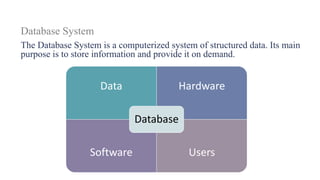
Database System
The Database System is a computerized system of structured data. Its main
purpose is to store information and provide it on demand.
Data Hardware
Software Users
Database
A database is a set of data that has a regular
structure and that is organized in such a way that
a computer can easily find the desired
information.
Well-known DBMSs include MySQL,
PostgreSQL, EnterpriseDB, MongoDB, MariaDB,
Microsoft SQL Server, Oracle, Sybase, SAP HANA,
MemSQL, SQLite and IBM DB2.
What Is Database Architecture?
Database architecture focuses on the design,
development, implementation and maintenance of
computer programs that store and organize information
for businesses, agencies and institutions. A database
architect develops and implements software to meet the
needs of users.
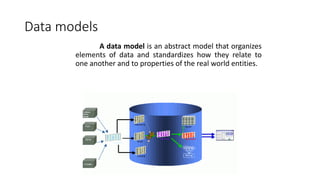
Data models
A data model is an abstract model that organizes
elements of data and standardizes how they relate to
one another and to properties of the real world entities.
Database System
The hierarchical data model.
Director
Head of Sales
Department
Head of PR
Department
Head of Service
Department
Employee Employee Employee Employee Employee
Benefits:
- simplicity;
- minimum memory
consumption.
Disadvantages:
- lack of flexibility ;
- an exceptional
navigation principle
of access to the data;
- access to the data
through the root
member only.
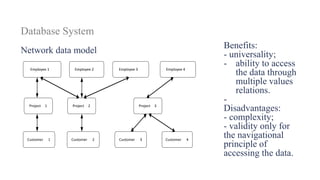
Database System
Network data model
Benefits:
- universality;
- ability to access
the data through
multiple values
relations.
-
Disadvantages:
- complexity;
- validity only for
the navigational
principle of
accessing the data.
Employee 1 Employee 2 Employee 3 Employee 4
Project 1 Project 2 Project 3
Customer 2 Customer 3 Customer 4
Customer 1
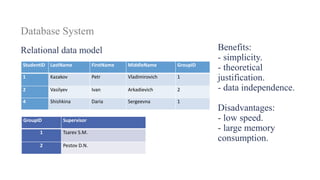
Database System
Relational data model Benefits:
- simplicity.
- theoretical
justification.
- data independence.
Disadvantages:
- low speed.
- large memory
consumption.
StudentID LastName FirstName MiddleName GroupID
1 Kazakov Petr Vladimirovich 1
2 Vasilyev Ivan Arkadievich 2
4 Shishkina Daria Sergeevna 1
GroupID Supervisor
1 Tsarev S.M.
2 Pestov D.N.
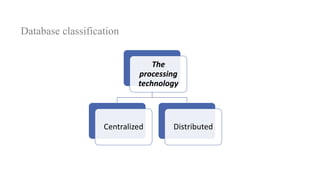
Database classification
The
processing
technology
Centralized Distributed
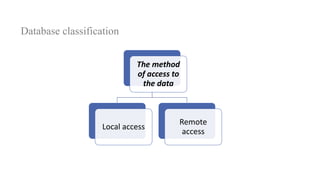
Database classification
The method
of access to
the data
Local access
Remote
access
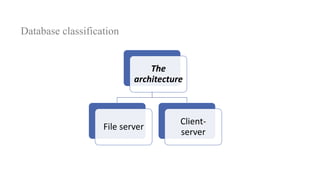
Database classification
The
architecture
File server
Client-
server
Data integrity is the maintenance of, and the assurance of the
accuracy and consistency of, data over its entire life-cycle, and is a critical
aspect to the design, implementation and usage of any system which stores,
processes, or retrieves data.
4 Types of Data Integrity
• Entity integrity
• Referential integrity
• Domain integrity
• User-defined integrity
Optimizing Queries and their processing
To prepare queries using various DBMS, two main languages for query
description are most often used:
• The QBE (QueryByExample);
• SQL (StructuredQueryLanguage);
Data processing includes a set of various functions and operations that can be
divided into sodium groups:
• search, filter and sort data;
• queries to the database;
• mechanism for implementing events, rules (triggers), and procedures in the
database.
The Structured Query Language is one of the fundamental
building blocks of modern database architecture. SQL defines the
methods used to create and manipulate relational databases on all
major platforms.
Fundamentals of SQL
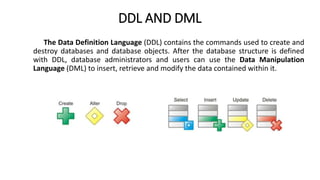
The Data Definition Language (DDL) contains the commands used to create and
destroy databases and database objects. After the database structure is defined
with DDL, database administrators and users can use the Data Manipulation
Language (DML) to insert, retrieve and modify the data contained within it.
DDL AND DML
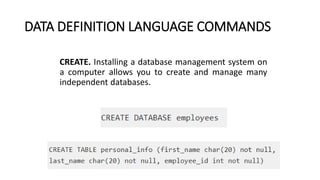
CREATE. Installing a database management system on
a computer allows you to create and manage many
independent databases.
DATA DEFINITION LANGUAGE COMMANDS
USE. The USE command allows you to specify the database you want to work with
within your DBMS.
ALTER. Once you've created a table within a database, you may want to modify its
definition. The ALTER command allows you to make changes to the structure of a
table without deleting and recreating it.
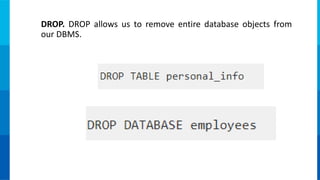
DROP. DROP allows us to remove entire database objects from
our DBMS.
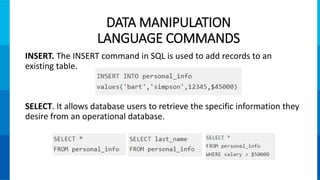
INSERT. The INSERT command in SQL is used to add records to an
existing table.
SELECT. It allows database users to retrieve the specific information they
desire from an operational database.
DATA MANIPULATION
LANGUAGE COMMANDS
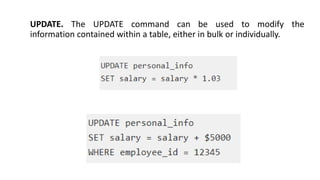
UPDATE. The UPDATE command can be used to modify the
information contained within a table, either in bulk or individually.
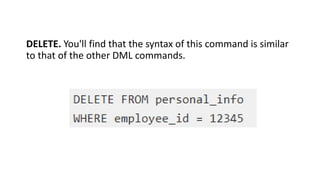
DELETE. You'll find that the syntax of this command is similar
to that of the other DML commands.
A parallel DBMS can be defined as a DBMS implementation for a
multiprocessor computer.
In the database software, there can be three types of parallelism
inherent in data intensive applications:
• Inter-request parallelism;
• intra-query parallelism;
• intra-operation parallelism.
The parallel databases
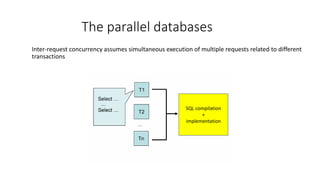
Inter-request concurrency assumes simultaneous execution of multiple requests related to different
transactions
The parallel databases
SQL compilation
+
implementation
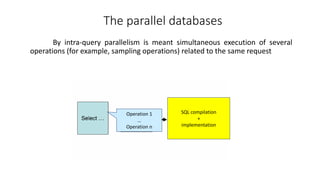
By intra-query parallelism is meant simultaneous execution of several
operations (for example, sampling operations) related to the same request
The parallel databases
SQL compilation
+
implementation
Operation 1
…
Operation n
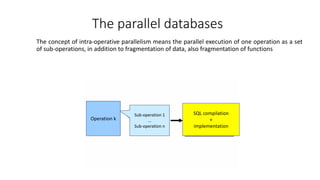
The concept of intra-operative parallelism means the parallel execution of one operation as a set
of sub-operations, in addition to fragmentation of data, also fragmentation of functions
The parallel databases
Sub-operation 1
…
Sub-operation n
Operation k
SQL compilation
+
implementation
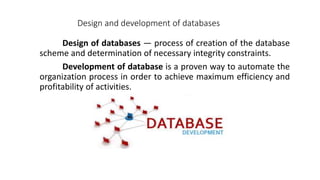
Design of databases — process of creation of the database
scheme and determination of necessary integrity constraints.
Development of database is a proven way to automate the
organization process in order to achieve maximum efficiency and
profitability of activities.
Design and development of databases
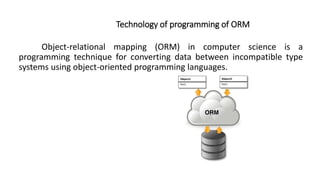
Object-relational mapping (ORM) in computer science is a
programming technique for converting data between incompatible type
systems using object-oriented programming languages.
Technology of programming of ORM
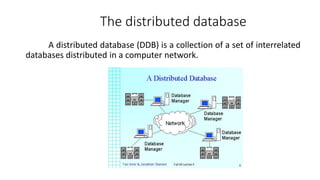
A distributed database (DDB) is a collection of a set of interrelated
databases distributed in a computer network.
The distributed database
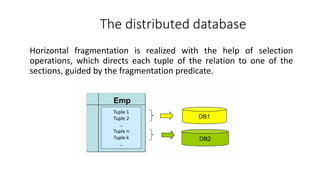
Horizontal fragmentation is realized with the help of selection
operations, which directs each tuple of the relation to one of the
sections, guided by the fragmentation predicate.
The distributed database
Tuple 1
Tuple 2
…
Tuple n
Tuple k
…
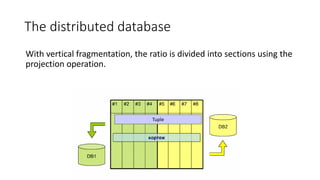
With vertical fragmentation, the ratio is divided into sections using the
projection operation.
The distributed database
Tuple
A heterogeneous database
• A heterogeneous database is an automated (or semi-automated)
system for the integration of heterogeneous, disparate database
management systems to present a user with a single, unified query
interface.
• A parallel database system seeks to improve performance through
parallelization of various operations, such as loading data, building
indexes and evaluating queries.
Control Questions
What is meant by the database? What is the difference
between a database and a simple set of data?
What is the database system? What are its components?
What are the main elements of the database?
What is the data model? Name the existing data models.
What are the differences between them?
References
• Information and Communication Technologies Part 1: Textbook/
D.Shynybekov. - Almaty: IITU, 2017. - 588 p.
• Information and Communication Technologies Part 2: Textbook/
D.Shynybekov. - Almaty: IITU, 2017. - 624 p
• Sheth, Amit P.; James A. Larson (September 1990). "Federated Database
Systems for Managing Distributed, Heterogeneous, and Autonomous
Databases" (PDF). ACM Computing Surveys. 22 (3): 183–236.
• Lorenzo Cantoni (University of Lugano, Switzerland) James A. Danowski
(University of Illinois at Chicago, IL, USA) Communication and
Technology, 576 pages.
• Craig Van Slyke Information Communication Technologies: Concepts,
Methodologies, Tools, and Applications (6 Volumes). ISBN13:
9781599049496, 2008, Pages: 4288
• Utelbaeva A.K.,Utelbaeva A.K. Study guide for lectures on discipline
“Computer science”, Shimkent 2008, 84 pages.

ICT L5+.pptx

  • 1.
    INFORMATION AND COMMUNICATIONTECHNOLOGIES Database systems
  • 2.
    Lecture content 1. Conceptof DBMS 2. Database System 3. Database classification 4. Normalization 5. Data integrity 6. Optimizing Queries and their processing 7. Fundamentals of SQL 8. The parallel databases 9. Technology of programming of ORM 10. Control questions
  • 3.
    Concept of DBMS Thedatabase refers to a named set of structured data related to a certain subject area. The DB is stored and processed on a computer system. The data in the database is well structured, i.e. it highlights the main elements of the types and relationships between the elements, as well as the restrictions on the permitted operations. It provides data search and data processing.
  • 4.
    Database System The DatabaseSystem is a computerized system of structured data. Its main purpose is to store information and provide it on demand. Data Hardware Software Users Database
  • 5.
    A database isa set of data that has a regular structure and that is organized in such a way that a computer can easily find the desired information. Well-known DBMSs include MySQL, PostgreSQL, EnterpriseDB, MongoDB, MariaDB, Microsoft SQL Server, Oracle, Sybase, SAP HANA, MemSQL, SQLite and IBM DB2.
  • 6.
    What Is DatabaseArchitecture? Database architecture focuses on the design, development, implementation and maintenance of computer programs that store and organize information for businesses, agencies and institutions. A database architect develops and implements software to meet the needs of users.
  • 7.
    Data models A datamodel is an abstract model that organizes elements of data and standardizes how they relate to one another and to properties of the real world entities.
  • 8.
    Database System The hierarchicaldata model. Director Head of Sales Department Head of PR Department Head of Service Department Employee Employee Employee Employee Employee Benefits: - simplicity; - minimum memory consumption. Disadvantages: - lack of flexibility ; - an exceptional navigation principle of access to the data; - access to the data through the root member only.
  • 9.
    Database System Network datamodel Benefits: - universality; - ability to access the data through multiple values relations. - Disadvantages: - complexity; - validity only for the navigational principle of accessing the data. Employee 1 Employee 2 Employee 3 Employee 4 Project 1 Project 2 Project 3 Customer 2 Customer 3 Customer 4 Customer 1
  • 10.
    Database System Relational datamodel Benefits: - simplicity. - theoretical justification. - data independence. Disadvantages: - low speed. - large memory consumption. StudentID LastName FirstName MiddleName GroupID 1 Kazakov Petr Vladimirovich 1 2 Vasilyev Ivan Arkadievich 2 4 Shishkina Daria Sergeevna 1 GroupID Supervisor 1 Tsarev S.M. 2 Pestov D.N.
  • 11.
  • 12.
    Database classification The method ofaccess to the data Local access Remote access
  • 13.
  • 15.
    Data integrity isthe maintenance of, and the assurance of the accuracy and consistency of, data over its entire life-cycle, and is a critical aspect to the design, implementation and usage of any system which stores, processes, or retrieves data.
  • 16.
    4 Types ofData Integrity • Entity integrity • Referential integrity • Domain integrity • User-defined integrity
  • 17.
    Optimizing Queries andtheir processing To prepare queries using various DBMS, two main languages for query description are most often used: • The QBE (QueryByExample); • SQL (StructuredQueryLanguage); Data processing includes a set of various functions and operations that can be divided into sodium groups: • search, filter and sort data; • queries to the database; • mechanism for implementing events, rules (triggers), and procedures in the database.
  • 18.
    The Structured QueryLanguage is one of the fundamental building blocks of modern database architecture. SQL defines the methods used to create and manipulate relational databases on all major platforms. Fundamentals of SQL
  • 19.
    The Data DefinitionLanguage (DDL) contains the commands used to create and destroy databases and database objects. After the database structure is defined with DDL, database administrators and users can use the Data Manipulation Language (DML) to insert, retrieve and modify the data contained within it. DDL AND DML
  • 20.
    CREATE. Installing adatabase management system on a computer allows you to create and manage many independent databases. DATA DEFINITION LANGUAGE COMMANDS
  • 21.
    USE. The USEcommand allows you to specify the database you want to work with within your DBMS. ALTER. Once you've created a table within a database, you may want to modify its definition. The ALTER command allows you to make changes to the structure of a table without deleting and recreating it.
  • 22.
    DROP. DROP allowsus to remove entire database objects from our DBMS.
  • 23.
    INSERT. The INSERTcommand in SQL is used to add records to an existing table. SELECT. It allows database users to retrieve the specific information they desire from an operational database. DATA MANIPULATION LANGUAGE COMMANDS
  • 24.
    UPDATE. The UPDATEcommand can be used to modify the information contained within a table, either in bulk or individually.
  • 25.
    DELETE. You'll findthat the syntax of this command is similar to that of the other DML commands.
  • 26.
    A parallel DBMScan be defined as a DBMS implementation for a multiprocessor computer. In the database software, there can be three types of parallelism inherent in data intensive applications: • Inter-request parallelism; • intra-query parallelism; • intra-operation parallelism. The parallel databases
  • 27.
    Inter-request concurrency assumessimultaneous execution of multiple requests related to different transactions The parallel databases SQL compilation + implementation
  • 28.
    By intra-query parallelismis meant simultaneous execution of several operations (for example, sampling operations) related to the same request The parallel databases SQL compilation + implementation Operation 1 … Operation n
  • 29.
    The concept ofintra-operative parallelism means the parallel execution of one operation as a set of sub-operations, in addition to fragmentation of data, also fragmentation of functions The parallel databases Sub-operation 1 … Sub-operation n Operation k SQL compilation + implementation
  • 30.
    Design of databases— process of creation of the database scheme and determination of necessary integrity constraints. Development of database is a proven way to automate the organization process in order to achieve maximum efficiency and profitability of activities. Design and development of databases
  • 31.
    Object-relational mapping (ORM)in computer science is a programming technique for converting data between incompatible type systems using object-oriented programming languages. Technology of programming of ORM
  • 32.
    A distributed database(DDB) is a collection of a set of interrelated databases distributed in a computer network. The distributed database
  • 33.
    Horizontal fragmentation isrealized with the help of selection operations, which directs each tuple of the relation to one of the sections, guided by the fragmentation predicate. The distributed database Tuple 1 Tuple 2 … Tuple n Tuple k …
  • 34.
    With vertical fragmentation,the ratio is divided into sections using the projection operation. The distributed database Tuple
  • 35.
    A heterogeneous database •A heterogeneous database is an automated (or semi-automated) system for the integration of heterogeneous, disparate database management systems to present a user with a single, unified query interface. • A parallel database system seeks to improve performance through parallelization of various operations, such as loading data, building indexes and evaluating queries.
  • 36.
    Control Questions What ismeant by the database? What is the difference between a database and a simple set of data? What is the database system? What are its components? What are the main elements of the database? What is the data model? Name the existing data models. What are the differences between them?
  • 37.
    References • Information andCommunication Technologies Part 1: Textbook/ D.Shynybekov. - Almaty: IITU, 2017. - 588 p. • Information and Communication Technologies Part 2: Textbook/ D.Shynybekov. - Almaty: IITU, 2017. - 624 p • Sheth, Amit P.; James A. Larson (September 1990). "Federated Database Systems for Managing Distributed, Heterogeneous, and Autonomous Databases" (PDF). ACM Computing Surveys. 22 (3): 183–236. • Lorenzo Cantoni (University of Lugano, Switzerland) James A. Danowski (University of Illinois at Chicago, IL, USA) Communication and Technology, 576 pages. • Craig Van Slyke Information Communication Technologies: Concepts, Methodologies, Tools, and Applications (6 Volumes). ISBN13: 9781599049496, 2008, Pages: 4288 • Utelbaeva A.K.,Utelbaeva A.K. Study guide for lectures on discipline “Computer science”, Shimkent 2008, 84 pages.