INDIVIDUAL DIFFERENCES            and           CALL


                     By Group 3:

                                   ü Zulkifli

                             ü Eka Margianti S

                              ü Miftahuljannah

                            ü Qori Aturrahmah

                                   ü Dhony
           Free Powerpoint Templates               Page 1
BACKGROUND

 Objective : Investigating what factors on
learners/students that may affect the
Computer-Assisted Language Learning
(CALL).

 The factors have been studied on the
basis of learner variables which are
assumed to be affecting the language
learning process. And further study
observed which individual variables which
should be considered most relevant in
affecting language Templates outcomes
      Free Powerpoint
                      learning
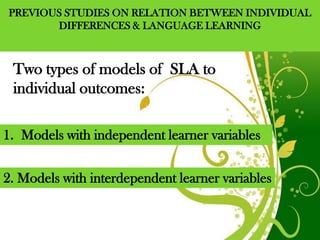
PREVIOUS STUDIES ON RELATION BETWEEN INDIVIDUAL
       DIFFERENCES & LANGUAGE LEARNING


 Two types of models of SLA to
 individual outcomes:

1. Models with independent learner variables


2. Models with interdependent learner variables


                    Free Powerpoint Templates     Page 3
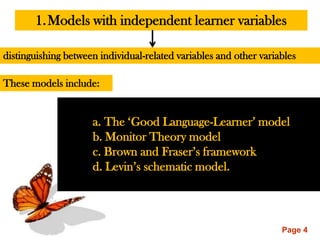
1. Models with independent learner variables

distinguishing between individual-related variables and other variables

These models include:


                     a. The „Good Language-Learner‟ model
                     b. Monitor Theory model
                     c. Brown and Fraser‟s framework
                     d. Levin‟s schematic model.


                                                                   Page 4
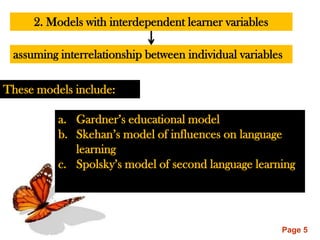
2. Models with interdependent learner variables

 assuming interrelationship between individual variables

These models include:

          a. Gardner‟s educational model
          b. Skehan‟s model of influences on language
             learning
          c. Spolsky‟s model of second language learning


                                                       Page 5
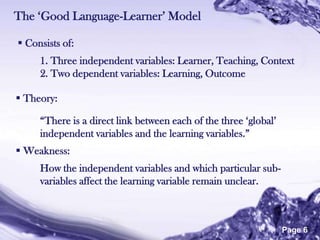
The „Good Language-Learner‟ Model

 Consists of:
     1. Three independent variables: Learner, Teaching, Context
     2. Two dependent variables: Learning, Outcome

 Theory:

     “There is a direct link between each of the three „global‟
     independent variables and the learning variables.”
 Weakness:
     How the independent variables and which particular sub-
     variables affect the learning variable remain unclear.


                        Powerpoint Templates
                                                                  Page 6
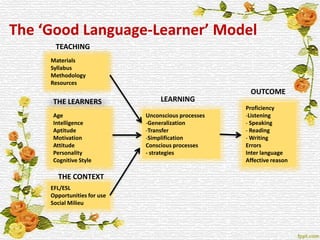
The ‘Good Language-Learner’ Model
      TEACHING
     Materials
     Syllabus
     Methodology
     Resources
                                                      OUTCOME
     THE LEARNERS                 LEARNING
                                                     Proficiency
     Age                     Unconscious processes   -Listening
     Intelligence            -Generalization         - Speaking
     Aptitude                -Transfer               - Reading
     Motivation              -Simplification         - Writing
     Attitude                Conscious processes     Errors
     Personality             - strategies            Inter language
     Cognitive Style                                 Affective reason

       THE CONTEXT
     EFL/ESL
     Opportunities for use
     Social Milieu
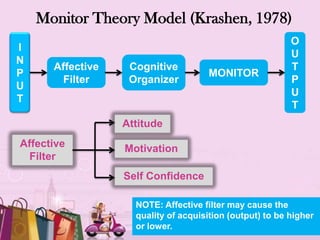
Monitor Theory Model (Krashen, 1978)
                                                            O
I
                                                            U
N
      Affective     Cognitive                               T
P                                      MONITOR
       Filter       Organizer                               P
U
                                                            U
T
                                                            T
                  Attitude
Affective          Motivation
  Filter
                  Self Confidence

                      NOTE: Affective filter may cause the
                      quality of acquisition (output) to be higher
                  Freeor lower. Templates
                       Powerpoint
                                                           Page 8
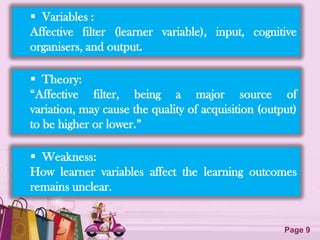
 Variables :
Affective filter (learner variable), input, cognitive
organisers, and output.

 Theory:
“Affective filter, being a major source of
variation, may cause the quality of acquisition (output)
to be higher or lower.”

 Weakness:
How learner variables affect the learning outcomes
remains unclear.

                  Free Powerpoint Templates
                                                     Page 9
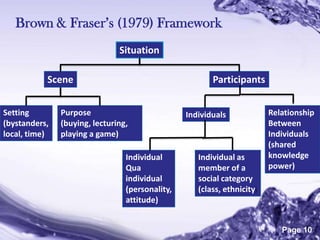
Brown & Fraser‟s (1979) Framework
                               Situation

           Scene                                        Participants


Setting        Purpose                           Individuals             Relationship
(bystanders,   (buying, lecturing,                                       Between
local, time)   playing a game)                                           Individuals
                                                                         (shared
                                 Individual         Individual as        knowledge
                                 Qua                member of a          power)
                                 individual         social category
                                 (personality,      (class, ethnicity)
                                 attitude)

                               Powerpoint Templates
                                                                            Page 10
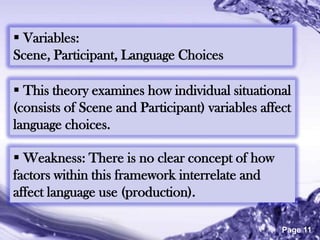
 Variables:
Scene, Participant, Language Choices

 This theory examines how individual situational
(consists of Scene and Participant) variables affect
language choices.

 Weakness: There is no clear concept of how
factors within this framework interrelate and
affect language use (production).

                    Powerpoint Templates
                                                  Page 11
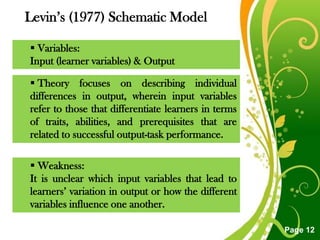
Levin‟s (1977) Schematic Model

 Variables:
Input (learner variables) & Output

 Theory focuses on describing individual
differences in output, wherein input variables
refer to those that differentiate learners in terms
of traits, abilities, and prerequisites that are
related to successful output-task performance.

 Weakness:
It is unclear which input variables that lead to
learners‟ variation in output or how the different
variables influence one another.
                      Free Powerpoint Templates
                                                      Page 12
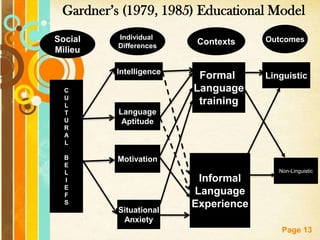
Gardner‟s (1979, 1985) Educational Model
Social    Individual                     Outcomes
          Differences
                             Contexts
Milieu

         Intelligence
                             Formal      Linguistic
  C                         Language
  U
  L
                             training
  T       Language
  U        Aptitude
  R
  A
  L

  B       Motivation
  E
  L                                         Non-Linguistic
  I                          Informal
  E
  F                         Language
  S                         Experience
          Situational
           Anxiety
          Free Powerpoint Templates
                                             Page 13
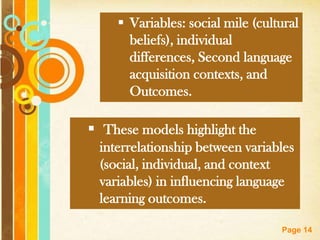
 Variables: social mile (cultural
      beliefs), individual
      differences, Second language
      acquisition contexts, and
      Outcomes.

 These models highlight the
 interrelationship between variables
 (social, individual, and context
 variables) in influencing language
 learning outcomes.
     Free Powerpoint Templates
                                  Page 14
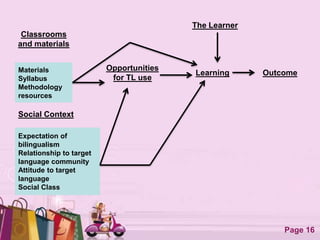
Skehan‟s (1986, 1989) model of influences
               on language learning
Improvement from Naiman‟s „Good Language-Learner‟
model, however Sekhan highlights the importance of a joined-
variables effect on language learning.


                       Free Powerpoint Templates
                                                       Page 15
The Learner
 Classrooms
and materials


Materials                Opportunities
                                               Learning     Outcome
Syllabus                  for TL use
Methodology
resources

Social Context

Expectation of
bilingualism
Relationship to target
language community
Attitude to target
language
Social Class


                            Free Powerpoint Templates
                                                                Page 16
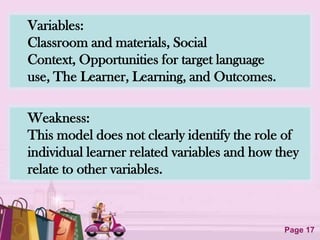
Variables:
Classroom and materials, Social
Context, Opportunities for target language
use, The Learner, Learning, and Outcomes.

Weakness:
This model does not clearly identify the role of
individual learner related variables and how they
relate to other variables.


                Free Powerpoint Templates
                                              Page 17
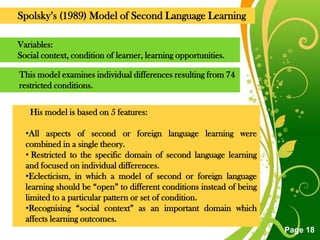
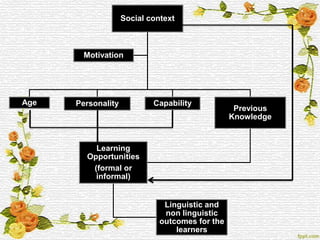
Spolsky‟s (1989) Model of Second Language Learning

Variables:
Social context, condition of learner, learning opportunities.

This model examines individual differences resulting from 74
restricted conditions.


   His model is based on 5 features:

  •All aspects of second or foreign language learning were
  combined in a single theory.
  • Restricted to the specific domain of second language learning
  and focused on individual differences.
  •Eclecticism, in which a model of second or foreign language
  learning should be “open” to different conditions instead of being
  limited to a particular pattern or set of condition.
  •Recognising “social context” as an important domain which
  affects learning outcomes.
                              Free Powerpoint Templates
                                                                       Page 18
Two main clusters in Spolsky‟s model:


1. Conditions of social context, i.e.
   conditions which influence
   learning in two ways.

       2. Conditions of learners


          Powerpoint Templates
                                        Page 19
Social context


        Motivation


Age   Personality           Capability
                                                  Previous
                                                 Knowledge


          Learning
        Opportunities
         (formal or
          informal)


                               Linguistic and
                               non linguistic
                              outcomes for the
                                  learners
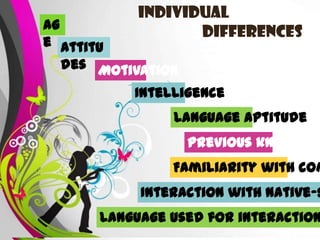
INDIVIDUAL
Ag
                    DIFFERENCES
e Attitu
  des Motivation
            Intelligence
                  Language aptitude
                    Previous knowled
                  Familiarity with com
             Interaction with native-s
       Language used for interaction
         Free Powerpoint Templates Page 21

Ict for presentation group 3

  • 1.
    INDIVIDUAL DIFFERENCES and CALL By Group 3: ü Zulkifli ü Eka Margianti S ü Miftahuljannah ü Qori Aturrahmah ü Dhony Free Powerpoint Templates Page 1
  • 2.
    BACKGROUND  Objective :Investigating what factors on learners/students that may affect the Computer-Assisted Language Learning (CALL).  The factors have been studied on the basis of learner variables which are assumed to be affecting the language learning process. And further study observed which individual variables which should be considered most relevant in affecting language Templates outcomes Free Powerpoint learning
  • 3.
    PREVIOUS STUDIES ONRELATION BETWEEN INDIVIDUAL DIFFERENCES & LANGUAGE LEARNING Two types of models of SLA to individual outcomes: 1. Models with independent learner variables 2. Models with interdependent learner variables Free Powerpoint Templates Page 3
  • 4.
    1. Models withindependent learner variables distinguishing between individual-related variables and other variables These models include: a. The „Good Language-Learner‟ model b. Monitor Theory model c. Brown and Fraser‟s framework d. Levin‟s schematic model. Page 4
  • 5.
    2. Models withinterdependent learner variables assuming interrelationship between individual variables These models include: a. Gardner‟s educational model b. Skehan‟s model of influences on language learning c. Spolsky‟s model of second language learning Page 5
  • 6.
    The „Good Language-Learner‟Model  Consists of: 1. Three independent variables: Learner, Teaching, Context 2. Two dependent variables: Learning, Outcome  Theory: “There is a direct link between each of the three „global‟ independent variables and the learning variables.”  Weakness: How the independent variables and which particular sub- variables affect the learning variable remain unclear. Powerpoint Templates Page 6
  • 7.
    The ‘Good Language-Learner’Model TEACHING Materials Syllabus Methodology Resources OUTCOME THE LEARNERS LEARNING Proficiency Age Unconscious processes -Listening Intelligence -Generalization - Speaking Aptitude -Transfer - Reading Motivation -Simplification - Writing Attitude Conscious processes Errors Personality - strategies Inter language Cognitive Style Affective reason THE CONTEXT EFL/ESL Opportunities for use Social Milieu
  • 8.
    Monitor Theory Model(Krashen, 1978) O I U N Affective Cognitive T P MONITOR Filter Organizer P U U T T Attitude Affective Motivation Filter Self Confidence NOTE: Affective filter may cause the quality of acquisition (output) to be higher Freeor lower. Templates Powerpoint Page 8
  • 9.
     Variables : Affectivefilter (learner variable), input, cognitive organisers, and output.  Theory: “Affective filter, being a major source of variation, may cause the quality of acquisition (output) to be higher or lower.”  Weakness: How learner variables affect the learning outcomes remains unclear. Free Powerpoint Templates Page 9
  • 10.
    Brown & Fraser‟s(1979) Framework Situation Scene Participants Setting Purpose Individuals Relationship (bystanders, (buying, lecturing, Between local, time) playing a game) Individuals (shared Individual Individual as knowledge Qua member of a power) individual social category (personality, (class, ethnicity) attitude) Powerpoint Templates Page 10
  • 11.
     Variables: Scene, Participant,Language Choices  This theory examines how individual situational (consists of Scene and Participant) variables affect language choices.  Weakness: There is no clear concept of how factors within this framework interrelate and affect language use (production). Powerpoint Templates Page 11
  • 12.
    Levin‟s (1977) SchematicModel  Variables: Input (learner variables) & Output  Theory focuses on describing individual differences in output, wherein input variables refer to those that differentiate learners in terms of traits, abilities, and prerequisites that are related to successful output-task performance.  Weakness: It is unclear which input variables that lead to learners‟ variation in output or how the different variables influence one another. Free Powerpoint Templates Page 12
  • 13.
    Gardner‟s (1979, 1985)Educational Model Social Individual Outcomes Differences Contexts Milieu Intelligence Formal Linguistic C Language U L training T Language U Aptitude R A L B Motivation E L Non-Linguistic I Informal E F Language S Experience Situational Anxiety Free Powerpoint Templates Page 13
  • 14.
     Variables: socialmile (cultural beliefs), individual differences, Second language acquisition contexts, and Outcomes.  These models highlight the interrelationship between variables (social, individual, and context variables) in influencing language learning outcomes. Free Powerpoint Templates Page 14
  • 15.
    Skehan‟s (1986, 1989)model of influences on language learning Improvement from Naiman‟s „Good Language-Learner‟ model, however Sekhan highlights the importance of a joined- variables effect on language learning. Free Powerpoint Templates Page 15
  • 16.
    The Learner Classrooms andmaterials Materials Opportunities Learning Outcome Syllabus for TL use Methodology resources Social Context Expectation of bilingualism Relationship to target language community Attitude to target language Social Class Free Powerpoint Templates Page 16
  • 17.
    Variables: Classroom and materials,Social Context, Opportunities for target language use, The Learner, Learning, and Outcomes. Weakness: This model does not clearly identify the role of individual learner related variables and how they relate to other variables. Free Powerpoint Templates Page 17
  • 18.
    Spolsky‟s (1989) Modelof Second Language Learning Variables: Social context, condition of learner, learning opportunities. This model examines individual differences resulting from 74 restricted conditions. His model is based on 5 features: •All aspects of second or foreign language learning were combined in a single theory. • Restricted to the specific domain of second language learning and focused on individual differences. •Eclecticism, in which a model of second or foreign language learning should be “open” to different conditions instead of being limited to a particular pattern or set of condition. •Recognising “social context” as an important domain which affects learning outcomes. Free Powerpoint Templates Page 18
  • 19.
    Two main clustersin Spolsky‟s model: 1. Conditions of social context, i.e. conditions which influence learning in two ways. 2. Conditions of learners Powerpoint Templates Page 19
  • 20.
    Social context Motivation Age Personality Capability Previous Knowledge Learning Opportunities (formal or informal) Linguistic and non linguistic outcomes for the learners
  • 21.
    INDIVIDUAL Ag DIFFERENCES e Attitu des Motivation Intelligence Language aptitude Previous knowled Familiarity with com Interaction with native-s Language used for interaction Free Powerpoint Templates Page 21