Visual 6.1
Unified Command
Unit 6:
Unified Command
Visual 6.2
Unified Command
 Define Unified Command.
 List the advantages of
Unified Command.
 Identify the primary
features of Unified
Command.
 Differentiate between
command and
coordination.
Unit Objectives
Visual 6.3
Unified Command
Activity: Optimal Strategy
Instructions: Working individually . . .
1. Review the scenario presented in the
Student Manual and select the optimal
strategy that provides the best solution.
2. Be prepared to share your answer in
5 minutes.
Visual 6.4
Unified Command
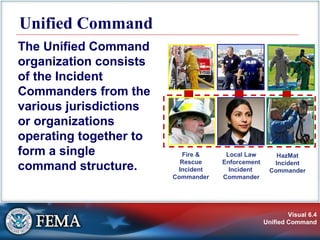
Unified Command
The Unified Command
organization consists
of the Incident
Commanders from the
various jurisdictions
or organizations
operating together to
form a single
command structure.
Fire &
Rescue
Incident
Commander
Local Law
Enforcement
Incident
Commander
HazMat
Incident
Commander
Visual 6.5
Unified Command
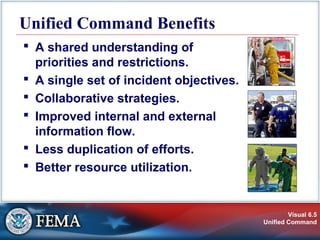
Unified Command Benefits
 A shared understanding of
priorities and restrictions.
 A single set of incident objectives.
 Collaborative strategies.
 Improved internal and external
information flow.
 Less duplication of efforts.
 Better resource utilization.
Visual 6.6
Unified Command
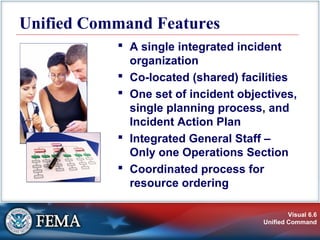
Unified Command Features
 A single integrated incident
organization
 Co-located (shared) facilities
 One set of incident objectives,
single planning process, and
Incident Action Plan
 Integrated General Staff –
Only one Operations Section
 Coordinated process for
resource ordering
Visual 6.7
Unified Command
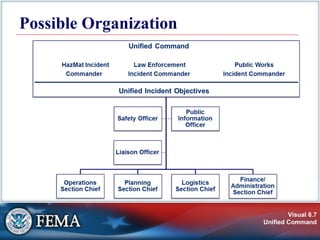
Possible Organization
Visual 6.8
Unified Command
What are potential
barriers to
implementing Unified
Command?
Discussion Question
Visual 6.9
Unified Command
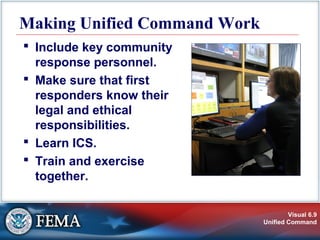
Making Unified Command Work
 Include key community
response personnel.
 Make sure that first
responders know their
legal and ethical
responsibilities.
 Learn ICS.
 Train and exercise
together.
Visual 6.10
Unified Command
Coordination activities
include:
 Establishing policy.
 Collecting information.
 Establishing priorities.
 Resolving resource
issues.
 Facilitating support.
 Synchronizing public
messages.
Incident Coordination
Visual 6.11
Unified Command
The Joint Information
Center (JIC):
 May be established to
coordinate public
information activities.
 Serves as the central
point of contact for all
news media.
Joint Information Center
Visual 6.12
Unified Command
Activity: Unified Command
Instructions: Working as a team . . .
1. Review the scenario and questions
presented in the Student Manual.
2. Refer to the quick-reference guides
in the Student Manual as needed.
3. Select a spokesperson and be
prepared to present your work in
20 minutes.
Visual 6.13
Unified Command
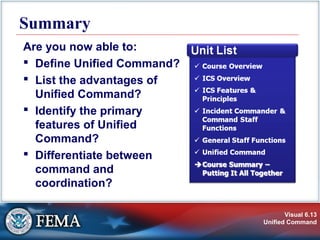
Summary
Are you now able to:
 Define Unified Command?
 List the advantages of
Unified Command?
 Identify the primary
features of Unified
Command?
 Differentiate between
command and
coordination?

Ics part 5

  • 1.
  • 2.
    Visual 6.2 Unified Command Define Unified Command.  List the advantages of Unified Command.  Identify the primary features of Unified Command.  Differentiate between command and coordination. Unit Objectives
  • 3.
    Visual 6.3 Unified Command Activity:Optimal Strategy Instructions: Working individually . . . 1. Review the scenario presented in the Student Manual and select the optimal strategy that provides the best solution. 2. Be prepared to share your answer in 5 minutes.
  • 4.
    Visual 6.4 Unified Command UnifiedCommand The Unified Command organization consists of the Incident Commanders from the various jurisdictions or organizations operating together to form a single command structure. Fire & Rescue Incident Commander Local Law Enforcement Incident Commander HazMat Incident Commander
  • 5.
    Visual 6.5 Unified Command UnifiedCommand Benefits  A shared understanding of priorities and restrictions.  A single set of incident objectives.  Collaborative strategies.  Improved internal and external information flow.  Less duplication of efforts.  Better resource utilization.
  • 6.
    Visual 6.6 Unified Command UnifiedCommand Features  A single integrated incident organization  Co-located (shared) facilities  One set of incident objectives, single planning process, and Incident Action Plan  Integrated General Staff – Only one Operations Section  Coordinated process for resource ordering
  • 7.
  • 8.
    Visual 6.8 Unified Command Whatare potential barriers to implementing Unified Command? Discussion Question
  • 9.
    Visual 6.9 Unified Command MakingUnified Command Work  Include key community response personnel.  Make sure that first responders know their legal and ethical responsibilities.  Learn ICS.  Train and exercise together.
  • 10.
    Visual 6.10 Unified Command Coordinationactivities include:  Establishing policy.  Collecting information.  Establishing priorities.  Resolving resource issues.  Facilitating support.  Synchronizing public messages. Incident Coordination
  • 11.
    Visual 6.11 Unified Command TheJoint Information Center (JIC):  May be established to coordinate public information activities.  Serves as the central point of contact for all news media. Joint Information Center
  • 12.
    Visual 6.12 Unified Command Activity:Unified Command Instructions: Working as a team . . . 1. Review the scenario and questions presented in the Student Manual. 2. Refer to the quick-reference guides in the Student Manual as needed. 3. Select a spokesperson and be prepared to present your work in 20 minutes.
  • 13.
    Visual 6.13 Unified Command Summary Areyou now able to:  Define Unified Command?  List the advantages of Unified Command?  Identify the primary features of Unified Command?  Differentiate between command and coordination?

Editor's Notes

  • #2 IS-700.A: National Incident Management System, An Introduction January 2009 Page 2.