as a tool
to learn languages online
in teletandem
        Teresa Cardoso, Univ. Aberta (Portugal)
           Filipa Matos, Univ. de Salerno (Itália)
 TELETANDEM
FRAMEWORK


 tandem
 e-tandem
 teletandem
 TELETANDEM
KEY PRINCIPLES
(Panichi, 2002)


  equality
  reciprocity
  autonomy
 TELETANDEM
RESOURCES
(Instant Messaging/Voip)


  easy
  free
  flexible
 TELETANDEM BRAZIL
FOREIGN LANGUAGES FOR ALL
http://www.teletandembrasil.org/home.asp


   Italian                         as a context

   Portuguese                          to collaboratively teach and
                                       learn foreign languages
 PRELIMINARY STUDY
TARGET


  Italian students
  Brazilian students
  (FL courses)
 PRELIMINARY STUDY
METHODOLOGY


  questionnaires
  interviews
  contents analysis
 PRELIMINARY STUDY
AIMS
(research questions)


  uses?
  motivations?
  impact?
 PRELIMINARY STUDY
MAIN CONCLUSIONS


  teletandem
  new CALLT option
  satisfaction
 PRELIMINARY STUDY
USES

       “Thus, through an instant messaging
        program we can practice the language
        and not just study the grammatical
        issues (which is what happens in the
        university)” #22
 PRELIMINARY STUDY
MOTIVATIONS
   “To be able to learn more about this issue
    with greater commodity and easiness.
    As we are in a world of technology, we
    have to adapt to the tools that might
    make our work easier. And, besides, it
    is a great opportunity to know people
    from different countries” #6
 PRELIMINARY STUDY
IMPACT
   “more dynamic and allows for a contact
     with the language in the «event». And
     this is very different from learning by the
     method of didactical repetitions, etc.” #5
   “I can practice directly and rapidly, in an
     illustrative and efficient way with a
     native speaker of the foreign language I
     am learning” #10
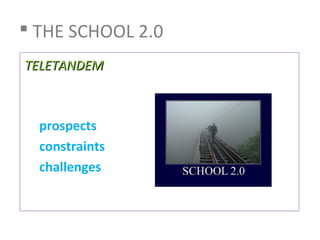
 THE SCHOOL 2.0
TELETANDEM


  prospects
  constraints
  challenges
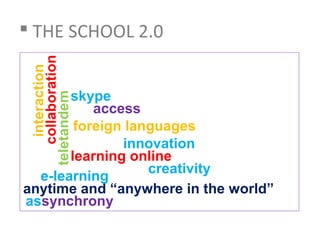
 THE SCHOOL 2.0
     collaboration
      interaction


       skype
 teletandem


           access
        foreign languages
               innovation
       learning online
                   creativity
  e-learning
anytime and “anywhere in the world”
assynchrony
Thank you!


        Teresa Cardoso, Univ. Aberta (Portugal)
                         tcardoso@univ-ab.pt

Icem2011 t cardoso-fmatos