What should genebank managers be
knowledgeable about?
(or, how can they know what they don’t know, and do something about it)
Some international perspectives
• What’s been done in the past?
• What’s out there now?
• What do the international instruments say?
• What’s in the literature?
• The wisdom of the crowd
• Some final general suggestions
Contents
“I would like to be remembered for establishing a functioning,
well-organized and documented genebank. But I think the
people who carry on after me will be the legacy that I leave
behind.”
Jean Hanson, ILRI
https://www.genebanks.org/news-activities/news/jean-hanson/
1. The pioneers: U Birmingham course
• https://mikejackson1948.wordpress.com/2012/03/24/genetic-resources-the-
impact-of-the-university-of-birmingham/
• SADC connection: SPGRC, UNZA
• U London distance learning course
2. The IPGRI contribution
• Regionalization (Africa, Asia, Latin America hubs)
• Generalization (curriculum, materials)
3. The last (MSc) course standing?
• UPLB
History
4
UPLB, The Philippines
http://uplbgraduateschool.org/academic-programs/plant-genetic-resources-conservation-and-management-pgrcm/
UPM, Spain
https://masteroficialrecursosfitogeneticos.wordpress.com/
U. Saskatchewan, Canada
http://ocw.usask.ca/AB/PLSC/408/#
UNALM, Mexico
http://www.leisa-al.org/web/index.php/lasnoticias/biodiversidad/3166-curso-internacional-domesticacion-manejo-y-conservacion-in-situ-de-
recursos-geneticos
CGN, The Netherlands
https://www.wur.nl/nl/show/CDIcourse_contemporary_approaches_2018.htm
Existing courses (selected)
5
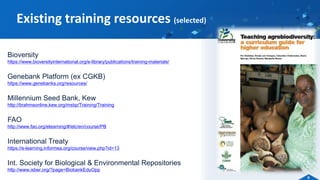
Bioversity
https://www.bioversityinternational.org/e-library/publications/training-materials/
Genebank Platform (ex CGKB)
https://www.genebanks.org/resources/
Millennium Seed Bank, Kew
http://brahmsonline.kew.org/msbp/Training/Training
FAO
http://www.fao.org/elearning/#/elc/en/course/PB
International Treaty
https://e-learning.informea.org/course/view.php?id=13
Int. Society for Biological & Environmental Repositories
http://www.isber.org/?page=BiobankEduOpp
Existing training resources (selected)
6
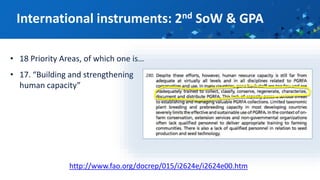
• 18 Priority Areas, of which one is…
• 17. “Building and strengthening
human capacity”
International instruments: 2nd SoW & GPA
http://www.fao.org/docrep/015/i2624e/i2624e00.htm
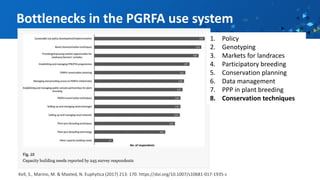
Bottlenecks in the PGRFA use system
Kell, S., Marino, M. & Maxted, N. Euphytica (2017) 213: 170. https://doi.org/10.1007/s10681-017-1935-z
1. Policy
2. Genotyping
3. Markets for landraces
4. Participatory breeding
5. Conservation planning
6. Data management
7. PPP in plant breeding
8. Conservation techniques
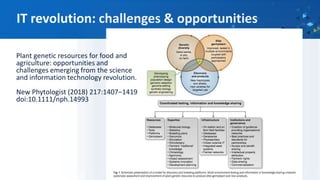
IT revolution: challenges & opportunities
Plant genetic resources for food and
agriculture: opportunities and
challenges emerging from the science
and information technology revolution.
New Phytologist (2018) 217:1407–1419
doi:10.1111/nph.14993
• Debouck (CIAT): Dealing with the media
 Including social media 
• Ellis (CIP): Navigating policy environment
 Only getting more complex
• Sackville Hamilton (IRRI): How to get out of “genebank database hell”
 GRIN-Global
 DOIs
 Metadata for char/eval
Neglected areas: retiring CG genebank managers
• Genetic resources policy
• Taxonomy
• Extinction: genes, varieties, knowledge,
wisdom
• Seed physiology – including seed
development, aging, vigour
 Knowledge of and disseminating information
on strategies for germinating older seed
 Conservation of recalcitrant species
• Incentives: commercialization of adaptive local
varieties
• Linking crop diversity management and
climate change
Other neglected areas: crowdsourcing
https://agro.biodiver.se/2018/03/crowdsourcing-genebank-training-needs/#comments
• Financial management
 The economics of genetically efficient
genetic resource curation
• Strategic partnerships
• Traditional knowledge
• A good control of what is in their collection
and the status of each accession
 Sample and lot tracking
 Maintaining genetic integrity
 Seed banks vs. gene banks: What’s the unit
of conservation and what are the biologically
and economically justifiable thresholds for
keeping genetically similar accessions?
• Disease testing and seed treatments for
seed import and distribution
• Valuation of PGR in genebanks
• Counteract trend towards specialization
• Don’t stop at conservation (use, impact etc)
• Plan for different audiences, levels, length of course
Modularity
Flexibility
Use cases
• Build around quality management
GOAL
• Factor in mentorship
• Remember other languages
Some final thoughts
THANK YOU
WWW.CROPTRUST.ORG

Genebank training needs

  • 1.
    What should genebankmanagers be knowledgeable about? (or, how can they know what they don’t know, and do something about it) Some international perspectives
  • 2.
    • What’s beendone in the past? • What’s out there now? • What do the international instruments say? • What’s in the literature? • The wisdom of the crowd • Some final general suggestions Contents
  • 3.
    “I would liketo be remembered for establishing a functioning, well-organized and documented genebank. But I think the people who carry on after me will be the legacy that I leave behind.” Jean Hanson, ILRI https://www.genebanks.org/news-activities/news/jean-hanson/
  • 4.
    1. The pioneers:U Birmingham course • https://mikejackson1948.wordpress.com/2012/03/24/genetic-resources-the- impact-of-the-university-of-birmingham/ • SADC connection: SPGRC, UNZA • U London distance learning course 2. The IPGRI contribution • Regionalization (Africa, Asia, Latin America hubs) • Generalization (curriculum, materials) 3. The last (MSc) course standing? • UPLB History 4
  • 5.
    UPLB, The Philippines http://uplbgraduateschool.org/academic-programs/plant-genetic-resources-conservation-and-management-pgrcm/ UPM,Spain https://masteroficialrecursosfitogeneticos.wordpress.com/ U. Saskatchewan, Canada http://ocw.usask.ca/AB/PLSC/408/# UNALM, Mexico http://www.leisa-al.org/web/index.php/lasnoticias/biodiversidad/3166-curso-internacional-domesticacion-manejo-y-conservacion-in-situ-de- recursos-geneticos CGN, The Netherlands https://www.wur.nl/nl/show/CDIcourse_contemporary_approaches_2018.htm Existing courses (selected) 5
  • 6.
    Bioversity https://www.bioversityinternational.org/e-library/publications/training-materials/ Genebank Platform (exCGKB) https://www.genebanks.org/resources/ Millennium Seed Bank, Kew http://brahmsonline.kew.org/msbp/Training/Training FAO http://www.fao.org/elearning/#/elc/en/course/PB International Treaty https://e-learning.informea.org/course/view.php?id=13 Int. Society for Biological & Environmental Repositories http://www.isber.org/?page=BiobankEduOpp Existing training resources (selected) 6
  • 7.
    • 18 PriorityAreas, of which one is… • 17. “Building and strengthening human capacity” International instruments: 2nd SoW & GPA http://www.fao.org/docrep/015/i2624e/i2624e00.htm
  • 8.
    Bottlenecks in thePGRFA use system Kell, S., Marino, M. & Maxted, N. Euphytica (2017) 213: 170. https://doi.org/10.1007/s10681-017-1935-z 1. Policy 2. Genotyping 3. Markets for landraces 4. Participatory breeding 5. Conservation planning 6. Data management 7. PPP in plant breeding 8. Conservation techniques
  • 9.
    IT revolution: challenges& opportunities Plant genetic resources for food and agriculture: opportunities and challenges emerging from the science and information technology revolution. New Phytologist (2018) 217:1407–1419 doi:10.1111/nph.14993
  • 10.
    • Debouck (CIAT):Dealing with the media  Including social media  • Ellis (CIP): Navigating policy environment  Only getting more complex • Sackville Hamilton (IRRI): How to get out of “genebank database hell”  GRIN-Global  DOIs  Metadata for char/eval Neglected areas: retiring CG genebank managers
  • 11.
    • Genetic resourcespolicy • Taxonomy • Extinction: genes, varieties, knowledge, wisdom • Seed physiology – including seed development, aging, vigour  Knowledge of and disseminating information on strategies for germinating older seed  Conservation of recalcitrant species • Incentives: commercialization of adaptive local varieties • Linking crop diversity management and climate change Other neglected areas: crowdsourcing https://agro.biodiver.se/2018/03/crowdsourcing-genebank-training-needs/#comments • Financial management  The economics of genetically efficient genetic resource curation • Strategic partnerships • Traditional knowledge • A good control of what is in their collection and the status of each accession  Sample and lot tracking  Maintaining genetic integrity  Seed banks vs. gene banks: What’s the unit of conservation and what are the biologically and economically justifiable thresholds for keeping genetically similar accessions? • Disease testing and seed treatments for seed import and distribution • Valuation of PGR in genebanks
  • 12.
    • Counteract trendtowards specialization • Don’t stop at conservation (use, impact etc) • Plan for different audiences, levels, length of course Modularity Flexibility Use cases • Build around quality management GOAL • Factor in mentorship • Remember other languages Some final thoughts
  • 13.