controllabilityand observability
content
Concept of controllability
Concept of Observability
Prepared By
Mr.K.Jawahar, M.E.,
Assistant Professor
Department of EEE
Controllability and Observability
Kongunadunadu College of Engineering and Technology Department of EEE
STATE VARIABLE ANALYSIS
Introduction
 The state variable approach is a powerful tool/techniques for the
analysis of design of control systems.
 The analysis and design of the following systems can be carried
using state space method
i. Linear system
ii. Non-linear system
iii. Time invariant system
iv. Time varying system
v. Multiple input and multiple output system
 The state space analysis is a modern approach and also easier for
analysis using digital computers.
Kongunadunadu College of Engineering and Technology Department of EEE
Controllability and Observability
The drawbacks in the transfer function model and analysis are,
 Transfer function is defined under zero initial condition
 Transfer function is applicable to linear time invariant systems
 Transfer function analysis is restricted to single input and single
output systems
 Does not provides information regarding the internal state of the
system.
Kongunadunadu College of Engineering and Technology Department of EEE
Controllability and Observability
Concepts of controllability and observability
Controllability:
 The controllability verifies the usefulness of a state variables. In
the controllability test we can find, whether the state variable can
be controlled to achieve the desired output.
Definition for controllability:
 A system is said to be completely state controllable if it is
possible to transfer the system state from an initial state X(t0) to
any other desired state X(td) in specified finite time by a control
vector U(t).
 The controllability of a state model can be tested by
Kalman’s and Gilbert’s test.
Kongunadunadu College of Engineering and Technology Department of EEE
Controllability and Observability
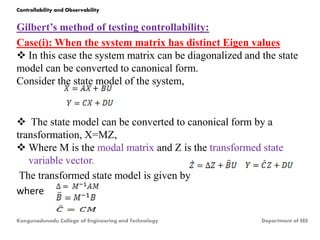
Gilbert’s method of testing controllability:
Case(i): When the system matrix has distinct Eigen values
 In this case the system matrix can be diagonalized and the state
model can be converted to canonical form.
Consider the state model of the system,
 The state model can be converted to canonical form by a
transformation, X=MZ,
 Where M is the modal matrix and Z is the transformed state
variable vector.
The transformed state model is given by
where
Kongunadunadu College of Engineering and Technology Department of EEE
Controllability and Observability
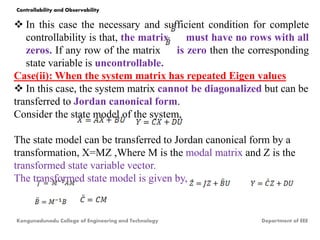
 In this case the necessary and sufficient condition for complete
controllability is that, the matrix must have no rows with all
zeros. If any row of the matrix is zero then the corresponding
state variable is uncontrollable.
Case(ii): When the system matrix has repeated Eigen values
 In this case, the system matrix cannot be diagonalized but can be
transferred to Jordan canonical form.
Consider the state model of the system,
The state model can be transferred to Jordan canonical form by a
transformation, X=MZ ,Where M is the modal matrix and Z is the
transformed state variable vector.
The transformed state model is given by,
Kongunadunadu College of Engineering and Technology Department of EEE
Controllability and Observability
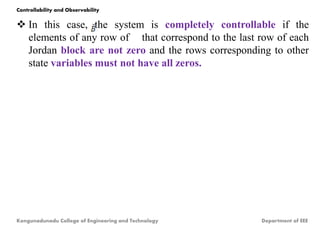
 In this case, the system is completely controllable if the
elements of any row of that correspond to the last row of each
Jordan block are not zero and the rows corresponding to other
state variables must not have all zeros.
Kongunadunadu College of Engineering and Technology Department of EEE
Controllability and Observability
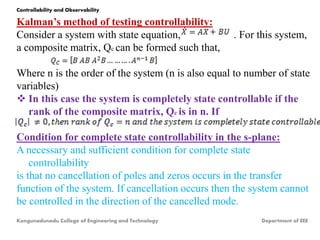
Kalman’s method of testing controllability:
Consider a system with state equation, . For this system,
a composite matrix, Qc can be formed such that,
Where n is the order of the system (n is also equal to number of state
variables)
 In this case the system is completely state controllable if the
rank of the composite matrix, Qc is in n. If
Condition for complete state controllability in the s-plane:
A necessary and sufficient condition for complete state
controllability
is that no cancellation of poles and zeros occurs in the transfer
function of the system. If cancellation occurs then the system cannot
be controlled in the direction of the cancelled mode.
Kongunadunadu College of Engineering and Technology Department of EEE
Controllability and Observability
Observability:
 In observability test we can find whether the state variable is
observable or measurable. The concept of observability is useful
in solving the problem of reconstructing unmeasurable state
variables from measurable ones in the minimum possible length of
time.
Definition for Observability :
 A system is said to be completely observable if every state X(t)
can be completely identified by measurements of the output Y(t)
over a finite time interval.
Kongunadunadu College of Engineering and Technology Department of EEE
Controllability and Observability
Gilbert’s method of testing observability:
The state model can be converted to a canonical or Jordan canonical
form by a transformation, X=MZ
The necessary and sufficient condition for complete observability is
that none of the columns of the matrix be zero. If any of the
column’s of has all zeros then the corresponding state variable is
not observable.
Kongunadunadu College of Engineering and Technology Department of EEE
Controllability and Observability
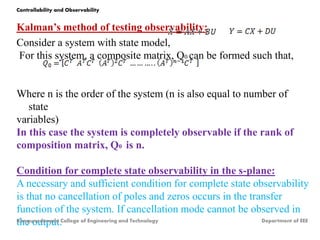
Kalman’s method of testing observability:
Consider a system with state model,
For this system, a composite matrix, Q0 can be formed such that,
Where n is the order of the system (n is also equal to number of
state
variables)
In this case the system is completely observable if the rank of
composition matrix, Q0 is n.
Condition for complete state observability in the s-plane:
A necessary and sufficient condition for complete state observability
is that no cancellation of poles and zeros occurs in the transfer
function of the system. If cancellation mode cannot be observed in
the output.
Kongunadunadu College of Engineering and Technology Department of EEE
Controllability and Observability
Reference:
• A.Nagoor Kani, “ Control Systems”, RBA Publications, June
2012.
Kongunadunadu College of Engineering and Technology Department of EEE
Controllability and Observability

IC-6501-CS-UNIT-V.ppt

  • 1.
    controllabilityand observability content Concept ofcontrollability Concept of Observability Prepared By Mr.K.Jawahar, M.E., Assistant Professor Department of EEE Controllability and Observability Kongunadunadu College of Engineering and Technology Department of EEE
  • 2.
    STATE VARIABLE ANALYSIS Introduction The state variable approach is a powerful tool/techniques for the analysis of design of control systems.  The analysis and design of the following systems can be carried using state space method i. Linear system ii. Non-linear system iii. Time invariant system iv. Time varying system v. Multiple input and multiple output system  The state space analysis is a modern approach and also easier for analysis using digital computers. Kongunadunadu College of Engineering and Technology Department of EEE Controllability and Observability
  • 3.
    The drawbacks inthe transfer function model and analysis are,  Transfer function is defined under zero initial condition  Transfer function is applicable to linear time invariant systems  Transfer function analysis is restricted to single input and single output systems  Does not provides information regarding the internal state of the system. Kongunadunadu College of Engineering and Technology Department of EEE Controllability and Observability
  • 4.
    Concepts of controllabilityand observability Controllability:  The controllability verifies the usefulness of a state variables. In the controllability test we can find, whether the state variable can be controlled to achieve the desired output. Definition for controllability:  A system is said to be completely state controllable if it is possible to transfer the system state from an initial state X(t0) to any other desired state X(td) in specified finite time by a control vector U(t).  The controllability of a state model can be tested by Kalman’s and Gilbert’s test. Kongunadunadu College of Engineering and Technology Department of EEE Controllability and Observability
  • 5.
    Gilbert’s method oftesting controllability: Case(i): When the system matrix has distinct Eigen values  In this case the system matrix can be diagonalized and the state model can be converted to canonical form. Consider the state model of the system,  The state model can be converted to canonical form by a transformation, X=MZ,  Where M is the modal matrix and Z is the transformed state variable vector. The transformed state model is given by where Kongunadunadu College of Engineering and Technology Department of EEE Controllability and Observability
  • 6.
     In thiscase the necessary and sufficient condition for complete controllability is that, the matrix must have no rows with all zeros. If any row of the matrix is zero then the corresponding state variable is uncontrollable. Case(ii): When the system matrix has repeated Eigen values  In this case, the system matrix cannot be diagonalized but can be transferred to Jordan canonical form. Consider the state model of the system, The state model can be transferred to Jordan canonical form by a transformation, X=MZ ,Where M is the modal matrix and Z is the transformed state variable vector. The transformed state model is given by, Kongunadunadu College of Engineering and Technology Department of EEE Controllability and Observability
  • 7.
     In thiscase, the system is completely controllable if the elements of any row of that correspond to the last row of each Jordan block are not zero and the rows corresponding to other state variables must not have all zeros. Kongunadunadu College of Engineering and Technology Department of EEE Controllability and Observability
  • 8.
    Kalman’s method oftesting controllability: Consider a system with state equation, . For this system, a composite matrix, Qc can be formed such that, Where n is the order of the system (n is also equal to number of state variables)  In this case the system is completely state controllable if the rank of the composite matrix, Qc is in n. If Condition for complete state controllability in the s-plane: A necessary and sufficient condition for complete state controllability is that no cancellation of poles and zeros occurs in the transfer function of the system. If cancellation occurs then the system cannot be controlled in the direction of the cancelled mode. Kongunadunadu College of Engineering and Technology Department of EEE Controllability and Observability
  • 9.
    Observability:  In observabilitytest we can find whether the state variable is observable or measurable. The concept of observability is useful in solving the problem of reconstructing unmeasurable state variables from measurable ones in the minimum possible length of time. Definition for Observability :  A system is said to be completely observable if every state X(t) can be completely identified by measurements of the output Y(t) over a finite time interval. Kongunadunadu College of Engineering and Technology Department of EEE Controllability and Observability
  • 10.
    Gilbert’s method oftesting observability: The state model can be converted to a canonical or Jordan canonical form by a transformation, X=MZ The necessary and sufficient condition for complete observability is that none of the columns of the matrix be zero. If any of the column’s of has all zeros then the corresponding state variable is not observable. Kongunadunadu College of Engineering and Technology Department of EEE Controllability and Observability
  • 11.
    Kalman’s method oftesting observability: Consider a system with state model, For this system, a composite matrix, Q0 can be formed such that, Where n is the order of the system (n is also equal to number of state variables) In this case the system is completely observable if the rank of composition matrix, Q0 is n. Condition for complete state observability in the s-plane: A necessary and sufficient condition for complete state observability is that no cancellation of poles and zeros occurs in the transfer function of the system. If cancellation mode cannot be observed in the output. Kongunadunadu College of Engineering and Technology Department of EEE Controllability and Observability
  • 12.
    Reference: • A.Nagoor Kani,“ Control Systems”, RBA Publications, June 2012. Kongunadunadu College of Engineering and Technology Department of EEE Controllability and Observability