Technological Trends of the Future: Next Era of Computing
Kerrie Holley, IBM Fellow
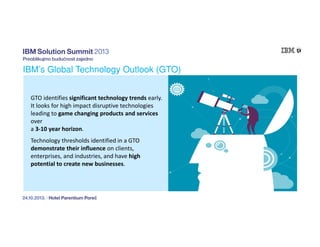
IBM’s Global Technology Outlook (GTO)
GTO identifies significant technology trends early.
It looks for high impact disruptive technologies
leading to game changing products and services
over
a 3-10 year horizon.
Technology thresholds identified in a GTO
demonstrate their influence on clients,
enterprises, and industries, and have high
potential to create new businesses.
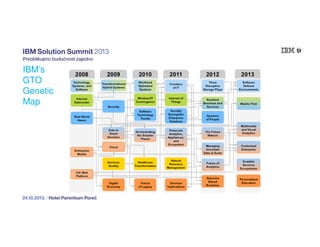
IBM’s
GTO
Genetic
Map
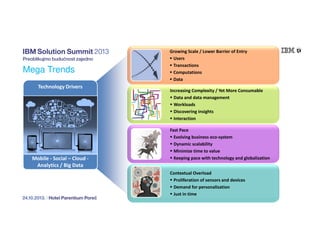
Mega Trends
Technology Drivers

Mobile - Social – Cloud Analytics / Big Data

Growing Scale / Lower Barrier of Entry
Users
Transactions
Computations
Data
Increasing Complexity / Yet More Consumable
Data and data management
Workloads
Discovering insights
Interaction
Fast Pace
Evolving business eco-system
Dynamic scalability
Minimize time to value
Keeping pace with technology and globalization
Contextual Overload
Proliferation of sensors and devices
Demand for personalization
Just in time
IBM’s 5 in 5
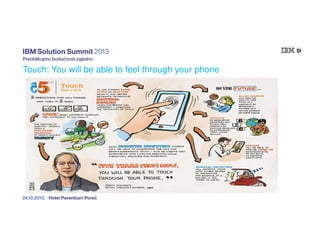
Touch: You will be able to feel through your phone
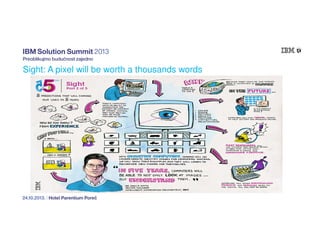
Sight: A pixel will be worth a thousands words
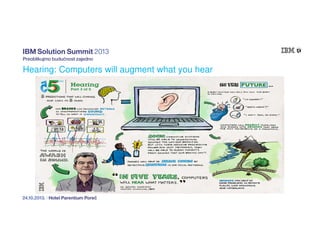
Hearing: Computers will augment what you hear
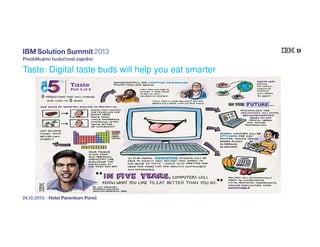
Taste: Digital taste buds will help you eat smarter
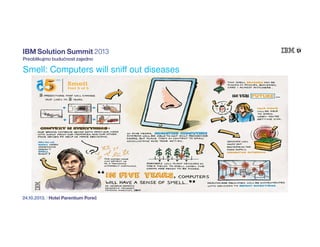
Smell: Computers will sniff out diseases
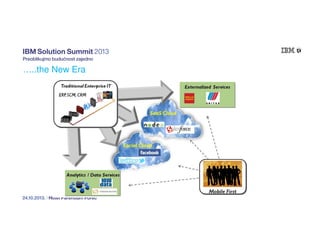
…..the New Era
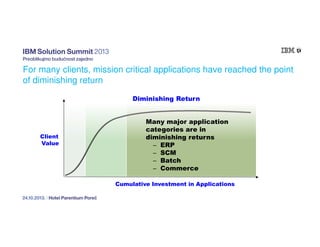
For many clients, mission critical applications have reached the point
of diminishing return
Diminishing Return

Client
Value

Many major application
categories are in
diminishing returns
– ERP
– SCM
– Batch
– Commerce
Cumulative Investment in Applications
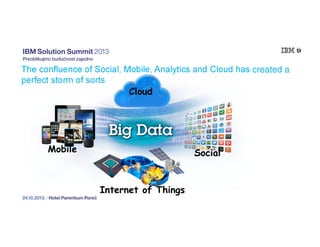
The confluence of Social, Mobile, Analytics and Cloud has created a
perfect storm of sorts
Cloud

Mobile

Social

Internet of Things
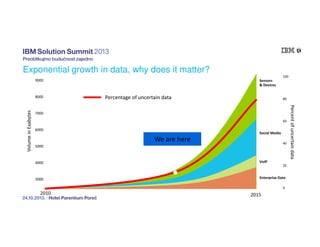
Exponential growth in data, why does it matter?
100

9000

Percentage of uncertain data

80

7000
60

6000

Social Media

We are here

40

5000

4000

VoIP

3000

Enterprise Data

20

0

2010

2015

Percent of uncertain data

Volume in Exabytes

8000

Sensors
& Devices
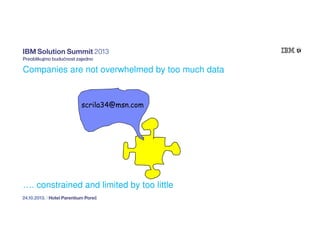
Companies are not overwhelmed by too much data

scrila34@msn.com

…. constrained and limited by too little
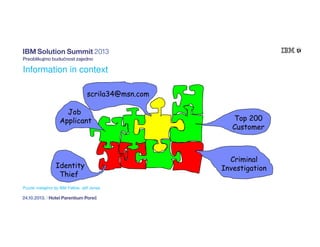
Information in context
scrila34@msn.com
Job
Applicant

Identity
Thief
Puzzle metaphor by IBM Fellow, Jeff Jonas

Top 200
Customer

Criminal
Investigation
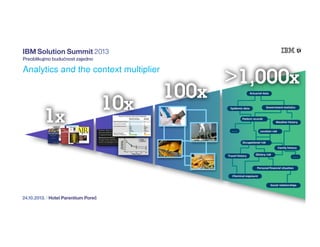
Analytics and the context multiplier
Actuarial data

Government statistics

Epidemic data
Patient records

Weather history

...

Location risk

Occupational risk
Family history

Raw Data

Travel history

Feature
extraction metadata

Dietary risk

...

Personal financial situation
Chemical exposure

Domain linkages

Social relationships

Full
contextual analytics
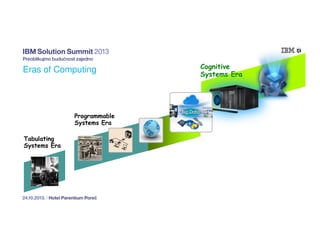
Eras of Computing

Programmable
Systems Era
Tabulating
Systems Era

Cognitive
Systems Era
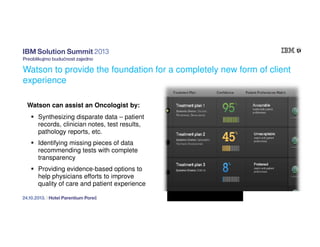
Watson to provide the foundation for a completely new form of client
experience
Watson can assist an Oncologist by:
Synthesizing disparate data – patient
records, clinician notes, test results,
pathology reports, etc.
Identifying missing pieces of data
recommending tests with complete
transparency
Providing evidence-based options to
help physicians efforts to improve
quality of care and patient experience
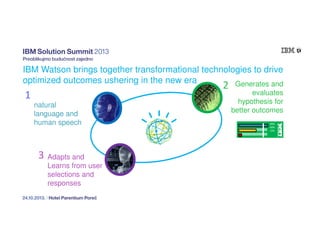
IBM Watson brings together transformational technologies to drive
optimized outcomes ushering in the new era
Generates and

1 Understands
natural
language and
human speech

3

Adapts and
Learns from user
selections and
responses

2

evaluates
hypothesis for
better outcomes
99%
60%
10%
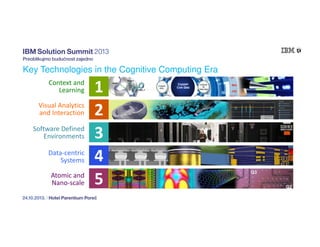
Key Technologies in the Cognitive Computing Era
Context and
Learning
Visual Analytics
and Interaction
Software Defined
Environments
Data-centric
Systems
Atomic and
Nano-scale

1
2
3
4
5
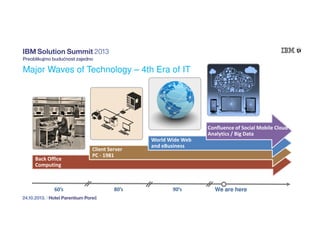
Major Waves of Technology – 4th Era of IT

Confluence of Social Mobile Cloud
Analytics / Big Data

Back Office
Computing

60’s

Client Server
PC - 1981

80’s

World Wide Web
and eBusiness

90’s

We are here
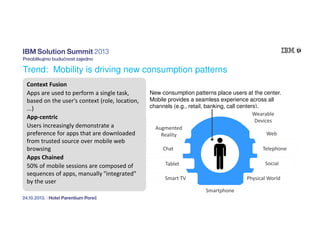
Trend: Mobility is driving new consumption patterns
Context Fusion
Apps are used to perform a single task,
based on the user's context (role, location,
...)
App-centric
Users increasingly demonstrate a
preference for apps that are downloaded
from trusted source over mobile web
browsing
Apps Chained
50% of mobile sessions are composed of
sequences of apps, manually "integrated"
by the user

New consumption patterns place users at the center.
Mobile provides a seamless experience across all
channels (e.g., retail, banking, call centers).
Wearable
Devices
Augmented
Web
Reality
Chat

Telephone
Social

Tablet
Smart TV

Physical World
Smartphone
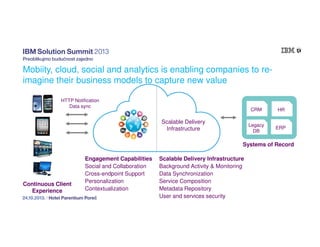
Mobiity, cloud, social and analytics is enabling companies to reimagine their business models to capture new value
HTTP Notification
Data sync

CRM
Legacy
DB

Scalable Delivery
Infrastructure

HR

ERP

Systems of Record

Continuous Client
Experience

Engagement Capabilities
Social and Collaboration
Cross-endpoint Support
Personalization
Contextualization

Scalable Delivery Infrastructure
Background Activity & Monitoring
Data Synchronization
Service Composition
Metadata Repository
User and services security
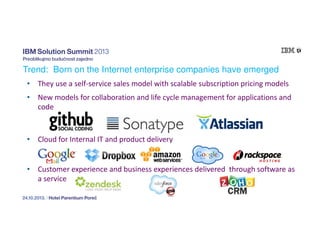
Trend: Born on the Internet enterprise companies have emerged
• They use a self-service sales model with scalable subscription pricing models
• New models for collaboration and life cycle management for applications and
code

• Cloud for Internal IT and product delivery

• Customer experience and business experiences delivered through software as
a service
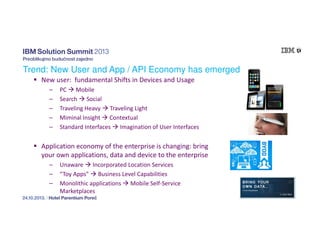
Trend: New User and App / API Economy has emerged
New user: fundamental Shifts in Devices and Usage
–
–
–
–
–

PC Mobile
Search Social
Traveling Heavy Traveling Light
Miminal Insight Contextual
Standard Interfaces Imagination of User Interfaces

Application economy of the enterprise is changing: bring
your own applications, data and device to the enterprise
–
–
–

Unaware Incorporated Location Services
“Toy Apps” Business Level Capabilities
Monolithic applications Mobile Self-Service
Marketplaces
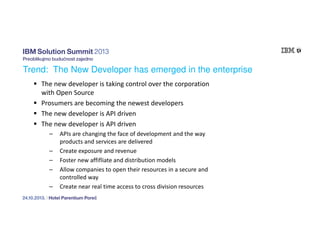
Trend: The New Developer has emerged in the enterprise
The new developer is taking control over the corporation
with Open Source
Prosumers are becoming the newest developers
The new developer is API driven
–
–
–
–
–

APIs are changing the face of development and the way
products and services are delivered
Create exposure and revenue
Foster new affifliate and distribution models
Allow companies to open their resources in a secure and
controlled way
Create near real time access to cross division resources
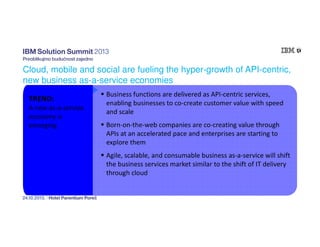
Cloud, mobile and social are fueling the hyper-growth of API-centric,
new business as-a-service economies
TREND:
A new as-a-service
economy is
emerging

Business functions are delivered as API-centric services,
enabling businesses to co-create customer value with speed
and scale
Born-on-the-web companies are co-creating value through
APIs at an accelerated pace and enterprises are starting to
explore them
Agile, scalable, and consumable business as-a-service will shift
the business services market similar to the shift of IT delivery
through cloud
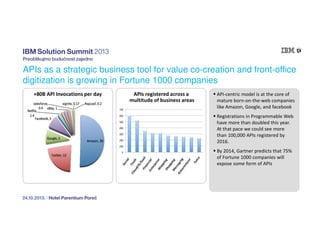
APIs as a strategic business tool for value co-creation and front-office
digitization is growing in Fortune 1000 companies
+80B API Invocations per day

APIs registered across a
multitude of business areas

API-centric model is at the core of
mature born-on-the-web companies
like Amazon, Google, and facebook
Registrations in Programmable Web
have more than doubled this year.
At that pace we could see more
than 100,000 APIs registered by
2016.
By 2014, Gartner predicts that 75%
of Fortune 1000 companies will
expose some form of APIs
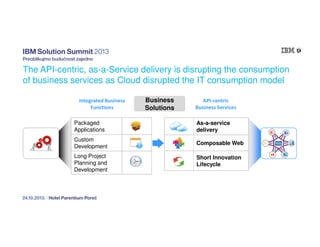
The API-centric, as-a-Service delivery is disrupting the consumption
of business services as Cloud disrupted the IT consumption model
Integrated Business
Functions

Business
Solutions

API-centric
Business Services

Packaged
Applications

As-a-service
delivery

Custom
Development

Composable Web

Long Project
Planning and
Development

Short Innovation
Lifecycle

API

API
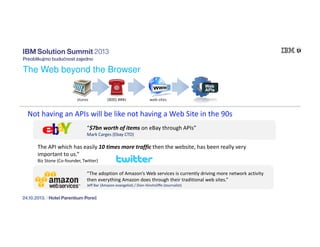
The Web beyond the Browser
Web APIs are the new,
fast-growing business
channel

Businesses
Are Evolving
stores

(800) ###s

web sites

Not having an APIs will be like not having a Web Site in the 90s
“$7bn worth of items items on eBay through APIs”
“$7bn worth of on eBay through APIs”
Mark Carges (Ebay CTO)

Mark Carges (Ebay CTO)

The API which has easily 10 times more traffic then the website, has been really very
important to us.”
Biz Stone (Co-founder, Twitter)

“The adoption of Amazon’s Web services is currently driving more network activity
then everything Amazon does through their traditional web sites.”
Jeff Bar (Amazon evangelist) / Dion Hinchcliffe (Journalist)
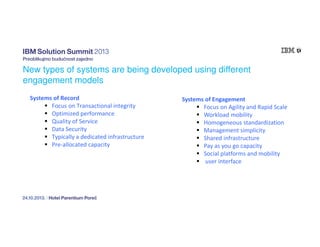
New types of systems are being developed using different
engagement models
Systems of Record
Focus on Transactional integrity
Optimized performance
Quality of Service
Data Security
Typically a dedicated infrastructure
Pre-allocated capacity

Systems of Engagement
Focus on Agility and Rapid Scale
Workload mobility
Homogeneous standardization
Management simplicity
Shared infrastructure
Pay as you go capacity
Social platforms and mobility
user interface
Questions? :
Kerrie holley ; klholley@us.ibm.com
twitter.com/kerrieh
http://www.facebook.com/KerrieHolley
IBM
http://www03.ibm.com/developerworks/blogs/pag
e/ClientSOA
Nova era računarstva

Nova era računarstva

  • 1.
    Technological Trends ofthe Future: Next Era of Computing Kerrie Holley, IBM Fellow
  • 2.
    IBM’s Global TechnologyOutlook (GTO) GTO identifies significant technology trends early. It looks for high impact disruptive technologies leading to game changing products and services over a 3-10 year horizon. Technology thresholds identified in a GTO demonstrate their influence on clients, enterprises, and industries, and have high potential to create new businesses.
  • 3.
  • 4.
    Mega Trends Technology Drivers Mobile- Social – Cloud Analytics / Big Data Growing Scale / Lower Barrier of Entry Users Transactions Computations Data Increasing Complexity / Yet More Consumable Data and data management Workloads Discovering insights Interaction Fast Pace Evolving business eco-system Dynamic scalability Minimize time to value Keeping pace with technology and globalization Contextual Overload Proliferation of sensors and devices Demand for personalization Just in time
  • 5.
  • 6.
    Touch: You willbe able to feel through your phone
  • 7.
    Sight: A pixelwill be worth a thousands words
  • 8.
    Hearing: Computers willaugment what you hear
  • 9.
    Taste: Digital tastebuds will help you eat smarter
  • 10.
    Smell: Computers willsniff out diseases
  • 11.
  • 12.
    For many clients,mission critical applications have reached the point of diminishing return Diminishing Return Client Value Many major application categories are in diminishing returns – ERP – SCM – Batch – Commerce Cumulative Investment in Applications
  • 13.
    The confluence ofSocial, Mobile, Analytics and Cloud has created a perfect storm of sorts Cloud Mobile Social Internet of Things
  • 14.
    Exponential growth indata, why does it matter? 100 9000 Percentage of uncertain data 80 7000 60 6000 Social Media We are here 40 5000 4000 VoIP 3000 Enterprise Data 20 0 2010 2015 Percent of uncertain data Volume in Exabytes 8000 Sensors & Devices
  • 15.
    Companies are notoverwhelmed by too much data scrila34@msn.com …. constrained and limited by too little
  • 16.
    Information in context scrila34@msn.com Job Applicant Identity Thief Puzzlemetaphor by IBM Fellow, Jeff Jonas Top 200 Customer Criminal Investigation
  • 17.
    Analytics and thecontext multiplier Actuarial data Government statistics Epidemic data Patient records Weather history ... Location risk Occupational risk Family history Raw Data Travel history Feature extraction metadata Dietary risk ... Personal financial situation Chemical exposure Domain linkages Social relationships Full contextual analytics
  • 18.
    Eras of Computing Programmable SystemsEra Tabulating Systems Era Cognitive Systems Era
  • 19.
    Watson to providethe foundation for a completely new form of client experience Watson can assist an Oncologist by: Synthesizing disparate data – patient records, clinician notes, test results, pathology reports, etc. Identifying missing pieces of data recommending tests with complete transparency Providing evidence-based options to help physicians efforts to improve quality of care and patient experience
  • 21.
    IBM Watson bringstogether transformational technologies to drive optimized outcomes ushering in the new era Generates and 1 Understands natural language and human speech 3 Adapts and Learns from user selections and responses 2 evaluates hypothesis for better outcomes 99% 60% 10%
  • 22.
    Key Technologies inthe Cognitive Computing Era Context and Learning Visual Analytics and Interaction Software Defined Environments Data-centric Systems Atomic and Nano-scale 1 2 3 4 5
  • 23.
    Major Waves ofTechnology – 4th Era of IT Confluence of Social Mobile Cloud Analytics / Big Data Back Office Computing 60’s Client Server PC - 1981 80’s World Wide Web and eBusiness 90’s We are here
  • 24.
    Trend: Mobility isdriving new consumption patterns Context Fusion Apps are used to perform a single task, based on the user's context (role, location, ...) App-centric Users increasingly demonstrate a preference for apps that are downloaded from trusted source over mobile web browsing Apps Chained 50% of mobile sessions are composed of sequences of apps, manually "integrated" by the user New consumption patterns place users at the center. Mobile provides a seamless experience across all channels (e.g., retail, banking, call centers). Wearable Devices Augmented Web Reality Chat Telephone Social Tablet Smart TV Physical World Smartphone
  • 25.
    Mobiity, cloud, socialand analytics is enabling companies to reimagine their business models to capture new value HTTP Notification Data sync CRM Legacy DB Scalable Delivery Infrastructure HR ERP Systems of Record Continuous Client Experience Engagement Capabilities Social and Collaboration Cross-endpoint Support Personalization Contextualization Scalable Delivery Infrastructure Background Activity & Monitoring Data Synchronization Service Composition Metadata Repository User and services security
  • 26.
    Trend: Born onthe Internet enterprise companies have emerged • They use a self-service sales model with scalable subscription pricing models • New models for collaboration and life cycle management for applications and code • Cloud for Internal IT and product delivery • Customer experience and business experiences delivered through software as a service
  • 27.
    Trend: New Userand App / API Economy has emerged New user: fundamental Shifts in Devices and Usage – – – – – PC Mobile Search Social Traveling Heavy Traveling Light Miminal Insight Contextual Standard Interfaces Imagination of User Interfaces Application economy of the enterprise is changing: bring your own applications, data and device to the enterprise – – – Unaware Incorporated Location Services “Toy Apps” Business Level Capabilities Monolithic applications Mobile Self-Service Marketplaces
  • 28.
    Trend: The NewDeveloper has emerged in the enterprise The new developer is taking control over the corporation with Open Source Prosumers are becoming the newest developers The new developer is API driven The new developer is API driven – – – – – APIs are changing the face of development and the way products and services are delivered Create exposure and revenue Foster new affifliate and distribution models Allow companies to open their resources in a secure and controlled way Create near real time access to cross division resources
  • 29.
    Cloud, mobile andsocial are fueling the hyper-growth of API-centric, new business as-a-service economies TREND: A new as-a-service economy is emerging Business functions are delivered as API-centric services, enabling businesses to co-create customer value with speed and scale Born-on-the-web companies are co-creating value through APIs at an accelerated pace and enterprises are starting to explore them Agile, scalable, and consumable business as-a-service will shift the business services market similar to the shift of IT delivery through cloud
  • 31.
    APIs as astrategic business tool for value co-creation and front-office digitization is growing in Fortune 1000 companies +80B API Invocations per day APIs registered across a multitude of business areas API-centric model is at the core of mature born-on-the-web companies like Amazon, Google, and facebook Registrations in Programmable Web have more than doubled this year. At that pace we could see more than 100,000 APIs registered by 2016. By 2014, Gartner predicts that 75% of Fortune 1000 companies will expose some form of APIs
  • 32.
    The API-centric, as-a-Servicedelivery is disrupting the consumption of business services as Cloud disrupted the IT consumption model Integrated Business Functions Business Solutions API-centric Business Services Packaged Applications As-a-service delivery Custom Development Composable Web Long Project Planning and Development Short Innovation Lifecycle API API
  • 34.
    The Web beyondthe Browser Web APIs are the new, fast-growing business channel Businesses Are Evolving stores (800) ###s web sites Not having an APIs will be like not having a Web Site in the 90s “$7bn worth of items items on eBay through APIs” “$7bn worth of on eBay through APIs” Mark Carges (Ebay CTO) Mark Carges (Ebay CTO) The API which has easily 10 times more traffic then the website, has been really very important to us.” Biz Stone (Co-founder, Twitter) “The adoption of Amazon’s Web services is currently driving more network activity then everything Amazon does through their traditional web sites.” Jeff Bar (Amazon evangelist) / Dion Hinchcliffe (Journalist)
  • 35.
    New types ofsystems are being developed using different engagement models Systems of Record Focus on Transactional integrity Optimized performance Quality of Service Data Security Typically a dedicated infrastructure Pre-allocated capacity Systems of Engagement Focus on Agility and Rapid Scale Workload mobility Homogeneous standardization Management simplicity Shared infrastructure Pay as you go capacity Social platforms and mobility user interface
  • 36.
    Questions? : Kerrie holley; klholley@us.ibm.com twitter.com/kerrieh http://www.facebook.com/KerrieHolley IBM http://www03.ibm.com/developerworks/blogs/pag e/ClientSOA