WELCOME

MAY 1, 2013
Robin Tatam, Director of Security Technologies
Today’s Agenda

•
•
•
•
•
•

2

Introductions
Regulations on IBM i
Conducting The Study
The State of IBM i Security Study
Resources for Security Officers
Questions and Answers
Today’s Speaker

ROBIN TATAM
Director of Security Technologies
952-563-2768

robin.tatam@powertech.com

3
About PowerTech

•

Premier Provider of Security Solutions & Services
–

16 years in the security industry as an established thought leader

–

Customers in over 70 countries, representing every industry

–

Security Subject Matter Expert for COMMON

•
•

•
•

4

IBM Advanced Business Partner
Member of PCI Security Standards Council

Authorized by NASBA to issue CPE Credits for Security Education
Publisher of the Annual “State of IBM i Security” Report
Today’s Agenda

•
•
•
•
•
•

5

Introductions
Regulations on IBM i
Conducting The Study
The State of IBM i Security Study
Resources for Security Officers
Questions and Answers
Why Do I Need To Audit?

•
•

Industry Regulations, such as Payment
Card Industry (PCI DSS)

•

Internal Activity Tracking

•

High Availability

•

6

Legislation, such as Sarbanes-Oxley
(SOX), HIPAA, GLBA, State Privacy Acts

Application Research & Debugging
Which Standards Do
I Audit Against?

• Is there a company Security Policy?
(We’ve got one to help you get started)

• Guidelines and Standards
– COBIT
– ISO 27002 (formerly known as 17799)
– ITIL

7
IT Controls—
An Auditor’s Perspective

Can users perform functions/activities that are in
conflict with their job responsibilities?

Can users modify/corrupt application data?

Can users circumvent controls to
initiate/record unauthorized transactions?

Can users engage in fraud and cover their tracks?

8
The Auditor’s Credo…

Of course
I believe you!
(But you still have
to prove it to me)

9
Today’s Agenda

•
•
•
•
•
•

10

Introductions
Regulations on IBM i
Conducting The Study
The State of IBM i Security Study
Resources for Security Officers
Questions and Answers
Purpose Of The Study

Help IT managers and auditors
understand IBM i security exposures
Focus on top areas of concern in
meeting regulatory compliance
Help IT develop strategic plans to
address—or confirm—high risk
vulnerabilities

11
How We Collect
The Data

PowerTech Compliance Assessment
– Launched from a PC
– Collects security data
– Data for the study is anonymous

Companies are self-selected
– More, or less, security-aware?

Study first published in 2003
– Over 1,700 participants since inception

Schedule your Compliance Assessment
at www.PowerTech.com
12
Be A Part of the Study!

YOUR PC

YOUR IBM i SERVER

YOUR VULNERABILITIES

(Participation in the Security Study is optional)
13
Simple summary provides
auditor & executives with
visual indicators
IBM i registry is reviewed
to see if network event
are audited or controlled

15
*PUBLIC authority levels
on application libraries
are interrogated
Statistics are retrieved on
profile metrics, such as any
with default passwords

17
Review of the
system values that
impact security
Verify if auditing is
active, and what types of
audit events are being
logged
Determine how many users
have Special Authorities
(admin privileges)
Six Major Areas of Review

•
•
•
•
•
•

21

System auditing
Privileged users
User and password management
Data access
Network access control
System security values
Today’s Agenda

•
•
•
•
•
•

22

Introductions
Regulations on IBM i
Conducting The Study
The State of IBM i Security Study
Resources for Security Officers
Questions and Answers
State of IBM i
Security—Overall

Assessed 101 different systems
A total of:
– 109,251 Users
– 43,104 Libraries

On average, per assessed
system there were:
– 1,082 Users
– 427 Libraries

23
State of IBM i
Security—Overall

24
State of IBM i
Security—Overall

WARNING:
September 30 will be here SOON!

25
No. of Systems

QSECURITY
(System Security Level)

System Value: QSECURITY

26
System Security
Level Historically

27
What Does IBM Say About
Security Level 30?

28
Using QUADJRN?

Systems Using the System i Audit Journal

29
Audit Settings Historically

Systems Using the System i Audit Journal (2010-2012)

30
Top 10 “Invalid Sign-On
Attempts” Found

2010: 1,000,000+
2011: 789,962
2012: 154,404

31
Top 10 “Invalid Sign-On
Attempts” Found

10)
9)
8)
7)
6)
5)
4)
3)
2)
1)

32

7,729
8,333
12,921
19,201
23,183
28,078
147,918
161,427
211,631
567,772
Top 10 “Invalid Sign-On
Attempts” Found

But there was one that even shocked us!

6.9 million... All undetected!

33
What should I look for?

34
What Good Is Audit
Journal Data?

Too much data
Too many places to look
Manual reporting processes
Audit and IT get locked in a
request/respond cycle

35
Is Anyone Paying
Attention?

88% of systems were logging audit data but…
…only 27% of those had a recognized auditing
tool installed

Over 6.9 million invalid sign-on attempts
against a single profile!
– Would you be more concerned if you knew it was
the QSECOFR profile?

36
Library Authority

The only library authority that keeps users out
is *EXCLUDE
A policy of ―Least Privilege‖ calls for *PUBLIC
to be excluded and then authorized users
granted the appropriate access
You can (potentially) delete objects with only
*USE authority to the library

37
Library Authority

38
Library Authority—
Historically

39
When New Objects
Are Created

Default Create Authority by Library

40
Network Access
Control
Many IBM i applications rely on menu security because…
– It’s easy to build
– It’s the legacy of many existing business applications

Menu security design assumes:
– Access always originates via the menus
– No users has command line access
– Users have no access to SQL-based tools

Menu security is often accompanied by:
– User being a member of group that owns the objects
– *PUBLIC is granted broad (*CHANGE) access to data
41
Network Access
Control

ODBC isn’t rocket
science anymore

42
Are These Services Running?

43
Exit Program
Coverage

44
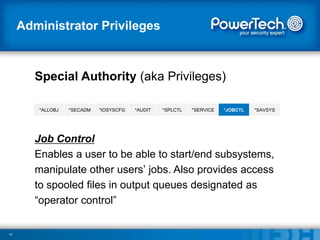
Administrator Privileges

Special Authority (aka Privileges)
*ALLOBJ

*SECADM

*IOSYSCFG

*AUDIT

*SPLCTL

*SERVICE

*JOBCTL

*SAVSYS

All Object
The ―gold key‖ to every object, and almost every
administrative operation on the system, including
unstoppable data access

45
Administrator Privileges

Special Authority (aka Privileges)
*ALLOBJ

*SECADM

*IOSYSCFG

*AUDIT

*SPLCTL

*SERVICE

*JOBCTL

*SAVSYS

Security Administration
Enables a user to create and maintain the system
user profiles without requiring the user to be in the
*SECOFR user class or giving *ALLOBJ authority

46
Administrator Privileges

Special Authority (aka Privileges)
*ALLOBJ

*SECADM

*IOSYSCFG

*AUDIT

*SPLCTL

*SERVICE

*JOBCTL

*SAVSYS

I/O Systems Configuration
Allows the user to create, delete, and manage
devices, lines, and controllers. Also permits the
configuration of TCP/IP, and the start of associated
servers (e.g., HTTP)

47
Administrator Privileges

Special Authority (aka Privileges)
*ALLOBJ

*SECADM

*IOSYSCFG

*AUDIT

*SPLCTL

*SERVICE

*JOBCTL

*SAVSYS

Audit
The user is permitted to manage all aspects of
auditing, including setting the audit system values
and running the audit commands
(CHGOBJAUD / CHGUSRAUD)

48
Administrator Privileges

Special Authority (aka Privileges)
*ALLOBJ

*SECADM

*IOSYSCFG

*AUDIT

*SPLCTL

*SERVICE

*JOBCTL

*SAVSYS

Spool Control
This is the *ALLOBJ of Spooled Files. Allows a user to
view/delete/hold/release any spooled file in any
output queue, regardless of restrictions

49
Administrator Privileges

Special Authority (aka Privileges)
*ALLOBJ

*SECADM

*IOSYSCFG

*AUDIT

*SPLCTL

*SERVICE

*JOBCTL

*SAVSYS

Service
Allows a user to access the System Service Tools
(SST) login, although, since V5R1, they also need
an SST login

50
Administrator Privileges

Special Authority (aka Privileges)
*ALLOBJ

*SECADM

*IOSYSCFG

*AUDIT

*SPLCTL

*SERVICE

*JOBCTL

*SAVSYS

Job Control
Enables a user to be able to start/end subsystems,
manipulate other users’ jobs. Also provides access
to spooled files in output queues designated as
―operator control‖

51
Administrator Privileges

Special Authority (aka Privileges)
*ALLOBJ

*SECADM

*IOSYSCFG

*AUDIT

*SPLCTL

*SERVICE

*JOBCTL

*SAVSYS

Save System
Enables a user to perform save/restore operations on
any object on the system, even if there is insufficient
authority to use the object
* Be cautious if securing objects at only a library level *
52
Administrator Privileges

53
Administrator Privileges

Best Practices call for
<10 users with SPCAUTs

54
Powerful Users Historically

55
Endless News Reports
of Insider Breaches

56
No. of Systems

Minimum Password
Length

System Value: QPWDMINLEN

57
No. of Systems

Minimum Password
Length

Not too hard to
guess your way in!

System Value: QPWDMINLEN

58
No. of Systems

Default Passwords

59
No. of Systems

Password Expiration

Password Expiration Period (Days)

60
No. of Systems

How Many Attempts?

Maximum Signon Attempts Allowed

61
No. of Systems

How Many Attempts?

Let’s hope this wasn’t the
server that experienced 6.9
million invalid attempts

Maximum Sign On Attempts Allowed

62
And Then What?

Default Action for Exceeding Invalid Sign On Attempts

63
No. of Profiles

Inactive Profiles

64
No. of Profiles

5250 Command Line

65
The Perfect Storm
Of Vulnerability

Security awareness among IBM I
professionals is generally low
IBM i awareness among audit
professionals is generally low
Some of the most valuable data in any
organization is on your Power Systems
server (System i, iSeries, AS/400)
Most IBM i data is not secured and the
users are far too powerful

66
The Call To Action

1. Conduct a Compliance Assessment (free and deep-dive options)
2. Remediate ―low-hanging fruit‖ such as default passwords and
inactive accounts
3. Review appropriateness of profile settings: password rules, limit
capabilities (command line), special authorities, etc.
4. Perform intrusion tests over FTP and ODC to assess data leak risk
5. Evaluate PowerTech solutions to mitigate risk

67
Comprehensive Security
Solutions for Power Systems

68
Today’s Agenda

•
•
•
•
•
•

69

Introductions
Regulations on IBM i
Conducting The Study
The State of IBM i Security Study
Resources for Security Officers
Questions and Answers
Additional Resources

Online Compliance Guide

70

Security Policy
Today’s Agenda

•
•
•
•
•
•

71

Introductions
Regulations on IBM i
Conducting The Study
The State of IBM i Security Study
Resources for Security Officers
Questions and Answers
Questions

72
Thanks for your time!

Please visit www.PowerTech.com to access:
• Demonstration Videos & Trial Downloads
• Product Information Data Sheets
• White Papers / Technical Articles
• Customer Success Stories
• PowerNews (Newsletter)
• Robin’s Security Blog
• To request a FREE Compliance Assessment
www.powertech.com
73

(800) 915-7700

info@powertech.com

IBM i Security Study

  • 1.
    WELCOME MAY 1, 2013 RobinTatam, Director of Security Technologies
  • 2.
    Today’s Agenda • • • • • • 2 Introductions Regulations onIBM i Conducting The Study The State of IBM i Security Study Resources for Security Officers Questions and Answers
  • 3.
    Today’s Speaker ROBIN TATAM Directorof Security Technologies 952-563-2768 robin.tatam@powertech.com 3
  • 4.
    About PowerTech • Premier Providerof Security Solutions & Services – 16 years in the security industry as an established thought leader – Customers in over 70 countries, representing every industry – Security Subject Matter Expert for COMMON • • • • 4 IBM Advanced Business Partner Member of PCI Security Standards Council Authorized by NASBA to issue CPE Credits for Security Education Publisher of the Annual “State of IBM i Security” Report
  • 5.
    Today’s Agenda • • • • • • 5 Introductions Regulations onIBM i Conducting The Study The State of IBM i Security Study Resources for Security Officers Questions and Answers
  • 6.
    Why Do INeed To Audit? • • Industry Regulations, such as Payment Card Industry (PCI DSS) • Internal Activity Tracking • High Availability • 6 Legislation, such as Sarbanes-Oxley (SOX), HIPAA, GLBA, State Privacy Acts Application Research & Debugging
  • 7.
    Which Standards Do IAudit Against? • Is there a company Security Policy? (We’ve got one to help you get started) • Guidelines and Standards – COBIT – ISO 27002 (formerly known as 17799) – ITIL 7
  • 8.
    IT Controls— An Auditor’sPerspective Can users perform functions/activities that are in conflict with their job responsibilities? Can users modify/corrupt application data? Can users circumvent controls to initiate/record unauthorized transactions? Can users engage in fraud and cover their tracks? 8
  • 9.
    The Auditor’s Credo… Ofcourse I believe you! (But you still have to prove it to me) 9
  • 10.
    Today’s Agenda • • • • • • 10 Introductions Regulations onIBM i Conducting The Study The State of IBM i Security Study Resources for Security Officers Questions and Answers
  • 11.
    Purpose Of TheStudy Help IT managers and auditors understand IBM i security exposures Focus on top areas of concern in meeting regulatory compliance Help IT develop strategic plans to address—or confirm—high risk vulnerabilities 11
  • 12.
    How We Collect TheData PowerTech Compliance Assessment – Launched from a PC – Collects security data – Data for the study is anonymous Companies are self-selected – More, or less, security-aware? Study first published in 2003 – Over 1,700 participants since inception Schedule your Compliance Assessment at www.PowerTech.com 12
  • 13.
    Be A Partof the Study! YOUR PC YOUR IBM i SERVER YOUR VULNERABILITIES (Participation in the Security Study is optional) 13
  • 14.
    Simple summary provides auditor& executives with visual indicators
  • 15.
    IBM i registryis reviewed to see if network event are audited or controlled 15
  • 16.
    *PUBLIC authority levels onapplication libraries are interrogated
  • 17.
    Statistics are retrievedon profile metrics, such as any with default passwords 17
  • 18.
    Review of the systemvalues that impact security
  • 19.
    Verify if auditingis active, and what types of audit events are being logged
  • 20.
    Determine how manyusers have Special Authorities (admin privileges)
  • 21.
    Six Major Areasof Review • • • • • • 21 System auditing Privileged users User and password management Data access Network access control System security values
  • 22.
    Today’s Agenda • • • • • • 22 Introductions Regulations onIBM i Conducting The Study The State of IBM i Security Study Resources for Security Officers Questions and Answers
  • 23.
    State of IBMi Security—Overall Assessed 101 different systems A total of: – 109,251 Users – 43,104 Libraries On average, per assessed system there were: – 1,082 Users – 427 Libraries 23
  • 24.
    State of IBMi Security—Overall 24
  • 25.
    State of IBMi Security—Overall WARNING: September 30 will be here SOON! 25
  • 26.
    No. of Systems QSECURITY (SystemSecurity Level) System Value: QSECURITY 26
  • 27.
  • 28.
    What Does IBMSay About Security Level 30? 28
  • 29.
    Using QUADJRN? Systems Usingthe System i Audit Journal 29
  • 30.
    Audit Settings Historically SystemsUsing the System i Audit Journal (2010-2012) 30
  • 31.
    Top 10 “InvalidSign-On Attempts” Found 2010: 1,000,000+ 2011: 789,962 2012: 154,404 31
  • 32.
    Top 10 “InvalidSign-On Attempts” Found 10) 9) 8) 7) 6) 5) 4) 3) 2) 1) 32 7,729 8,333 12,921 19,201 23,183 28,078 147,918 161,427 211,631 567,772
  • 33.
    Top 10 “InvalidSign-On Attempts” Found But there was one that even shocked us! 6.9 million... All undetected! 33
  • 34.
    What should Ilook for? 34
  • 35.
    What Good IsAudit Journal Data? Too much data Too many places to look Manual reporting processes Audit and IT get locked in a request/respond cycle 35
  • 36.
    Is Anyone Paying Attention? 88%of systems were logging audit data but… …only 27% of those had a recognized auditing tool installed Over 6.9 million invalid sign-on attempts against a single profile! – Would you be more concerned if you knew it was the QSECOFR profile? 36
  • 37.
    Library Authority The onlylibrary authority that keeps users out is *EXCLUDE A policy of ―Least Privilege‖ calls for *PUBLIC to be excluded and then authorized users granted the appropriate access You can (potentially) delete objects with only *USE authority to the library 37
  • 38.
  • 39.
  • 40.
    When New Objects AreCreated Default Create Authority by Library 40
  • 41.
    Network Access Control Many IBMi applications rely on menu security because… – It’s easy to build – It’s the legacy of many existing business applications Menu security design assumes: – Access always originates via the menus – No users has command line access – Users have no access to SQL-based tools Menu security is often accompanied by: – User being a member of group that owns the objects – *PUBLIC is granted broad (*CHANGE) access to data 41
  • 42.
    Network Access Control ODBC isn’trocket science anymore 42
  • 43.
    Are These ServicesRunning? 43
  • 44.
  • 45.
    Administrator Privileges Special Authority(aka Privileges) *ALLOBJ *SECADM *IOSYSCFG *AUDIT *SPLCTL *SERVICE *JOBCTL *SAVSYS All Object The ―gold key‖ to every object, and almost every administrative operation on the system, including unstoppable data access 45
  • 46.
    Administrator Privileges Special Authority(aka Privileges) *ALLOBJ *SECADM *IOSYSCFG *AUDIT *SPLCTL *SERVICE *JOBCTL *SAVSYS Security Administration Enables a user to create and maintain the system user profiles without requiring the user to be in the *SECOFR user class or giving *ALLOBJ authority 46
  • 47.
    Administrator Privileges Special Authority(aka Privileges) *ALLOBJ *SECADM *IOSYSCFG *AUDIT *SPLCTL *SERVICE *JOBCTL *SAVSYS I/O Systems Configuration Allows the user to create, delete, and manage devices, lines, and controllers. Also permits the configuration of TCP/IP, and the start of associated servers (e.g., HTTP) 47
  • 48.
    Administrator Privileges Special Authority(aka Privileges) *ALLOBJ *SECADM *IOSYSCFG *AUDIT *SPLCTL *SERVICE *JOBCTL *SAVSYS Audit The user is permitted to manage all aspects of auditing, including setting the audit system values and running the audit commands (CHGOBJAUD / CHGUSRAUD) 48
  • 49.
    Administrator Privileges Special Authority(aka Privileges) *ALLOBJ *SECADM *IOSYSCFG *AUDIT *SPLCTL *SERVICE *JOBCTL *SAVSYS Spool Control This is the *ALLOBJ of Spooled Files. Allows a user to view/delete/hold/release any spooled file in any output queue, regardless of restrictions 49
  • 50.
    Administrator Privileges Special Authority(aka Privileges) *ALLOBJ *SECADM *IOSYSCFG *AUDIT *SPLCTL *SERVICE *JOBCTL *SAVSYS Service Allows a user to access the System Service Tools (SST) login, although, since V5R1, they also need an SST login 50
  • 51.
    Administrator Privileges Special Authority(aka Privileges) *ALLOBJ *SECADM *IOSYSCFG *AUDIT *SPLCTL *SERVICE *JOBCTL *SAVSYS Job Control Enables a user to be able to start/end subsystems, manipulate other users’ jobs. Also provides access to spooled files in output queues designated as ―operator control‖ 51
  • 52.
    Administrator Privileges Special Authority(aka Privileges) *ALLOBJ *SECADM *IOSYSCFG *AUDIT *SPLCTL *SERVICE *JOBCTL *SAVSYS Save System Enables a user to perform save/restore operations on any object on the system, even if there is insufficient authority to use the object * Be cautious if securing objects at only a library level * 52
  • 53.
  • 54.
    Administrator Privileges Best Practicescall for <10 users with SPCAUTs 54
  • 55.
  • 56.
    Endless News Reports ofInsider Breaches 56
  • 57.
    No. of Systems MinimumPassword Length System Value: QPWDMINLEN 57
  • 58.
    No. of Systems MinimumPassword Length Not too hard to guess your way in! System Value: QPWDMINLEN 58
  • 59.
  • 60.
    No. of Systems PasswordExpiration Password Expiration Period (Days) 60
  • 61.
    No. of Systems HowMany Attempts? Maximum Signon Attempts Allowed 61
  • 62.
    No. of Systems HowMany Attempts? Let’s hope this wasn’t the server that experienced 6.9 million invalid attempts Maximum Sign On Attempts Allowed 62
  • 63.
    And Then What? DefaultAction for Exceeding Invalid Sign On Attempts 63
  • 64.
  • 65.
    No. of Profiles 5250Command Line 65
  • 66.
    The Perfect Storm OfVulnerability Security awareness among IBM I professionals is generally low IBM i awareness among audit professionals is generally low Some of the most valuable data in any organization is on your Power Systems server (System i, iSeries, AS/400) Most IBM i data is not secured and the users are far too powerful 66
  • 67.
    The Call ToAction 1. Conduct a Compliance Assessment (free and deep-dive options) 2. Remediate ―low-hanging fruit‖ such as default passwords and inactive accounts 3. Review appropriateness of profile settings: password rules, limit capabilities (command line), special authorities, etc. 4. Perform intrusion tests over FTP and ODC to assess data leak risk 5. Evaluate PowerTech solutions to mitigate risk 67
  • 68.
  • 69.
    Today’s Agenda • • • • • • 69 Introductions Regulations onIBM i Conducting The Study The State of IBM i Security Study Resources for Security Officers Questions and Answers
  • 70.
  • 71.
    Today’s Agenda • • • • • • 71 Introductions Regulations onIBM i Conducting The Study The State of IBM i Security Study Resources for Security Officers Questions and Answers
  • 72.
  • 73.
    Thanks for yourtime! Please visit www.PowerTech.com to access: • Demonstration Videos & Trial Downloads • Product Information Data Sheets • White Papers / Technical Articles • Customer Success Stories • PowerNews (Newsletter) • Robin’s Security Blog • To request a FREE Compliance Assessment www.powertech.com 73 (800) 915-7700 info@powertech.com