Wireless & VoIP

 Christian Huitema
 February 26, 2000
Wireless Voice over IP:
          2 Questions
• Can we make it work?
  – Can we provide decent quality?
  – Can we support efficient signaling?
• Can the telcos accept it?
  – Loose control of voice?
  – Loose control on “services” ?
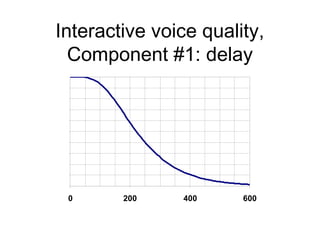
Interactive voice quality,
  Component #1: delay


 0      200    400     600
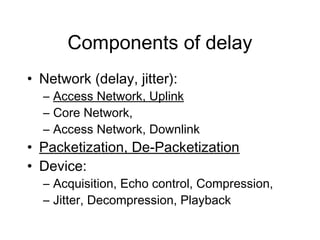
Components of delay
• Network (delay, jitter):
  – Access Network, Uplink
  – Core Network,
  – Access Network, Downlink
• Packetization, De-Packetization
• Device:
  – Acquisition, Echo control, Compression,
  – Jitter, Decompression, Playback
Managing the Uplink:
      beware of contention
• Data Usage emphasizes “load”
  – Highly variable sources,
  – Contention access fits best (CSMA, TDMA-
    DA, slot request, etc.)
• Contention access unfit for voice
  – Generates “large deviation”
  – Deviation => jitter => delay.
• … Unless very low load factor
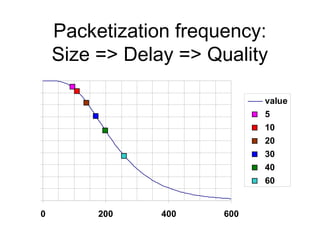
Packetization frequency:
    Size => Delay => Quality

                             value
                             5
                             10
                             20
                             30
                             40
                             60


0        200    400    600
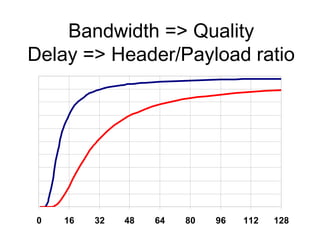
Bandwidth => Quality
Delay => Header/Payload ratio


0   16   32   48   64   80   96   112   128
Voice Quality: Effects of
        Packet Losses
• Loss effect aggravated by “fractal”
  distribution.
• Moderate losses (1%) can be
  concealed.
• Higher losses require redundancy:
  (standard in RTP):
  – Affects bandwidth (split / N packets)
  – affects delay (N packets) => quality…
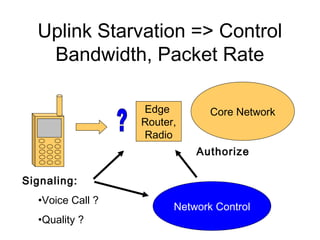
Uplink Starvation => Control
   Bandwidth, Packet Rate

                  Edge         Core Network
                  Router,
                  Radio
                            Authorize

Signaling:
  •Voice Call ?
                        Network Control
  •Quality ?
Can we do efficient signaling?
 Wireless VoIP => Mobility
• Classic telephony approach:
  – HLR (home) /VLR (visitor)
  – Based on phone number
  – Number = Transport + User identity.
• VoIP separates network, service
  – Network: IP address
  – Service: DNS name, e-mail, URL
• Need clean architecture
The VoIP Protocol Soup
      More than one choice…
• H.323
  – ITU standard, implementations
  – Complex, heavy, hard to evolve
• MGCP
  –   Client server, “telephony device”
  –   Used in Cable networks
  –   Not really adequate for mobility support
  –   MGCP / Megaco / H.248 debacle
• SIP
  – Clean end-to-end architecture
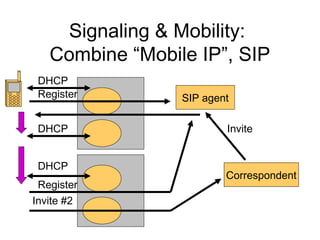
Signaling & Mobility:
   Combine “Mobile IP”, SIP
 DHCP
 Register        SIP agent

 DHCP                    Invite


 DHCP
                         Correspondent
 Register
Invite #2
Can the telcos accept VoIP?
       Wireless VoIP?
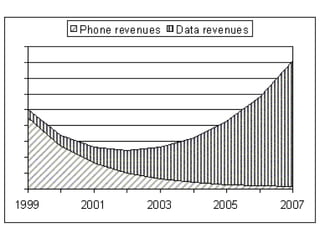
• Special price for voice, data:
  – Wire line: price of voice is 10 x data bit
  – Wireless: data is “special service.”
• Bundling of services:
  –   Caller-ID, Call-Waiting,
  –   Voice Mail,
  –   3000 “IN” services
  –   911, etc.
Wireless VoIP:
    loosing control of voice?
• In the short term, QoS issues
  – Contention on the uplink,
  – Telco can control “voice quality IP”,
  – But “real time” is more than voice (video,
    games, monitoring.)
• The end of uplink starvation?
  – High speed wireless LAN, 3GIP?
  – Need adequate “sharing” procedure.
Wireless VoIP:
 becoming “the” infrastructure
• Need to be always on, meet the classic
  99.999% requirement,
• Deal with societal issues, such as
  wiretap, in an end-to-end environment,
• Provide 911 like services:
  – Special signaling, no hang-up,
  – Location services, route to local 911,
  – “Emergency” level for QoS.
Wireless VoIP:
   loosing control of services
• IP signaling is end to end
  – SIP agent “outside” the network,
  – Service independent of transport.
• State is kept in the device:
  – Local implementation of services,
  – Call waiting, multiparty call in device.
• Empower users, unleash creativity
Wireless VoIP Roadmap
• Solve the uplink issue:
  – QoS on “first hop”, not end-to-end,
  – Independent of payload type (voice, etc.)
  – Security, authorization (DHCP, QoS).
• Encourage competition:
  – “Secure Wireless DHCP,” Roaming
• Concentrate signaling work on SIP:
  – Forget the ITU!

Iab wless-voip

  • 1.
    Wireless & VoIP Christian Huitema February 26, 2000
  • 2.
    Wireless Voice overIP: 2 Questions • Can we make it work? – Can we provide decent quality? – Can we support efficient signaling? • Can the telcos accept it? – Loose control of voice? – Loose control on “services” ?
  • 3.
    Interactive voice quality, Component #1: delay 0 200 400 600
  • 4.
    Components of delay •Network (delay, jitter): – Access Network, Uplink – Core Network, – Access Network, Downlink • Packetization, De-Packetization • Device: – Acquisition, Echo control, Compression, – Jitter, Decompression, Playback
  • 5.
    Managing the Uplink: beware of contention • Data Usage emphasizes “load” – Highly variable sources, – Contention access fits best (CSMA, TDMA- DA, slot request, etc.) • Contention access unfit for voice – Generates “large deviation” – Deviation => jitter => delay. • … Unless very low load factor
  • 6.
    Packetization frequency: Size => Delay => Quality value 5 10 20 30 40 60 0 200 400 600
  • 7.
    Bandwidth => Quality Delay=> Header/Payload ratio 0 16 32 48 64 80 96 112 128
  • 8.
    Voice Quality: Effectsof Packet Losses • Loss effect aggravated by “fractal” distribution. • Moderate losses (1%) can be concealed. • Higher losses require redundancy: (standard in RTP): – Affects bandwidth (split / N packets) – affects delay (N packets) => quality…
  • 9.
    Uplink Starvation =>Control Bandwidth, Packet Rate Edge Core Network Router, Radio Authorize Signaling: •Voice Call ? Network Control •Quality ?
  • 10.
    Can we doefficient signaling? Wireless VoIP => Mobility • Classic telephony approach: – HLR (home) /VLR (visitor) – Based on phone number – Number = Transport + User identity. • VoIP separates network, service – Network: IP address – Service: DNS name, e-mail, URL • Need clean architecture
  • 11.
    The VoIP ProtocolSoup More than one choice… • H.323 – ITU standard, implementations – Complex, heavy, hard to evolve • MGCP – Client server, “telephony device” – Used in Cable networks – Not really adequate for mobility support – MGCP / Megaco / H.248 debacle • SIP – Clean end-to-end architecture
  • 12.
    Signaling & Mobility: Combine “Mobile IP”, SIP DHCP Register SIP agent DHCP Invite DHCP Correspondent Register Invite #2
  • 13.
    Can the telcosaccept VoIP? Wireless VoIP? • Special price for voice, data: – Wire line: price of voice is 10 x data bit – Wireless: data is “special service.” • Bundling of services: – Caller-ID, Call-Waiting, – Voice Mail, – 3000 “IN” services – 911, etc.
  • 15.
    Wireless VoIP: loosing control of voice? • In the short term, QoS issues – Contention on the uplink, – Telco can control “voice quality IP”, – But “real time” is more than voice (video, games, monitoring.) • The end of uplink starvation? – High speed wireless LAN, 3GIP? – Need adequate “sharing” procedure.
  • 16.
    Wireless VoIP: becoming“the” infrastructure • Need to be always on, meet the classic 99.999% requirement, • Deal with societal issues, such as wiretap, in an end-to-end environment, • Provide 911 like services: – Special signaling, no hang-up, – Location services, route to local 911, – “Emergency” level for QoS.
  • 17.
    Wireless VoIP: loosing control of services • IP signaling is end to end – SIP agent “outside” the network, – Service independent of transport. • State is kept in the device: – Local implementation of services, – Call waiting, multiparty call in device. • Empower users, unleash creativity
  • 18.
    Wireless VoIP Roadmap •Solve the uplink issue: – QoS on “first hop”, not end-to-end, – Independent of payload type (voice, etc.) – Security, authorization (DHCP, QoS). • Encourage competition: – “Secure Wireless DHCP,” Roaming • Concentrate signaling work on SIP: – Forget the ITU!