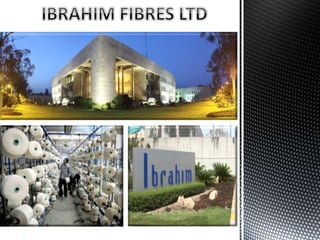
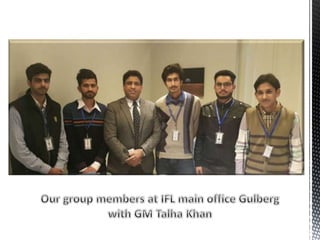
 Ibrahim Fibres Limited is incorporated
in Pakistan as a public limited company
under the Companies Ordinance, 1984
 It is listed on Karachi and Lahore Stock
Exchanges in Pakistan.
 The principal business is manufacture
and sale of polyester staple fibre and
yarn.
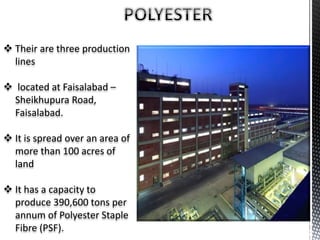
 Their are three production
lines
 located at Faisalabad –
Sheikhupura Road,
Faisalabad.
 It is spread over an area of
more than 100 acres of
land
 It has a capacity to
produce 390,600 tons per
annum of Polyester Staple
Fibre (PSF).
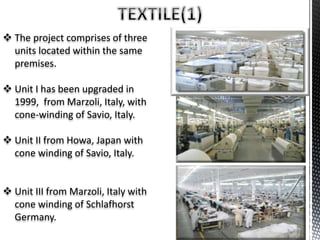
 The project comprises of three
units located within the same
premises.
 Unit I has been upgraded in
1999, from Marzoli, Italy, with
cone-winding of Savio, Italy.
 Unit II from Howa, Japan with
cone winding of Savio, Italy.
 Unit III from Marzoli, Italy with
cone winding of Schlafhorst
Germany.
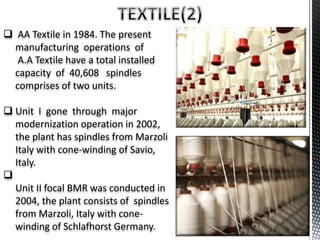
 AA Textile in 1984. The present
manufacturing operations of
A.A Textile have a total installed
capacity of 40,608 spindles
comprises of two units.
 Unit I gone through major
modernization operation in 2002,
the plant has spindles from Marzoli
Italy with cone-winding of Savio,
Italy.

Unit II focal BMR was conducted in
2004, the plant consists of spindles
from Marzoli, Italy with cone-
winding of Schlafhorst Germany.
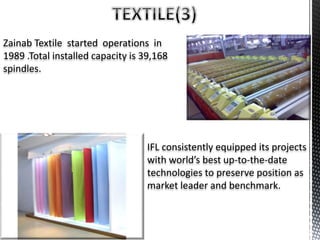
Zainab Textile started operations in
1989 .Total installed capacity is 39,168
spindles.
IFL consistently equipped its projects
with world’s best up-to-the-date
technologies to preserve position as
market leader and benchmark.
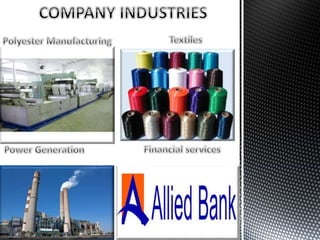
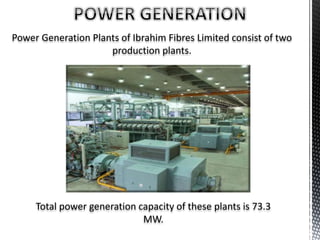
Power Generation Plants of Ibrahim Fibres Limited consist of two
production plants.
Total power generation capacity of these plants is 73.3
MW.
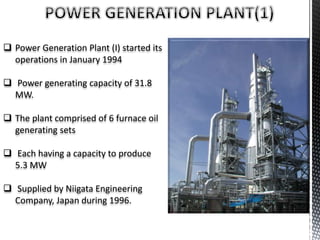
 Power Generation Plant (I) started its
operations in January 1994
 Power generating capacity of 31.8
MW.
 The plant comprised of 6 furnace oil
generating sets
 Each having a capacity to produce
5.3 MW
 Supplied by Niigata Engineering
Company, Japan during 1996.
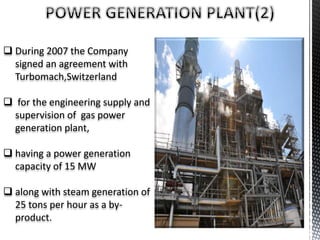
 During 2007 the Company
signed an agreement with
Turbomach,Switzerland
 for the engineering supply and
supervision of gas power
generation plant,
 having a power generation
capacity of 15 MW
 along with steam generation of
25 tons per hour as a by-
product.
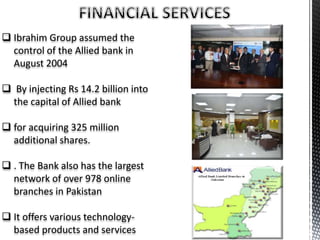
 Ibrahim Group assumed the
control of the Allied bank in
August 2004
 By injecting Rs 14.2 billion into
the capital of Allied bank
 for acquiring 325 million
additional shares.
 . The Bank also has the largest
network of over 978 online
branches in Pakistan
 It offers various technology-
based products and services
Product and services competitors are Chenab Limited, Masood Textiles,
Nishat linen
Financial services competitors are M.C.B Bank, H.B.L Bank, Askri
Bank.
“we do not have autocratic
leaders instead they are
participative. We have to
much sharing everybody
can participate and right to
discuss but final decisions is
taken by CEO.”
“We are in industrial market
so we do advertising through
pages, pamphlets. We gives
diaries, calendars, pens, key
chains and different products
for advertising.”
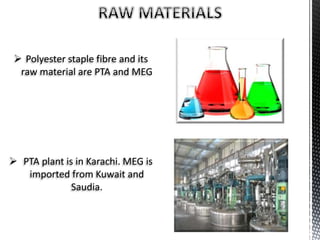
 Polyester staple fibre and its
raw material are PTA and MEG
 PTA plant is in Karachi. MEG is
imported from Kuwait and
Saudia.
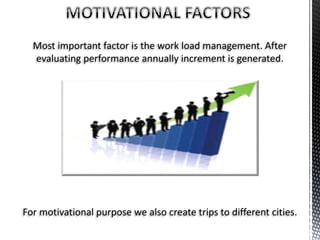
Most important factor is the work load management. After
evaluating performance annually increment is generated.
For motivational purpose we also create trips to different cities.
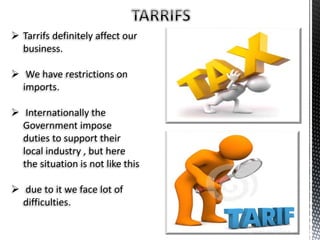
 Tarrifs definitely affect our
business.
 We have restrictions on
imports.
 Internationally the
Government impose
duties to support their
local industry , but here
the situation is not like this
 due to it we face lot of
difficulties.
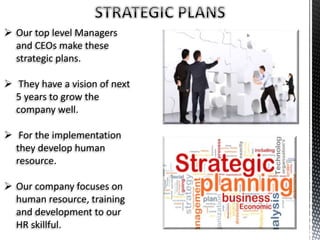
 Our top level Managers
and CEOs make these
strategic plans.
 They have a vision of next
5 years to grow the
company well.
 For the implementation
they develop human
resource.
 Our company focuses on
human resource, training
and development to our
HR skillful.
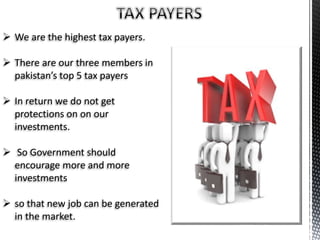
 We are the highest tax payers.
 There are our three members in
pakistan’s top 5 tax payers
 In return we do not get
protections on on our
investments.
 So Government should
encourage more and more
investments
 so that new job can be generated
in the market.
Ibrahim Fibres LTD
Ibrahim Fibres LTD
Ibrahim Fibres LTD

Ibrahim Fibres LTD

  • 5.
     Ibrahim FibresLimited is incorporated in Pakistan as a public limited company under the Companies Ordinance, 1984  It is listed on Karachi and Lahore Stock Exchanges in Pakistan.  The principal business is manufacture and sale of polyester staple fibre and yarn.
  • 6.
     Their arethree production lines  located at Faisalabad – Sheikhupura Road, Faisalabad.  It is spread over an area of more than 100 acres of land  It has a capacity to produce 390,600 tons per annum of Polyester Staple Fibre (PSF).
  • 7.
     The projectcomprises of three units located within the same premises.  Unit I has been upgraded in 1999, from Marzoli, Italy, with cone-winding of Savio, Italy.  Unit II from Howa, Japan with cone winding of Savio, Italy.  Unit III from Marzoli, Italy with cone winding of Schlafhorst Germany.
  • 8.
     AA Textilein 1984. The present manufacturing operations of A.A Textile have a total installed capacity of 40,608 spindles comprises of two units.  Unit I gone through major modernization operation in 2002, the plant has spindles from Marzoli Italy with cone-winding of Savio, Italy.  Unit II focal BMR was conducted in 2004, the plant consists of spindles from Marzoli, Italy with cone- winding of Schlafhorst Germany.
  • 9.
    Zainab Textile startedoperations in 1989 .Total installed capacity is 39,168 spindles. IFL consistently equipped its projects with world’s best up-to-the-date technologies to preserve position as market leader and benchmark.
  • 10.
    Power Generation Plantsof Ibrahim Fibres Limited consist of two production plants. Total power generation capacity of these plants is 73.3 MW.
  • 11.
     Power GenerationPlant (I) started its operations in January 1994  Power generating capacity of 31.8 MW.  The plant comprised of 6 furnace oil generating sets  Each having a capacity to produce 5.3 MW  Supplied by Niigata Engineering Company, Japan during 1996.
  • 12.
     During 2007the Company signed an agreement with Turbomach,Switzerland  for the engineering supply and supervision of gas power generation plant,  having a power generation capacity of 15 MW  along with steam generation of 25 tons per hour as a by- product.
  • 13.
     Ibrahim Groupassumed the control of the Allied bank in August 2004  By injecting Rs 14.2 billion into the capital of Allied bank  for acquiring 325 million additional shares.  . The Bank also has the largest network of over 978 online branches in Pakistan  It offers various technology- based products and services
  • 14.
    Product and servicescompetitors are Chenab Limited, Masood Textiles, Nishat linen Financial services competitors are M.C.B Bank, H.B.L Bank, Askri Bank.
  • 16.
    “we do nothave autocratic leaders instead they are participative. We have to much sharing everybody can participate and right to discuss but final decisions is taken by CEO.” “We are in industrial market so we do advertising through pages, pamphlets. We gives diaries, calendars, pens, key chains and different products for advertising.”
  • 17.
     Polyester staplefibre and its raw material are PTA and MEG  PTA plant is in Karachi. MEG is imported from Kuwait and Saudia.
  • 18.
    Most important factoris the work load management. After evaluating performance annually increment is generated. For motivational purpose we also create trips to different cities.
  • 19.
     Tarrifs definitelyaffect our business.  We have restrictions on imports.  Internationally the Government impose duties to support their local industry , but here the situation is not like this  due to it we face lot of difficulties.
  • 20.
     Our toplevel Managers and CEOs make these strategic plans.  They have a vision of next 5 years to grow the company well.  For the implementation they develop human resource.  Our company focuses on human resource, training and development to our HR skillful.
  • 21.
     We arethe highest tax payers.  There are our three members in pakistan’s top 5 tax payers  In return we do not get protections on on our investments.  So Government should encourage more and more investments  so that new job can be generated in the market.