Downloaded 16 times
![Riddhish Thakore et al. Int. Journal of Engineering Research and Applications www.ijera.com
ISSN : 2248-9622, Vol. 4, Issue 11(Version - 4), November 2014, pp.63-69
www.ijera.com 63 | P a g e
A Review: Six Sigma Implementation Practice in Manufacturing Industries Riddhish Thakore*1, Rajat Dave*2, Tejas Parsana**, Amit Solanki*** *Department of Mechanical, SVBIT, Gujarat Technological University, India ** Department of Mechanical, VVP college of Engineering, Rajkot, India
*** Department of Mechanical, C U Shah collge of Engineering, Surendranagar, India
ABSTRACT Higher Productivity achievement is very crucial factor for the field of production. With the High productivity various other factors must be taken in to consideration in manufacturing industries such as global competitors, diversity in product range, lead time and customer demand in terms of quality and quantity. A new benchmark called Six Sigma has been invented for dealing with all these needs. Six sigma is a quality initiative which reduces variations in a process and helps to lower the cost of product as well as process. The objective of this paper is to review and examine the advancement and encounters of six sigma practices in Global manufacturing Industries and identify the key tools for each step in successful Six Sigma project execution. The paper also integrates the lessons learned from successful six sigma projects and their prospective applications in various manufacturing Industries. In today scenario, many global manufacturing industries operate their processes at the two to four sigma quality levels.
Keywords – Six Sigma, DMAIC, review, Tools and Techniques.
I. INTRODUCTION
The history of quality is as old as civilization. Various quality management strategies have been applied for many years and those strategies are continuously involved in the quality improvement for the customer’s satisfaction [1]. There are several different definitions of the Quality Concept and many different opinions of what should be encompassed in the concept of product quality. "The quality of a product is its ability to satisfy and preferably exceed the needs and expectations of the customers".[2] In the more recent history of the quality development, the quality improvement program Six Sigma has been successful. Six Sigma was created at Motorola in the 1980s. Owing to Six Sigma, Motorola managed to reduce their poor-quality costs and decrease variation in many processes. As a result, Motorola became the first recipient of America’s Malcolm Baldrige National Quality Award in 1988.[3] Six Sigma is one of the last additions in the field of quality improvement methods and (or) business process improvements methods. Although it has been implemented for many years mainly in large manufacturing companies, like Motorola, GE and Honeywell etc.[4] Six Sigma leads mainly to reduction of poor quality cost. The DPMO concept is not just a slogan but a much grounded way to measure how successfully Six Sigma objectives are implemented.[6]
II. SIX SIGMA DEFINITION
The term Six Sigma comes from statistics as the Greek letter s (sigma) symbolizes the standard deviation, namely the dispersion of the data from the mean average. Number six expresses the accepted level of quality that is six times the standard deviation. Most people consider Six Sigma as a purely statistical methodology. In methodology’s practice the term Six Sigma level, means 3.4 defects per million opportunities or success rate of 99.999660 percentages. Six Sigma’s purpose is to reduce the variance-variability in processes, so to provide to the clients-consumers of the organization, products or services which are more reliable and with fewer errors. Moreover, some companies implement or try to adopt Seven Sigma level, which means even fewer defects and more satisfied customers.[4] The six sigma method includes measured and reported financial results, uses additional, more advanced data analysis tools, focuses on customer concerns, and uses project management tools and methodology. Six Sigma = TQM (CQI) + Stronger Customer Focus + Additional Data Analysis Tools+ Financial Results+ Project Management.[5] 2.1 DMAIC Process
The tools of Six Sigma are most often applied within a simple performance improvement model known as Define-Measure-Analyze-Improve-Control, or DMAIC. DMAIC is summarized in Figure 1. DMAIC
RESEARCH ARTICLE OPEN ACCESS](https://image.slidesharecdn.com/i0411046369-141212222804-conversion-gate01/85/A-Review-Six-Sigma-Implementation-Practice-in-Manufacturing-Industries-1-320.jpg)
![Riddhish Thakore et al. Int. Journal of Engineering Research and Applications www.ijera.com
ISSN : 2248-9622, Vol. 4, Issue 11(Version - 4), November 2014, pp.63-69
www.ijera.com 64 | P a g e
is used when a project’s goal can be accomplished by improving an existing product, process, or service.
Steps
Key processes
Define
Define the requirements and expectation of the customers. Define the project boundaries. Define the process by mapping the business flow.
Measure
Measure the process to satisfy customer’s need. Develop a data collection plan. Collect and compare data to determine issues and shortfalls.
Analyze
Analyze the causes of defect and sources of variation. Determine the variation in the process. Prioritize opportunities for future improvement.
Improve
Improve the process to eliminate variation. Develop creative alternatives and implement enhanced plan.
Control
Control process variations to meet customer requirements. Develop a strategy to monitor and control the improved process. Implement the improvements of systems and structures.
Table 1 Key steps of Six sigma DMAIC process[7] 2.2 DFSS Process As shown in figure 1. Design for Six Sigma (DFSS) is a systematic methodology utilizing tools, training and measurements to enable the organization to design products and processes that meet customer expectations and can be produced at Six Sigma quality levels. DFSS is potentially far more effective than DMAIC as its application is in the early stage of new product/process development.[8] Fig 1 Five Step DFSS process[9]
III. RESEARCH METHODOLOGY
The main purpose of this study is to present the benefits and to discover the various trends of six sigma. The research strategy was made by selecting the research paper in which successful implementation of six sigma was presented and documented. The considered cases are taken up from the well-known journals and publications. Due to lack of Information only 9 cases are considered. The study of all the cases is then compared and is presented in the following sequence 1) General overview of publication and the case industry. 2) General methodology of Six Sigma implementation and the methodology adopted by the cases industries 3) Tools and Techniques used in various phase by them 4) Benefits reaped by each of case industries.
IV. GENERAL OVERVIEW OF CASE INDUSTRIES
The table II below gives the publication name (i.e. research paper title), the product of the case industry and country it belongs. The referred name on the left most column indicates the name by which the publication has been referred in the rest of the review paper. The table also gives information about the journal, authors’ name and year of publication of the selected cases. The publish cases
Considered from a set time frame (i.e. 21stcentury).
Referred name
Title
Journal ,Year
Author/Authors
Product (Country)
A
Improving the Quality of Asbestos Roofing at PT BBI Using Six Sigma Methodology
International Congress on Interdisciplinary Business and Social Science,2012
Jonny and Jessika Christyanti
asbestos roofing (Indonesia)
B
Process improvement in
farm equipment sector (FES): a case on Six Sigma
International Journal of Lean Six Sigma,2014
Anupama Prashar.
Farm Equipment (India)](https://image.slidesharecdn.com/i0411046369-141212222804-conversion-gate01/85/A-Review-Six-Sigma-Implementation-Practice-in-Manufacturing-Industries-2-320.jpg)
![Riddhish Thakore et al. Int. Journal of Engineering Research and Applications www.ijera.com
ISSN : 2248-9622, Vol. 4, Issue 11(Version - 4), November 2014, pp.63-69
www.ijera.com 65 | P a g e
adoption
C
Study of feasibility of six sigma implementation in a Manufacturing industry : a case study
International Journal of Mechanical and Industrial Engineering,2013
Mehdiuz zaman,sujit kumar pattanayak and arun chandra paul
Welding Electrode (India)
D
Right- First- Time dyeing in Textile using Six Sigma methods
International Journal of Scientific & Enginee ring Research,2013
Dr. Anupama Prashar
fabric dyeing process (India)
E
Reducing electronic component Losses in lean electronics Assembly with Six Sigma Approach
International Journal of Lean Six Sigma,2012
Tan Ping Yi, Chin Jeng Feng, Joshua Prakash and Loh Wei Ping
Electronic components (Malaysia)
F
Improvement process for rolling mill Through the DMAIC six sigma approach
International Journal for Quality research,2012
Kunal Ganguly
Rolling mill (India )
G
A Case Study of Defects Reduction in a Rubber Gloves Manufacturing Process by Applying Six Sigma Principles and DMAIC Problem Solving Methodology
International Conference on Industrial Engineering and Operations Management , 2012
Ploytip Jirasukprasert , Jose Art uro Garza-Reyes ,Horacio Soriano- Meier , Luis Rocha – Lona
Rubber Gloves (UK)
H
Implementation of Six Sigma in a Manufacturing Process: A Case Study
International Journal of Industrial Engineering,2009
Adan Valles, Jaime Sanchez, Salvador Noriega and Berenice Gómez Nuñez
Semiconductor (Mexico)
I
Engine Assembly Process Quality Improvement Using Six Sigma
World Congress on Engineering, 2008
Dr. R.L. Shrivastava, Khwaja Izhar Ahmad and Tushar N. Desai
Vehicle Engine,(India)
Table II an Overview of Case Industry These two methods/approaches are general approach but the author [1] has listed many methods which are a modified version of the above mentioned method. P-DMAIC (Project DMAIC), E-DMAIC (Enterprise DMAIC) and DMAICR (DMAIC report) are some DMAIC modified versions whereas DMADV (Define Measure Analyze Design
Verify), DCOV (Define Characterize Optimize Verify) are some of DFSS modified versions. DMAIC is generally used for process improvements and DFSS for new development of product and service. [10] The case industries here have used DMAIC as the general methodology. Table III shows the list of method and process used by case industry.
Name
Method Adopted
Process
A
DMAIC
Side Flat Rejection
B
DMAIC
To reduce field failures of its tractor assembly.
C
DMAIC
Reducing the rejection in Welding Electrode.
D
DMAIC
To improve the RTF % in fabric dyeing process.
E
DMAIC
Reducing electronic component losses in lean electronics assembly.](https://image.slidesharecdn.com/i0411046369-141212222804-conversion-gate01/85/A-Review-Six-Sigma-Implementation-Practice-in-Manufacturing-Industries-3-320.jpg)
![Riddhish Thakore et al. Int. Journal of Engineering Research and Applications www.ijera.com
ISSN : 2248-9622, Vol. 4, Issue 11(Version - 4), November 2014, pp.63-69
www.ijera.com 66 | P a g e
F
DMAIC
Improving the process of Rolling mill.
G
DMAIC
Reduction of defects in a rubber gloves.
H
DMAIC
Reduction in defects in manufacturing of circuits.
I
DMAIC
Reduce the number of Vehicle engine rejection.
Table III methodology and process under implementation
V. TOOLS AND TECHNIQUES USED BY CASE INDUSTRIES
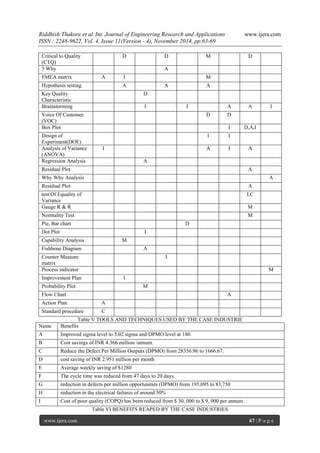
Over the years, companies have included numerous tools into the Six Sigma approach to make them more effective and to eliminate possible gaps after its application. Such toolsets include statistical and analytical tools both from industrial engineering and operations research fields.[11] In this instance, these tools enrich the practical and industrial approach with a stronger theoretical basis to achieve a better equipment and resources utilization.[12] There are many tools and techniques for Six Sigma implementation used in various phases of DMAIC methodology. In addition many of the tools/techniques used in the implementation of Six Sigma were referred and categorized by phase of define-measure-analyze-improve-control (DMAIC) which they are used. There was another classification according to proposals from ISO 13051-1 standard for the utilization of every tool or technique. The use of tools and techniques for cause exploring, data analysis and decision making, considered to be essential. These tools are not all statistical but there are also analytical or managerial, like brainstorming, process mapping, and etc.[4] Here the some other useful tools and Techniques are listed. The use of all this tools and techniques by the case industries in various phases are presented in table V. This is to study which are the most commonly used and prominent tools and techniques among the exporting industries. From the table V we can list down the general tools and
techniques used in different phase which is listed in Table IV. List involves the tools that are mostly used by the different case industries.
Phase
General tools and techniques
Define
Brainstorming, Pareto diagram, Pie, bar chart, SIPOC diagram and Critical to Quality matrix.
Measure
Pareto diagram, Control charts, Gauge R & R, Process map and Statistical process control.
Analyze
Pareto diagram, Histogram, Hypothesis testing, Analysis of variance, Brainstorming, Cause & Effect diagram, Process map, FMEA.
Improve
Pie, bar chart, analysis of variance, Design of experiments and brainstorming.
Control
Control charts, Flow Chart and descriptive statistics.
Table IV Phase and general tools and techniques
VI. BENEFITS REAPED BY CASE INDUSTRIES
SS implements methods of measuring performance, after its application, so to represent the success of its implementation. Financial benefits and sigma level are such as a measure of expressing the SS achievement.
For the past 3 decades Six Sigma has been implemented by many industries and most of them have reaped fruitful benefits. The benefits achieved mark a difference in their earlier and current status. These benefits do make a difference in their bottom-line. The benefits achieved in the case industries have been presented in the table VI.
Tools and Techniques
A
B
C
D
E
F
G
H
I
Pareto Chart
D
A
A,I,C
A
A
M
A
A
Cause and Effect Diagram
A
A
A
A
M
A
A
M,A
SIPOC/COPIS
D
D
D
D
D
D
Process map
M
D
M
M
D
Control Chart
D,M,C
C
C
C
C
C
Control plan
C
C
Project charter
D
D
D
D
Measurement System Analysis
M
M
Process capability
M](https://image.slidesharecdn.com/i0411046369-141212222804-conversion-gate01/85/A-Review-Six-Sigma-Implementation-Practice-in-Manufacturing-Industries-4-320.jpg)
![Riddhish Thakore et al. Int. Journal of Engineering Research and Applications www.ijera.com
ISSN : 2248-9622, Vol. 4, Issue 11(Version - 4), November 2014, pp.63-69
www.ijera.com 68 | P a g e
VII. CONCLUSION
From the study done on the manufacturing industries in 21st century we conclude that Six Sigma is indeed a business strategy that can provide a breakthrough improvement in the competitive era. The key strategy for successful implementation of Six Sigma is that the industry applying it should follow a correct methodology and use of tools and techniques is done in such a manner that it gives effective solution to respective problem. Thus a use of proper combination of tools and techniques can lead to great benefits. This study will help manufacturing units to motivate and apply Six Sigma at their organization and reap high benefits. The current status suggests there is future scope of getting better and become a world- class level organization by reaching Sigma level above 5. Reference
[1.] Chandrupatla T.R., “Quality Concepts”,Quality and reliability in Engineering, Cambridge University Press.
[2.] Berhman, B. & Klefsjo B. (2001) Kvalitet fran behov till anvandning (3rd ed.) Lund: Studentlitteratur. ISBN: 91- 44-01917-3.
[3.] Karin Scho n, Bjarne Bergquist and Bengt Klefsjo.,2010 ―The consequences of Six Sigma on job satisfaction: a study at three companies in Sweden‖ International journal of lean Six Sigma, 2010 pp. 99-118.
[4.] Vasileios Ismyrlis and Odysseas Moschidis,. 2013‖ Six Sigma’s critical success factors and toolbox‖ International Journal of Lean Six Sigma Pg no 108-113.
[5.] Young Hoon Kwak, Frank T. Anbari, 2004. ―Benefits, obstacles, and future of six sigma approach‖ P.n 1–8.
[6.] Andrea Chiarini .,2011 ―Japanese total quality control, TQM, Deming’s system of profound knowledge, BPR, Lean and Six Sigma‖2011, pp. 332- 355.
[7.] Hongbo Wang, “A Review of Six Sigma Approach: Methodology, Implementation and Future Research”, IEEE Xplore. February 1, 2009.
[8.] MasoudHekmatpanah, Mohammad Sadroddin, SaeidShahbaz,
FarhadMokhtari, FarahnazFadavinia, “Six Sigma Process and its Impact on the Organizational Productivity”, World Academy of Science, Engineering and Technology 19, 2008.
[9.] Kwak, Y .H. and Anbari, F. T., “Benefits, obstacles, and future of six sigma approach”, Technovation, Vol. 26, 2006, pp.708-715.
[10.] B. Tjahjono, P. Ball, V.I. Vitanov, C. Scorzafave, J. Nogueira, J. Calleja, M. Minguet, L. Narasimha, A. Rivas, A. Srivastava, S. Srivastava and A. Yadav. 2010 ―Six Sigma: a literature review‖, International Journal of Lean Six Sigma, Vol. 1, No. 3, pages 216-233.
[11.] Bunce, M.M., Wang, L. and Bidanda, B. (2008), “Leveraging Six Sigma with industrial engineering tools ins crateless retort production”, International Journal of Production Research, Vol. 46 No. 23, pp. 6701-19.
[12.] Maciel Junior, H., Batista Turrioni, J., Cesar Rosati, A., Garcia Neto, D., Kenji Go to, F.,Fujioka Mologni, J. and Machado Fernandes, M. (2008), “Application of design for Six Sigma (DFSS) on an automotive technology development process”, SAE Technical paper series, SAE International, Warrendale, PA.
[13.] Jonny and JessikaChristyanti, “Improving the Quality of Asbestos Roofing at PT BBI Using Six Sigma Methodology”, International Congress on Interdisciplinary Business and Social Science 2012, Procedia - Social and Behavioral Sciences 65 (2012), pp. 306 – 312.
[14.] AnupamaPrashar, "Process improvement in farm equipment sector (FES): a case on Six Sigma adoption", International Journal of Lean Six Sigma, Vol. 5 Issue: 1, 2014, pp.62 – 88.
[15.] MehdiuzZaman, Sujit Kumar, Pattanayak, Arun Chandra Paul, “Study of Feasibility of Six Sigma Implementation in A Manufacturing Industry: A Case Study” International Journal of Mechanical and Industrial](https://image.slidesharecdn.com/i0411046369-141212222804-conversion-gate01/85/A-Review-Six-Sigma-Implementation-Practice-in-Manufacturing-Industries-6-320.jpg)
![Riddhish Thakore et al. Int. Journal of Engineering Research and Applications www.ijera.com
ISSN : 2248-9622, Vol. 4, Issue 11(Version - 4), November 2014, pp.63-69
www.ijera.com 69 | P a g e
Engineering (IJMIE) Issn No. 2231- 6477, Vol-3, Iss-1, 2013.
[16.] Tan Ping Yi, Chin Jeng Feng, Joshna Prakash, Coh Wei Ping. 2012 Reducing electronic component losses in lean electronics assembly with six sigma approach‖, International Journal of Lean Six Sigma, Vol. 3, No. 3, pages 206-230.
[17.] Kunal Ganguly. 2012 ―Improvement process for rolling mill through the DMAIC six sigma approach‖, International Journal for quality research, Vol. 6, No. 3, pages 221-231.
[18.] Polytip Jirasukprasert, Jose Arturo Garza-Reyes, Vikas Kumar, Ming K. Lim. 2014 ―A six sigma and DMAIC application for the reduction of defects in a rubber gloves manufacturing process‖, International Journal of Lean Six Sigma.](https://image.slidesharecdn.com/i0411046369-141212222804-conversion-gate01/85/A-Review-Six-Sigma-Implementation-Practice-in-Manufacturing-Industries-7-320.jpg)

This document summarizes a research paper that reviews the practice of Six Sigma implementation in manufacturing industries. It discusses the key steps of the DMAIC methodology used in Six Sigma projects. Case studies from nine industries are presented that implemented Six Sigma through DMAIC to improve processes and reduce defects. Common tools used at each DMAIC phase are identified, such as Pareto charts, cause-and-effect diagrams, and control charts. The case studies achieved benefits like cost savings, reduced defects, and improved process cycle times through Six Sigma.


