Hyperthyroidism
MuhammadUsamaJamil
RollNo.268
Hyperthyroidism
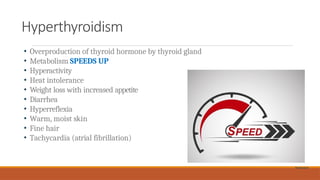
• Overproduction of thyroid hormone by thyroid gland
• Metabolism SPEEDS UP
• Hyperactivity
• Heat intolerance
• Weight loss with increased appetite
• Diarrhea
• Hyperreflexia
• Warm, moist skin
• Fine hair
• Tachycardia (atrial fibrillation)
Shutterstock
Hyperthyroidism
Subtypes
• Primary hyperthyroidism
• Most common form
• Overactivity of thyroid gland not due to high TSH
• Low TSH with high T3/T4
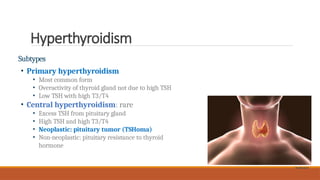
• Central hyperthyroidism: rare
• Excess TSH from pituitary gland
• High TSH and high T3/T4
• Neoplastic: pituitary tumor (TSHoma)
• Non-neoplastic: pituitary resistance to thyroid
hormone
Shutterstock
Hyperthyroidism
Lab Findings
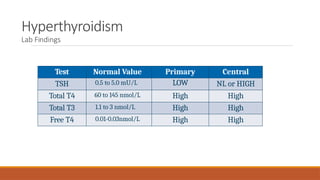
Test Normal Value Primary Central
TSH 0.5 to 5.0 mU/L LOW NL or HIGH
Total T4 60 to 145 nmol/L High High
Total T3 1.1 to 3 nmol/L High High
Free T4 0.01-0.03nmol/L High High
Primary
Hyperthyroidism
Causes
• Graves’ disease (most common)
• Multinodular goiter
• Toxic adenoma
• Iodine-induced
• Amiodarone
• Thyroiditis
• Levothyroxine
Graves’ Disease
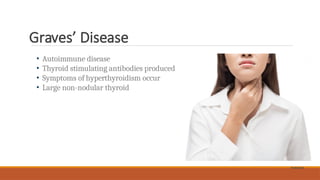
• Autoimmune disease
• Thyroid stimulating antibodies produced
• Symptoms of hyperthyroidism occur
• Large non-nodular thyroid
Shutterstock
Graves’ Disease
Special features
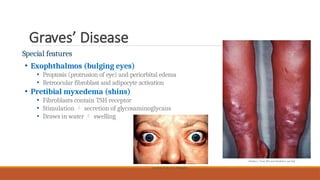
• Exophthalmos (bulging eyes)
• Proptosis (protrusion of eye) and periorbital edema
• Retroocular fibroblast and adipocyte activation
• Pretibial myxedema (shins)
• Fibroblasts contain TSH receptor
• Stimulation  secretion of glycosaminoglycans
• Draws in water  swelling
Jonathan Trobe, M.D./Wikipedia
Herbert L. Fred, MD and Hendrik A. van Dijk
Graves’ Disease
Diagnosis
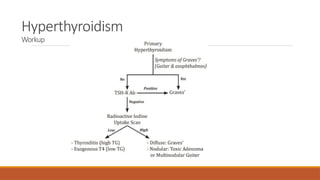
• Often clinical: hyperthyroid symptoms and labs, goiter plus exophthalmos
• TSH receptor antibodies
• Thyrotropin receptor antibodies (TRAb)
• Also called TSIs: “Thyroid stimulating immunoglobulins”
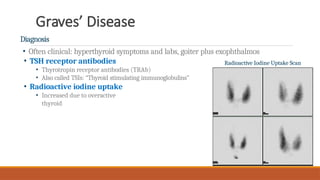
• Radioactive iodine uptake
• Increased due to overactive
thyroid
Radioactive Iodine Uptake Scan
Graves’ Disease
Treatment
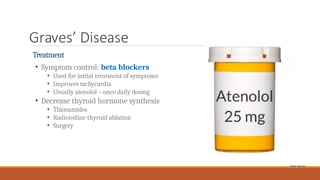
• Symptom control: beta blockers
• Used for initial treatment of symptoms
• Improves tachycardia
• Usually atenolol – once daily dosing
• Decrease thyroid hormone synthesis
• Thionamides
• Radioiodine thyroid ablation
• Surgery
Public Domain
Graves’ Disease
Treatment
• Radioiodine ablation
• Usually given as oral capsule
• Concentrated in thyroid  ablation
• Requires lifelong replacement therapy
• Associated with increase in TRAb
• May lead to worsening orbitopath
y
• Surgery (thyroidectomy)
• May cause hypoparathyroidism
• May cause recurrent laryngeal nerve damage
• Associated with a fall in TRAb
• Does not worsen orbitopathy
Shutterstock
Toxic
Adenomas
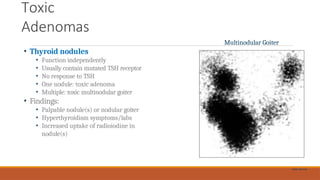
• Thyroid nodules
• Function independently
• Usually contain mutated TSH receptor
• No response to TSH
• One nodule: toxic adenoma
• Multiple: toxic multinodular goiter
• Findings:
• Palpable nodule(s) or nodular goiter
• Hyperthyroidism symptoms/labs
• Increased uptake of radioiodine in
nodule(s)
Multinodular Goiter
Public Domain
Toxic
Adenomas
Treatment
• Initial symptom control: beta blockers and thionamides
• Preferred therapy for most patients: radioiodine ablation
• Accumulates in hyperfunctioning nodules
• Underactive surrounding tissue not affected
• Patient may become euthryoid and avoid thyroid replacement
• Surgery in select patients
• Large, obstructive goiters
• Coexisting thyroid
malignancy
Shutterstock
Iodine-Induced
Hyperthyroidism
Jod-Basedow Phenomenon
• Wolff-Chaikoff effect: excess iodine  decreased hormone production
• Some patients “escape” the Wolff-Chaikoff effect
• Called the Jod-Basedow Phenomenon
• Excess iodine  hyperthyroidism
Iodine-Induced
Hyperthyroidism
Jod-Basedow Phenomenon
• Often occurs in regions of iodine deficiency
• Introduction of iodine  hyperthyroidism
• Often occurs in patients with toxic adenomas
• Drugs administered with high iodine content
• Expectorants (potassium iodide), CT contrast
dye
• Amiodarone
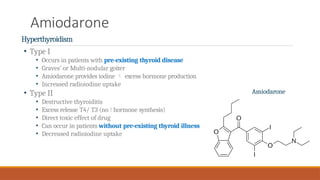
Amiodarone
Hyperthyroidism
• Type I
• Occurs in patients with pre-existing thyroid disease
• Graves’ or Multi-nodular goiter
• Amiodarone provides iodine  excess hormone production
• Increased radioiodine uptake
• Type II
• Destructive thyroiditis
• Excess release T4/ T3 (no ↑ hormone synthesis)
• Direct toxic effect of drug
• Can occur in patients without pre-existing thyroid illness
• Decreased radioiodine uptake
Amiodarone
Amiodarone
Amiodarone
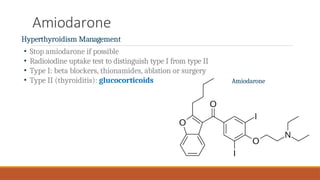
Hyperthyroidism Management
• Stop amiodarone if possible
• Radioiodine uptake test to distinguish type I from type II
• Type I: beta blockers, thionamides, ablation or surgery
• Type II (thyroiditis): glucocorticoids
Hyperthyroidism
Other Causes
• Early thyroiditis
• Low radioiodine uptake
• High serum thyroglobulin
concentration
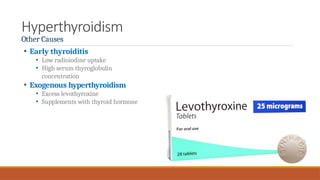
• Exogenous hyperthyroidism
• Excess levothyroxine
• Supplements with thyroid hormone
Hyperthyroidism
Workup
Thyroid
Storm
• Life-threatening hyperthyroidism
• Usually precipitated by acute event
• Patient with pre-existing hyperthyroid disease
• Graves’ or toxic multinodular goiter
• Surgery, trauma, infection
• Massive catecholamine surge
• Acute increase in thyroid hormone levels
Pixabay.com
Thyroid
Storm
Clinical Features
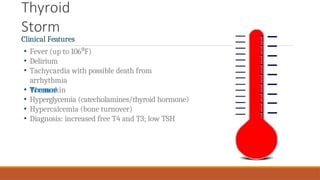
• Fever (up to 106 F
⁰ )
• Delirium
• Tachycardia with possible death from
arrhythmia
• Warm skin
• Tremor
• Hyperglycemia (catecholamines/thyroid hormone)
• Hypercalcemia (bone turnover)
• Diagnosis: increased free T4 and T3; low TSH
Thyroid
Storm
Treatment
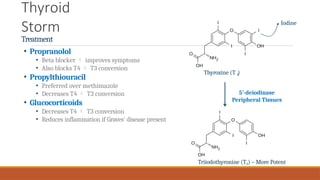
• Propranolol
• Beta blocker  improves symptoms
• Also blocks T4  T3 conversion
• Propylthiouracil
• Preferred over methimazole
• Decreases T4  T3 conversion
• Glucocorticoids
• Decreases T4  T3 conversion
• Reduces inflammation if Graves' disease present
Triiodothyronine (T3) – More Potent
4
Thyroxine (T )
5’-deiodinase
Peripheral Tissues
Iodine
Thyroid
Storm
Treatment
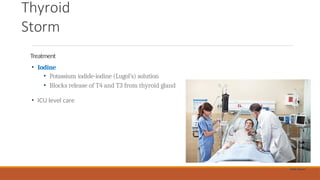
• Iodine
• Potassium iodide-iodine (Lugol’s) solution
• Blocks release of T4 and T3 from thyroid gland
• ICU level care
AfraTafreeh.com
Public Domain

Hyperthyroidism its cause and treatment.pptx

  • 1.
  • 2.
    Hyperthyroidism • Overproduction ofthyroid hormone by thyroid gland • Metabolism SPEEDS UP • Hyperactivity • Heat intolerance • Weight loss with increased appetite • Diarrhea • Hyperreflexia • Warm, moist skin • Fine hair • Tachycardia (atrial fibrillation) Shutterstock
  • 3.
    Hyperthyroidism Subtypes • Primary hyperthyroidism •Most common form • Overactivity of thyroid gland not due to high TSH • Low TSH with high T3/T4 • Central hyperthyroidism: rare • Excess TSH from pituitary gland • High TSH and high T3/T4 • Neoplastic: pituitary tumor (TSHoma) • Non-neoplastic: pituitary resistance to thyroid hormone Shutterstock
  • 4.
    Hyperthyroidism Lab Findings Test NormalValue Primary Central TSH 0.5 to 5.0 mU/L LOW NL or HIGH Total T4 60 to 145 nmol/L High High Total T3 1.1 to 3 nmol/L High High Free T4 0.01-0.03nmol/L High High
  • 5.
    Primary Hyperthyroidism Causes • Graves’ disease(most common) • Multinodular goiter • Toxic adenoma • Iodine-induced • Amiodarone • Thyroiditis • Levothyroxine
  • 6.
    Graves’ Disease • Autoimmunedisease • Thyroid stimulating antibodies produced • Symptoms of hyperthyroidism occur • Large non-nodular thyroid Shutterstock
  • 7.
    Graves’ Disease Special features •Exophthalmos (bulging eyes) • Proptosis (protrusion of eye) and periorbital edema • Retroocular fibroblast and adipocyte activation • Pretibial myxedema (shins) • Fibroblasts contain TSH receptor • Stimulation  secretion of glycosaminoglycans • Draws in water  swelling Jonathan Trobe, M.D./Wikipedia Herbert L. Fred, MD and Hendrik A. van Dijk
  • 8.
    Graves’ Disease Diagnosis • Oftenclinical: hyperthyroid symptoms and labs, goiter plus exophthalmos • TSH receptor antibodies • Thyrotropin receptor antibodies (TRAb) • Also called TSIs: “Thyroid stimulating immunoglobulins” • Radioactive iodine uptake • Increased due to overactive thyroid Radioactive Iodine Uptake Scan
  • 9.
    Graves’ Disease Treatment • Symptomcontrol: beta blockers • Used for initial treatment of symptoms • Improves tachycardia • Usually atenolol – once daily dosing • Decrease thyroid hormone synthesis • Thionamides • Radioiodine thyroid ablation • Surgery Public Domain
  • 10.
    Graves’ Disease Treatment • Radioiodineablation • Usually given as oral capsule • Concentrated in thyroid  ablation • Requires lifelong replacement therapy • Associated with increase in TRAb • May lead to worsening orbitopath y • Surgery (thyroidectomy) • May cause hypoparathyroidism • May cause recurrent laryngeal nerve damage • Associated with a fall in TRAb • Does not worsen orbitopathy Shutterstock
  • 11.
    Toxic Adenomas • Thyroid nodules •Function independently • Usually contain mutated TSH receptor • No response to TSH • One nodule: toxic adenoma • Multiple: toxic multinodular goiter • Findings: • Palpable nodule(s) or nodular goiter • Hyperthyroidism symptoms/labs • Increased uptake of radioiodine in nodule(s) Multinodular Goiter Public Domain
  • 12.
    Toxic Adenomas Treatment • Initial symptomcontrol: beta blockers and thionamides • Preferred therapy for most patients: radioiodine ablation • Accumulates in hyperfunctioning nodules • Underactive surrounding tissue not affected • Patient may become euthryoid and avoid thyroid replacement • Surgery in select patients • Large, obstructive goiters • Coexisting thyroid malignancy Shutterstock
  • 13.
    Iodine-Induced Hyperthyroidism Jod-Basedow Phenomenon • Wolff-Chaikoffeffect: excess iodine  decreased hormone production • Some patients “escape” the Wolff-Chaikoff effect • Called the Jod-Basedow Phenomenon • Excess iodine  hyperthyroidism
  • 14.
    Iodine-Induced Hyperthyroidism Jod-Basedow Phenomenon • Oftenoccurs in regions of iodine deficiency • Introduction of iodine  hyperthyroidism • Often occurs in patients with toxic adenomas • Drugs administered with high iodine content • Expectorants (potassium iodide), CT contrast dye • Amiodarone
  • 15.
    Amiodarone Hyperthyroidism • Type I •Occurs in patients with pre-existing thyroid disease • Graves’ or Multi-nodular goiter • Amiodarone provides iodine  excess hormone production • Increased radioiodine uptake • Type II • Destructive thyroiditis • Excess release T4/ T3 (no ↑ hormone synthesis) • Direct toxic effect of drug • Can occur in patients without pre-existing thyroid illness • Decreased radioiodine uptake Amiodarone
  • 16.
    Amiodarone Amiodarone Hyperthyroidism Management • Stopamiodarone if possible • Radioiodine uptake test to distinguish type I from type II • Type I: beta blockers, thionamides, ablation or surgery • Type II (thyroiditis): glucocorticoids
  • 17.
    Hyperthyroidism Other Causes • Earlythyroiditis • Low radioiodine uptake • High serum thyroglobulin concentration • Exogenous hyperthyroidism • Excess levothyroxine • Supplements with thyroid hormone
  • 18.
  • 19.
    Thyroid Storm • Life-threatening hyperthyroidism •Usually precipitated by acute event • Patient with pre-existing hyperthyroid disease • Graves’ or toxic multinodular goiter • Surgery, trauma, infection • Massive catecholamine surge • Acute increase in thyroid hormone levels Pixabay.com
  • 20.
    Thyroid Storm Clinical Features • Fever(up to 106 F ⁰ ) • Delirium • Tachycardia with possible death from arrhythmia • Warm skin • Tremor • Hyperglycemia (catecholamines/thyroid hormone) • Hypercalcemia (bone turnover) • Diagnosis: increased free T4 and T3; low TSH
  • 21.
    Thyroid Storm Treatment • Propranolol • Betablocker  improves symptoms • Also blocks T4  T3 conversion • Propylthiouracil • Preferred over methimazole • Decreases T4  T3 conversion • Glucocorticoids • Decreases T4  T3 conversion • Reduces inflammation if Graves' disease present Triiodothyronine (T3) – More Potent 4 Thyroxine (T ) 5’-deiodinase Peripheral Tissues Iodine
  • 22.
    Thyroid Storm Treatment • Iodine • Potassiumiodide-iodine (Lugol’s) solution • Blocks release of T4 and T3 from thyroid gland • ICU level care AfraTafreeh.com Public Domain