Hype vs. Reality The AI Explainer January 2017
Produced by Luminary Labs in partnership with
Fast Forward Labs
• Artificial intelligence (AI) is everywhere, promising self-
driving cars, medical breakthroughs, and new ways of
working. But how do you separate hype from reality? How
can your company apply AI to solve real business problems
in 2017? In September 2016, Luminary Labs convened 30
executives in healthcare, machine learning, and analytics
for a grounded discussion on these questions with machine
learning expert Hilary Mason, founder and CEO of Fast
Forward Labs, and Sandy Allerheiligen, VP of data science
and predictive and economic modeling at Merck. Here’s a
synopsis of what we discussed, and what AI learnings your
business should keep in mind for 2017. AI and the Near
Term
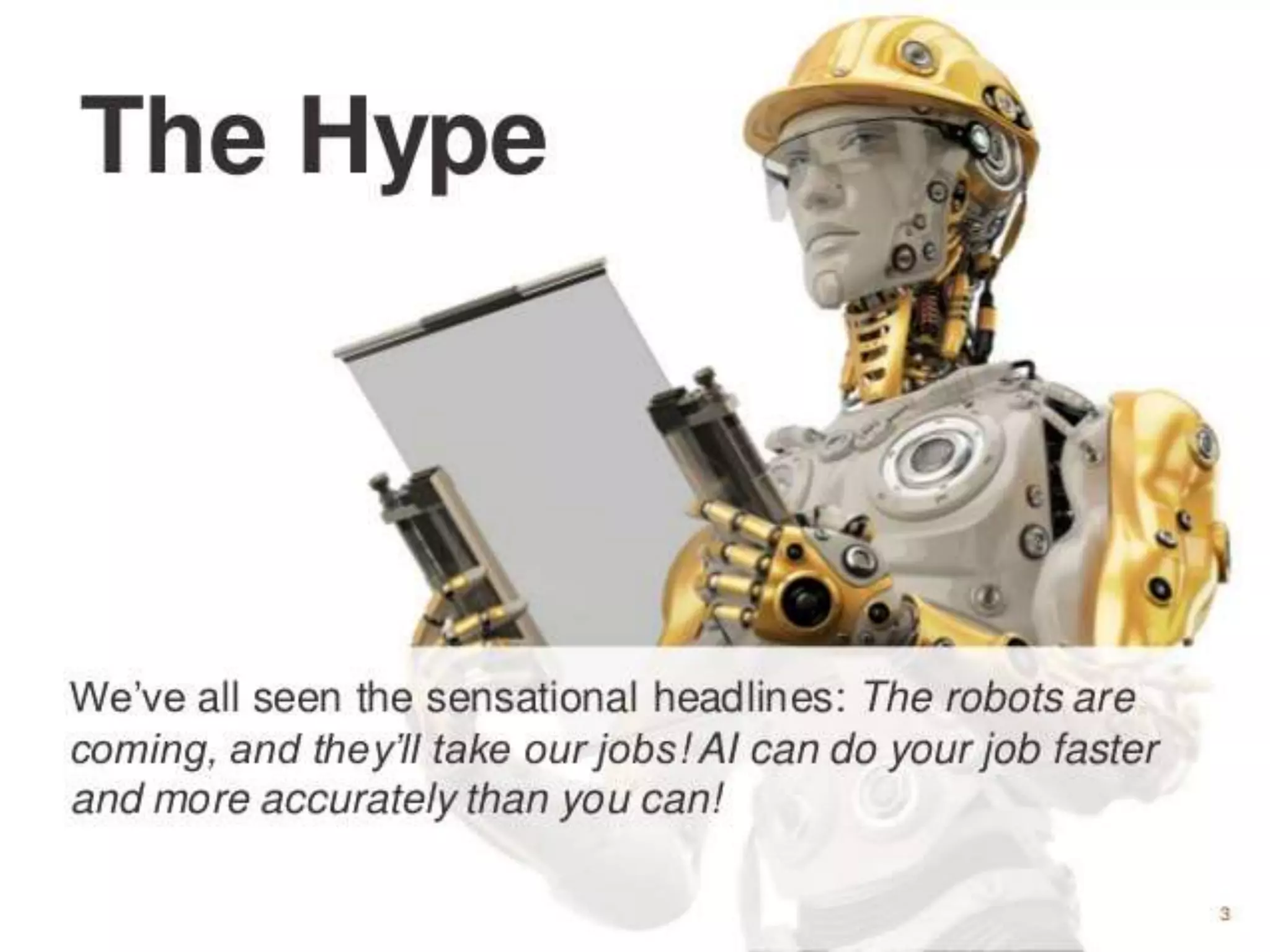
• We’ve all seen the sensational headlines: The
robots are coming, and they’ll take our jobs!
AI can do your job faster and more accurately
than you can! The Hype 3
• The Reality Human jobs won’t go away, but
they will change. Roles will be more creative
and specialized as AI is integrated into the
workday. Better data leads to better math
leads to better predictions, so people using AI
can automate the tedious work and take
action on the insights.
• In the short term AI does the math faster,
saving money by automating normally
complex processes. It makes your life easier
even now, behind the scenes. This is what it
looks like today.
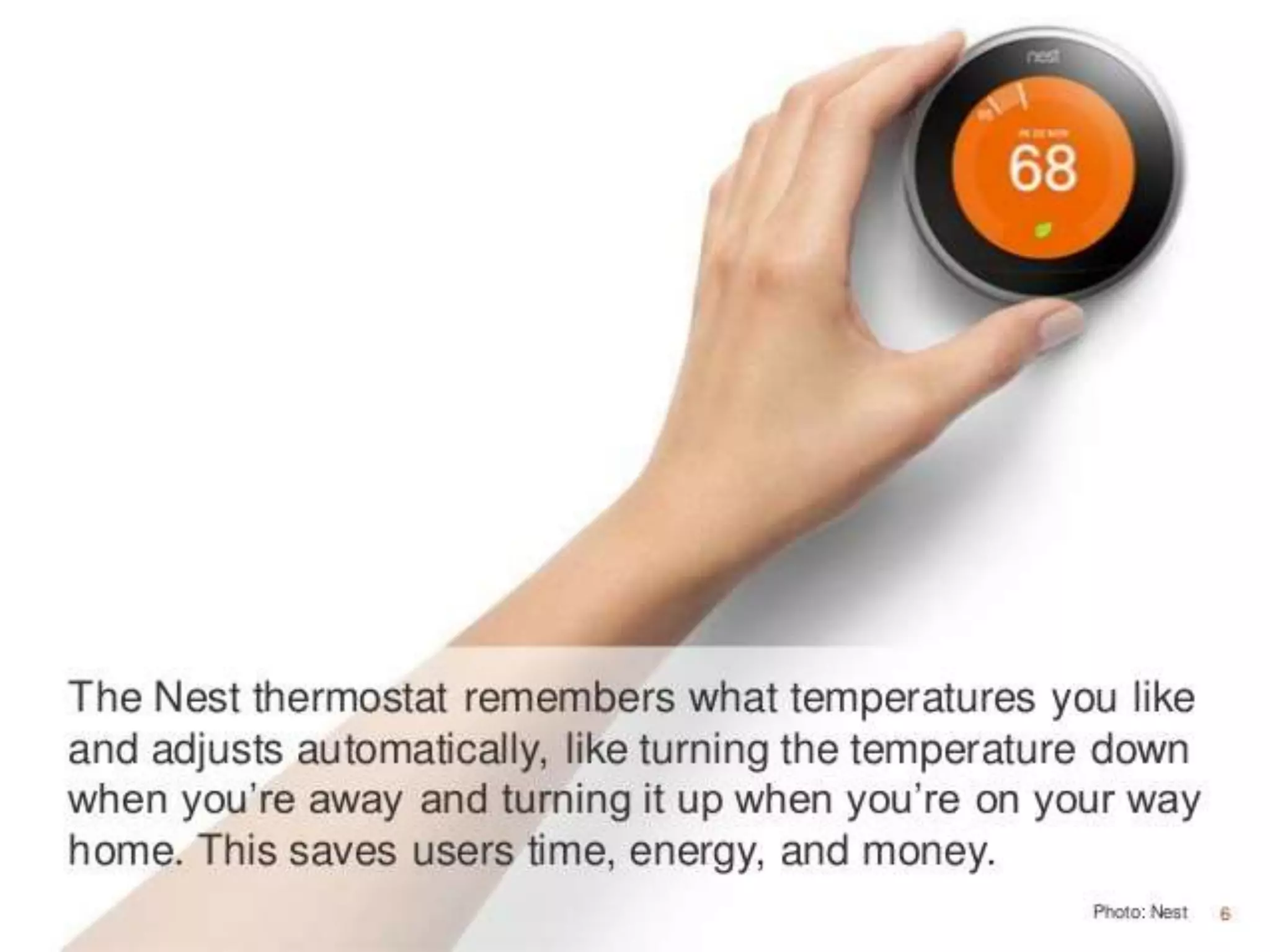
• The Nest thermostat remembers what
temperatures you like and adjusts
automatically, like turning the temperature
down when you’re away and turning it up
when you’re on your way home. This saves
users time, energy, and money. Photo: Nest 6
• Photo: Netflix 7 Netflix’s predictive analytics
recommend what you might want to watch
next—and what studios should create next—
based on viewer data. Amazon, iTunes,
Pandora, and other companies use predictive
analytics to make better recommendations.
• Salesforce Einstein applies natural language
processing to analyze text from e-mails
exchanged with customers to estimate the
likelihood that a user will buy, detect deals a
team is at risk of losing, and recommend
actions to improve sales. 8
• In the longer term AI will transform industries.
• For example, algorithms help healthcare
professionals recognize anomalies or patterns
in medical images with more accuracy than
the human eye. Over time, this can result in a
library of knowledge that can lead to potential
disease cures. 10
• Photo: NVIDIA Coporation One of AI’s
promises is to make self-driving cars safer.
Everyday driving decisions, such as whether to
stop abruptly or swerve to avoid hitting an
obstacle, will be powered by AI. 11
• AI will help redesign the entire shopping
experience, optimizing everything with more
and better data. Retailers will seamlessly stock
the precise number of goods needed on
shelves at any given time, and know which
product at which price should be highlighted
to a specific customer as they navigate a store.
12
• 13 Where do you start? Five ways to look past
the shiny-object phase and into practical AI
planning in 2017.
• 1. Don’t fear the robots. The idea is to
augment, not replace, work. AI can absorb
cognitive drudgery, like turning data points
into visual charts, calculating complex math
formulas, or summarizing the financial news
of the day into a single report. This frees up
people to focus on acting on the insights.
Photo: Flickr user joao_trindade 14
• 2. Start with the problem, not the solution.
Before launching an AI program, identify
concrete business problems, then consider if
AI can help. For example, rather than ask,
“What can we use AI for?”, think, “Where
could we make our operations more
efficient?” or “What decisions are we making
without data?” Photo: Flickr user Robert
Couse-Baker 15
• 3. Emphasize empathy. The more machines
we employ, the more people skills we need.
Leaders must build empathy across the
organization to help employees see impact.
Focus on how AI can help workers add more
human value, rather than replace them. For
example, McDonald’s added robots to their
franchises, but doesn’t plan to cut human
jobs. Photo: Flickr user EasySentrisentri 16
• 4. Engage the skeptics. Understand what they
fear and start there. Fast Forward Labs’ Hilary
Mason shared an example of winning buy-in
by demonstrating how machine learning could
solve a problem for an overburdened
regulatory team. 17
• Photo: Flicker user JDHancock 5. Remember:
It’s not magic. If a vendor can’t explain their AI
product or service in terms you understand,
don’t buy it. Much of what’s called AI today
(“AI personal assistants,” anyone?) is actually
humans wrangling a trove of data behind the
scenes. If it doesn’t make sense, it might not
be real. 18
• Glossary Some AI terms are used primarily for
marketing purposes, while others are more
technical. Here are our translations for
common terms you may hear, whether you’re
being sold an AI product or partnering with a
team of AI experts. It’s a great starting point
for becoming an AI leader in your
organization.
• Artificial intelligence (AI): Marketing term that describes a
continuum of non-living analytical power, fueled by fast
processing and data storage’s declining costs. Applications
today are termed weak AI (like IBM Watson), which are
algorithms built to accomplish a specific task. Strong AI (like
Skynet) is a term for hypothetical future applications that
will replicate human intelligence. Big data: Buzzword
alluding to a machine’s ability to generate insights and
learn from massive data sets, because sensors, software,
and recordkeeping generate a lot of data. For example, The
Weather Company and IBM researched weather’s impact
on business by analyzing millions of data points from
weather sensors, aircraft, smartphones, buildings, and
vehicles. The big picture
• Machine learning: Method of automated analytical model
building. Machine learning lets computers find hidden
insights without being explicitly programmed where to
look. For instance, Facebook’s machine learning software
uses algorithms and data points to show a user suggested
friends, display relevant ads, and detect spam. Algorithm:
Formula that represents a relationship between things. It’s
a self-contained, step-by-step set of operations that
automates a function, like a process, recommendation, or
analysis. For example, Netflix’s recommendation algorithms
can predict what movies a consumer might want to watch
based on their viewing history. Most important to
remember
• Deep learning: Branch of machine learning that uses
multiple layers of distributed representations (neural
networks) to recognize patterns in digital sounds, images,
or other data. For example, Google’s DeepDream photo-
editing software allows neural networks to “hallucinate”
patterns and images in a photo. Neural networks:
Computational approach that loosely models how the brain
solves problems with layers of inputs and outputs. Rather
than being programmed, the networks are trained with
several thousand cycles of interaction. Businesses can use
these to do a lot with a little; for example, neural networks
can generate image captions, classify objects, or predict
stock market fluctuations. Nuts and bolts
• Natural language processing: Field of study in which
machines are trained to understand human language
using machine-learning techniques. It’s useful for
automatic translations, chatbots, or AI personal
assistants. Think of the robot voice that picks up your
helpline call and asks, “What can I help you with?” or
an automated chatbot that responds to your texts.
Parsing: The process of evaluating text according to a
set of grammar or syntax rules. You can build
algorithms that parse text according to English
grammar rules, for example, to aid natural language
processing. Nuts and bolts
• Recommended reading
• AI: The big picture • The Hype and Hope of
Artificial Intelligence, The New Yorker • What
Counts as Artificially Intelligent? AI and Deep
Learning, Explained, The Verge • The
Extraordinary Link Between Deep Neural
Networks and the Nature of the Universe, MIT
Technology Review • The Competitive Landscape
for Machine Intelligence, Harvard Business
Review • What Do People—Not Techies, Not
Companies—Think About Artificial Intelligence?,
Harvard Business Review
• How companies use AI today • An Exclusive Look at
Machine Learning atApple, Backchannel • Preparing for
the Future ofArtificial Intelligence, White House Blog •
Using Artificial Intelligence to TransformHealthcare
with Pinaki Dsagupta, Hindsight, Startup Health •
Beyond Siri, The Next-GenerationAI AssistantsAre
Smarter Specialists, Fast Company • Infographic:What
You Need to Know About Google RankBrain, Contently
• Facebook is GivingAwaythe Softwareit Uses to
Understand Objects in Photos, The Verge • How AI is
Changing Human Resources, Fast Company • Beyond
Automation, Harvard Business Review
• Ethical considerations • The Head of Google’s Brain
Team is More Worried about the Lack of Diversityin
Artificial Intelligence than anAI Apocalypse, re/code •
The Tradeoffs of Imbuing Self-Driving Cars With Human
Morality, Motherboard • If We Don’t WantAI to Be Evil,
We Should Teach It to Read, Motherboard • The Ethics
of Artificial Intelligence, Nick Bostrom • Twitter Taught
Microsoft'sAI Chatbotto be a RacistAsshole in Less
Than a Day, The Verge • AlgorithmsAre BiasedAgainst
Women and the Poor, According to a Former Math
Professor, The Cut • Elon Musk elaborateson hisAI
concerns, Sam Altman YouTube interview
• Crave more content from us? Sign up for our
newsletter here.

Hype vs. Reality: The AI Explainer

  • 1.
    Hype vs. RealityThe AI Explainer January 2017 Produced by Luminary Labs in partnership with Fast Forward Labs
  • 2.
    • Artificial intelligence(AI) is everywhere, promising self- driving cars, medical breakthroughs, and new ways of working. But how do you separate hype from reality? How can your company apply AI to solve real business problems in 2017? In September 2016, Luminary Labs convened 30 executives in healthcare, machine learning, and analytics for a grounded discussion on these questions with machine learning expert Hilary Mason, founder and CEO of Fast Forward Labs, and Sandy Allerheiligen, VP of data science and predictive and economic modeling at Merck. Here’s a synopsis of what we discussed, and what AI learnings your business should keep in mind for 2017. AI and the Near Term
  • 3.
    • We’ve allseen the sensational headlines: The robots are coming, and they’ll take our jobs! AI can do your job faster and more accurately than you can! The Hype 3
  • 4.
    • The RealityHuman jobs won’t go away, but they will change. Roles will be more creative and specialized as AI is integrated into the workday. Better data leads to better math leads to better predictions, so people using AI can automate the tedious work and take action on the insights.
  • 5.
    • In theshort term AI does the math faster, saving money by automating normally complex processes. It makes your life easier even now, behind the scenes. This is what it looks like today.
  • 6.
    • The Nestthermostat remembers what temperatures you like and adjusts automatically, like turning the temperature down when you’re away and turning it up when you’re on your way home. This saves users time, energy, and money. Photo: Nest 6
  • 7.
    • Photo: Netflix7 Netflix’s predictive analytics recommend what you might want to watch next—and what studios should create next— based on viewer data. Amazon, iTunes, Pandora, and other companies use predictive analytics to make better recommendations.
  • 8.
    • Salesforce Einsteinapplies natural language processing to analyze text from e-mails exchanged with customers to estimate the likelihood that a user will buy, detect deals a team is at risk of losing, and recommend actions to improve sales. 8
  • 9.
    • In thelonger term AI will transform industries.
  • 10.
    • For example,algorithms help healthcare professionals recognize anomalies or patterns in medical images with more accuracy than the human eye. Over time, this can result in a library of knowledge that can lead to potential disease cures. 10
  • 11.
    • Photo: NVIDIACoporation One of AI’s promises is to make self-driving cars safer. Everyday driving decisions, such as whether to stop abruptly or swerve to avoid hitting an obstacle, will be powered by AI. 11
  • 12.
    • AI willhelp redesign the entire shopping experience, optimizing everything with more and better data. Retailers will seamlessly stock the precise number of goods needed on shelves at any given time, and know which product at which price should be highlighted to a specific customer as they navigate a store. 12
  • 13.
    • 13 Wheredo you start? Five ways to look past the shiny-object phase and into practical AI planning in 2017.
  • 14.
    • 1. Don’tfear the robots. The idea is to augment, not replace, work. AI can absorb cognitive drudgery, like turning data points into visual charts, calculating complex math formulas, or summarizing the financial news of the day into a single report. This frees up people to focus on acting on the insights. Photo: Flickr user joao_trindade 14
  • 15.
    • 2. Startwith the problem, not the solution. Before launching an AI program, identify concrete business problems, then consider if AI can help. For example, rather than ask, “What can we use AI for?”, think, “Where could we make our operations more efficient?” or “What decisions are we making without data?” Photo: Flickr user Robert Couse-Baker 15
  • 16.
    • 3. Emphasizeempathy. The more machines we employ, the more people skills we need. Leaders must build empathy across the organization to help employees see impact. Focus on how AI can help workers add more human value, rather than replace them. For example, McDonald’s added robots to their franchises, but doesn’t plan to cut human jobs. Photo: Flickr user EasySentrisentri 16
  • 17.
    • 4. Engagethe skeptics. Understand what they fear and start there. Fast Forward Labs’ Hilary Mason shared an example of winning buy-in by demonstrating how machine learning could solve a problem for an overburdened regulatory team. 17
  • 18.
    • Photo: Flickeruser JDHancock 5. Remember: It’s not magic. If a vendor can’t explain their AI product or service in terms you understand, don’t buy it. Much of what’s called AI today (“AI personal assistants,” anyone?) is actually humans wrangling a trove of data behind the scenes. If it doesn’t make sense, it might not be real. 18
  • 19.
    • Glossary SomeAI terms are used primarily for marketing purposes, while others are more technical. Here are our translations for common terms you may hear, whether you’re being sold an AI product or partnering with a team of AI experts. It’s a great starting point for becoming an AI leader in your organization.
  • 20.
    • Artificial intelligence(AI): Marketing term that describes a continuum of non-living analytical power, fueled by fast processing and data storage’s declining costs. Applications today are termed weak AI (like IBM Watson), which are algorithms built to accomplish a specific task. Strong AI (like Skynet) is a term for hypothetical future applications that will replicate human intelligence. Big data: Buzzword alluding to a machine’s ability to generate insights and learn from massive data sets, because sensors, software, and recordkeeping generate a lot of data. For example, The Weather Company and IBM researched weather’s impact on business by analyzing millions of data points from weather sensors, aircraft, smartphones, buildings, and vehicles. The big picture
  • 21.
    • Machine learning:Method of automated analytical model building. Machine learning lets computers find hidden insights without being explicitly programmed where to look. For instance, Facebook’s machine learning software uses algorithms and data points to show a user suggested friends, display relevant ads, and detect spam. Algorithm: Formula that represents a relationship between things. It’s a self-contained, step-by-step set of operations that automates a function, like a process, recommendation, or analysis. For example, Netflix’s recommendation algorithms can predict what movies a consumer might want to watch based on their viewing history. Most important to remember
  • 22.
    • Deep learning:Branch of machine learning that uses multiple layers of distributed representations (neural networks) to recognize patterns in digital sounds, images, or other data. For example, Google’s DeepDream photo- editing software allows neural networks to “hallucinate” patterns and images in a photo. Neural networks: Computational approach that loosely models how the brain solves problems with layers of inputs and outputs. Rather than being programmed, the networks are trained with several thousand cycles of interaction. Businesses can use these to do a lot with a little; for example, neural networks can generate image captions, classify objects, or predict stock market fluctuations. Nuts and bolts
  • 23.
    • Natural languageprocessing: Field of study in which machines are trained to understand human language using machine-learning techniques. It’s useful for automatic translations, chatbots, or AI personal assistants. Think of the robot voice that picks up your helpline call and asks, “What can I help you with?” or an automated chatbot that responds to your texts. Parsing: The process of evaluating text according to a set of grammar or syntax rules. You can build algorithms that parse text according to English grammar rules, for example, to aid natural language processing. Nuts and bolts
  • 24.
  • 25.
    • AI: Thebig picture • The Hype and Hope of Artificial Intelligence, The New Yorker • What Counts as Artificially Intelligent? AI and Deep Learning, Explained, The Verge • The Extraordinary Link Between Deep Neural Networks and the Nature of the Universe, MIT Technology Review • The Competitive Landscape for Machine Intelligence, Harvard Business Review • What Do People—Not Techies, Not Companies—Think About Artificial Intelligence?, Harvard Business Review
  • 26.
    • How companiesuse AI today • An Exclusive Look at Machine Learning atApple, Backchannel • Preparing for the Future ofArtificial Intelligence, White House Blog • Using Artificial Intelligence to TransformHealthcare with Pinaki Dsagupta, Hindsight, Startup Health • Beyond Siri, The Next-GenerationAI AssistantsAre Smarter Specialists, Fast Company • Infographic:What You Need to Know About Google RankBrain, Contently • Facebook is GivingAwaythe Softwareit Uses to Understand Objects in Photos, The Verge • How AI is Changing Human Resources, Fast Company • Beyond Automation, Harvard Business Review
  • 27.
    • Ethical considerations• The Head of Google’s Brain Team is More Worried about the Lack of Diversityin Artificial Intelligence than anAI Apocalypse, re/code • The Tradeoffs of Imbuing Self-Driving Cars With Human Morality, Motherboard • If We Don’t WantAI to Be Evil, We Should Teach It to Read, Motherboard • The Ethics of Artificial Intelligence, Nick Bostrom • Twitter Taught Microsoft'sAI Chatbotto be a RacistAsshole in Less Than a Day, The Verge • AlgorithmsAre BiasedAgainst Women and the Poor, According to a Former Math Professor, The Cut • Elon Musk elaborateson hisAI concerns, Sam Altman YouTube interview
  • 28.
    • Crave morecontent from us? Sign up for our newsletter here.